
Life, 1886-12-16 · page 10 of 16
Life — December 16, 1886 — page 10: what you’re looking at
What you’re looking at
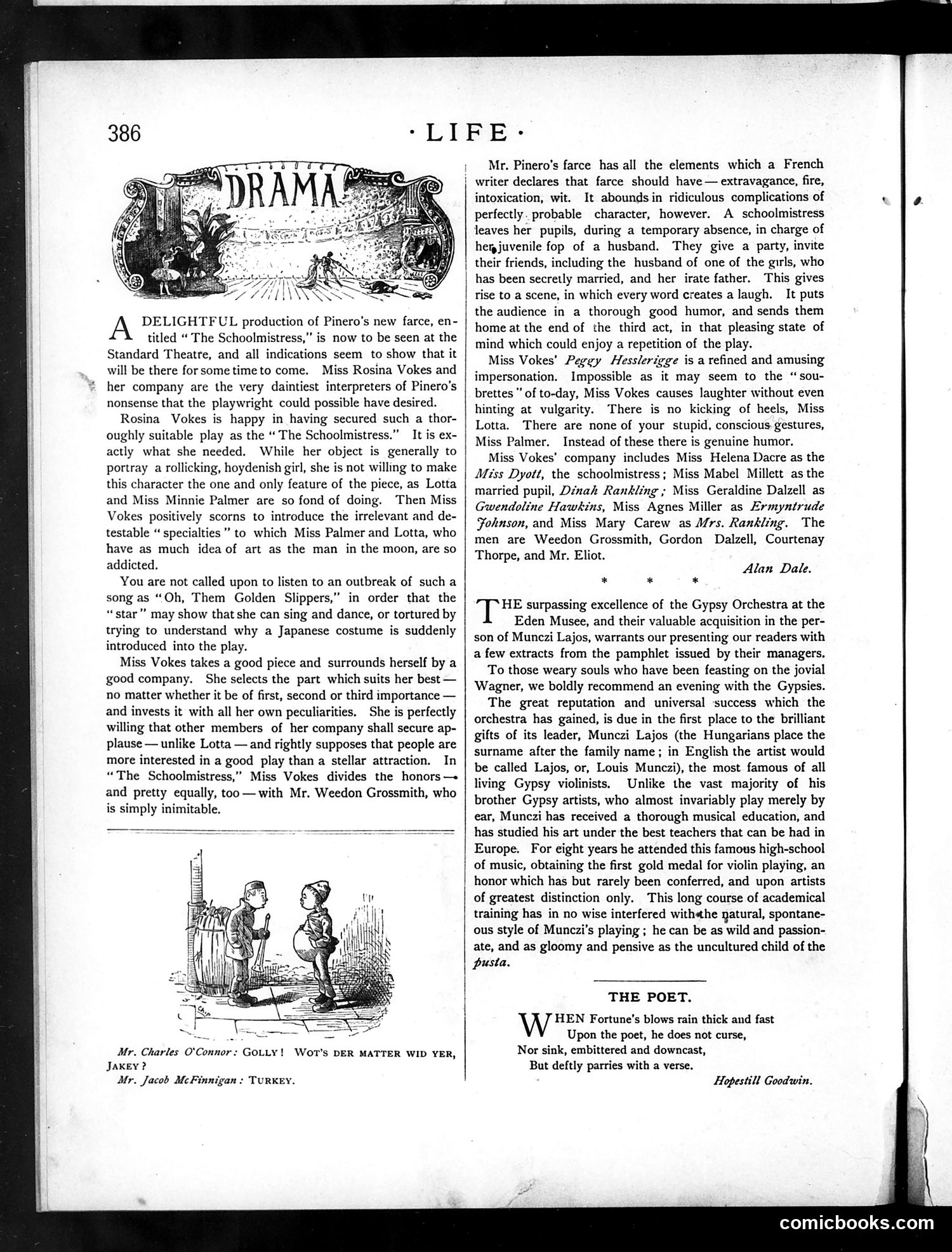
This page from *Life* magazine contains three distinct sections: 1. **"DRAMA" section** reviews Pinero's farce "The Schoolmistress," praising actress Rosina Vokes's comedic performance and the ensemble cast. It's a straightforward theater review. 2. **Small illustration** (bottom left) shows a dialogue between characters identified as Mr. Charles O'Connor, Golly, Wot's der matter wid yer, Jackey, and Mr. Jacob McFinegan as Turkey. The caption suggests this is satirizing working-class or immigrant dialect speech, likely mocking lower-class characters' speech patterns—a common form of period satire. 3. **"THE POET" section** begins with a poem by Hapshill Goodwin about Fortune and poets, unrelated to the cartoon. The page lacks explicit political satire; instead it reflects late-19th-century American humor based on ethnic/class stereotypes.
📄 Transcribed text from this page (OCR, searchable)
Machine-transcribed from the original scan — historical spelling and the odd misread are preserved.
“EI DELIGHTFUL production of Pinero’s new farce, en- titled “ The Schoolmistress,” is now to be seen at the Standard Theatre, and all indications seem to show that it will be there for sometime to come. Miss Rosina Vokes and her company are the very daintiest interpreters of Pinero’s nonsense that the playwright could possible have desired. Rosina Vokes is happy in having secured such a thor- oughly suitable play as the “ The Schoolmistress.” It is ex- actly what she needed. While her object is generally to portray a rollicking, hoydenish girl, she is not willing to make this character the one and only feature of the piece, as Lotta and Miss Minnie Palmer are so fond of doing. Then Miss Vokes positively scorns to introduce the irrelevant and de- testable “ specialties” to which Miss Palmer and Lotta, who have as much idea of art as the man in the moon, are so addicted. You are not called upon to listen to an outbreak of such a song as “Oh, Them Golden Slippers,” in order that the “star” may show that she can sing and dance, or tortured by trying to understand why a Japanese costume is suddenly introduced into the play. Miss Vokes takes a good piece and surrounds herself by a good company. She selects the part which suits her best — no matter whether it be of first, second or third importance — and invests it with all her own peculiarities. She is perfectly willing that other members of her company shall secure ap- plause — unlike Lotta — and rightly supposes that people are more interested in a good play than a stellar attraction. In “The Schoolmistress,” Miss Vokes divides the honors—+ and pretty equally, too—with Mr. Weedon Grossmith, who is simply inimitable. Mr. Charles O'Connor: GOLLY! Wot's DER MATTER WID YER, JaKEY? Mr. Jacob McFinnigan : TURKEY. FE: Mr. Pinero’s farce has all the elements which a French | writer declares that farce should have — extravagance, fire, intoxication, wit. It abounds in ridiculous complications of perfectly. probable character, however. A schoolmistress leaves her pupils, during a temporary absence, in charge of hetjuvenile fop of a husband. They give a party, invite | their friends, including the husband of one of the girls, who has been secretly married, and her irate father. This gives rise to a scene, in which every word creates a laugh. It puts the audience in a thorough good humor, and sends them home at the end of the third act, in that pleasing state of mind which could enjoy a repetition of the play. Miss Vokes’ Peggy Hesslerigge is a refined and amusing impersonation. Impossible as it may seem to the “sou- brettes ” of to-day, Miss Vokes causes laughter without even hinting at vulgarity. There is no kicking of heels, Miss Lotta. There are none of your stupid, conscious gestures, Miss Palmer. Instead of these there is genuine humor. Miss Vokes’ company includes Miss Helena Dacre as the Miss Dyott, the schoolmistress; Miss Mabel Millett as the married pupil, Dinah Rankling ; Miss Geraldine Dalzell as Gwendoline Hawkins, Miss Agnes Miller as Ermyntrude Fohnson, and Miss Mary Carew as Mrs. Rankling. The men are Weedon Grossmith, Gordon Dalzell, Courtenay Thorpe, and Mr. Eliot. Alan Date. * * * HE surpassing excellence of the Gypsy Orchestra at the Eden Musee, and their valuable acquisition in the per- son of Munczi Lajos, warrants our presenting our readers with a few extracts from the pamphlet issued by their managers. To those weary souls who have been feasting on the jovial Wagner, we boldly recommend an evening with the Gypsies. The great reputation and universal success which the orchestra has gained, is due in the first place to the brilliant gifts of its leader, Munczi Lajos (the Hungarians place the surname after the family name; in English the artist would be called Lajos, or, Louis Munczi), the most famous of all living Gypsy violinists. Unlike the vast majority of his brother Gypsy artists, who almost invariably play merely by ear, Munczi has received a thorough musical education, and has studied his art under the best teachers that can be had in Europe. For eight years he attended this famous high-school of music, obtaining the first gold medal for violin playing, an honor which has but rarely been conferred, and upon artists of greatest distinction only. This long course of academical training has in no wise interfered withthe gatural, spontane- ous style of Munczi’s playing ; he can be as wild and passion- ate, and as gloomy and pensive as the uncultured child of the pusta. THE POET. HEN Fortune's blows rain thick and fast Upon the poet, he does not curse, Nor sink, embittered and downcast, But deftly parries with a verse. Hopestill Goodwin. comicbooks.com