
Life, 1886-12-16 · page 2 of 16
Life — December 16, 1886 — page 2: what you’re looking at
What you’re looking at
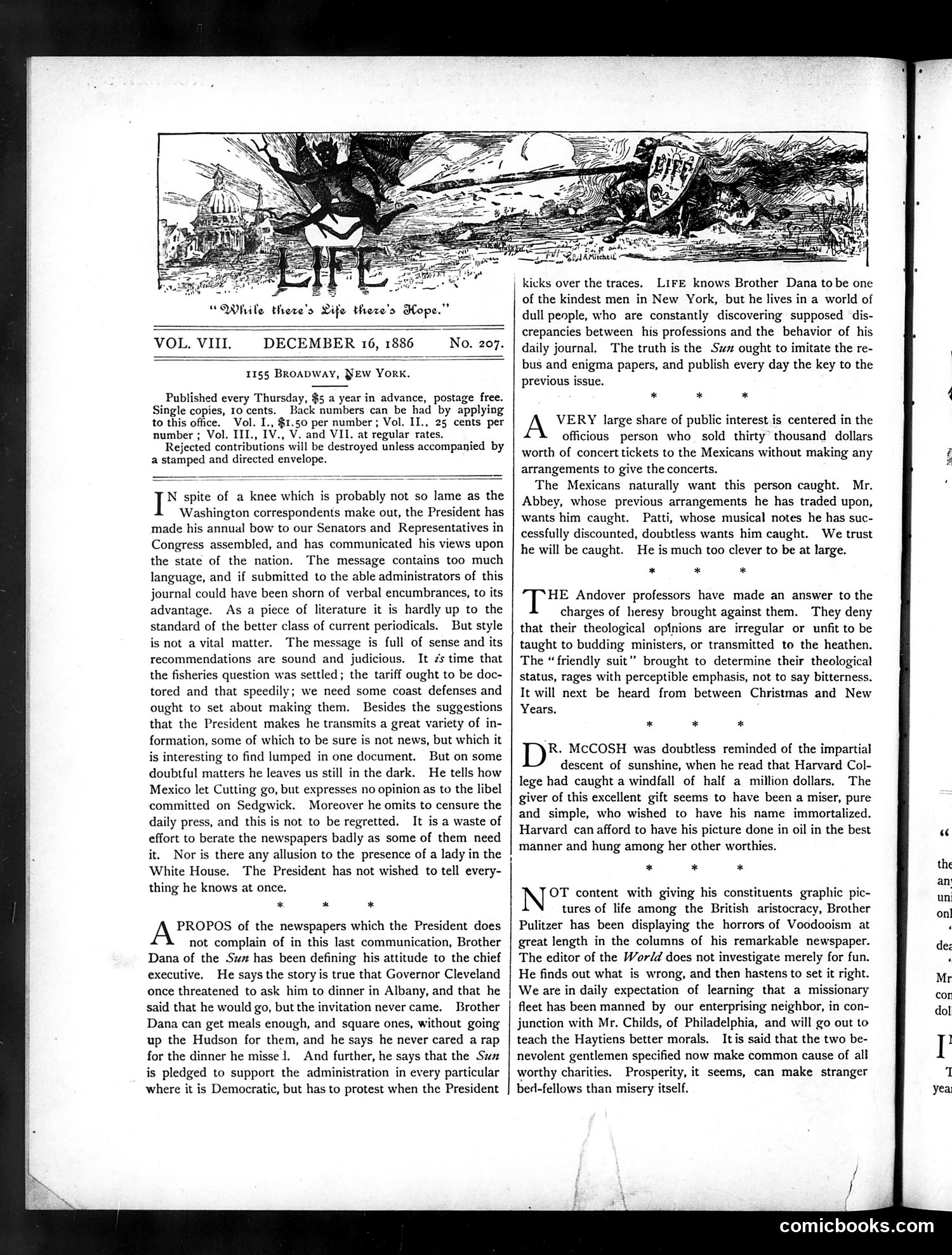
The masthead cartoon depicts **Death (skeleton figure) riding above a landscape**, with the caption "While there's Life there's Hope"—a dark pun on the magazine's name. The text critiques **President Cleveland's annual message to Congress**, praising its substance while noting its verbose style. The editorial defends the *Sun* newspaper's editor Brother Dana against accusations of disloyalty, arguing he supports Democratic principles while rightfully protesting when the President overreaches. Other brief items mock **Harvard College's large windfall donation**, ridicule the *World* newspaper's sensationalism, and comment on theological disputes at Andover Seminary. The overall tone is political commentary typical of 1880s satirical journalism—defending press independence while supporting selective presidential criticism.
📄 Transcribed text from this page (OCR, searchable)
Machine-transcribed from the original scan — historical spelling and the odd misread are preserved.
“While there's Life there's Hope.” VOL. VIII. DECEMBER 16, 1886 No. 207. 1155 BRoaADWay, WEW YorK. Published every Thursday, $5 a year in advance, postage free. Single copies, 10cents. Back numbers can be had by applying to this office. Vol. I., $1.50 per number ; Vol. II.. 25 cents per number ; Vol. III., IV., V. and VII. at regular rates. Rejected contributions will be destroyed unless accompanied by a stamped and directed envelope. N spite of a knee which is probably not so lame as the Washington correspondents make out, the President has made his annual bow to our Senators and Representatives in Congress assembled, and has communicated his views upon the state of the nation. The message contains too much language, and if submitted to the able administrators of this journal could have been shorn of verbal encumbrances, to its advantage. As a piece of literature it is hardly up to the standard of the better class of current periodicals. But style is not a vital matter. The message is full of sense and its recommendations are sound and judicious. It 2s time that the fisheries question was settled; the tariff ought to be doc- tored and that speedily; we need some coast defenses and ought to set about making them. Besides the suggestions that the President makes he transmits a great variety of in- formation, some of which to be sure is not news, but which it is interesting to find lumped in one document. But on some doubtful matters he leaves us still in the dark. He tells how Mexico let Cutting go, but expresses no opinion as to the libel committed on Sedgwick. Moreover he omits to censure the daily press, and this is not to be regretted. It is a waste of effort to berate the newspapers badly as some of them need it. Nor is there any allusion to the presence of a lady in the White House. The President has not wished to tell every- thing he knows at once. * * * PROPOS of the newspapers which the President does not complain of in this last communication, Brother Dana of the Su has been defining his attitude to the chief executive. He says the story is true that Governor Cleveland once threatened to ask him to dinner in Albany, and that he said that he would go, but the invitation never came. Brother Dana can get meals enough, and square ones, without going up the Hudson for them, and he says he never cared a rap for the dinner he misse 1. And further, he says that the Szz is pledged to support the administration in every particular where it is Democratic, but has to protest when the President kicks over the traces. LIFE knows Brother Dana tobe one of the kindest men in New York, but he lives in a world of dull people, who are constantly discovering supposed dis- crepancies between his professions and the behavior of his daily journal. The truth is the Sz ought to imitate the re- bus and enigma papers, and publish every day the key to the previous issue. * * * VERY large share of public interest is centered in the officious person who sold thirty thousand dollars worth of concert tickets to the Mexicans without making any arrangements to give the concerts. The Mexicans naturally want this person caught. Mr. Abbey, whose previous arrangements he has traded upon, wants him caught. Patti, whose musical notes he has suc- cessfully discounted, doubtless wants him caught. We trust he will be caught. He is much too clever to be at large. * * * HE Andover professors have made an answer to the charges of heresy brought against them. They deny that their theological opinions are irregular or unfit to be taught to budding ministers, or transmitted to the heathen. The “friendly suit” brought to determine their theological status, rages with perceptible emphasis, not to say bitterness. It will next be heard from between Christmas and New Years. * * * R. McCOSH was doubtless reminded of the impartial descent of sunshine, when he read that Harvard Col- lege had caught a windfall of half a million dollars. The giver of this excellent gift seems to have been a miser, pure and simple, who wished to have his name immortalized. Harvard can afford to have his picture done in oil in the best manner and hung among her other worthies. * * * OT content with giving his constituents graphic pic- tures of life among the British aristocracy, Brother Pulitzer has been displaying the horrors of Voodooism at great length in the columns of his remarkable newspaper. The editor of the Wor/d does not investigate merely for fun. He finds out what is wrong, and then hastens to set it right. Weare in daily expectation of learning that a missionary fleet has been manned by our enterprising neighbor, in con- junction with Mr. Childs, of Philadelphia, and will go out to teach the Haytiens better morals. It is said that the two be- nevolent gentlemen specified now make common cause of all worthy charities. Prosperity, it seems, can make stranger bed-fellows than misery itself. yeai comicbooks.com