
A complete issue · 16 pages · 1886
Life — November 18, 1886
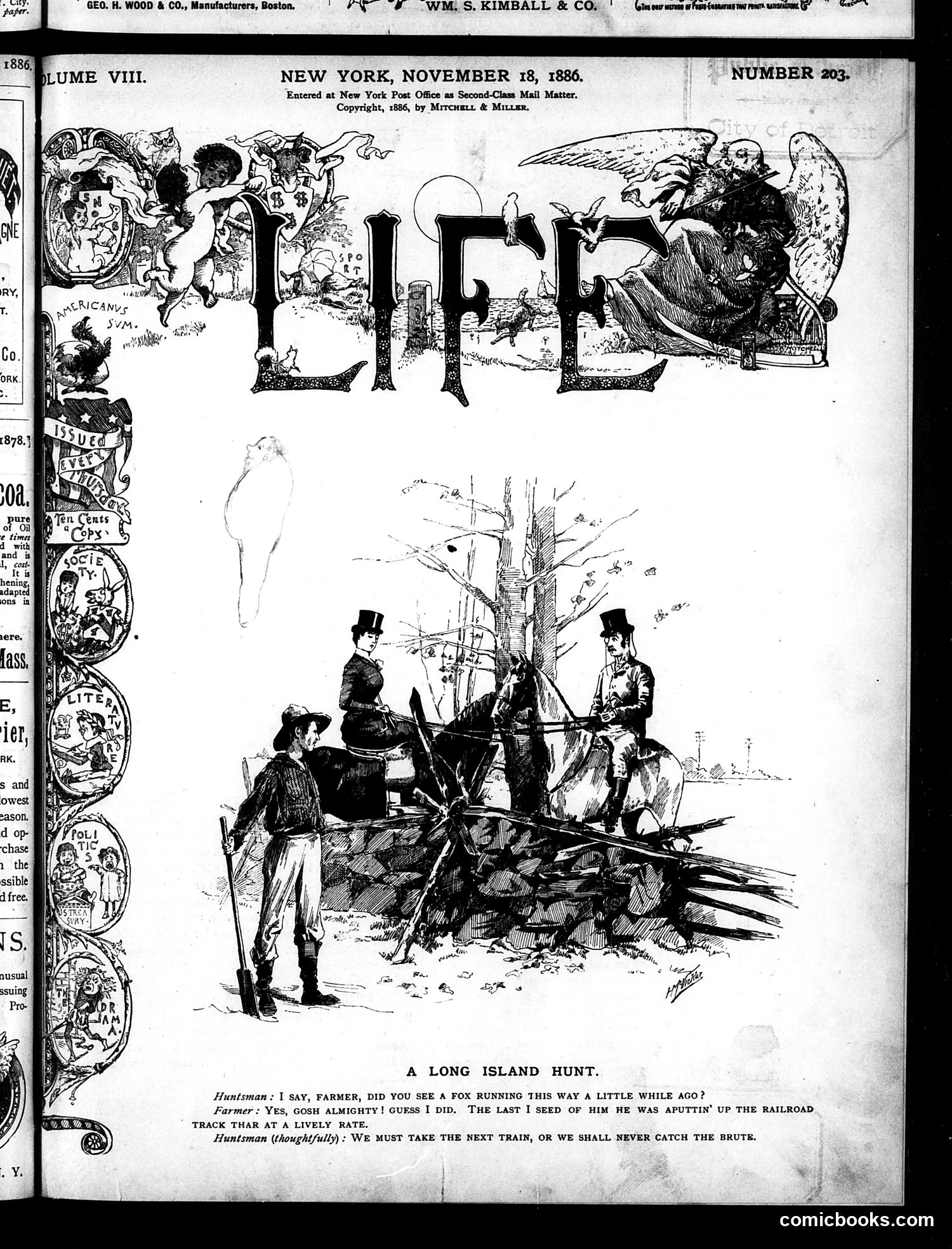
This cartoon depicts a fox hunt scene with four men in formal hunting attire around a bare tree. The dialogue reveals the satire: a huntsman asks a farmer if he saw a fox pass by; the farmer says yes, adding the fox was "puttin' up the railroad track at a lively rate." The huntsman responds they must catch the next train or lose the fox. The joke mocks the tension between traditional aristocratic leisure activities (fox hunting) and modern industrial progress (railroads). The satire suggests that foxes—and perhaps the hunting gentry themselves—are being displaced or outpaced by rapid railroad expansion across Long Island. It's commentary on how industrialization was transforming rural landscapes in the 1880s.
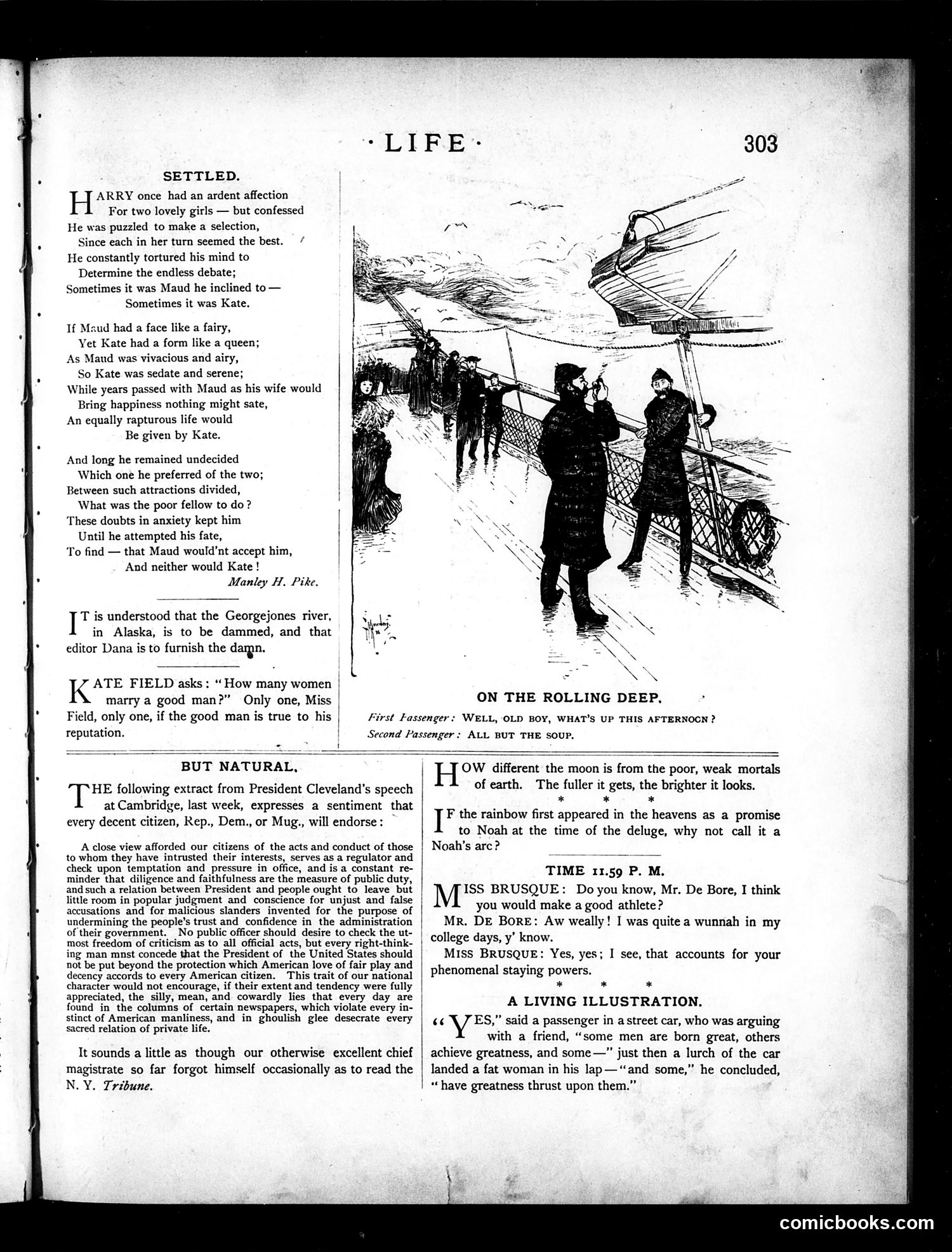
The main illustration "ON THE ROLLING DEEP" depicts passengers on a ship, with dialogue between first and second passengers about the afternoon and soup—likely a joke about seasickness or dining discomfort at sea. The "SETTLED" poem concerns Harry's romantic indecision between two women: Maud (described as fairy-like) and Kate (queenly and serene). The poem suggests Kate's steadiness would ultimately provide greater happiness than Maud's more dramatic charms—a commentary on preferring stable, practical partnerships over romantic intensity. The page also includes a quote from President Cleveland's speech about civic duty and honest government, presented as self-evidently sensible. The remaining sections are brief humorous anecdotes about women, athletics, and social observation—typical of Life's mix of poetry, satire, and comedic commentary on American life.
This page contains satirical "life" observations rather than political cartoons. The decorative header shows silhouettes of various animals and figures. The left column presents a sentimental poem about meeting a woman at the seashore, likely mocking romantic fiction popular in the era. The right column collects brief satirical "facts" and observations critiquing contemporary society: Boston refinement, fashion inconsistency, Queen Victoria's status anxiety, theatrical mediocrity, and economic absurdities. A final section titled "EXPLAINED" uses dialogue to mock a sculptor's pretentious claim about Chicago women's distinctive feet—the humor relies on urbane put-downs of American cities and social pretension. The overall tone is genteel satire targeting middle-class affectations and cultural pretensions rather than political targets.
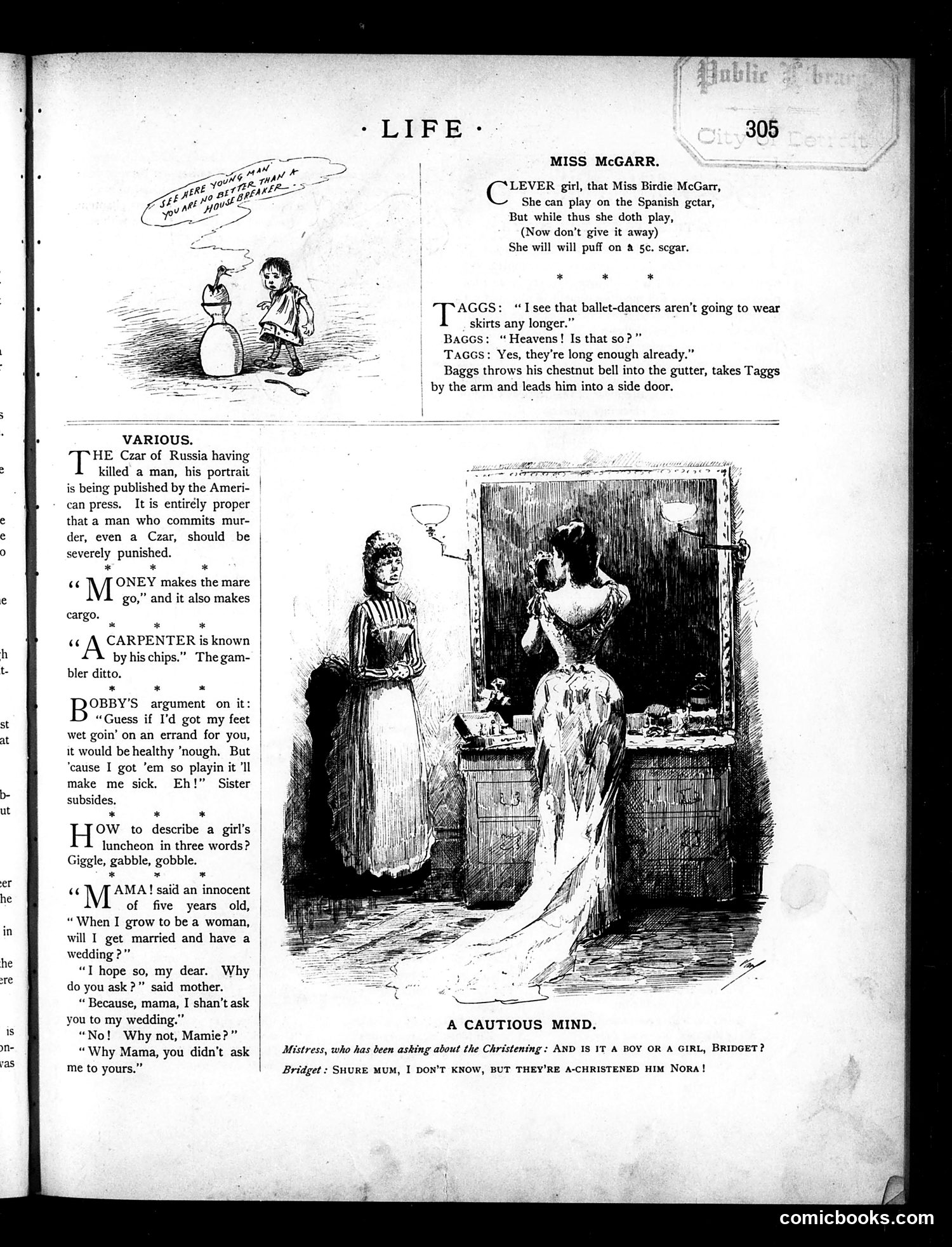
This page contains three separate humor pieces from *Life* magazine: 1. **"Miss McGarr"**: A verse mocking a woman named Birdie McGarr who plays Spanish guitar but smokes cigars—the humor trades on the incongruity of "refined" musical talent paired with "unladylike" cigar smoking. 2. **"Various"**: A collection of brief quips about contemporary topics (the Czar, money, carpenters, and children's logic). These are topical references now obscure without additional context. 3. **"A Cautious Mind"**: A sketch showing a mistress asking a servant (Bridget) whether a christened baby is a boy or girl. The humor lies in Bridget's confusion—she misidentifies the baby's gender, revealing her lack of understanding despite supposedly being experienced household help. These represent typical *Life* magazine humor: social satire targeting gender norms, class dynamics, and Irish servant stereotypes.
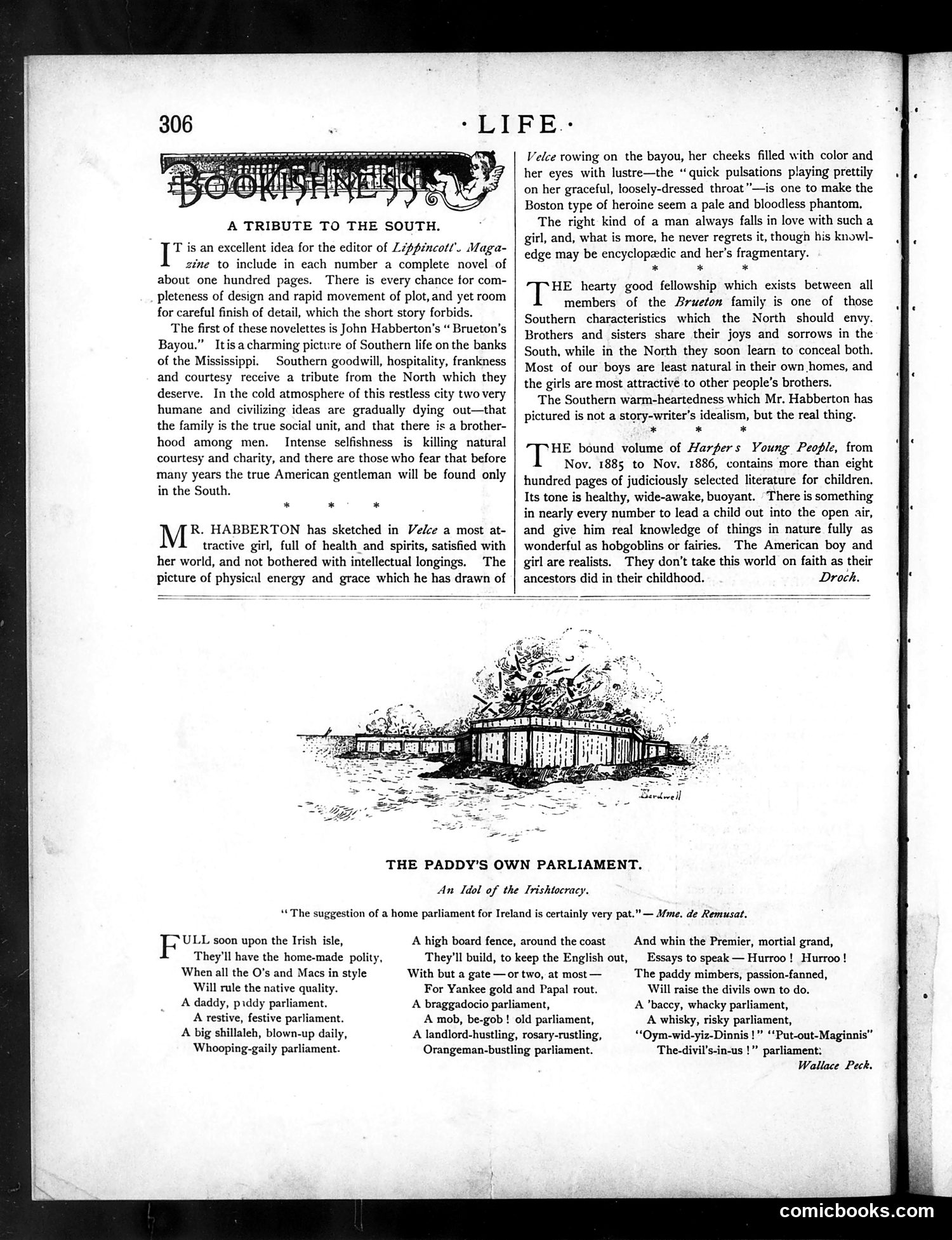
This satirical poem mocks the Irish independence movement by imagining a ridiculous Irish parliament. The verses use ethnic caricature—"Paddy" was a derogatory term for Irish people—to ridicule Irish Home Rule aspirations through absurdist humor. The joke presents an imaginary Irish government as chaotic and incompetent, featuring "a mob, be-gob! old parliament" and "a landlord-husting, rosary-roasting, Orangeman-busting parliament." The satire suggests Irish self-governance would be anarchic and sectarian conflict-ridden, mixing religious (rosary) and political (Orangeman—Protestant unionists) references. The accompanying illustration shows a simple structure, perhaps emphasizing primitiveness. This reflects late-19th/early-20th-century anti-Irish sentiment common in American publications, mocking Home Rule as unworkable.
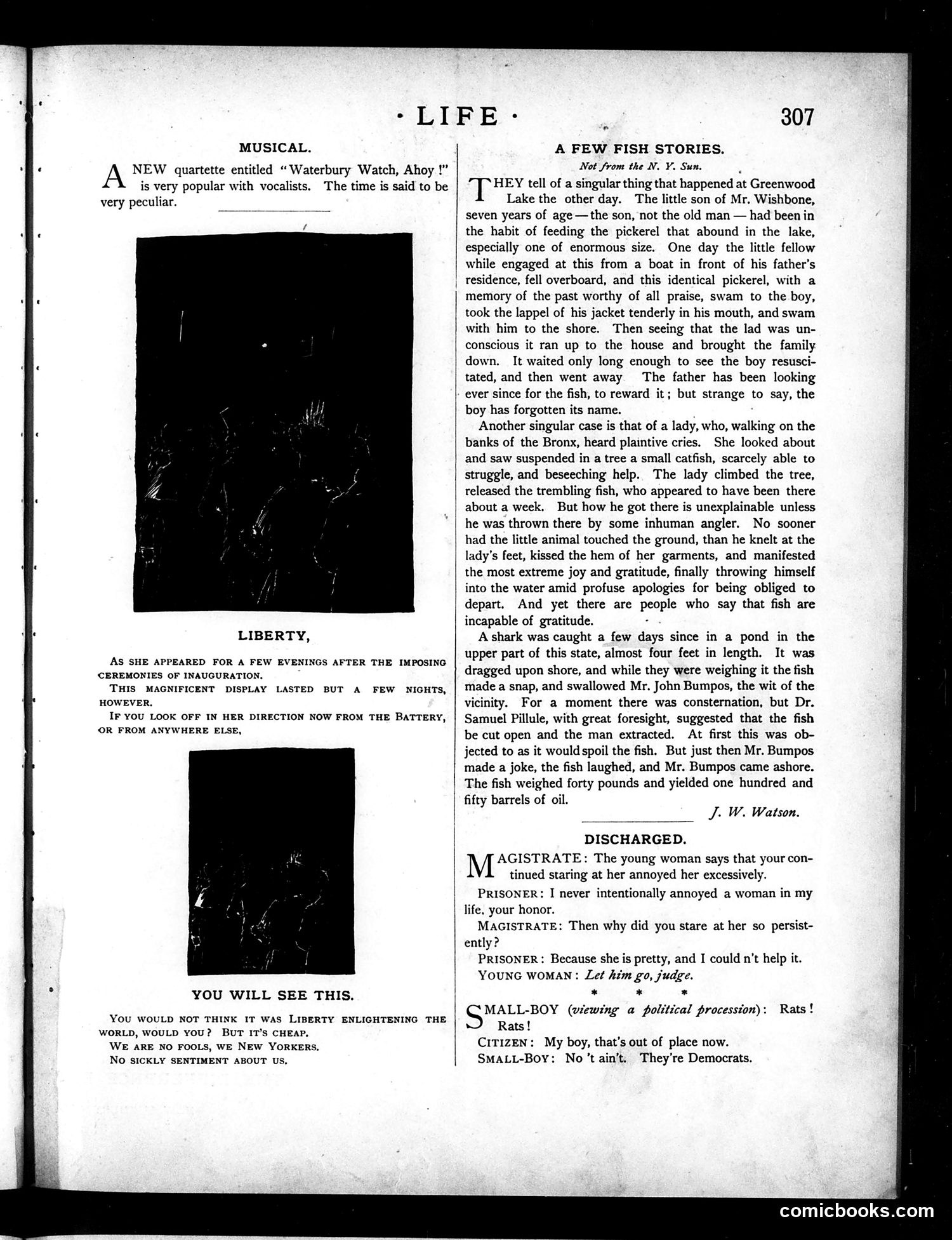
This page contains three distinct sections: **Left side:** Two political cartoon illustrations titled "Liberty" and "You Will See This," depicting a female figure (Liberty personified). The accompanying text references Liberty's appearance "after the imposing ceremonies of inauguration," suggesting this comments on a recent presidential inauguration. The cryptic final lines—"If you look off in her direction now from the Battery, or from anywhere else"—imply Liberty (the Statue) has been repositioned or altered, though the exact reference is unclear without dating context. **Right side:** "A Few Fish Stories" contains humorous anecdotes about fish rescues and a shark catch, followed by a short satirical dialogue titled "Discharged" mocking a magistrate's court case involving a woman's staring, and "Small-Boy" making a political joke equating rats with Democrats. The page blends political commentary with light humor and folklore.
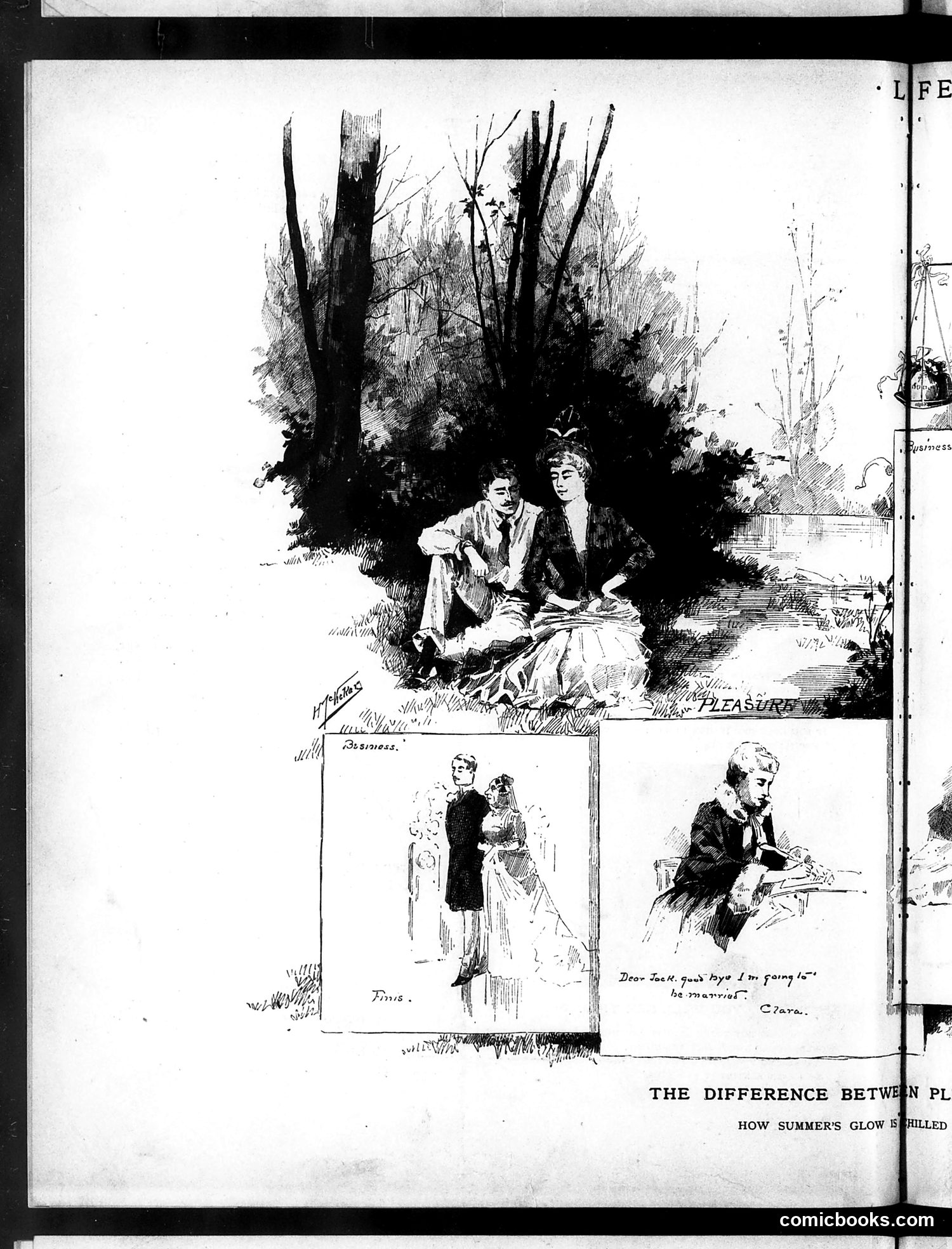
This page presents a satirical commentary titled "The Difference Between Pleasure" with the subtitle "How Summer's Glow Is Filled." The main illustration shows two figures relaxing by trees near water, labeled "Pleasure." Below are two smaller scenes: one labeled "Idleness" depicts a couple indoors (appears to be a social or romantic encounter), and another labeled "Cora" shows a figure at a desk with text that appears to reference some form of obligation or correspondence. The satire appears to contrast genuine leisure with mere idleness, and suggests that what might appear pleasurable on the surface (summer relaxation) differs from its reality—likely implying that leisure is disrupted by duties, correspondence, or social obligations that prevent true rest. The specific reference to "Cora" is unclear without additional context, but the overall message critiques the gap between romanticized summer pleasure and actual lived experience.
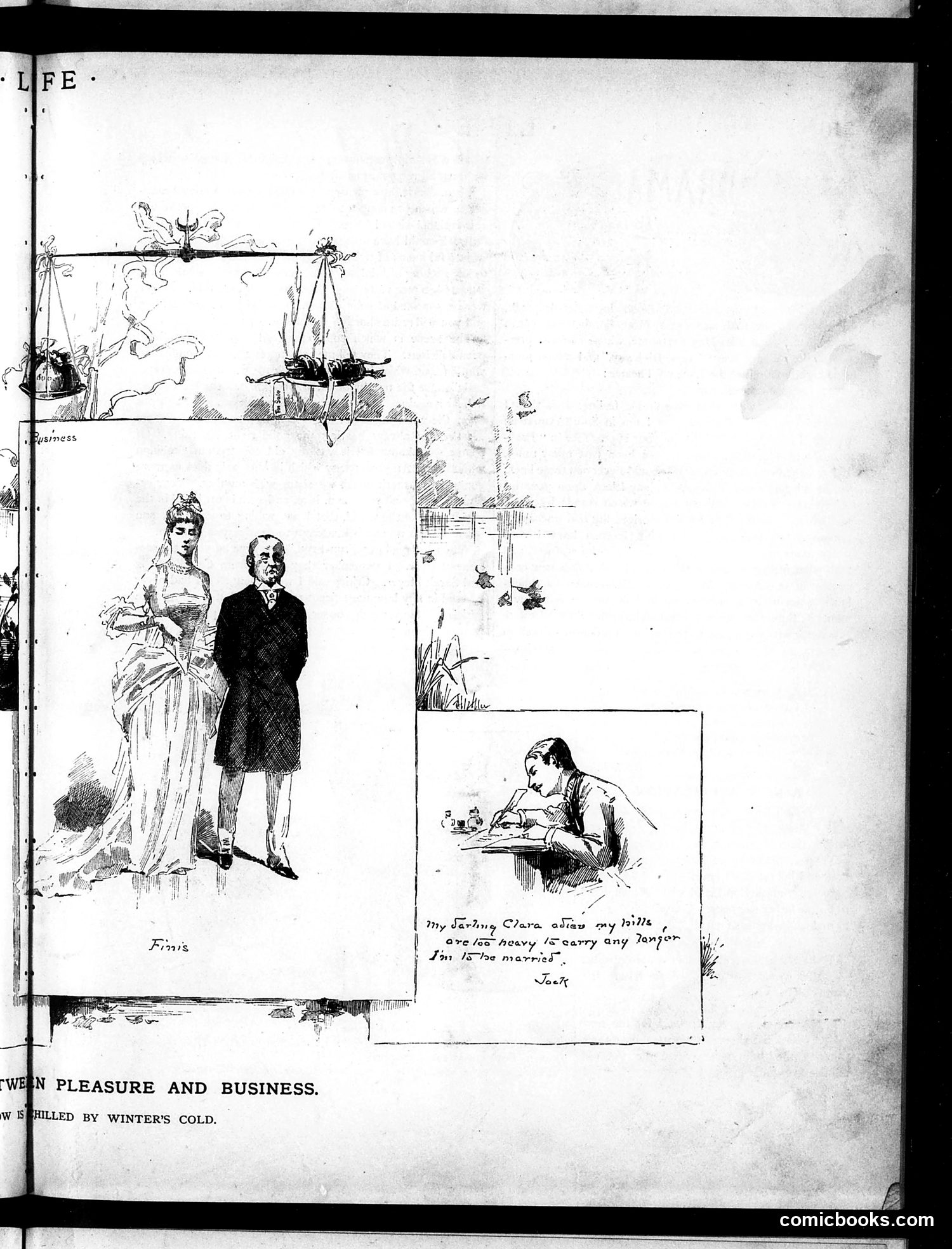
This page contains satirical illustrations addressing class and gender dynamics. The left panel labeled "Business" shows a well-dressed couple—a woman in elaborate Victorian dress and a man in formal attire—representing the leisured elite. The top panel depicts servants or workers on pulleys, suggesting labor exploitation. The right panel, captioned with handwritten text about "my darling Clara" and marriage, shows a man hunched over writing or working at a desk, likely in poor conditions. The overall satire contrasts the leisure and finery of the wealthy class with the drudgery and hardship of working people, particularly addressing the gap between romantic ideals ("pleasure and business") and harsh economic realities. The title references winter's cold as a practical hardship affecting the poor.
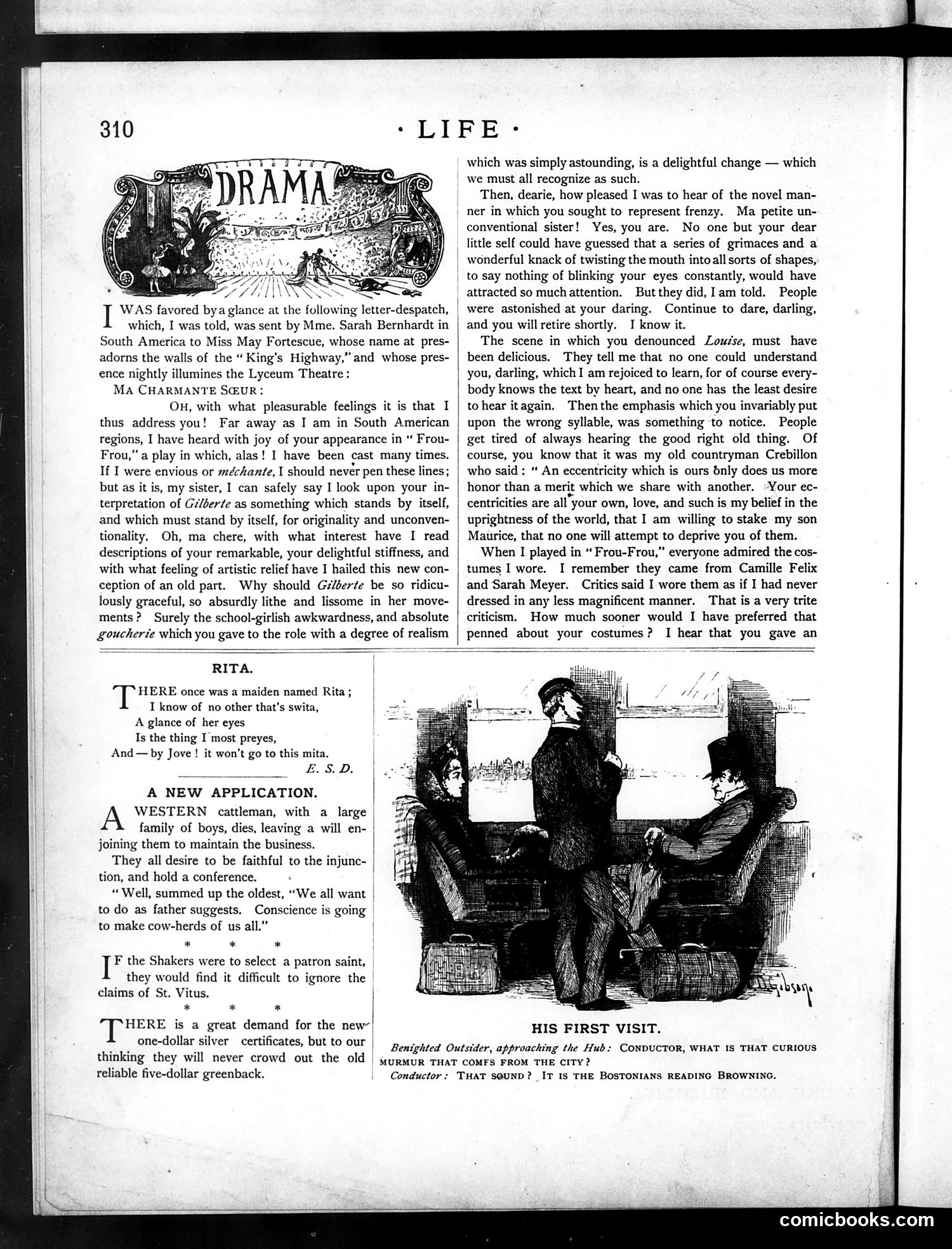
This sketch depicts a naive "Benighted Outsider" (labeled in the caption) visiting a city conductor on a streetcar. The outsider, apparently rural or from an isolated area, is bewildered by a "curious murmur" emanating from the city—which the conductor identifies as "Bostonians reading Browning." The satire targets Boston's reputation as an intellectually pretentious city obsessed with obscure high culture. Robert Browning, the Victorian poet famous for difficult, complex verse, symbolizes Boston's self-perceived sophistication. The joke: that city residents are so culturally absorbed they create an audible hum of earnest literary consumption—mocking both Boston snobbery and the impracticality of Browning's notoriously challenging poetry as everyday reading material.
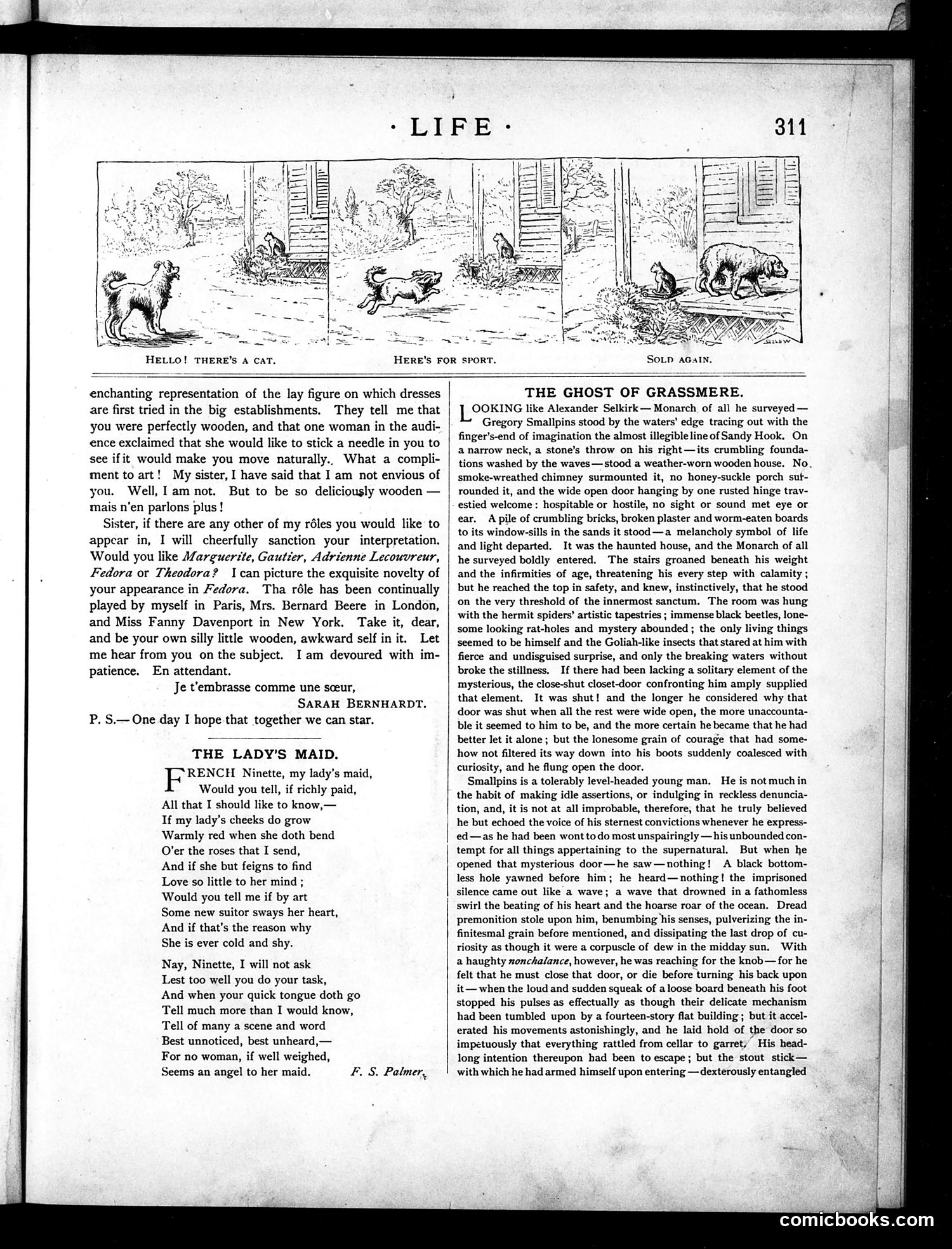
**The Comic Strip (top):** Three panels showing a dog encountering a cat. Panel 1: "Hello! there's a cat" (dog notices cat). Panel 2: "Here's for sport" (dog chases cat). Panel 3: "Sold again" (dog has apparently been tricked—possibly the "cat" was fake or the dog was fooled). This is a simple slapstick gag about a dog being outsmarted. **"The Lady's Maid" (poem):** A man tempts a French maid with money to reveal whether his romantic interest genuinely loves him. The poem's moral: don't ask servants to spy on their employers, because they'll reveal far more damaging gossip than you want to know. It's social commentary on class relations and the dangers of seeking uncomfortable truths. **"The Ghost of Grassmere" (story excerpt):** A man explores an abandoned, haunted house. The text emphasizes gothic atmosphere—decay, mystery, insects, and a mysteriously closed door he's afraid to open. Appears to be serialized supernatural fiction.
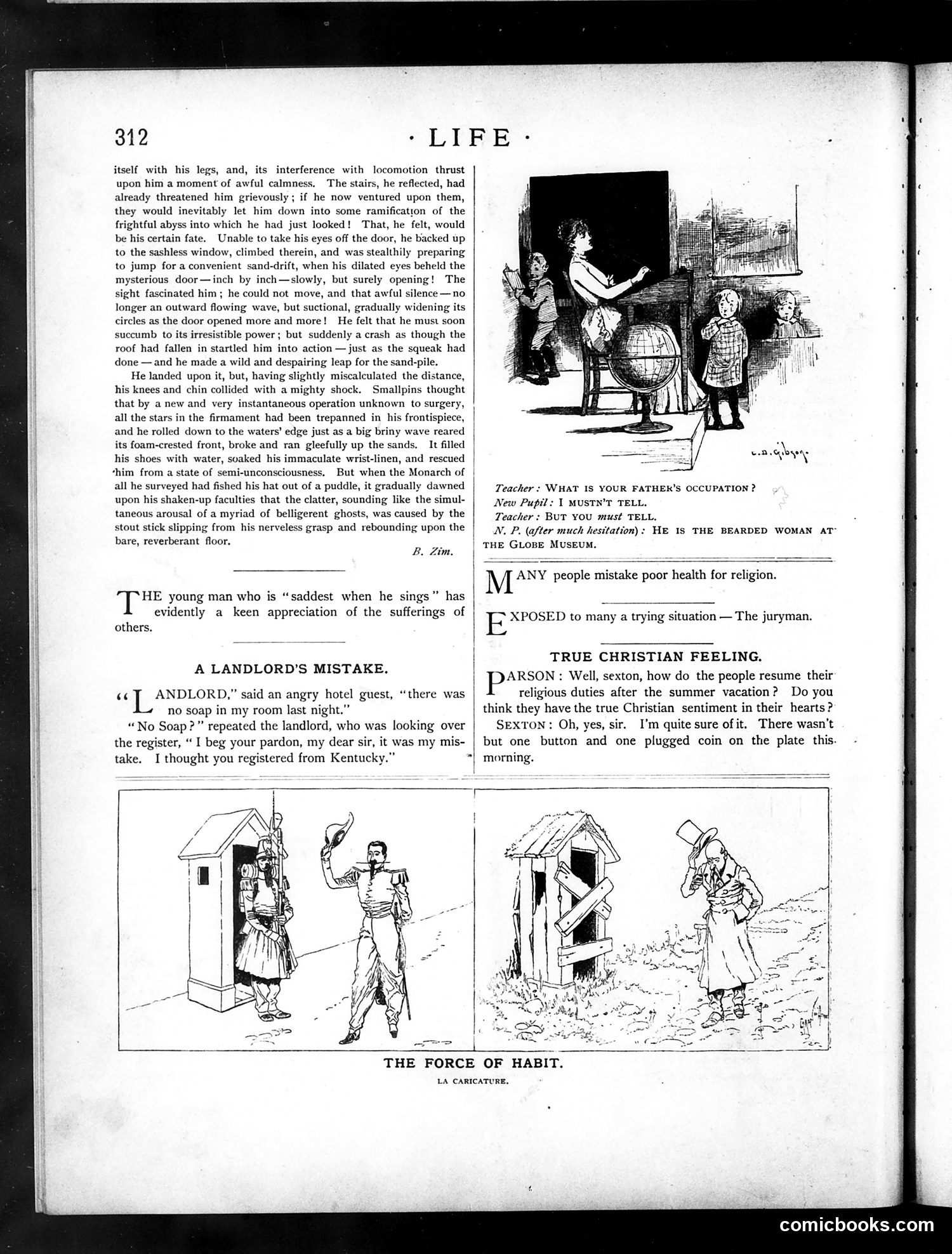
This page from *Life* magazine contains several brief satirical jokes targeting social hypocrisy and class prejudice: **"A Landlord's Mistake"** mocks regional bias: The landlord assumes a guest from Kentucky wouldn't notice missing soap, implying Kentuckians lack refinement or cleanliness—a common stereotype of rural/Southern Americans. **The teacher-pupil exchange** satirizes workplace secrecy and social embarrassment: a child cannot reveal his father works as "the bearded woman" at a museum—a carnival/sideshow attraction—suggesting shame about unconventional employment. **"True Christian Feeling"** is the sharpest critique: A parson and sexton discuss parishioners' post-summer religious devotion. The sexton's evidence? Only one real coin and one plugged (counterfeit) coin in the collection plate—exposing that churchgoers' "Christian sentiment" is superficial; their actual commitment (measured by donations) remains minimal. All jokes exploit gap between professed values and actual behavior, a recurring *Life* theme.
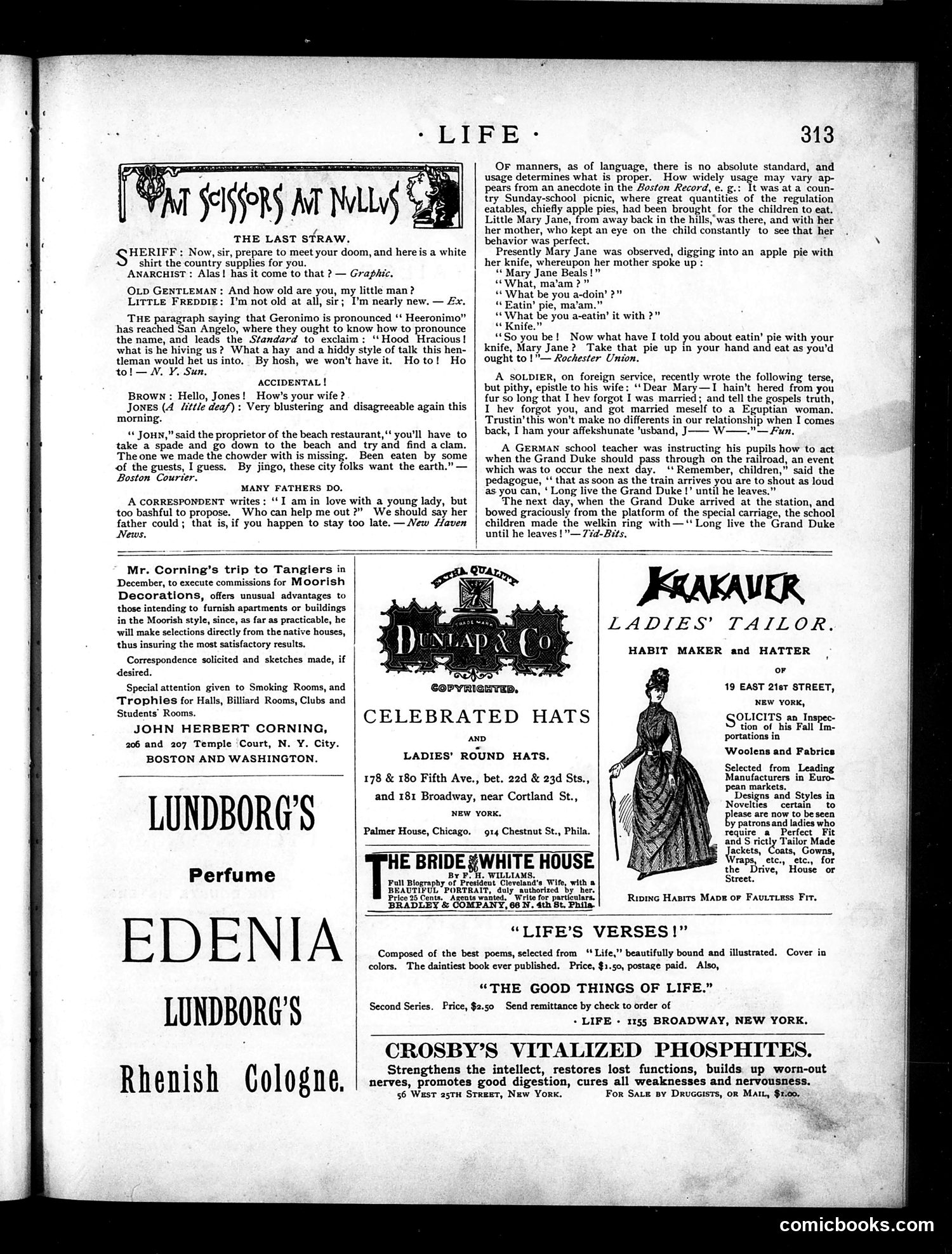
This page is primarily **advertisements and short humorous anecdotes** rather than political cartoons. The top cartoon, "Scissors at Nully," depicts a condemned anarchist meeting a sheriff—appearing to satirize anarchist executions, likely referencing late 19th-century anxieties about anarchist violence. The text includes brief jokes about **language and class**: a hillbilly mother corrects her daughter's table manners (eating pie with a knife instead of hands), a rural soldier writes wife-abandonment as a joke, and a German teacher's pupils accidentally insult the Grand Duke. These anecdotes mock rural speech patterns and dialects as markers of ignorance. The page is heavily dominated by **period advertisements** for Lundborg's perfume, Krakauer hats, Dunlap & Co. celebrated hats, and other products typical of wealthy consumer culture. The overall tone reflects *Life* magazine's satirical focus on class differences and contemporary social anxieties through humor targeting working-class speakers.
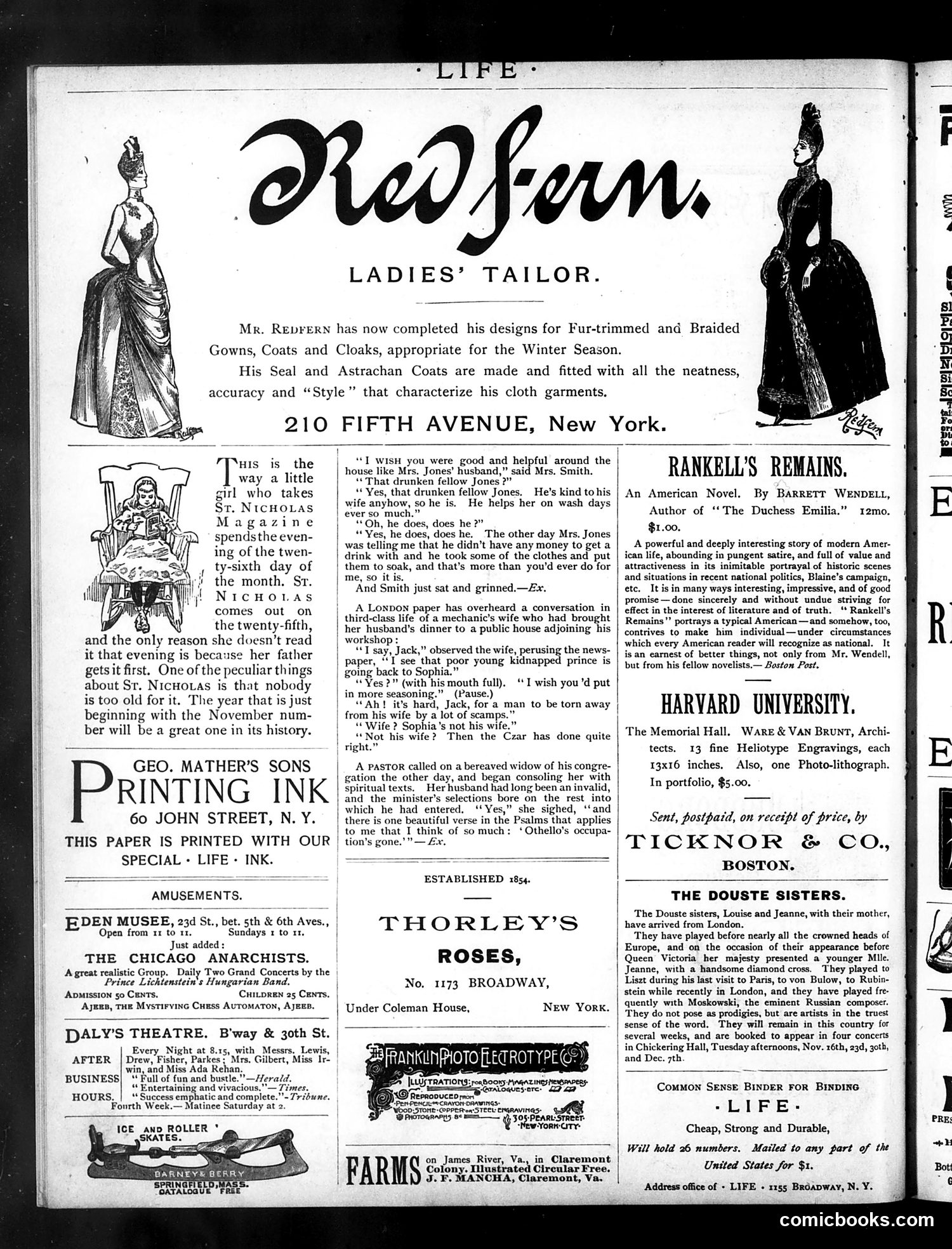
This page is primarily **advertisements and light humor** rather than political satire. The main content includes: **"St. Nicholas Magazine" segment**: A brief anecdote satirizing how eagerly children read the magazine—a girl must wait for her father to finish it first, humorously suggesting even adults find it irresistible. **Dialogue pieces**: Three separate humorous vignettes about working-class married life, featuring wives discussing their husbands' behavior. The humor is gentle domestic comedy—one wife praises her drunken husband for helping with laundry; another misreads a newspaper headline about a "kidnapped prince" going to "Sophia," confusing it with marital infidelity. **The bulk of the page** consists of period advertisements: Red Fern ladies' tailor, printing ink, theaters, amusement venues, book announcements, and flower delivery services. The satirical content is minimal and focuses on everyday domestic situations rather than political commentary. This appears to be a typical late-19th-century *Life* magazine page blending light humor with commercial advertising.
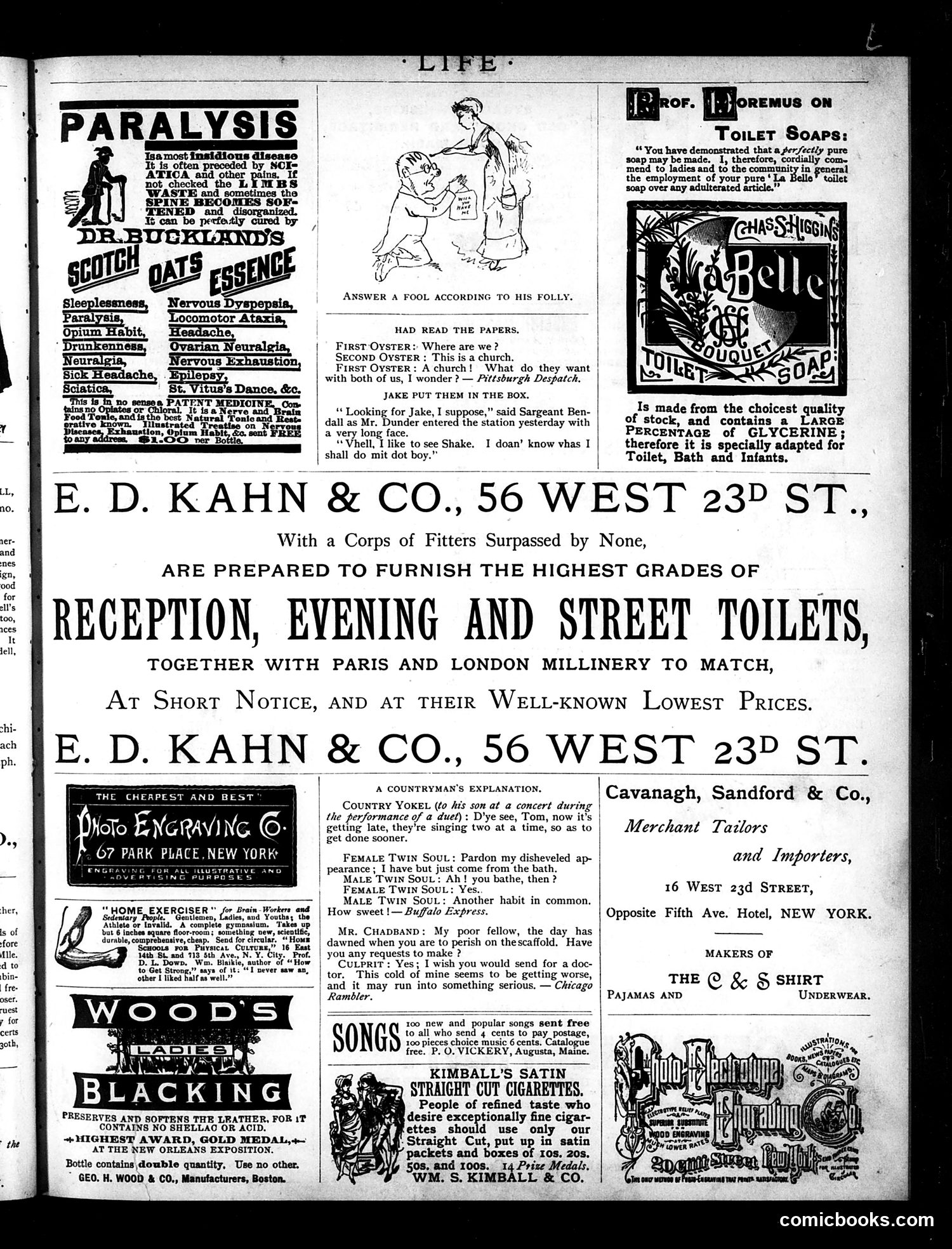
This page features several short humorous sketches satirizing contemporary society: **"Had Read the Papers"** depicts two oysters in a church, confused about their whereabouts. The joke mocks sensationalist newspaper coverage—the oysters have apparently read alarming news reports and mistakenly believe they're somewhere dangerous, when they're actually safe in a church. **"Jake Put Them in the Box"** shows a police sergeant seeking "Jake," using heavy dialect humor typical of the era. A man enters looking distressed, and the sergeant assumes Jake has committed a crime, but the punchline suggests a mundane misunderstanding about "Shake"—likely a dog or person. **"A Countryman's Explanation"** ridicules rural ignorance. A yokel father explains to his son that a musical duet proceeds faster than a solo, so "they're singing two at a time...to get done sooner"—absurdly literal misunderstanding of performance. The remaining sketches employ similar crude humor about social misunderstandings and dialect comedy. The page is primarily advertisements interspersed with these brief satirical vignettes typical of Life's format.
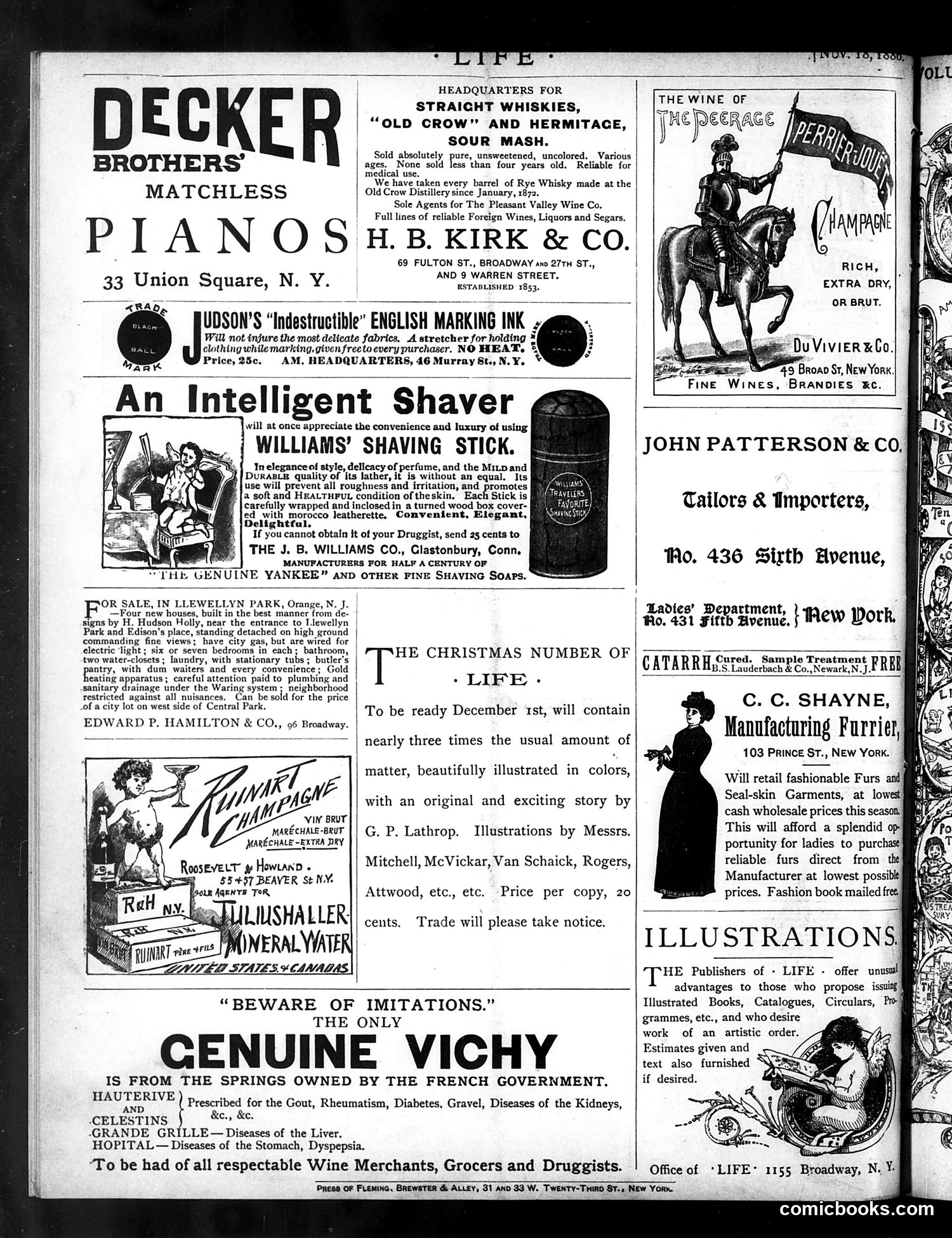
This is primarily an **advertising page** with minimal editorial content. The main text elements are commercial advertisements for products like Decker Brothers pianos, Williams' shaving products, Hudson's marking ink, and various wines and spirits popular in the 1880s. **Notable content:** The page announces the **Christmas issue of Life** (December 1st), promising "nearly three times the usual amount of matter" with illustrations and a story by G. P. Lathrop. This was the magazine's major holiday edition. **The "Intelligent Shaver" section** is not satirical—it's a straightforward product advertisement promoting Williams' Shaving Stick, emphasizing its elegance and health benefits for skin. **No political cartoons or satire** appear on this page. The imagery is purely decorative and promotional (a figure on horseback advertising champagne, a woman in silhouette for a furrier, a cherub sketching for the illustrations section). This page reflects **late-Victorian consumer culture** and the prominence of patent medicines and luxury goods in period magazines.