
Life, 1886-11-18 · page 2 of 16
Life — November 18, 1886 — page 2: what you’re looking at
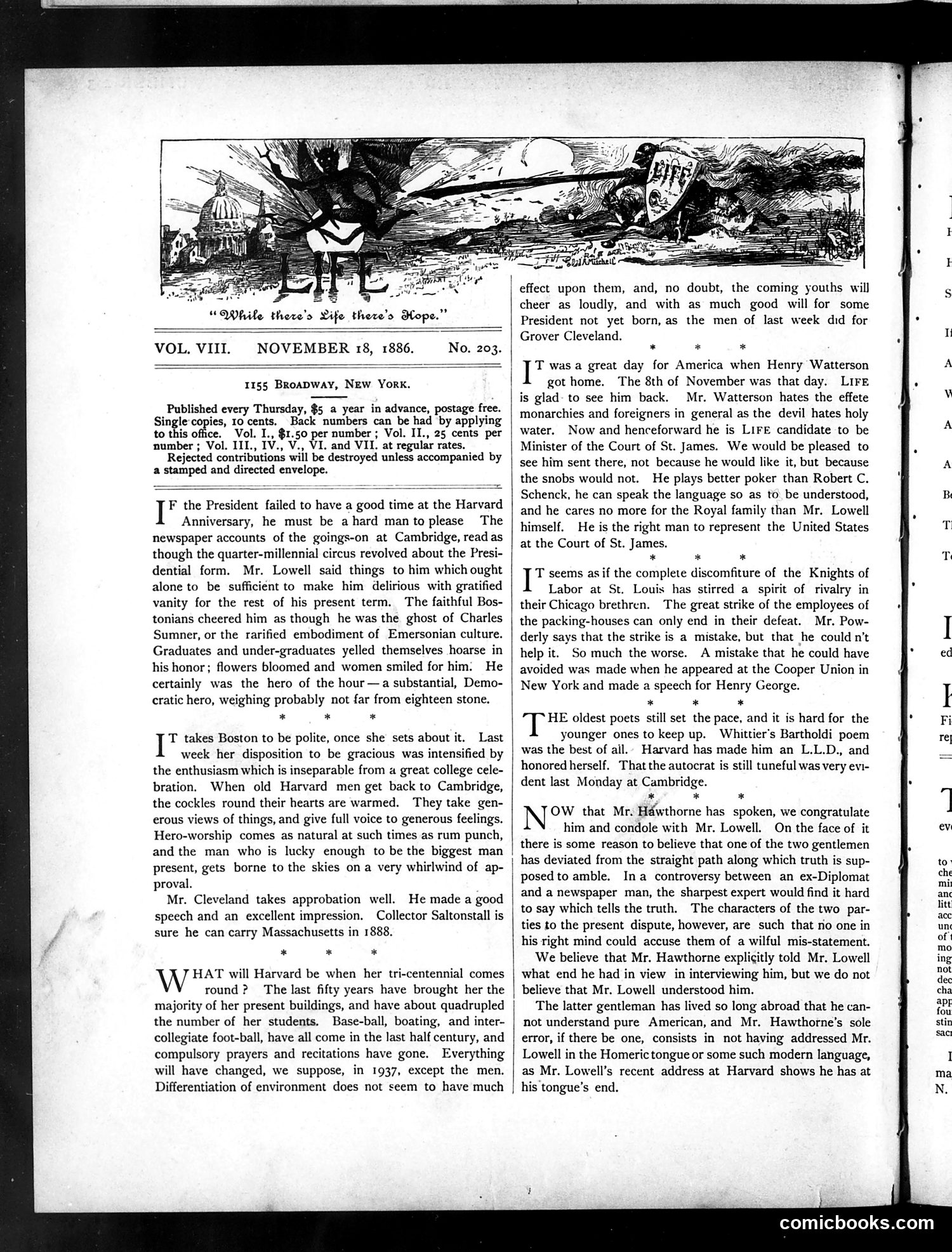
A restored page from Life, 1886-11-18. Page through the whole issue in the reader above.
📄 Transcribed text from this page (OCR, searchable)
Machine-transcribed from the original scan — historical spelling and the odd misread are preserved.
“OWMhile there's Life there's Hope.” VOL. VIII. NOVEMBER 18, 1886. No. 203. 1155 BroaDway, NEw York. Published every Thursday, $5 a year in advance, postage free. Single-copies, 10 cents. Back numbers can be had by applying to this office. Vol. I., $1.50 per number ; Vol. II., 25 cents per number ; Vol. III., IV., V., VI. and VII. at regular rates. Rejected contributions will be destroyed unless accompanied by a stamped and directed envelope. F the President failed to have a good time at the Harvard Anniversary, he must be a hard man to please The newspaper accounts of the goings-on at Cambridge, read as though the quarter-millennial circus revolved about the Presi- dential form. Mr. Lowell said things to him which ought alone to be sufficient to make him delirious with gratified vanity for the rest of his present term. The faithful Bos- tonians cheered him as though he was the ghost of Charles Sumner, or the rarified embodiment of Emersonian culture. Graduates and under-graduates yelled themselves hoarse in his honor; flowers bloomed and women smiled for him: He certainly was the hero of the hour—a substantial, Demo- cratic hero, weighing probably not far from eighteen stone. * * * T takes Boston to be polite, once she sets about it. Last week her disposition to be gracious was intensified by the enthusiasm which is inseparable from a great college cele- bration. When old Harvard men get back to Cambridge, the cockles round their hearts are warmed. They take gen- erous views of things, and give full voice to generous feelings. Hero-worship comes as natural at such times as rum punch, and the man who is lucky enough to be the biggest man present, gets borne to the skies on a very whirlwind of ap- proval. Mr. Cleveland takes approbation well. He made a good speech and an excellent impression. Collector Saltonstall is sure he can carry Massachusetts in 1888. * * * wer will Harvard be when her tri-centennial comes round? The last fifty years have brought her the majority of her present buildings, and have about quadrupled the number of her students. Base-ball, boating, and inter- collegiate foot-ball, have all come in the last half century, and compulsory prayers and recitations have gone. Everything will have changed, we suppose, in 1937, except the men. Differentiation of environment does not seem to have much | effect upon them, and, no doubt, the coming youths will cheer as loudly, and with as much good will for some President not yet born, as the men of last week did for Grover Cleveland. * * T was a great day for America when Henry Watterson got home. The 8th of November was that day. LIFE is glad- to see him back. Mr. Watterson hates the effete monarchies and foreigners in general as the devil hates holy water. Now and henceforward he is Lire candidate to be Minister of the Court of St. James. We would be pleased to see him sent there, not because he would like it, but because the snobs would not. He plays better poker than Robert C. Schenck, he can speak the language so as to: be understood, and he cares no more for the Royal family than Mr. Lowell himself. He is the right man to represent the United States at the Court of St. James. * * * T seems as if the complete discomfiture of the Knights of Labor at St. Louis has stirred a spirit of rivalry in their Chicago brethren. The great strike of the employees of the packing-houses can only end in their defeat. Mr. Pow- derly says that the strike is a mistake, but that he couldn't help it. So much the worse. A mistake that he could have avoided was made when he appeared at the Cooper Union in New York and made a speech for Henry George. * * * HE oldest poets still set the pace, and it is hard for the younger ones to keep up. Whittier’s Bartholdi poem was the best of ail. Harvard has made him an L.L.D., and honored herself. That the autocrat is still tuneful was very evi- dent last Monday at Cambridge. * * * OW that Mr. Hawthorne has spoken, we congratulate him and condole with Mr. Lowell. On the face of it there is some reason to believe that one of the two gentlemen has deviated from the straight path along which truth is sup- posedto amble. Ina controversy between an ex-Diplomat and a newspaper man, the sharpest expert would find it hard to say which tells the truth. The characters of the two par- ties to the present dispute, however, are such that no one in his right mind could accuse them of a wilful mis-statement. We believe that Mr. Hawthorne explicitly told Mr. Lowell what end he had in view in interviewing him, but we do not believe that Mr. Lowell understood him. The latter gentleman has lived so long abroad that he can- not understand pure American, and Mr. Hawthorne’s sole error, if there be one, consists in not having addressed Mr. Lowell in the Homeric tongue or some such modern language, as Mr. Lowell’s recent address at Harvard shows he has at his tongue’s end. comicbooks.com