
A complete issue · 16 pages · 1886
Life — November 4, 1886
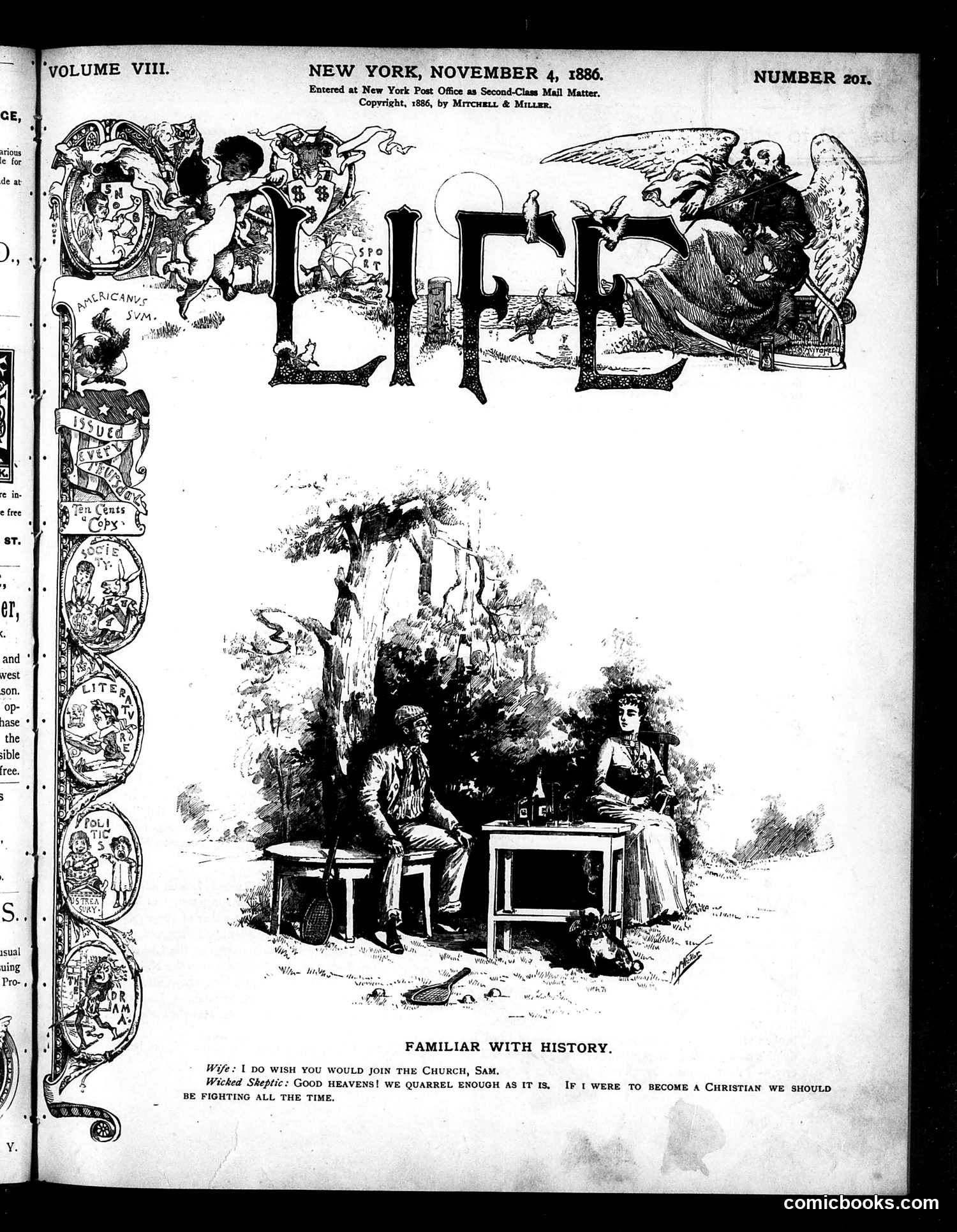
This cartoon satirizes a domestic argument about religion. A husband and wife sit beneath a hollow tree, with a table of drinks between them. The caption captures their dispute: **Wife:** "I do wish you would join the Church, Sam." **Husband Skeptic:** "Good Heavens! we quarrel enough as it is. If I were to become a Christian we should be fighting all the time." The joke mocks the husband's cynical view that Christian morality and marital harmony are incompatible—suggesting that adopting Christian principles would only increase conflict in their already-contentious marriage. The satire implies either that Christians are unnecessarily combative, or that this particular couple's dysfunction would be incompatible with religious practice. The hollow tree setting suggests precarious circumstances matching their unstable relationship.
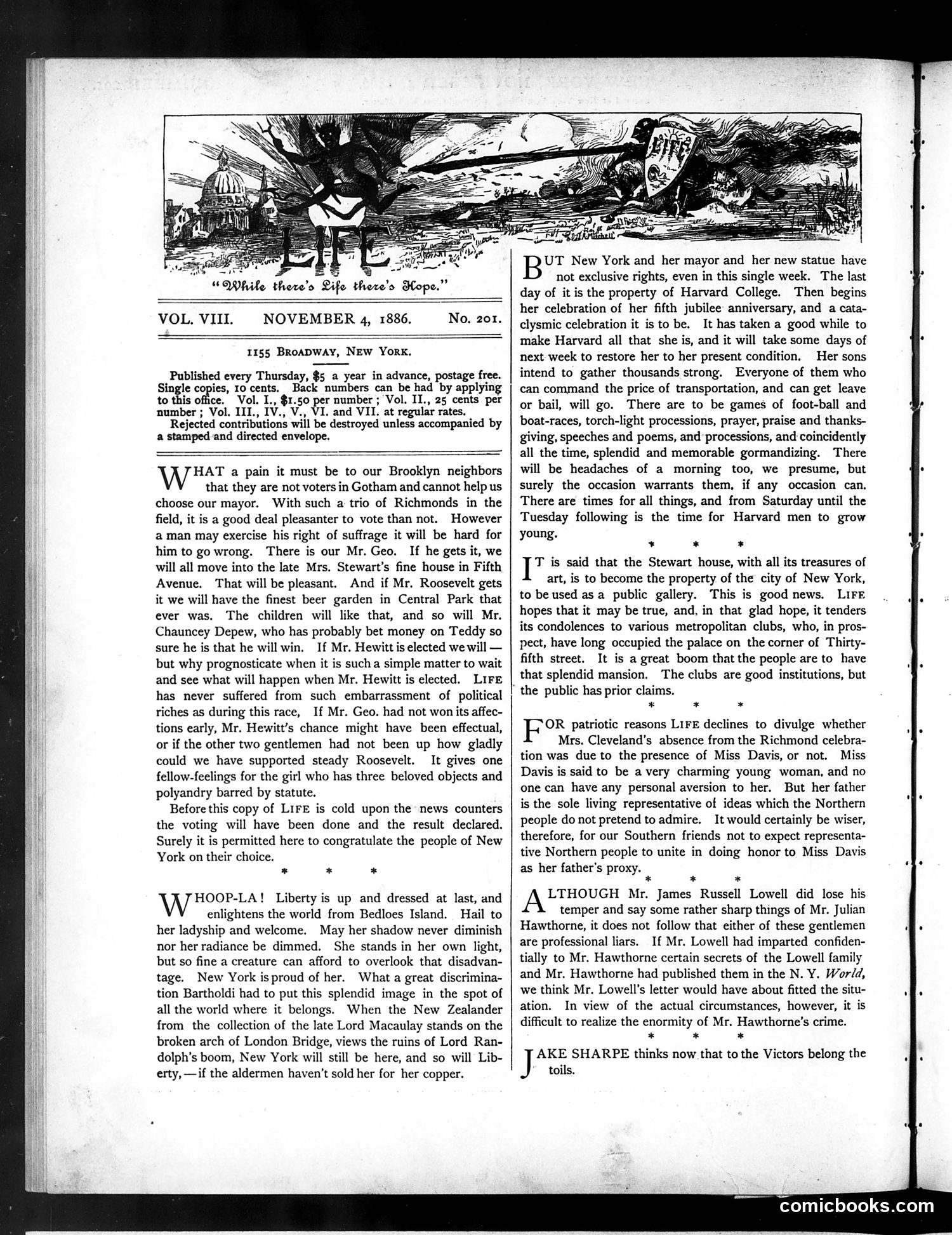
The masthead cartoon shows a figure labeled "Life" suspended between two opposing forces—likely representing competing political or social interests of the era. The caption "While there's Life there's Hope" suggests optimism amid conflict. The page's text addresses contemporary New York politics, including mayoral elections and the recently dedicated Statue of Liberty. References to the Stewart mansion becoming a public gallery, Harvard's jubilee, and debates over Miss Davis's attendance at Richmond celebrations indicate this reflects Gilded Age social hierarchies and regional tensions between North and South. The "Jake Sharpe" reference at bottom suggests commentary on a contemporary scandal or political figure, though context for this specific allusion is unclear without additional documentation.
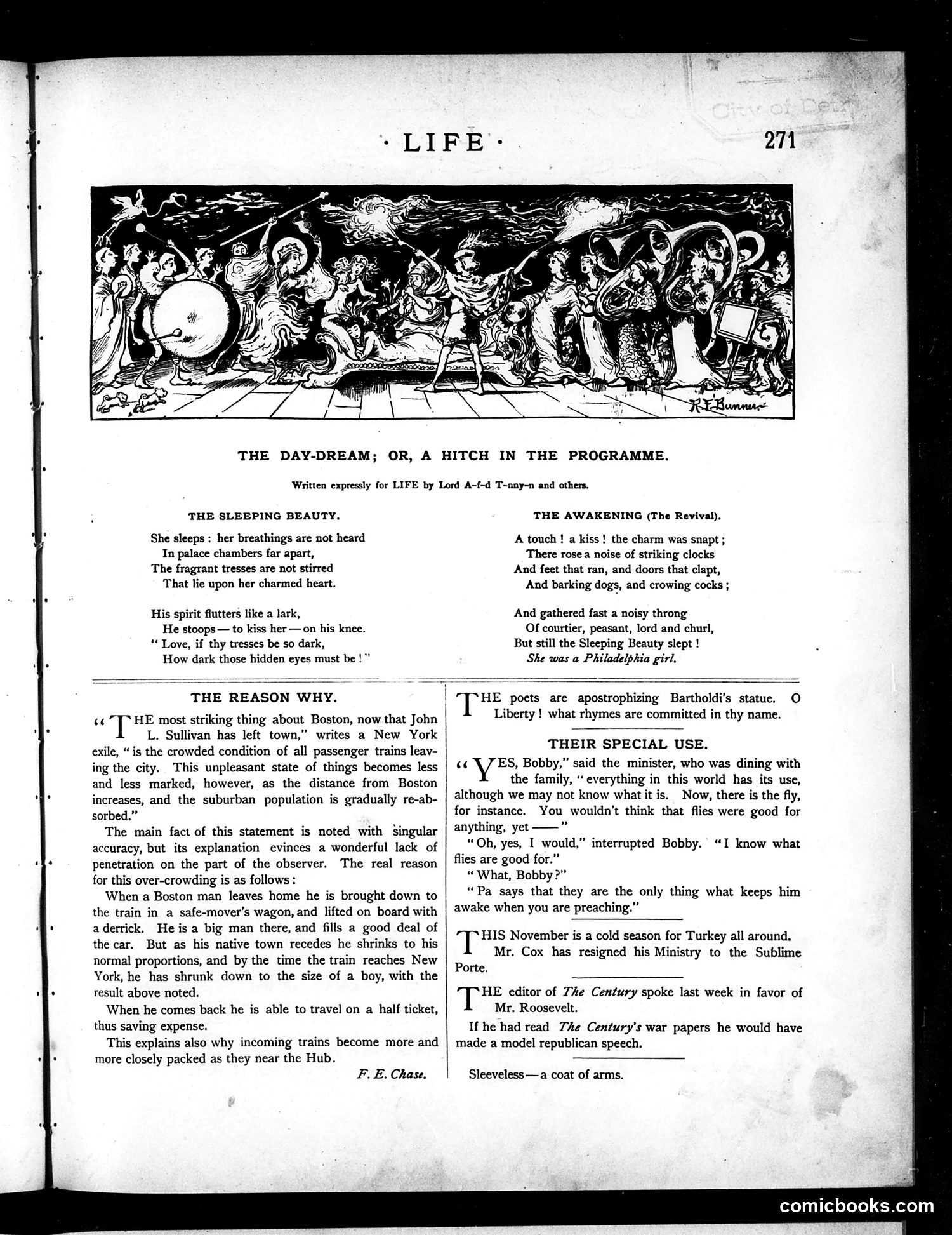
The top illustration, titled "The Day-Dream; or, A Hitch in the Programme," depicts a chaotic theatrical or musical performance scene with numerous figures in period dress. The accompanying poem contrasts "The Sleeping Beauty" with "The Awakening (The Revival)," suggesting satirical commentary on artistic or cultural performance. Below, the article "The Reason Why" humorously explains Boston's crowded train conditions: when Bostonians travel to New York, the train's interior shrinks proportionally to accommodate their supposedly larger frames. This is playful social satire mocking regional stereotypes. The remaining brief items mock contemporary figures and events—references to poets, Roosevelt, and the editor of *The Century* magazine—using witty one-liners typical of *Life*'s satirical style.
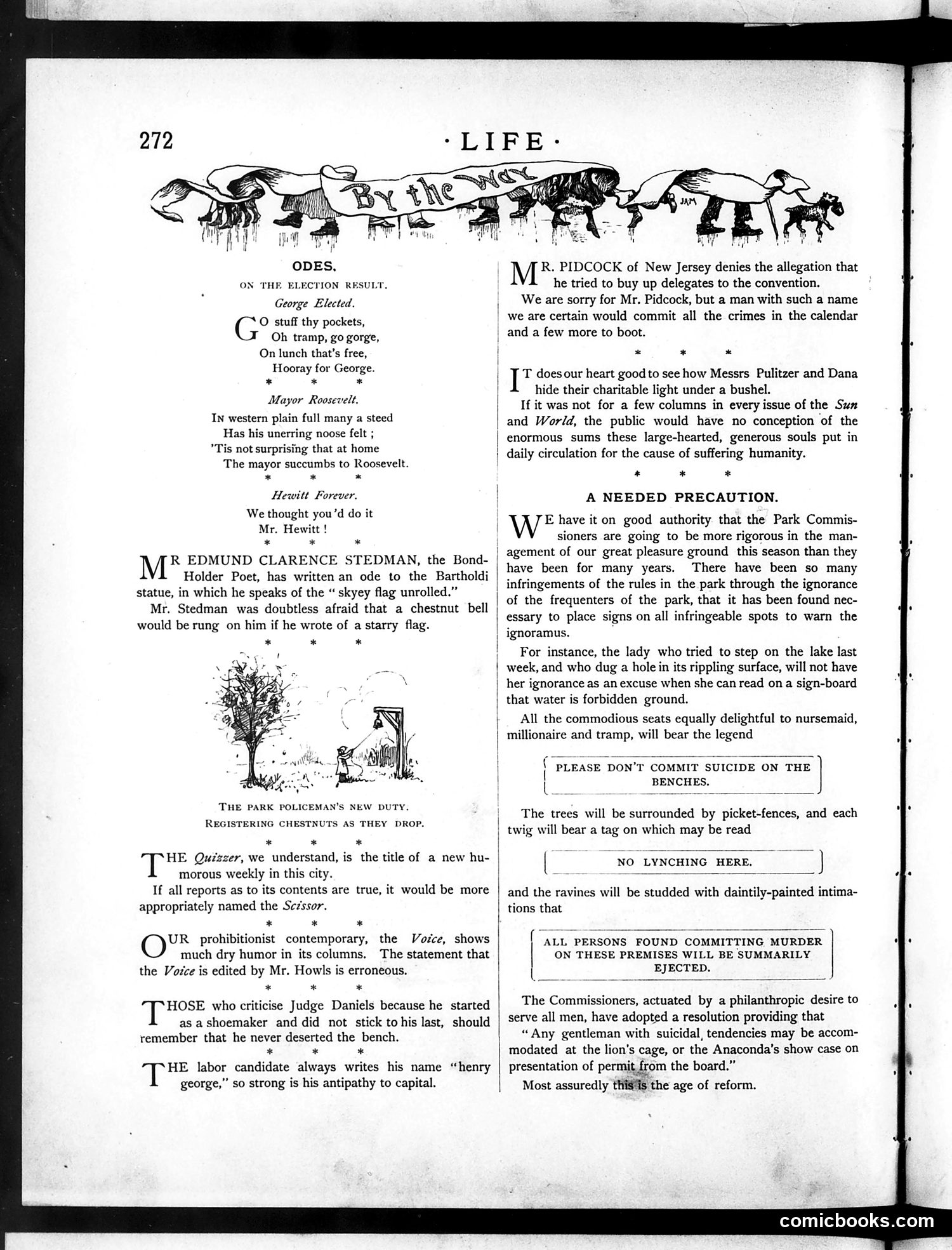
This page contains several brief satirical items mocking 1904 election politics and contemporary figures: **"Odes on the Election Result"** celebrates Theodore Roosevelt's election victory with jabs at opponents, including Mayor Roosevelt and others. The "George" references likely relate to election-outcome mockery. **The main cartoon** (bottom left) shows a policeman registering chestnuts as they drop—apparently satirizing urban graft or bureaucratic absurdity regarding park management. **"A Needed Precaution"** satirizes Park Commissioners' plans to post warning signs throughout parks (about suicide, lynching, and murder) to protect the ignorant from themselves. The piece mocks this excessive bureaucratic paternalism and the commissioners' condescending assumption that citizens cannot read basic danger warnings without official signage. The satire targets Progressive Era reform overreach and governmental condescension.
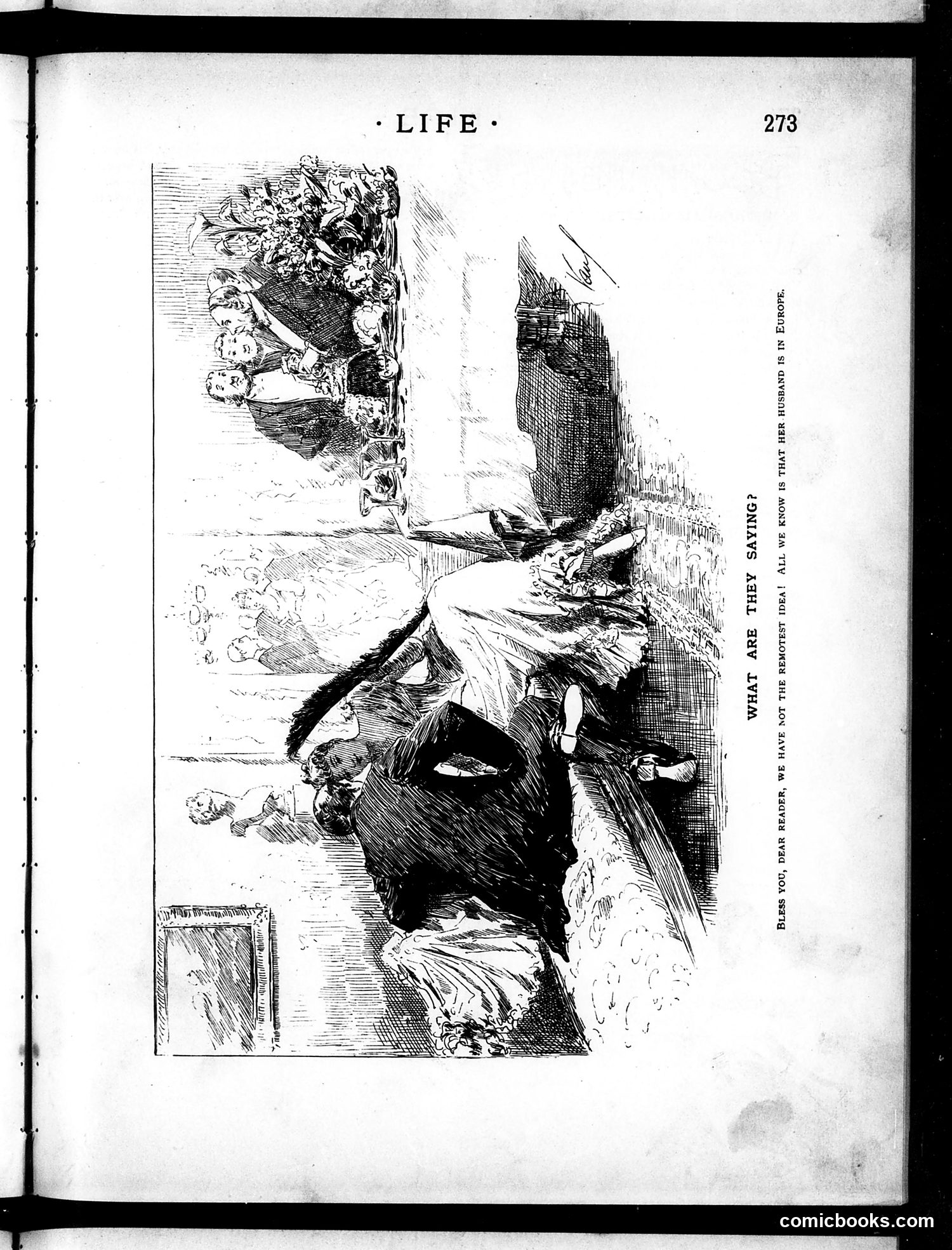
This satirical cartoon depicts a woman in fashionable dress standing before a building, with a group of well-dressed figures visible in a window above. The caption reads: "BLESS YOU, FOR THERE WE GIVE NOT THE SLIGHTEST IDEA ALL WE EVER IS MAKE STIR IN EUROPE." The satire appears to mock wealthy American socialites or tourists abroad—likely critiquing their superficial engagement with European culture. The woman's elaborate clothing and the formal setting suggest commentary on American pretension or materialism while traveling in Europe. The figures observing from above may represent Europeans or society observers judging American visitors. The joke seems to suggest that despite fashionable appearances, these Americans contribute nothing meaningful to cultural exchange or understanding during their European visits.
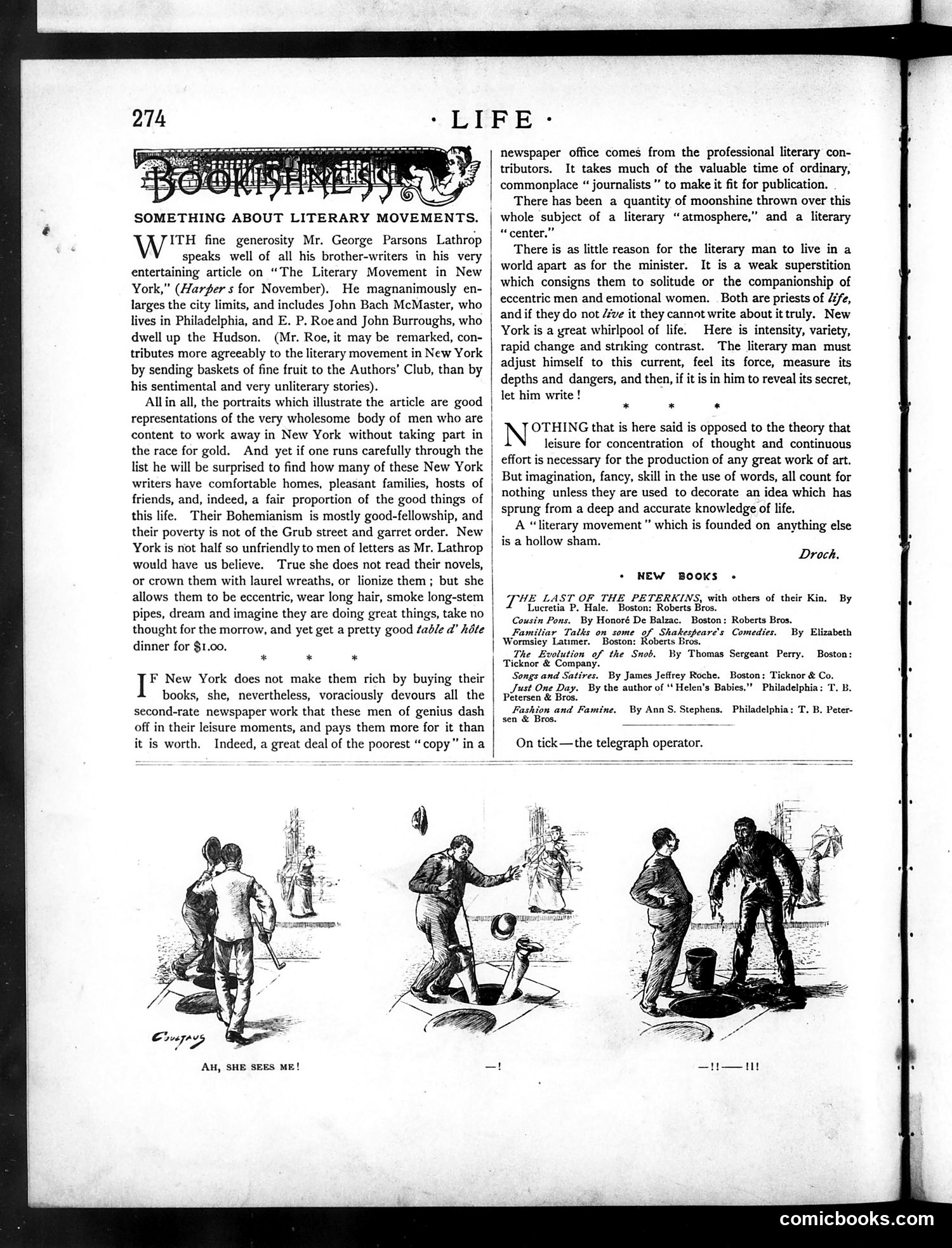
This page contains a literary criticism article titled "Something About Literary Movements" by George Parsons Lathrop, discussing New York's literary scene and writers including John Burroughs and E.P. Roe. The three cartoon panels at the bottom appear to illustrate a sequential humorous scenario labeled "Ah, She Sees Me!" and marked with dashes "—I" and "—II —III!" The sketches show men in period dress (appearing to be late 19th century) in what seems to be a comedic situation involving a woman's observation or reaction. The specific narrative is unclear without additional context, but it depicts a social embarrassment or awkward moment typical of satirical humor in Life magazine. The cartoon style and subject matter suggest commentary on courtship or social propriety customs of the era.
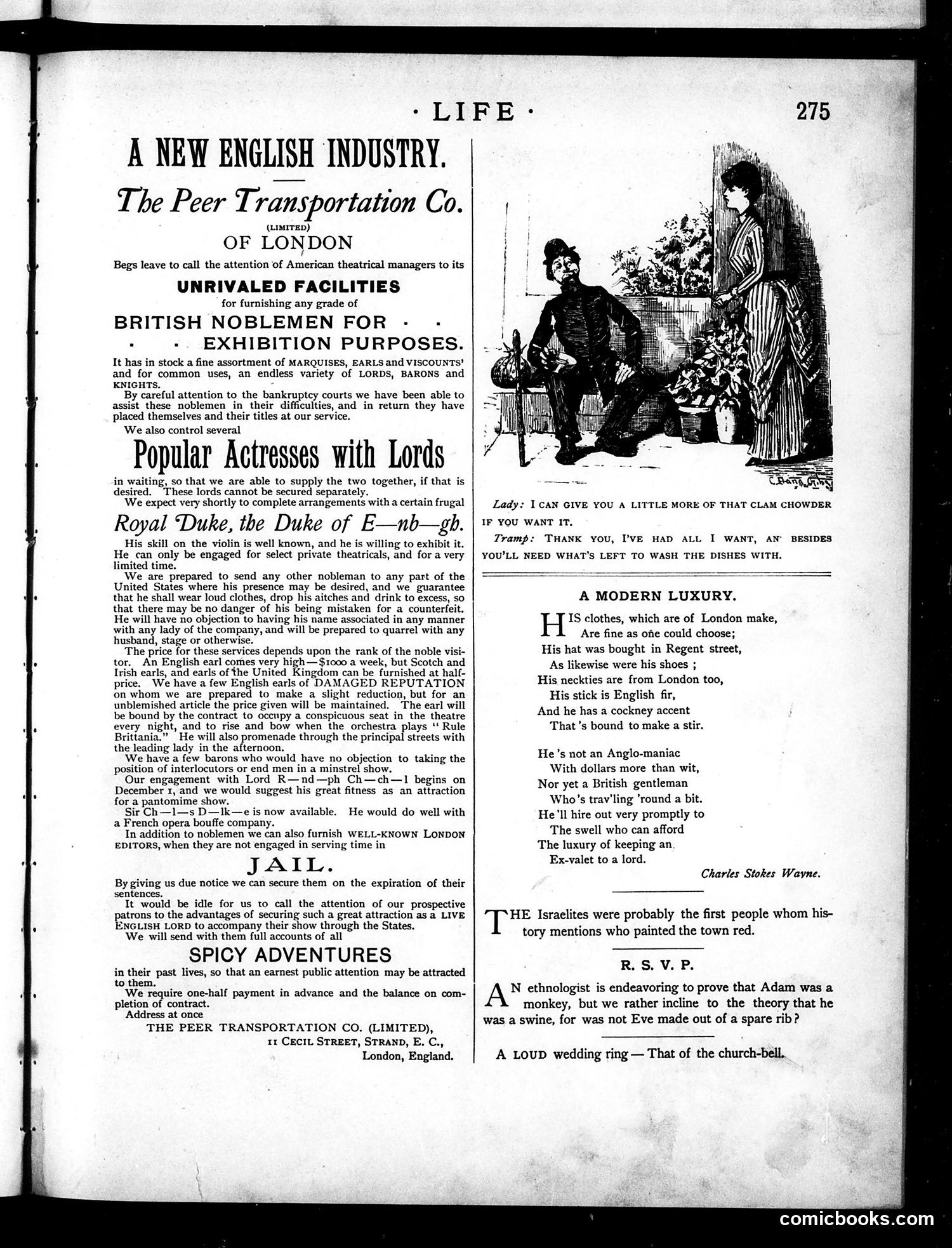
The main cartoon depicts a dialogue between a working-class "Tramp" and a well-dressed "Lady." She offers him clam chowder; he declines, saying he's had all he wants and needs to wash dishes instead. The satire mocks the Victorian era's sentimental charity—wealthy women giving alms to the poor while the tramp himself recognizes the transactional nature of such "generosity." His retort suggests he's already been used as labor and won't accept more patronizing handouts. The joke satirizes both aristocratic condescension and the exhausting cycle of poverty-based servitude. The facing page contains a poem "A Modern Luxury" by Charles Stokes Wayne, mocking aspirational working-class Londoners who adopt genteel affectations. The surrounding text advertises "The Peer Transportation Co.," a humorous proposal to exhibit British nobility.
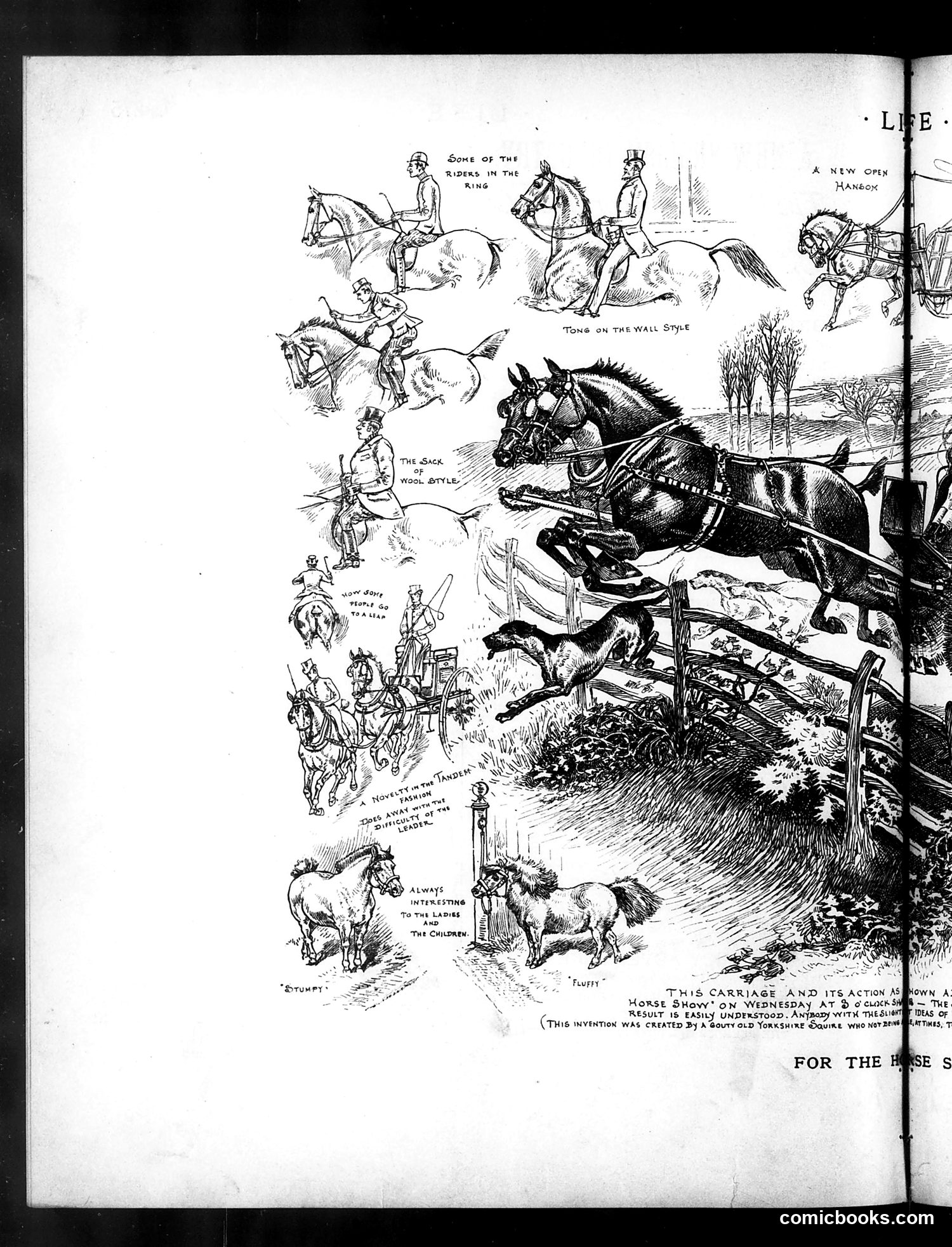
This page illustrates various equestrian activities and riding styles, seemingly educational or demonstrative in nature. The sketches show different horseback riding techniques labeled "Some of the Riders in the Ring," "Tone on the Wall Style," "The Sack," and other riding positions. The dominant illustration depicts a horse and rider jumping over a fence—likely representing fashionable horsemanship at an elite horse show. Two animals labeled "Stumpy" and "Fluffy" appear at the bottom, suggesting humor about the contrast between impressive horses and ordinary pets. The page appears to be gentle satire about horse-show culture and the various (sometimes absurd) riding styles exhibited by participants, rather than sharp political commentary.
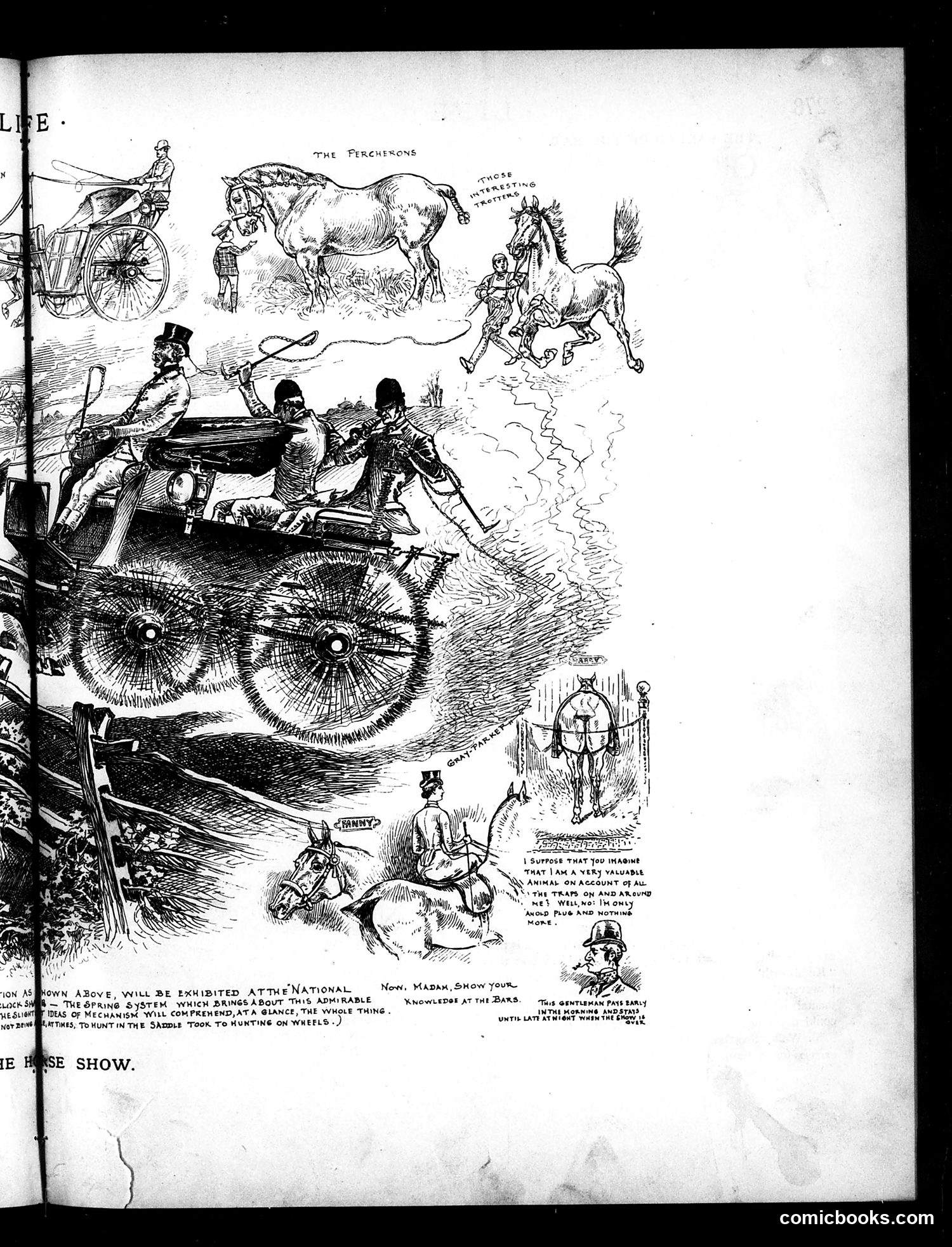
This satirical illustration comments on the fashionable "Horse Show" exhibition popular among the wealthy elite. The central image depicts an elaborate mechanical contraption—essentially a mechanical horse made of large spoked wheels—operated by uniformed soldiers or attendants, contrasting absurdly with the refined equestrian world above. The upper portion shows "The Persimmons" and other actual horses with riders and handlers in proper dress. The satire appears to mock both the pretension of horse shows as displays of wealth and status, and perhaps the increasing mechanization of modern life. The juxtaposition suggests that such exhibitions had become ridiculous spectacles detached from genuine horsemanship, reduced to mechanical performance rather than authentic skill or breeding. The joke critiques upper-class vanity through this impossible "mechanical horse" absurdity.
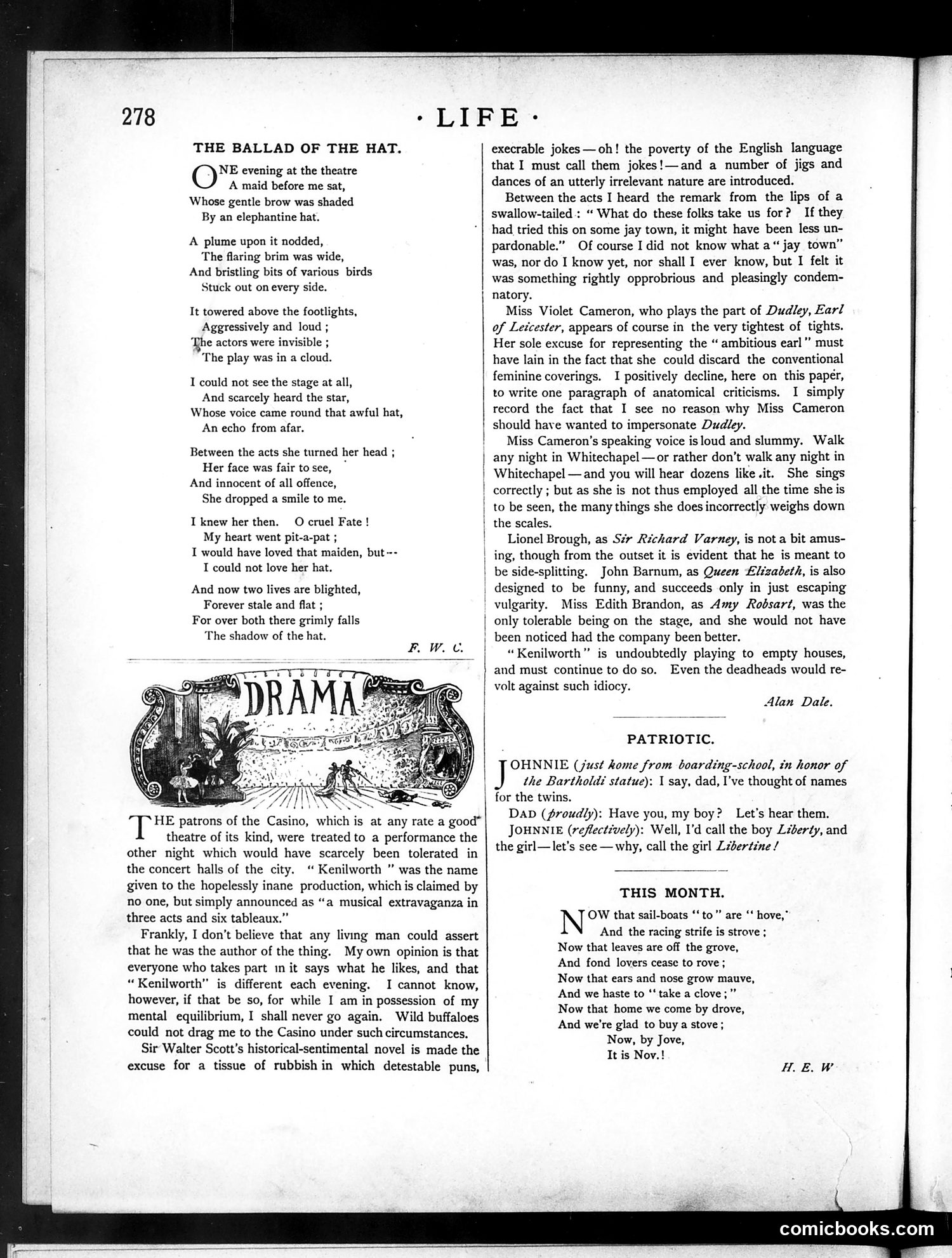
This page contains three distinct pieces of satirical theater criticism and verse, not political cartoons: 1. **"The Ballad of the Hat"** (poem): A romantic lament about a man losing a woman to her theatrical hat—a joke about distraction and fashion's power. 2. **"Drama" section**: Caustic reviews of theatrical performances. The critic particularly mocks a production called "Kenilworth" as "playing to empty houses" and attacks various actors' performances, including Miss Violet Cameron, Lionel Brough, and others for their inadequate talent. 3. **"Patriotic"** (dialogue): A brief comic sketch about a father testing his son's patriotism regarding naming twins—likely satirizing jingoistic attitudes. The page demonstrates *Life*'s use of humor to critique both theater quality and social pretensions of the era.
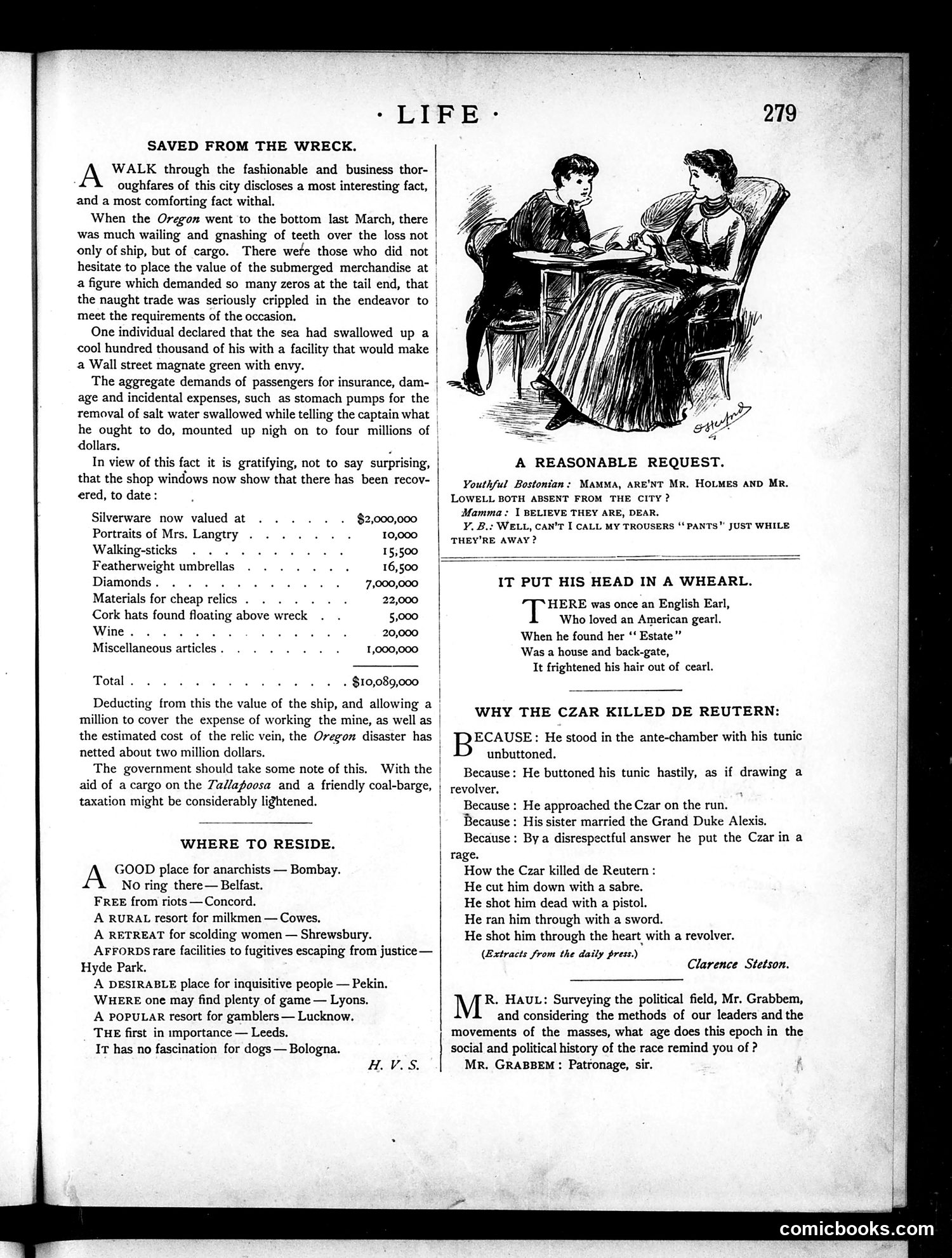
This satirical page mocks the shipwreck of the SS *Oregon* (March 1884). The main article ridicules inflated insurance claims by listing "recovered" cargo with absurd valuations—$2 million in silverware, $7 million in diamonds, and $1 million in "miscellaneous articles"—totaling $10 billion against actual recovery of ~$2 million. Life suggests the disaster became a profiteering scheme for merchants and claimants. The cartoon "A Reasonable Request" depicts a Boston youth asking his mother whether he can call his trousers "pants" while famous literati (likely Oliver Wendell Holmes and James Russell Lowell) are absent from the city—mocking American colloquialism versus proper English usage. Other brief satirical items mock Russian politics, British-American romance, and contemporary politicians. The "Where to Reside" section uses puns to criticize various cities and social groups.
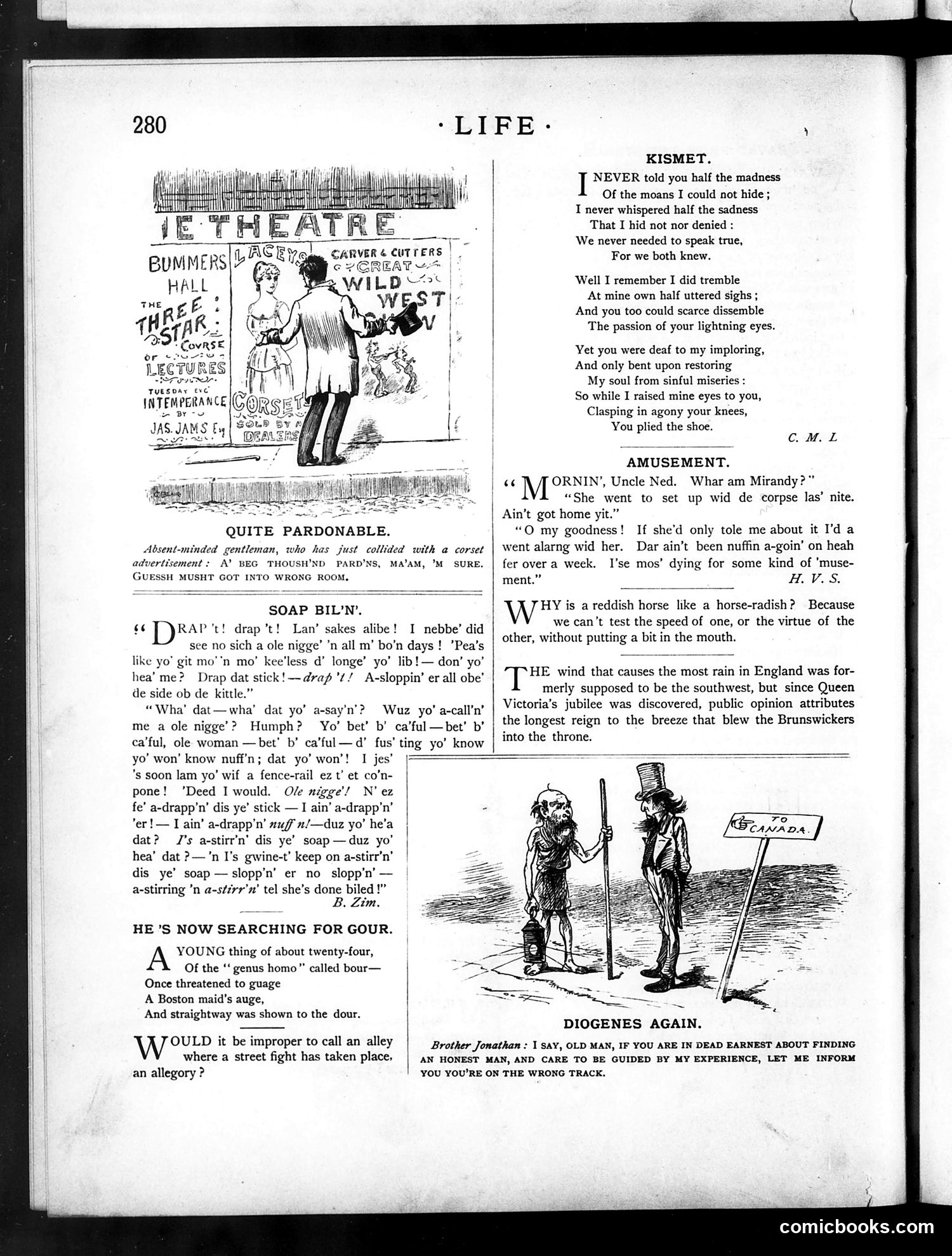
This page contains several satirical pieces typical of late 19th-century American humor: **"Quite Pardonable"**: A gentleman apologizes for colliding with a corset advertisement, mistaking it for a woman—satirizing both absent-mindedness and the prevalence of suggestive advertising. **"Soap Bilin'"**: Dialect humor depicting an enslaved person's complaint about careless work, using heavy phonetic African American vernacular. This reflects the magazine's reliance on racial caricature common to the era. **"Diogenes Again"**: A cartoon showing Brother Jonathan (personification of America) telling an old man searching for an honest person that he's "on the wrong track"—cynically suggesting honest men don't exist in America, playing on Diogenes's famous search. **Various wordplay sections**: Puns about reddish horses and English weather reference Queen Victoria's long reign. The page demonstrates Life's mix of observational humor, puns, and period-typical racial stereotyping aimed at educated readers.
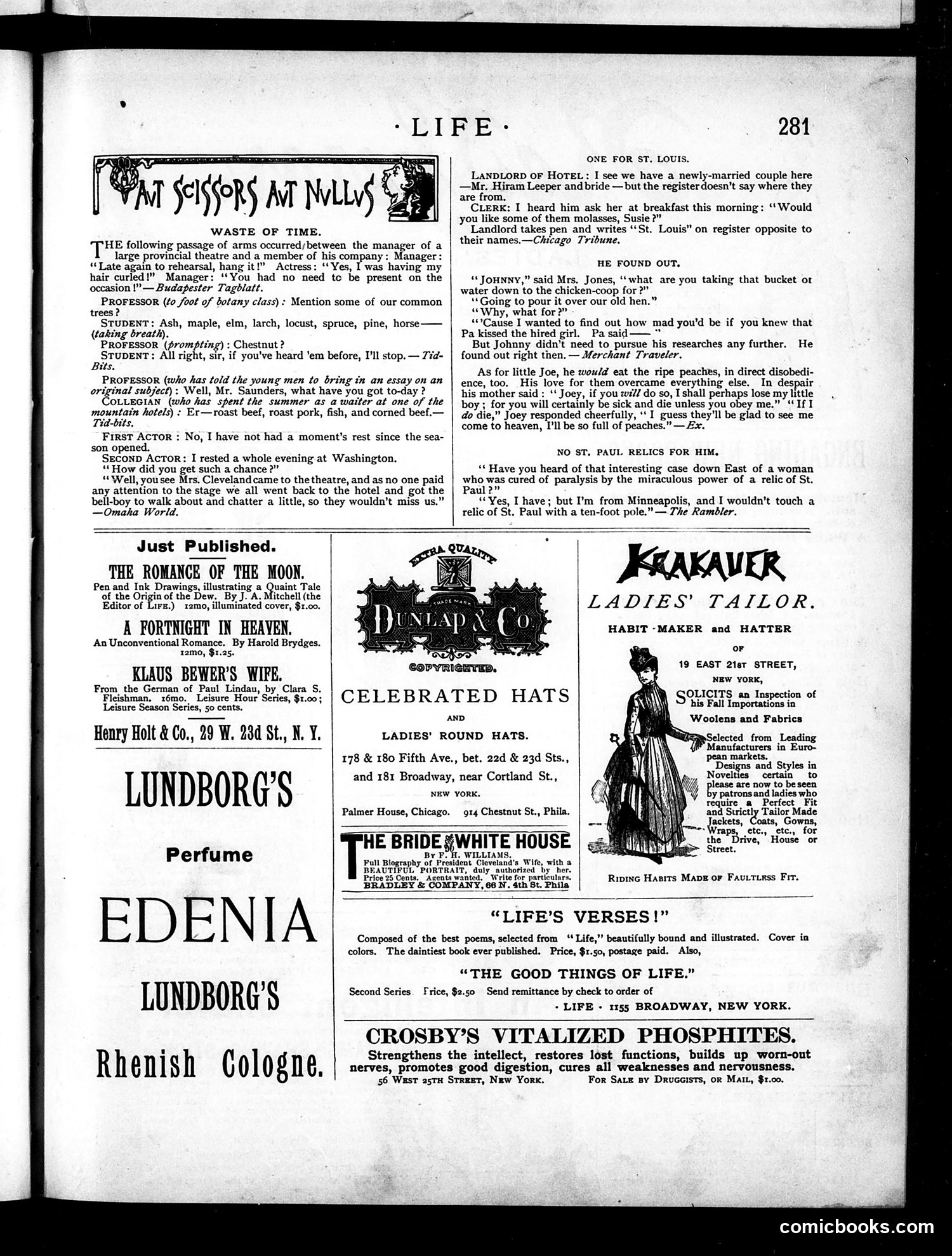
This page collects brief comedic anecdotes mocking professional and domestic absurdities. The "Waste of Time" cartoon isn't illustrated—it's a joke about a theatre manager rebuking an actress for curling her hair before rehearsal when she didn't need to be present anyway, exposing the manager's own illogical thinking. Other jokes target: a botany student's nervous rambling, a college student who learned nothing but menu items as a hotel waiter, actors claiming exhaustion (one actor's "rest" at Washington consisted of ignoring Mrs. Cleveland's theatre visit to socialize elsewhere), and domestic mishaps involving children investigating adult behavior or disobeying parental warnings about peaches. The humor is gentle, middle-class satire focused on everyday human folly rather than political targets. The "St. Louis" and "St. Paul" jokes contain mild regional rivalry between Midwestern cities—contemporary readers would recognize these as local jabs.
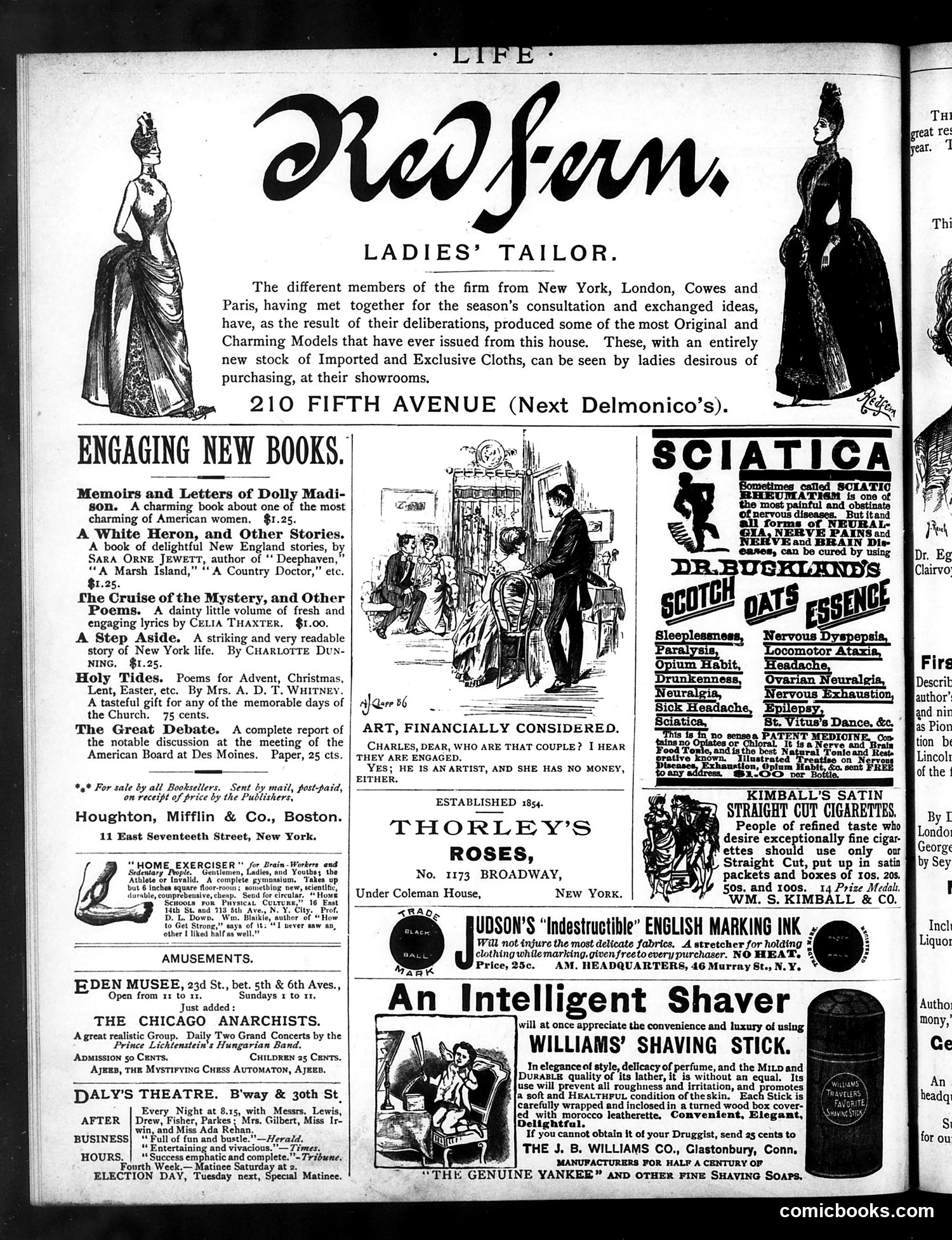
This small cartoon satirizes the economics of courtship among artists. Two wealthy figures discuss an engaged couple: he's an artist (implicitly poor), she has no money either. The joke's satirical point: in Gilded Age society, marrying for love between two financially disadvantaged people was considered absurd or impractical. The cartoon mocks both the couple's romantic naiveté and, implicitly, society's mercenary marriage expectations. The title "Art, Financially Considered" underscores the irony—suggesting that romantic artistic pursuits were incompatible with financial security, a common Victorian anxiety about bohemian lifestyles versus respectable bourgeois stability. For modern readers, it reflects period class anxieties: marriage was fundamentally a financial transaction, and poverty made even mutual affection seem foolish.
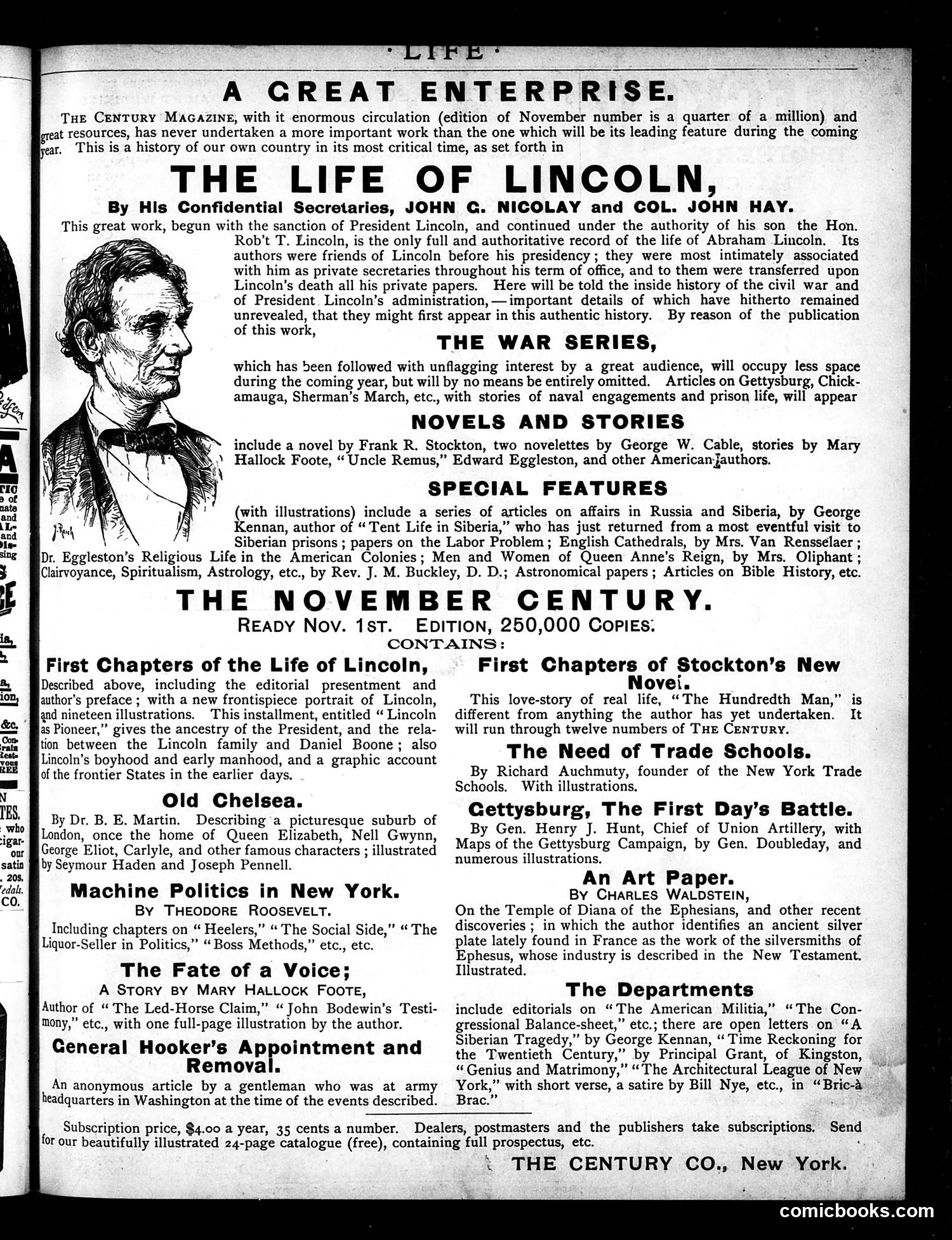
This is **not a cartoon page** but rather an **advertisement/announcement** for *The Century Magazine's* November issue. The only image is a **portrait engraving of Abraham Lincoln** (identified by context, not labeled). The content announces *The Century's* major publishing initiative: a serialized biography of Lincoln written by his former secretaries Nicolay and Hay, authorized by Lincoln's son. This was genuinely significant—it promised "inside history" and access to Lincoln's private papers, presenting itself as the authoritative account. The advertisement emphasizes prestige by listing notable contributors (Theodore Roosevelt writes about New York politics; established authors like George W. Cable and Mary Hallock Foote contribute fiction). The print run of 250,000 copies underscores the venture's commercial ambition. For modern context: this represents 19th-century "prestige journalism"—major magazines competing for cultural authority through exclusive access to historical figures and serious writers.
This is primarily an **advertising page** with no political cartoons or satirical content. The page features commercial advertisements for late 19th-century New York businesses, including: - Piano and furniture retailers - Tailors and importers of fine clothing - Wall paper manufacturers - A furrier (fur clothing merchant) - Whiskey and wine distributors - Toilet soap and printing ink companies The only illustration with potential humor is a **bear appearing to fish or handle money** in the E.D. Kahn & Co. clothing advertisement—likely a visual pun related to getting "good deals" or suggesting customers should "strike" before inventory runs out. The page demonstrates Life magazine's business model: satirical editorial content subsidized by luxury goods advertising targeting wealthy New York readers. No specific political figures or events are referenced; this is purely a commercial page showcasing Gilded Age consumer goods and services.