
Life, 1886-11-04 · page 6 of 16
Life — November 4, 1886 — page 6: what you’re looking at
What you’re looking at
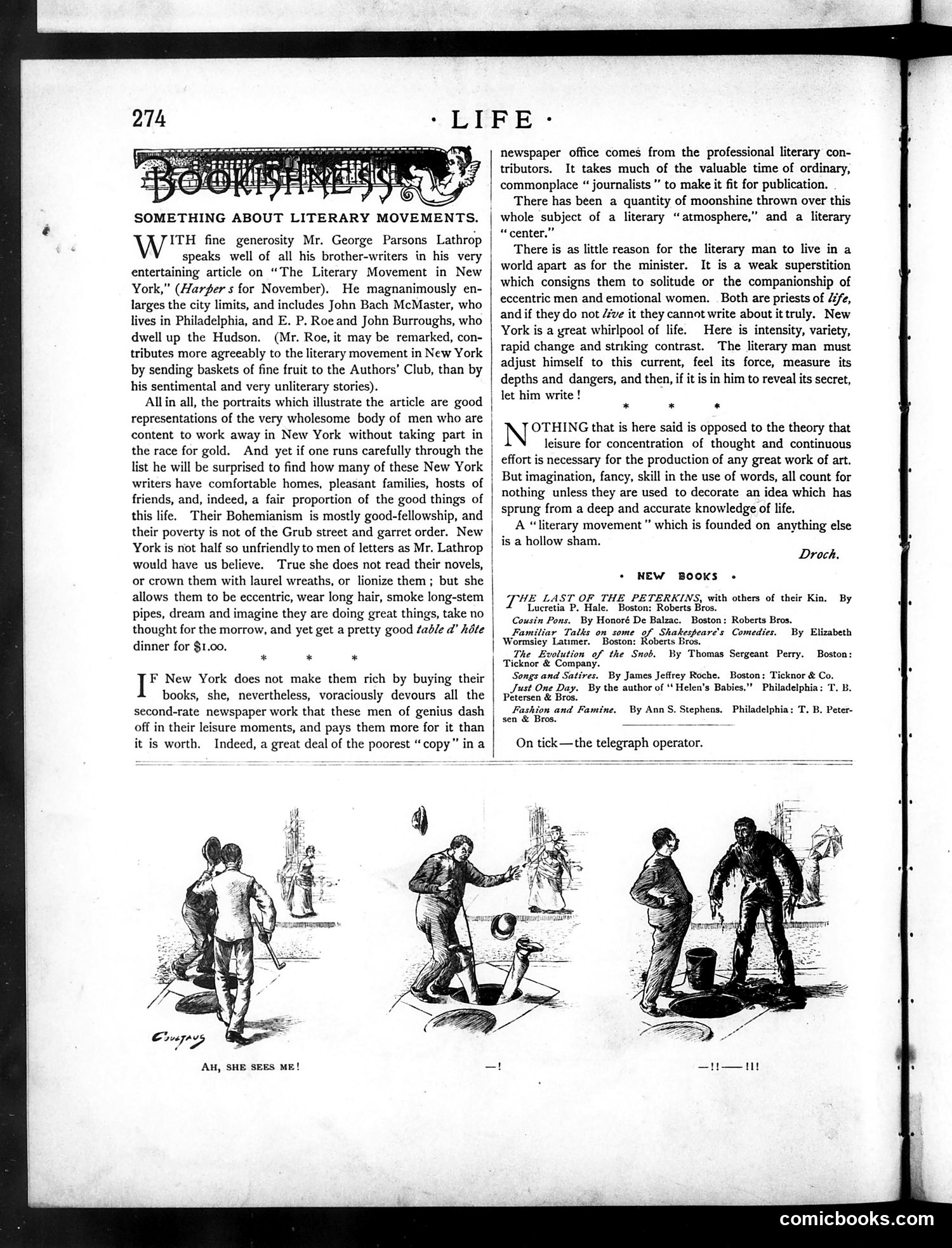
This page contains a literary criticism article titled "Something About Literary Movements" by George Parsons Lathrop, discussing New York's literary scene and writers including John Burroughs and E.P. Roe. The three cartoon panels at the bottom appear to illustrate a sequential humorous scenario labeled "Ah, She Sees Me!" and marked with dashes "—I" and "—II —III!" The sketches show men in period dress (appearing to be late 19th century) in what seems to be a comedic situation involving a woman's observation or reaction. The specific narrative is unclear without additional context, but it depicts a social embarrassment or awkward moment typical of satirical humor in Life magazine. The cartoon style and subject matter suggest commentary on courtship or social propriety customs of the era.
📄 Transcribed text from this page (OCR, searchable)
Machine-transcribed from the original scan — historical spelling and the odd misread are preserved.
SOMETHING ABOUT LITERARY MOVEMENTS. ITH fine generosity Mr. George Parsons Lathrop speaks well of all his brother-writers in his very entertaining article on “The Literary Movement in New York,” (Harper s for November). He magnanimously en- larges the city limits, and includes John Bach McMaster, who lives in Philadelphia, and E. P. Roe and John Burroughs, who dwell up the Hudson. (Mr. Roe, it may be remarked, con- tributes more agreeably to the literary movement in New York by sending baskets of fine fruit to the Authors’ Club, than by his sentimental and very unliterary stories). Allin all, the portraits which illustrate the article are good representations of the very wholesome body of men who are content to work away in New York without taking part in the race for gold. And yet if one runs carefully through the list he will be surprised to find how many of these New York writers have comfortable homes, pleasant families, hosts of friends, and, indeed, a fair proportion of the good things of this life. Their Bohemianism is mostly good-fellowship, and their poverty is not of the Grub street and garret order. New York is not half so unfriendly to men of letters as Mr. Lathrop would have us believe. or crown them with laurel wreaths, or lionize them ; but she allows them to be eccentric, wear long hair, smoke long-stem pipes, dream and imagine they are doing great things, take no thought for the morrow, and yet get a pretty good sable d’ héte dinner for $1.00. * * * F New York does not make them rich by buying their books, she, nevertheless, voraciously devours all the second-rate newspaper work that these men of genius dash off in their leisure moments, and pays them more for it than it is worth. Indeed, a great deal of the poorest “copy” in a Crnzus AH, SHE SEES ME! True she does not read their novels, | newspaper office comes from the professional literary con- tributors. It takes much of the valuable time of ordinary, commonplace “ journalists ” to make it fit for publication. There has been a quantity of moonshine thrown over this | whole subject of a literary “atmosphere,” and a literary | “center.” There is as little reason for the literary man to live in a world apart as for the minister. It is a weak superstition which consigns them to solitude or the companionship of eccentric men and emotional women. Both are priests of fe, and if they do not ve it they cannot write about it truly. New York is a yreat whirlpool of life. Here is intensity, variety, rapid change and striking contrast. The literary man must adjust himself to this current, feel its force, measure its depths and dangers, and then, if it is in him to reveal its secret, let him write ! * * * OTHING that is here said is opposed to the theory that leisure for concentration of thought and continuous effort is necessary for the production of any great work of art. | But imagination, fancy, skill in the use of words, all count for nothing unless they are used to decorate an idea which has sprung from a deep and accurate knowledge of life. A “literary movement ” which is founded on anything else is a hollow sham. Droch. + NEW BOOKS - THE LAST OF THE PETERKINS, with others of their Kin, By Lucretia P. Hale. Boston: Roberts Bros. Cousin Pons. By Honoré De Balzac. Familiar Talks on some of Shakespeare's Comedies. Wormsiey Latimer. Boston: Roberts Bros. The Evolution of the Snob. By Thomas Sergeant Perry. Ticknor & Company. Songs and Satires. By James Jeffrey Roche. Boston: Ticknor & Co. plist One Day. By the author of “Helen's Babies."” Philadelphia: T. B. etersen & Bros. Fashion and Famine. sen & Bros. Boston: Roberts Bros. By Elizabeth Boston: By Ann S. Stephens. Philadelphia: T. B. Peter- On tick—the telegraph operator. comicbooks.com