
Life, 1886-11-04 · page 10 of 16
Life — November 4, 1886 — page 10: what you’re looking at
What you’re looking at
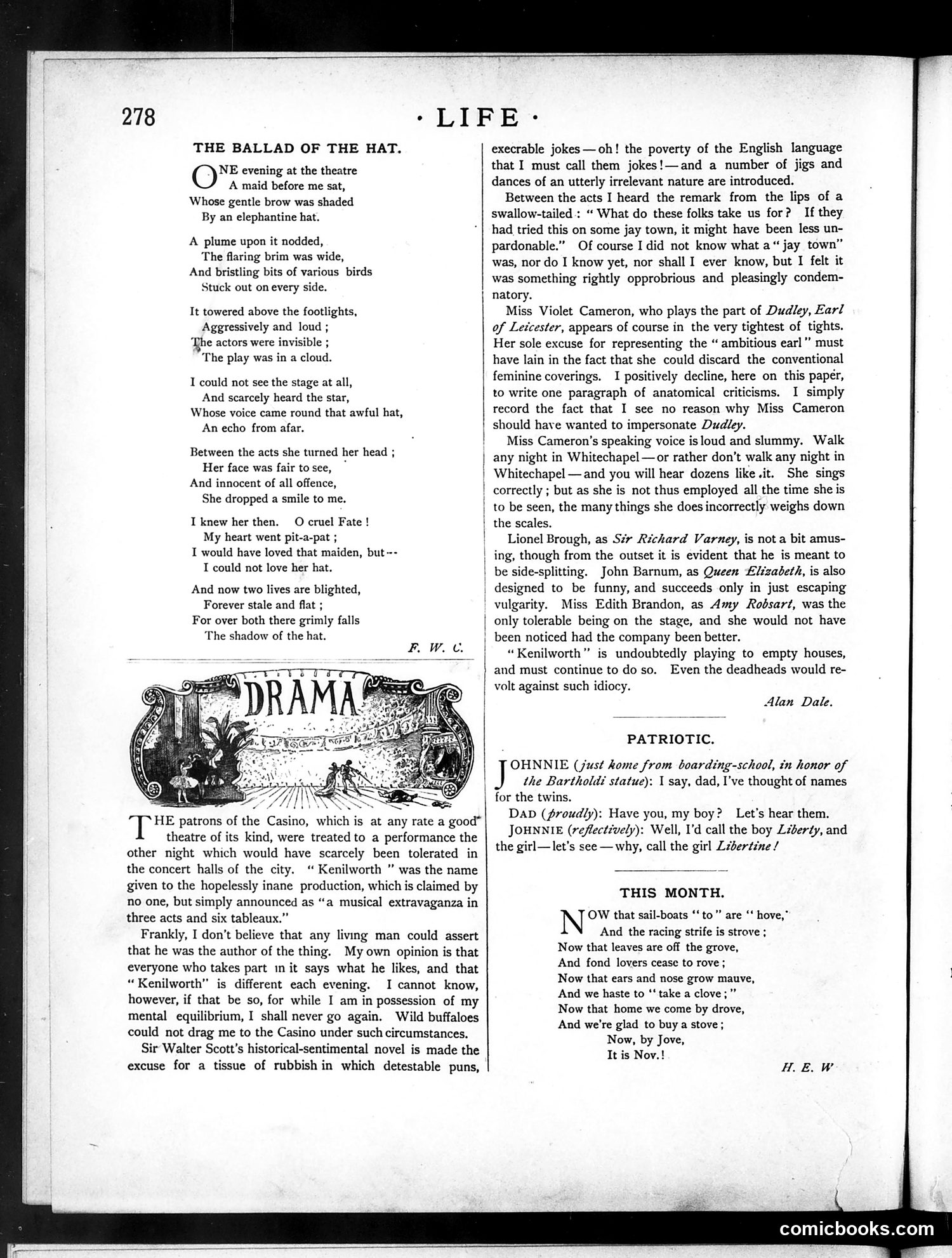
This page contains three distinct pieces of satirical theater criticism and verse, not political cartoons: 1. **"The Ballad of the Hat"** (poem): A romantic lament about a man losing a woman to her theatrical hat—a joke about distraction and fashion's power. 2. **"Drama" section**: Caustic reviews of theatrical performances. The critic particularly mocks a production called "Kenilworth" as "playing to empty houses" and attacks various actors' performances, including Miss Violet Cameron, Lionel Brough, and others for their inadequate talent. 3. **"Patriotic"** (dialogue): A brief comic sketch about a father testing his son's patriotism regarding naming twins—likely satirizing jingoistic attitudes. The page demonstrates *Life*'s use of humor to critique both theater quality and social pretensions of the era.
📄 Transcribed text from this page (OCR, searchable)
Machine-transcribed from the original scan — historical spelling and the odd misread are preserved.
- LIFE: THE BALLAD OF THE HAT. NE evening at the theatre A maid before me sat, Whose gentle brow was shaded By an elephantine hat. A plume upon it nodded, The flaring brim was wide, And bristling bits of various birds Stuck out on every side. It towered above the footlights, Aggressively and loud ; ‘The actors were invisible ; The play was in a cloud. I could not see the stage at all, And scarcely heard the star, Whose voice came round that awful hat, An echo from afar. Between the acts she turned her head ; Her face was fair tosee, And innocent of all offence, She dropped a smile to me. I knew her then. O cruel Fate! My heart went pit-a-pat ; I would have loved that maiden, but-- I could not love her hat. And now two lives are blighted, Forever stale and flat ; For over both there grimly falls The shadow of the hat. t hen ORs HE patrons of the Casino, which is at any rate a good” theatre of its kind, were treated to a performance the other night which would have scarcely been tolerated in the concert halls of the city. “Kenilworth ” was the name given to the hopelessly inane production, which is claimed by no one, but simply announced as “a musical extravaganza in three acts and six tableaux.” Frankly, I don’t believe that any living man could assert that he was the author of the thing. My own opinion is that everyone who takes part in it says what he likes, and that “Kenilworth” is different each evening. I cannot know, however, if that be so, for while I am in possession of my mental equilibrium, I shall never go again. Wild buffaloes could not drag me to the Casino under such circumstances. Sir Walter Scott’s historical-sentimental novel is made the excuse for a tissue of rubbish in which detestable puns, | Whitechapel — and you will hear dozens like .it. execrable jokes—oh! the poverty of the English language that I must call them jokes!—and a number of jigs and dances of an utterly irrelevant nature are introduced. Between the acts I heard the remark from the lips of a swallow-tailed.: “ What do these folks take us for? If they had tried this on some jay town, it might have been less un- pardonable.” Of course I did not know what a“ jay town” was, nor do I know yet, nor shall I ever know, but I felt it was something rightly opprobrious and pleasingly condem- natory. Miss Violet Cameron, who plays the part of Dudley, Earl of Leicester, appears of course in the very tightest of tights. Her sole excuse for representing the “ ambitious earl” must have lain in the fact that she could discard the conventional feminine coverings. I positively decline, here on this paper, to write one paragraph of anatomical criticisms. I simply record the fact that I see no reason why Miss Cameron | should have wanted to impersonate Dudley. Miss Cameron's speaking voice isloud and slummy. Walk any night in Whitechapel —or rather don’t walk any night in She sings correctly ; but as she is not thus employed all the time she is to be seen, the many things she does incorrectly weighs down the scales. Lionel Brough, as Str Richard Varney, is not a bit amus- | ing, though from the outset it is evident that he is meant to | be side-splitting. John Barnum, as Queen £iizabeth, is also designed to be funny, and succeeds only in just escaping vulgarity. Miss Edith Brandon, as Amy Robsart, was the only tolerable being on the stage, and she would not have | been noticed had the company been better. “Kenilworth” is undoubtedly playing to empty houses, and must continue to do so. Even the deadheads would re- volt against such idiocy. Alan Dale. PATRIOTIC. OHNNIE (just home from boarding-school, in honor of J the Bartholdi statue): 1 say, dad, I’ve thought of names for the twins. Dab (proudly): Have you, my boy? Let's hear them. JOHNNIE (reflectively): Well, I’d call the boy Lzserty, and the girl—let's see —why, call the girl Lzbertzne/ THIS MONTH. OW that sail-boats ‘‘ to” are ‘‘ hove,” And the racing strife is strove ; Now that leaves are off the grove, And fond lovers cease to rove ; Now that ears and nose grow mauve, And we haste to ‘‘ take a clove; ” Now that home we come by drove, And we're glad to buy a stove; Now, by Jove, It is Nov.! comicbooks.com