
A complete issue · 16 pages · 1886
Life — August 5, 1886
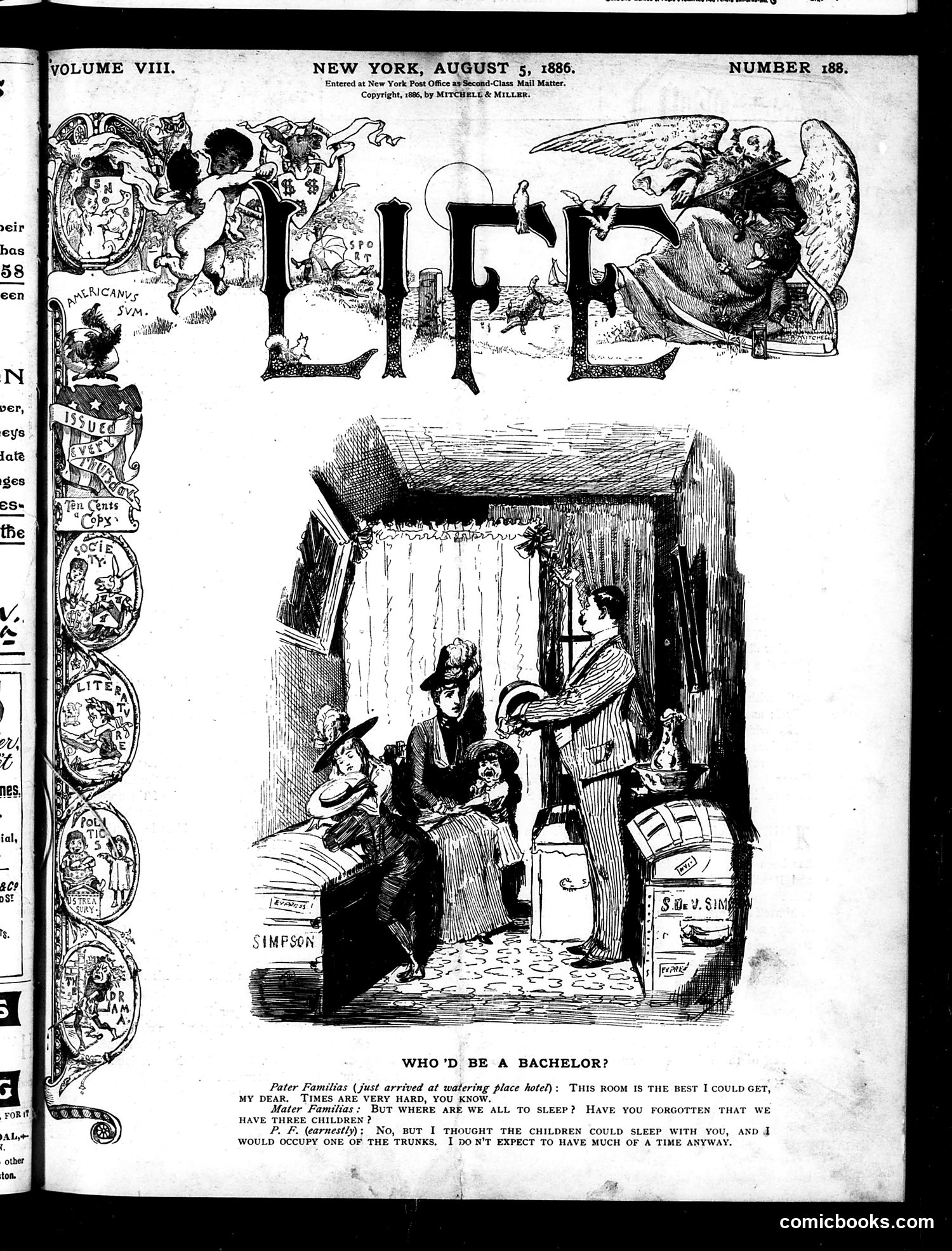
This satirical cartoon mocks the domestic burdens of unmarried men caring for children. The scene shows a harried bachelor managing multiple youngsters in cramped quarters, with trunks and household goods scattered about. The accompanying dialogue presents a conversation between "Peter Familias" (a family man) and a bachelor friend. Peter ironically claims bachelorhood is ideal given "hard times," but reveals the real issue: where would everyone sleep? He notes he can't expect children to share the bachelor's space, suggesting bachelors lack resources for family life. The satire critiques both the impracticality of unmarried men as caregivers and Victorian assumptions about domestic arrangements. It's fundamentally a joke about why men should marry—society expected bachelors to be unprepared for child-rearing.
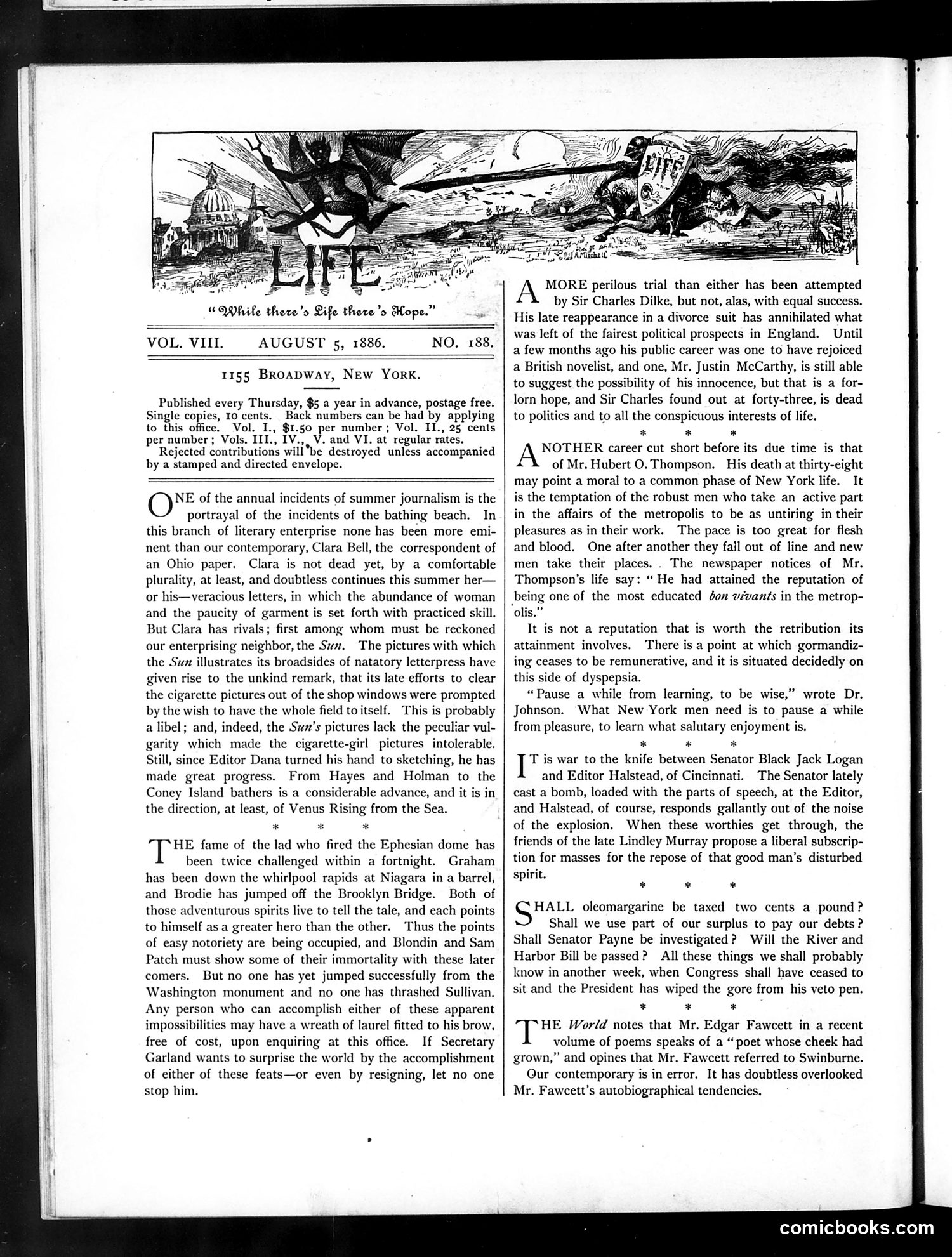
The masthead cartoon depicts "Life" as a classical female figure navigating perilous terrain—drowning figures, shipwrecks, and turbulent waters—captioned "While there's Life there's Hope." The text discusses several contemporary scandals: Sir Charles Dilke's divorce suit (which damaged his political career), and Hubert O. Thompson's sudden death, both presented as cautionary tales about public figures whose reputations collapsed. The article criticizes New York journalists and editors for sensationalism, specifically praising the *Sun's* beach coverage while condemning similar competitors' "unkind remarks." It also mocks various political controversies including Senator Logan's conflict with Cincinnati editor Halstead. The overall theme satirizes Victorian-era political instability and journalistic excess.
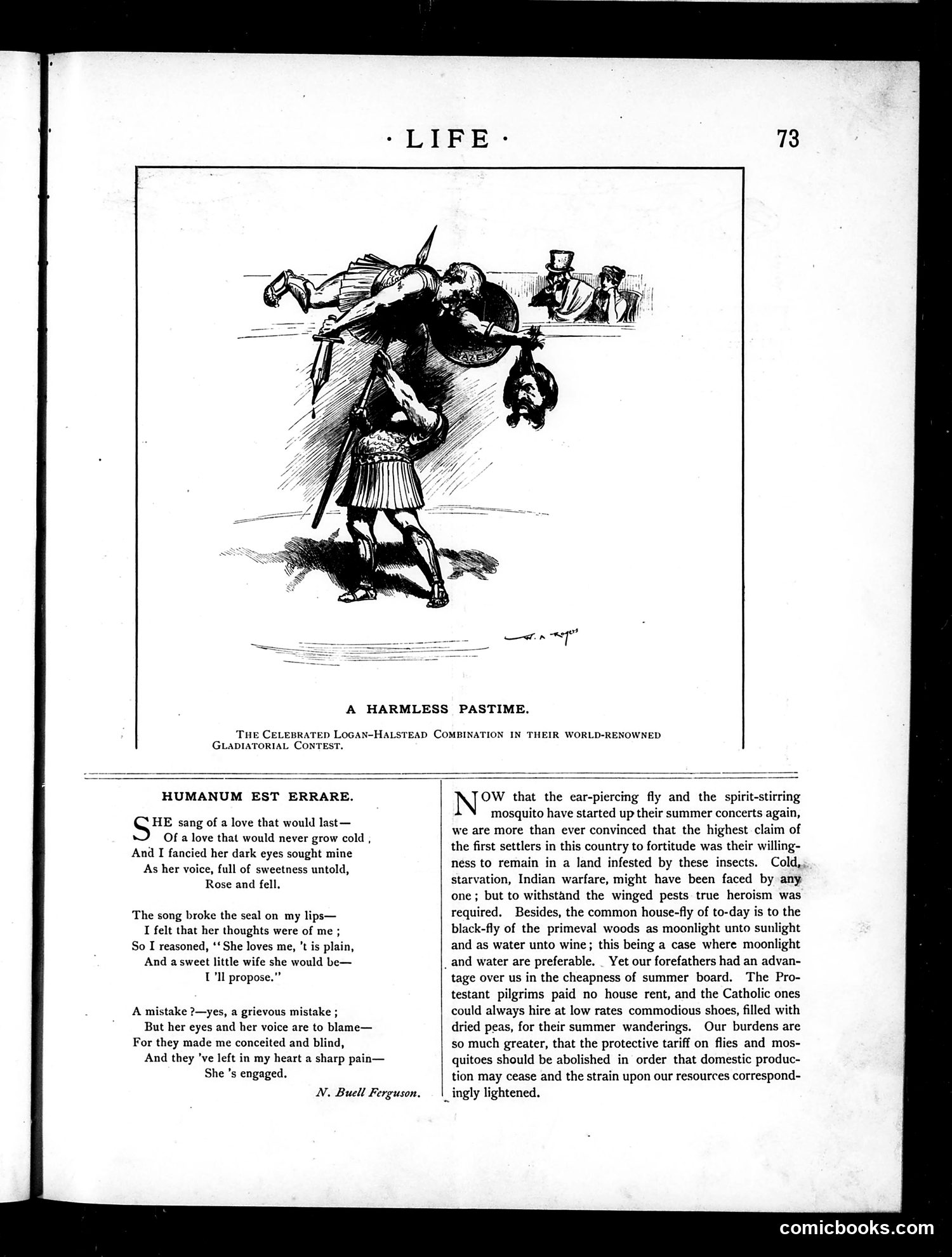
This satirical illustration depicts a gladiatorial scene where a muscular figure (appearing to represent a boxer or fighter in classical Roman style) holds aloft two smaller figures—likely representing the "Logan-Halstead Combination in their world-renowned gladiatorial contest," as the caption indicates. The satire mocks a famous boxing match or rivalry, possibly between fighters named Logan and Halstead, treating their bout as primitive entertainment comparable to ancient Roman gladiatorial combat. The spectators visible in the background suggest a public spectacle. The accompanying poem "Humanus Est Errare" and the essay discuss summer pests and domestic hardships, suggesting this page juxtaposes trivial entertainment concerns with practical household worries—a commentary on misplaced social priorities.
The page is primarily **satirical commentary** rather than political cartoons. The header "By the Way" introduces brief humorous observations on contemporary topics: **Key references include:** - Summer hotel economics for the middle class - Chicago's "bomb-throwers" (likely anarchists, given the dynamite reference) - St. John politics in Maine - A suspicious dynamite shipment allegedly from Prince Angostura to Japan - France's political instability ("Boulanger") - Anarchists seeking summer retreats - Ellen Terry's failing voice - California's agricultural grafting The page concludes with "Apologies to Goldsmith"—a parody poem about a woman's infidelity. **Overall tone:** These are gossipy, lightweight social and political jabs at contemporary figures and trends, typical of Life's humor during this era. The content suggests late 19th-century American concerns about labor unrest, European politics, and entertainment industry gossip.
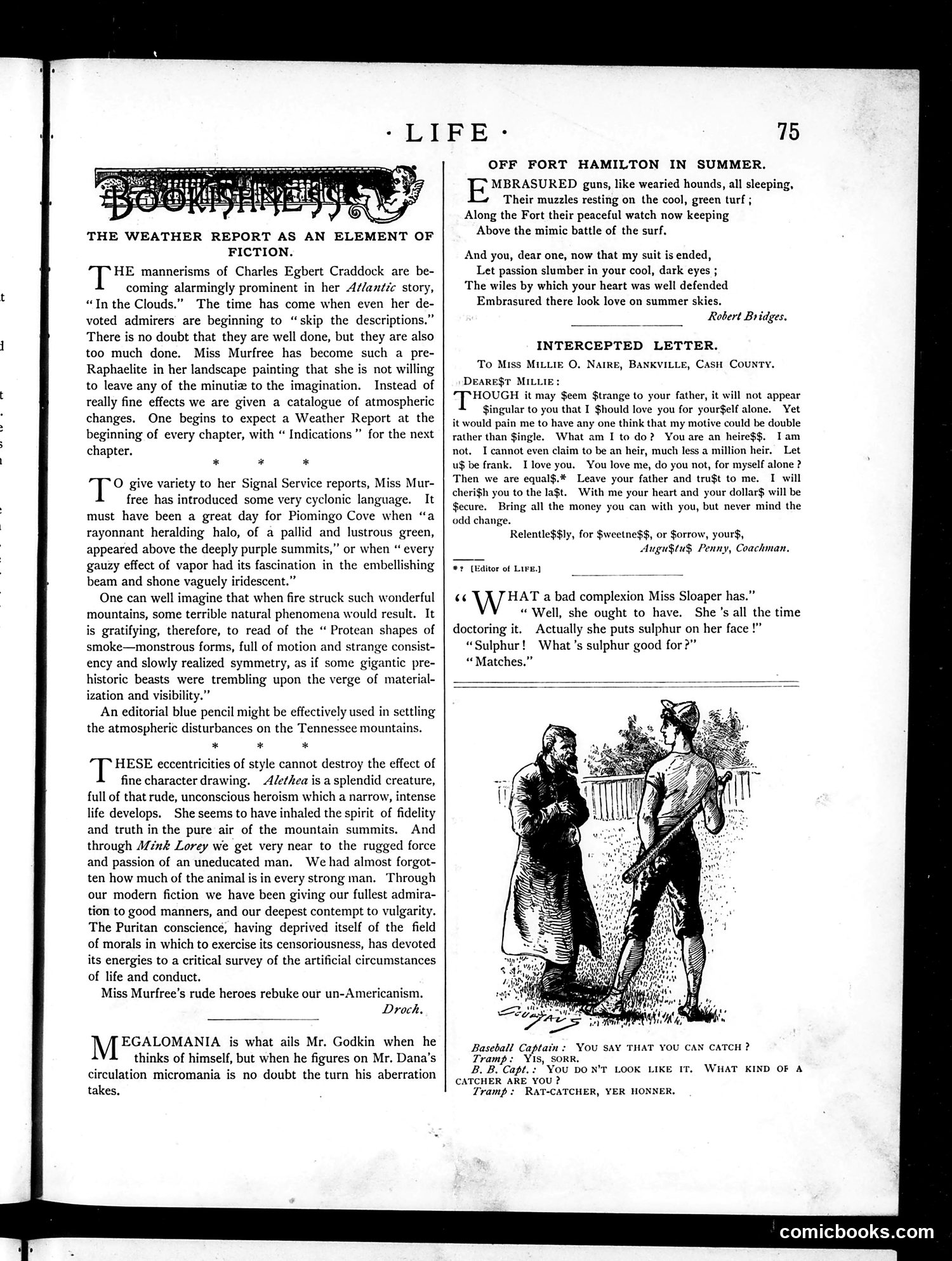
The page contains literary criticism and social commentary rather than political cartoons. The main illustration shows two figures in what appears to be a baseball scene, with dialogue identifying them as "Baseball Captain" and "Tramp." The captain asks if the tramp can catch; the tramp replies he's a "rat-catcher, yer honsser." This appears to be gentle social satire about class differences—a vagrant (tramp) being asked to participate in a genteel sport. The humor relies on the tramp's self-identification with a lowly occupation, suggesting the absurdity of expecting someone from the underclass to engage in leisured activities. The surrounding text discusses American fiction, weather descriptions in novels, and literary technique—primarily critical essays rather than political commentary.
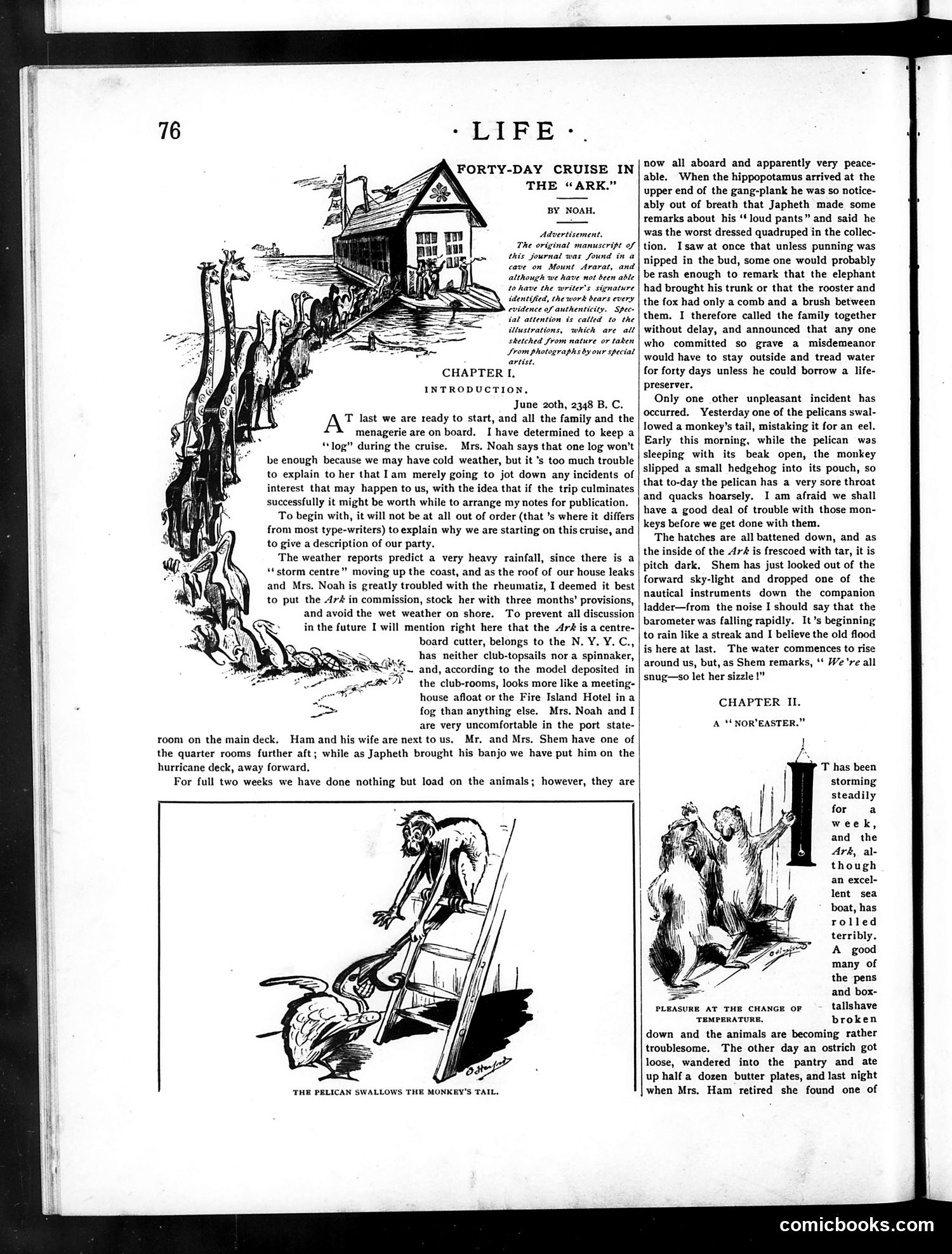
This is a humorous fictional narrative by Noah about a modern pleasure cruise aboard a ship called the "Ark." The satire targets contemporary travel experiences and animal behavior. The main cartoon shows a pelican swallowing a monkey's tail—a visual gag about shipboard mishaps and the absurdity of transporting animals. The accompanying text describes the cruise's chaos: temperamental animals in close quarters, seasickness, escaped livestock causing damage, and general discomfort. The joke relies on contrasting Noah's biblical ark (a serious biblical narrative about animal salvation) with modern leisure travel's petty annoyances—leaky cabins, uncomfortable accommodations, and troublesome animal companions. It's gentle satire mocking both cruise culture and the romanticization of travel in the early 20th century.
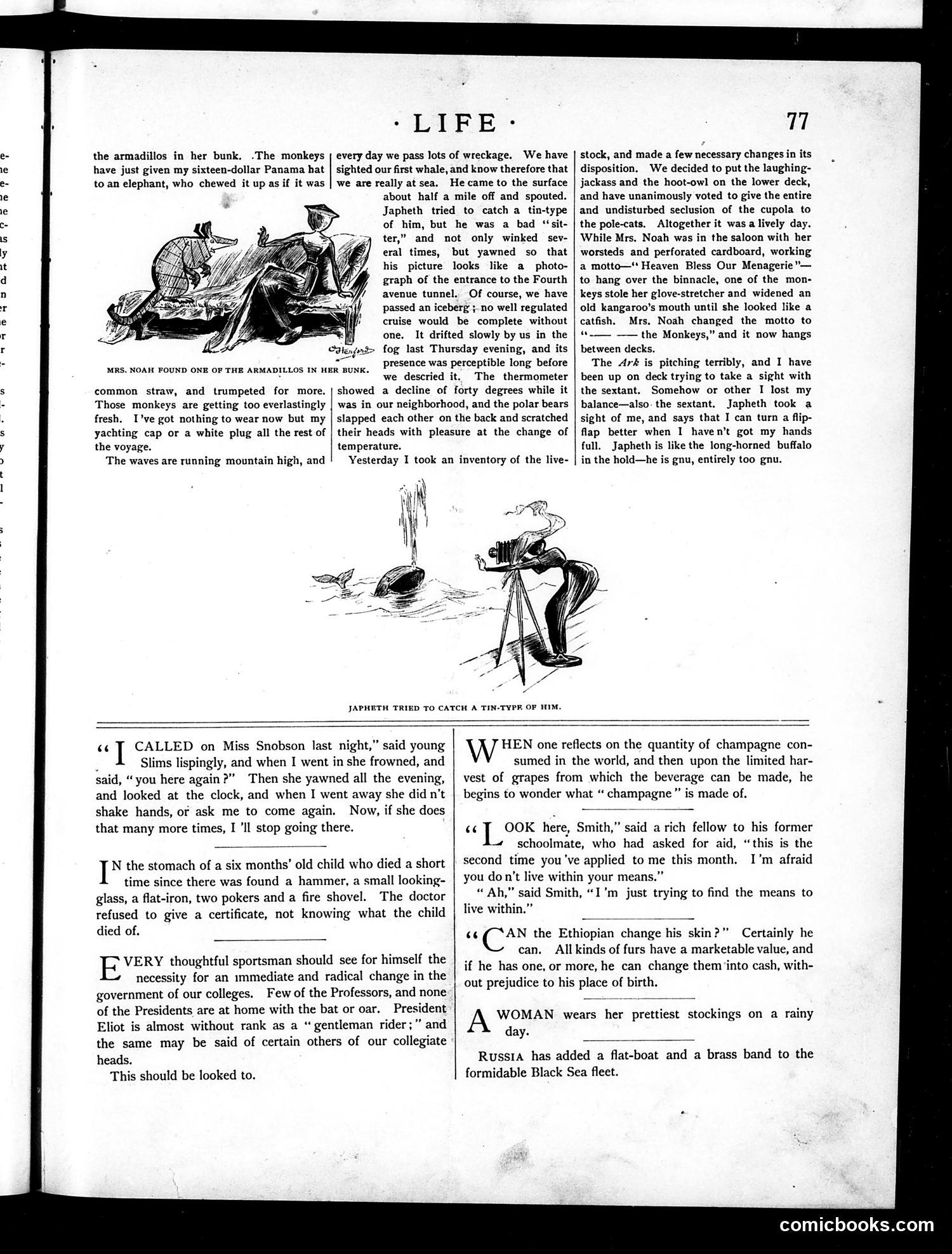
This page contains two illustrations accompanying travel narratives rather than political satire. The upper cartoon shows "Mrs. Noah Found One of the Armadillos in Her Bunk" — a humorous domestic scene from what appears to be a voyage account, depicting an armadillo discovered in sleeping quarters. The lower illustration, captioned "Japheth Tried to Catch a Tin-Type of Him," depicts a figure with a camera on a tripod attempting to photograph a whale or marine creature. This accompanies the narrator's account of encountering whales during their voyage. These are travel-humor cartoons meant to entertain readers with anecdotes from an ocean journey, featuring amusing wildlife encounters. They represent *Life* magazine's use of illustration to enhance adventure narratives rather than political commentary.
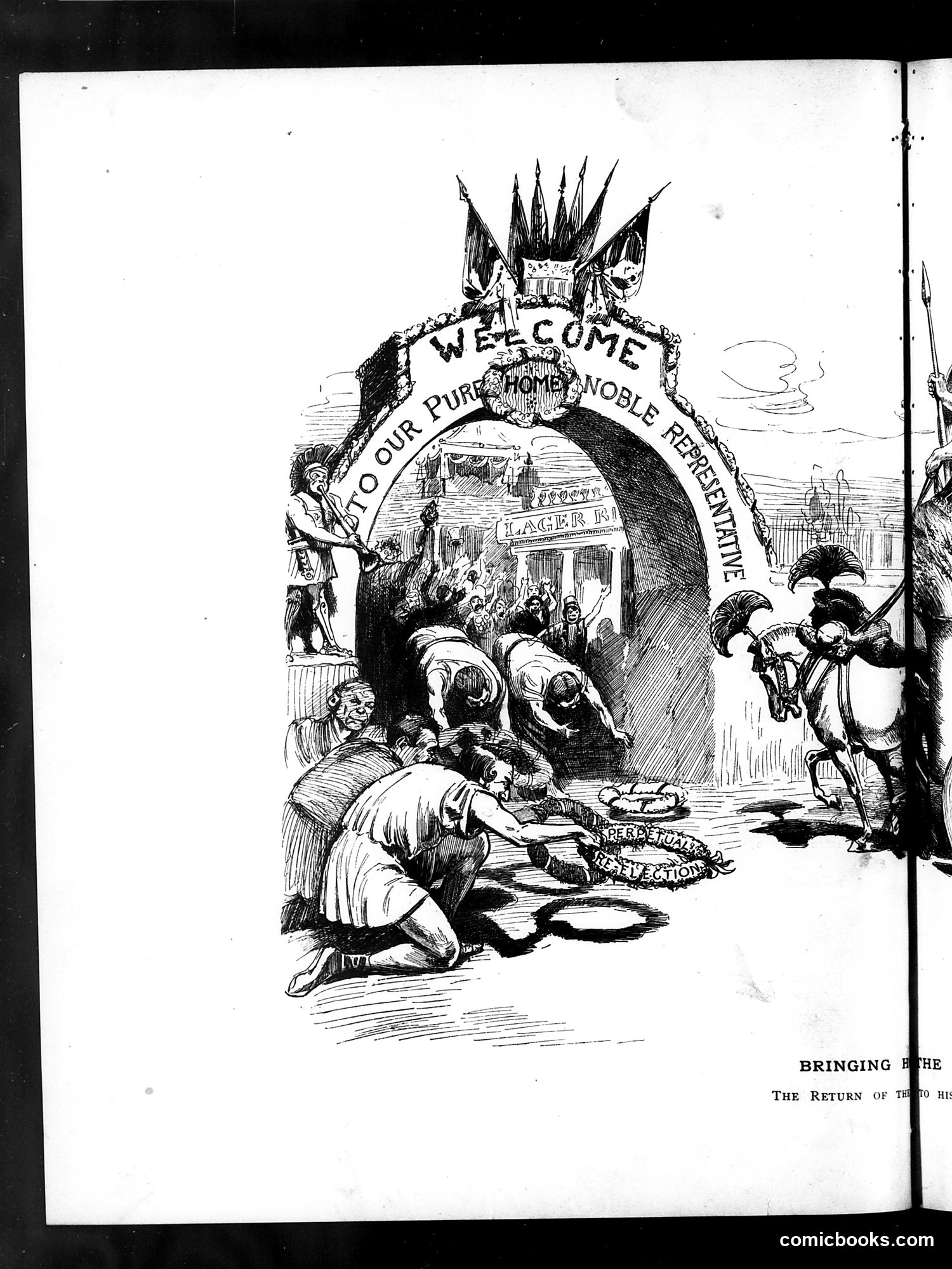
This appears to be a satirical illustration welcoming dignitaries to "our pure noble republic." The central arch displays this ironic phrase while figures below engage in what appears to be corrupt or underhanded activity—possibly bribery or electoral manipulation, suggested by the scattered papers and kneeling figures. The contrast between the grandiose welcome banner (complete with flags and patriotic imagery) and the seedy dealings beneath it constitutes the satire's core message: American democracy's stated ideals conflict sharply with actual political practice. The cartoon likely critiques late 19th or early 20th-century American political corruption, suggesting that while the nation presents itself as noble and pure, behind the scenes involve questionable dealings and moral compromise.
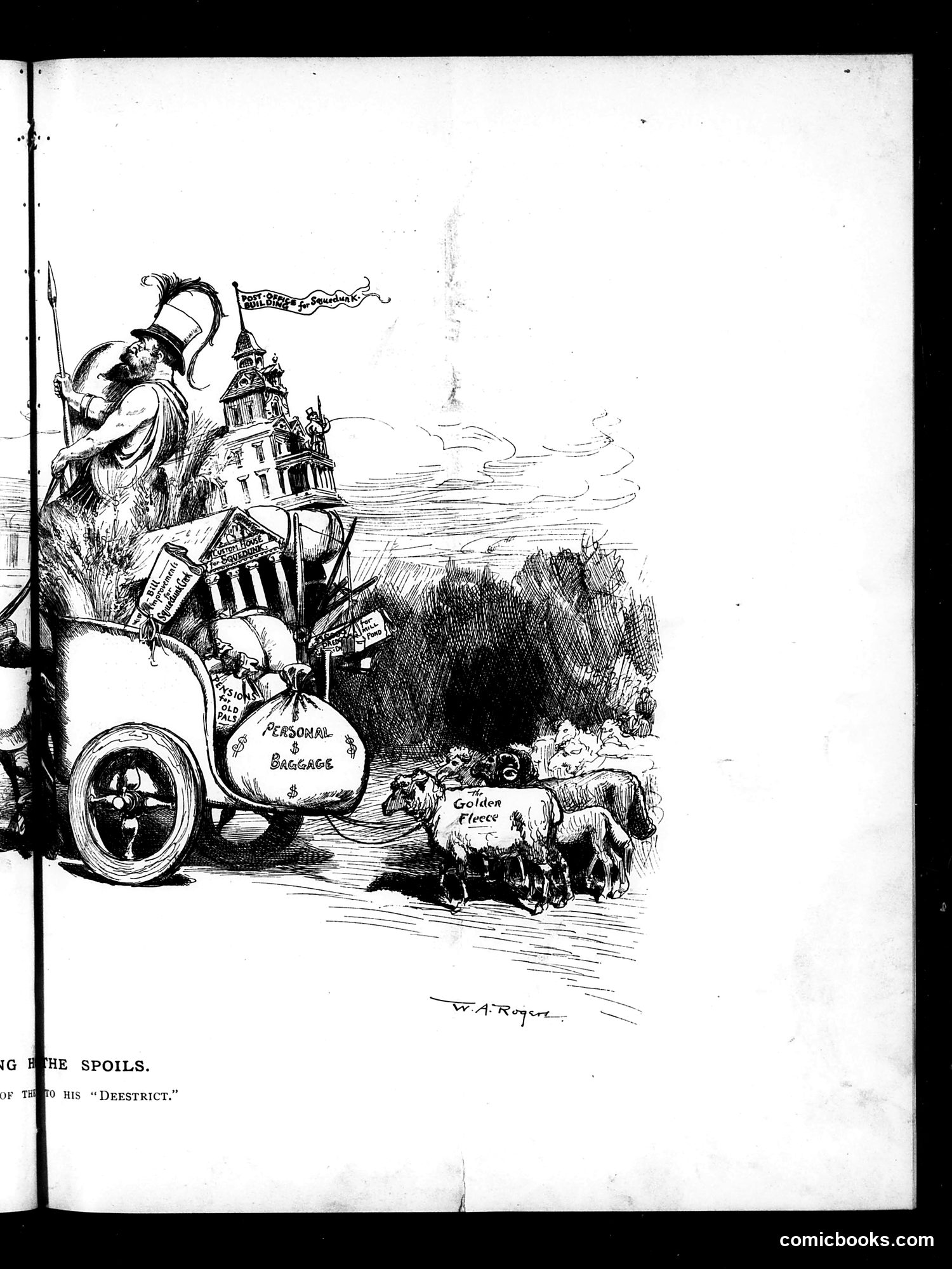
This is a satirical cartoon by W.A. Rogers depicting political corruption, likely from the early 20th century. A rotund political figure (appearing to be a corrupt politician or "boss") rides in an ornate carriage pulled by goats labeled "Golden Fleece." The carriage is laden with bags marked "Personal Baggage," while the Capitol building sits atop the vehicle. A banner reading "Post Office" or similar government institution waves above, and a sword is raised triumphantly. The satire critiques a politician using his governmental position (the Capitol) for personal enrichment (the "Golden Fleece" and "Personal Baggage"). The goats suggest foolishness and the squandering of public resources. The overall message condemns the misuse of political office for self-aggrandizement and corruption within American government institutions.
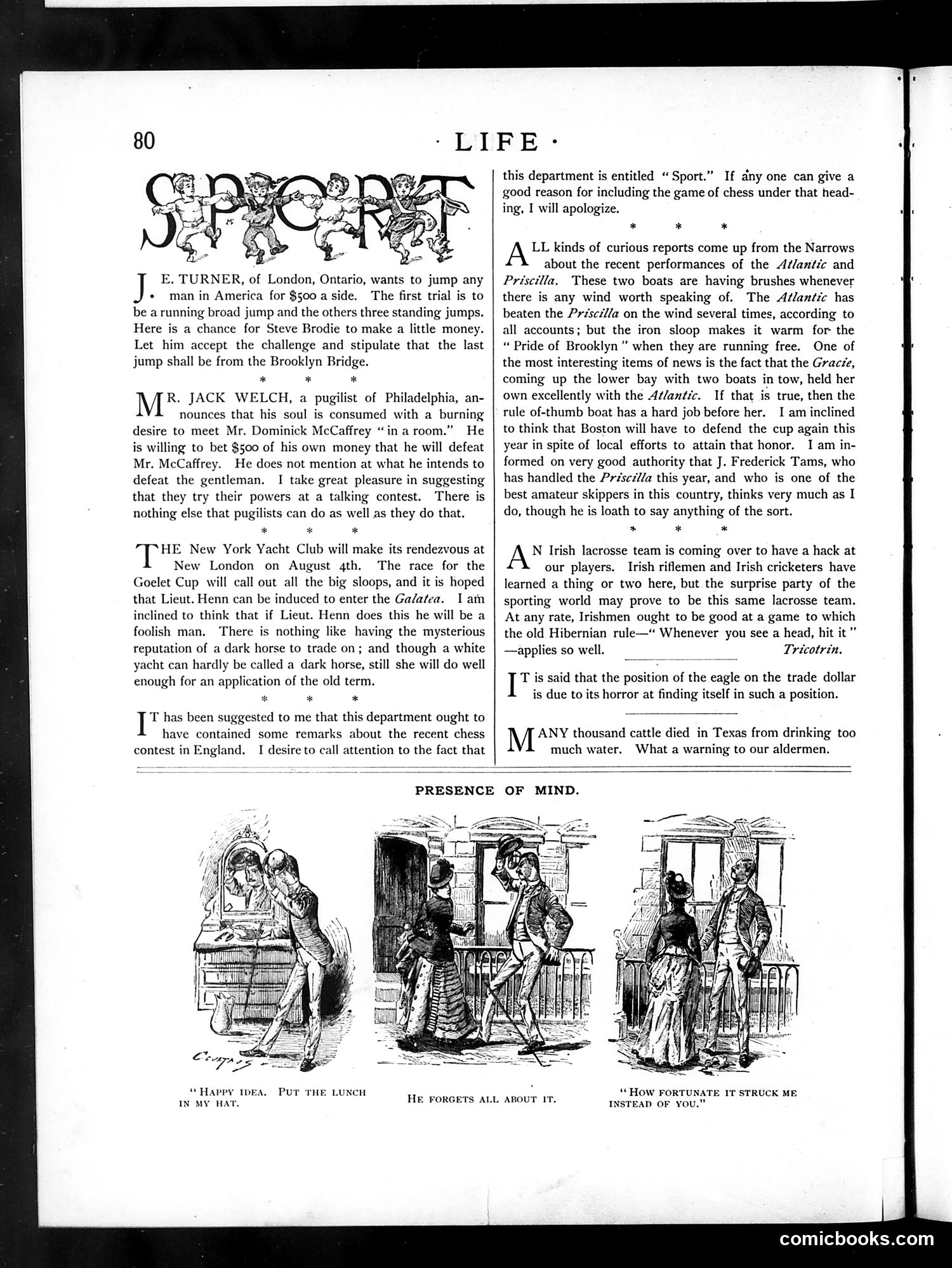
This page features three comedic illustrations depicting genteel Victorian social scenarios where characters respond to awkward situations with wit rather than embarrassment. The cartoons show: 1. A woman stuffing her lunch into her hat—a humorous solution to being caught eating 2. A man conveniently "forgetting" an uncomfortable social encounter 3. A woman claiming bad luck ("How fortunate it struck me instead of you") when something goes wrong The satire targets upper-class pretension and social maneuvering—how wealthy Victorians use clever excuses and deflection to maintain appearances and avoid social embarrassment. "Presence of mind" refers to quick thinking, but these illustrations mock how that thinking often involves transparent lies or self-serving reinterpretations of events. The humor relies on recognizing the obvious absurdity of these excuses.
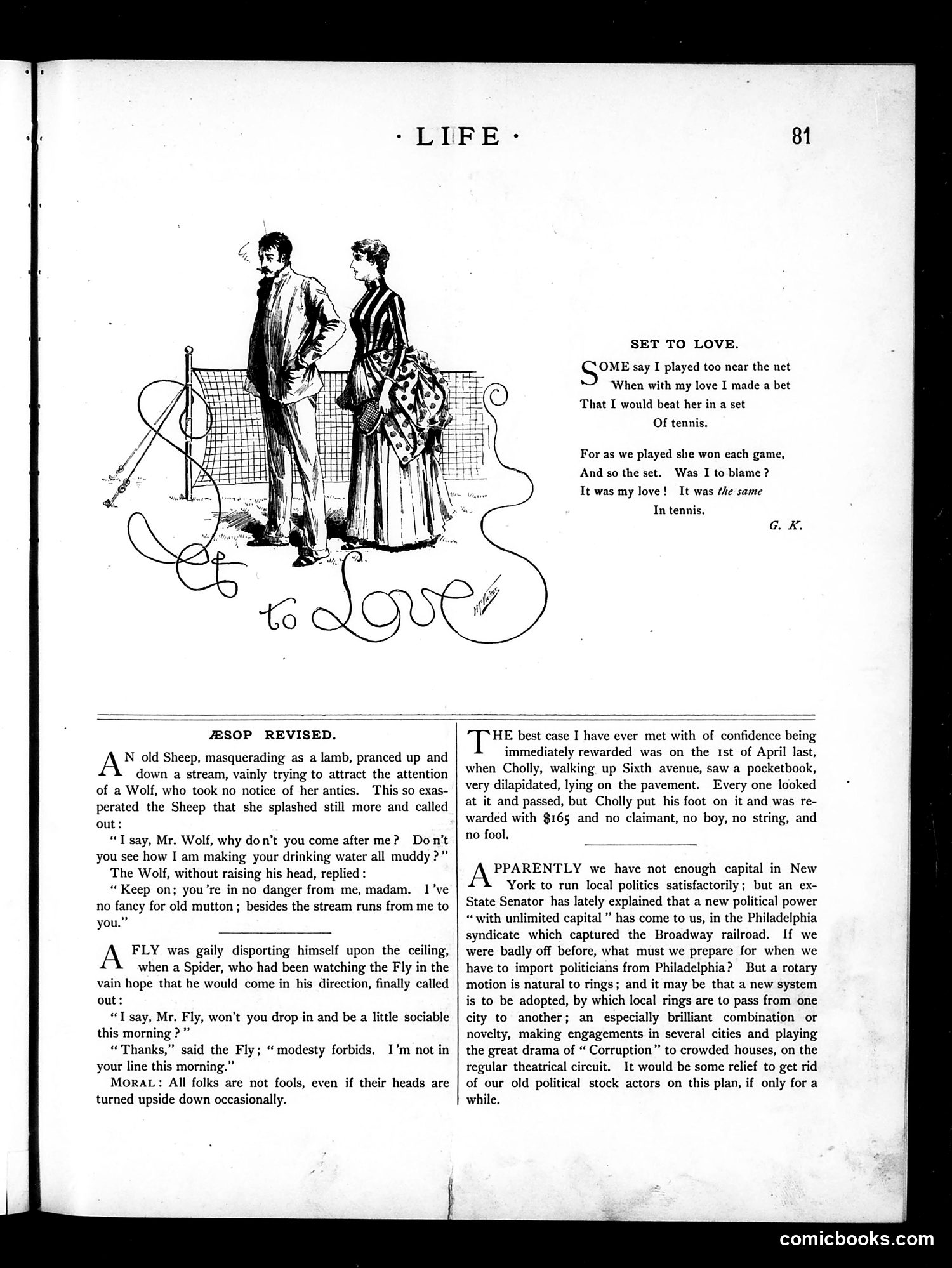
This page contains three distinct pieces: **"Set to Love" (top):** A romantic poem-cartoon about a man who loses a tennis match to his love interest. The joke plays on double meaning: he loses because his emotional investment ("my love") distracts him, just as it would in romance itself. **"Aesop Revised" (middle):** Three fables with modern urban settings and a shared moral about self-awareness. A sheep fails to attract a wolf by muddying water (the wolf prefers fresh meat), a fly avoids a spider's obvious trap, and the moral warns that people aren't always foolish despite appearances. These satirize naïve or transparent attempts at manipulation. **Political Commentary (bottom right):** Two brief articles. One describes finding a lost wallet with $165—rewarding honesty. The other criticizes New York politics, sarcastically suggesting that Philadelphia's corrupt political "machine" (the Broadway railroad syndicate) may soon rotate its operations to other cities like a theatrical touring company. It's dark satire about corruption becoming systematized and mobile across cities.
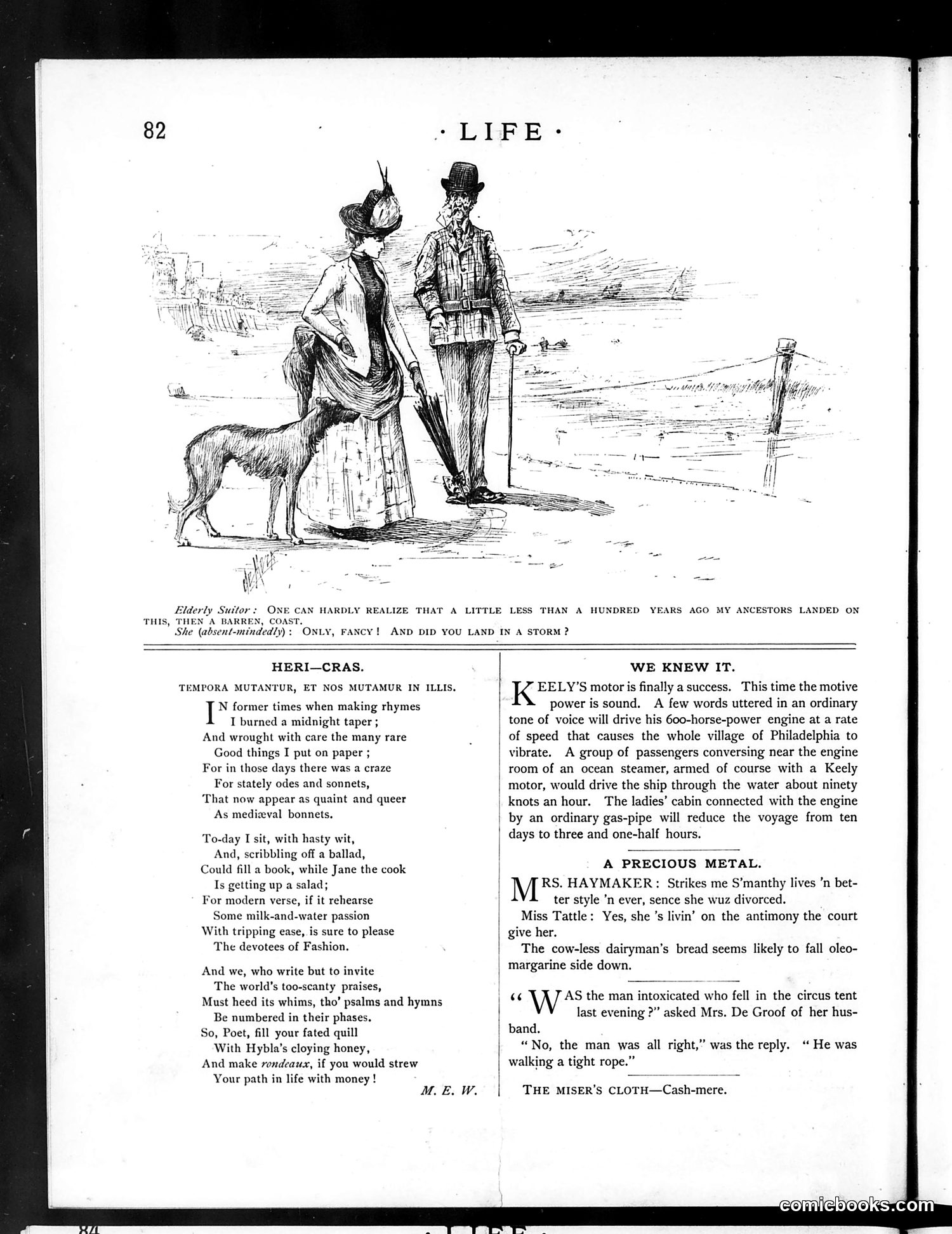
This page contains three satirical pieces typical of late 19th-century American humor: **Top cartoon**: An elderly man recounts landing on a colonial beach "a hundred years ago" to a fashionably dressed woman with a dog. The joke mocks nostalgic romanticization—his ancestors' dramatic colonial landing contrasts with her polite disinterest. **"Heri-Cras" poem**: Satirizes changing literary tastes. The author laments that serious poetry (odes, sonnets) once required midnight labor but now pedestrian "milk-and-water" verse succeeds because it's fashionable. He ironically advises poets to write commercial drivel ("rondeaux") for money rather than art. **Brief humor items**: - "We Knew It" mocks the Keely motor, a perpetual-motion machine hoax of the era, sarcastically suggesting sound-powered engines could power ships. - Social jokes about divorce ("antimony" puns on alimony), oleomargarine, circus acrobats, and "cash-mere" (cashmere/money pun). The satire targets shallow fashion, scientific fraud, and social pretension—common *Life* themes.
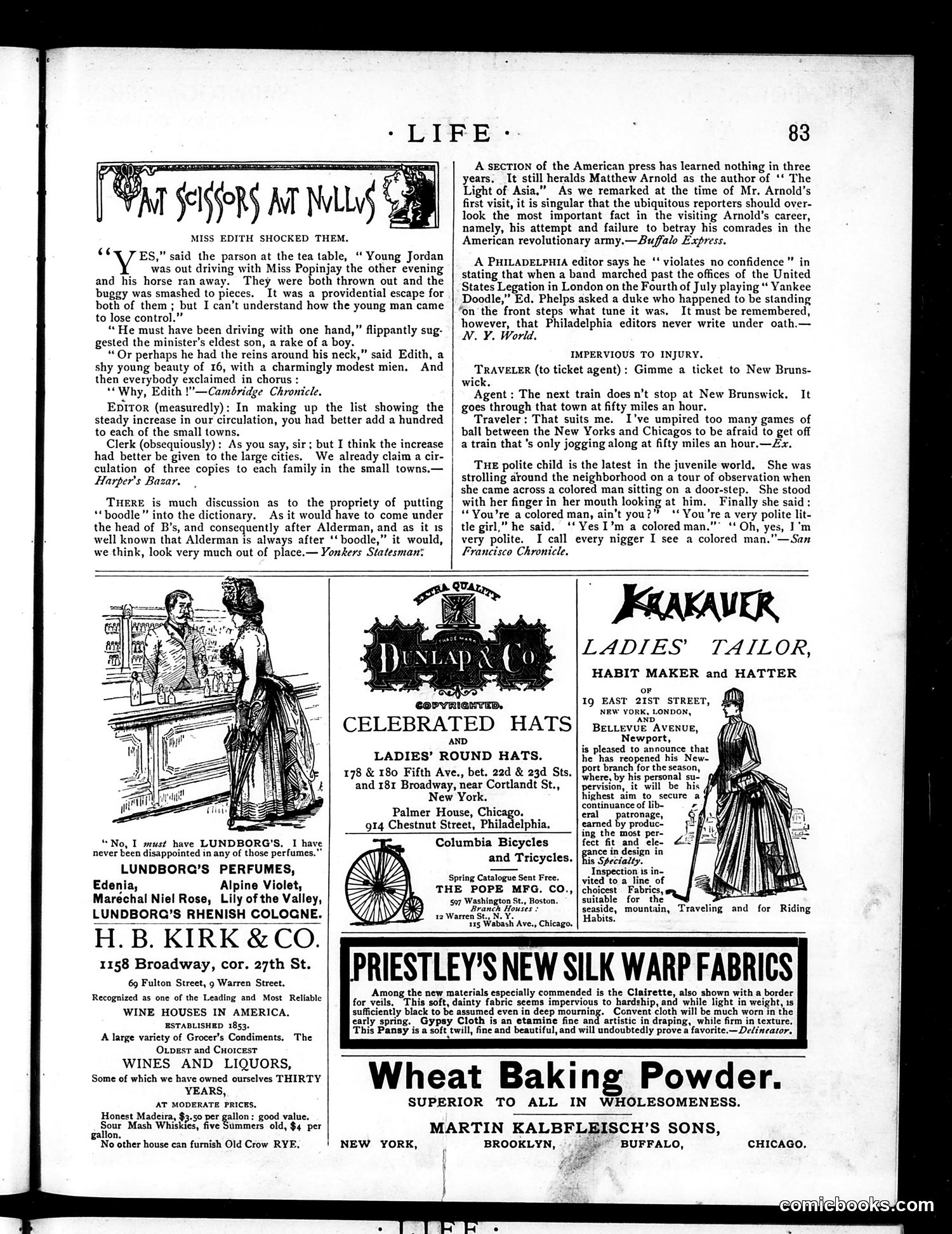
This page from *Life* magazine consists primarily of **satirical anecdotes and jokes** rather than political cartoons. The content targets various social pretenses and professional incompetence: **Key items:** 1. **"Miss Edith Shocked Them"**: A joke mocking prudish Victorian sensibilities—a modest 16-year-old girl shocks adults by crudely suggesting a man lost control of his horse while driving one-handed (implying intimate contact). 2. **Press criticism**: Attacks on American newspapers for factual errors (misattributing Matthew Arnold's work, misreporting diplomatic incidents). 3. **"Impervious to Injury"**: A traveling salesman, hardened by umpiring violent baseball games, fearlessly boards a fast train. 4. **"The Polite Child"**: A commentary on 19th-century racial attitudes—a polite child addresses a Black man directly using then-acceptable (but offensive) terminology. The page is largely **advertisements** for hats, bicycles, wines, and baking powder. The satire reflects *Life*'s focus on mocking social hypocrisy, journalistic incompetence, and contemporary absurdities.
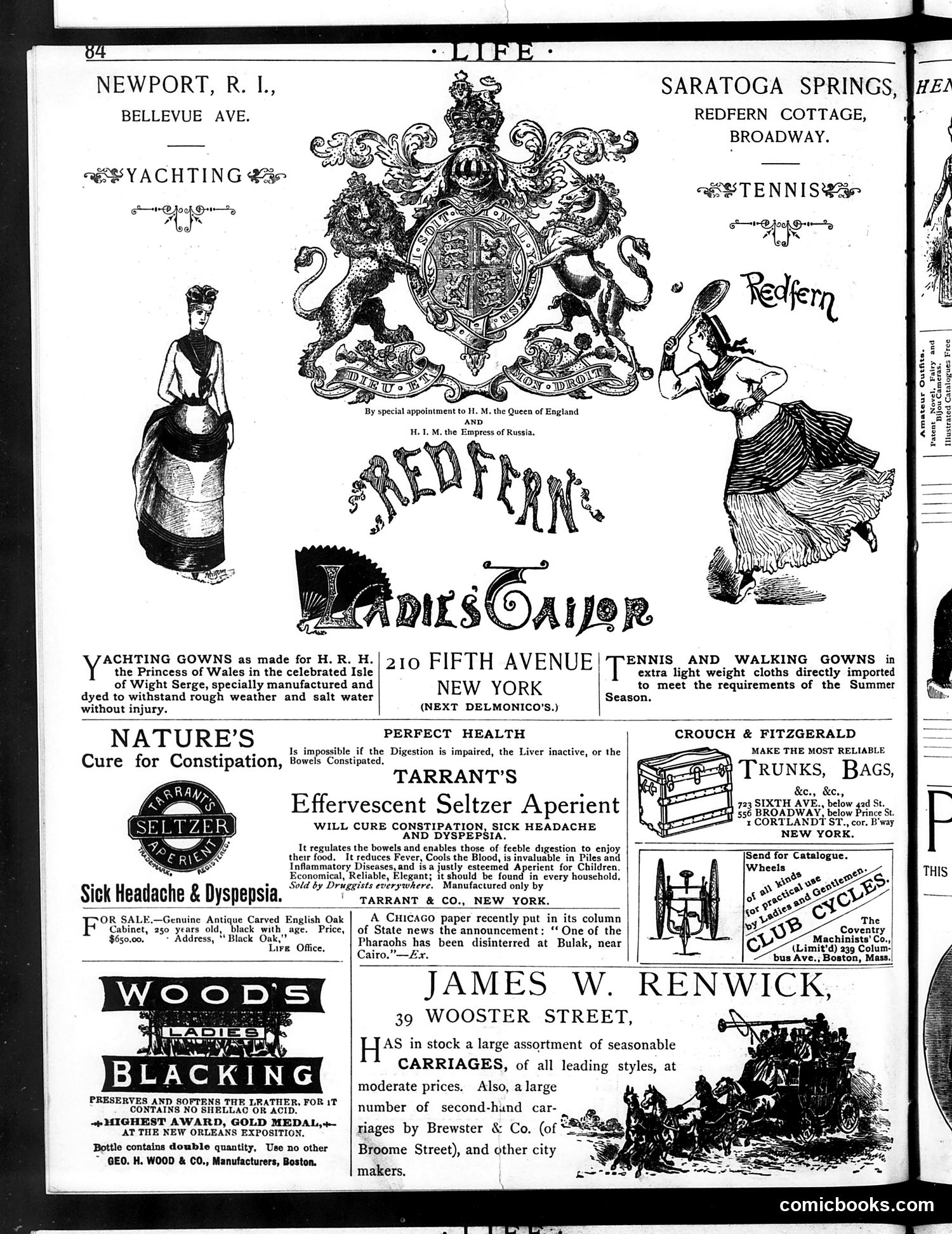
This is primarily a **fashion and advertising page** from a Gilded Age Life magazine, not a political cartoon. The content reflects upper-class leisure activities and consumer goods of the era. The central image shows "Redfern Ladies Tailor" branding with royal endorsement—"By special appointment to H.R.H. the Queen of England and H.I.M. the Empress of Russia." This advertises fashionable yachting and tennis wear for wealthy women, emphasizing that garments were worn by European royalty. The page features illustrations of fashionably dressed women in sporting attire, alongside advertisements for luxury goods: custom carriages by James W. Renwick, trunks by Crouch & Fitzgerald, bicycles, and patent medicines (Tarrant's Seltzer for digestive complaints, Wood's Blacking shoe polish). The satirical *Life* magazine's inclusion of these elite advertisements reflects contemporary social commentary on American wealth, conspicuous consumption, and the aspirational mimicry of European aristocracy among the American leisure class.
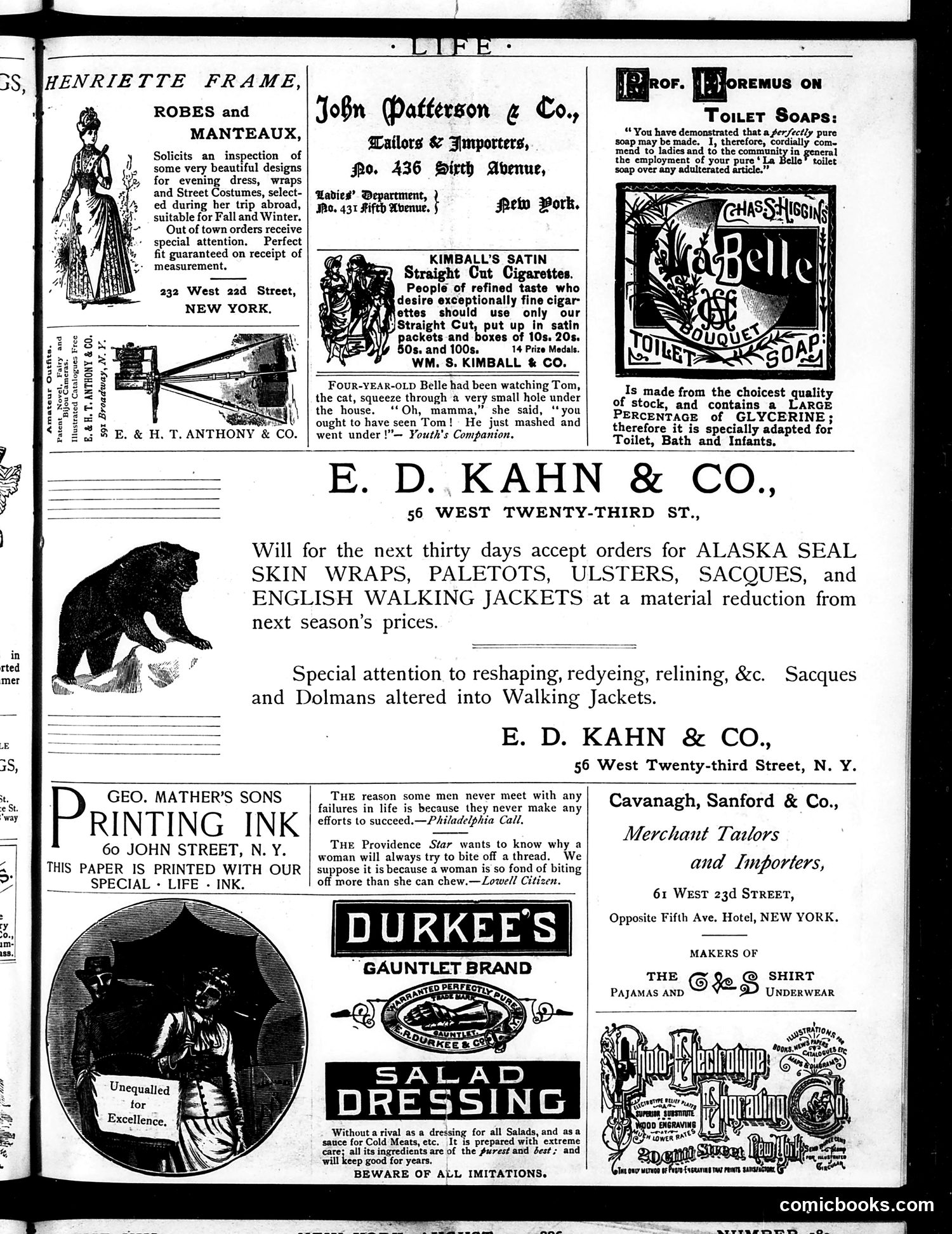
This page is **primarily advertising** with minimal satirical content. The main items are commercial advertisements for clothing, toiletries, and food products typical of late 19th-century New York merchants. The only identifiable humor appears in the **"Youth's Companion" anecdote** about a four-year-old named Belle watching a cat squeeze through a hole, then asking her mother if she saw how the cat "mashed and went under." The joke relies on a child's innocent misunderstanding of the cat's physical action—she appears to think the cat was flattened. Additionally, there are **two brief satirical quotes** from newspapers: - One suggesting men succeed by never trying - Another implying women bite off threads because they like biting off more than they can chew (a gendered joke about female gluttony or recklessness) These are mild social observations rather than pointed political satire. The page functions primarily as a commercial venue for merchants advertising to Life's urban readership.
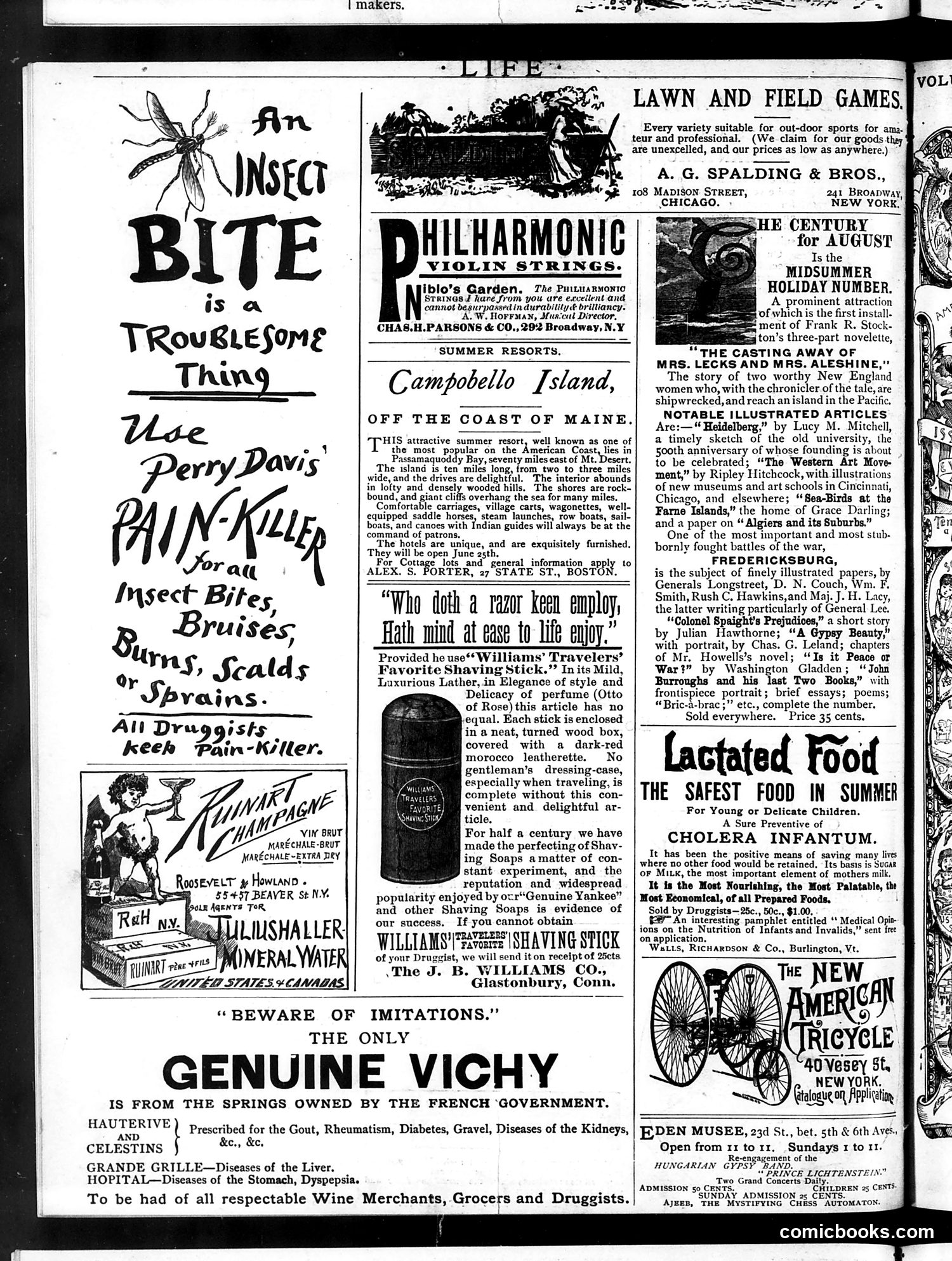
This is primarily an **advertising page** from Life magazine's midsummer issue, with minimal editorial content or satire. The page features: **Main Advertisement:** A large Perry Davis Pain-Killer ad depicting an insect bite as "troublesome," promoting the patent medicine for various ailments (bites, bruises, burns, scalds, sprains). **Other Advertisements:** Williams' Shaving Stick (emphasizing gentlemanly grooming), Vichy mineral water (marketed for gout and kidney diseases), Philharmonic Violin Strings, American Tricycle, and various summer resort listings. **Editorial Content:** Small notices for upcoming Century Magazine features, including stories about shipwreck survivors and European landmarks. The page reflects late-19th-century American consumer culture, emphasizing patent medicines, luxury goods, and leisure travel. There is **no political cartoon or satire present**—the "insect bite" illustration is purely commercial messaging, not social commentary.