
Life, 1886-08-05 · page 2 of 16
Life — August 5, 1886 — page 2: what you’re looking at
What you’re looking at
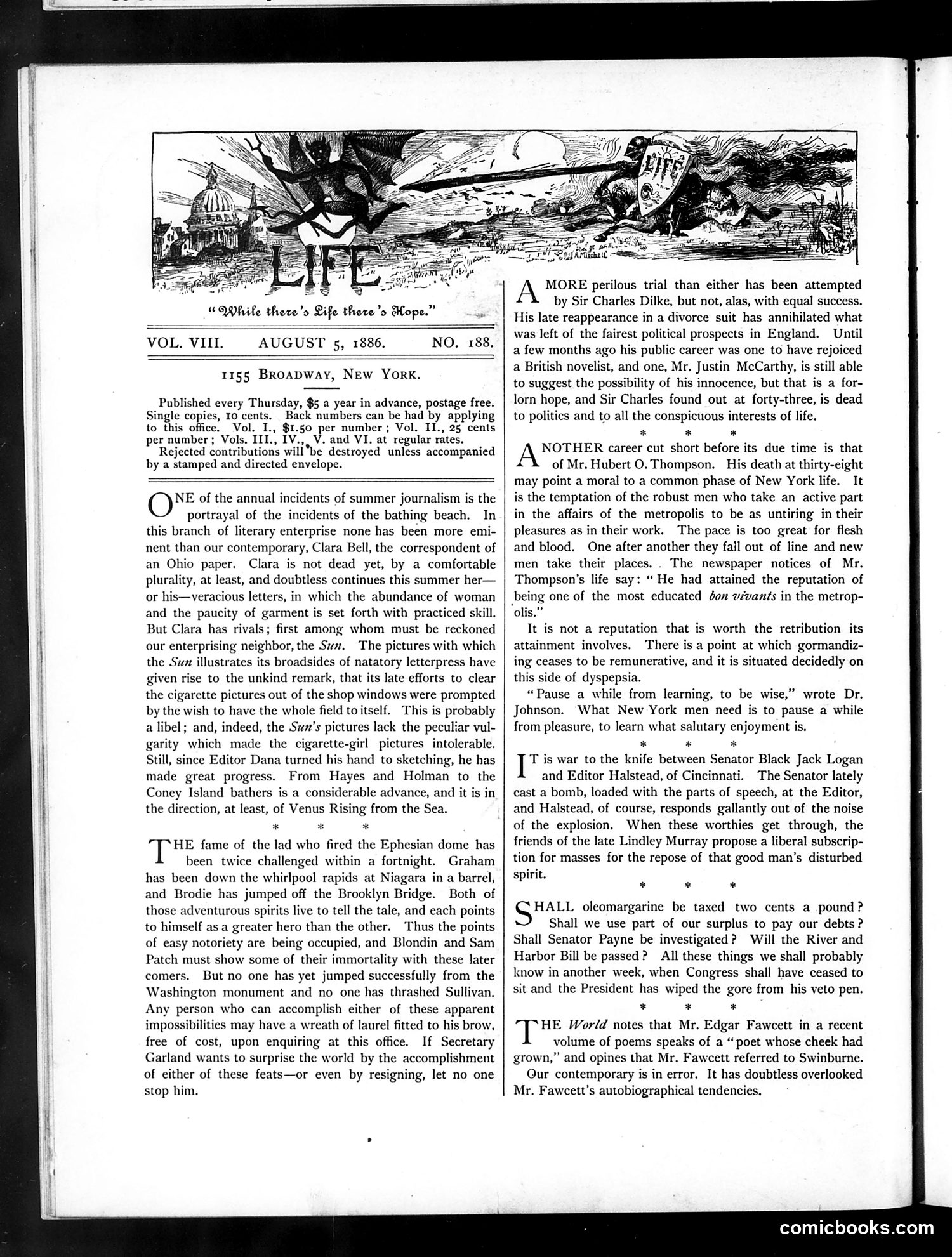
The masthead cartoon depicts "Life" as a classical female figure navigating perilous terrain—drowning figures, shipwrecks, and turbulent waters—captioned "While there's Life there's Hope." The text discusses several contemporary scandals: Sir Charles Dilke's divorce suit (which damaged his political career), and Hubert O. Thompson's sudden death, both presented as cautionary tales about public figures whose reputations collapsed. The article criticizes New York journalists and editors for sensationalism, specifically praising the *Sun's* beach coverage while condemning similar competitors' "unkind remarks." It also mocks various political controversies including Senator Logan's conflict with Cincinnati editor Halstead. The overall theme satirizes Victorian-era political instability and journalistic excess.
📄 Transcribed text from this page (OCR, searchable)
Machine-transcribed from the original scan — historical spelling and the odd misread are preserved.
- =] “While there’s Life there's Hope.” ; VOL. VIII. AUGUST 5, 1886. NO. 188. 1155 Broapway, New York. Published every Thursday, $5 a year in advance, postage free, Single copies, 10 cents. Back numbers can be had by applying to this office. Vol. I., $1.50 per number; Vol. II., 25 cents per number; Vols. III., IV.,, V. and VI. at regular rates. Rejected contributions will*be destroyed unless accompanied by a stamped and directed envelope. NE of the annual incidents of summer journalism is the portrayal of the incidents of the bathing beach. In this branch of literary enterprise none has been more emi- nent than our contemporary, Clara Bell, the correspondent of an Ohio paper. Clara is not dead yet, by a comfortable plurality, at least, and doubtless continues this summer her— or his—veracious letters, in which the abundance of woman and the paucity of garment is set forth with practiced skill. But Clara has rivals; first among whom must be reckoned our enterprising neighbor, the Sz. The pictures with which the Suz illustrates its broadsides of natatory letterpress have given rise to the unkind remark, that its late efforts to clear the cigarette pictures out of the shop windows were prompted by the wish to have the whole field toitself. This is probably a libel; and, indeed, the Swm’s pictures lack the peculiar vul- garity which made the cigarette-girl pictures intolerable. Still, since Editor Dana turned his hand to sketching, he has made great progress. From Hayes and Holman to the Coney Island bathers is a considerable advance, and it is in the direction, at least, of Venus Rising from the Sea. * * * HE fame of the lad who fired the Ephesian dome has been twice challenged within a fortnight. Graham has been down the whirlpool rapids at Niagara in a barrel, and Brodie has jumped off the Brooklyn Bridge. Both of those adventurous spirits live to tell the tale, and each points to himself as a greater hero than the other. Thus the points of easy notoriety are being occupied, and Blondin and Sam Patch must show some of their immortality with these later comers. But no one has yet jumped successfully from the Washington monument and no one has thrashed Sullivan, Any person who can accomplish either of these apparent impossibilities may have a wreath of laurel fitted to his brow, free of cost, upon enquiring at this office. If Secretary Garland wants to surprise the world by the accomplishment of either of these feats—or even by resigning, let no one stop him. MORE perilous trial than either has been attempted by Sir Charles Dilke, but not, alas, with equal success. His late reappearance in a divorce suit has annihilated what was left of the fairest political prospects in England. Until a few months ago his public career was one to have rejoiced a British novelist, and one, Mr. Justin McCarthy, is still able to suggest the possibility of his innocence, but that is a for- lorn hope, and Sir Charles found out at forty-three, is dead to politics and to all the conspicuous interests of life. * * * NOTHER career cut short before its due time is that of Mr. Hubert O. Thompson. His death at thirty-eight may point a moral to a common phase of New York life. It is the temptation of the robust men who take an active part in the affairs of the metropolis to be as untiring in their pleasures as in their work. The pace is too great for flesh and blood. One after another they fall out of line and new men take their places. . The newspaper notices of Mr. Thompson's life say: “ He had attained the reputation of being one of the most educated don vvants in the metrop- olis.” It is not a reputation that is worth the retribution its attainment involves. There is a point at which gormandiz- ing ceases to be remunerative, and it is situated decidedly on this side of dyspepsia. “Pause a while from learning, to be wise,” wrote Dr. Johnson. What New York men need is to pause a while from pleasure, to learn what salutary enjoyment is. * * * T is war to the knife between Senator Black Jack Logan and Editor Halstead, of Cincinnati. The Senator lately cast a bomb, loaded with the parts of speech, at the Editor, and Halstead, of course, responds gallantly out of the noise of the explosion. When these worthies get through, the friends of the late Lindley Murray propose a liberal subscrip- tion for masses for the repose of that good man’s disturbed spirit. * * * HALL oleomargarine be taxed two cents a pound? Shall we use part of our surplus to pay our debts? Shall Senator Payne be investigated? Will the River and Harbor Bill be passed? All these things we shall probably know in another week, when Congress shall have ceased to sit and the President has wiped the gore from his veto pen. * * * HE World notes that Mr. Edgar Fawcett in a recent volume of poems speaks of a “ poet whose cheek had grown,” and opines that Mr. Fawcett referred to Swinburne. Qur contemporary is in error. It has doubtless overlooked Mr. Faweett’s autobiographical tendencies. comicbooks.com