
Life, 1886-08-05 · page 12 of 16
Life — August 5, 1886 — page 12: what you’re looking at
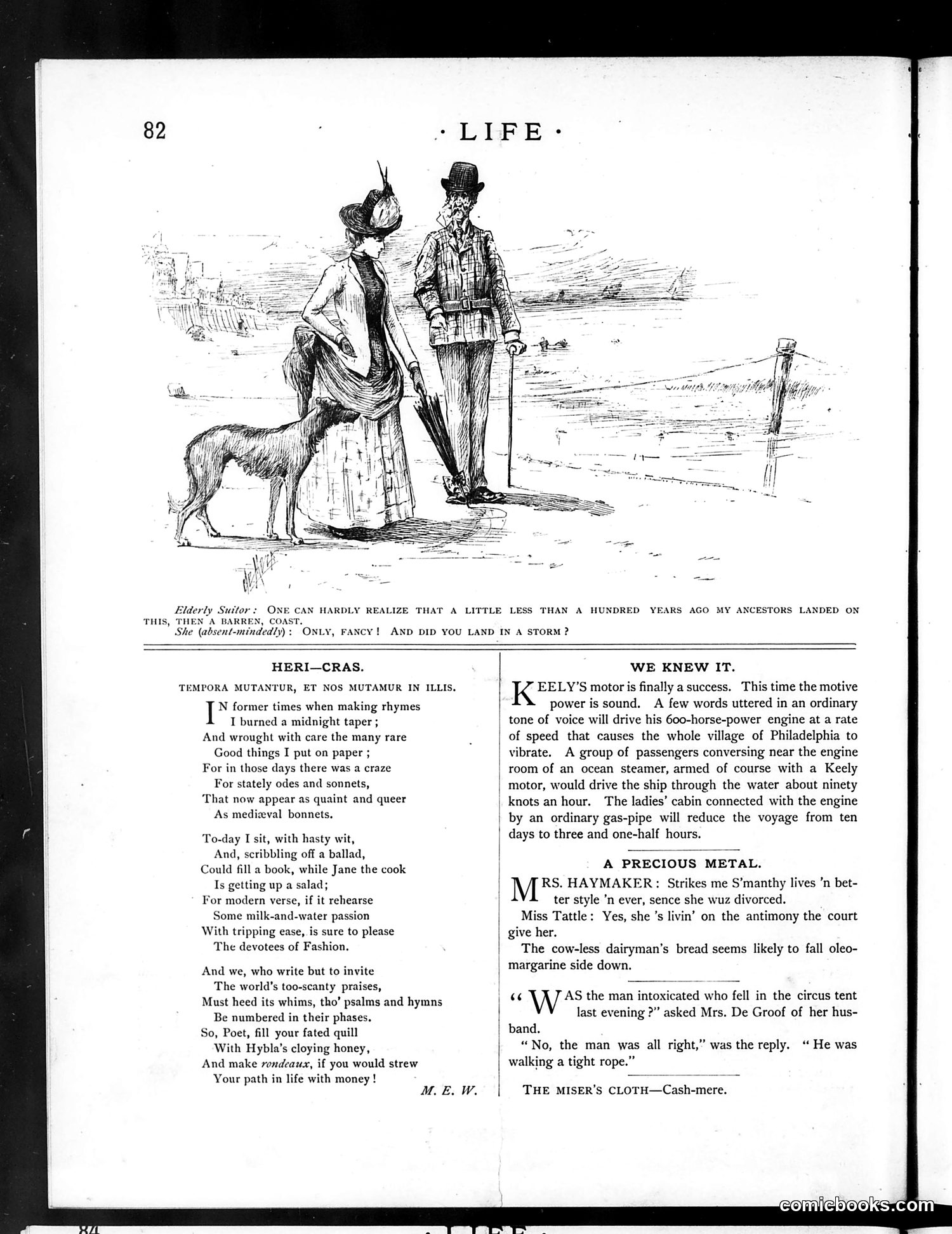
What you’re looking at
This page contains three satirical pieces typical of late 19th-century American humor: **Top cartoon**: An elderly man recounts landing on a colonial beach "a hundred years ago" to a fashionably dressed woman with a dog. The joke mocks nostalgic romanticization—his ancestors' dramatic colonial landing contrasts with her polite disinterest. **"Heri-Cras" poem**: Satirizes changing literary tastes. The author laments that serious poetry (odes, sonnets) once required midnight labor but now pedestrian "milk-and-water" verse succeeds because it's fashionable. He ironically advises poets to write commercial drivel ("rondeaux") for money rather than art. **Brief humor items**: - "We Knew It" mocks the Keely motor, a perpetual-motion machine hoax of the era, sarcastically suggesting sound-powered engines could power ships. - Social jokes about divorce ("antimony" puns on alimony), oleomargarine, circus acrobats, and "cash-mere" (cashmere/money pun). The satire targets shallow fashion, scientific fraud, and social pretension—common *Life* themes.
📄 Transcribed text from this page (OCR, searchable)
Machine-transcribed from the original scan — historical spelling and the odd misread are preserved.
Iderly Suitor ‘HARDLY REALIZE THAT A LITTLE LESS THAN A HUNDRED YEARS AGO MY AN She (absent-mindedly ONLY, FANCY! AND DID YOU LAND IN A STORM ? HERI—CRAS. TEMPORA MUTANTUR, ET NOS MUTAMUR IN ILLIS. N former times when making rhymes I burned a midnight taper ; And wrought with care the many rare Good things I put on paper ; For in those days there was a craze For stately odes and sonnets, That now appear as quaint and queer As medieval bonnets. To-day I sit, with hasty wit, And, scribbling off a ballad, Could fill a book, while Jane the cook Is getting up a salad; For modern verse, if it rehearse Some milk-and-water passion With tripping ease, is sure to please The devotees of Fashion. And we, who write but to invite The world’s too-scanty praises, Must heed its whims, tho’ psalms and hymns Be numbered in their phases. So, Poet, fill your fated quill With Hybla’s cloying honey, And make rondeaux, if you would strew Your path in life with money ! ME. WE KNEW IT. EELY’S motor is finally a success. This time the motive power is sound. A few words uttered in an ordinary | tone of voice will drive his 600-horse-power engine at a rate of speed that causes the whole village of Philadelphia to | vibrate. A group of passengers conversing near the engine | room of an ocean steamer, armed of course with a Keely | motor, would drive the ship through the water about ninety knots an hour. The ladies’ cabin connected with the engine by an ordinary gas-pipe will reduce the voyage from ten | days to three and one-half hours. A PRECIOUS METAL. RS. HAYMAKER: Strikes me S’manthy lives ’n bet- ter style ’n ever, sence she wuz divorced. Miss Tattle: Yes, she ’s livin’ on the antimony the court give her. The cow-less dairyman’s bread seems likely to fall oleo- margarine side down. “ AS the man intoxicated who fell in the circus tent last evening ?” asked Mrs. De Groof of her hus- band. “No, the man was all right,” was the reply. ‘« He was walking a tight rope.” THE MISER’S CLOTH—Cash-mere.