
A complete issue · 18 pages · 1886
Life — July 1, 1886
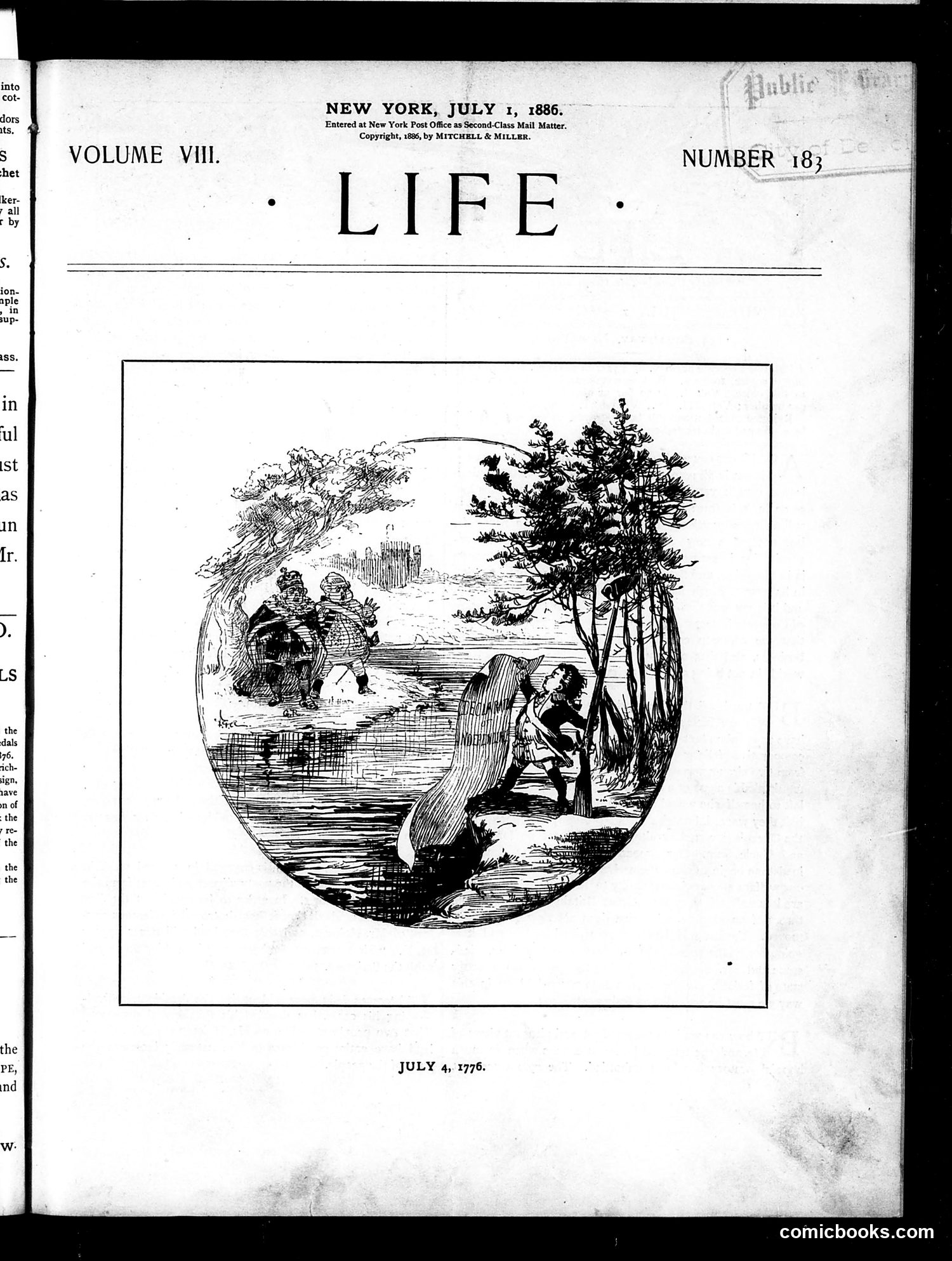
This is the cover of Life Magazine (Volume VIII, Number 183), published in New York in 1886. The illustration depicts an idealized, pastoral scene dated "JULY 4, 1776"—America's Independence Day centennial. The engraving shows a figure in period dress reclining by a tree near a waterfront, gazing contentedly at a landscape with distant figures and sailboats. The romantic, peaceful composition celebrates American independence and natural liberty a century after the Declaration. Published during the nation's centennial celebrations, this cover uses nostalgic imagery to commemorate the founding moment. The leisurely figure embodies the ideals of freedom and pastoral tranquility that 1880s Americans associated with their revolutionary heritage—likely reflecting contemporary pride in national progress and democratic values.
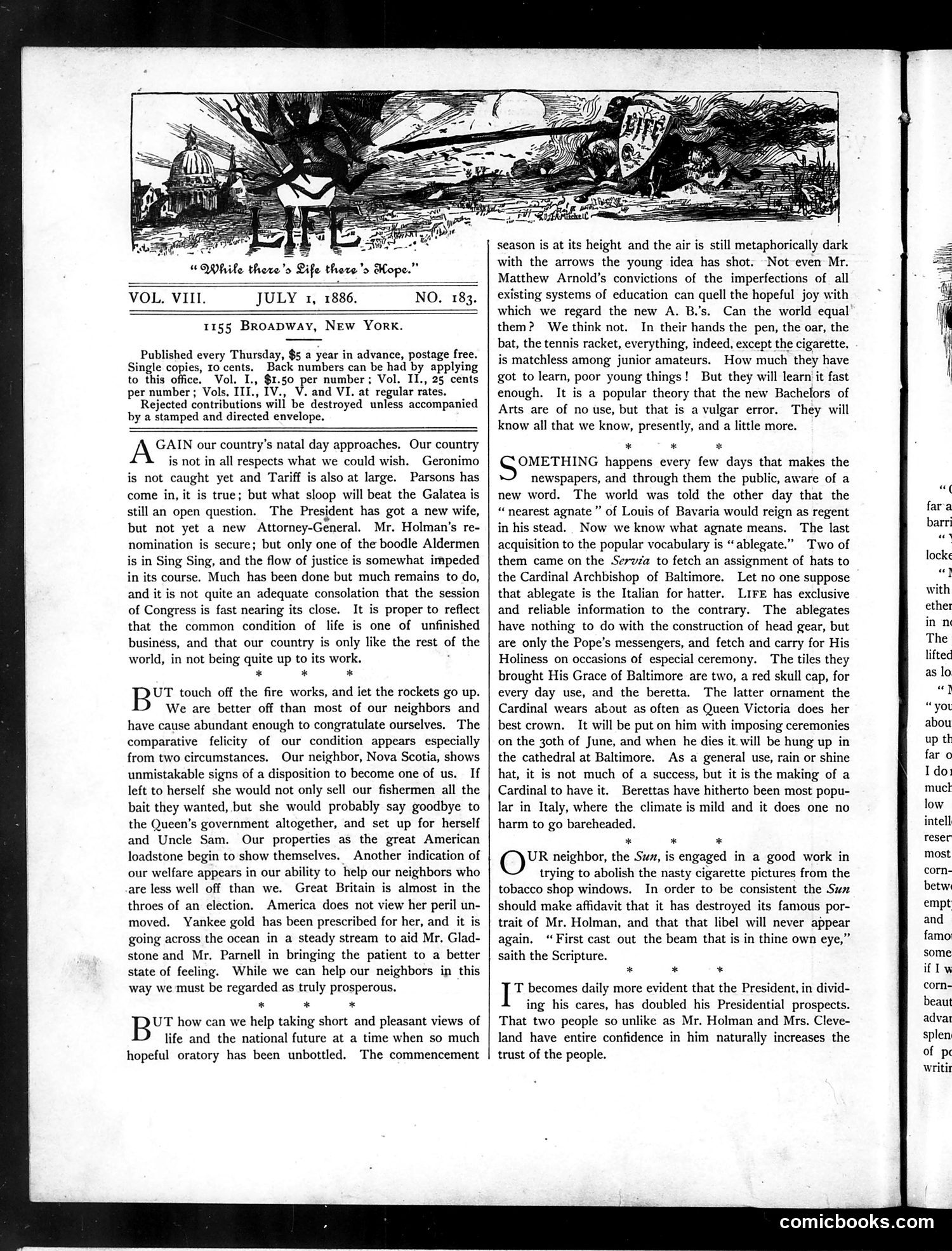
The masthead cartoon depicts a chaotic scene with a large figure wearing a Phrygian cap (symbol of liberty/revolution) dominating a landscape. This likely references contemporary anxieties about anarchism and labor unrest in America during the 1880s. The editorial text discusses national concerns: the incomplete Tariff debate, Presidential succession (Holman and Cleveland), and Nova Scotia's potential independence from Britain—positioning America favorably against its neighbors. A significant section addresses the *Sun* newspaper's campaign against cigarette advertising imagery, particularly caricatures of figures like Holman. The editors defend this effort as destroying harmful portraits. Overall, the page reflects 1880s preoccupations with political stability, national prosperity, press ethics, and social reform—characteristic of this era's satirical commentary.
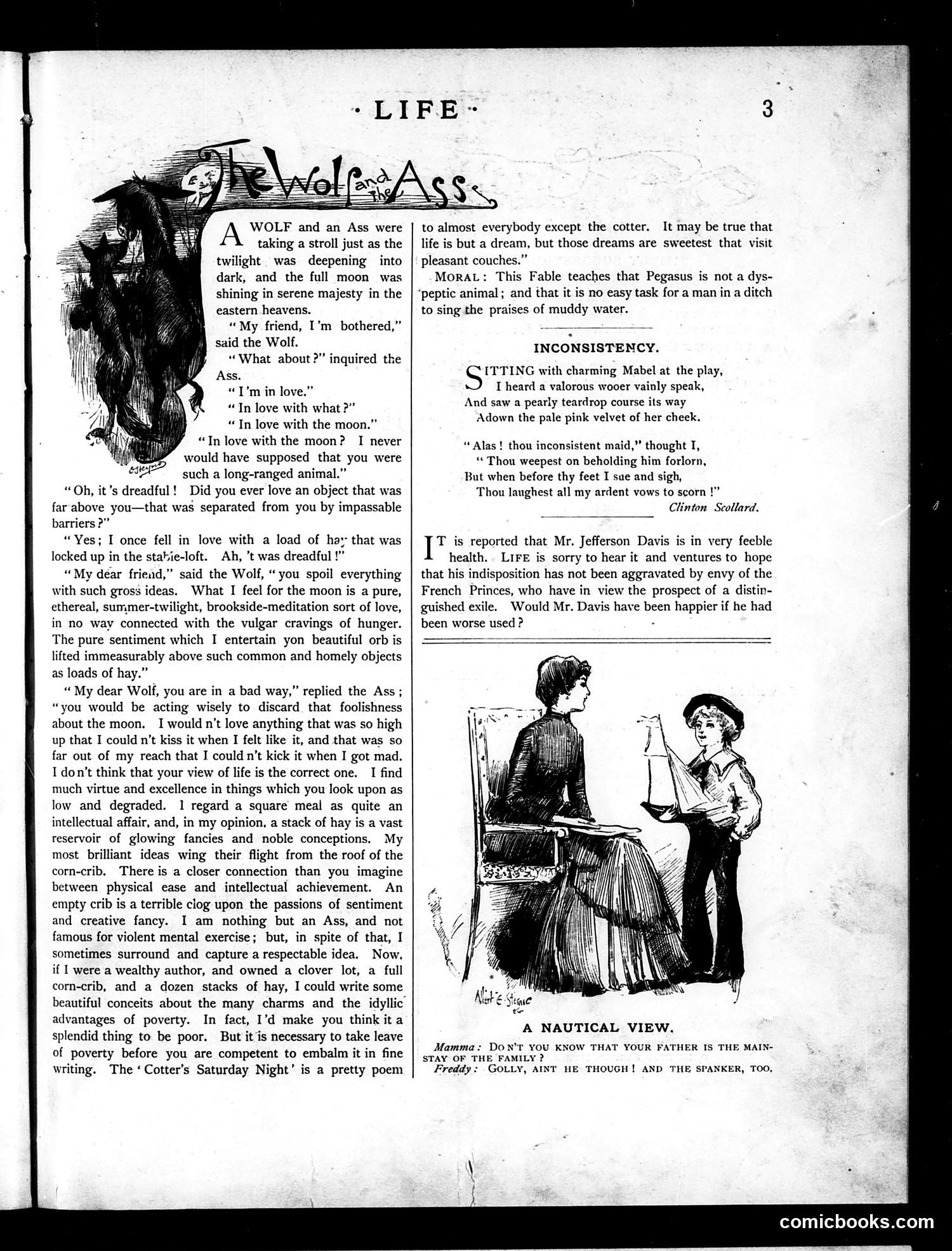
This page contains two distinct pieces: **"The Wolf and Ass"** is a fable illustration showing a wolf and donkey in philosophical debate. The Ass argues that poverty and humble circumstances allow for noble intellectual pursuits, while the Wolf dismisses such sentimentality. The moral critiques romantic notions of poverty—suggesting that while poverty might inspire fine writing, it's better to be wealthy. This appears to be social commentary on Victorian-era idealization of the struggling artist. **"A Nautical View"** is a brief comic dialogue between a mother and son (Freddy) about the father being the family's mainstay, with a joke about the spanker. It's a simple domestic humor piece with a nautical pun. Both rely on wordplay and philosophical debate typical of Life's satirical style.
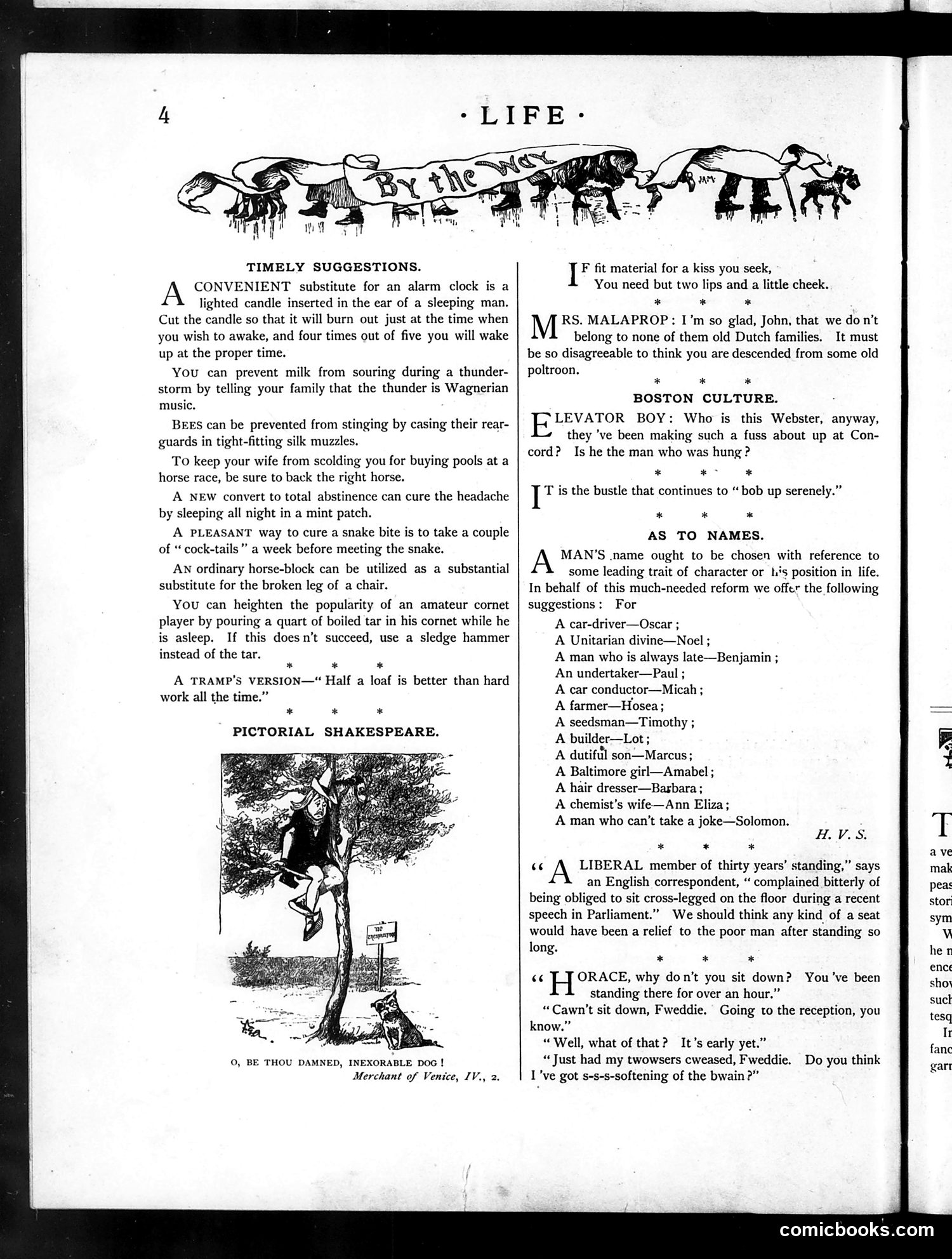
This page contains satirical advice and literary humor rather than political cartoons. The "Timely Suggestions" section mocks impractical solutions to everyday problems—using candles as alarm clocks, claiming thunder is "Wagnerian music," and other absurd remedies. The "Pictorial Shakespeare" illustration shows a man climbing a tree while a dog barks below, captioned "O, BE THOU DAMNED, INEXORABLE DOG!" from *Merchant of Venice*. This appears to humorously juxtapose Shakespeare's flowery language with a mundane, relatable scene of someone fleeing a dog. The remaining sections—"Boston Culture," "As to Names," and quoted dialogues—offer gentle social satire about naming conventions, pretentious behavior, and upper-class affectations typical of Life's satirical approach to American society and manners.
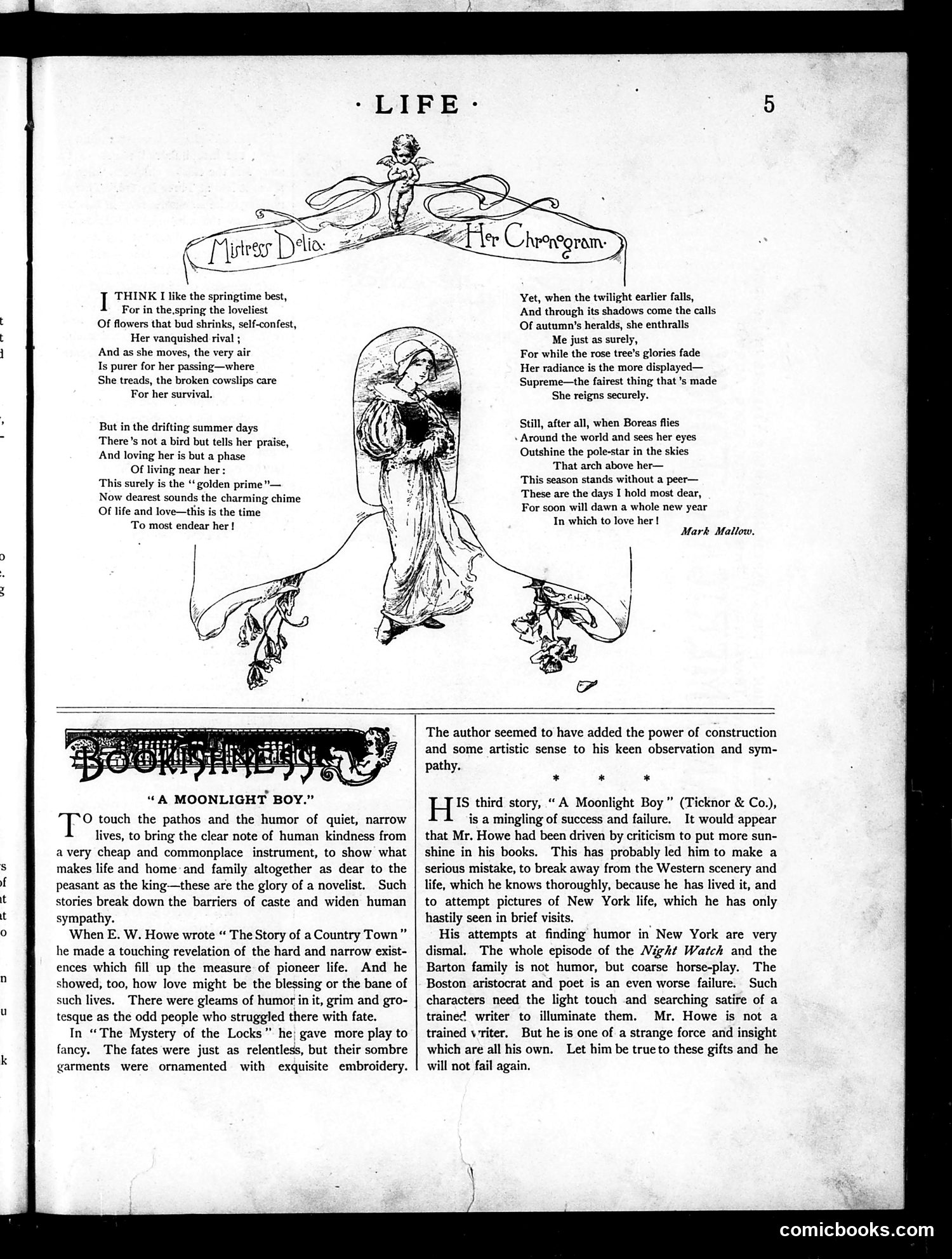
This page contains a poem titled "Mistress Delia" and "Her Chronogram" featuring an allegorical illustration of a woman representing the seasons. The decorative artwork shows a female figure in classical dress with flowing fabric connecting to seasonal imagery—likely representing spring, summer, and autumn. Below is a book review of E.W. Howe's "A Moonlight Boy." The critic praises Howe's ability to depict humble life and human kindness through "cheap and commonplace" details, contrasting this with his failed attempts at New York society satire. The reviewer suggests Howe succeeds when writing about rural/small-town life but struggles with urban subjects and character portrayal, encouraging him to stick to his strengths. This is literary criticism rather than political satire.
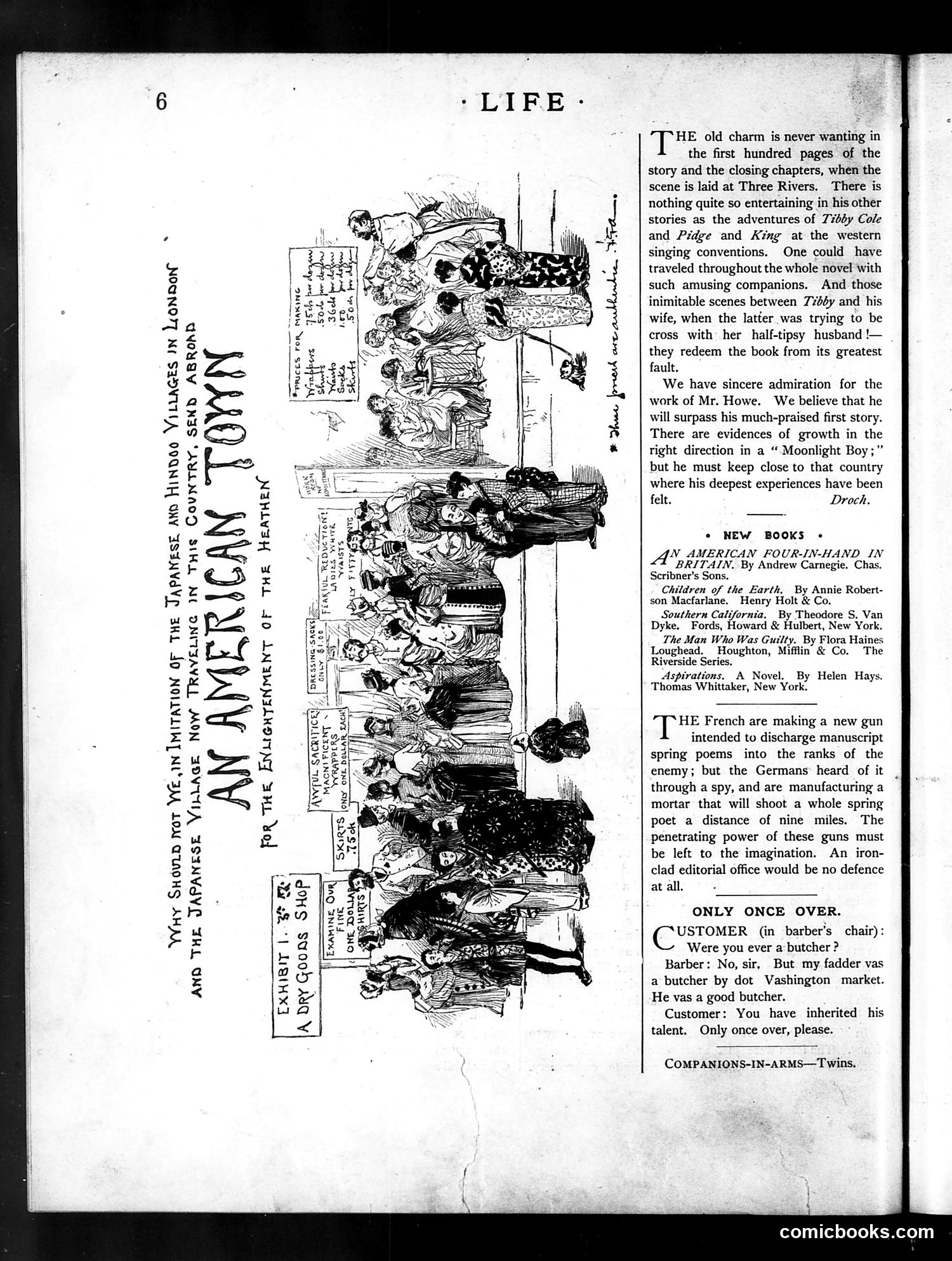
This page features a complex satirical illustration titled "An American Tragedy" positioned vertically on the left side. The cartoon appears to depict chaotic scenes stacked vertically, likely satirizing American life or politics, though the specific subject requires clearer resolution to identify definitively. The right side contains book reviews praising a work by Mr. Howe, followed by a humorous anecdote titled "ONLY ONCE OVER" about a barber claiming to have inherited butchering talent from his father. There's also commentary on French weapons development—a gun designed to fire manuscript poems—presented as satirical commentary on wartime innovation. The page blends literary criticism with social humor typical of Life's satirical approach during this period.
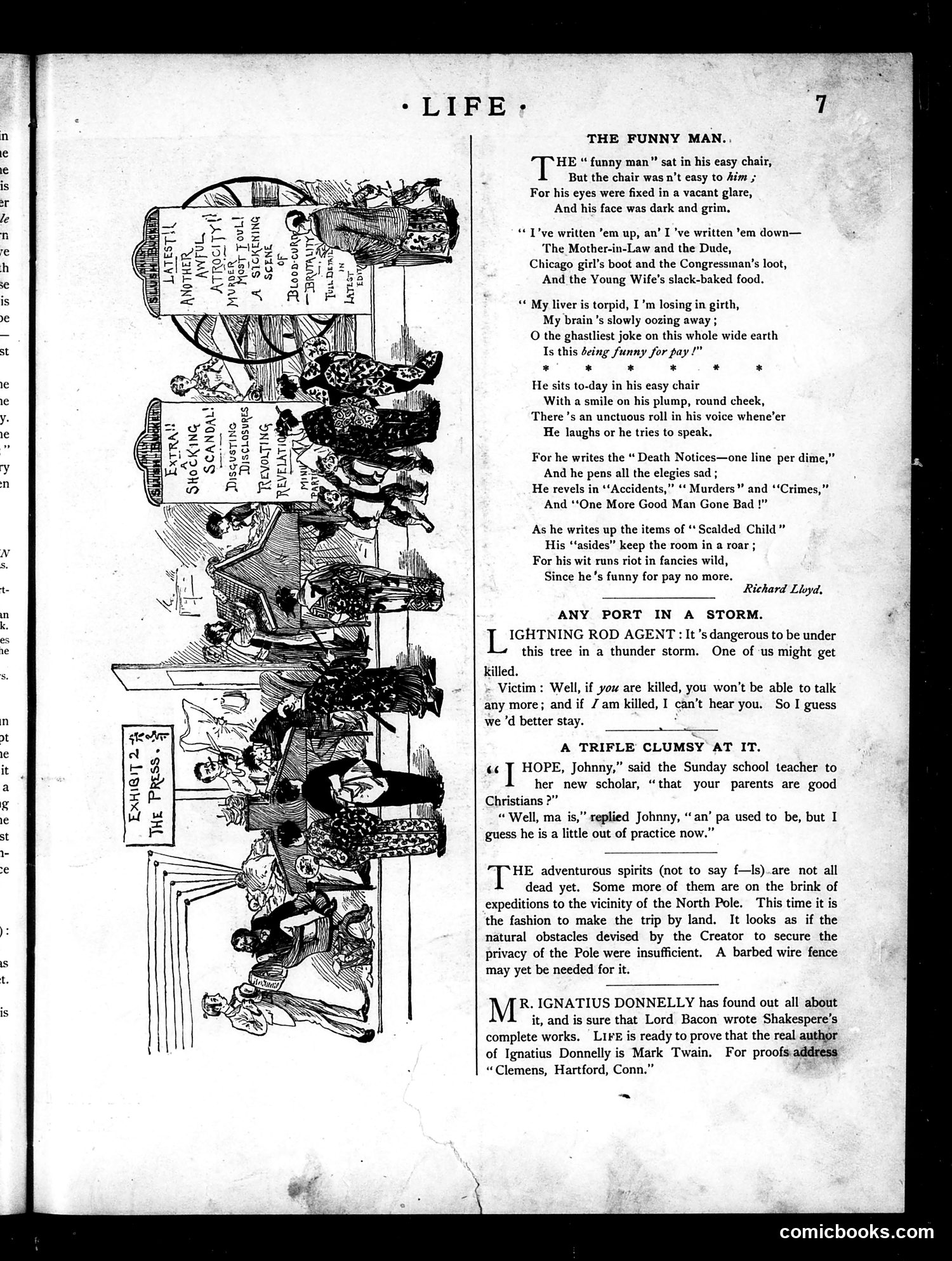
This page contains three distinct humor pieces rather than a unified political cartoon. **"The Funny Man"** (poem by Richard Lloyd): A satirical portrait of a newspaper humorist who writes light pieces about domestic mishaps ("Chicago girl's boot," "Young Wife's slack-baked food") and death notices. The accompanying illustration shows a man in an easy chair, suggesting the piece mocks journalists who create humor from everyday tragedies while remaining emotionally detached. **"Any Port in a Storm"**: A brief joke about lightning rod safety during thunderstorms. **"A Trifle Clumsy at It"**: A Sunday school anecdote about a student claiming his father is "out of practice" being Christian. **Bottom item**: A humorous claim that Ignatius Donnelly wrote Shakespeare's works, with Life offering "proofs" upon request—likely mocking contemporary literary conspiracy theories.
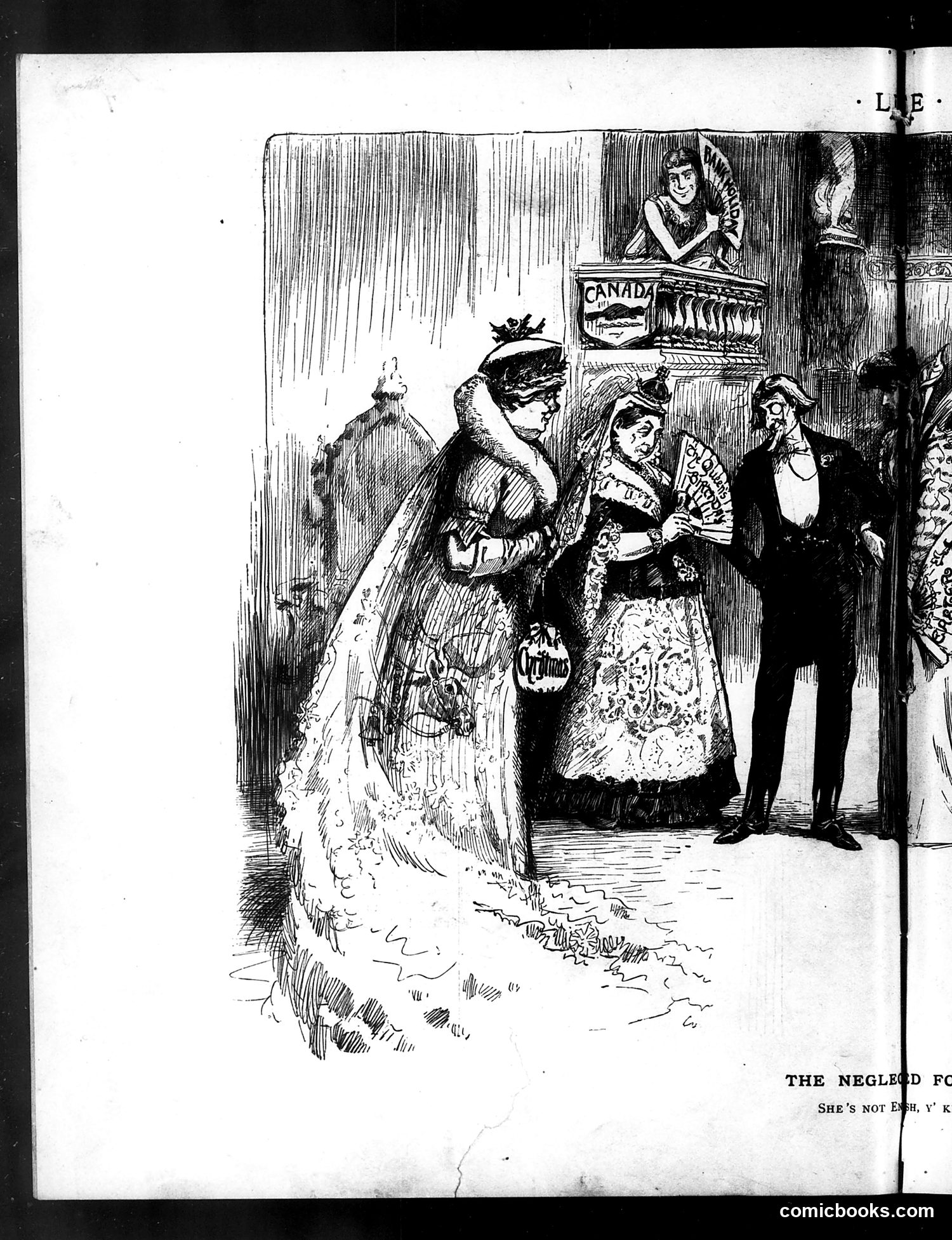
This page shows a satirical illustration titled "THE NEGLECTED FO[REIGN VISITOR]" with the caption "SHE'S NOT EVEN, Y' K[NOW]..." The sketch depicts a woman in an elaborate wedding dress with a long train, standing amid what appears to be a crowd at what looks like an immigration or customs station (suggested by the "CANADA" sign visible in the background). The woman appears neglected or ignored despite her formal attire and obvious importance. The satire likely comments on how foreign visitors—particularly women of apparent status—were treated dismissively by American immigration or reception officials, or how Canada-bound immigrants were overlooked. The contrast between her dignified wedding dress and the indifferent crowd around her emphasizes the joke: despite her obvious refinement, she receives no special attention or courtesy. The specific identity of the woman and precise historical context remain unclear from the visible text.
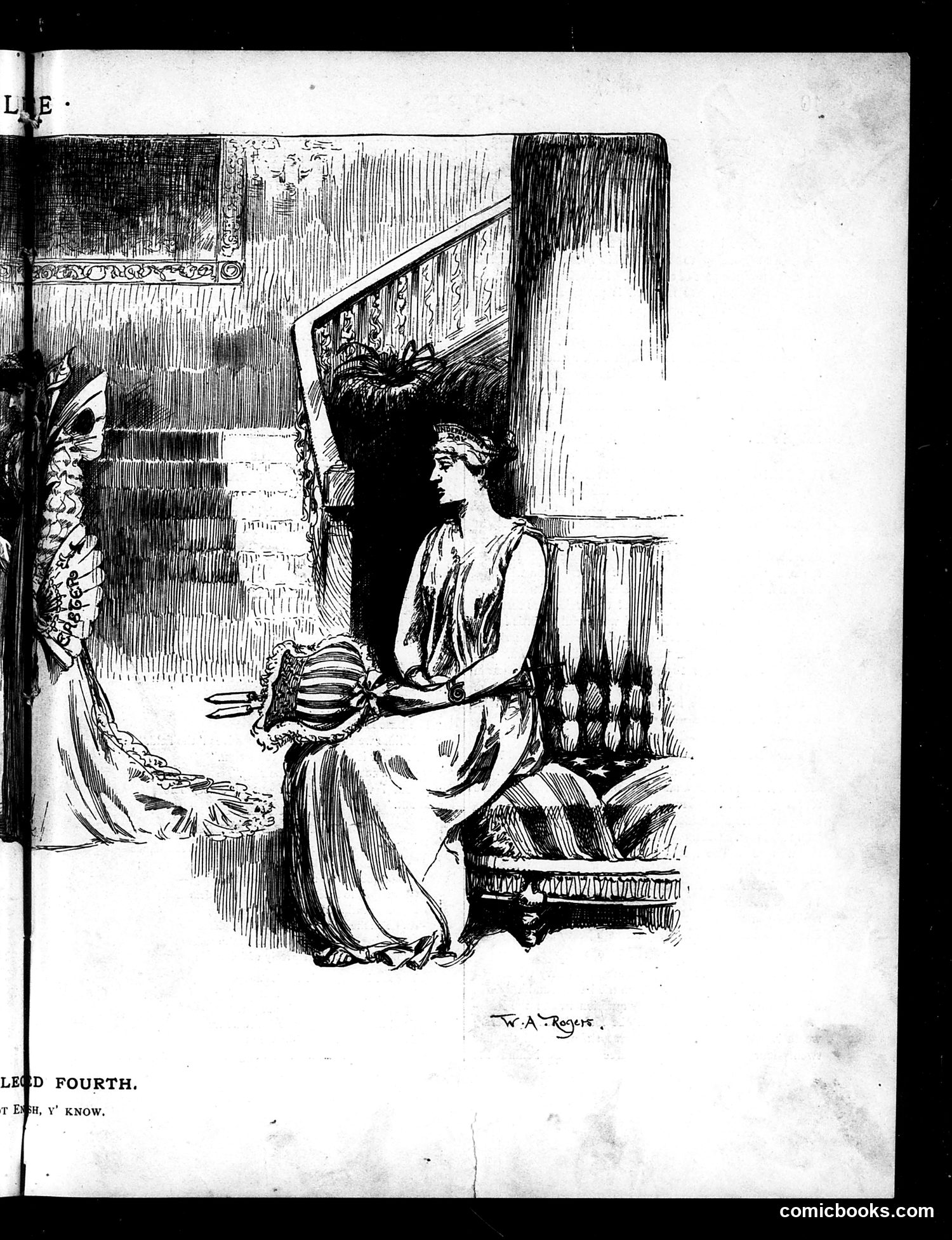
This pen-and-ink illustration by F.W.A. Rogue depicts a woman in classical dress seated indoors, holding what appears to be a decorative basket or vessel. The ornate interior setting—with draped fabrics, decorated walls, and architectural details—suggests a wealthy or aristocratic household. The image appears to be a satirical commentary on leisure, domesticity, or possibly women's roles in upper-class society. However, without additional context from the surrounding text (the OCR references "LEOD FOURTH" and "t ERR, Y' KNOW" which are fragmentary), the specific satirical target remains unclear. The classical styling may reference historical or mythological themes common in Life magazine's social commentary of the period.
This page from *Life* magazine (appears to be late 1880s based on references) contains sports commentary and theater criticism with no political cartoons visible. The **"Sport" section** discusses college athletics competitions between Yale, Princeton, and Harvard, noting the outcomes seem fairly distributed among elite institutions. It analyzes competitive yacht racing between vessels named *Puritan*, *Priscilla*, *Mayflower*, and *Atlantic*—discussing which boats perform better in different weather conditions. The author skeptically evaluates a sprinter's record, doubting the accuracy of non-New York timers. The **theater section** reviews Richard Mansfield's performance as "Prince Karl" at Madison Square Theatre, praising his acting skill while noting the supporting cast was inadequate. The **"Per Astra ad Aspera"** section appears to be poetry about academic life and collegiate ambitions. The content reflects upper-class interests of the era: elite university sports, yacht racing (an expensive leisure activity), and professional theater.
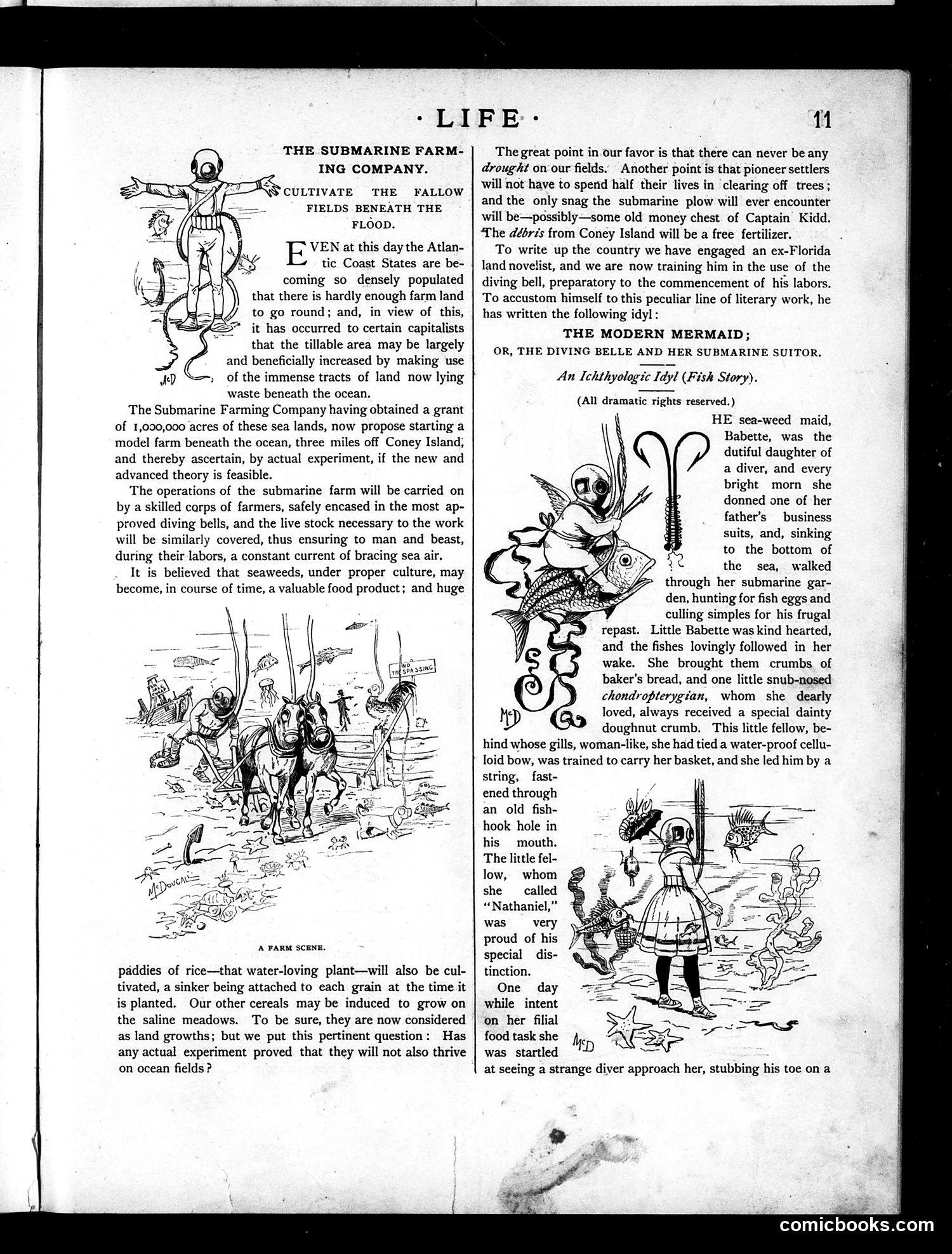
This page satirizes late-19th-century American capitalist overreach and land speculation. The left column mocks a fictional scheme to farm underwater near Coney Island, proposing absurd solutions to coastal overpopulation: submerged farmers in diving bells growing seaweed and rice with sinkers attached to prevent floating away. The satire targets the era's credulous acceptance of "advanced theory" and get-rich-quick schemes. References to Captain Kidd's treasure and using Coney Island debris as fertilizer add absurdist humor. The scheme promises drought-proof fields and "bracing sea air" for workers—obviously ridiculous. The right column parodies romantic fiction with "The Modern Mermaid," a deliberately overwrought tale of a dutiful diver's daughter named Babette tending an underwater garden with her fish companion "Nathaniel." This mocks both sentimental Victorian literature and the submarine farming premise's fundamental implausibility. The humor relies on readers recognizing the logical impossibility of the entire enterprise.
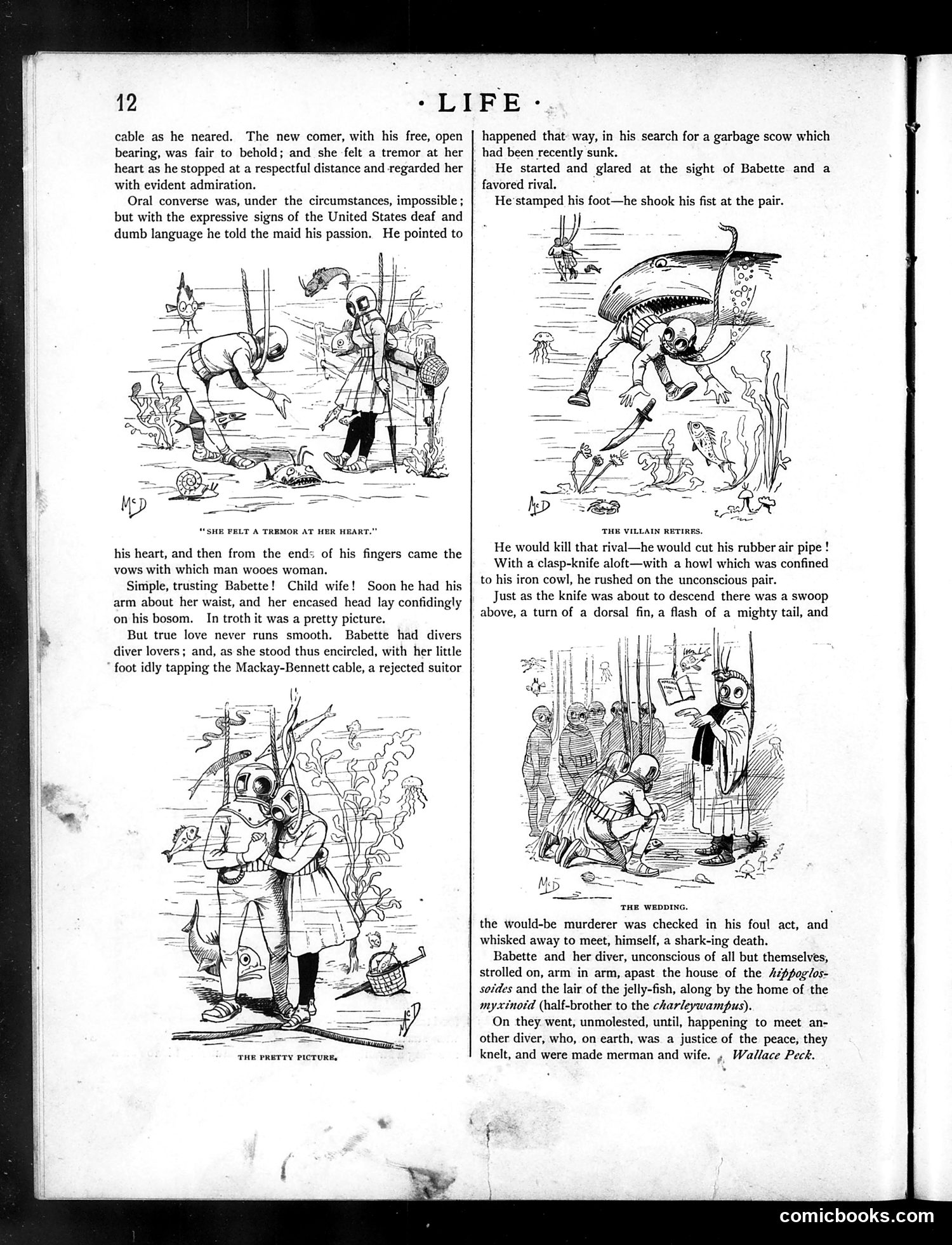
This is a whimsical underwater romance parody featuring deep-sea divers. The story mocks Victorian melodrama by transplanting it to an absurd setting—divers courting on the ocean floor. The satire works through several layers: divers communicate via sign language (sign for "deaf and dumb"), creating comic impossibility of "oral converse." A rejected suitor attempts murder with a knife, only to be killed by a shark—a darkly comic intervention. The story concludes with an underwater wedding performed by a justice-of-the-peace diver. References to real elements ground the fantasy: the "Mackay-Bennett cable" was an actual transatlantic telegraph cable; the invented sea creatures (myxtnotd, charleywampus) are pure nonsense. The joke targets sentimental romance literature's melodramatic conventions—love triangles, rejected suitors, dramatic interventions—by rendering them ridiculous through underwater logistics. Wallace Peck's cartoon illustrations emphasize the absurdity throughout.
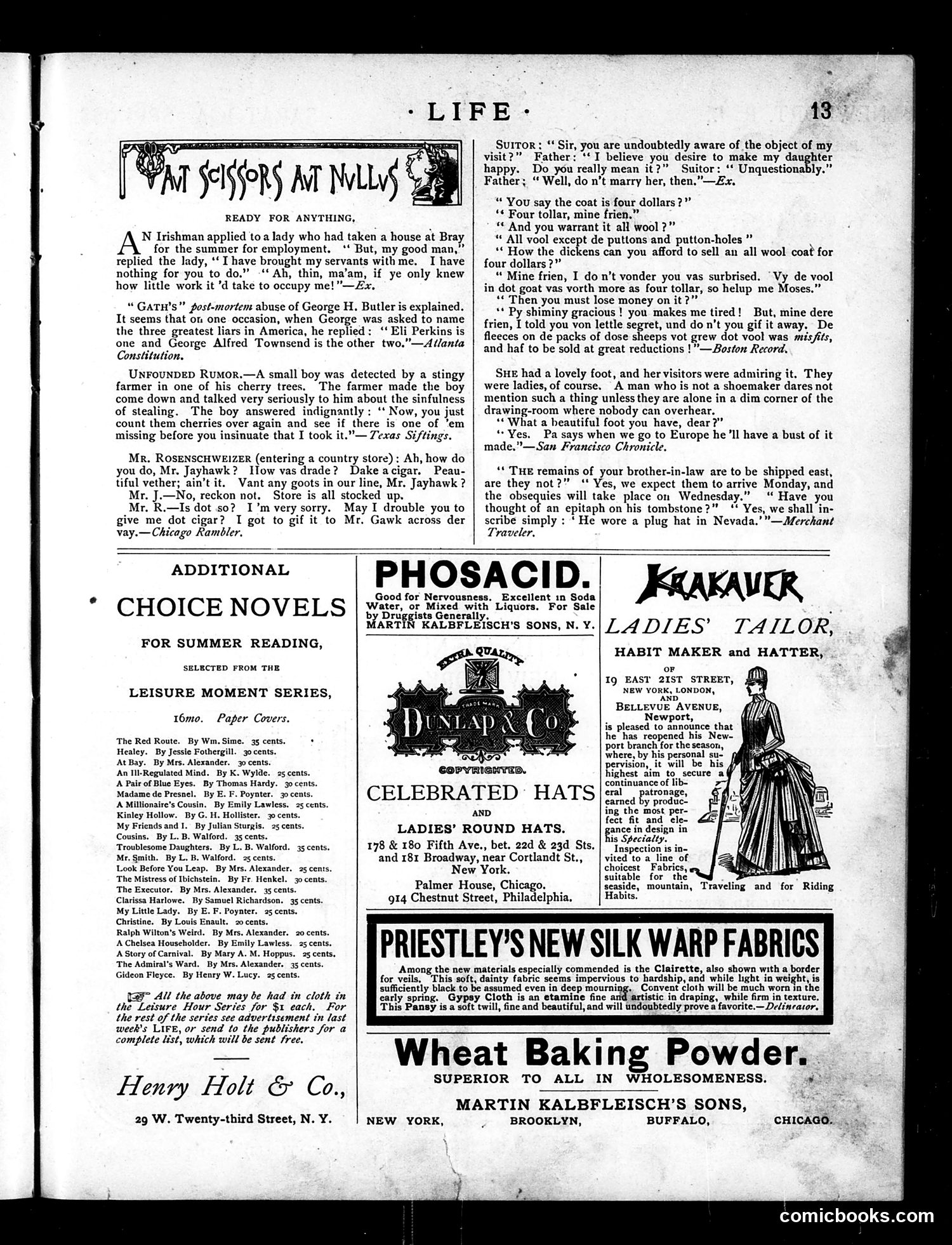
This page contains primarily **humorous anecdotes and advertisements** rather than political cartoons. The humor pieces satirize social types and ethnic stereotypes common to the era: 1. **Irish immigrant** seeking employment—jokes about Irish willingness to work for minimal compensation. 2. **Exaggeration of liars** among American public figures (Eli Perkins, George Alfred Townsend)—satirizing American journalism/politics. 3. **German-accented merchant** (Rosenschweizer/Jayhawk dialogue)—ethnic humor based on German-Jewish immigrant speech patterns and business practices. The joke involves selling wool coats suspiciously cheaply, with the merchant claiming the wool came from "misfits" requiring discount sales. 4. **Victorian courtship/marriage** joke—father warns suitor not to marry if he truly loves the daughter. 5. **Women's vanity** about feet—gentle satire of female preoccupation with beauty and European sophistication. The advertisements promote patent medicines, clothing services, and baking products—typical period marketing. The content reflects 1880s-90s American popular humor sensibilities.
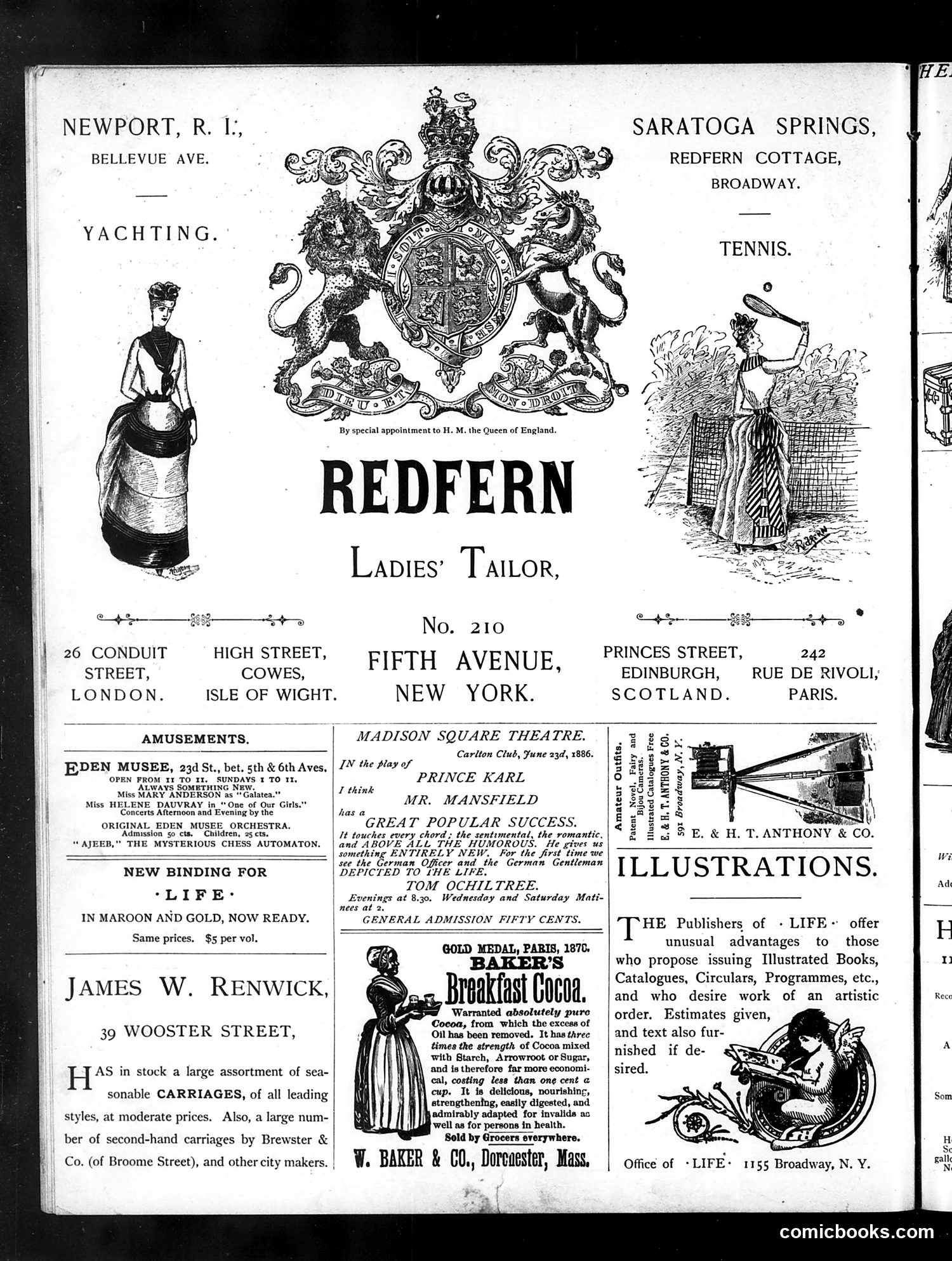
This is primarily an **advertising and announcements page** rather than a satirical cartoon page. It showcases upscale leisure and consumer goods targeting wealthy Americans in the 1880s. **Key advertised services:** - **Redfern**: A luxury ladies' tailor with locations in New York, London, Paris, and Edinburgh, holding royal appointment to Queen Victoria - **Yachting and Tennis**: Illustrations depicting leisure activities of the wealthy at Newport, Rhode Island and Saratoga Springs - **Entertainment**: Eden Musée (wax museum) and Madison Square Theatre productions - **Carriages**: High-end transportation by Renwick - **Baker's Cocoa**: A branded luxury food product - **Photography equipment**: E. & H. T. Anthony's cameras The page reflects **Gilded Age consumerism**, displaying aspirational luxury goods and services for wealthy Americans. The royal warrant and international locations emphasize exclusivity and Old World sophistication sought by American elites during this period.
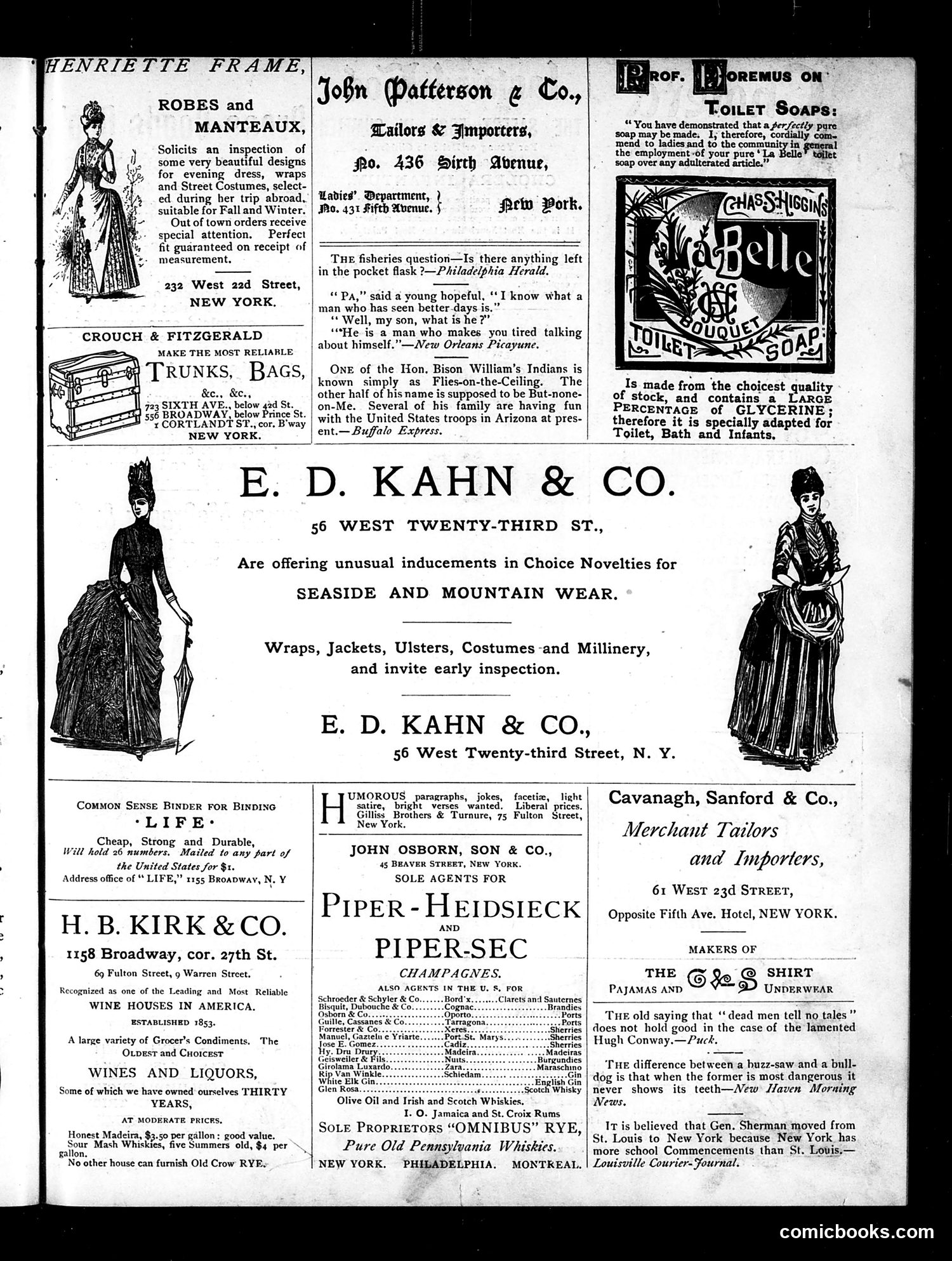
This is primarily an **advertising page** with minimal editorial content. The few humorous items are brief jokes typical of *Life* magazine's satirical style: 1. **Fisheries joke**: A quip about whether anything remains in a "pocket flask" — references drinking/alcohol in casual conversation. 2. **"Pa" joke**: A child defines a man who "has seen better days" as someone tedious about his past misfortunes — gentle social satire about bore-ish behavior from the formerly wealthy. 3. **Bison William's Indian**: References Hon. Bison William (likely a Wild West show performer), with wordplay on an Indian named "Flies-on-the-Ceiling" and "But-none-on-Me," suggesting he's involved in military conflicts in Arizona. 4. **Sherman/St. Louis quip**: A pun suggesting Gen. Sherman relocated to New York because it has more school commencements than St. Louis. The page is dominated by period clothing, wine, champagne, and luxury goods advertisements targeting wealthy New Yorkers. No significant political satire or caricatures are present.
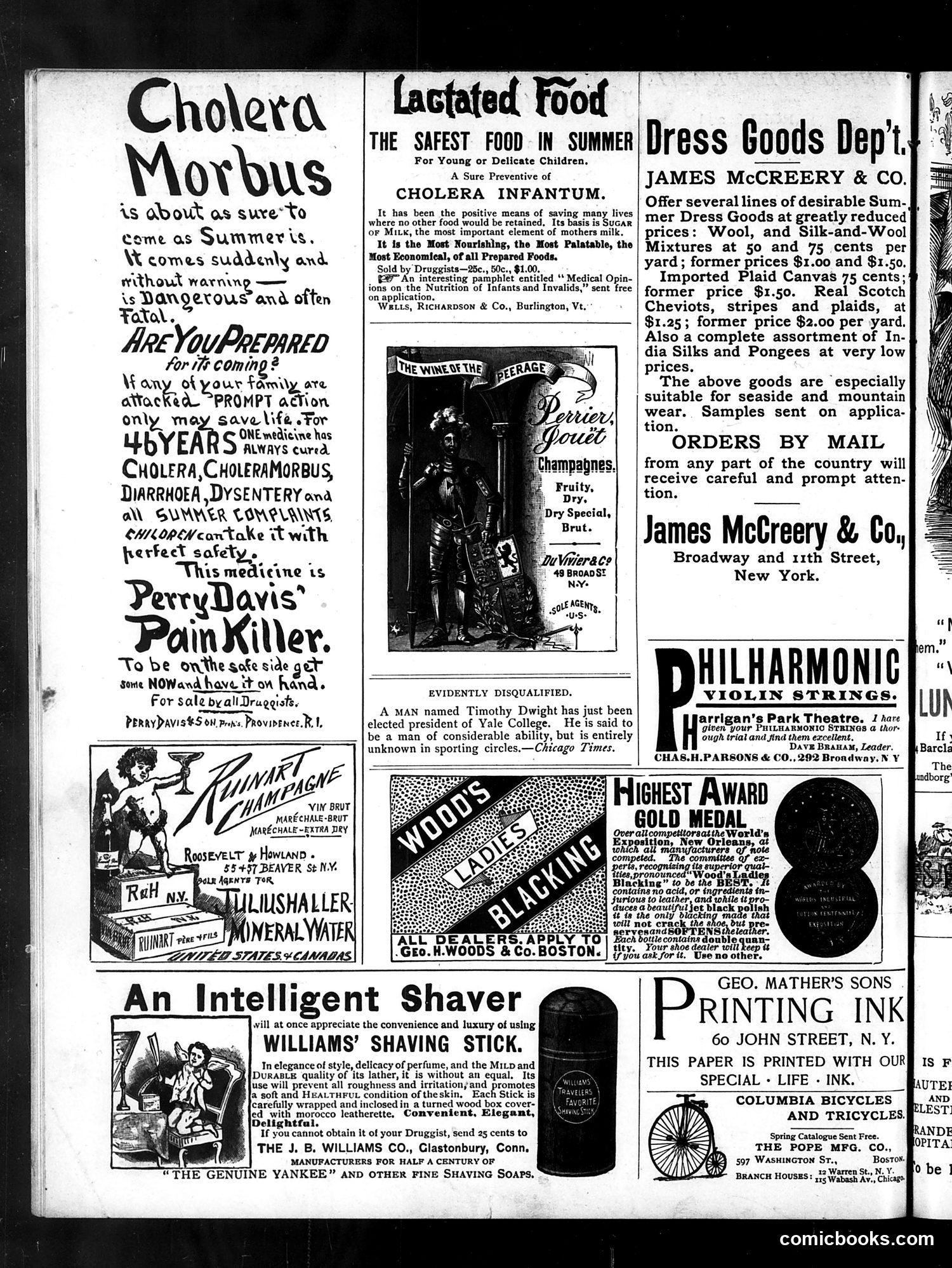
This is primarily an **advertisement page** from an American satirical magazine, likely from the 1880s-1890s. The content reflects period anxieties about public health. ## Main Content: The dominant advertisements address **cholera and summer illnesses**—genuine public health threats of the era. Perry Davis' Pain Killer and Lactated Food are promoted as preventatives, reflecting pre-germ-theory medical panic about seasonal disease. ## The Satire: The only joke appears at bottom: a brief item about Timothy Dwight's election as Yale president. The satire suggests he's "disqualified" because he's unknown "in sporting circles"—mocking the notion that athletic prowess or social prominence in sports should matter for academic leadership. It's gentle mockery of Yale's sporting culture. ## Historical Context: The page reflects genuine Victorian anxieties: cholera infantum was a real killer of children; summer months brought disease spikes; medical advertising exploited these fears with dubious remedies. The Yale joke assumes readers understood athletics dominated elite university culture.
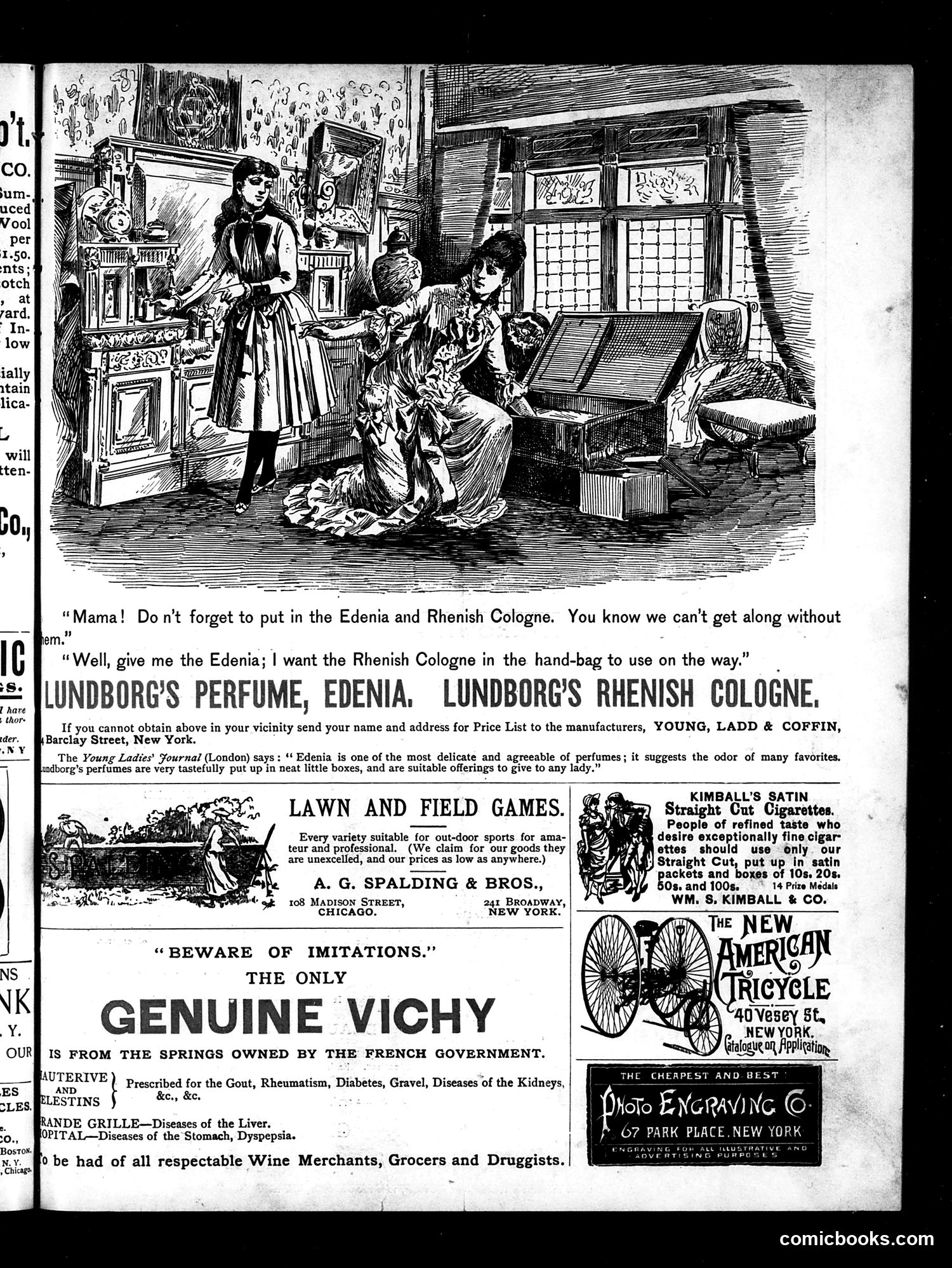
This is primarily an **advertising page**, not editorial content. The main illustration depicts a humorous domestic scene where a mother prepares her daughter for travel, emphasizing that quality perfumes (Lundborg's Edenia and Rhenish Cologne) are essential luxuries—so vital the daughter insists on carrying the Cologne in her hand-bag for use "on the way." The satire targets **upper-class consumer culture**: the joke is that refined ladies consider expensive perfumes absolutely indispensable, treating them as necessities rather than luxuries. The "Young Ladies' Journal" quote reinforces this by endorsing the products as tasteful gifts. The page surrounds this central cartoon with period advertisements for sports equipment (Spalding), cigarettes (Kimball's), tricycles, mineral water (Vichy—marketed as medicinal), and engraving services. The Vichy ad humorously claims the water treats numerous ailments, typical of 19th-century patent medicine marketing. The overall effect satirizes **conspicuous consumption** among the wealthy while simultaneously selling the very products being mocked.
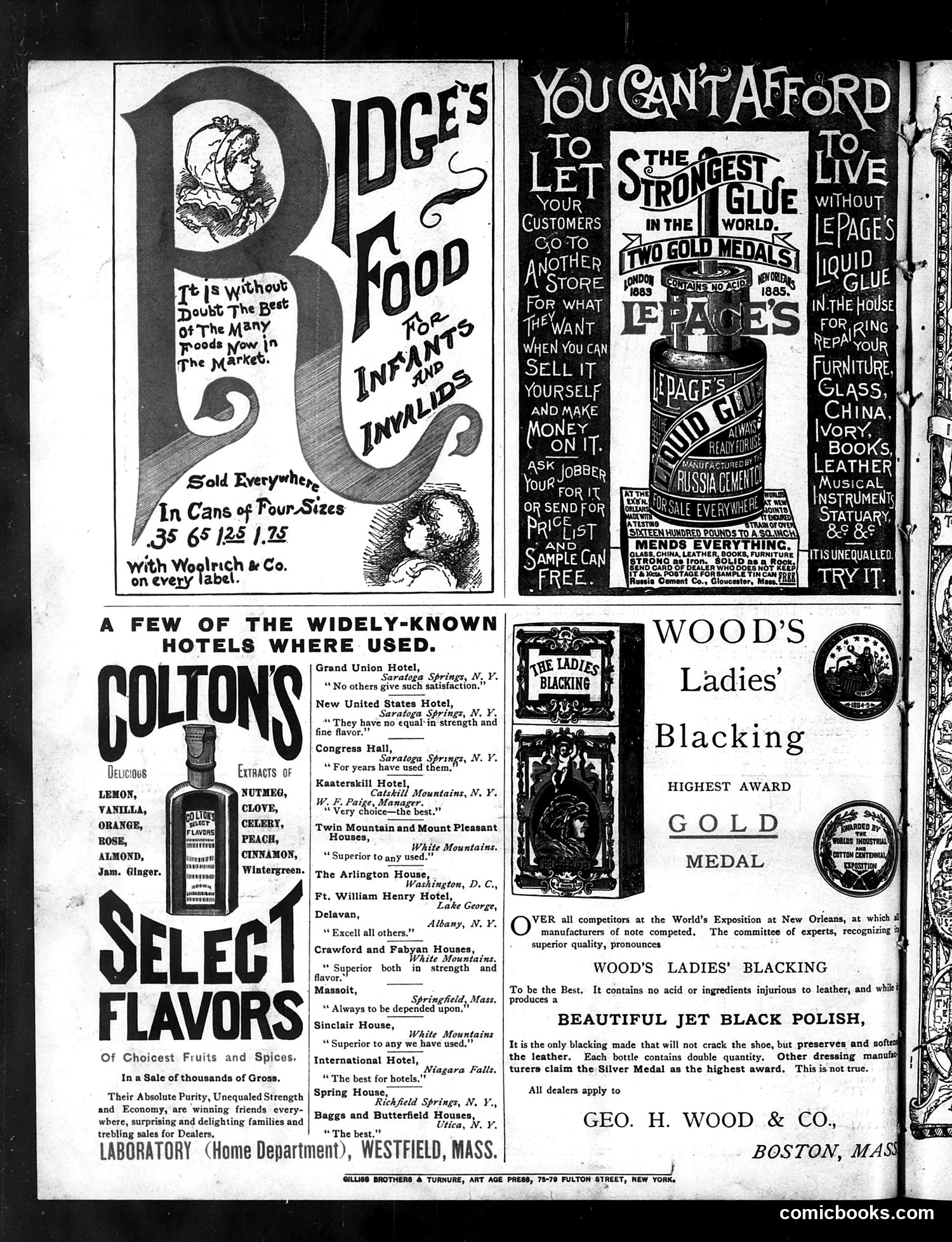
This page is primarily **advertising**, not political satire. It contains four Victorian-era product advertisements: 1. **Binge's Food for Infants and Invalids** — a nutritional product sold in multiple can sizes, claiming to be "the best" food available. 2. **Le Page's Liquid Glue** — advertised as "the strongest glue in the world," useful for household repairs of furniture, glass, china, books, etc. 3. **Colton's Select Flavors** — extracts (lemon, vanilla, orange, etc.) endorsed by numerous high-end hotels like those in Saratoga Springs and the Catskills, emphasizing purity and strength. 4. **Wood's Ladies' Blacking** — shoe polish that won a gold medal at the World's Exposition in New Orleans, claiming superior quality over competitors. The page reflects late 19th-century advertising strategy: testimonials from prestigious establishments, claims of awards and superiority, and emphasis on product quality. There is no political cartoon or satirical content visible.