
Life, 1886-07-01 · page 11 of 18
Life — July 1, 1886 — page 11: what you’re looking at
What you’re looking at
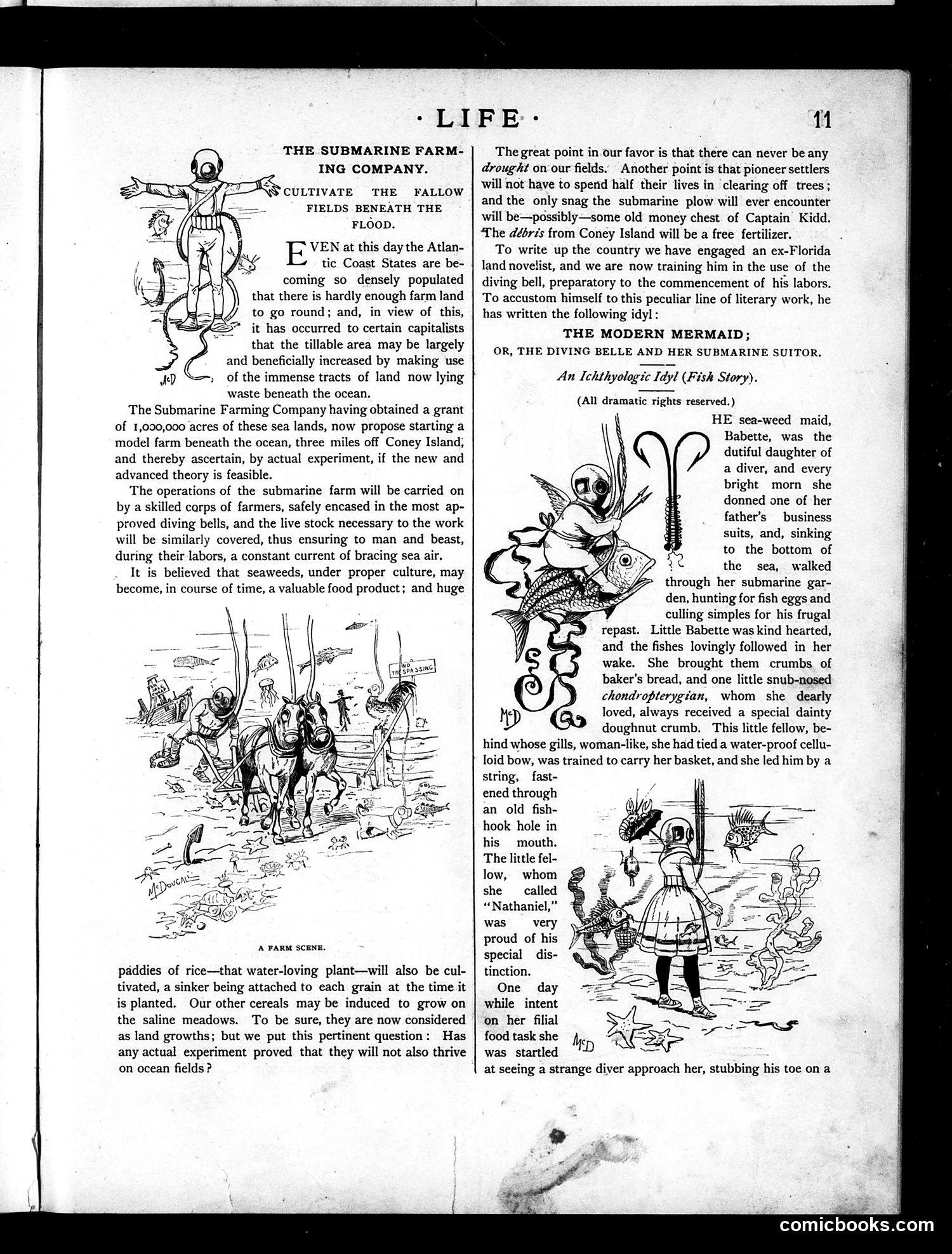
This page satirizes late-19th-century American capitalist overreach and land speculation. The left column mocks a fictional scheme to farm underwater near Coney Island, proposing absurd solutions to coastal overpopulation: submerged farmers in diving bells growing seaweed and rice with sinkers attached to prevent floating away. The satire targets the era's credulous acceptance of "advanced theory" and get-rich-quick schemes. References to Captain Kidd's treasure and using Coney Island debris as fertilizer add absurdist humor. The scheme promises drought-proof fields and "bracing sea air" for workers—obviously ridiculous. The right column parodies romantic fiction with "The Modern Mermaid," a deliberately overwrought tale of a dutiful diver's daughter named Babette tending an underwater garden with her fish companion "Nathaniel." This mocks both sentimental Victorian literature and the submarine farming premise's fundamental implausibility. The humor relies on readers recognizing the logical impossibility of the entire enterprise.
📄 Transcribed text from this page (OCR, searchable)
Machine-transcribed from the original scan — historical spelling and the odd misread are preserved.
- LIFE: THE SUBMARINE FARM- ING COMPANY. S CULTIVATE THE FALLOW FIELDS BENEATH THE FLOOD. VEN at this day the Atlan- tic Coast States are be- coming so densely populated that there is hardly enough farm land to go round; and, in view of this, it has occurred to certain capitalists that the tillable area may be largely and beneficially increased by making use of the immense tracts of land now lying waste beneath the ocean. The Submarine Farming Company having obtained a grant of 1,000,000 acres of these sea lands, now propose starting a model farm beneath the ocean, three miles off Coney Island, and thereby ascertain, by actual experiment, if the new and advanced theory is feasible. The operations of the submarine farm will be carried on by a skilled carps of farmers, safely encased in the most ap- proved diving bells, and the live stock necessary to the work will be similarly covered, thus ensuring to man and beast, during their labors, a constant current of bracing sea air. It is believed that seaweeds, under proper culture, may become, in course of time, a valuable food product; and huge A FARM SCENE. paddies of rice—that water-loving plant—will also be cul- tivated, a sinker being attached to each grain at the time it is planted. Our other cereals may be induced to grow on the saline meadows. To be sure, they are now considered as land growths; but we put this pertinent question: Has any actual experiment proved that they will not also thrive on ocean fields ? 1 The great point in our favor is that there can never be any @rought on our fields. Another point is that pioneer settlers will not have to spend half their lives in clearing off trees; and the only snag the submarine plow will ever encounter will be—possibly—some old money chest of Captain Kidd. ‘The débris from Coney Island will be a free fertilizer. To write up the country we have engaged an ex-Florida land novelist, and we are now training him in the use of the diving bell, preparatory to the commencement of his labors. To accustom himself to this peculiar line of literary work, he has written the following idyl : THE MODERN MERMAID; OR, THE DIVING BELLE AND HER SUBMARINE SUITOR. An Ichthyologic Idyl (Fish Story). (All dramatic rights reserved.) HE sea-weed maid, Babette, was the dutiful daughter of a diver, and every bright morn she donned one of her father’s business suits, and, sinking to the bottom of t the sea, walked through her submarine gar- den, hunting for fish eggs and culling simples for his frugal repast. Little Babette was kind hearted, and the fishes lovingly followed in her wake. She brought them crumbs of baker’s bread, and one little snub-nosed chondropterygian, whom she dearly loved, always received a special dainty doughnut crumb. This little fellow, be- hind whose gills, woman-like, she had tied a water-proof cellu- loid bow, was trained to carry her basket, and she led him by a string, fast- ened through an old fish- hook hole in his mouth. The little fel- low, whom she called “Nathaniel,” was very proud of his special dis- tinction. One day while intent on her filial food task she was startled at seeing a strange diver approach her, stubbing his toe on a comicbooks.com