
Life, 1886-07-01 · page 5 of 18
Life — July 1, 1886 — page 5: what you’re looking at
What you’re looking at
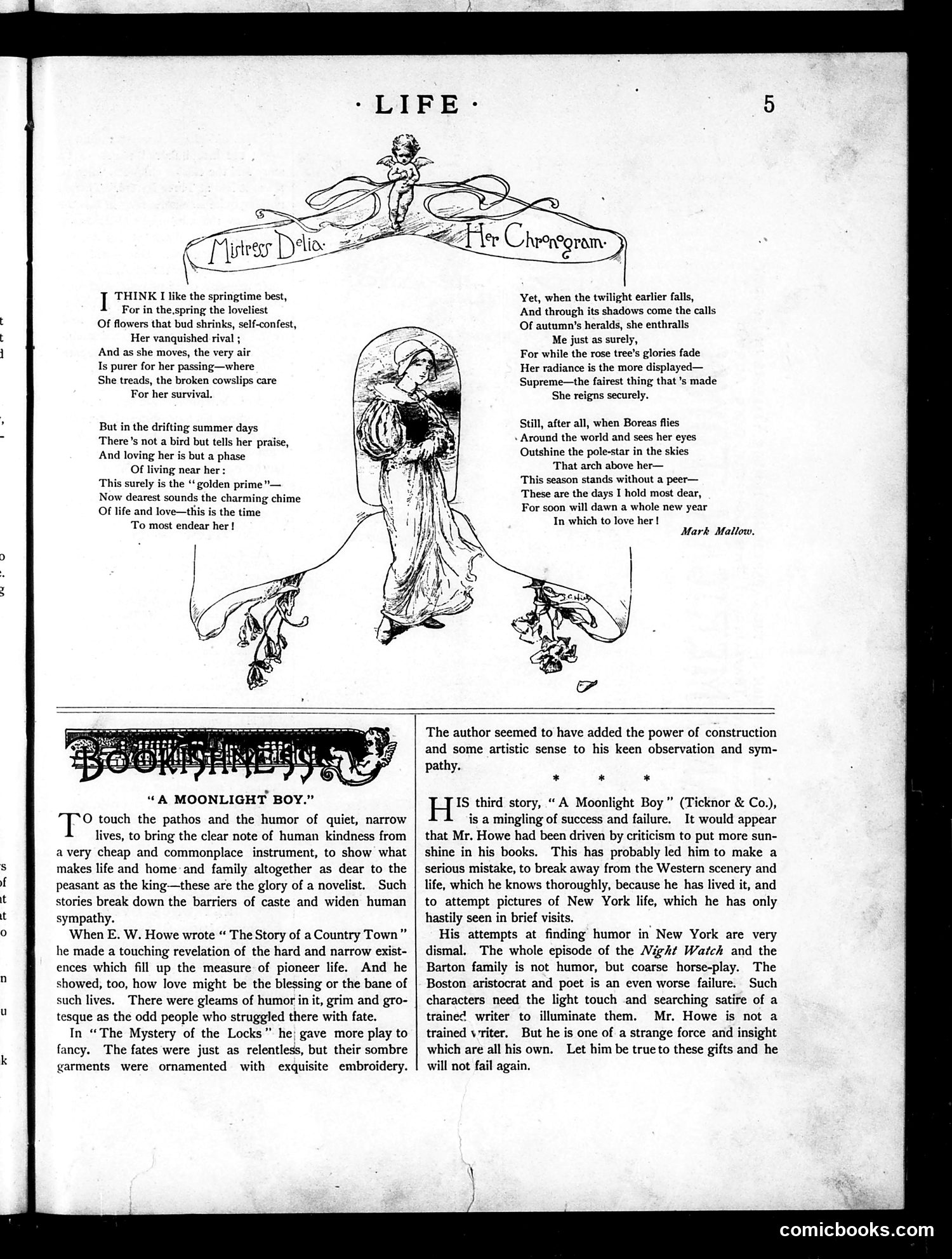
This page contains a poem titled "Mistress Delia" and "Her Chronogram" featuring an allegorical illustration of a woman representing the seasons. The decorative artwork shows a female figure in classical dress with flowing fabric connecting to seasonal imagery—likely representing spring, summer, and autumn. Below is a book review of E.W. Howe's "A Moonlight Boy." The critic praises Howe's ability to depict humble life and human kindness through "cheap and commonplace" details, contrasting this with his failed attempts at New York society satire. The reviewer suggests Howe succeeds when writing about rural/small-town life but struggles with urban subjects and character portrayal, encouraging him to stick to his strengths. This is literary criticism rather than political satire.
📄 Transcribed text from this page (OCR, searchable)
Machine-transcribed from the original scan — historical spelling and the odd misread are preserved.
THINK I like the springtime best, For in the,spring the loveliest Of flowers that bud shrinks, self-confest, Her vanquished rival ; And as she moves, the very air Is purer for her passing—where She treads, the broken cowslips care For her survival. But in the drifting summer days There's not a bird but tells her praise, And loving her is but a phase Of living near her : This surely is the “golden prime”— Now dearest sounds the charming chime Of life and love—this is the time To most endear her ! Yet, when the twilight earlier falls, And through its shadows come the calls Of autumn’s heralds, she enthralls Me just as surely, For while the rose tree’s glories fade Her radiance is the more displayed— Supreme—the fairest thing that’s made She reigns securely. Still, after all, when Boreas flies . Around the world and sees her eyes Outshine the pole-star in the skies That arch above her— ‘This season stands without a peer— ‘These are the days I hold most dear, For soon will dawn a whole new year In which to love her! Mark Mallow. “A MOONLIGHT BOY.” T° touch the pathos and the humor of quiet, narrow lives, to bring the clear note of human kindness from avery cheap and commonplace instrument, to show what makes life and home and family altogether as dear to the peasant as the king—these are the glory of a novelist. Such stories break down the barriers of caste and widen human sympathy. When E. W. Howe wrote “ The Story of a Country Town” he made a touching revelation of the hard and narrow exist- ences which fill up the measure of pioneer life. And he showed, too, how love might be the blessing or the bane of such lives. There were gleams of humor in it, grim and gro- tesque as the odd people who struggled there with fate. In “The Mystery of the Locks” he; gave more play to fancy. The fates were just as relentless, but their sombre garments were ornamented with exquisite embroidery. The author seemed to have added the power of construction and some artistic sense to his keen observation and sym- pathy. * * * IS third story, “ A Moonlight Boy” (Ticknor & Co.), is a mingling of success and failure. It would appear that Mr. Howe had been driven by criticism to put more sun- shine in his books. This has probably led him to make a serious mistake, to break away from the Western scenery and life, which he knows thoroughly, because he has lived it, and to attempt pictures of New York life, which he has only hastily seen in brief visits. His attempts at finding humor in New York are very dismal. The whole episode of the Might Watch and the Barton family is not humor, but coarse horse-play. The Boston aristocrat and poet is an even worse failure. Such characters need the light touch and searching satire of a trained writer to illuminate them. Mr. Howe is not a trained vriter. But he is one of a strange force and insight which are all his own. Let him be true to these gifts and he will not fail again. comicbooks.com