
A complete issue · 16 pages · 1886
Life — May 27, 1886
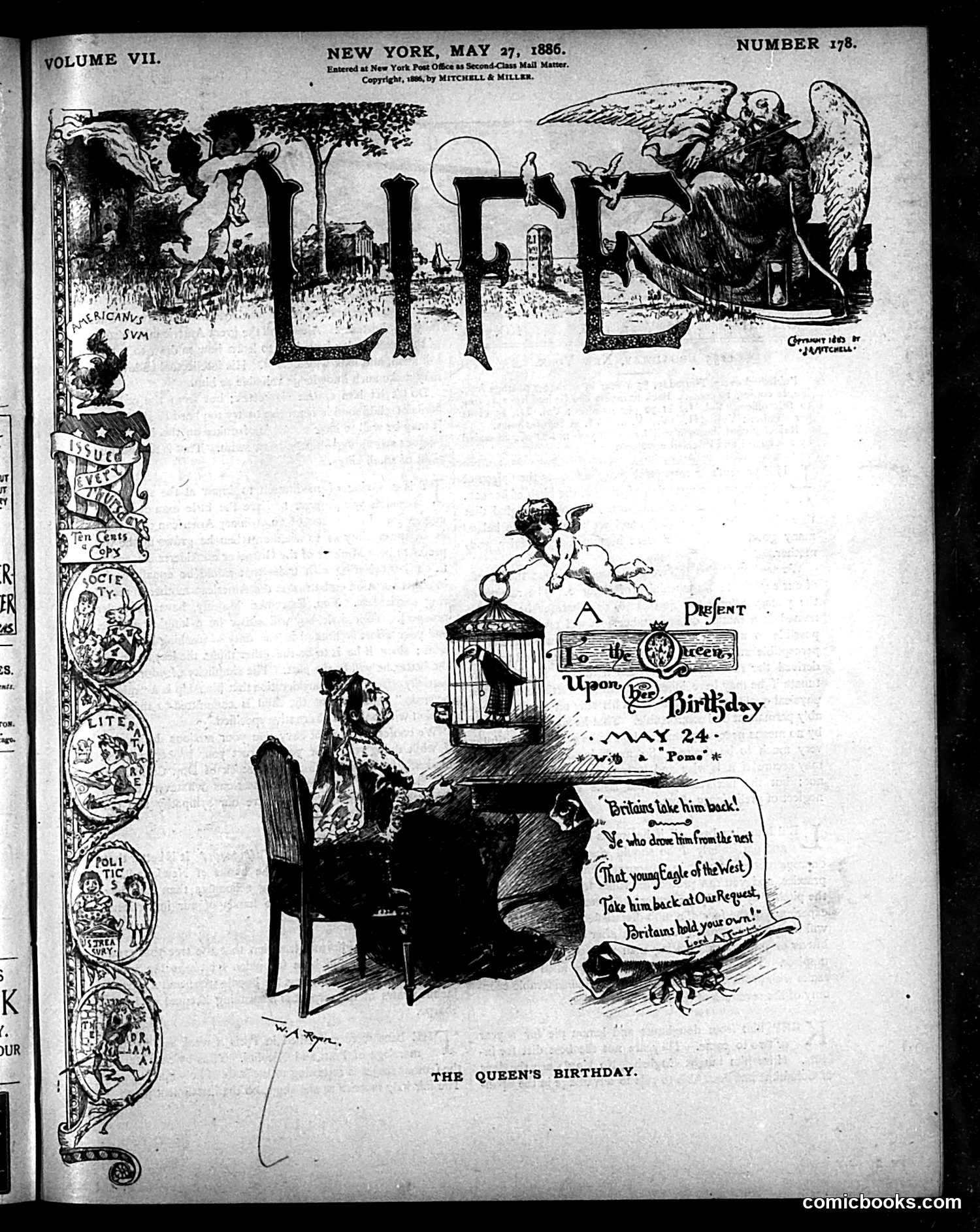
This satirical cartoon appears to reference Queen Victoria's birthday celebration (May 24). The main illustration shows Britannia (the female personification of Britain, identifiable by her characteristic pose and crown) seated, with a cherub above presenting a birdcage containing what appears to be an eagle—likely representing America or American interests. The accompanying text reads: "Britannia take him back! Ye who drew him from the nest / (That young Eagle of the West) / Take him back at Our request / Britannia hold your arms!" The satire suggests tension between Britain and America, humorously requesting America "return" to British control. This reflects late 19th-century Anglo-American relations and likely references specific contemporary diplomatic disputes, though the exact context remains unclear from this image alone.
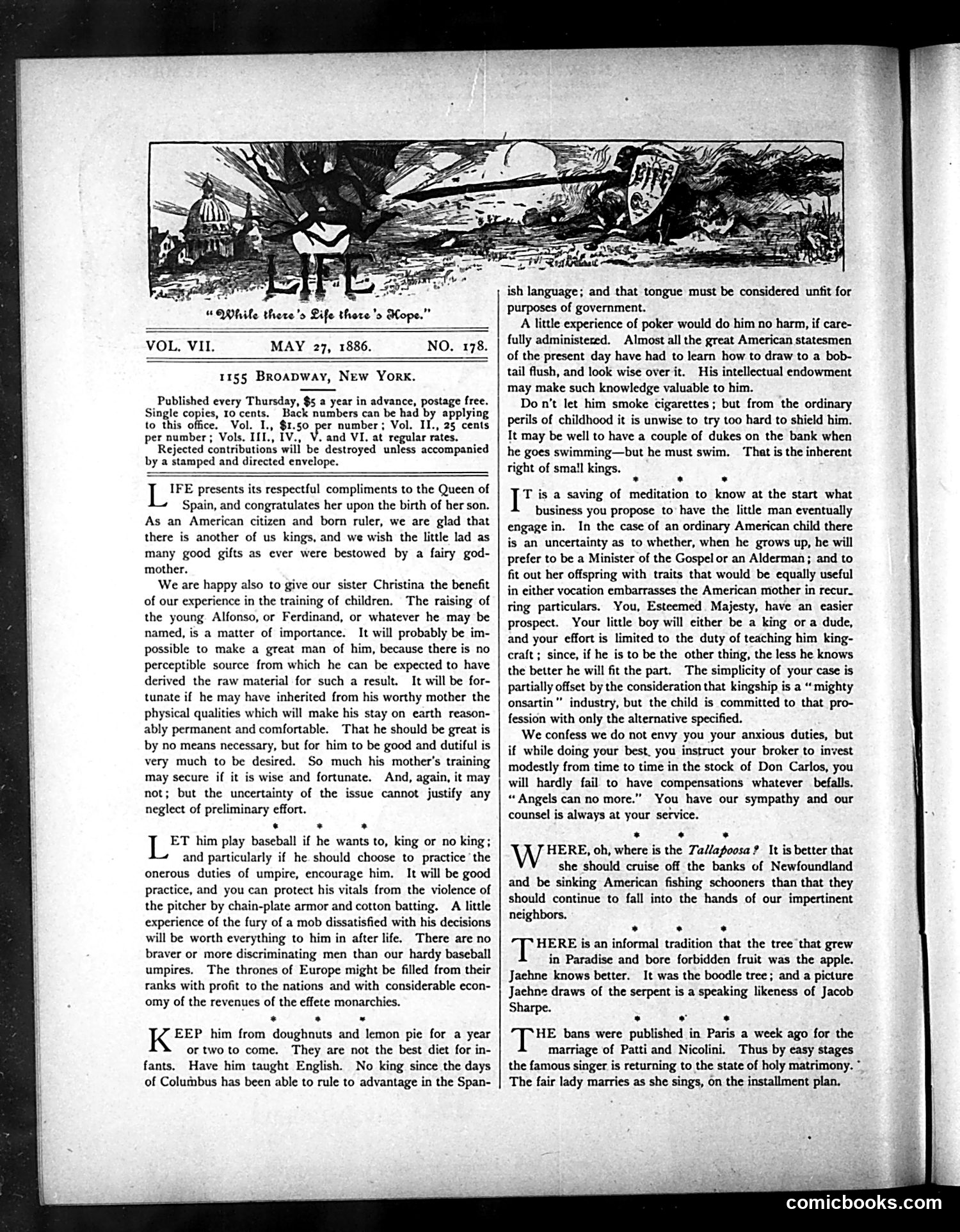
The masthead cartoon depicts a chaotic scene with the Statue of Liberty prominently featured, suggesting themes about immigration and American ideals during this period. The text columns discuss advice for raising children of prominent families, including references to a Spanish royal birth and suggestions about education. One section humorously advises allowing a boy to "play baseball if he wants to" and experience life's lessons naturally rather than through excessive protection. The satirical tone targets upper-class parenting anxieties of the era—balancing strict discipline with practical experience. References to "Don Carlos" and Spanish nobility indicate the piece addresses wealthy American readers concerned with their children's prospects in politics, business, or the ministry. The humor mocks excessive parental worry while endorsing moderate childhood freedoms as character-building.
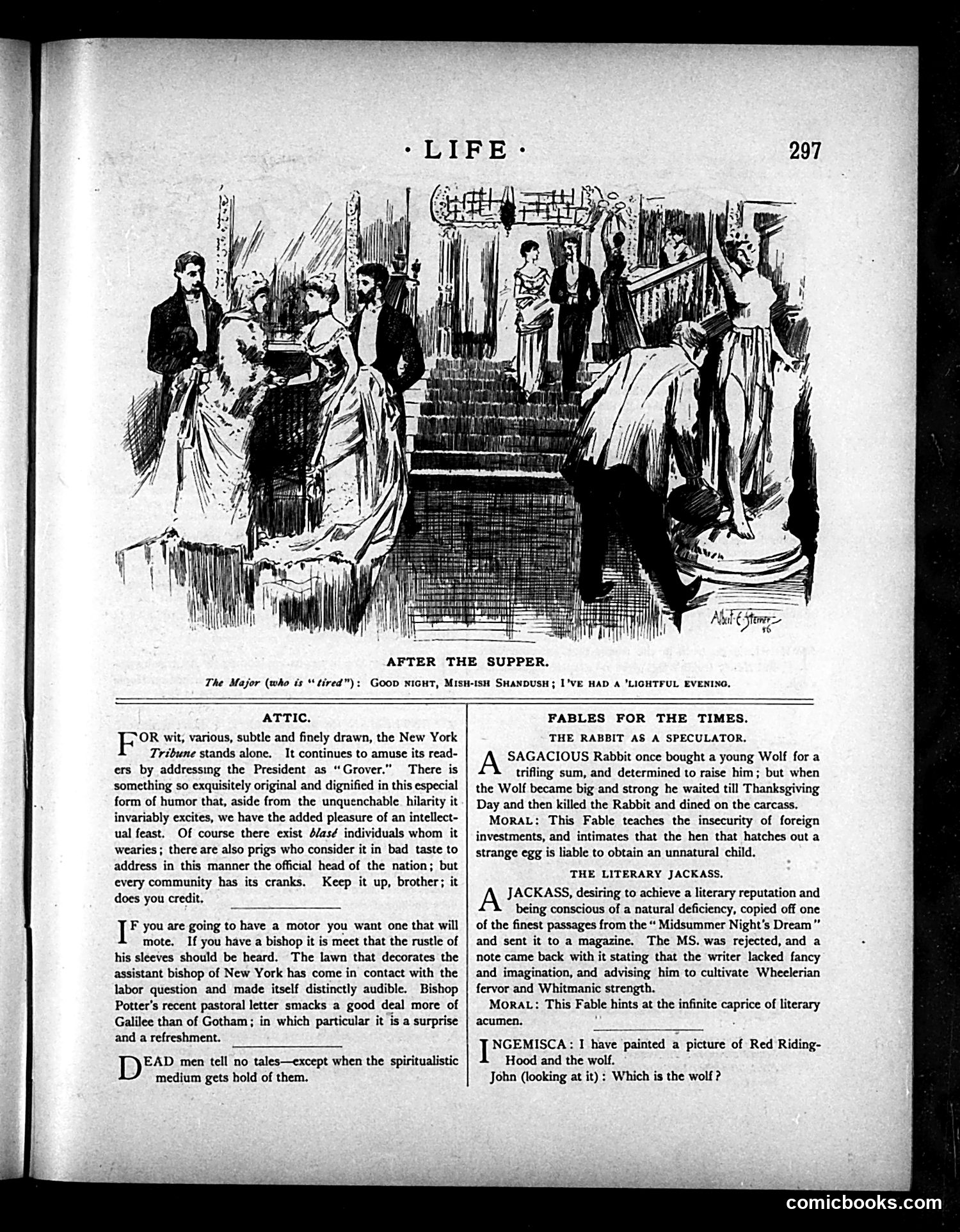
The main cartoon depicts an elegant social gathering, likely from the early 20th century. The caption attributes a quote to "The Major (who is 'tired')," suggesting satirical commentary on a specific public figure or type—possibly a military officer or politician affected by social obligations. The text below addresses wit and humor in *Life* magazine's coverage of President Theodore Roosevelt as "Grocer," referencing his populist appeal. References to motor cars, labor disputes, and spiritualist mediums indicate satirical commentary on contemporary social issues and fads. The "Fables for the Times" section offers moral tales about literary pretension and financial speculation, typical of *Life*'s social satire aimed at middle-class readers concerned with authenticity versus affectation.
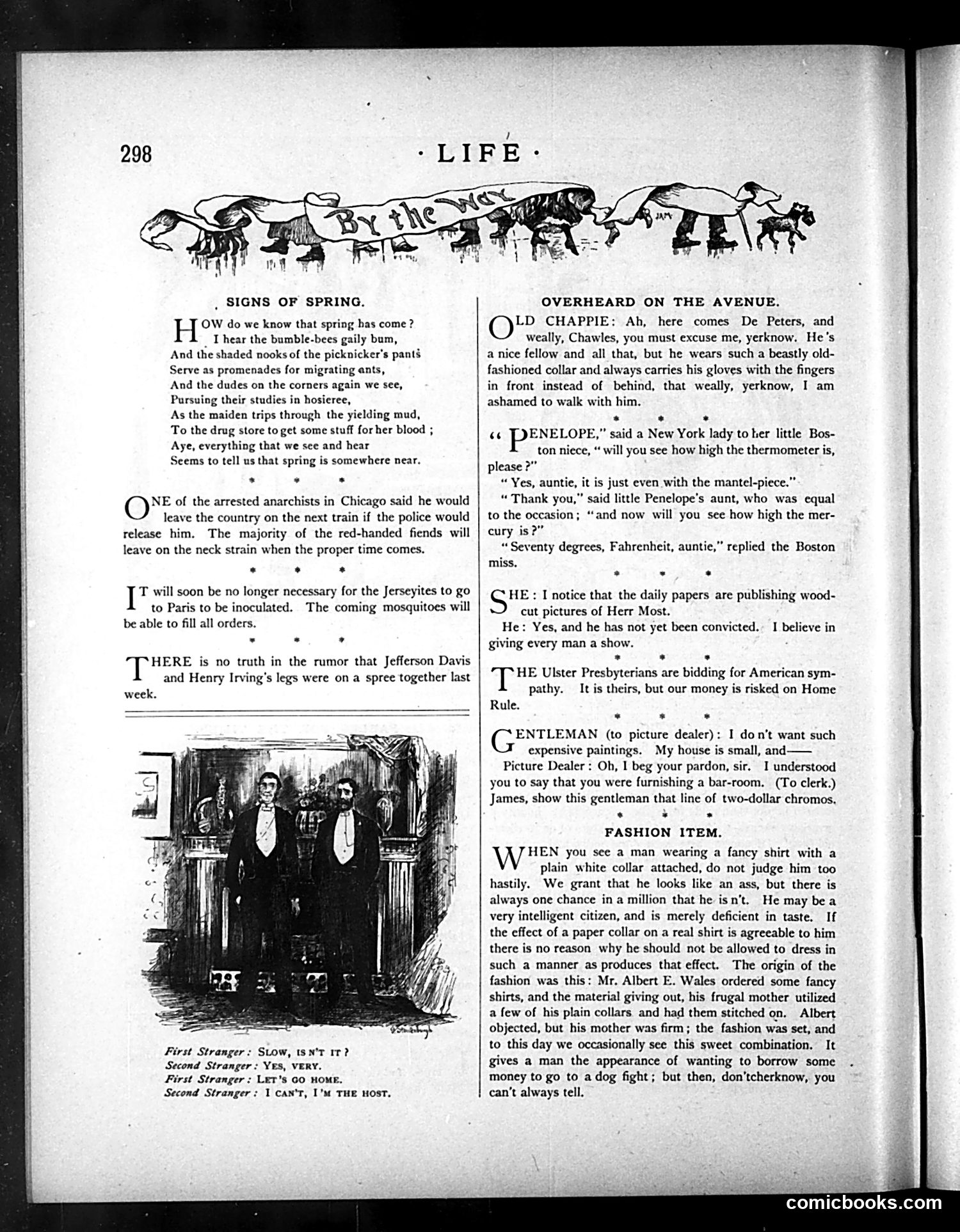
This page contains several brief satirical items and a cartoon rather than a single coherent political statement. **The cartoon** depicts two men in formal dress with the caption "First Stranger: Slow, isn't it? / Second Stranger: Yes, very. / First Stranger: Let's go home. / Second Stranger: I can't, I'm the host." It's a social humor piece about the awkwardness of a dull gathering. **The text items** mock various contemporary subjects: Chicago anarchists' legal proceedings, Jersey mosquitoes, Jefferson Davis and Henry Irving, Ulster Presbyterians' political stance, and a gentleman purchasing expensive art. **"Fashion Item"** discusses men wearing plain collars with fancy shirts—apparently initiated by Albert E. Wales—as social commentary on class performance and appearance versus reality. The page is primarily *social satire* rather than hard political commentary, targeting manners, fashion pretension, and everyday absurdities of the era.
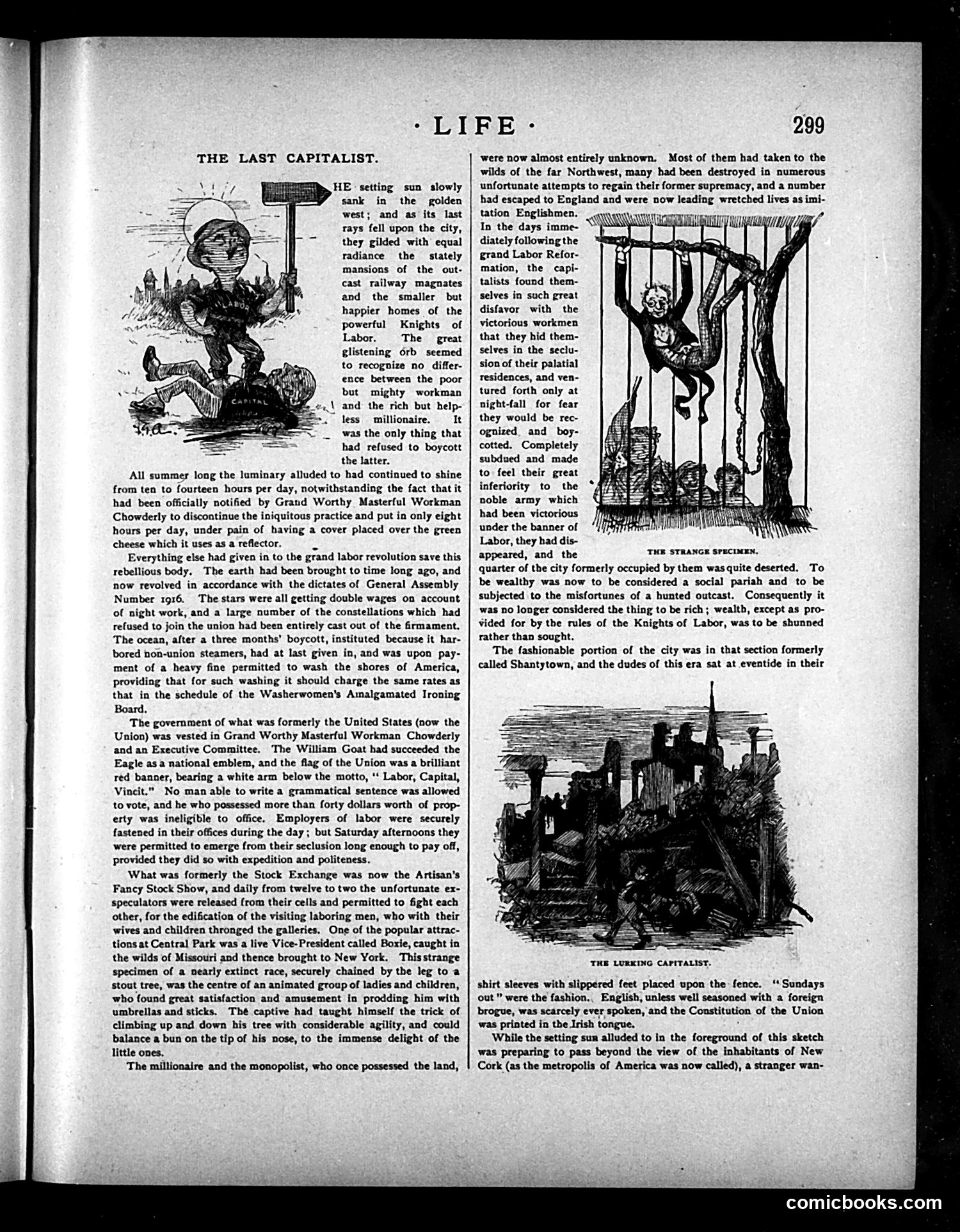
This page satirizes the post-Labor Reformation period, depicting a dystopian future where capitalists have been overthrown. The left illustration shows a wealthy capitalist being exhibited like a museum specimen—labeled "CAPITAL"—suggesting the rich have become curiosities rather than rulers. The right illustrations depict the Knights of Labor's victory: wealthy mansions now serve as public hangings sites ("The Strange Specimen," "The Lurking Capitalist"), with capitalists treated as dangerous relics to be displayed or executed. The text mocks how former power structures inverted—Grand Worthy Masterworkman Chowdery now governs, the Stock Exchange became a "Fancy Stock Show," and capitalists are hunted outcasts. The satire warns upper-class readers about labor movement strength and social revolution, presenting their potential dispossession as darkly comic inevitability.
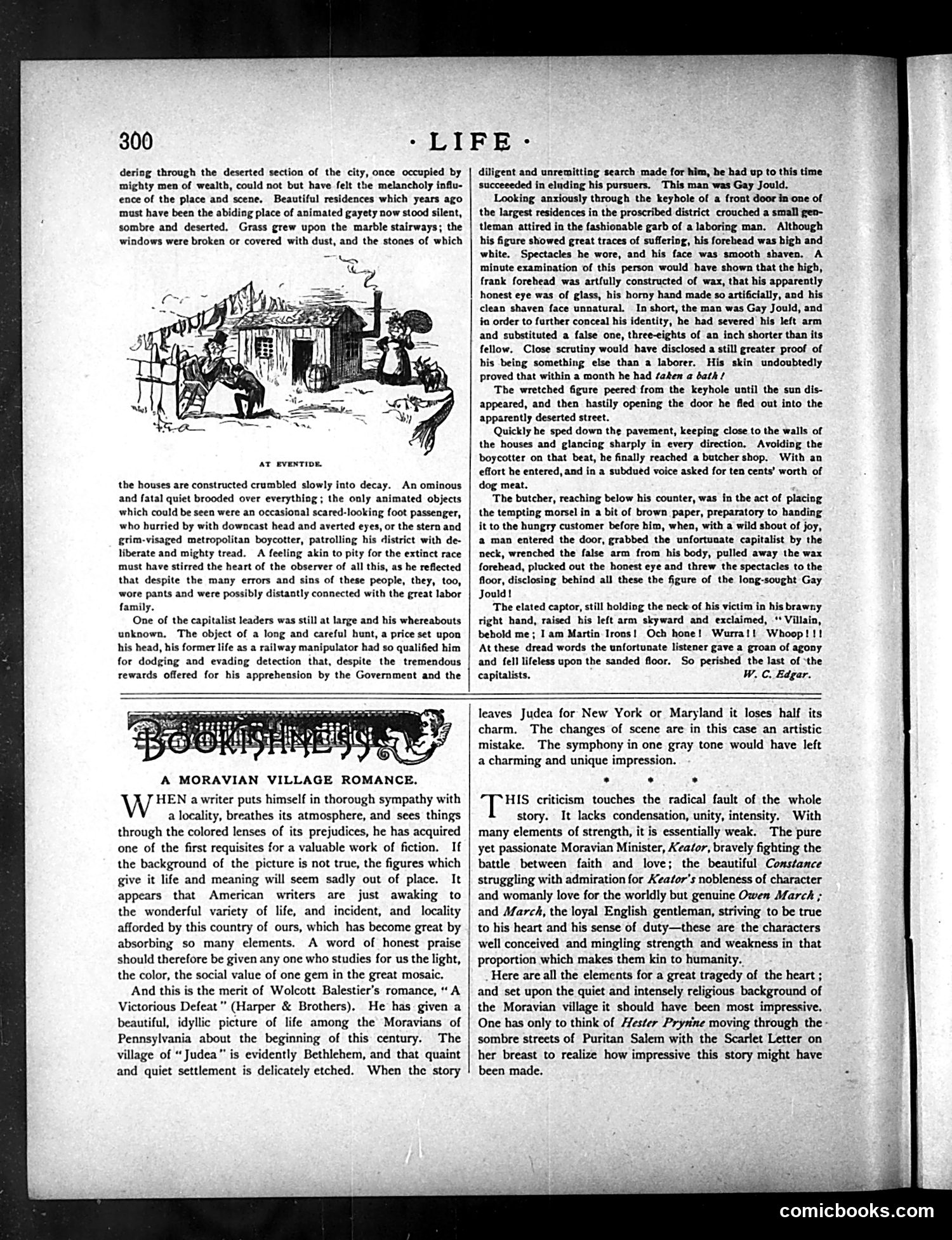
The main illustration titled "At Eventide" depicts a deteriorating urban slum scene where laborers' tenements have "crumbled slowly into decay." The image shows working-class residents amid dilapidated housing, illustrating the social commentary on industrial-era poverty. The text criticizes capitalist exploitation, describing how a wealthy businessman manipulates a desperate laborer seeking work. When the man enters a butcher shop, the capitalist "grabbed the unfortunate capitalist by the neck, wrenched the false arm from his body, pulled away the was and threw the spectacles to the floor"—revealing the capitalist's deception. The cartoon satirizes wealthy industrialists' hypocrisy and the stark class divisions of turn-of-the-century America, particularly the brutal conditions faced by urban working-class communities.
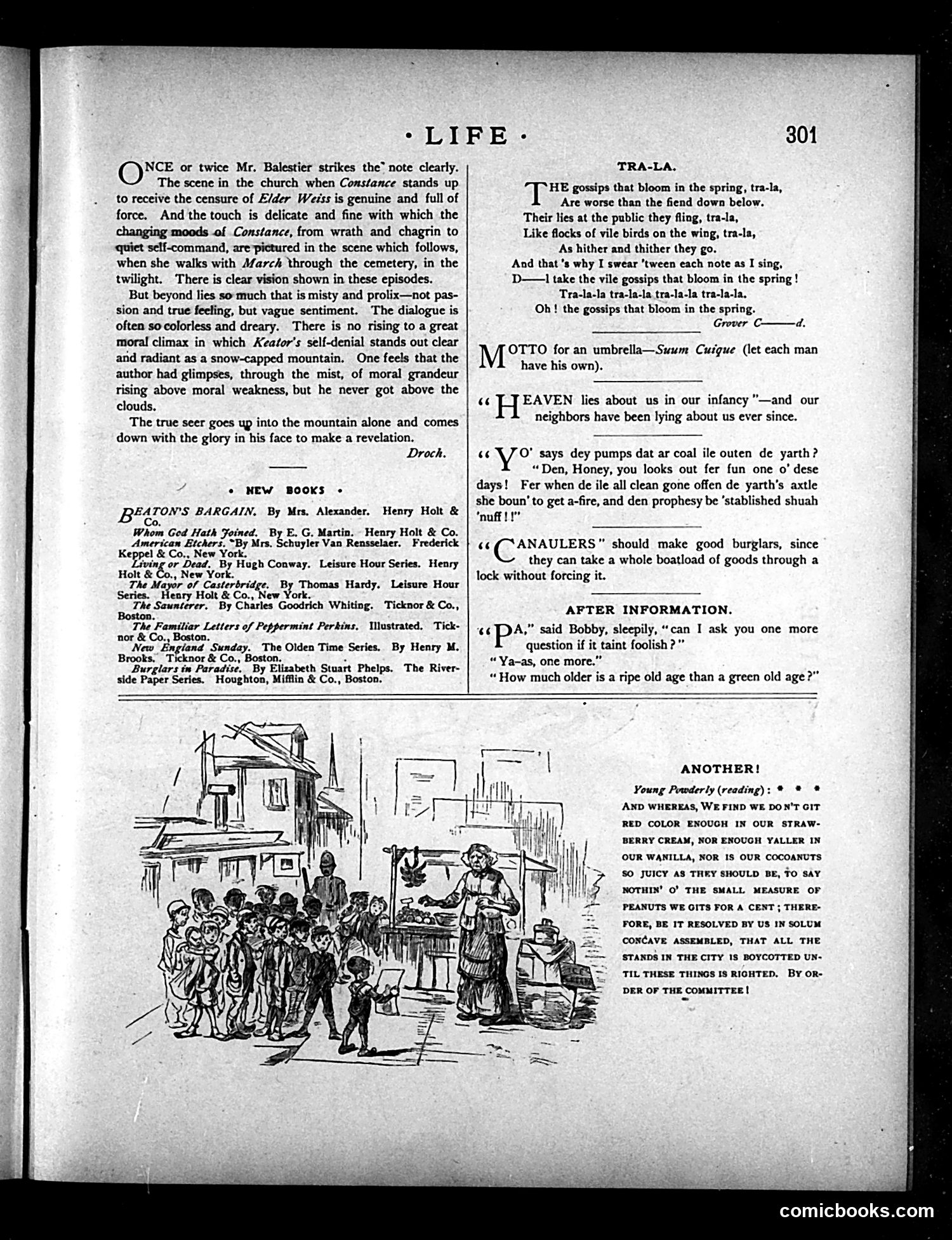
This page contains literary criticism and humor pieces rather than political cartoons. The left column discusses works by authors like Elder Weiss and discusses character "Kvastor's" moral journey through mountains—literary analysis typical of the era. The "Tra-la" section features gossipy verse about spring romance and social behavior, presented as light satire on courtship customs. The "Motto" and subsequent quoted sections appear to be humorous observations on contemporary life—including commentary on lying ("Heaven lies about us"), colloquial speech patterns, and social expectations around appearance and consumer goods. The sketch at bottom depicts what appears to be a street market or vendor scene with crowds, likely illustrating one of the accompanying anecdotes. The "After Information" section contains children's riddles. Overall, this is general cultural humor and literary content, not political satire.
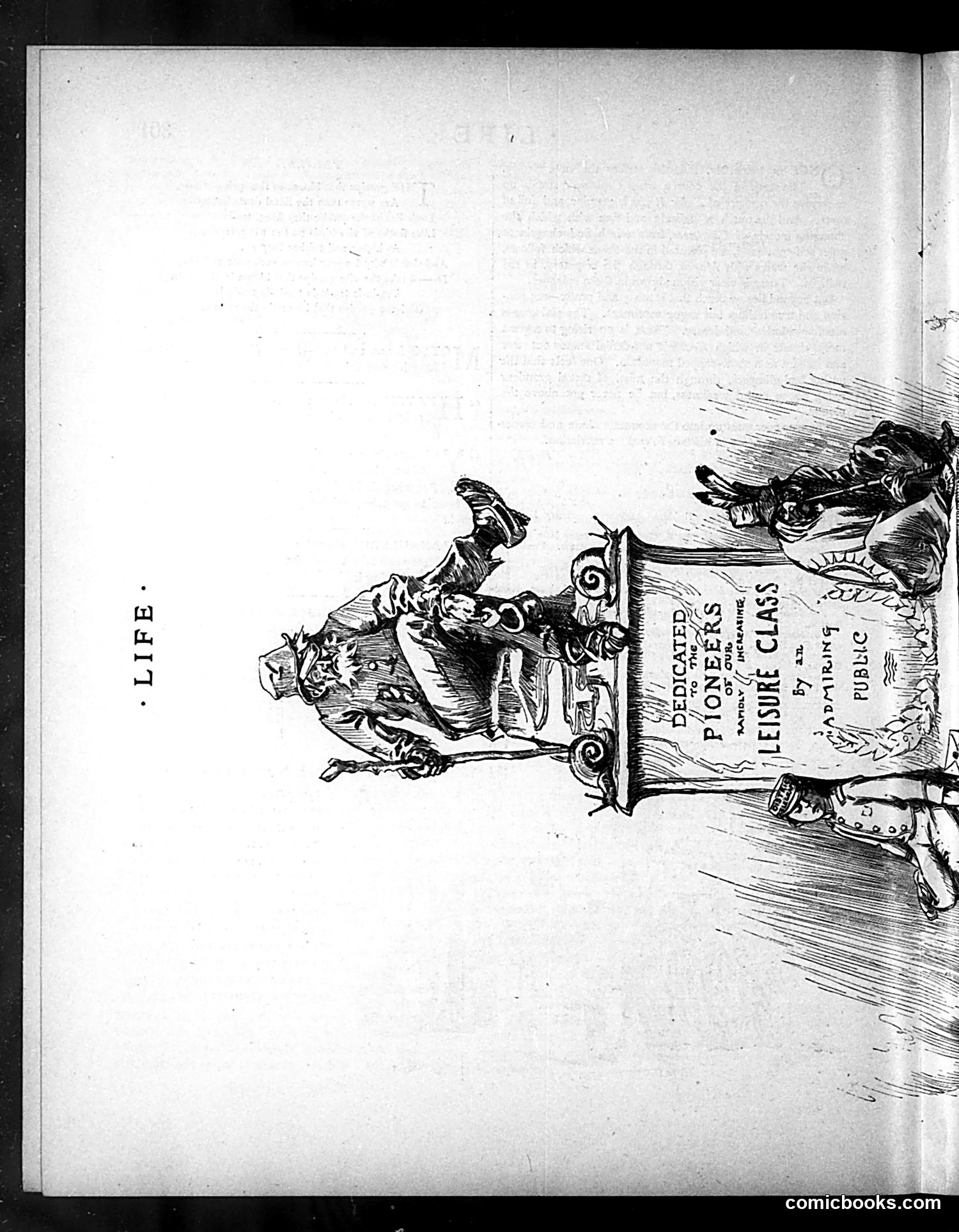
This is a title page from *Life* magazine featuring an ornate, decorative illustration. The central image shows a classical female figure in flowing robes, positioned within an elaborate architectural frame with scrollwork and decorative elements. Text on the frame reads "DEDICATED TO HONEST PLEASURES" and appears to reference publication details. The left margin contains the word "LIBER" (Latin for "book" or "free"). Without additional context or visible date information on this page, I cannot definitively identify which specific issue this is or what contemporary political/social events it references. The classical allegorical style suggests an early-to-mid period *Life* cover, but the exact satirical target remains unclear from this image alone.
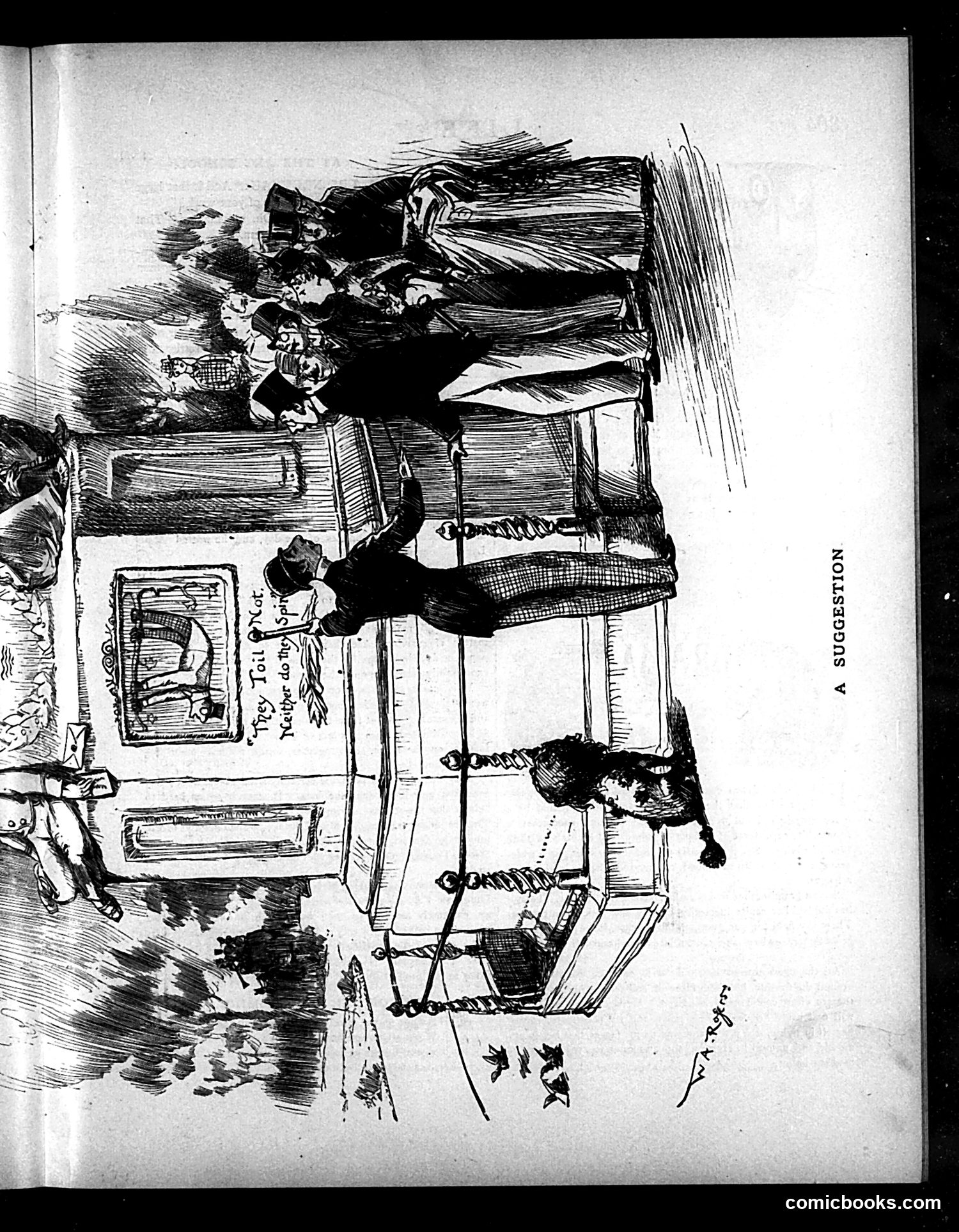
This appears to be a satirical sketch showing a domestic interior scene. The image depicts what seems to be a social commentary on household dynamics or domestic relations, likely from the early 20th century based on the artistic style and furnishings shown. The cartoon shows figures in a room with period furniture and decorative elements. The title "A SUGGESTION" implies the artist is offering social commentary or critique on some aspect of domestic or social behavior. However, without clearer visibility of specific facial features, text labels, or additional context, I cannot definitively identify which specific political figures or social issues this cartoon addresses. The sketch quality and historical nature suggest it satirizes common social situations or relationships of its era, but the exact target remains unclear from this image alone.
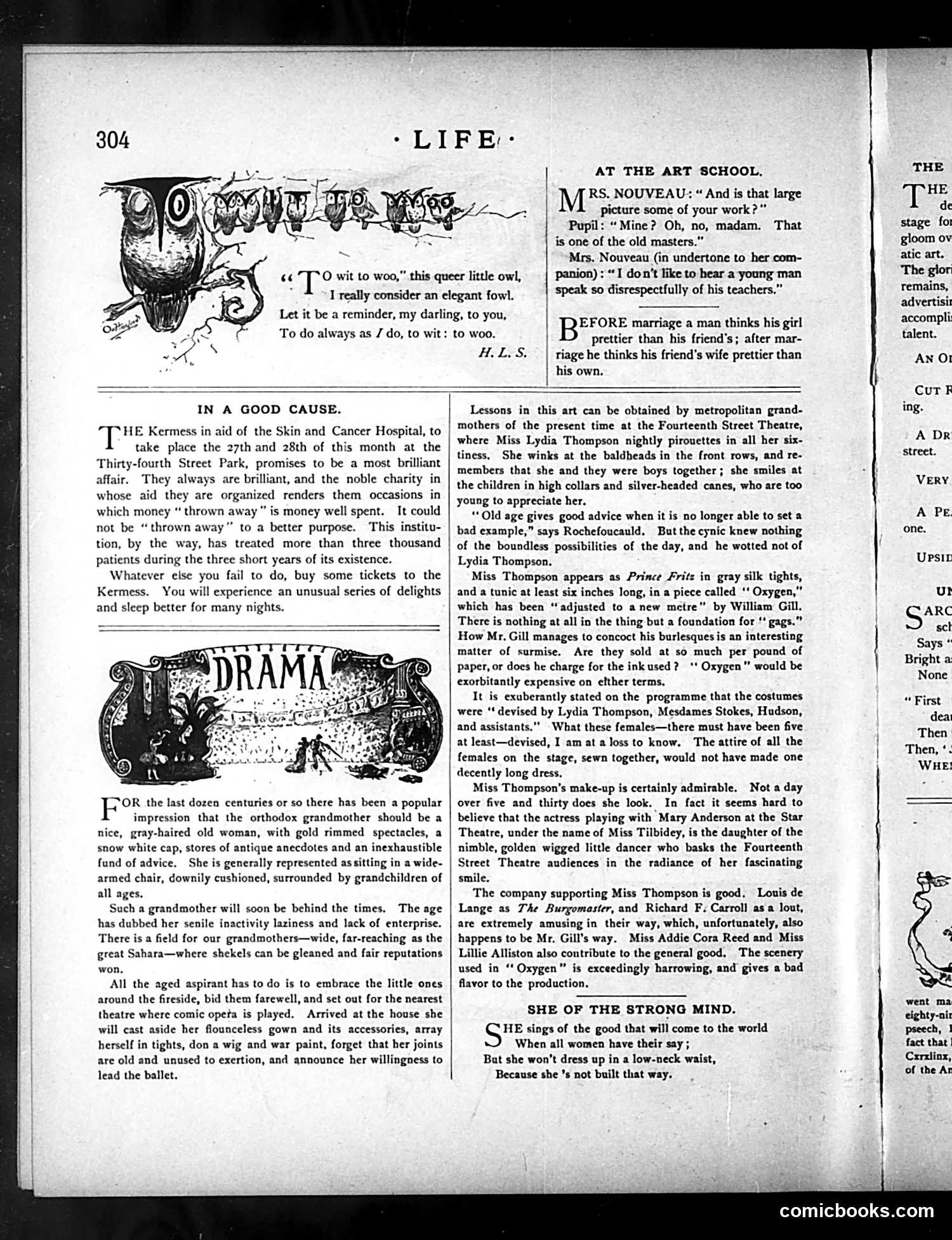
This page contains three satirical pieces: **"To Wit to Woo"** (top): A brief illustrated quip about an owl, offering courtship advice in typically ornate Victorian verse. **"At the Art School"**: Mocks newly wealthy "nouveau riche" patrons. Mrs. Nouveau criticizes a young art student for disrespectfully calling old masters "old"—she's so culturally insecure she doesn't realize he means historical painters, not teachers. The joke exposes her pretentious ignorance. **"Before Marriage"**: A cynical aphorism about male perception: men idealize their girlfriends until marriage, then find other men's wives more attractive than their own. **Main Content** discusses **Lydia Thompson**, an aging actress performing as "Prince Fritz" in burlesque. Life celebrates her vitality while satirizing the absurdity of elderly women in theatrical tights. The piece mocks both aging performers and the flimsy plots ("nothing but foundation for gags") of contemporary burlesque theater—suggesting these productions are pure spectacle masquerading as art. The overall tone is urbane mockery of cultural pretension and theatrical excess.
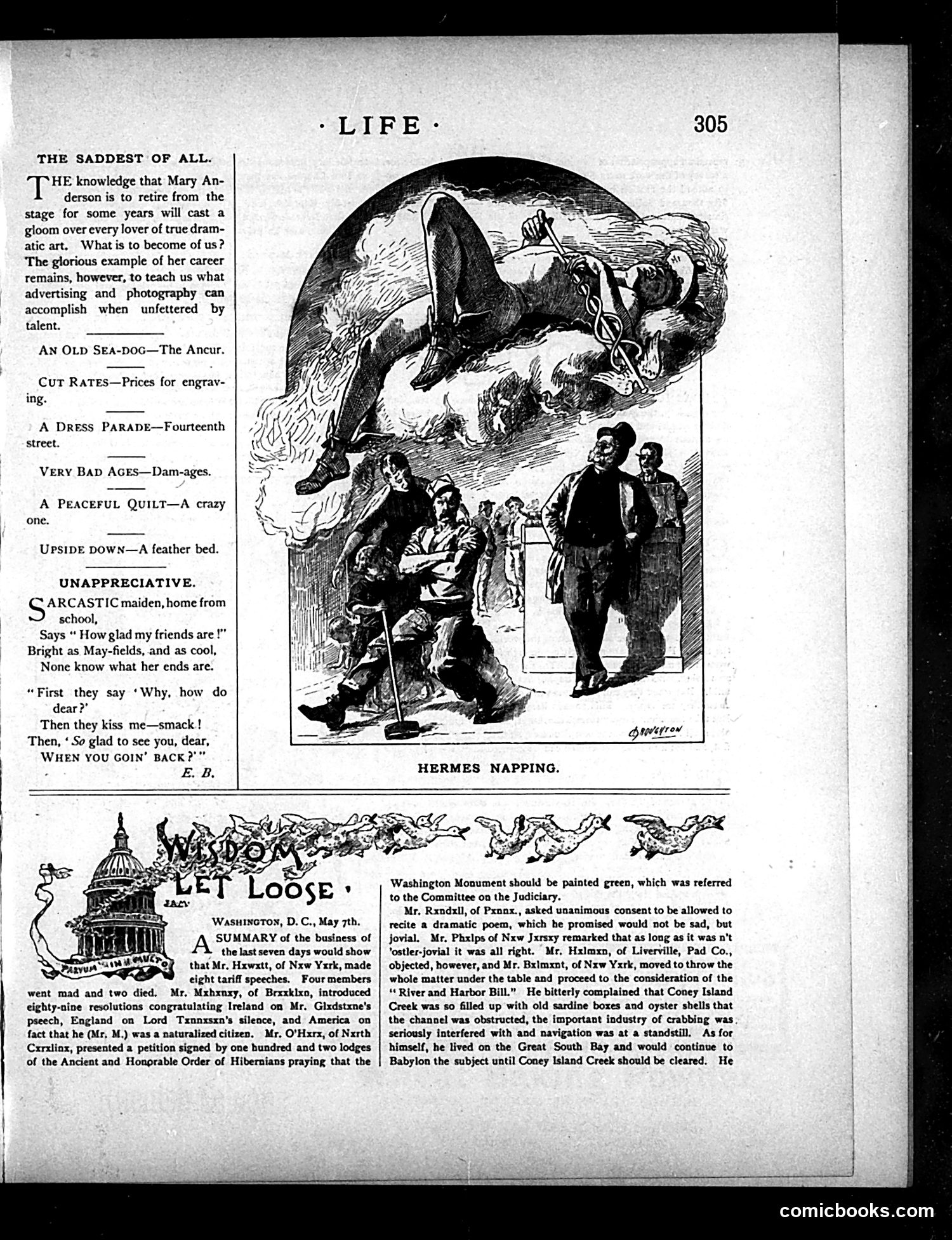
This page contains several satirical items mocking American politics and social conventions of the era. **Main Cartoon ("Hermes Napping"):** Shows the Greek messenger god asleep while well-dressed men conduct business below—likely satirizing government inefficiency or the slow pace of official action. **Text Satire:** The "Summary" section parodies Congressional absurdity. Named congressmen (with deliberately obscured names using X's) perform pointless tasks: endless tariff speeches, resolutions congratulating foreign politicians, and petitions about trivial matters like painting the Washington Monument green. The final anecdote mocks self-interested politicians—a congressman complains that Coney Island Creek is clogged with oyster shells, disrupting his crabbing hobby, rather than addressing actual navigation concerns. **Other Items:** Brief puns ("Dam-ages," "feather bed") and a poem mocking an ungrateful schoolgirl whose friends kiss her hello but immediately ask when she's leaving. The overall tone satirizes political posturing, vanity, and disconnection from genuine public service.
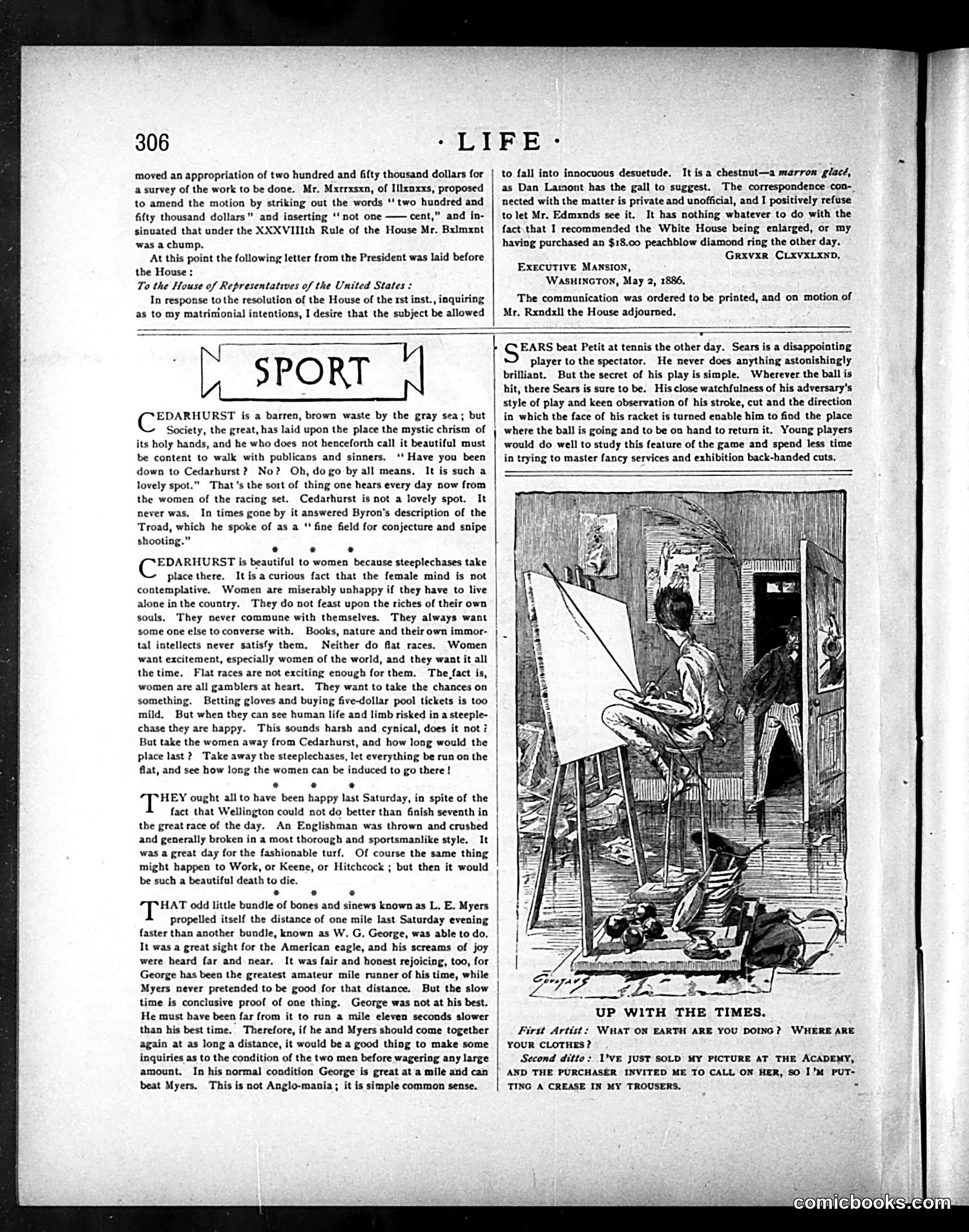
The page opens with a mock letter from President Grover Cleveland to Congress, dismissing inquiries about his marriage intentions as a "chestnut" (worn-out joke). The satire mocks Cleveland's defensive tone—he denies that his recommendation for White House enlargement or purchase of a "$18.00 peachblow diamond ring" relates to matrimonial plans. This references real contemporary gossip about Cleveland's personal life and spending, presenting his formal response as absurdly overwrought. The "SPORT" section shifts to satirizing wealthy society women at Cedarhurst, a fashionable racing venue. The author argues women find steeplechases (horse races with obstacles) exciting only because human injury is risked, and would abandon the location entirely if races became "flat" (safer). This is caustic social commentary on female frivolousness and dependence on spectacle for entertainment—typical of the era's condescending attitudes toward women.
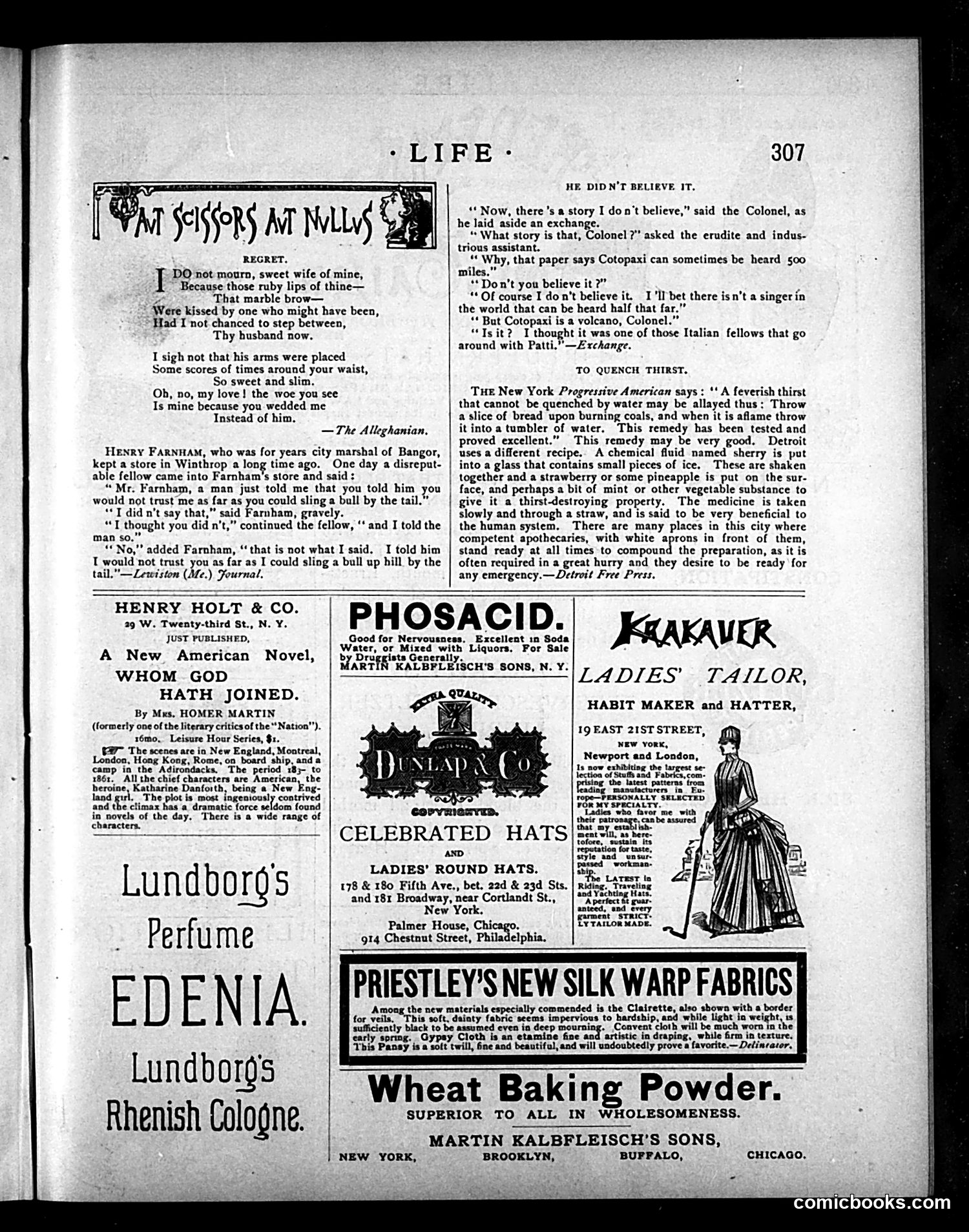
This page is primarily **advertisements and light humor pieces**, not political satire requiring historical context. The main content includes: **"He Didn't Believe It"** — A brief anecdote mocking a Colonel's ignorance. He dismisses a newspaper claim that Cotopaxi volcano can be heard 500 miles away, insisting no singer could project that far. The joke hinges on his confusion: he apparently thinks "Cotopaxi" refers to an Italian opera performer traveling with the famous singer Patti, not the volcano itself. This is simple wordplay humor, not political commentary. **"Regret"** and **"Henry Farnham"** — Sentimental poetry and a brief anecdote about trust and negotiation. **"To Quench Thirst"** — A humorous piece contrasting practical remedies (burnt bread in water) with more elaborate preparations involving sherry and fruit. The remainder consists of period advertisements for perfume, novels, hats, baking powder, and fabric — typical of 19th-century magazine content.
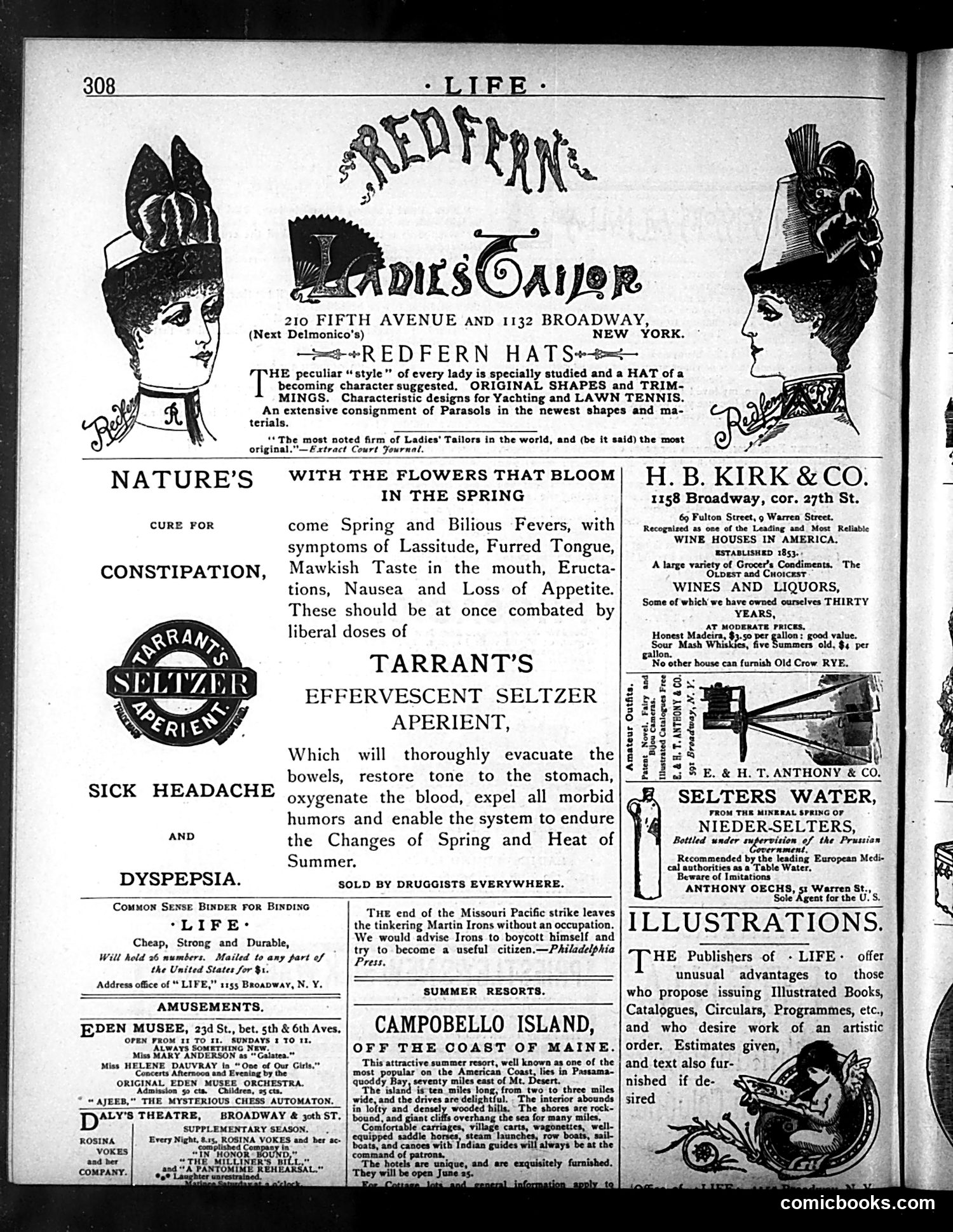
This page is primarily **advertising and announcements** rather than satirical content. The dominant features are commercial advertisements for fashionable goods typical of the 1880s-90s era. **Main Content:** - Two illustrated women's heads advertising Redfern Hats (a high-end millinery house), emphasizing custom styling for ladies' activities like yachting and lawn tennis - Patent medicine ads for Tarrant's Effervescent Seltzer, marketing it as a spring tonic for constipation, headaches, and "bilious fevers"—typical of the era's dubious health cure marketing - Wine, camera equipment, and resort advertisements **Notable Editorial Item:** A brief satirical note about **Martin Irons**, a labor strike leader, suggesting he "boycott himself" and become useful—likely referring to the recent Missouri Pacific Railroad strike, mocking a controversial labor figure of that period. The page reflects Life's dual function as both satirical publication and advertising vehicle, with commercial content dominating the layout.
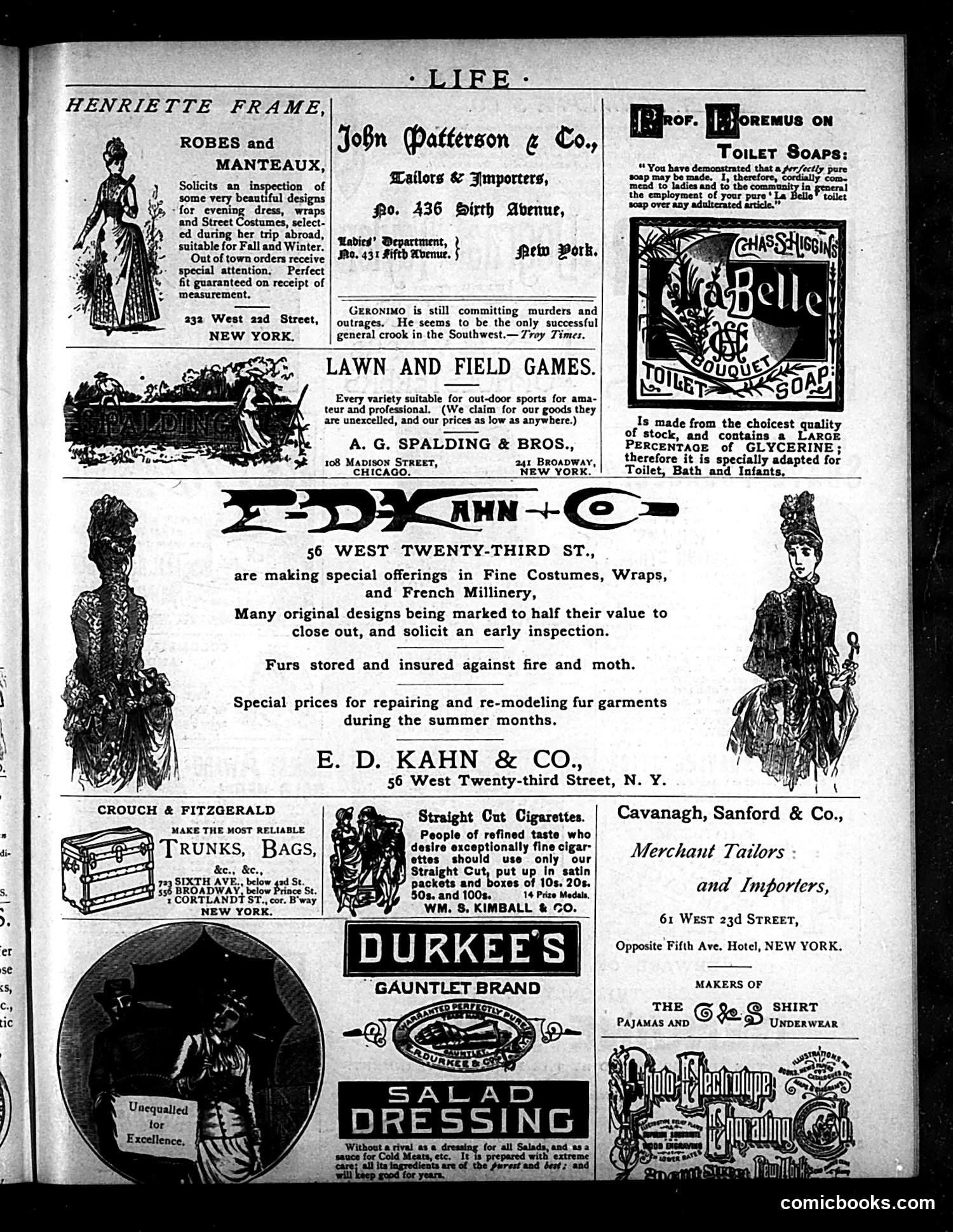
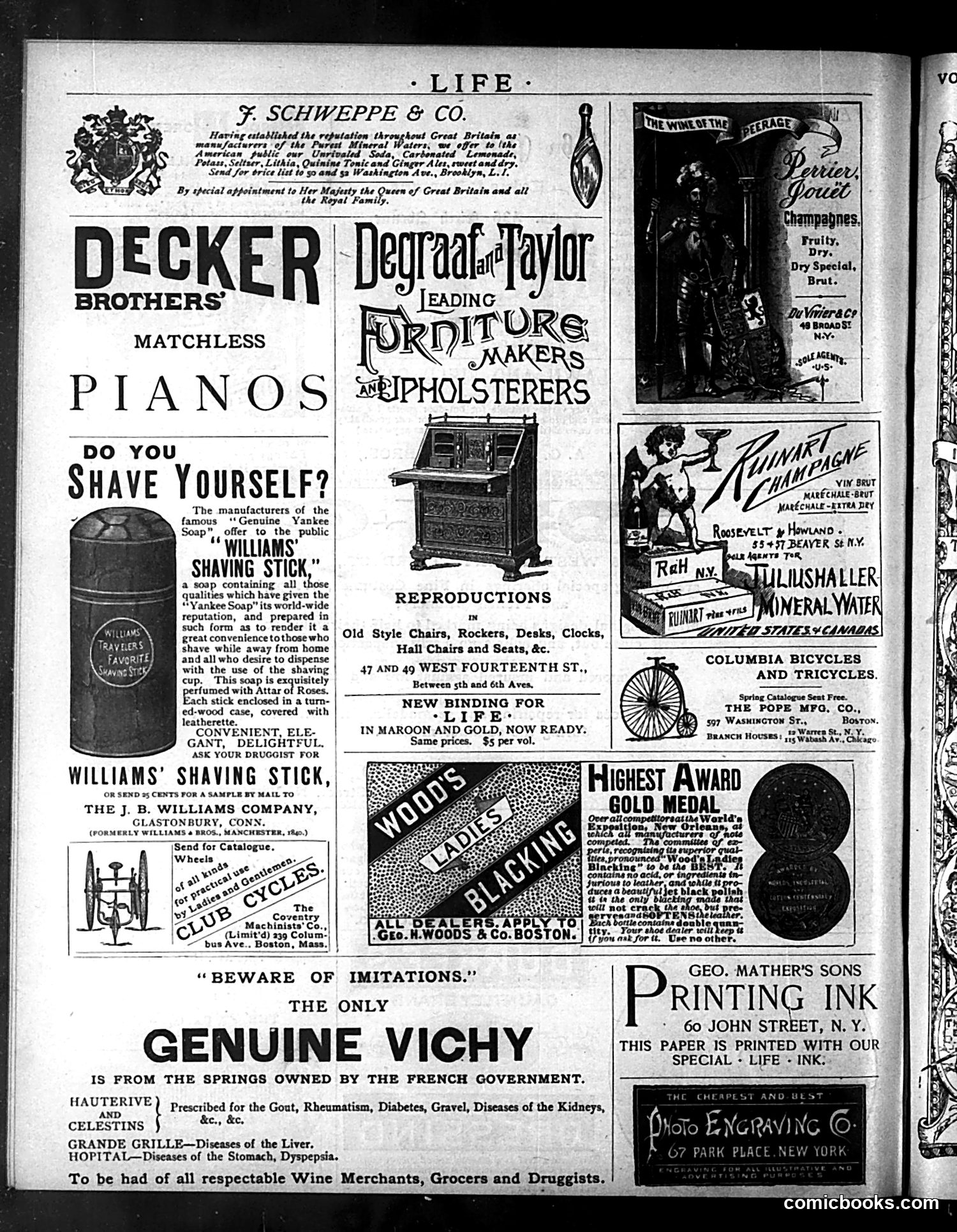
This page from *Life* magazine is overwhelmingly **advertisements** rather than editorial content or political satire. There are no identifiable political cartoons or satirical commentary visible. The ads promote various consumer products and services typical of the late 19th century: Decker Brothers pianos, Williams' shaving stick, Vichy mineral water (imported from France), Degraaf & Taylor furniture, Columbia bicycles, and printing services. There's also a small notice about new bindings for *Life* magazine itself. The only potentially noteworthy element is the repeated warning "BEWARE OF IMITATIONS" regarding Vichy water—reflecting period concerns about counterfeit imported goods—but this is commercial messaging, not satire. Without visible cartoon imagery or satirical text targeting political figures or social issues, this page demonstrates how early *Life* combined light editorial content with substantial advertising revenue.