
Life, 1886-05-27 · page 6 of 16
Life — May 27, 1886 — page 6: what you’re looking at
What you’re looking at
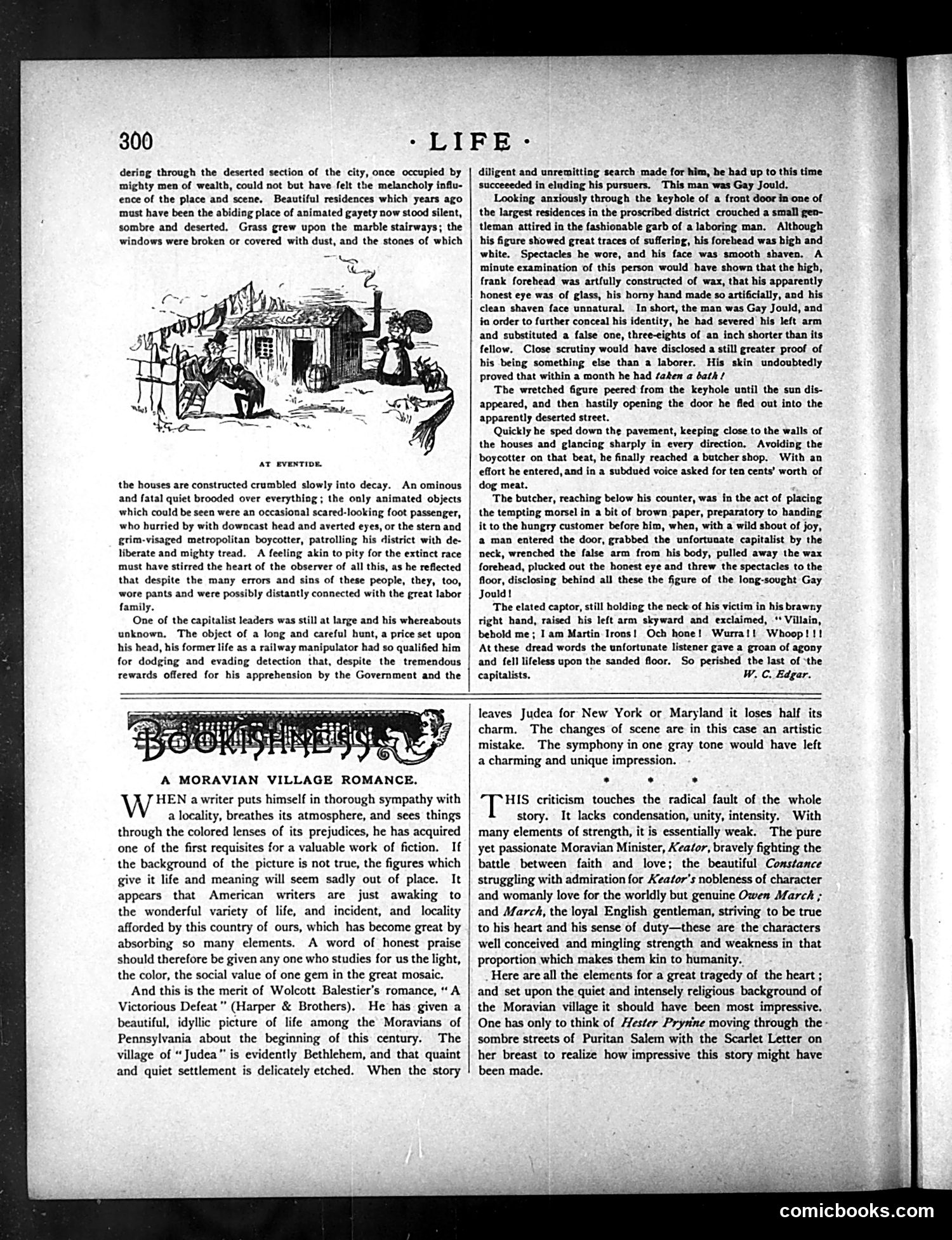
The main illustration titled "At Eventide" depicts a deteriorating urban slum scene where laborers' tenements have "crumbled slowly into decay." The image shows working-class residents amid dilapidated housing, illustrating the social commentary on industrial-era poverty. The text criticizes capitalist exploitation, describing how a wealthy businessman manipulates a desperate laborer seeking work. When the man enters a butcher shop, the capitalist "grabbed the unfortunate capitalist by the neck, wrenched the false arm from his body, pulled away the was and threw the spectacles to the floor"—revealing the capitalist's deception. The cartoon satirizes wealthy industrialists' hypocrisy and the stark class divisions of turn-of-the-century America, particularly the brutal conditions faced by urban working-class communities.
📄 Transcribed text from this page (OCR, searchable)
Machine-transcribed from the original scan — historical spelling and the odd misread are preserved.
300 dering through the deserted section of the city, once occupied by mighty men of wealth, could not but have felt the melancholy influ- ence of the place and scene. Beautiful residences which years ago must have been the abiding place of animated gayety now stood silent, sombre and deserted. Grass grew upon the marble stairways; the windows were broken or covered with dust, and the stones of which AT EVENTIDE. the houses are constructed crumbled slowly into decay. An ominous and fatal quiet brooded over everything; the only animated objects which could be seen were an occasional scared-looking foot passenger, who hurried by with downcast head and averted eyes, or the stern and grim-visaged metropolitan boycotter, patrolling his district with de- liberate and mighty tread. A feeling akin to pity for the extinct race must have stirred the heart of the observer of all this, as he reflected that despite the many errors and sins of these people, they, too, wore pants and were possibly distantly connected with the great labor family. One of the capitalist leaders was still at large and his whereabouts unknown. The object of a long and careful hunt, a price set upon his head, his former life as a railway manipulator had so qualified him for dodging and evading detection that, despite the tremendous rewards offered for his apprehension by the Government and the - LIFE: diligent and unremitting search made for him, he had up to this time succeeeded in eluding his pursuers, This man was Gay Jould. Looking anxiously through the keyhole of a front door in one of the largest residences in the proscribed district crouched a small gen- tleman attired in the fashionable garb of a laboring man. Although his figure showed great traces of suffering, his forehead was high and white. Spectacles he wore, and his face was smooth shaven. A minute examination of this person would have shown that the high, frank forehead was artfully constructed of wax, that his apparently honest eye was of glass, his horny hand made so artificially, and his clean shaven face unnatural. In short, the man was Gay Jould, and in order to further conceal his identity, he had severed his left arm and substituted a false one, three-eights of an inch shorter than its fellow. Close scrutiny would have disclosed a still greater proof of his being something else than a laborer. His skin undoubtedly proved that within a month he had ¢aken a bath! The wretched figure peered from the keyhole until the sun dis- appeared, and then hastily opening the door he fied out into the apparently deserted street. Quickly he sped down the pavement, keeping close to the walls of the houses and glancing sharply in every direction, Avoiding the boycotter on that beat, he finally reached a butcher shop. With an effort he entered, and in a subdued voice asked for ten cents’ worth of dog meat. ‘The butcher, reaching below his counter, was in the act of placing the tempting morsel in a bit of brown paper, preparatory to handing it to the hungry customer before him, when, with a wild shout of joy, a man entered the door, grabbed the unfortunate capitalist by the neck, wrenched the false arm from his body, pulled away the wax forehead, plucked out the honest eye and threw the spectacles to the floor, disclosing behind all these the figure of the long-sought Gay Jould! The elated captor, still holding the neck of his victim in his brawny right hand, raised his left arm skyward and exclaimed, ‘ Villain, bebold me; I am Martin Irons! Och hone! Wurra!l! Whoop!!! At these dread words the unfortunate listener gave a groan of agony and fell lifeless upon the sanded floor. So perished the last of ‘the capitalists, W. C. Edgar. A MORAVIAN VILLAGE ROMANCE. HEN a writer puts himself in thorough sympathy with a locality, breathes its atmosphere, and sees things through the colored lenses of its prejudices, he has acquired one of the first requisites for a valuable work of fiction. If the background of the picture is not true, the figures which give it life and meaning will seem sadly out of place. It appears that American writers are just awaking to the wonderful variety of life, and incident, and locality afforded by this country of ours, which has become great by absorbing so many elements. should therefore be given any one who studies for us the light, the color, the social value of one gem in the great mosaic. And this is the merit of Wolcott Balestier’s romance, “ A Victorious Defeat” (Harper & Brothers). He has given a beautiful, idyllic picture of life among the Moravians of Pennsylvania about the beginning of this century. The village of “Judea” is evidently Bethlehem, and that quaint and quiet settlement is delicately etched. When the story A word of honest praise | | leaves Judea for New York or Maryland it loses half its charm. The changes of scene are in this case an artistic mistake. The symphony in one gray tone would have left a charming and unique impression. . . . HIS criticism touches the radical fault of the whole story. It lacks condensation, unity, intensity. With many elements of strength, it is essentially weak. The pure yet passionate Moravian Minister, Xeaéor, bravely fighting the battle between faith and love; the beautiful Constance struggling with admiration for Xeator’s nobleness of character and womanly love for the worldly but genuine Owen March ; and March, the loyal English gentleman, striving to be true to his heart and his sense of duty—these are the characters well conceived and mingling strength and weakness in that proportion which makes them kin to humanity. . Here are all the elements for a great tragedy of the heart ; and set upon the quiet and intensely religious background of the Moravian village it should have been most impressive. One has only to think of Hester Pryrine moving through the - sombre streets of Puritan Salem with the Scarlet Letter on her breast to realize how impressive this story might have been made. omicbooks.com