
Life, 1886-05-27 · page 3 of 16
Life — May 27, 1886 — page 3: what you’re looking at
What you’re looking at
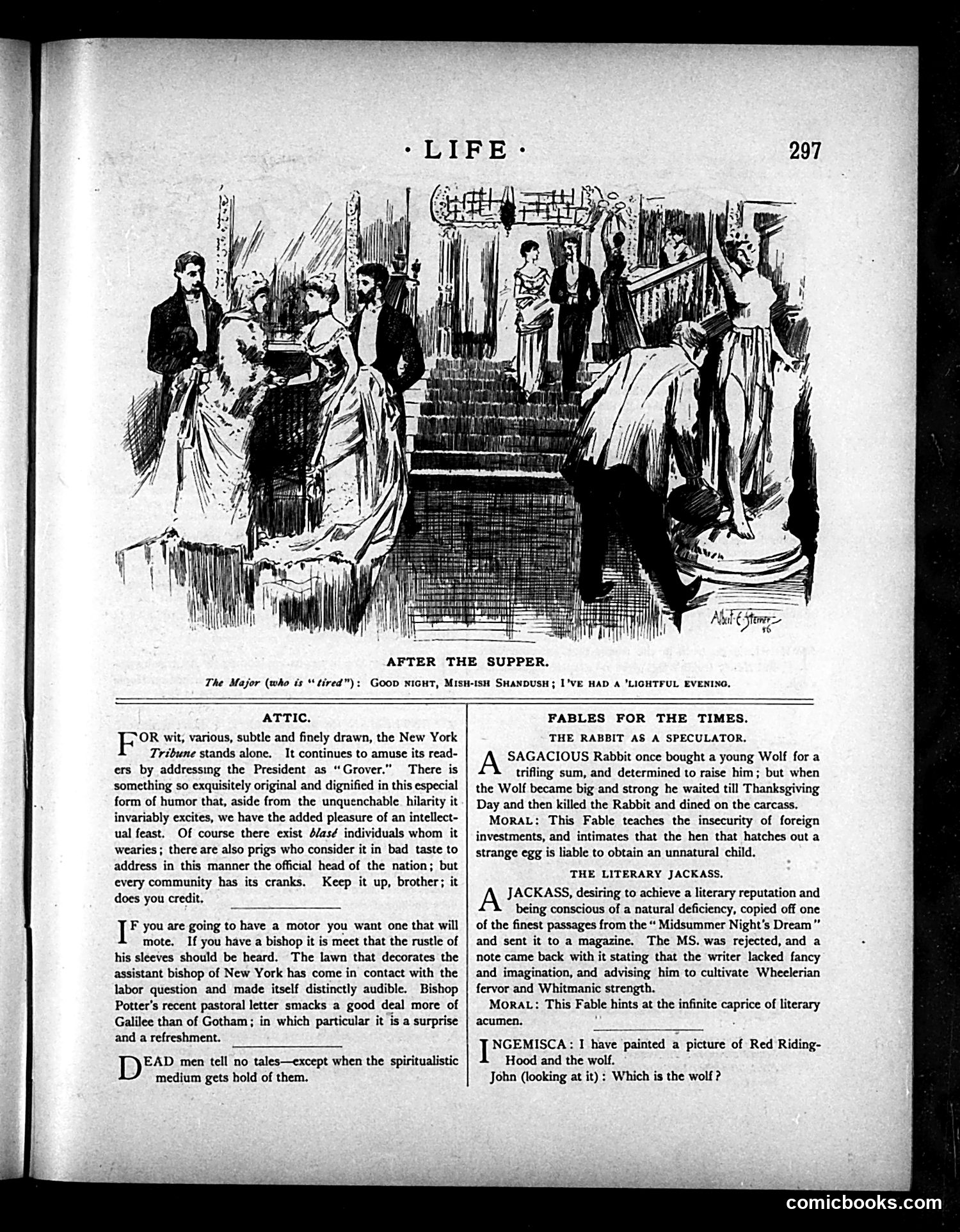
The main cartoon depicts an elegant social gathering, likely from the early 20th century. The caption attributes a quote to "The Major (who is 'tired')," suggesting satirical commentary on a specific public figure or type—possibly a military officer or politician affected by social obligations. The text below addresses wit and humor in *Life* magazine's coverage of President Theodore Roosevelt as "Grocer," referencing his populist appeal. References to motor cars, labor disputes, and spiritualist mediums indicate satirical commentary on contemporary social issues and fads. The "Fables for the Times" section offers moral tales about literary pretension and financial speculation, typical of *Life*'s social satire aimed at middle-class readers concerned with authenticity versus affectation.
📄 Transcribed text from this page (OCR, searchable)
Machine-transcribed from the original scan — historical spelling and the odd misread are preserved.
AFTER THE SUPPER. The Major (who is * tired"): GOOD NIGHT, MISH-ISH SHANDUSH; I'VE HAD A 'LIGHTFUL EVENING, ATTIC. OR wit, various, subtle and finely drawn, the New York Tribune stands alone. It continues to amuse its read- ers by addressing the President as “Grover.” There is something so exquisitely original and dignified in this especial form of humor that, aside from the unquenchable. hilarity it invariably excites, we have the added pleasure of an intellect- ual feast. Of course there exist d/as¢ individuals whom it wearies ; there are also prigs who consider it in bad taste to address in this manner the official head of the nation; but every community has its cranks. Keep it up, brother; it does you credit. F you are going to have a motor you want one that will mote. If you have a bishop it is meet that the rustle of his sleeves should be heard. The lawn that decorates the assistant bishop of New York has come in contact with the labor question and made itself distinctly audible. Bishop Potter's recent pastoral letter smacks a good deal more of Galilee than of Gotham; in which particular it is a surprise and a refreshment. EAD men tell no tales—except when the spiritualistic medium gets hold of them. FABLES FOR THE TIMES. THE RABBIT AS A SPECULATOR. SAGACIOUS Rabbit once bought a young Wolf for a trifling sum, and determined to raise him; but when the Wolf became big and strong he waited till Thanksgiving Day and then killed the Rabbit and dined on the carcass. MoRAL: This Fable teaches the insecurity of foreign investments, and intimates that the hen that hatches out a strange egg is liable to obtain an unnatural child. THE LITERARY JACKASS. JACKASS, desiring to achieve a literary reputation and being conscious of a natural deficiency, copied off one of the finest passages from the “ Midsummer Night’s Dream” and sent it to a magazine, The MS. was rejected, and a note came back with it stating that the writer lacked fancy and imagination, and advising him to cultivate Wheelerian fervor and Whitmanic strength. Morat: This Fable hints at the infinite caprice of literary acumen. 2 . NGEMISCA: I have painted a picture of Red Riding- Hood and the wolf. John (looking at it) : Which is the wolf? comicbooks.com