
Life, 1886-05-27 · page 5 of 16
Life — May 27, 1886 — page 5: what you’re looking at
What you’re looking at
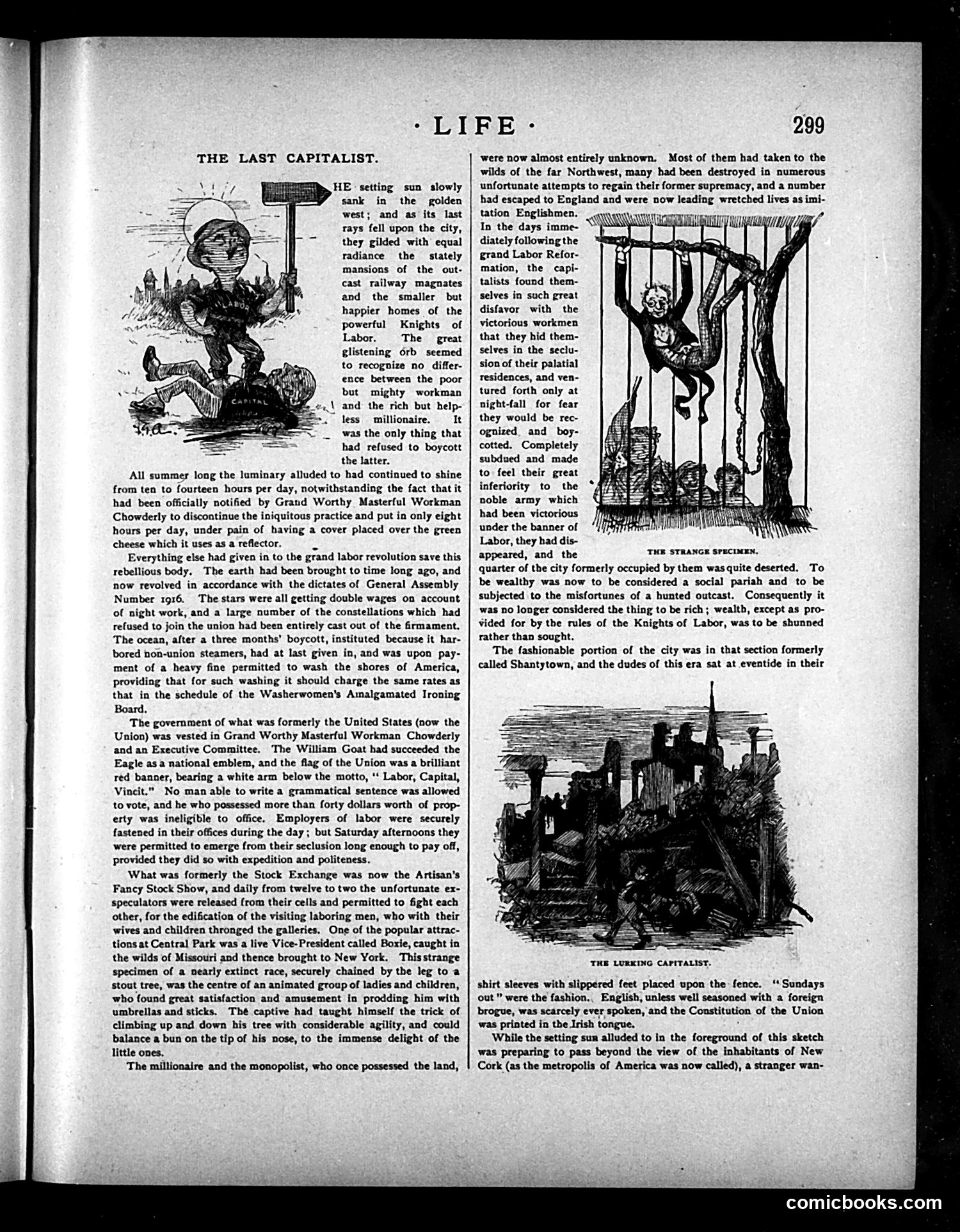
This page satirizes the post-Labor Reformation period, depicting a dystopian future where capitalists have been overthrown. The left illustration shows a wealthy capitalist being exhibited like a museum specimen—labeled "CAPITAL"—suggesting the rich have become curiosities rather than rulers. The right illustrations depict the Knights of Labor's victory: wealthy mansions now serve as public hangings sites ("The Strange Specimen," "The Lurking Capitalist"), with capitalists treated as dangerous relics to be displayed or executed. The text mocks how former power structures inverted—Grand Worthy Masterworkman Chowdery now governs, the Stock Exchange became a "Fancy Stock Show," and capitalists are hunted outcasts. The satire warns upper-class readers about labor movement strength and social revolution, presenting their potential dispossession as darkly comic inevitability.
📄 Transcribed text from this page (OCR, searchable)
Machine-transcribed from the original scan — historical spelling and the odd misread are preserved.
- LIFE: THE LAST CAPITALIST. HE ‘setting sun slowly Y sank in the golden west; and as its last rays fell upon the city, they gilded with’ equal radiance the stately mansions of the out- cast railway magnates and the smaller but happier homes of the powerful Knights of Labor. The great glistening drb seemed to recognize no differ- ence between the poor but mighty workman and the rich but help- “less millionaire. It was the only thing that had refused to boycott the latter. All summer long the luminary alluded to had continued to shine from ten to fourteen hours per day, notwithstanding the fact that it had been officially notified by Grand Worthy Masterful Workman Chowderly to discontinue the iniquitous practice and put in only eight hours per day, under pain of having a cover placed over the green cheese which it uses as a reflector. a Everything else had given in to the grand labor revolution save this rebellious body. The earth had been brought to time long ago, and now revolved in accordance with the dictates of General Assembly Number 1916. ‘The stars were all getting double wages on account of night work, and a large number of the constellations which had refused to join the union had been entirely cast out of the firmament. The ocean, after a three months’ boycott, instituted because it har- bored non-union steamers, had at last given in, and was upon pay- ment of a heavy fine permitted to wash the sbores of America, providing that for such washing it should charge the same rates as that in the schedule of the Washerwomen's Aialgamated Ironing Board, The government of what was formerly the United States (now the Union) was vested in Grand Worthy Masterful Workman Chowderly and an Executive Committee. The William Goat had succeeded the Eagle as a national emblem, and the flag of the Union was a brilliant red banner, bearing a white arm below the motto, ‘‘ Labor, Capital, Vincit.” No man able to write a grammatical sentence was allowed to vote, and he who possessed more than forty dollars worth of prop- erty was ineligible to office. Employers of labor were securely fastened in their offices during the day; but Saturday afternoons they were permitted to emerge from their seclusion long enough to pay off, provided they did so with expedition and politeness. ‘What was formerly the Stock Exchange was now the Artisan's Fancy Stock Show, and daily from twelve to two the unfortunate ex- speculators were released from their cells and permitted to fight each other, for the edification of the visiting laboring men, who with their wives and children thronged the galleries. One of the popular attrac- tions at Central Park was a live Vice-President called Boxie, caught in the wilds of Missouri and thence brought to New York. Thisstrange specimen of a nearly extinct race, securely chained by the leg to a stout tree, was the centre of an animated group of ladies and children, who found great satisfaction and amusement in prodding him with umbrellas and sticks. Thé captive had taught himself the trick of climbing up and down his tree with considerable agility, and could balance a bun on the tip of his nose, to the immense delight of the little ones. The millionaire and the monopolist, who once possessed the land, 299 were now almost entirely unknown. Most of them had taken to the wilds of the far Northwest, many had been destroyed in numerous unfortunate attempts to regain their former supremacy, and a number had escaped to England and were now leading wretched lives as imi- tation Englishmen. In the days imme- © diately following the grand Labor Refor- mation, the capi- talists found them- selves in such great disfavor with the victorious workmen that they hid them- selves in the seclu- sion of their palatial residences, and ven- tured forth only at night-fall for fear they would be rec- ognized. and boy- cotted. Completely subdued and made to feel their great inferiority to the noble army which had been victorious under the banner of Labor, they had dis- appeared, and the quarter of the city formerly occupied by them wasquite deserted. To be wealthy was now to be considered a social pariah and to be subjected to the misfortunes of a hunted outcast. Consequently it was no longer considered the thing to be rich; wealth, except as pro- vided for by the rules of the Knights of Labor, was to be shunned rather than sought. The fashionable portion of the city was in that section formerly called Shantytown, and the dudes of this era sat at eventide in their ‘THE STRANGE SPECIMEN. THE LURKING CAPITALIST. shirt sleeves with slippered feet placed upon the fence. ‘Sundays out ” were the fashion.. English, unless well seasoned with a foreign brogue, was scarcely ever spoken, and the Constitution of the Union was printed in the Irish tongue. : While the setting sun alluded to in the foreground of this sketch was preparing to pass beyond the view of the inhabitants of New Cork (as the metropolis of America was now called), a stranger wan- comicbooks.com