
A complete issue · 16 pages · 1886
Life — April 1, 1886
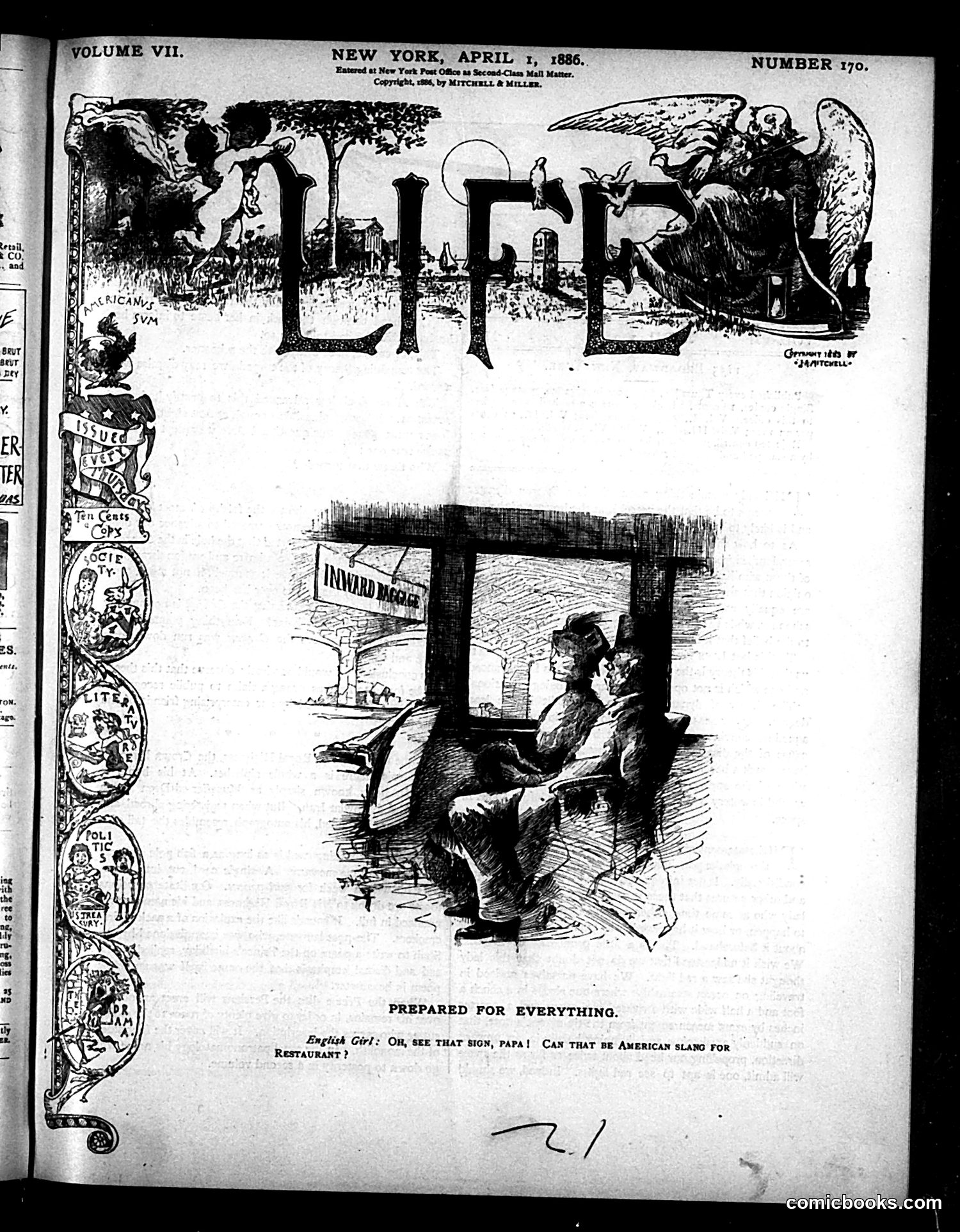
**The Main Cartoon: "Prepared for Everything"** The illustration shows an English girl at an "Invalid Maggie" restaurant counter, asking her father if American slang terms are acceptable in polite conversation. The satire mocks cultural differences between England and America regarding language and refinement. The title "Prepared for Everything" suggests ironic commentary on American informality and linguistic casualness compared to British formality. The father's apparent concern reflects Victorian-era anxieties about American culture's perceived coarseness corrupting proper English manners. This represents 1880s transatlantic cultural tensions—specifically anxiety that American colloquialism was spreading and threatening established British social conventions and propriety.
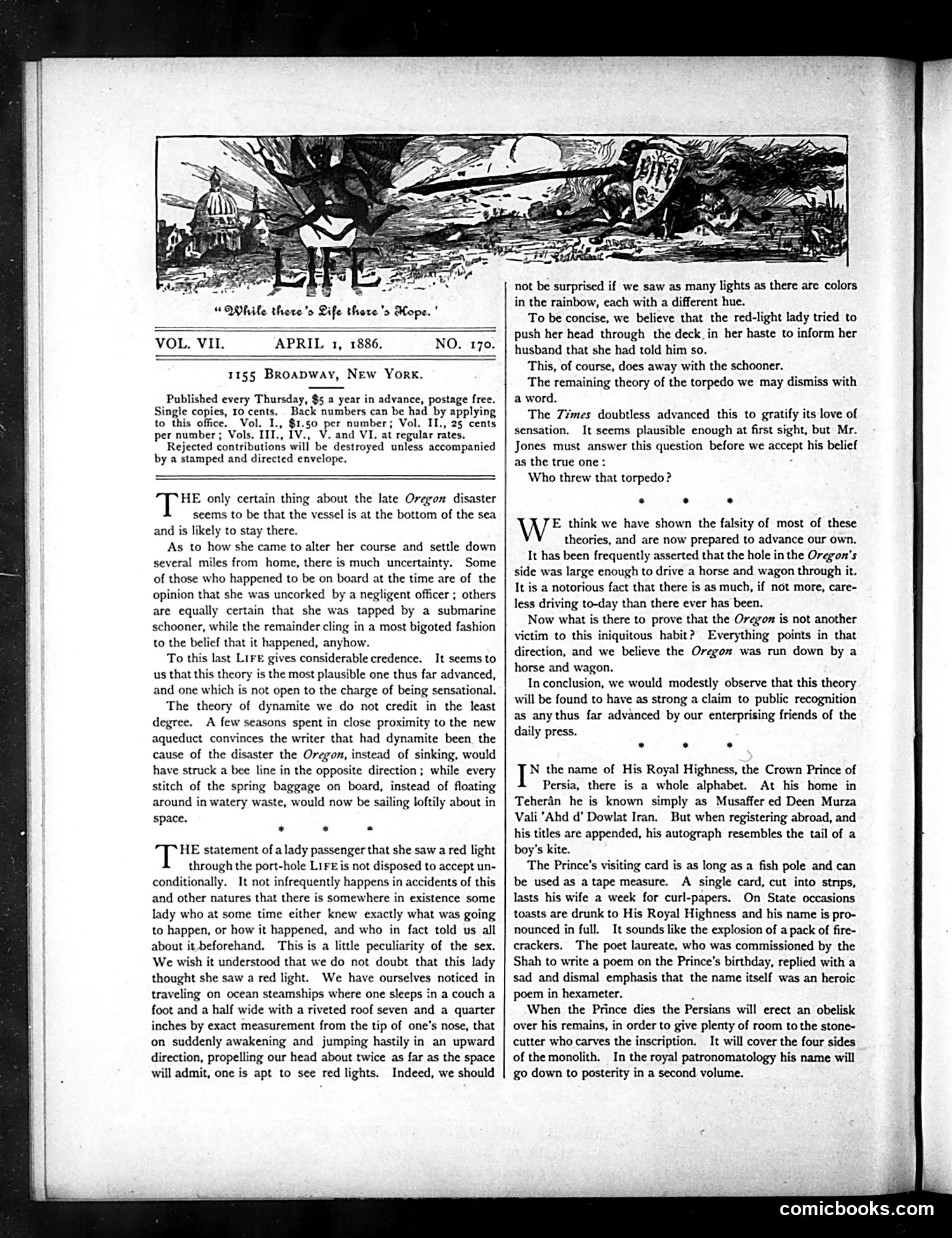
The cartoon at top illustrates the caption "While there's Life there's Hope," depicting a shipwreck scene with a vessel and survivors. The text discusses theories about the **USS Oregon disaster**—a real naval incident. The magazine dismisses sensational explanations (dynamite, a torpedo) in favor of the mundane reality: the Oregon was simply driven onto rocks by a horse and wagon on deck, causing it to sink. The satire targets newspapers' appetite for dramatic disaster narratives over factual reporting. The magazine also includes unrelated satirical content about the **Crown Prince of Persia's** absurdly long titles and eccentric customs, mocking both Persian nobility and the pretensions of international formality.
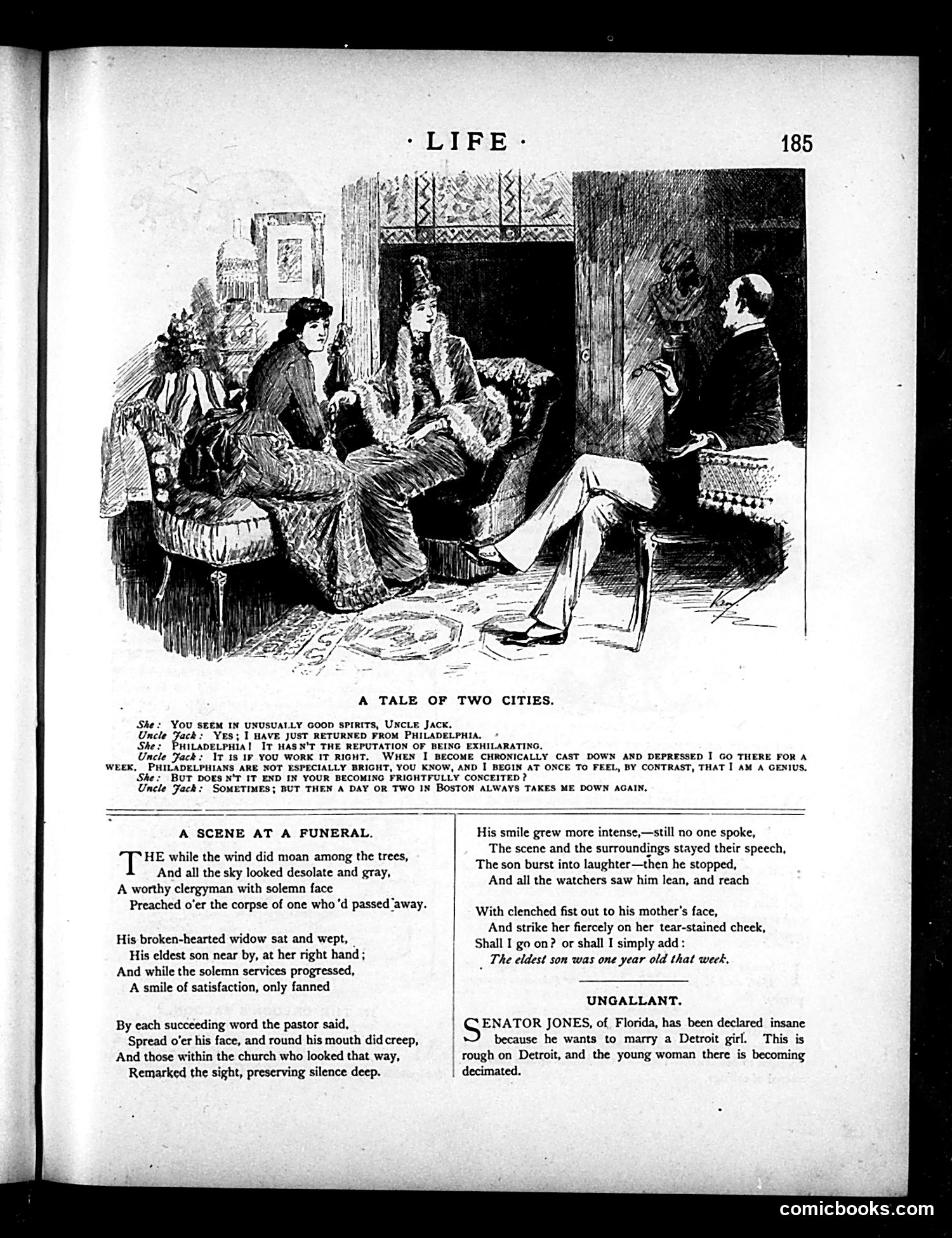
**"A Tale of Two Cities"** presents a dialogue between Uncle Jack and "She" about Philadelphia versus Boston. Uncle Jack has just returned from Philadelphia, which he describes as depressing—business is bad and the city seems gloomy. "She" counters that Philadelphia isn't uniquely troubled; Boston similarly experiences periodic downturns. The joke satirizes regional rivalry between major American cities, with both claiming to suffer economic hardship. It's gentle social satire comparing East Coast urban centers. Below, "A Scene at a Funeral" is sentimental verse about a widow, her son, and a clergyman at a funeral service—unrelated to the cartoon above. The "Ungallant" brief note mocks Senator Jones of Florida for wanting to marry a Detroit girl, calling him insane for pursuing an out-of-state romance.
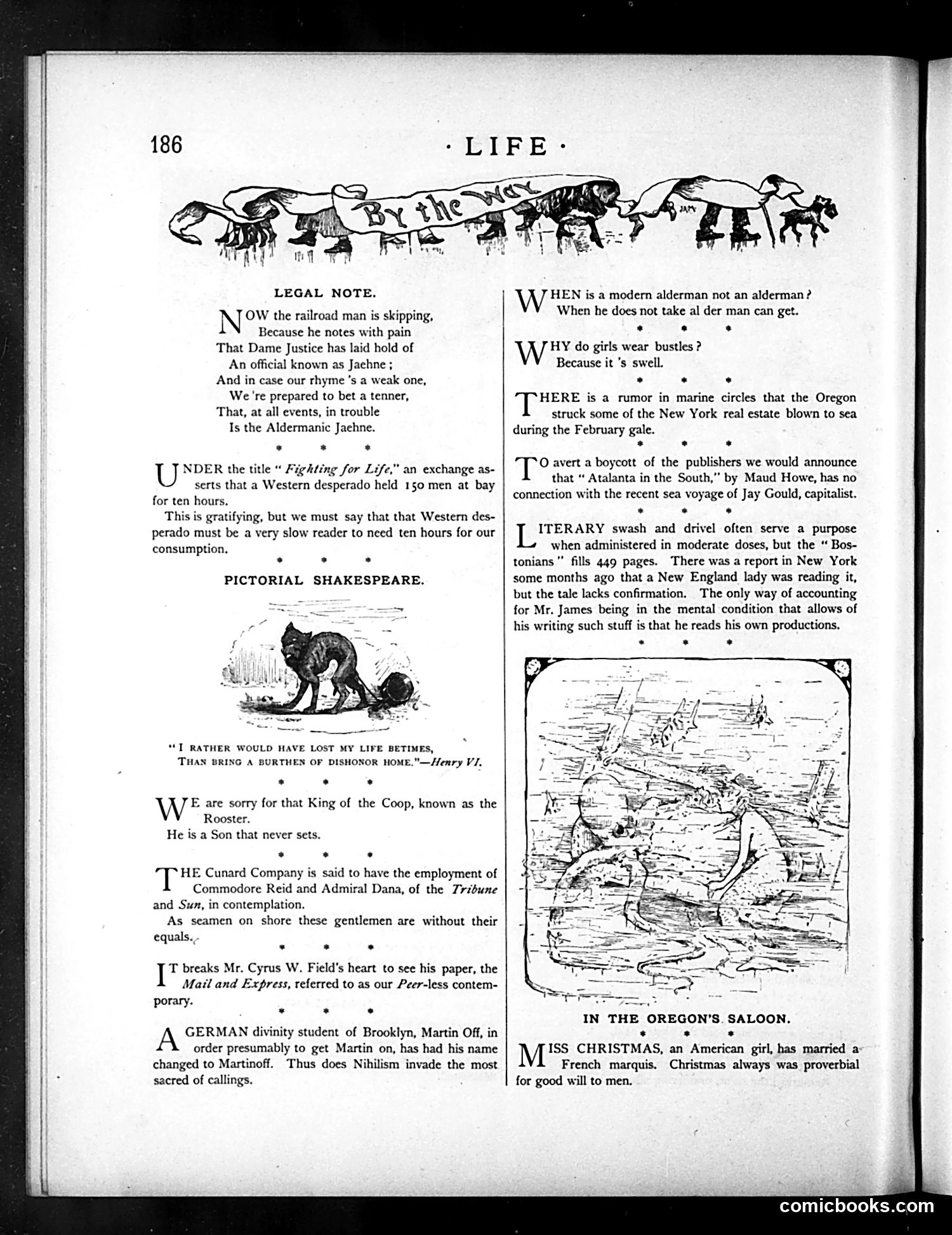
This page contains miscellaneous satirical notes and humor rather than a unified political cartoon. Key items include: **"Pictorial Shakespeare"**: A small illustration of a dog with a ball, captioned with a Shakespeare quote about losing one's life rather than bringing dishonor home—likely mocking overwrought dramatic interpretations. **Social Commentary**: Several brief jokes targeting contemporary topics: railroad business practices, women's fashion (bustles), and shipping disasters. One note mocks New York real estate losses during a gale. **"In the Oregon's Saloon"**: A sketch depicting the aftermath of the USS Oregon ship incident, showing damage or chaos in the ship's saloon. The page exemplifies Life's style: punchy satirical commentary on current events, social pretension, and absurdities, aimed at educated readers familiar with news of the day.
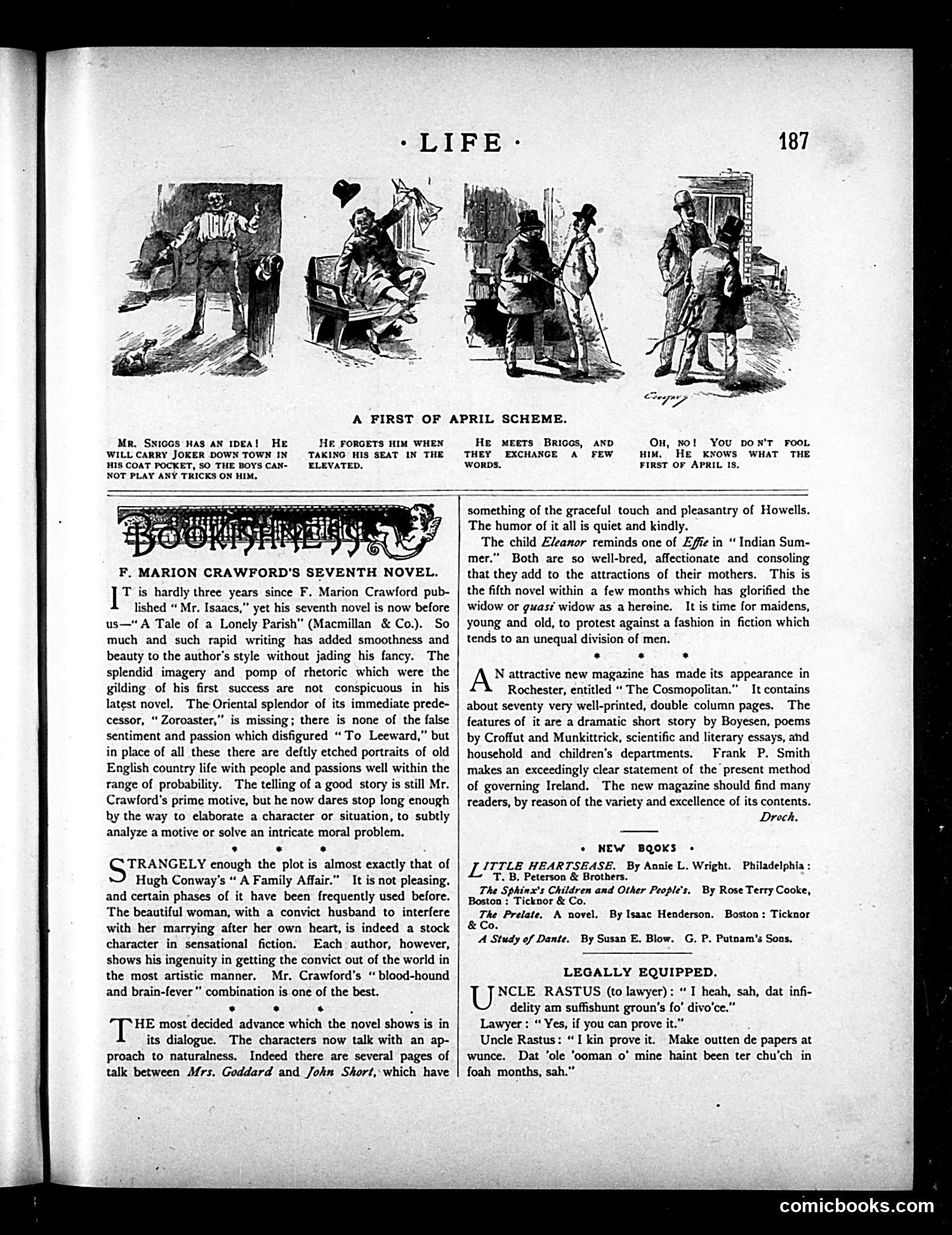
This is an April Fools' Day comic strip showing four sequential panels. Mr. Snigs plans to play a prank: he'll place a joker card in his coat pocket so boys can't trick him. However, the joke backfires when he encounters Briggs—they exchange words, and Snigs ends up foolishly carrying the joker downtown in his coat without realizing it. The final panel shows Briggs laughing at Snigs, who remains unaware of the successful prank. The humor relies on the classic April Fools' trope: someone who thinks they've outsmarted potential pranksters becomes the unwitting victim instead. The satire gently mocks human overconfidence and the inevitability of being fooled despite precautions.
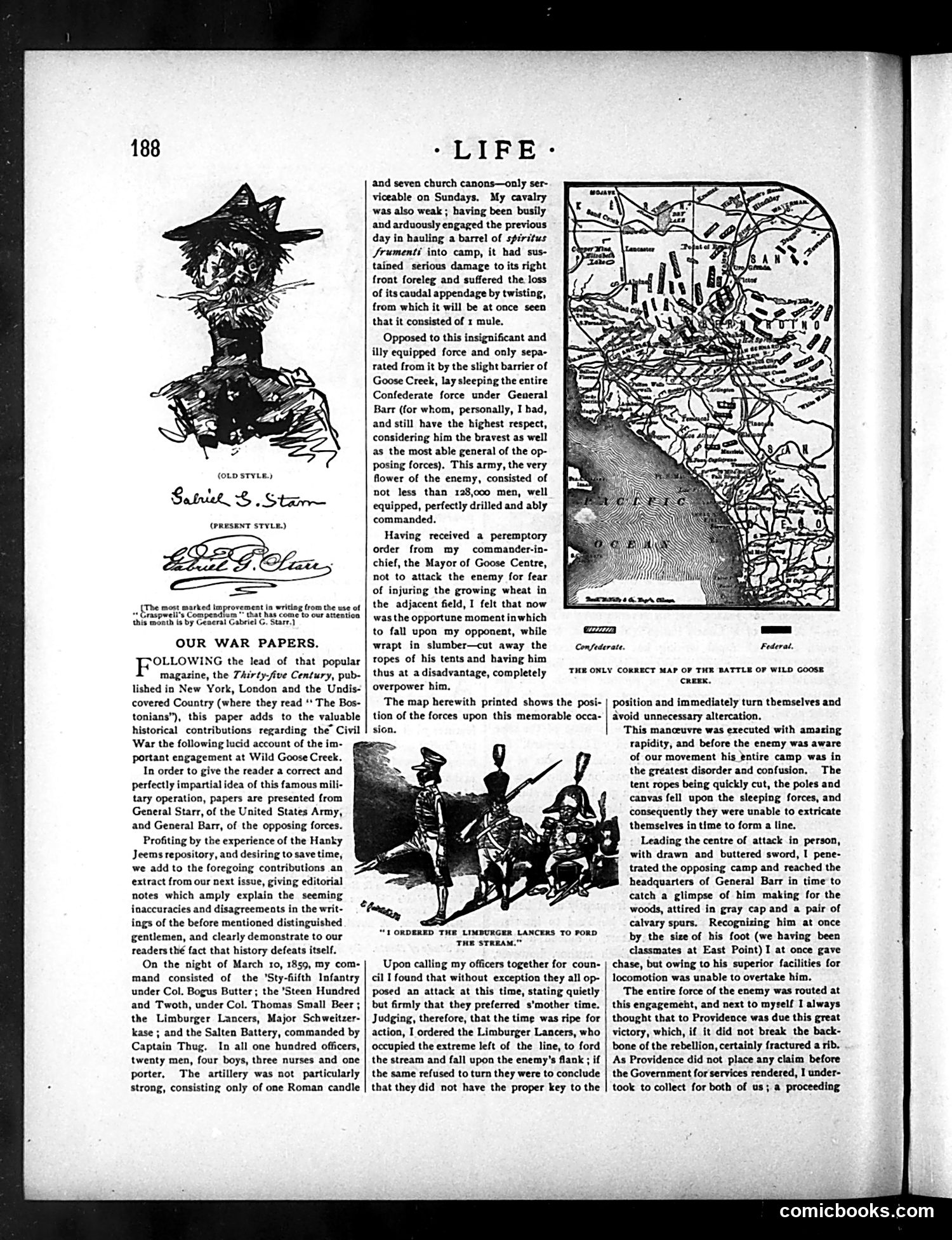
This page features a Civil War military memoir by General Gabriel C. Starr (shown in two portrait sketches). The main content describes the Battle of Wild Goose Creek, where Starr commanded Union forces against Confederate General Barr. The illustrated map shows the battle's position and troop movements. The accompanying narrative details a tactical victory: Starr's forces exploited the enemy's vulnerability by cutting tent ropes while they slept, causing chaos and allowing his outnumbered cavalry to overwhelm the Confederate position. The satirical element appears subtle—this may be presented as earnest military history while the tactics described (cutting ropes on sleeping soldiers) border on comedic absurdity. The piece parodieswar memoirs' tendency toward self-aggrandizing accounts of military genius.
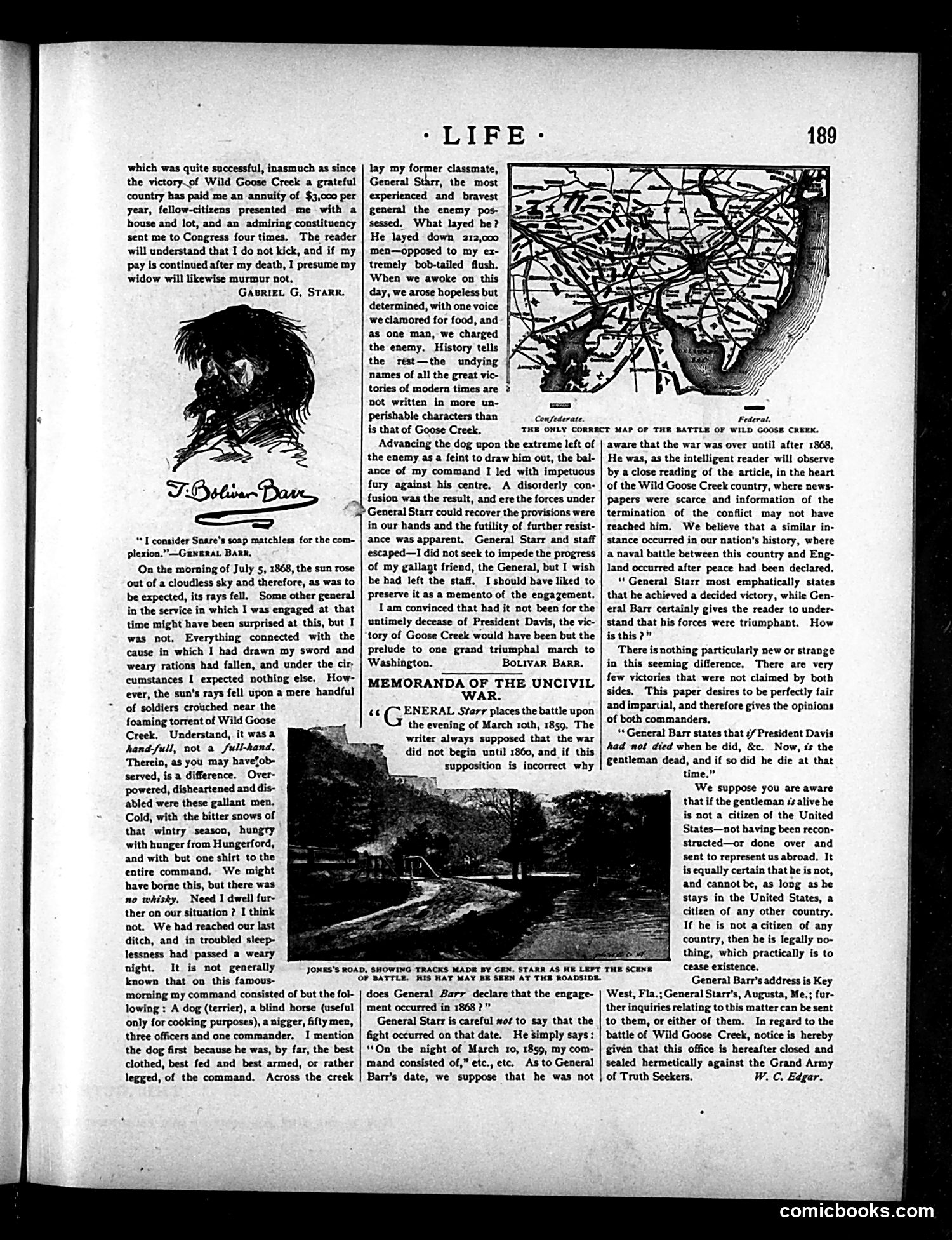
This page contains Civil War memoirs and correspondence about the **Battle of Wild Goose Creek** (March 10, 1859). The content includes: 1. **A portrait sketch** (top left) labeled with a signature, appearing to be a Civil War military figure. 2. **A map** (top right) titled "THE ONLY CORRECT MAP OF THE BATTLE OF WILD GOOSE CREEK" — presented satirically, as the battle's actual historical significance is disputed. 3. **Two photographs** showing landscape/terrain views of the battle site. The text debates whether President Davis died at the battle and discusses General Starr's account. The satire appears to mock inflated historical claims about a minor skirmish, treating it with mock-serious documentation while questioning its actual importance in Civil War history.
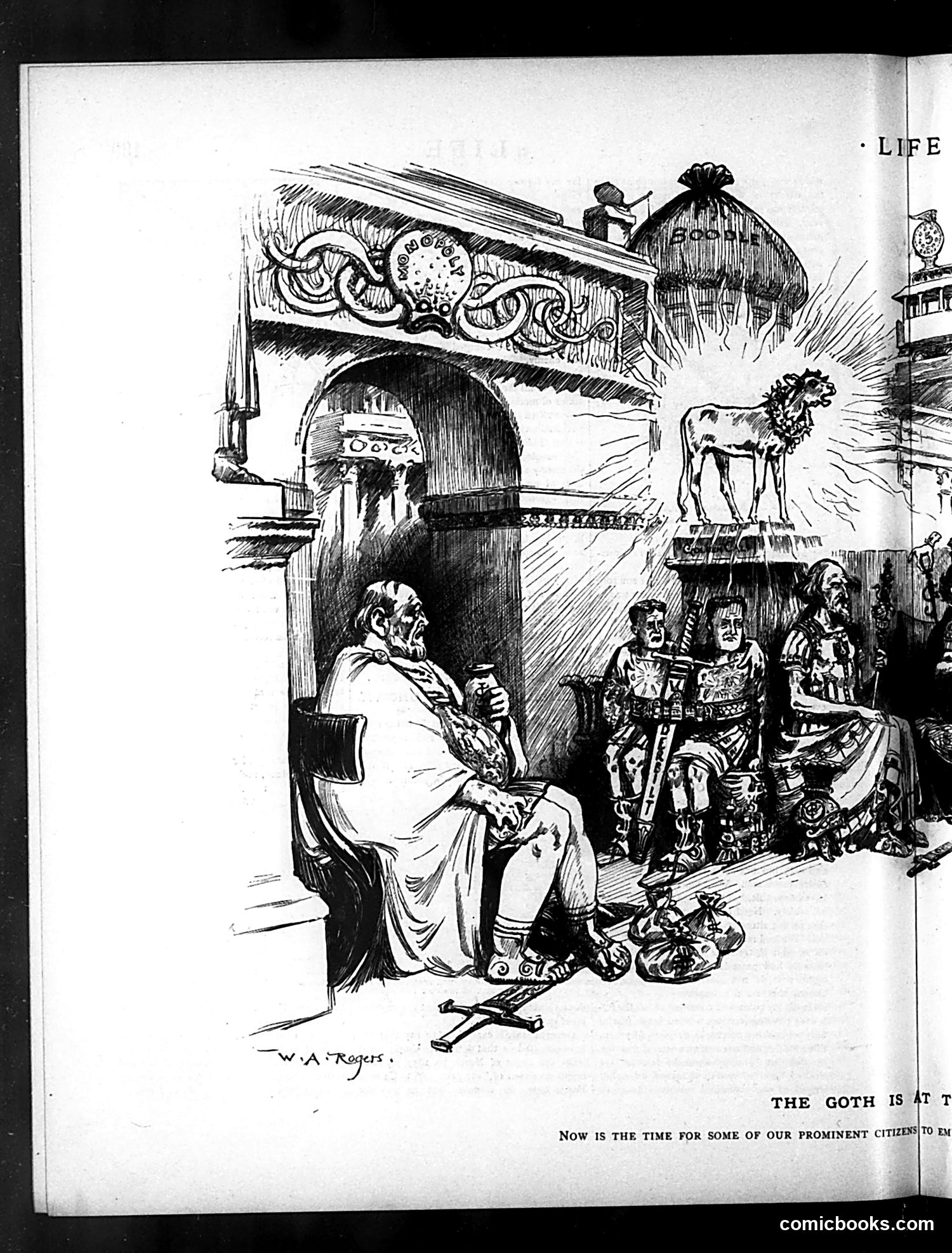
This political cartoon by W.A. Rogers depicts a scene titled "The Goth Is at the Gate" (visible at bottom right). A bearded figure in robes sits contemplatively in the foreground, while elaborately dressed military or political officials gather to his right, discussing matters near an ornate architectural doorway. The "Goth" reference suggests an external threat—likely commentary on Germanic or barbarian invasion fears. The contrast between the thoughtful, humble seated figure and the ornately decorated officials appears to satirize how prominent citizens or leaders respond to crisis: through bureaucratic pageantry rather than substantive action. The exact historical context remains unclear without the article's full text, but the imagery suggests anxieties about civilization under threat during a period of political upheaval.
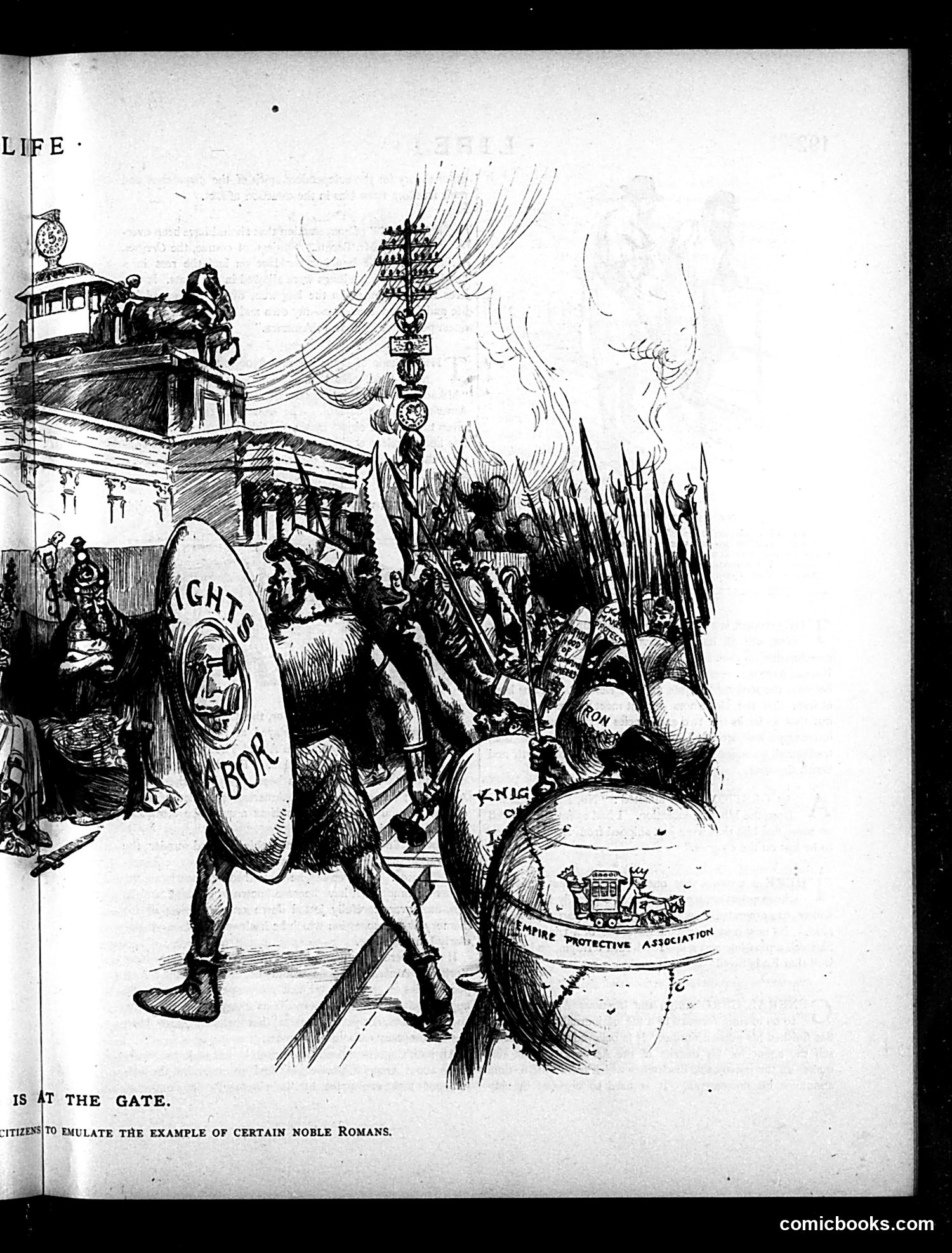
This satirical cartoon depicts a militaristic scene with soldiers carrying shields labeled "RIGHTS" and "LABOR" alongside references to an "EMPIRE PROTECTIVE ASSOCIATION" and "IRON KING." The fortified tower on the left appears to represent established authority or power structures. The incomplete caption reads "IS AT THE GATE" and references "CITIZENS TO EMULATE THE EXAMPLE OF CERTAIN NOBLE ROMANS," suggesting a critique of those advocating military or authoritarian solutions to social problems. The imagery—flames, armed masses, organizational symbols—satirizes what Life's editors apparently viewed as dangerous militaristic or proto-fascist movements gaining strength. The "noble Romans" reference likely mocks invocations of historical precedent to justify contemporary authoritarian movements, a common satirical target in early 20th-century American magazines.
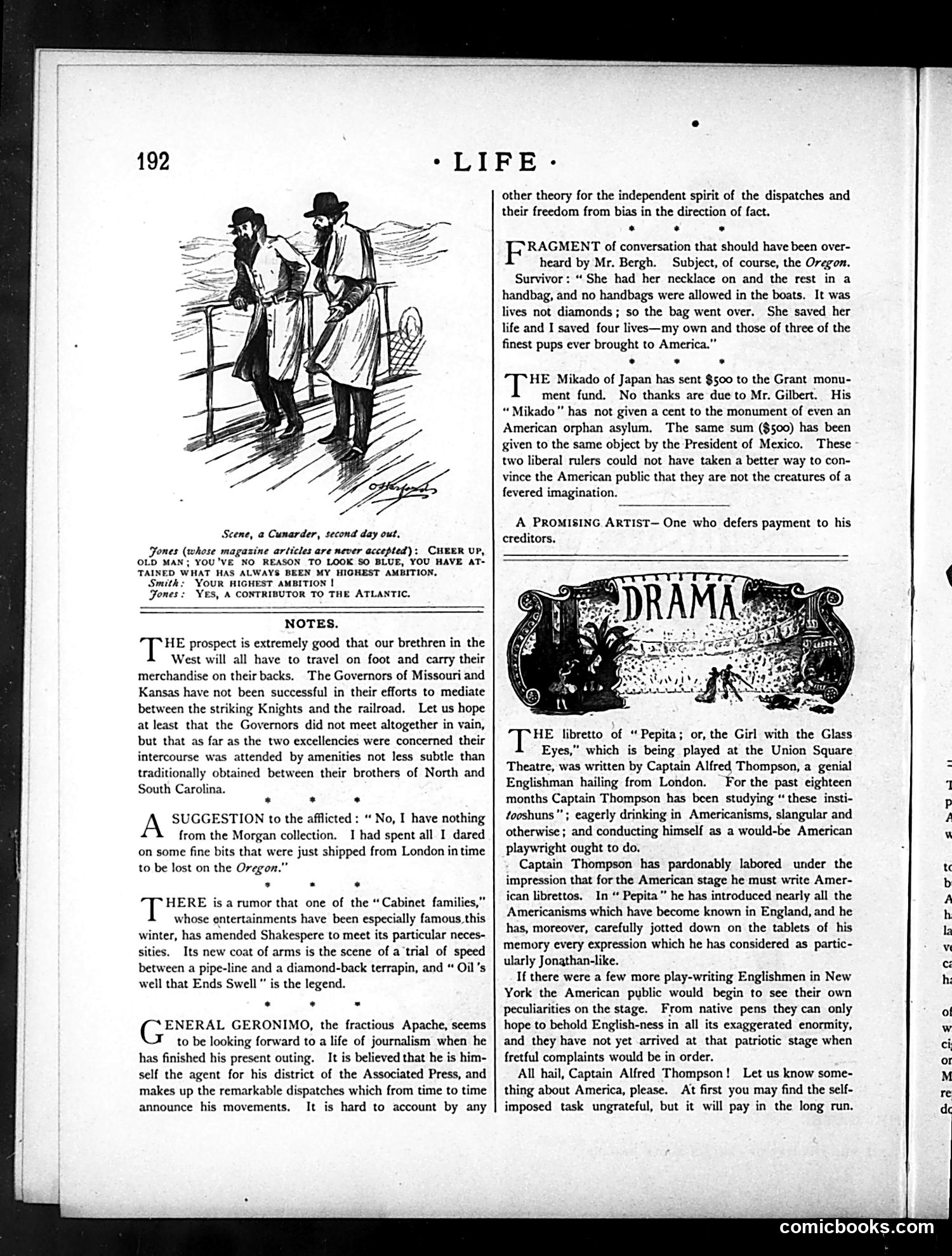
The main cartoon depicts two men aboard a ship (a "Cunarder," a Cunard liner). Jones, a perpetually rejected magazine writer, congratulates Smith on achieving Jones's "highest ambition": becoming a contributor to *The Atlantic* magazine. The joke is self-deprecating—Jones considers publication in a prestigious literary journal so difficult that he views it as his ultimate life goal, yet he hasn't achieved it himself. The "Notes" section contains satirical brief items: references to railroad labor strikes (Knights of Labor), a ship disaster (the *Oregon*), General Geronimo portrayed as ironically biased in his press dispatches, and Captain Alfred Thompson, an English playwright overstudying American slang for his Broadway play *Pepita*. The satire mocks literary ambition, labor unrest, immigrant writers attempting forced Americanism, and the era's sensational journalism.
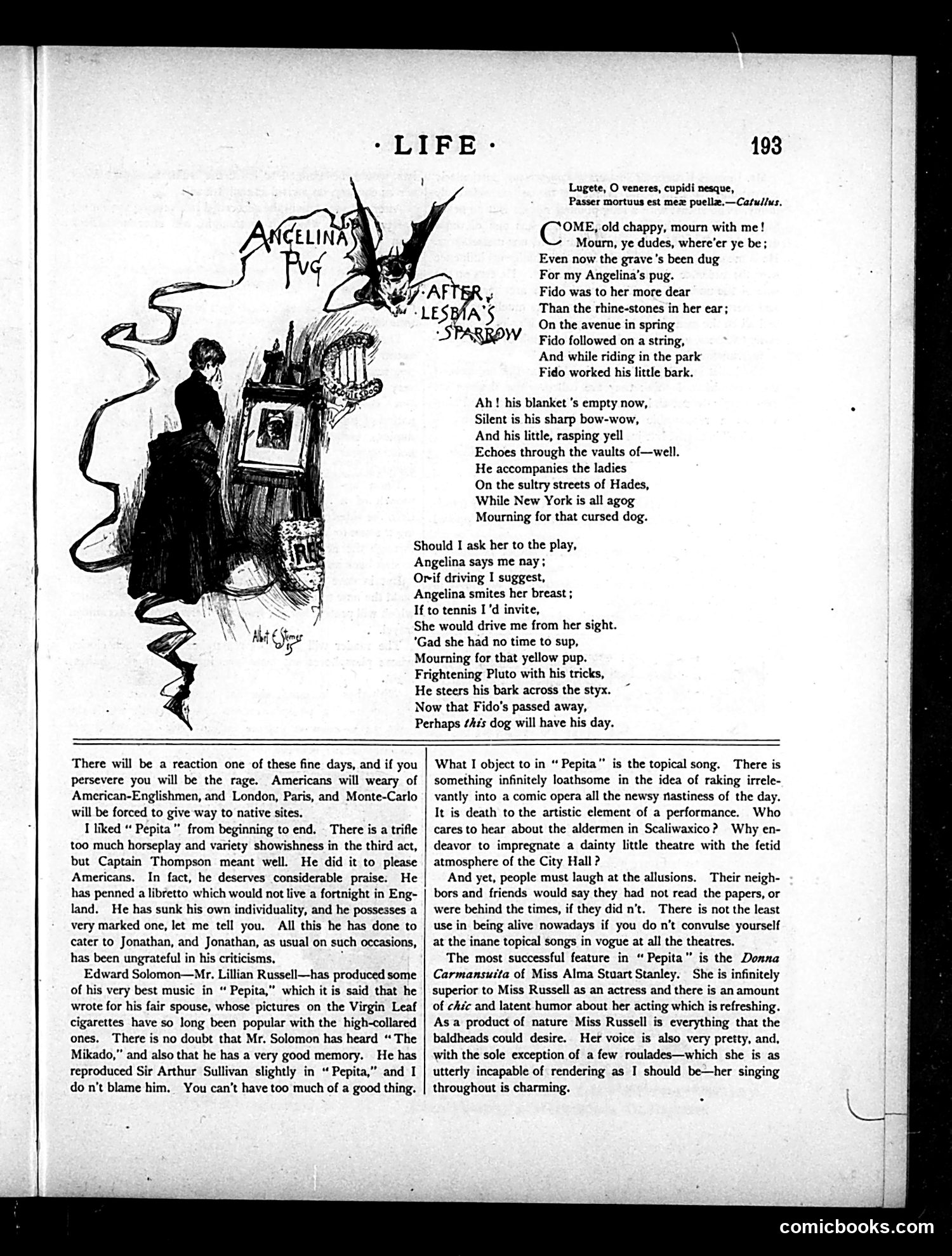
This satirical poem mocks wealthy New York society women's excessive sentimentality over their lap dogs. The illustration shows a fashionable woman mourning her deceased pug, "Fido," with dramatic grief—the dog receives an elaborate funeral complete with a coffin and grave. The joke targets the absurdity of upper-class women prioritizing their pets over social obligations and romance. The narrator, presumably Angelina's suitor, complains that she refuses theater invitations, carriage rides, and tennis outings because she's mourning "that yellow pup." The poem uses mock-classical Latin epigraph and references to Hades/Pluto to humorously elevate the dog's death to tragic importance. The satire criticizes both the frivolous nature of high society and women's perceived emotional excess. The closing line suggests the pug may find better companionship in the afterlife than the living narrator will on Fifth Avenue. The page also reviews the operetta "Pepita," featuring actress Lillian Russell, criticizing its topical songs but praising co-star Alma Stuart Stanley's performance.
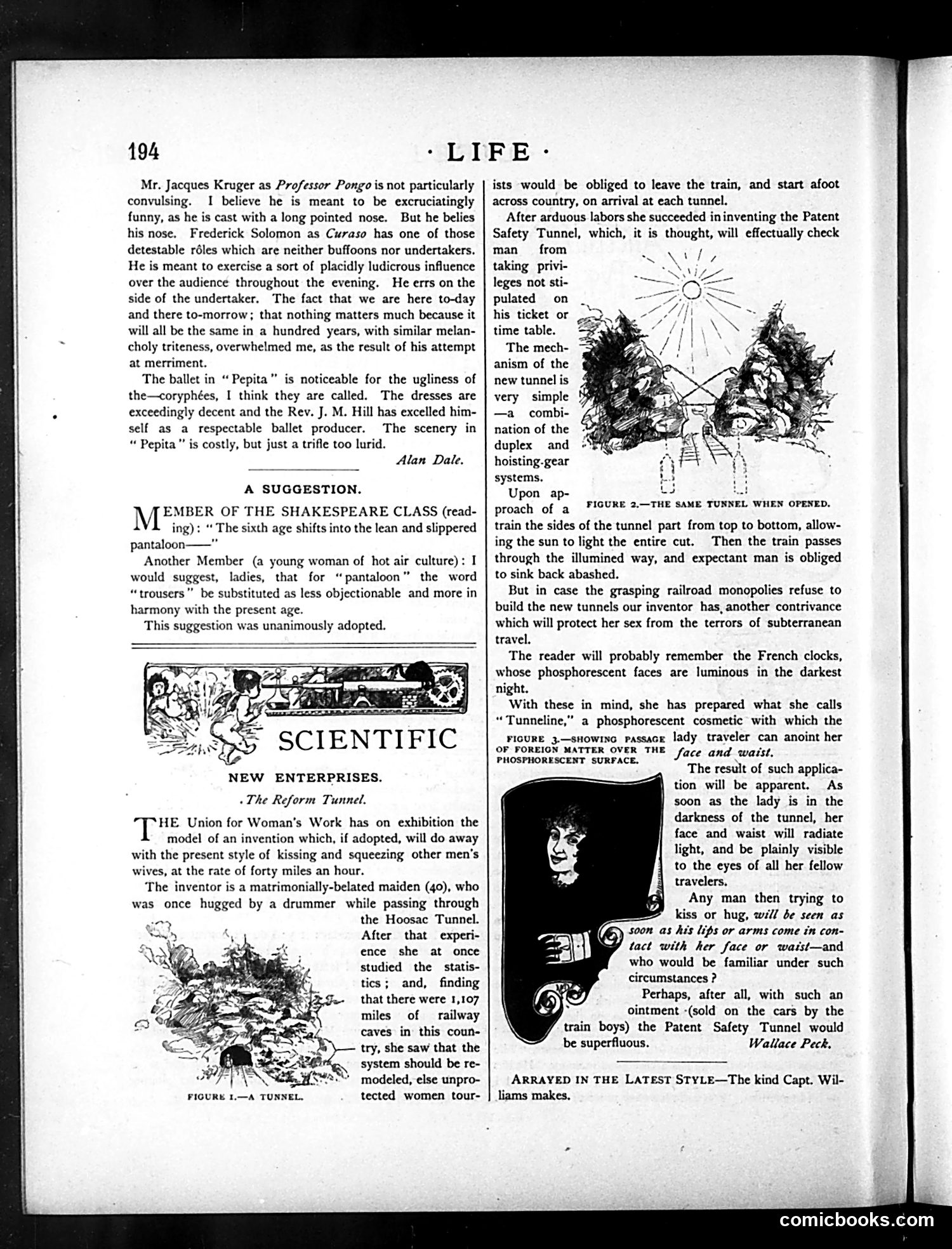
This satirical piece mocks Victorian anxieties about women's safety and propriety in railroad tunnels. The humor centers on a fictional "Reform Tunnel" invention by an unmarried 40-year-old woman traumatized by unwanted physical contact during a train journey through the Hoosac Tunnel. The joke proposes absurd solutions: either mechanically opening tunnel sides to flood them with sunlight (preventing inappropriate touching), or selling "Tunneline"—a phosphorescent cosmetic making women glow in darkness so any man attempting to kiss or hug them would be visible to witnesses. The satire targets both: (1) the genuine problem of women's vulnerability to harassment in dark spaces, and (2) the era's prudish obsession with preventing any unauthorized physical contact between unrelated people. By presenting ridiculous inventions as serious innovations, the magazine lampoons both Victorian sexual anxiety and the patent-filing culture of the era.
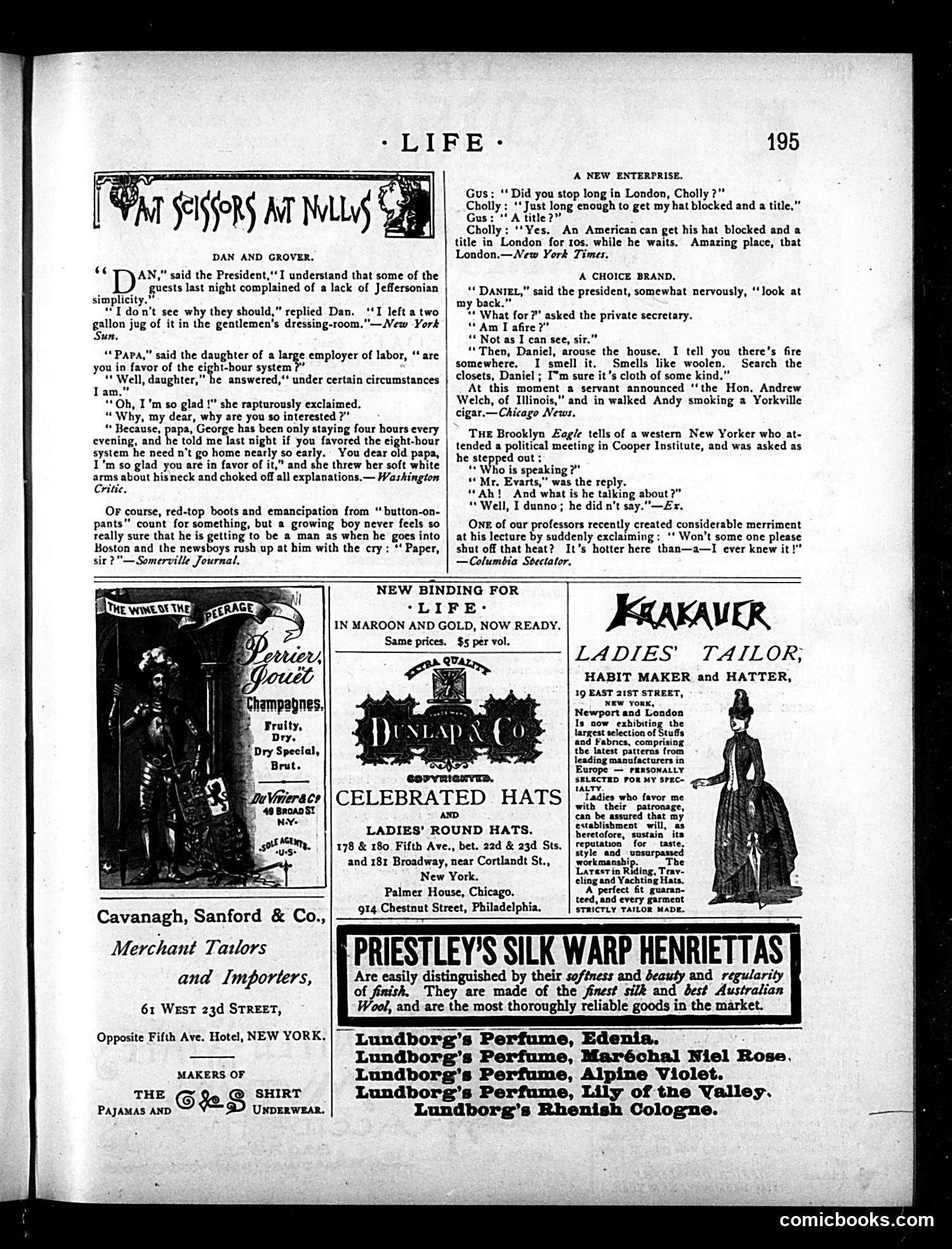
This page contains several short satirical jokes typical of late 19th-century American humor: **"Dan and Glover"** mocks presidential pretension—the President complains guests found his gathering lacking "Jeffersonian simplicity," but his aide reveals he simply left alcohol ("two gallon jug") in the dressing room. **"A Choice Brand"** satirizes New Money snobbery. A wealthy American businessman, "Cholly," brags that in London he obtained both a hat blocking *and* a title for ten shillings—implying American wealth can literally purchase aristocratic status abroad, a jab at both American materialism and European venality. Other jokes target emerging social trends: the eight-hour workday (labor reform), boys' coming-of-age rituals in Boston, and academic pretension. The page is otherwise dominated by **advertisements** for ladies' clothing, hats, perfumes, and merchant tailoring—reflecting Life's audience of urban, middle-to-upper-class readers.
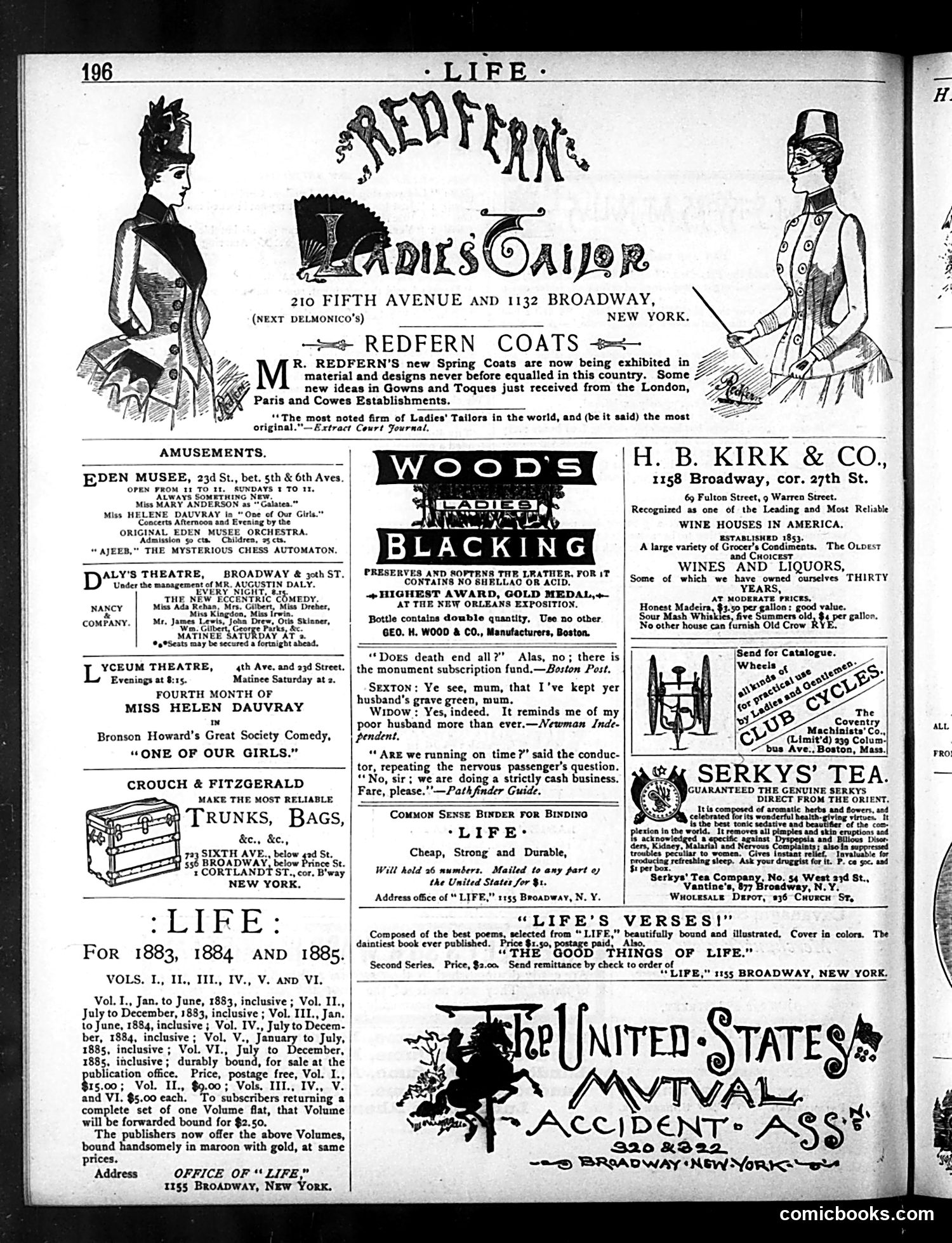
This page is primarily **advertisements and amusement listings** rather than editorial cartoons. The masthead features a fashion advertisement for "Redfern Ladies Tailor" (a high-end dressmaker), showcasing two elegantly dressed women in Spring coats. The bulk of the page comprises **classified advertisements** for 1880s New York City services: theater listings (Eden Musée, Daly's Theatre, Lyceum Theatre featuring actress Helen Dauvray), luggage makers, shoe polish, wine merchants, and bicycle manufacturers. Interspersed are brief **humorous quips** in the style typical of Life magazine—short jokes about death monuments, graveyards, and train conductors. These appear designed as filler content between advertisements. The page also advertises **back issues of Life itself** (1883-1885 volumes available bound in maroon with gold lettering). This represents Life's dual function as both satirical publication and commercial advertising vehicle for affluent urban readers.
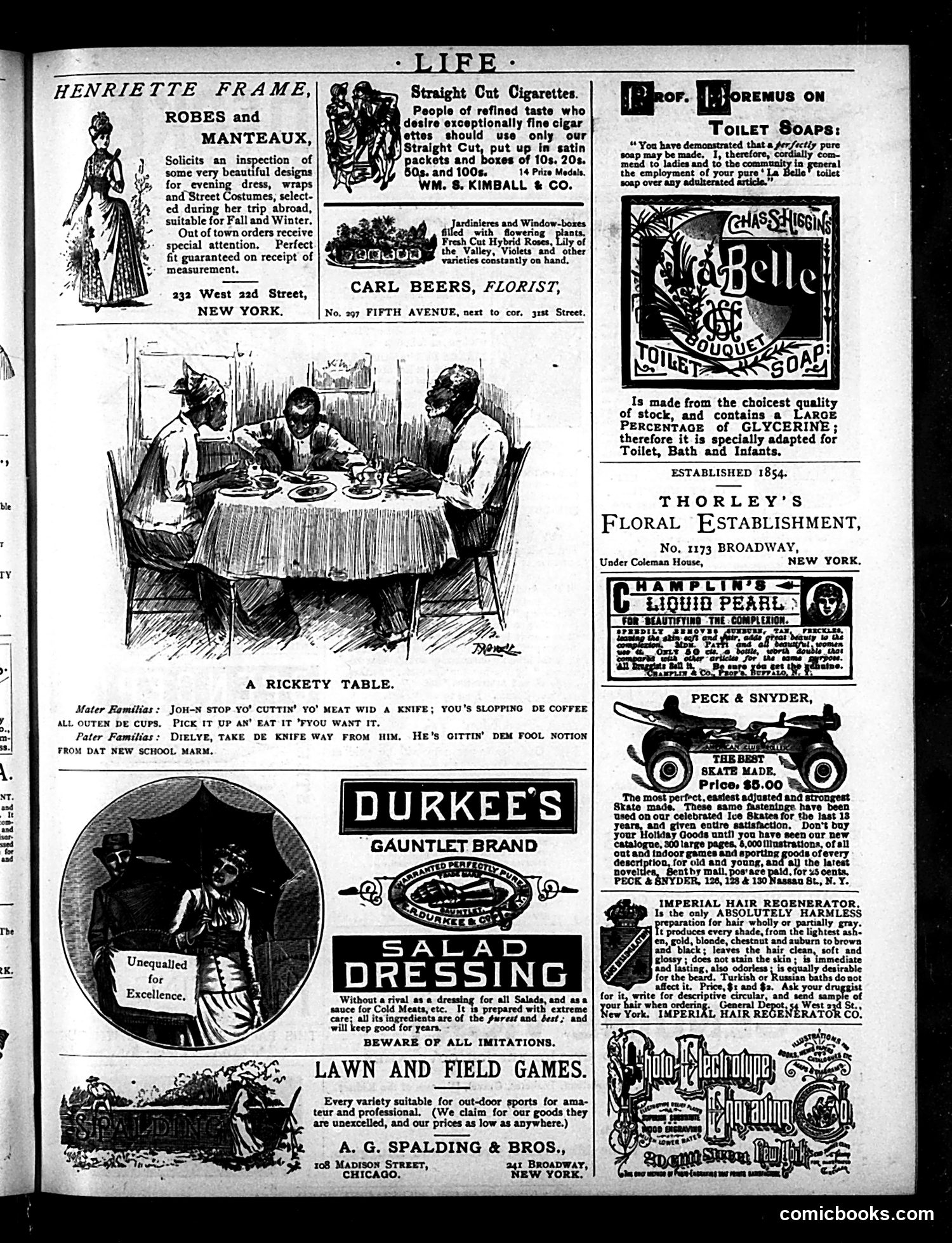
This cartoon depicts a domestic scene where a Black family is dining at a wobbly table. The humor—and social critique—lies in the dialogue: the mother scolds the father for eating messily with a knife, then the father blames their young son's crude behavior on lessons from "dat new school marm" (schoolteacher). The satire targets late 19th-century education reformers and their methods. The implication is that modern schooling is producing poorly-mannered children rather than refined ones—a common complaint among conservatives skeptical of educational innovation. The rickety table itself reinforces the joke: the family's circumstances are unstable, yet they're adopting "newfangled" school ideas. This reflects period anxieties about rapid social change, immigration, and shifting class dynamics, with the racial caricature (common in period *Life* magazine) emphasizing perceived cultural difference.
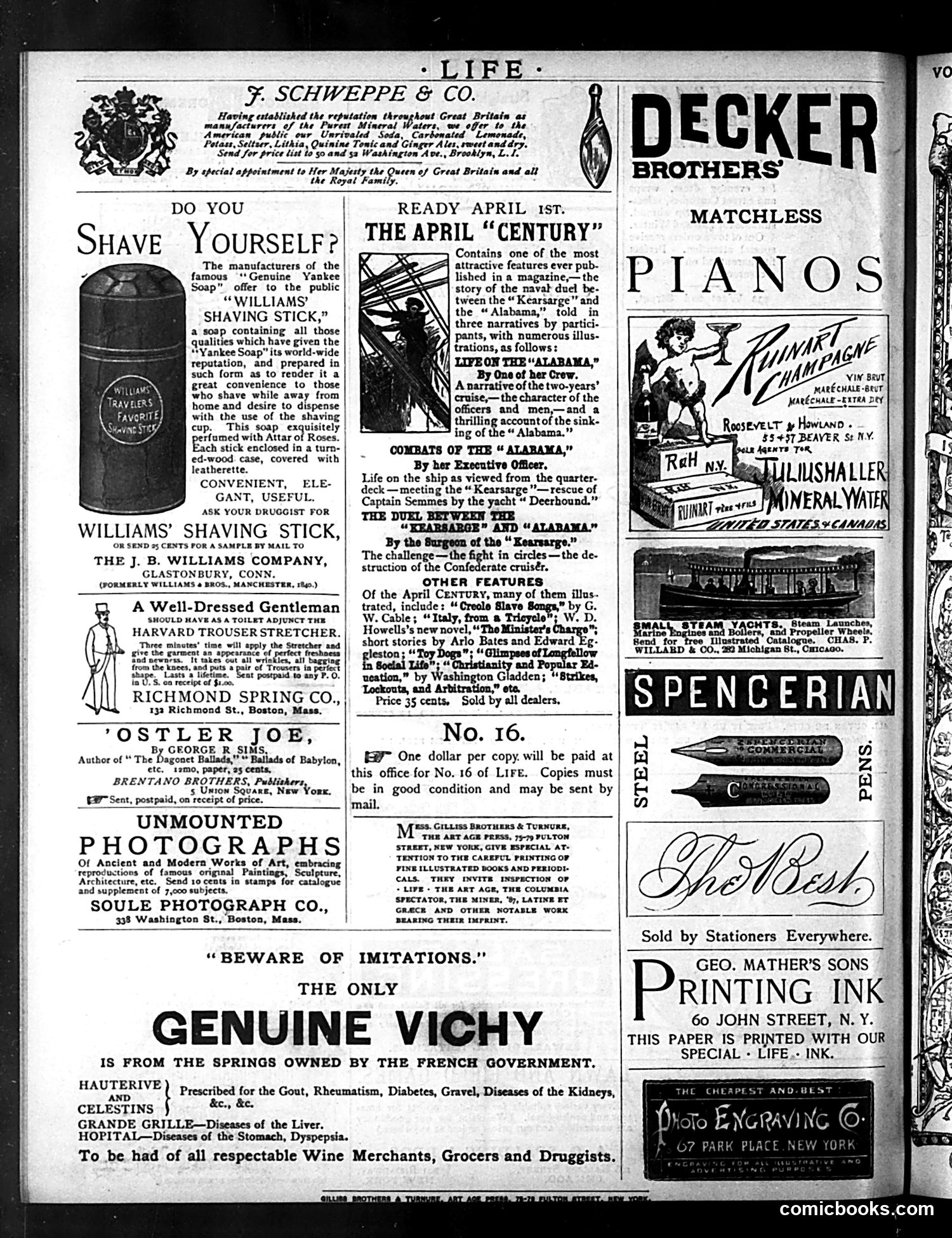
This page is primarily **advertisements and magazine notices**, not political satire or comics. It's from Life magazine's back matter section. Key content: - **Schweppe mineral water ad** (top): References royal patronage—a common Victorian marketing claim to suggest quality and refinement - **Shaving products**: Williams' Shaving Stick and Harvard Trouser Stretcher ads reflect gentlemen's grooming concerns of the era - **Century Magazine announcement**: Promotes upcoming April issue featuring Civil War content—specifically narratives about the famous 1864 naval battle between USS Kearsarge and Confederate ironclad CSS Alabama, told from multiple perspectives with illustrations - **Vintage magazine wanted**: Life seeks a pristine copy of issue No. 16, offering payment—suggesting collectibility - **Various services**: Photography reproductions, printing ink, book publishing The page demonstrates period commercial culture and publishing practices rather than containing satirical commentary. The Civil War naval battle coverage reflects ongoing American historical interest in the recently-concluded conflict.