
Life, 1886-04-01 · page 5 of 16
Life — April 1, 1886 — page 5: what you’re looking at
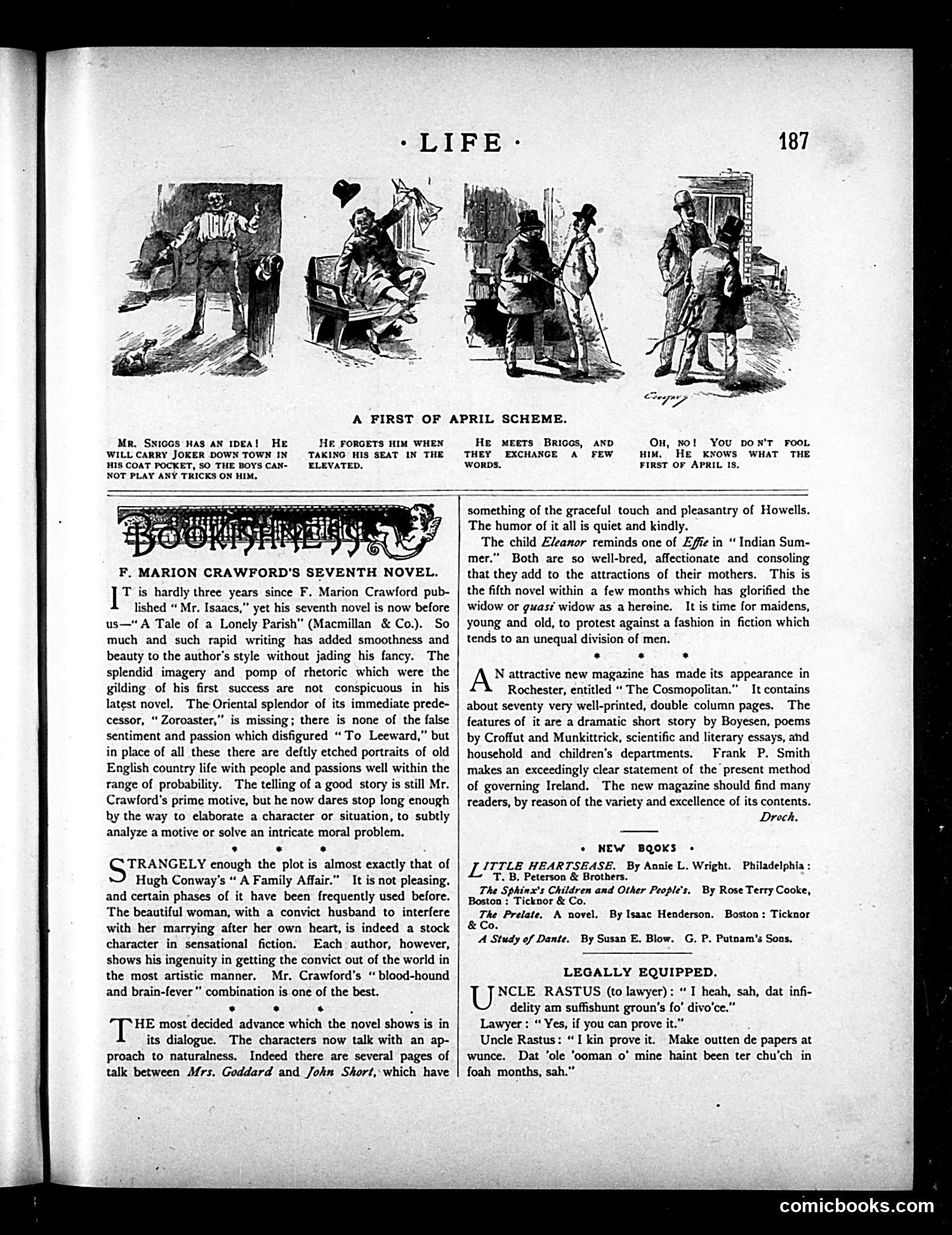
What you’re looking at
This is an April Fools' Day comic strip showing four sequential panels. Mr. Snigs plans to play a prank: he'll place a joker card in his coat pocket so boys can't trick him. However, the joke backfires when he encounters Briggs—they exchange words, and Snigs ends up foolishly carrying the joker downtown in his coat without realizing it. The final panel shows Briggs laughing at Snigs, who remains unaware of the successful prank. The humor relies on the classic April Fools' trope: someone who thinks they've outsmarted potential pranksters becomes the unwitting victim instead. The satire gently mocks human overconfidence and the inevitability of being fooled despite precautions.
📄 Transcribed text from this page (OCR, searchable)
Machine-transcribed from the original scan — historical spelling and the odd misread are preserved.
A FIRST OF APRIL SCHEME. Mr. Sniccs Has AN IDEA! HE WILL CARRY JOKER DOWN TOWN IN HIS COAT POCKET, SO THE BOYS CAN- NOT PLAY ANY TRICKS ON HIM, HE FORGETS HIM WHEN TAKING HIS SEAT IN THE ELEVATED. HE MEETS BRIGGS, AND THEY EXCHANGE A FEW worDs. On, so! You pon’t FOOL Him, HE KNOWS WHAT THE FIRST OF APRIL IS, F. MARION CRAWFORD'S SEVENTH NOVEL. T is hardly three years since F. Marion Crawford pub- lished “ Mr. Isaacs,” yet his seventh novel is now before us—“A Tale of a Lonely Parish” (Macmillan & Co.). So much and such rapid writing has added smoothness and beauty to the author's style without jading his fancy. The splendid imagery and pomp of rhetoric which were the gilding of his first success are not conspicuous in his latest novel. The Oriental splendor of its immediate prede- cessor, “Zoroaster,” is missing; there is none of the false sentiment and passion which disfigured “To Leeward,” but in place of all these there are deftly etched portraits of old English country life with people and passions well within the range of probability. The telling of a good story is still Mr. Crawford's prime motive, but he now dares stop long enough by the way to elaborate a character or situation, to subtly analyze a motive or solve an intricate moral problem. . * * TRANGELY enough the plot is almost exactly that of Hugh Conway's “ A Family Affair.” It is not pleasing, and certain phases of it have been frequently used before. The beautiful woman, with a convict husband to interfere with her marrying after her own heart, is indeed a stock character in sensational fiction. Each author, however, shows his ingenuity in getting the convict out of the world in the most artistic manner. Mr. Crawford's ‘“ blood-hound and brain-fever” combination is one of the best. * . . is HE most decided advance which the novel shows is in its dialogue. The characters now talk with an ap- proach to naturalness. Indeed there are several pages of talk between Mrs. Goddard and John Short, which have something of the graceful touch and pleasantry of Howells. The humor of it all is quiet and kindly. The child E/eanor reminds one of Effie in “ Indian Sum- mer.” Both are so well-bred, affectionate and consoling that they add to the attractions of their mothers. This is the fifth novel within a few months which has glorified the widow or guast widow as a heroine. It is time for maidens, young and old, to protest against a fashion in fiction which tends to an unequal division of men. * * . N attractive new magazine has made its appearance in Rochester, entitled “ The Cosmopolitan.” It contains about seventy very well-printed, double column pages. The features of it are a dramatic short story by Boyesen, poems by Croffut and Munkittrick, scientific and literary essays, and household and children’s departments. Frank P. Smith makes an exceedingly clear statement of the present method of governing Ireland. The new magazine should find many readers, by reason of the variety and excellence of its contents. Droch. * NEW BQOKS + LITTLE HEARTSEASE. By Annie L. Wright. T. B. Peterson & Brothers. The Sphinx’s Children and Other People's. Boston : Ticknor & Co. The Prelate. A novel. & Co. A Study of Dante. Philadelphia : By Rose Terry Cooke, By Isaac Henderson. Boston: Ticknor By Susan E. Blow. G. P. Putnam's Sons. LEGALLY EQUIPPED. NCLE RASTUS (to lawyer): “I heah, sah, dat infi- delity am suffishunt groun’s fo’ divo'ce.” Lawyer: “ Yes, if you can prove it.” Uncle Rastus: “I kin prove it. Make outten de papers at wunce. Dat ‘ole ‘ooman o’ mine haint been ter chu’ch in foah months, sah.” comicbooks.com