
Life, 1886-04-01 · page 11 of 16
Life — April 1, 1886 — page 11: what you’re looking at
What you’re looking at
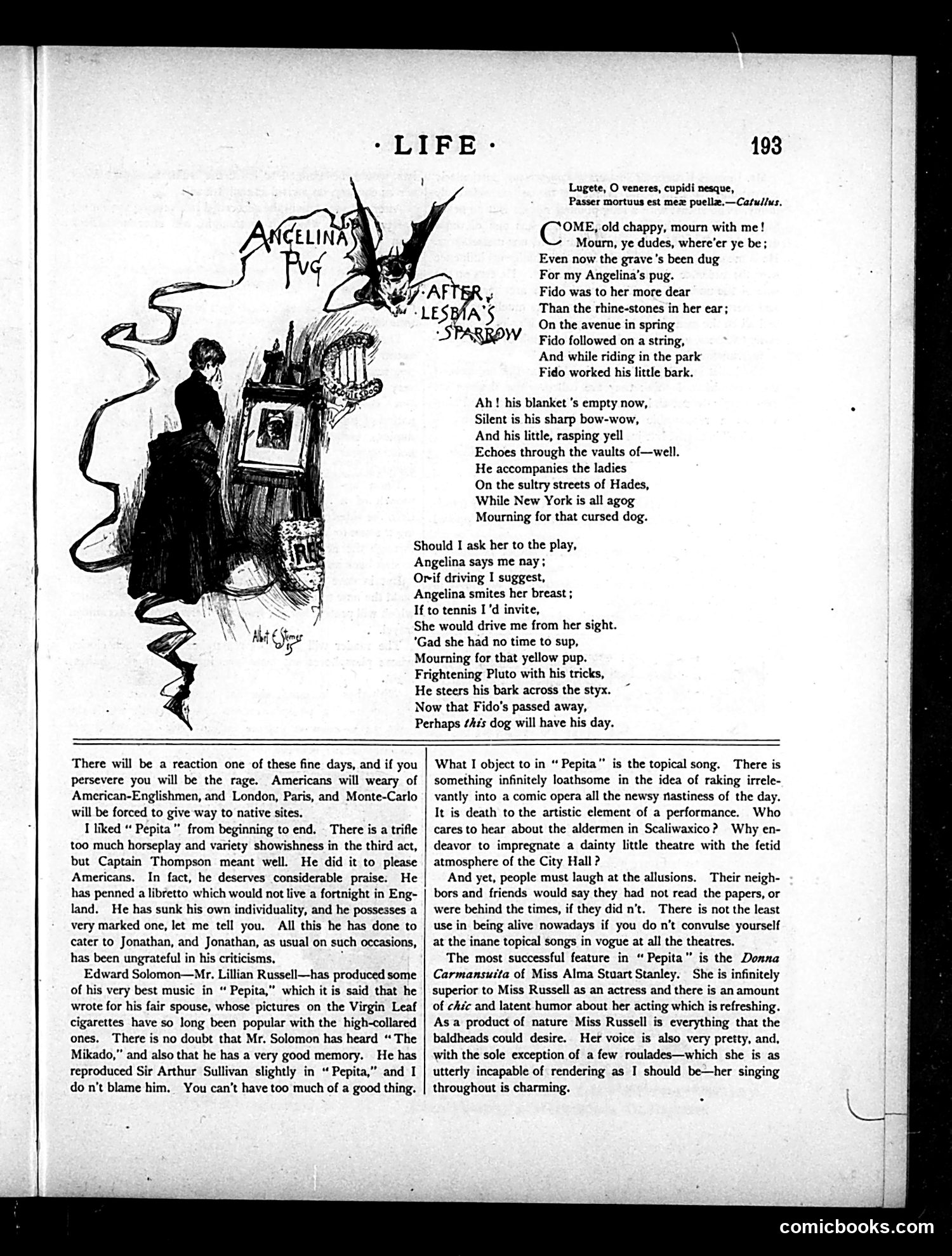
This satirical poem mocks wealthy New York society women's excessive sentimentality over their lap dogs. The illustration shows a fashionable woman mourning her deceased pug, "Fido," with dramatic grief—the dog receives an elaborate funeral complete with a coffin and grave. The joke targets the absurdity of upper-class women prioritizing their pets over social obligations and romance. The narrator, presumably Angelina's suitor, complains that she refuses theater invitations, carriage rides, and tennis outings because she's mourning "that yellow pup." The poem uses mock-classical Latin epigraph and references to Hades/Pluto to humorously elevate the dog's death to tragic importance. The satire criticizes both the frivolous nature of high society and women's perceived emotional excess. The closing line suggests the pug may find better companionship in the afterlife than the living narrator will on Fifth Avenue. The page also reviews the operetta "Pepita," featuring actress Lillian Russell, criticizing its topical songs but praising co-star Alma Stuart Stanley's performance.
📄 Transcribed text from this page (OCR, searchable)
Machine-transcribed from the original scan — historical spelling and the odd misread are preserved.
Lugete, O veneres, cupidi nesque, Passer mortuus est mex puellz.—Cafullus, OME, old chappy, mourn with me! Mourn, ye dudes, where’er ye be; Even now the grave 's been dug For my Angelina’s pug. Fido was to her more dear Than the rhine-stones in her ear; On the avenue in spring Fido followed on a string, And while riding in the park Fido worked his little bark. Ah! his blanket 's empty now, Silent is his sharp bow-wow, And his little, rasping yell Echoes through the vaults of—well. He accompanies the ladies On the sultry streets of Hades, While New York is all agog Mourning for that cursed dog. Should I ask her to the play, Angelina says me nay; Orif driving I suggest, Angelina smites her breast ; If to tennis I'd invite, She would drive me from her sight. ‘Gad she had no time to sup, Mourning for that yellow pup. Frightening Pluto with his tricks, He steers his bark across the styx. Now that Fido’s passed away, Perhaps ¢hzs dog will have his day. There will be a reaction one of these fine days, and if you persevere you will be the rage. Americans will weary of Amcrican-Englishmen, and London, Paris, and Monte-Carlo will be forced to give way to native sites. I liked “ Pepita” from beginning to end. — There is a trifle too much horseplay and variety showishness in the third act, but Captain Thompson meant well. He did it to please Americans. In fact, he deserves considerable praise. He has penned a libretto which would not live a fortnight in Eng- land. He has sunk his own individuality, and he possesses a very marked one, let me tell you. All this he has done to cater to Jonathan, and Jonathan, as usual on such occasions, has been ungrateful in his criticisms, ‘i Edward Solomon—Mr. Lillian Russell—has produced some of his very best music in “ Pepita,” which it is said that he wrote for his fair spouse, whose pictures on the Virgin Leaf cigarettes have so Jong been popular with the high-collared ones. There is no doubt that Mr. Solomon has heard “ The Mikado,” and also that he has a very good memory. He has reproduced Sir Arthur Sullivan slightly in “ Pepita,” and I do n't blame him. You can’t have too much of a good thing. What I object to in “ Pepita” is the topical song. There is something infinitely loathsome in the idea of raking irrele- vantly into a comic opera all the newsy nastiness of the day. It is death to the artistic element of a performance. Who cares to hear about the aldermen in Scaliwaxico? Why en- deavor to impregnate a dainty little theatre with the fetid atmosphere of the City Hall ? And yet, people must laugh at the allusions. Their neigh- bors and friends would say they had not read the papers, or were behind the times, if they did n’t. There is not the least use in being alive nowadays if you don’t convulse yourself at the inane topical songs in vogue at all the theatres. The most successful feature in “ Pepita” is the Donna Carmansutta of Miss Alma Stuart Stanley. She is infinitely superior to Miss Russell as an actress and there is an amount of chic and latent humor about her acting which is refreshing. As a product of nature Miss Russell is everything that the baldheads could desire. Her voice is also very pretty, and, with the sole exception of a few roulades—which she is as utterly incapable of rendering as I should be—her singing throughout is charming. comicbooks.com