
Life, 1886-04-01 · page 10 of 16
Life — April 1, 1886 — page 10: what you’re looking at
What you’re looking at
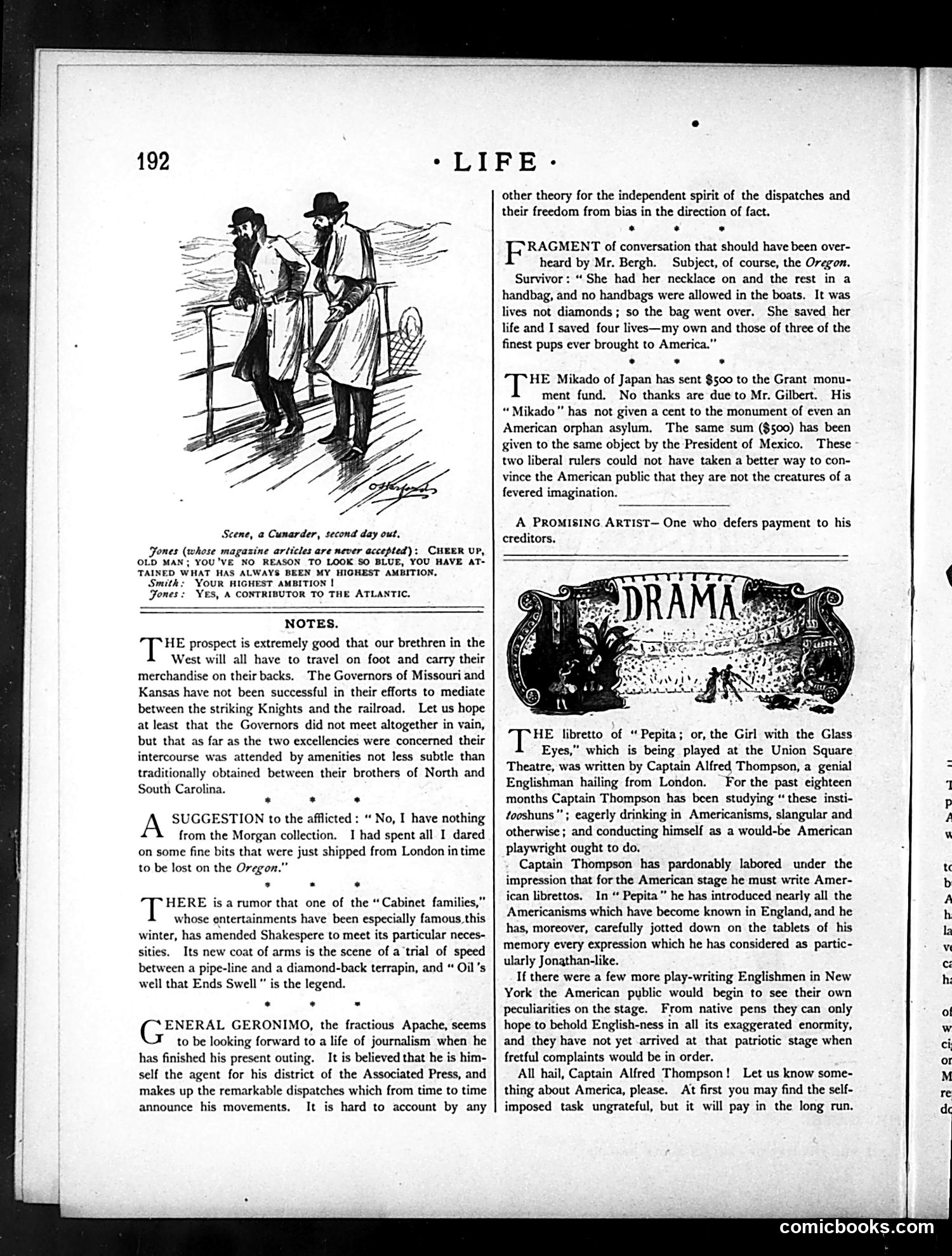
The main cartoon depicts two men aboard a ship (a "Cunarder," a Cunard liner). Jones, a perpetually rejected magazine writer, congratulates Smith on achieving Jones's "highest ambition": becoming a contributor to *The Atlantic* magazine. The joke is self-deprecating—Jones considers publication in a prestigious literary journal so difficult that he views it as his ultimate life goal, yet he hasn't achieved it himself. The "Notes" section contains satirical brief items: references to railroad labor strikes (Knights of Labor), a ship disaster (the *Oregon*), General Geronimo portrayed as ironically biased in his press dispatches, and Captain Alfred Thompson, an English playwright overstudying American slang for his Broadway play *Pepita*. The satire mocks literary ambition, labor unrest, immigrant writers attempting forced Americanism, and the era's sensational journalism.
📄 Transcribed text from this page (OCR, searchable)
Machine-transcribed from the original scan — historical spelling and the odd misread are preserved.
* LIFE: Scene, a Cunarder, second day out, Fones (whose magazine articles are never accepted): CHEER UP, OLD MAN; YOU'VE NO REASON TO LOOK SO BLUE, YOU HAVE AT- TAINED WHAT HAS ALWAYS BEEN MY HIGHEST AMBITION. Smith: YOuR HIGHEST AMBITION ! Jones: YES, A CONTRIBUTOR TO THE ATLANTIC. NOTES. HE prospect is extremely good that our brethren in the West will all have to travel on foot and carry their merchandise on their backs. The Governors of Missouri and Kansas have not been successful in their efforts to mediate between the striking Knights and the railroad. Let us hope at least that the Governors did not meet altogether in vain, but that as far as the two excellencies were concerned their intercourse was attended by amenities not less subtle than traditionally obtained between their brothers of North and South Carolina. * * . SUGGESTION to the afflicted : “ No, I have nothing from the Morgan collection. I had spent all I dared on some fine bits that were just shipped from London in time to be lost on the Oregon.” ’ * . HERE isa rumor that one of the “Cabinet families,” whose entertainments have been especially famous this winter, has amended Shakespere to meet its particular neces- sities. Its new coat of arms is the scene of atrial of speed between a pipe-line and a diamond-back terrapin, and “ Oil’s well that Ends Swell” is the legend. * . . ENERAL GERONIMO, the fractious Apache, seems to be looking forward to a life of journalism when he has finished his present outing. It is believed that he is him- self the agent for his district of the Associated Press, and makes up the remarkable dispatches which from time to time announce his movements. It is hard to account by any other theory for the independent spirit of the dispatches and their freedom from bias in the direction of fact. * . . RAGMENT of conversation that should have been over- heard by Mr. Bergh. Subject, of course, the Oregon. Survivor: “ She had her necklace on and the rest in a handbag, and no handbags were allowed in the boats. It was lives not diamonds; so the bag went over, She saved her life and I saved four lives—my own and those of three of the finest pups ever brought to America.” . * . HE Mikado of Japan has sent $500 to the Grant monu- ment fund. No thanks are due to Mr. Gilbert. His “Mikado” has not given a cent to the monument of even an American orphan asylum. The same sum ($500) has been given to the same object by the President of Mexico. These two liberal rulers could not have taken a better way to con- vince the American public that they are not the creatures of a fevered imagination. A PROMISING ARTIST— One who defers payment to his creditors. << HE libretto of “ Pepita; or, the Girl with the Glass Eyes,” which is being played at the Union Square Theatre, was written by Captain Alfred Thompson, a genial Englishman hailing from London. For the past eighteen months Captain Thompson has been studying “ these insti- tooshuns"’; eagerly drinking in Americanisms, slangular and otherwise; and conducting himself as a would-be American playwright ought to do. Captain Thompson has pardonably labored under the impression that for the American stage he must write Amer- ican librettos. In “ Pepita” he has introduced nearly all the Americanisms which have become known in England, and he has, moreover, carefully jotted down on the tablets of his memory every expression which he has considered as partic- ularly Jonathan-like. If there were a few more play-writing Englishmen in New York the American public would begin to see their own peculiarities on the stage. From native pens they can only hope to behold English-ness in all its exaggerated enormity, and they have not yet arrived at that patriotic stage when fretful complaints would be in order. All hail, Captain Alfred Thompson! Let us know some- thing about America, please. At first you may find the self- imposed task ungrateful, but it will pay in the long run. comicbooks.com