
Life, 1886-04-01 · page 2 of 16
Life — April 1, 1886 — page 2: what you’re looking at
What you’re looking at
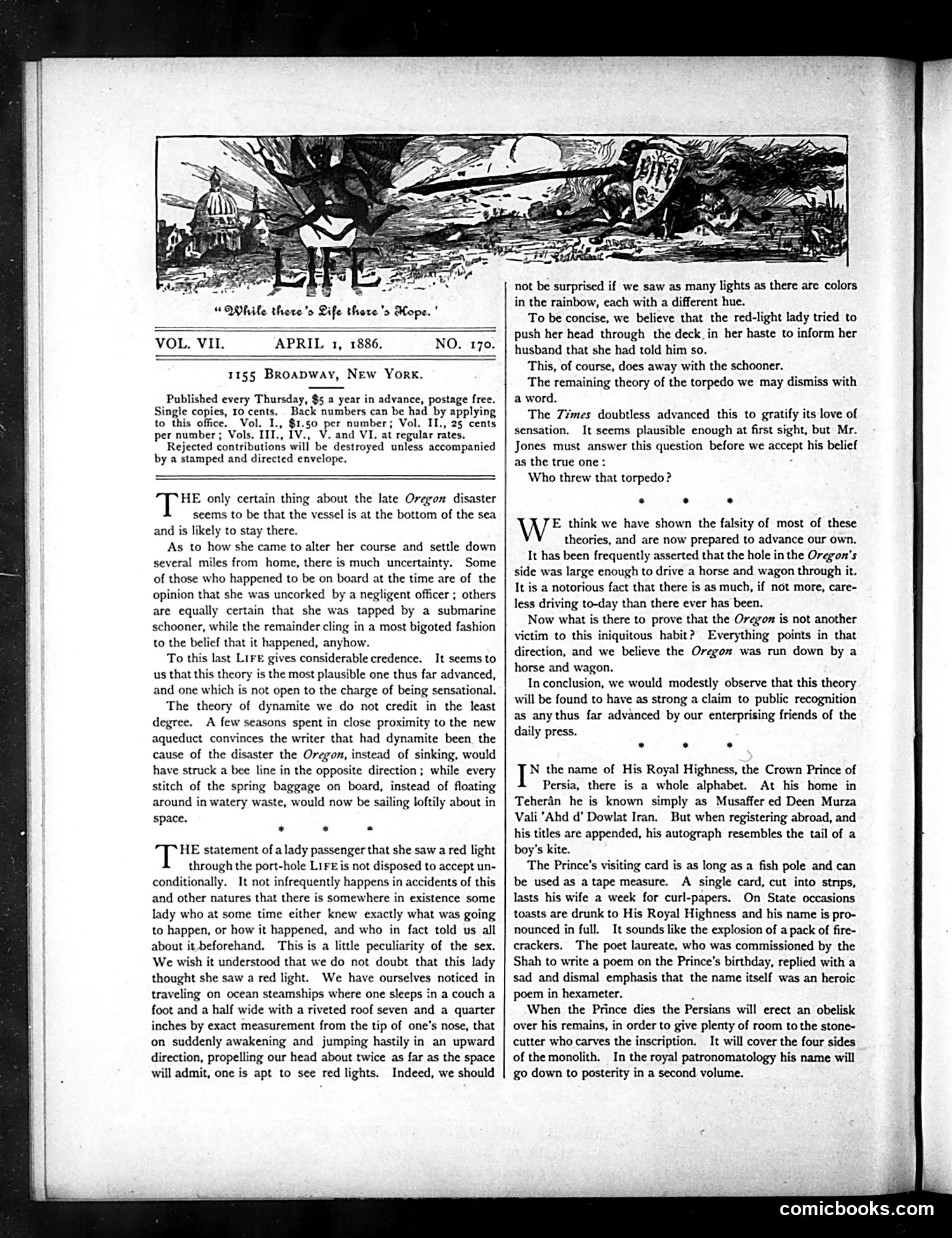
The cartoon at top illustrates the caption "While there's Life there's Hope," depicting a shipwreck scene with a vessel and survivors. The text discusses theories about the **USS Oregon disaster**—a real naval incident. The magazine dismisses sensational explanations (dynamite, a torpedo) in favor of the mundane reality: the Oregon was simply driven onto rocks by a horse and wagon on deck, causing it to sink. The satire targets newspapers' appetite for dramatic disaster narratives over factual reporting. The magazine also includes unrelated satirical content about the **Crown Prince of Persia's** absurdly long titles and eccentric customs, mocking both Persian nobility and the pretensions of international formality.
📄 Transcribed text from this page (OCR, searchable)
Machine-transcribed from the original scan — historical spelling and the odd misread are preserved.
; wv “While there's Life there’s Hope. ' VOL. VII. NO. 170. APRIL 1, 1886. 1155 Broapway, New York. Published every Thursday, $5 a year in advance, postage free. Single copies, 10 cents. Back numbers can be had by applying to this office. Vol. I., $1.50 per number; Vol. II., 25 cents per number ; Vols, III., IV., V. and VI. at regular rates. Rejected contributions will be destroyed unless accompanied by a stamped and directed envelope. HE only certain thing about the late Oregon disaster seems to be that the vessel is at the bottom of the sea and is likely to stay there. As to how she came to alter her course and settle down several miles from home, there is much uncertainty. Some of those who happened to be on board at the time are of the opinion that she was uncorked by a negligent officer ; others are equally certain that she was tapped by a submarine schooner, while the remainder cling in a most bigoted fashion to the belief that it happened, anyhow. To this last LiFE gives considerable credence. It seems to us that this theory is the most plausible one thus far advanced, and one which is not open to the charge of being sensational. The theory of dynamite we do not credit in the least degree. A few seasons spent in close proximity to the new aqueduct convinces the writer that had dynamite been. the cause of the disaster the Oregon, instead of sinking, would have struck a bee line in the opposite direction ; while every stitch of the spring baggage on board, instead of floating around in watery waste, would now be sailing loftily about in space. * . « HE statement of a lady passenger that she saw a red light through the port-hole LIFE is not disposed to accept un- conditionally, It not infrequently happens in accidents of this and other natures that there is somewhere in existence some lady who at some time either knew exactly what was going to happen, or how it happened, and who in fact told us all about it beforehand. This is a little peculiarity of the sex. We wish it understood that we do not doubt that this lady thought she saw a red light. We have ourselves noticed in traveling on ocean steamships where one sleeps in a couch a foot and a half wide with a riveted roof seven and a quarter inches by exact measurement from the tip of one’s nose, that on suddenly awakening and jumping hastily in an upward direction, propelling our head about twice as far as the space will admit, one is apt to see red lights. Indeed, we should not be surprised if we saw as many lights as there are colors in the rainbow, each with a different hue. To be concise, we believe that the red-light lady tried to push her head through the deck, in her haste to inform her husband that she had told him so. This, of course, does away with the schooner. The remaining theory of the torpedo we may dismiss with a word. The 7imes doubtless advanced this to gratify its love of sensation. It seems plausible enough at first sight, but Mr. Jones must answer this question before we accept his belief as the true one: 3 Who threw that torpedo? * * * E think we have shown the falsity of most of these theories, and are now prepared to advance our own. It has been frequently asserted that the hole in the Oregon's side was large enough to drive a horse and wagon through it. It is a notorious fact that there is as much, if not more, care- less driving to-day than there ever has been. Now what is there to prove that the Oregon is not another victim to this iniquitous habit? Everything points in that direction, and we believe the Oregon was run down by a horse and wagon, In conclusion, we would modestly observe that this theory will be found to have as strong a claim to public recognition as any thus far advanced by our enterprising friends of the daily press. . . . N the name of His Royal Highness, the Crown Prince of Persia, there is a whole alphabet. At his home in Teheran he is known simply as Musaffer ed Deen Murza Vali 'Ahd d’ Dowlat Iran. But when registering abroad, and his titles are appended, his autograph resembles the tail of a boy’s kite. The Prince's visiting card is as long as a fish pole and can be used as a tape measure, A single card, cut into stnps, lasts his wife a week for curl-papers. On State occasions toasts are drunk to His Royal Highness and his name is pro- nounced in full. It sounds like the explosion of a pack of fire- crackers. The poet laureate, who was commissioned by the Shah to write a poem on the Prince's birthday, replied with a sad and dismal emphasis that the name itself was an heroic poem in hexameter. : When the Prince dies the Persians will erect an obelisk over his remains, in order to give plenty of room to the stone- cutter who carves the inscription. It will cover the four sides of the monolith. In the royal patronomatology his name will go down to posterity in a second volume. comicbooks.com