
A complete issue · 16 pages · 1886
Life — March 25, 1886
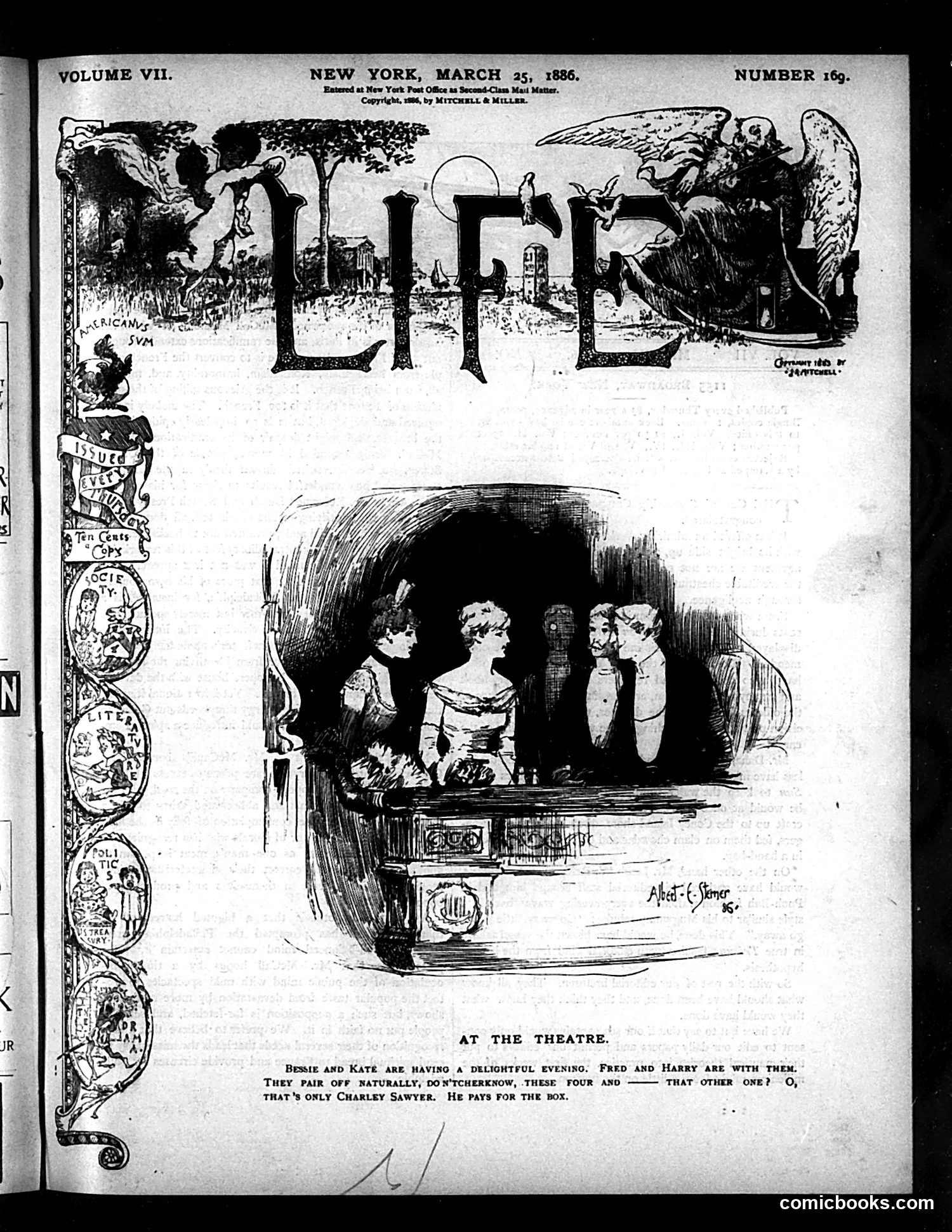
This page features a theatrical scene titled "At the Theatre." The caption identifies four characters: Bessie and Kate are enjoying an evening with Fred and Harry. The joke centers on a social hierarchy concern—the caption notes that "naturally" these four are "do'tcherow, these four and — that other one? O, that's only Charley Sawyer. He pays for the box." The satire mocks class pretension and social climbing in Gilded Age New York. The implication is that Charley Sawyer, though financially generous enough to pay for the theatre box, is socially beneath the other four and thus relegated to the background. The cartoon ridicules how wealthy but socially inferior individuals were treated as mere financial conveniences by the upper class, highlighted through the dismissive reference to him as merely "that other one."
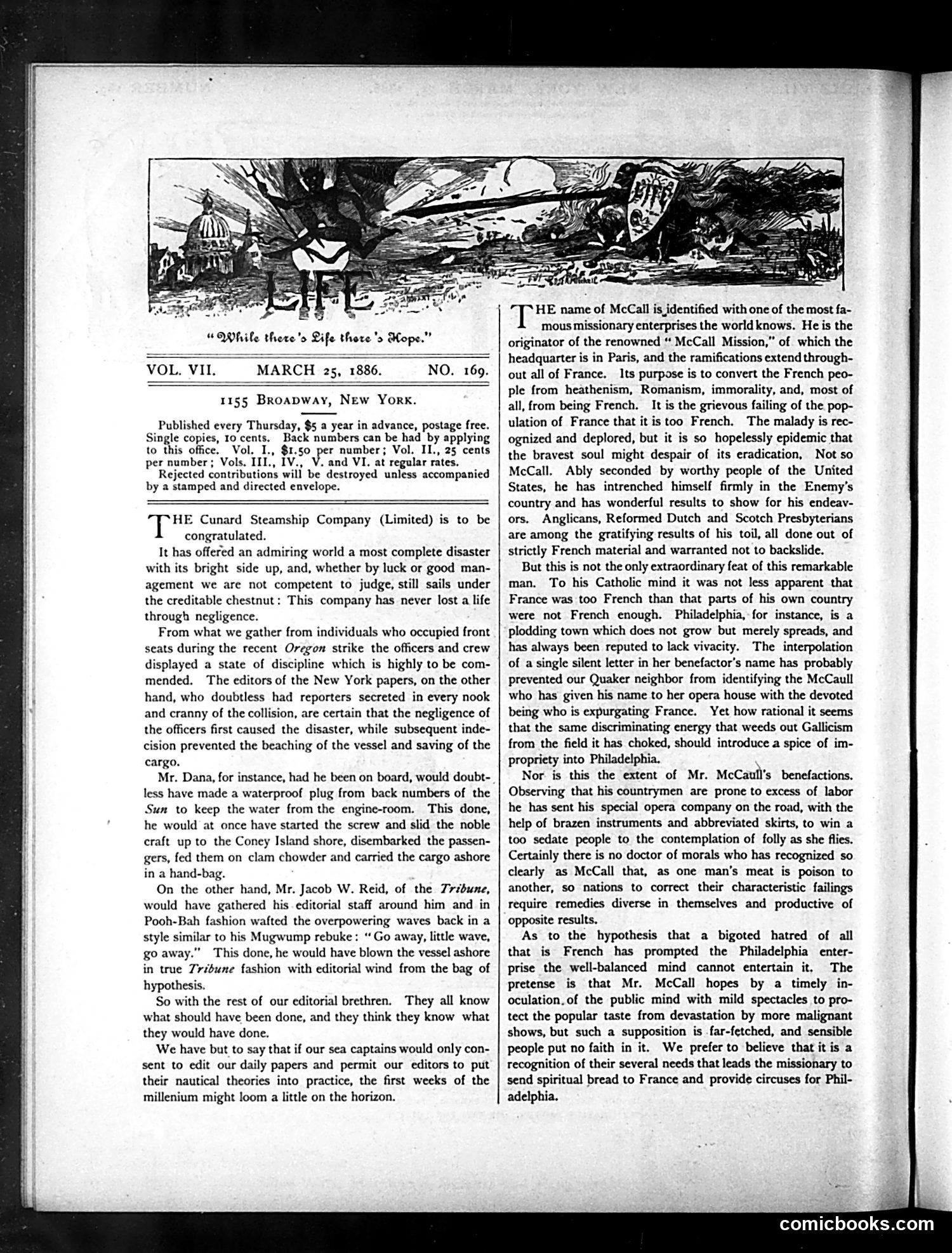
**The Cartoon:** The header illustration titled "While there's Life there's Hope" depicts a dramatic maritime scene—likely referencing the recent *Oregon* steamship strike mentioned in the text below. The image shows a vessel in distress with turbulent waters, appearing to critique negligence in maritime operations. **The Editorial Content:** The accompanying text discusses the *Cunard Steamship Company* disaster and editorial disagreement about responsibility. Editors of competing New York papers (the *Sun* and *Tribune*) debated whether captains or officers caused the wreck. The satire criticizes these editorial disputes as armchair theorizing disconnected from actual nautical practice. The piece argues that newspaper editors should defer to experienced sea captains rather than imposing "nautical theories" based on incomplete knowledge.
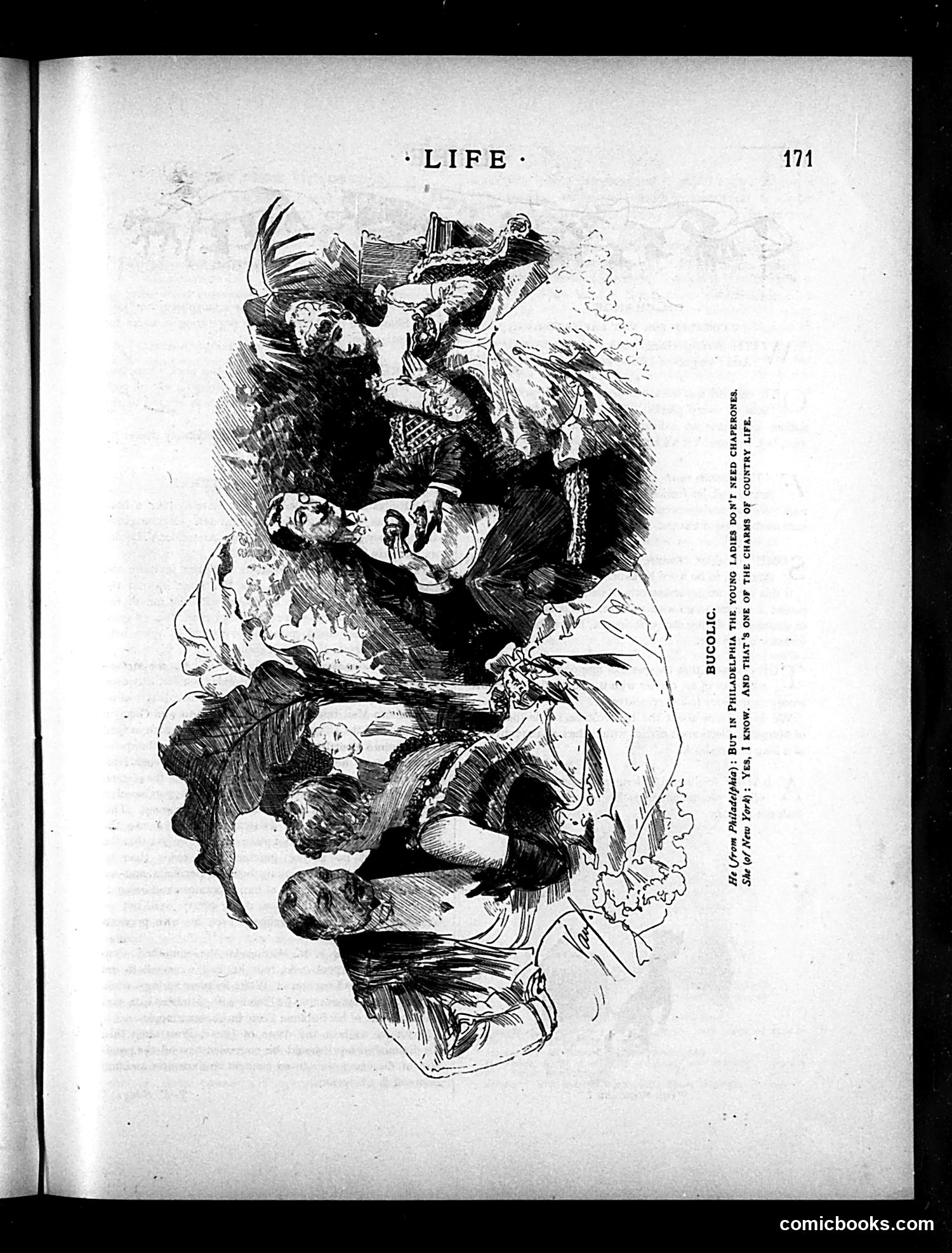
This is a satirical cartoon depicting what appears to be a grotesque pile-up of figures stacked vertically, suggesting political or social chaos. The style uses heavy cross-hatching typical of late 19th/early 20th-century satirical illustration. The OCR text mentions "Eurochic" and references "publishing" and "one or complete life," though the exact meaning is unclear due to OCR errors. The vertical stacking composition suggests commentary on social hierarchy, political confusion, or perhaps the overwhelming nature of modern life. Without clearer text or caption identification, I cannot definitively name the figures or pinpoint the specific historical event being satirized. The artistic technique and magazine context indicate this critiques contemporary social or political conditions through exaggerated, grotesque imagery—typical of *Life* magazine's approach.
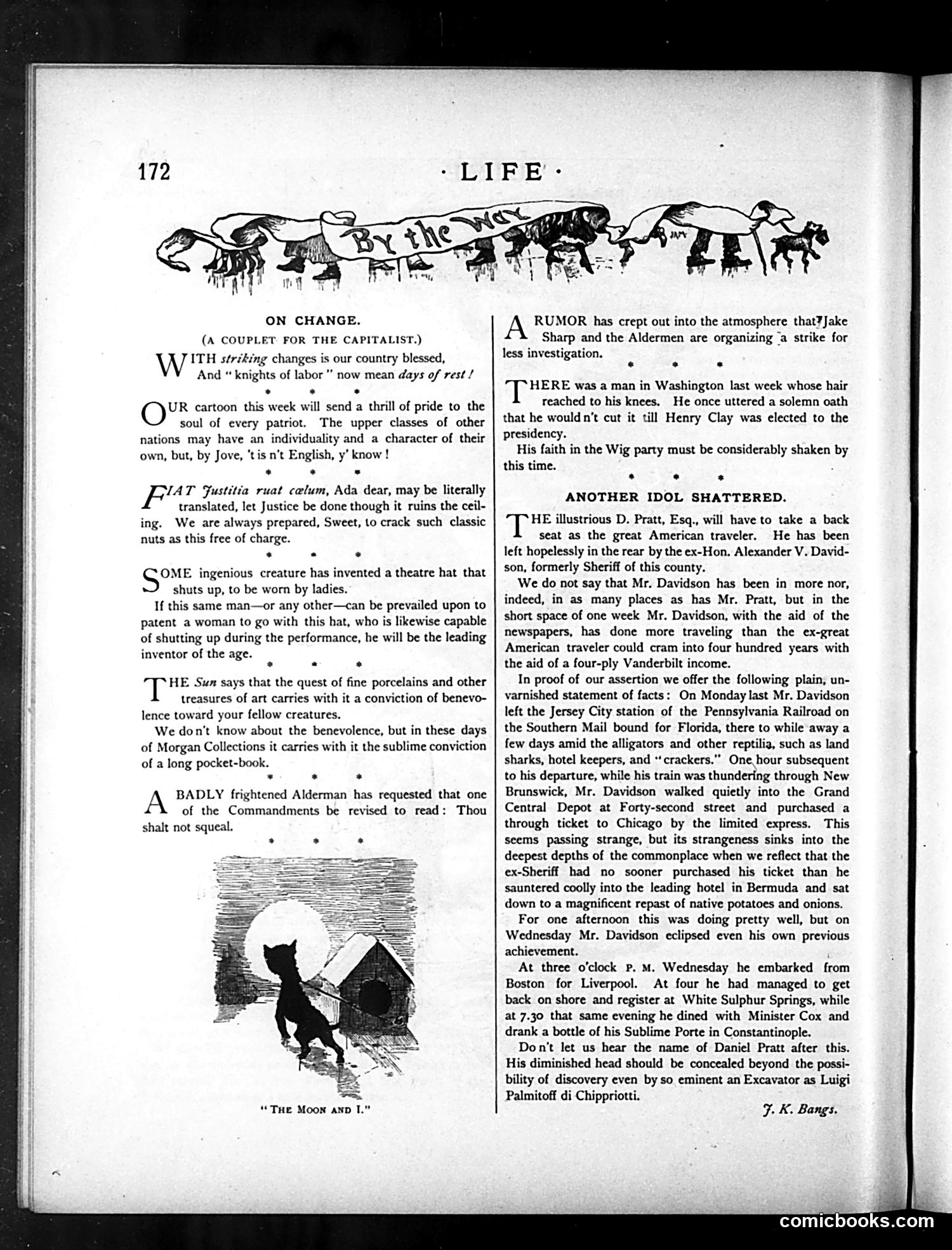
This cartoon depicts a silhouetted cat gazing at the moon through a window. The caption "The Moon and I" is a visual pun on the famous saying "The moon and I" (often attributed to romantic or philosophical musings). The accompanying text discusses political figures including Jake Sharp, the Aldermen, Henry Clay, and D. Pratt (called "the great American traveler"). The satire mocks capitalist "knights of labor" and their rest days, critiques nouveau riche collecting of porcelains, and ridicules an Alderman's request to revise the Commandments to "Thou shalt not squeal." The cartoon likely satirizes the disconnect between ordinary people (represented by the cat) and those in power, who pursue grand ambitions while common folk simply observe from below.
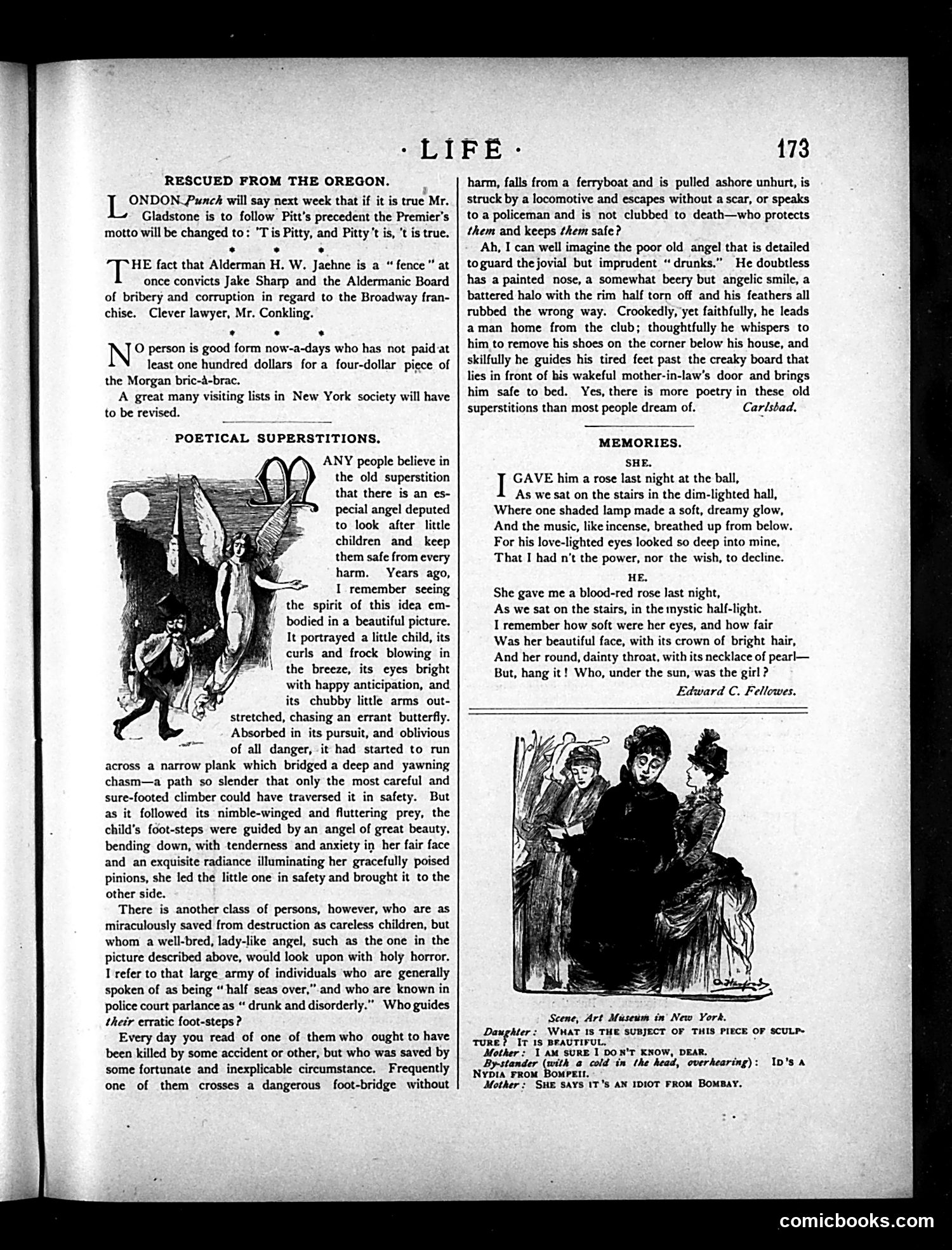
This page contains three separate satirical pieces: 1. **"Rescued from the Oregon"**: A brief note mocking Alderman H.W. Jaehne as a "fence" (criminal accomplice) regarding the Broadway franchise scheme, with lawyer Conkling mentioned. 2. **"Poetical Superstitions"**: An illustrated essay about guardian angels protecting children. The accompanying engraving shows an angelic figure guiding a small child across a narrow, dangerous plank over a chasm—depicting the Victorian-era superstition that special angels protect children from harm. 3. **"Memories"**: A sentimental poem by Edward C. Fellowes about romantic moments with a woman at a ball, paired with an illustration showing three fashionably-dressed women in conversation. The page mixes light social satire with sentimental poetry typical of Life's content.
This page contains **literary reviews and short fiction** rather than political cartoons. The content includes: 1. **"Grande Pointe"** - A review of an unpublished story by George W. Cable, praised for its artistic characterization of Acadian settlers, though criticized for dramatic exaggeration. 2. **"The Life of Henry Wadsworth Longfellow"** - A brief review noting editor Samuel Longfellow's presentation of the poet through letters and journals. 3. **Fiction pieces** titled "Revenge" and "The Reform Barber" - The latter appears to be satirical commentary on a wealthy, corpulent gentleman entering a barber shop, likely mocking either vanity or social pretension. The page focuses on **literary criticism and entertainment** rather than political satire or commentary.
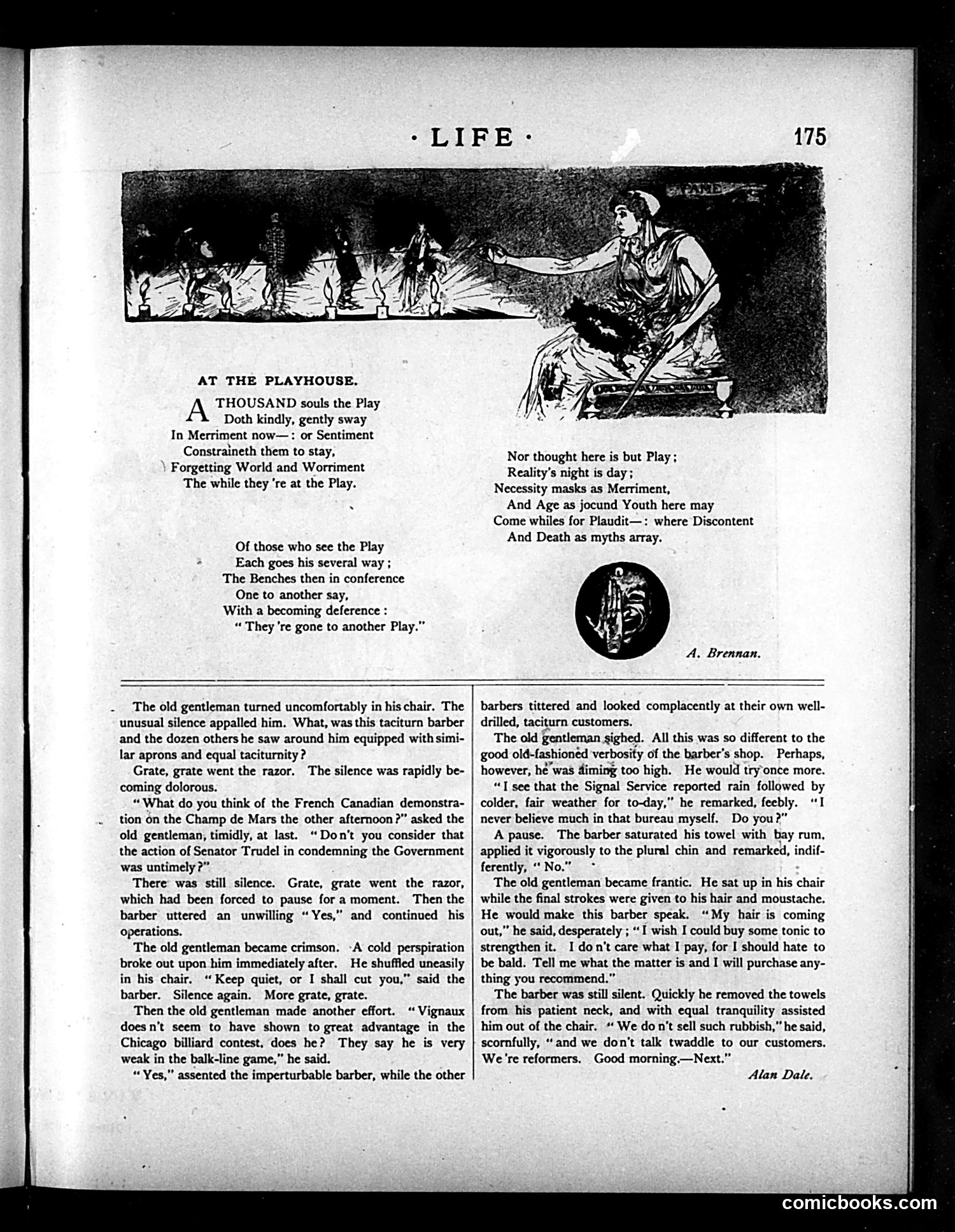
**Content Type:** This page contains a poem titled "At the Playhouse" (attributed to A. Brennan) and a short story or sketch titled "The Barber's Shop" (attributed to Alan Dale). **The Illustration:** The top shows a theatrical scene with figures on stage and a woman gesturing dramatically—consistent with the "Playhouse" poem's theme about theater attendance and mortality. **The Satirical Point:** The poem gently mocks theatergoers' pretensions—how audiences treat plays as serious matters ("Necessity masks as Merriment") while ultimately the experience is temporary entertainment masking life's darker realities (age, death). **The Story:** Depicts a silent, tense barber encounter with an elderly customer discussing politics (Senator Trudel, government condemnation, a French-Canadian demonstration). The humor lies in the barber's professional awkwardness and the customer's political anxiety during an otherwise mundane grooming service.
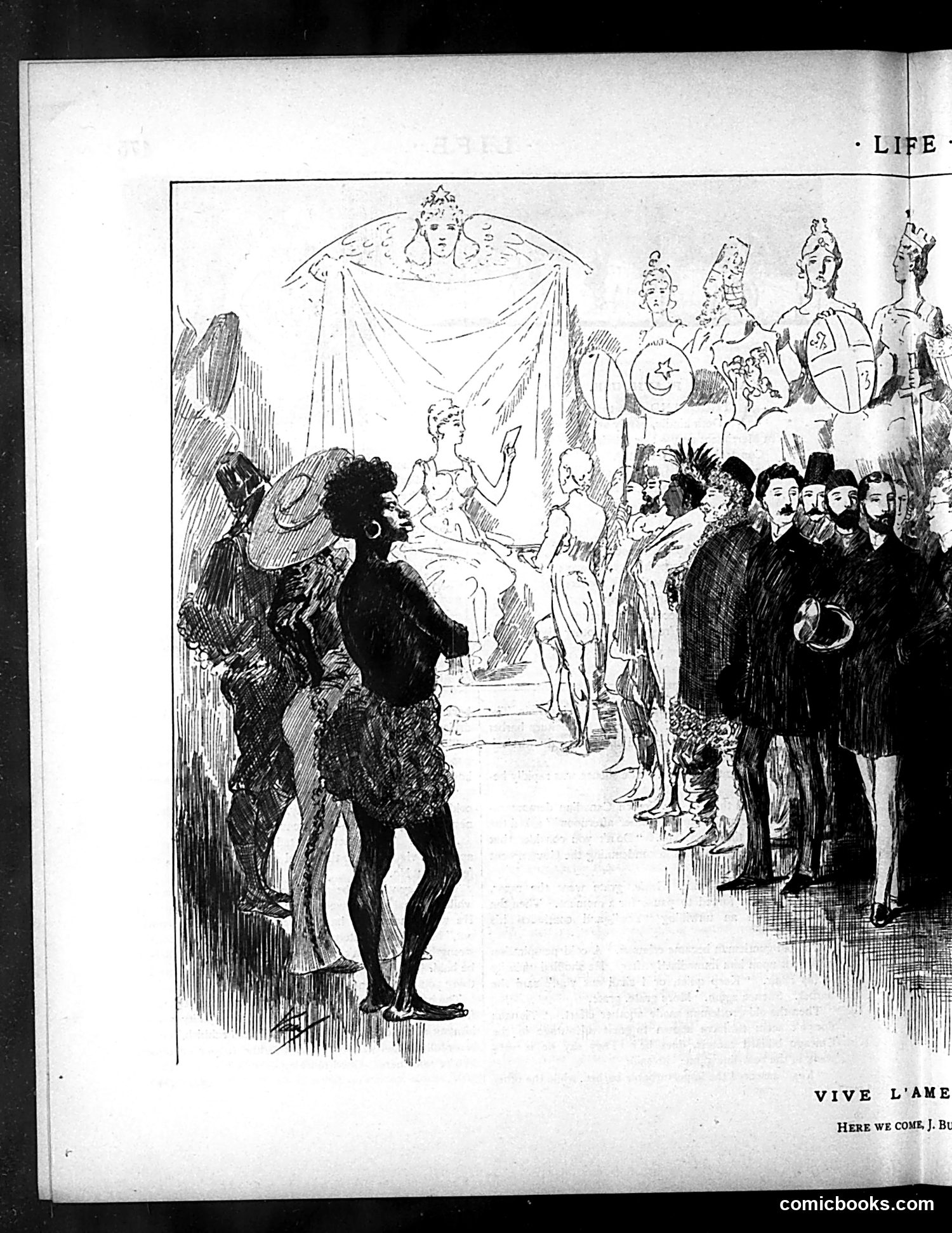
This satirical illustration depicts a scene titled "VIVE L'AME" (likely "Vive l'Âme"—Long Live the Soul), with the caption "HERE WE COME." The cartoon shows a contrast: on the left, a Black figure in tattered clothing appears to be entering or presenting himself; on the right stand well-dressed European figures in formal winter coats and hats, holding shields with crosses—appearing to represent Christian or Western civilization. The composition suggests satire about colonialism or missionary activity, depicting the meeting between an African individual and representatives of European imperial/religious institutions. The elaborate angelic or heavenly imagery above may mock the "civilizing mission" rhetoric used to justify colonization. The specific historical context and target of this satire requires additional publication date information to interpret fully.
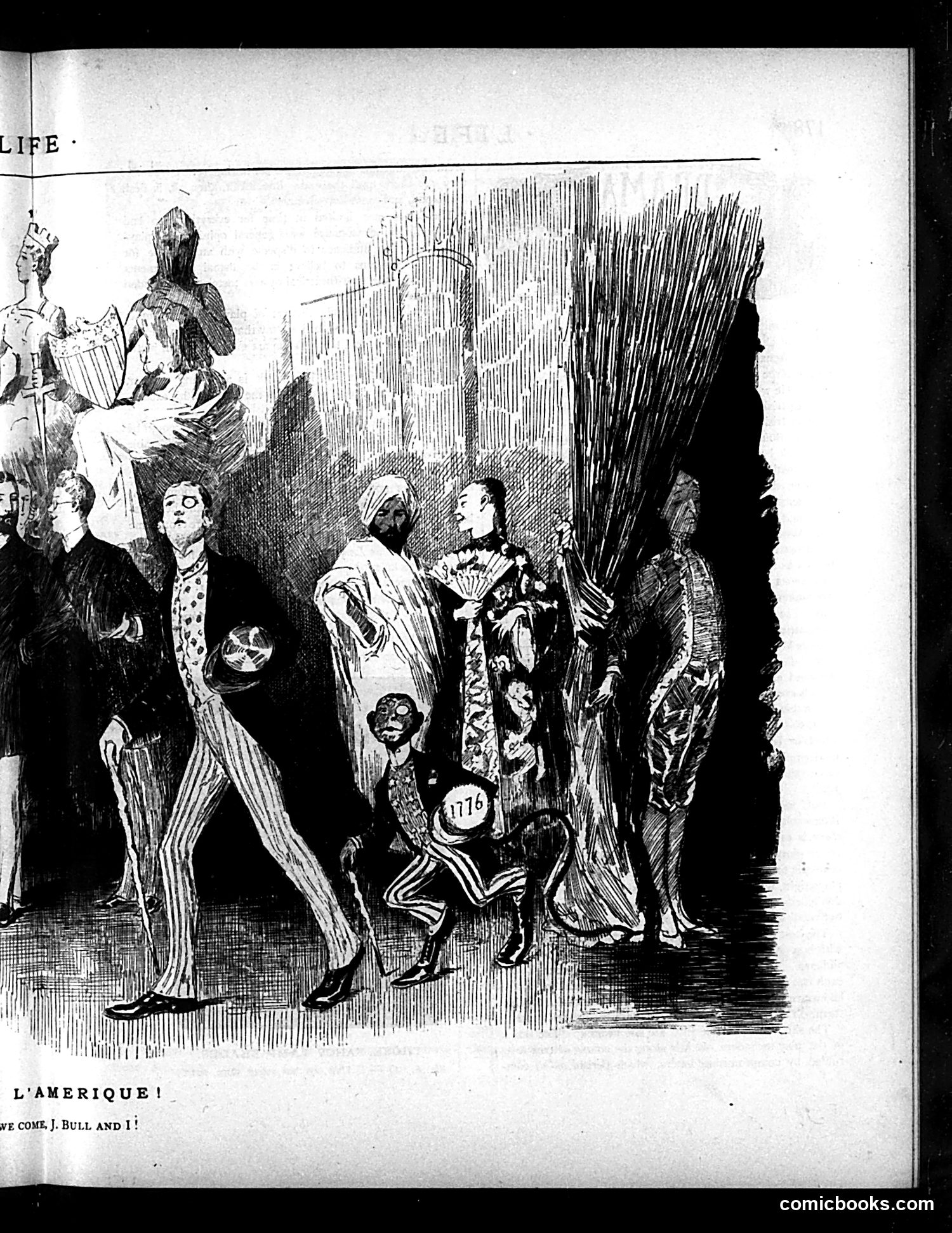
This appears to be a satirical cartoon from Life magazine titled "L'AMERIQUE!" (America!) with the caption "WE COME! BULL AND I!" The image depicts a formal reception or diplomatic scene with various figures in period dress. A small figure labeled "1119" (possibly representing a specific individual or symbolic number) stands centrally among elegantly dressed men and women in what appears to be a grand interior with draped curtains. The satire likely comments on American diplomatic relations or cultural pretensions—possibly mocking American visitors abroad or foreign dignitaries visiting America. The reference to "BULL" suggests a crude American stereotype. Without knowing the specific historical date and context, the exact political target remains unclear, though it appears to critique American manners or international conduct through exaggerated caricature.
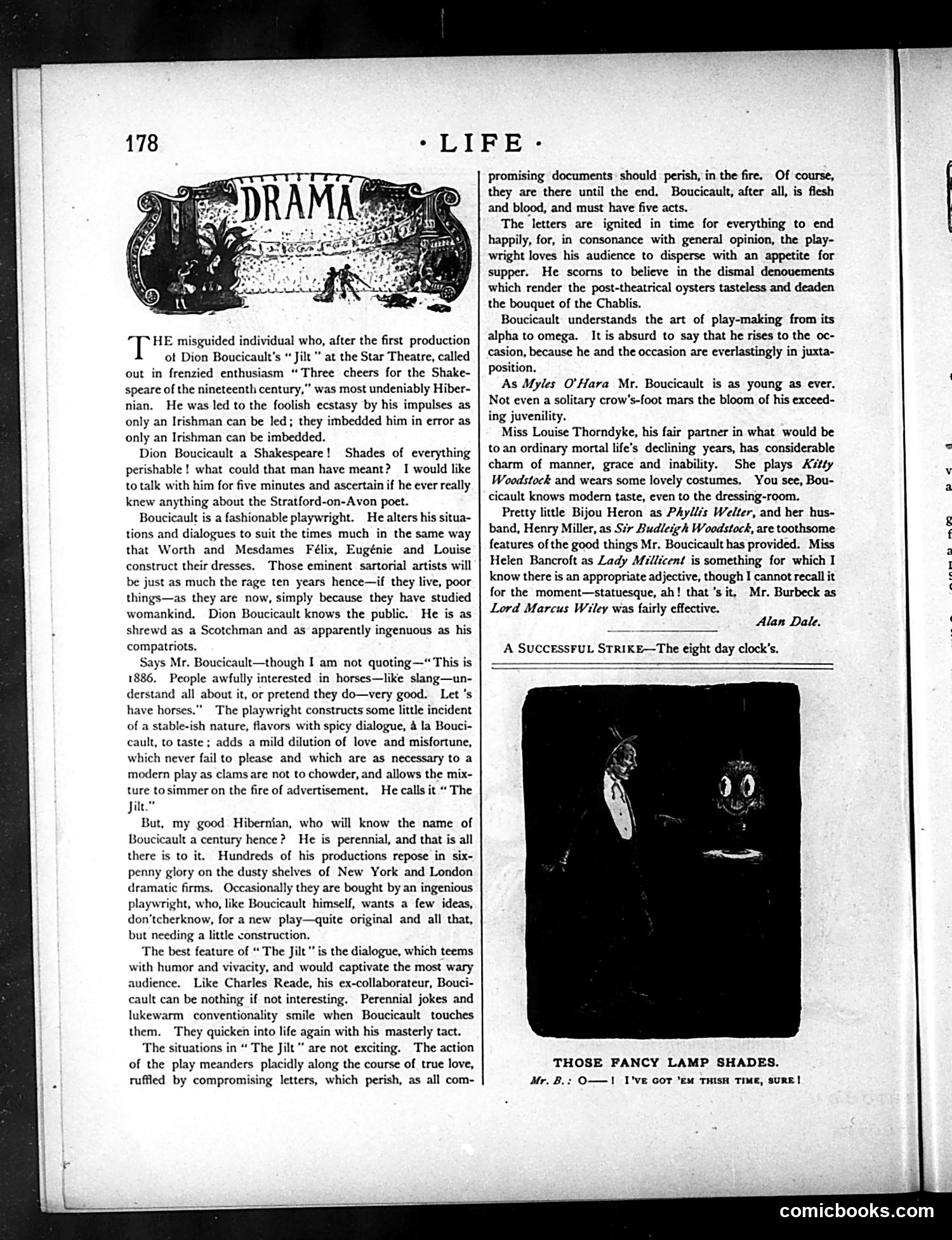
This is a theatre review of Dion Boucicault's play "The Jilt," performed at the Star Theatre. The critic mocks an Irish audience member who enthusiastically compared Boucicault to Shakespeare—dismissing this as typically foolish Irish sentiment. The reviewer argues Boucicault is a commercial hack, not an artist. He cynically constructs plays by adding fashionable elements (horses, slang, romance, compromising letters) to suit current tastes, like a dressmaker tailoring garments. The critic predicts Boucicault will be forgotten in a century, his hundreds of plays gathering dust on theatrical shelves. The accompanying illustration titled "Those Fancy Lamp Shades" shows a figure examining decorative lamp shades—likely visual satire on superficial theatrical decoration matching the text's critique of Boucicault's formulaic, surface-level approach to playwriting.
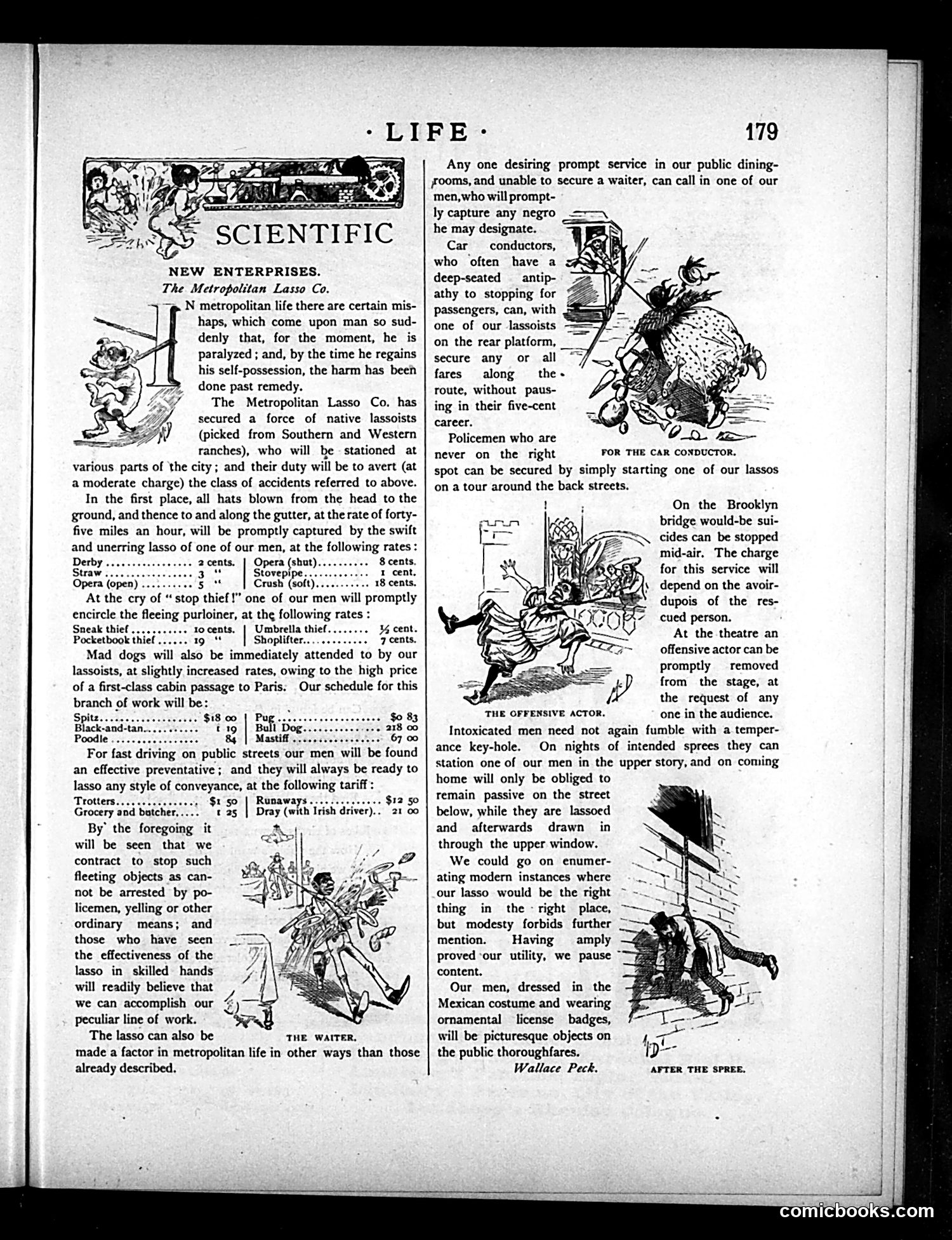
This is a satirical advertisement for a fictional "lasso service" company, mocking both contemporary urban anxieties and racist attitudes of the era. The joke proposes using cowboys with lassos to solve metropolitan problems—from retrieving blown hats to capturing fleeing pickpockets and "mad dogs." The satire targets class and racial prejudices evident in several references: one service explicitly involves "lassoing" Black waiters to compel service, and another mocks intoxicated men being forcibly "lassoed" home through windows. The piece ridicules how American society treated various groups—immigrants, workers, and Black people—as problems to be physically controlled rather than respectfully served. The cartoons by Wallace Peck illustrate absurd scenarios: a waiter being lassoed, a drunk man hoisted through a window. By treating serious social issues (poverty, racism, alcoholism, public safety) as opportunities for comedic mechanical "solutions," the satire exposes how 19th-century America approached these problems: with mockery and coercion rather than systemic reform.
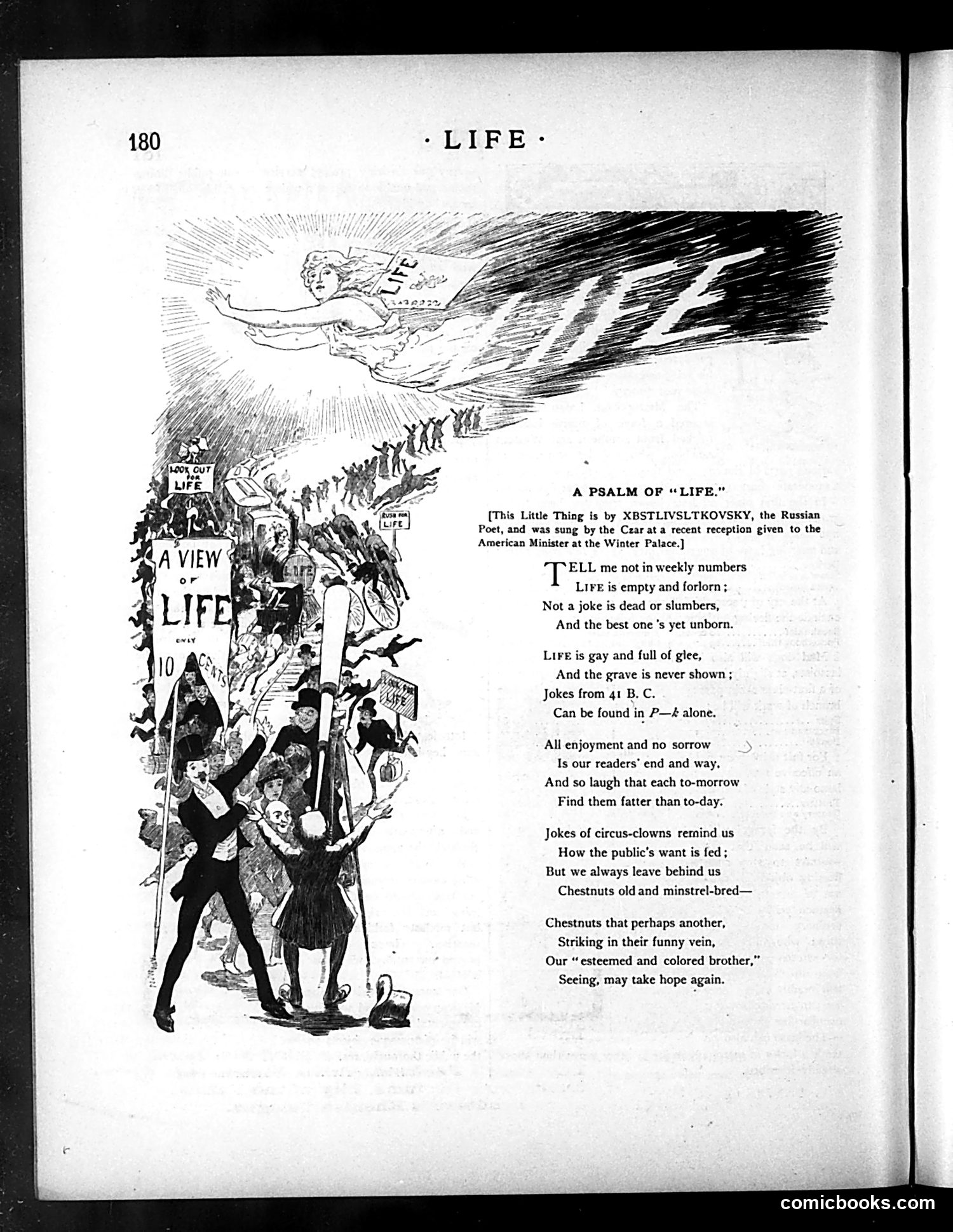
This page satirizes *Life* magazine itself through a mock poem attributed to a fictional Russian poet. The text parodies *Life's* editorial philosophy: prioritizing entertainment and humor over substance, recycling ancient jokes, and avoiding serious content ("the grave is never shown"). The elaborate left-side illustration depicts "A View of Life"—a chaotic tower of figures representing the magazine's comedic approach: circus performers, revelers, and entertainers stacked together, with ascending angels above. This visualizes the satirical claim that *Life* offers only frivolous amusement. The reference to "P—é" (likely *Puck*, a competing humor magazine) and the dismissive mention of "esteemed and colored brother" suggests *Life's* competitive relationship with other satirical publications and touches on racial attitudes of the era. The poem mocks the magazine's philosophy of endless entertainment without moral gravity.
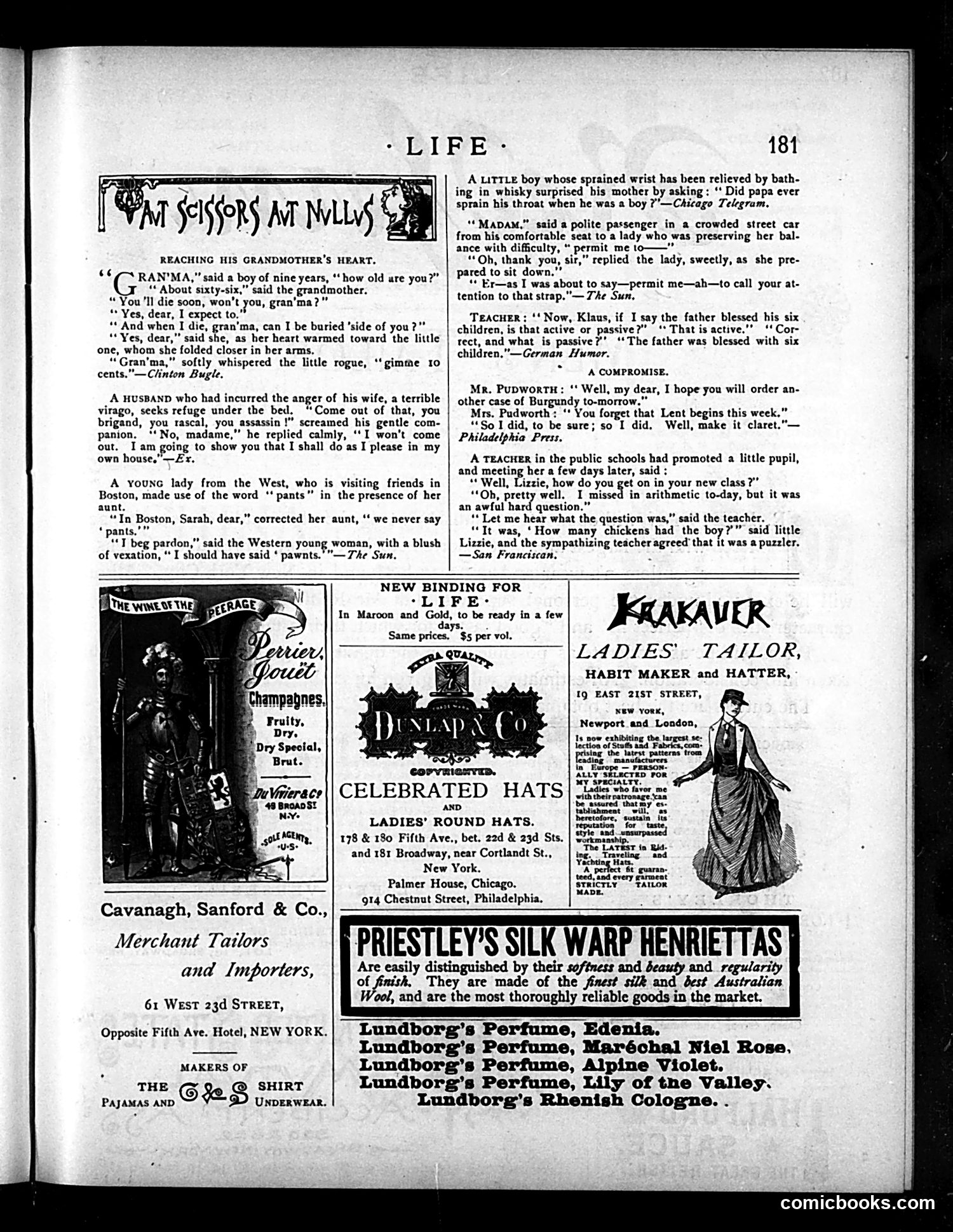
This page is primarily **humorous anecdotes and advertising** rather than political satire. The "Scissors at Mills" section contains brief jokes on various topics: **Notable humor:** - A boy asks his grandmother for money after discussing her mortality—gentle satire on childhood opportunism - A husband hiding from his angry wife; she threatens to do as she pleases in "her" house—commentary on marital power dynamics and domestic control - A Western woman's mispronunciation of "pants" as "pawnts" to sound refined—regional/class-based humor about Eastern propriety - A child's confused grammar: "the father was blessed with six children" as "passive voice"—innocent misunderstanding of grammar rules **The advertisements** (occupying roughly half the page) showcase late-19th/early-20th century fashion and luxury goods: tailors, hatmakers, silk products, and perfumes. **No clear political figures or major satire** are present. The humor is domestic, anecdotal, and relies on misunderstandings, regional differences, and family dynamics typical of *Life*'s light satirical style.
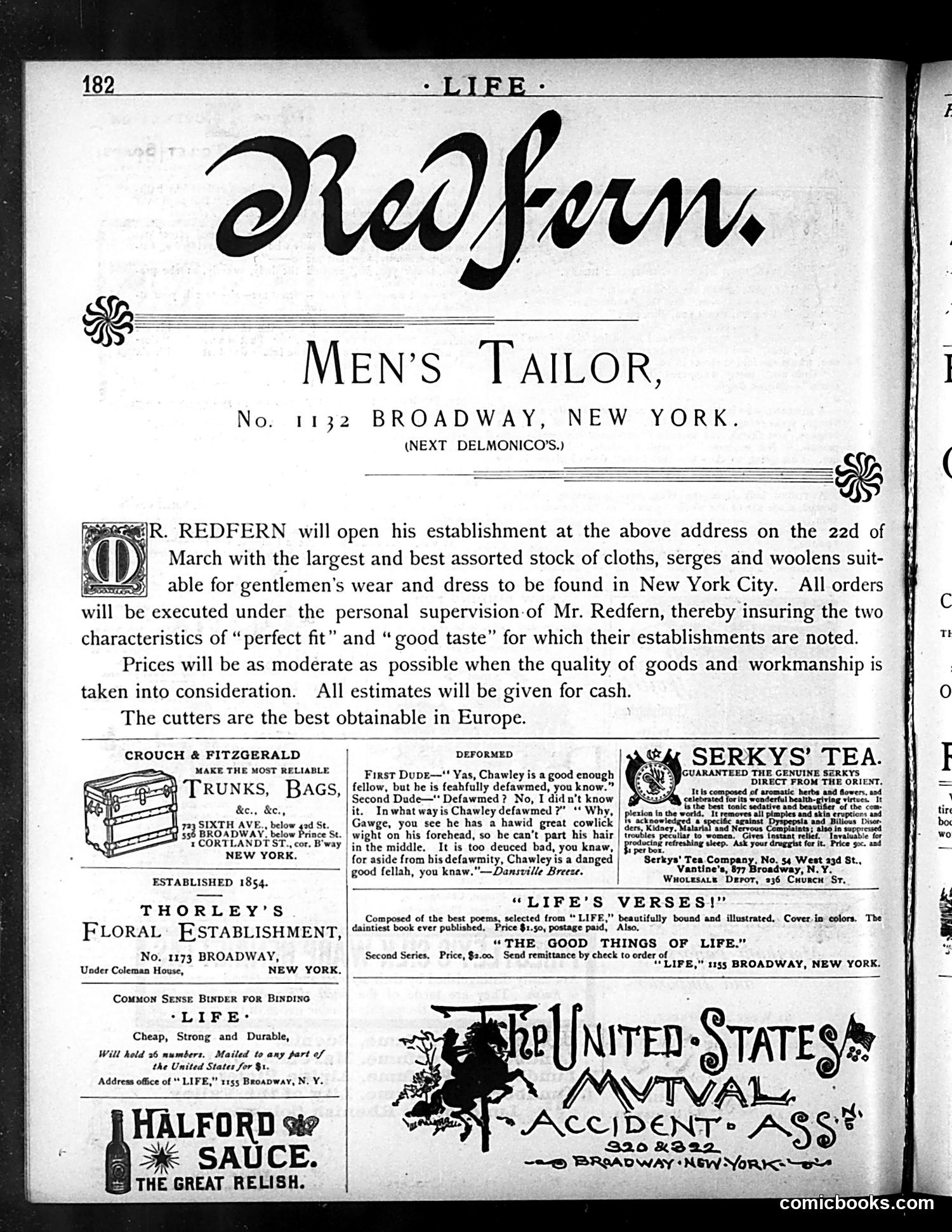
This is primarily an **advertising page** rather than political satire. The dominant content includes: **Main Advertisements:** - Red Fern (men's tailor on Broadway) - Crouch & Fitzgerald (trunks and bags) - Thorley's Floral Establishment - Halford Sauce - Serkys' Tea **The Only Comedic Content:** A brief dialogue labeled "DEFORMED" mocking upper-class affectation. Two wealthy dandies ("dupes") discuss a man named Chawley, debating whether his defining flaw is a physical deformity or merely a bad haircut (a cowlick he cannot part). The humor relies on exaggerated upper-class speech patterns ("defawmed," "Gawge") and the trivial concern these men express over superficial appearance. The satire targets **vanity and pretension among the wealthy elite**, but it's a light, social-manners joke rather than serious political commentary. The remainder of the page consists of Life's own promotional materials and standard period advertisements.
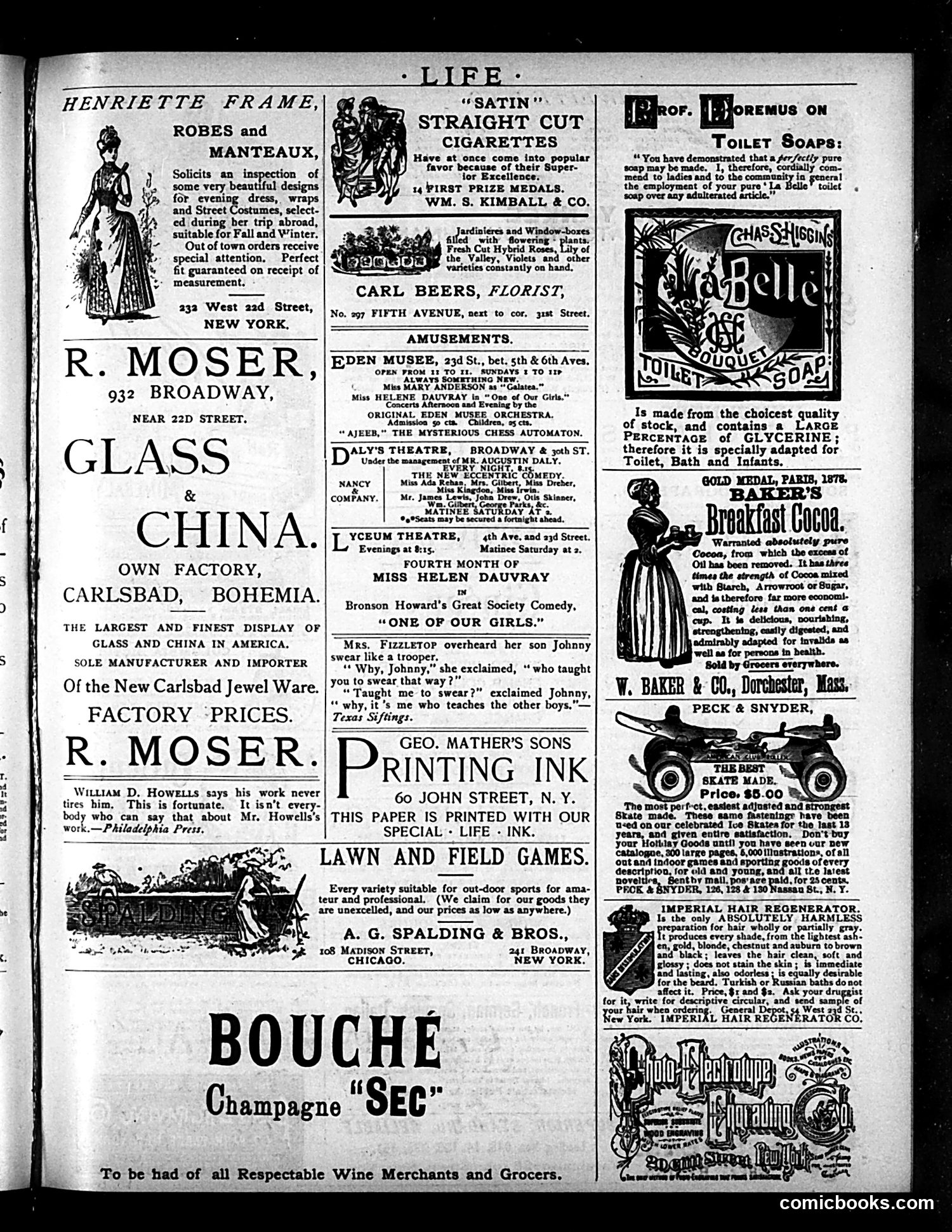
This page is **primarily advertisements** with minimal editorial content. The notable exception is a brief satirical joke in the text: **The Satire:** A dialogue between Mrs. Fizzletop and her son Johnny about swearing. When she asks "who taught you to swear that way?" Johnny replies that *he* teaches the other boys to swear—inverting her expectation that he learned bad behavior from peers. The joke mocks parental naivety about children's actual influence and misbehavior. **The Advertisements** showcase late-19th-century consumer goods: fashionable dress, glassware, cigarettes (promoted as award-winning), flowers, theater productions, cocoa, soap, and sporting equipment. **One detail:** The reference to "Miss Helene Dauvray" in multiple theater advertisements suggests she was a popular performer of this era, though her specific significance isn't explained on this page. The page reflects the era's values: luxury imports, theatrical entertainment, and emerging branded consumer products.
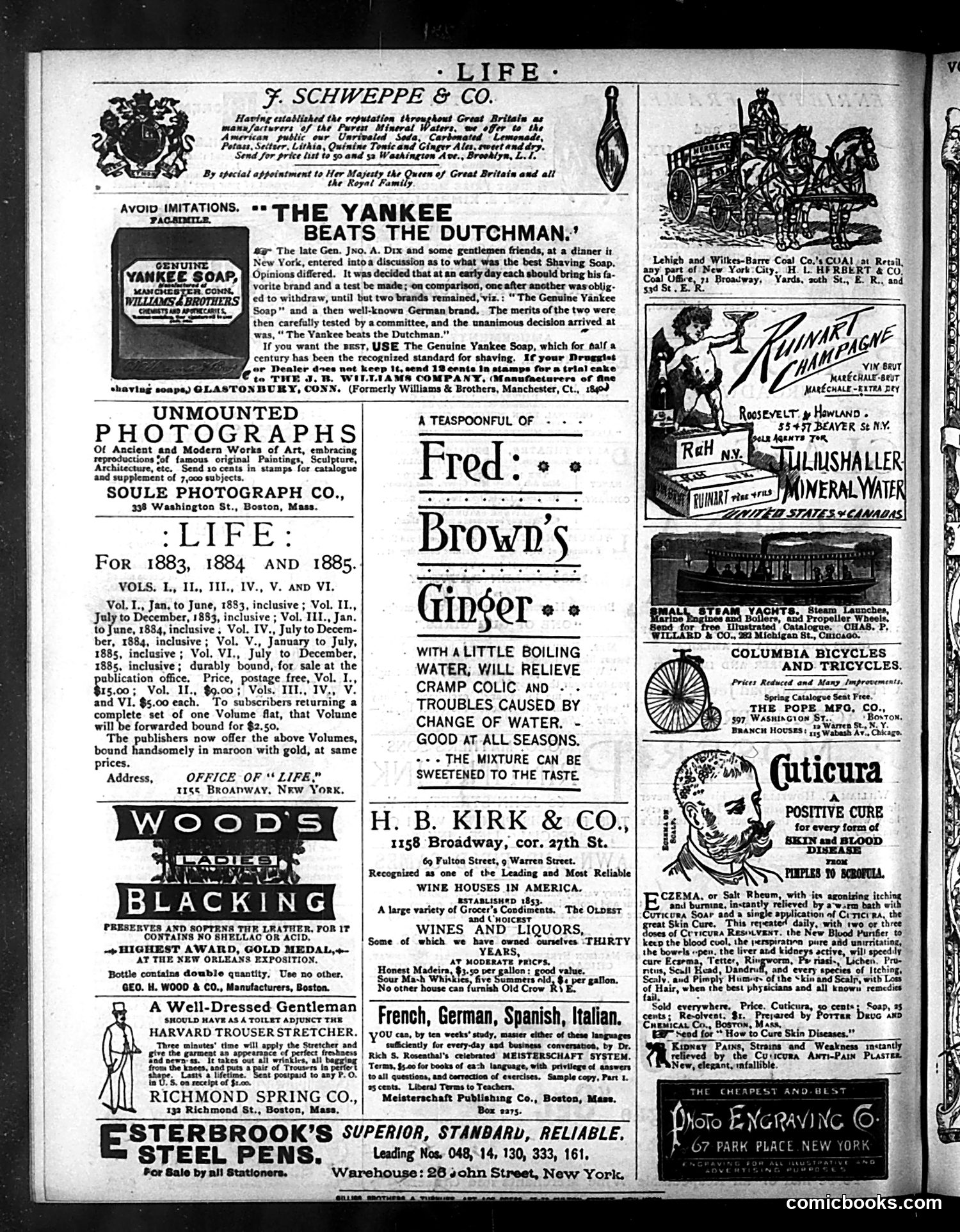
This page is primarily **advertising**, not political satire. The main featured content is a soap advertisement narrative. The ad describes a dinner where General John A. Dix and friends tested competing shaving soaps. After systematic comparison, a committee unanimously declared "The Genuine Yankee Soap" superior to "a then well-known German brand," concluding: "The Yankee beats the Dutchman." **The satire is commercial, not political**: The headline plays on American nationalist sentiment and ethnic stereotyping common in 19th-century advertising. "Dutchman" (referring to German products) was used colloquially for German goods. The narrative frames American superiority through a supposedly objective test, a common advertising technique of the era. The page contains dozens of other product advertisements (photographs, bicycles, wine, patent medicines), typical of *Life* magazine's revenue model. No specific political figures or events are referenced—this reflects general American consumer culture and advertising practices circa 1883-1885.