
Life, 1886-03-25 · page 2 of 16
Life — March 25, 1886 — page 2: what you’re looking at
What you’re looking at
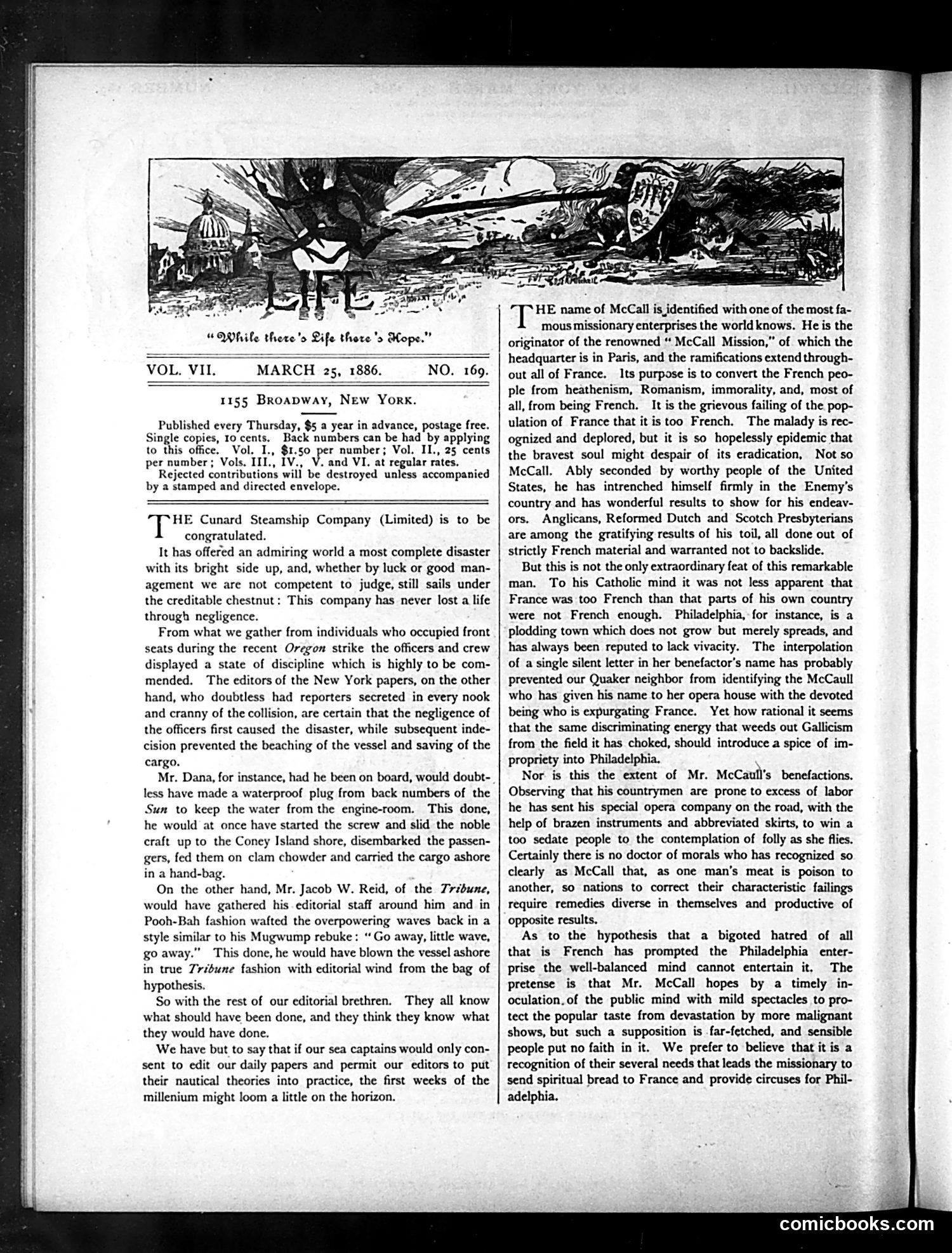
**The Cartoon:** The header illustration titled "While there's Life there's Hope" depicts a dramatic maritime scene—likely referencing the recent *Oregon* steamship strike mentioned in the text below. The image shows a vessel in distress with turbulent waters, appearing to critique negligence in maritime operations. **The Editorial Content:** The accompanying text discusses the *Cunard Steamship Company* disaster and editorial disagreement about responsibility. Editors of competing New York papers (the *Sun* and *Tribune*) debated whether captains or officers caused the wreck. The satire criticizes these editorial disputes as armchair theorizing disconnected from actual nautical practice. The piece argues that newspaper editors should defer to experienced sea captains rather than imposing "nautical theories" based on incomplete knowledge.
📄 Transcribed text from this page (OCR, searchable)
Machine-transcribed from the original scan — historical spelling and the odd misread are preserved.
“While there's Life there's Hope.” VOL. VII. “MARCH 25, 1886. NO. 169. 1155 Broapway, New York. Published every Thursday, $5 a year in advance, postage free. Single copies, 10 cents. Back numbers can be had by applying to this office. Vol. I., $1.50 per number; Vol. II., 25 cents per number; Vols. III., IV., V. and VI. at regular rates. Rejected contributions will be destroyed unless accompanied by a stamped and directed envelope. T= Cunard Steamship Company (Limited) is to be congratulated. It has offered an admiring world a most complete disaster with its bright side up, and, whether by luck or good man- agement we are not competent to judge, still sails under the creditable chestnut: This company has never lost a life through negligence. From what we gather from individuals who occupied front seats during the recent Oregon strike the officers and crew displayed a state of discipline which is highly to be com- mended. The editors of the New York papers, on the other hand, who doubtless had reporters secreted in every nook and cranny of the collision, are certain that the negligence of the officers first caused the disaster, while subsequent inde- cision prevented the beaching of the vessel and saving of the cargo. Mr. Dana, for instance, had he been on board, would doubt- less have made a waterproof plug from back numbers of the Sun to keep the water from the engine-room. This done, he would at once have started the screw and slid the noble craft up to the Coney Island shore, disembarked the passen- gers, fed them on clam chowder and carried the cargo ashore in a hand-bag. On the other hand, Mr. Jacob W. Reid, of the 7rtbune, would have gathered his editorial staff around him and in Pooh-Bah fashion wafted the overpowering waves back in a style similar to his Mugwump rebuke: “Go away, little wave, go away.” This done, he would have blown the vessel ashore in true 7rzéune fashion with editorial wind from the bag of hypothesis. So with the rest of our editorial brethren. They all know what should have been done, and they think they know what they would have done. We have but to say that if our sea captains would only con- sent to edit our daily papers and permit our editors to put their nautical theories into practice, the first weeks of the millenium might loom a little on the horizon. HE name of McCall is identified with one of the most fa- mous missionary enterprises the world knows. He is the originator of the renowned “ McCall Mission,” of which the headquarter is in Paris, and the ramifications extend through- out all of France. Its purpose is to convert the French peo- ple from heathenism, Romanism, immorality, and, most of all, from being French. It is the grievous failing of the pop- ulation of France that it is too French. The malady is rec- ognized and deplored, but it is so hopelessly epidemic that the bravest soul might despair of its eradication, Not so McCall. Ably seconded by worthy people of the United States, he has intrenched himself firmly in the Enemy's country and has wonderful results to show for his endeav- ors. Anglicans, Reformed Dutch and Scotch Presbyterians are among the gratifying results of his toil, all done out of strictly French material and warranted not to backslide. But this is not the only extraordinary feat of this remarkable man. To his Catholic mind it was not less apparent that France was too French than that parts of his own country were not French enough. Philadelphia, for instance, is a plodding town which does not grow but merely spreads, and has always been reputed to lack vivacity. The interpolation of a single silent letter in her benefactor’s name has probably prevented our Quaker neighbor from identifying the McCaull who has given his name to her opera house with the devoted being who is expurgating France. Yet how rational it seems that the same discriminating energy that weeds out Gallicism from the field it has choked, should introduce a spice of im- propriety into Philadelphia. “ Nor is this the extent of Mr. McCaull's benefactions. Observing that his countrymen are prone to excess of labor he has sent his special opera company on the road, with the help of brazen instruments and abbreviated skirts, to win a too sedate people to the contemplation of folly as she flies. Certainly there is no doctor of morals who has recognized so clearly as McCall that, as one man’s meat is poison to another, so nations to correct their characteristic failings require remedies diverse in themselves and productive of opposite results. As to the hypothesis that a bigoted hatred of all that is French has prompted the Philadelphia enter- prise the well-balanced mind cannot entertain it, The pretense is that Mr. McCall hopes by a timely in- oculation.of the public mind with mild spectacles to pro- tect the popular taste from devastation by more malignant shows, but such a supposition is far-fetched, and sensible people put no faith in it. We prefer to believe that it is a recognition of their several needs that leads the missionary to send spiritual bread to France and provide circuses for Phil- adelphia. comicbooks.com