
Life, 1886-03-25 · page 6 of 16
Life — March 25, 1886 — page 6: what you’re looking at
What you’re looking at
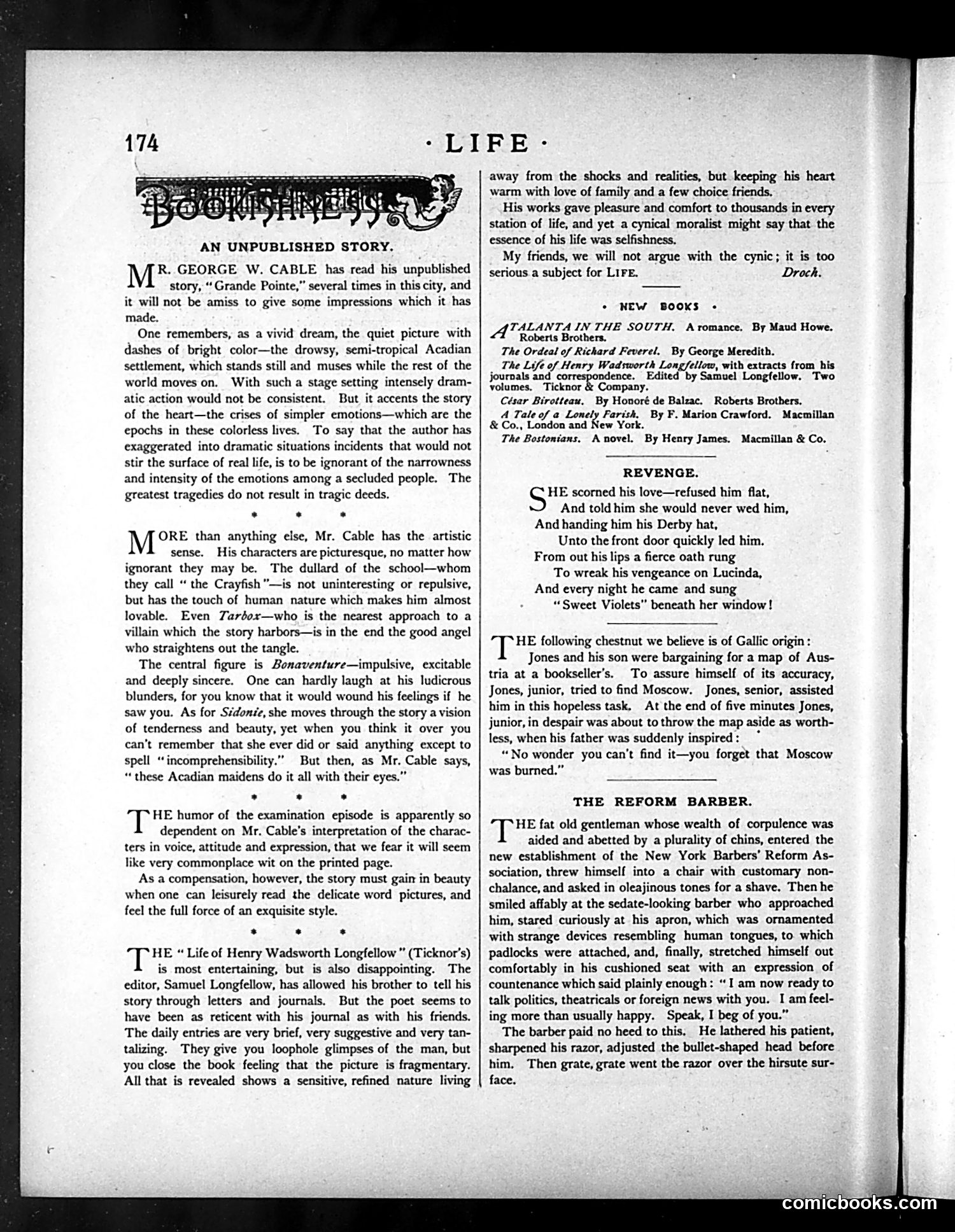
This page contains **literary reviews and short fiction** rather than political cartoons. The content includes: 1. **"Grande Pointe"** - A review of an unpublished story by George W. Cable, praised for its artistic characterization of Acadian settlers, though criticized for dramatic exaggeration. 2. **"The Life of Henry Wadsworth Longfellow"** - A brief review noting editor Samuel Longfellow's presentation of the poet through letters and journals. 3. **Fiction pieces** titled "Revenge" and "The Reform Barber" - The latter appears to be satirical commentary on a wealthy, corpulent gentleman entering a barber shop, likely mocking either vanity or social pretension. The page focuses on **literary criticism and entertainment** rather than political satire or commentary.
📄 Transcribed text from this page (OCR, searchable)
Machine-transcribed from the original scan — historical spelling and the odd misread are preserved.
> LIFE - AN UNPUBLISHED STORY. R. GEORGE W. CABLE has read his unpublished story, “ Grande Pointe,” several times in this city, and it will not be amiss to give some impressions which it has made, One remembers, as a vivid dream, the quiet picture with dashes of bright color—the drowsy, semi-tropical Acadian settlement, which stands still and muses while the rest of the world moves on. With such a stage setting intensely dram- atic action would not be consistent. But it accents the story of the heart—the crises of simpler emotions—which are the epochs in these colorless lives. To say that the author has exaggerated into dramatic situations incidents that would not stir the surface of real life, is to be ignorant of the narrowness and intensity of the emotions among a secluded people. The greatest tragedies do not result in tragic deeds. ORE than anything else, Mr. Cable has the artistic sense. His characters are picturesque, no matter how ignorant they may be. The dullard of the school—whom they call “ the Crayfish”—is not uninteresting or repulsive, but has the touch of human nature which makes him almost lovable. Even Yaréox—who is the nearest approach to a villain which the story harbors—is in the end the good angel who straightens out the tangle. The central figure is Bonaventure—impulsive, excitable and deeply sincere. One can hardly laugh at his ludicrous blunders, for you know that it would wound his feelings if he saw you. As for Sidonse, she moves through the story a vision of tenderness and beauty, yet when you think it over you can’t remember that she ever did or said anything except to spell “‘incomprehensibility.” But then, as Mr. Cable says, “these Acadian maidens do it all with their eyes.” . * . T HE humor of the examination episode is apparently so dependent on Mr. Cable's interpretation of the charac- ters in voice, attitude and expression, that we fear it will seem like very commonplace wit on the printed page. As a compensation, however, the story must gain in beauty when one can leisurely read the delicate word pictures, and feel the full force of an exquisite style. * . * HE “ Life of Henry Wadsworth Longfellow ” (Ticknor’s) is most entertaining, but is also disappointing. The editor, Samuel Longfellow, has allowed his brother to tell his story through letters and journals, But the poet seems to have been as reticent with his journal as with his friends. The daily entries are very brief, very suggestive and very tan- talizing. They give you loophole glimpses of the man, but you close the book feeling that the picture is fragmentary. All that is revealed shows a sensitive, refined nature living away from the shocks and realities, but keeping his heart warm with love of family and a few choice friends. His works gave pleasure and comfort to thousands in every station of life, and yet a cynical moralist might say that the essence of his life was selfishness. My friends, we will not argue with the cynic; it is too serious a subject for LIFE. Drockh. * NEW BOOKS «+ ATALANTA IN THE SOUTH, Aromance, By Maud Howe. Roberts Brothers. The Ordeal of Richard Feverel, By George Meredith. The Life of Henry Wadsworth Longfellow, with extracts from his journals and co: lence. Edited by Samuel Longfellow. Two volumes. Ticknor & Company. César Birotteau, By Honoré de Balzac, Roberts Brothers. A Tale of a Lonely Farish, By F. Marion Crawford. Macmillan & Co., London and New York. The Bostonians, A novel. By Henry James, Macmillan & Co. REVENGE. HE scorned his love—refused him flat, And told him she would never wed him, And handing him his Derby hat, Unto the front door quickly led him. From out his lips a fierce oath rung To wreak his vengeance on Lucinda, And every night he came and sung “Sweet Violets” beneath her window! HE following chestnut we believe is of Gallic origin : Jones and his son were bargaining for a map of Aus- tria at a bookseller’s. To assure himself of its accuracy, Jones, junior, tried to find Moscow. Jones, senior, assisted him in this hopeless task, At the end of five minutes Jones, junior, in despair was about to throw the map aside as worth- less, when his father was suddenly inspired: ~ “No wonder you can’t find it—you forget that Moscow was burned.” THE REFORM BARBER. HE fat old gentleman whose wealth of corpulence was aided and abetted by a plurality of chins, entered the new establishment of the New York Barbers’ Reform As- sociation, threw himself into a chair with customary non- chalance, and asked in oleajinous tones for a shave. Then he smiled affably at the sedate-looking barber who approached him, stared curiously at his apron, which was ornamented with strange devices resembling human tongues, to which padlocks were attached, and, finally, stretched himself out comfortably in his cushioned seat with an expression of countenance which said plainly enough: “I am now ready to talk politics, theatricals or foreign news with you. I am feel- ing more than usually happy. Speak, I beg of you.” The barber paid no heed to this. He lathered his patient, sharpened his razor, adjusted the bullet-shaped head before him. Then grate, grate went the razor over the hirsute sur- face, ~comicbooks.com