
Life, 1886-03-25 · page 5 of 16
Life — March 25, 1886 — page 5: what you’re looking at
What you’re looking at
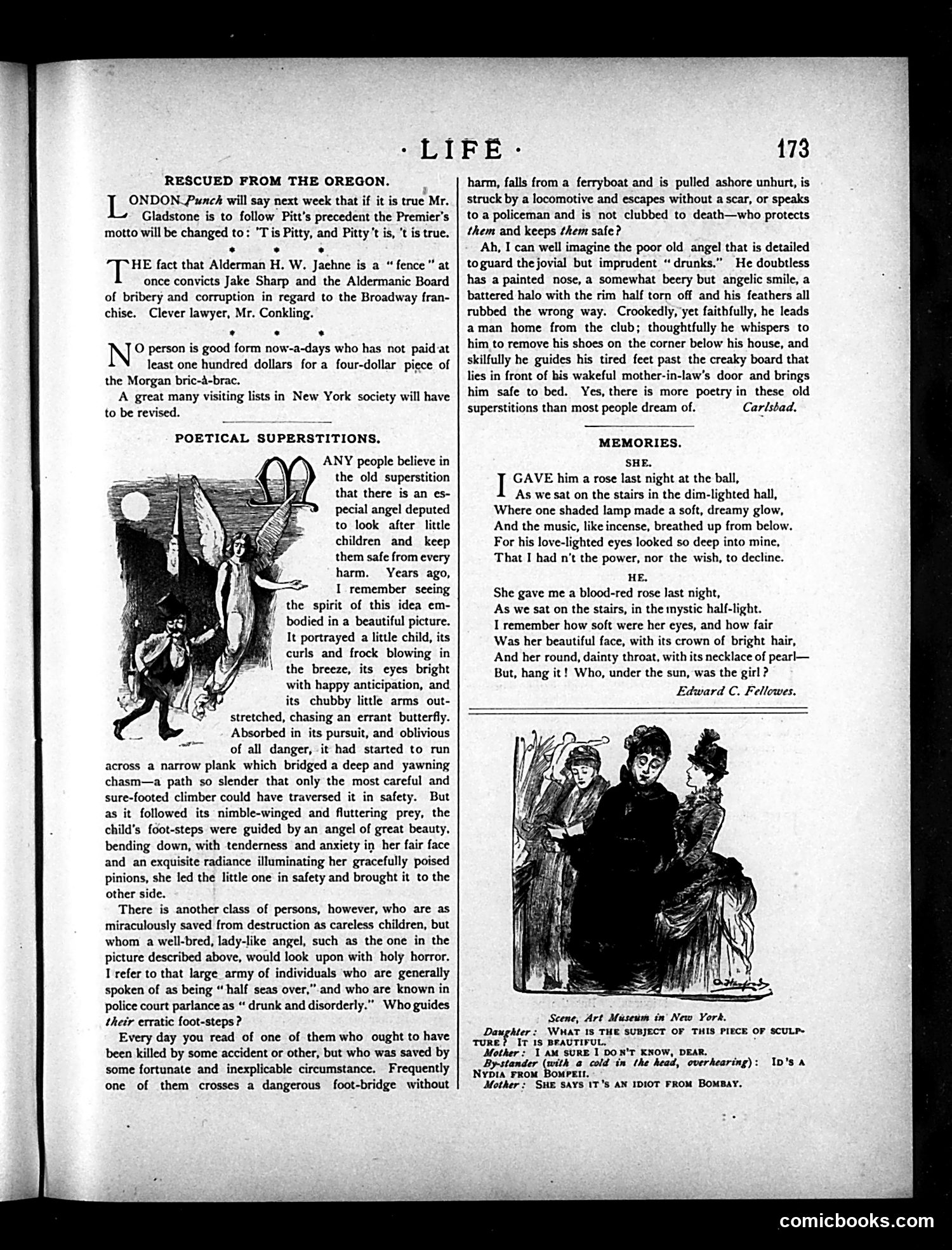
This page contains three separate satirical pieces: 1. **"Rescued from the Oregon"**: A brief note mocking Alderman H.W. Jaehne as a "fence" (criminal accomplice) regarding the Broadway franchise scheme, with lawyer Conkling mentioned. 2. **"Poetical Superstitions"**: An illustrated essay about guardian angels protecting children. The accompanying engraving shows an angelic figure guiding a small child across a narrow, dangerous plank over a chasm—depicting the Victorian-era superstition that special angels protect children from harm. 3. **"Memories"**: A sentimental poem by Edward C. Fellowes about romantic moments with a woman at a ball, paired with an illustration showing three fashionably-dressed women in conversation. The page mixes light social satire with sentimental poetry typical of Life's content.
📄 Transcribed text from this page (OCR, searchable)
Machine-transcribed from the original scan — historical spelling and the odd misread are preserved.
-LIFE- RESCUED FROM THE OREGON. ‘ ONDON- Punch will say next week that if it is true Mr. Gladstone is to follow Pitt’s precedent the Premier’s motto will be changed to: "Tis Pitty, and Pitty’t is, 't is true. . . . HE fact that Alderman H. W. Jaehne is a “fence” at once convicts Jake Sharp and the Aldermanic Board of bribery and corruption in regard to the Broadway fran- chise. Clever lawyer, Mr. Conkling. . . . O person is good form now-a-days who has not paid-at least one hundred dollars for a four-dollar piece of the Morgan bric-a-brac. A great many visiting lists in New York society will have to be revised. POETICAL SUPERSTITIONS. ANY people believe in the old superstition that there is an es- pecial angel deputed to look after little children and keep them safe from every harm. Years ago, "A I remember seeing , the spirit of this idea em- bodied in a beautiful picture. It portrayed a little child, its curls and frock blowing in the breeze, its eyes bright with happy anticipation, and its chubby little arms out- stretched, chasing an errant butterfly. Absorbed in its pursuit, and oblivious of all danger, it had started to run across a narrow plank which bridged a deep and yawning chasm—a path so slender that only the most careful and sure-footed climber could have traversed it in safety. But as it followed its nimble-winged and fluttering prey, the child’s foot-steps were guided by an angel of great beauty, bending down, with tenderness and anxiety in her fair face and an exquisite radiance illuminating her gracefully poised pinions, she led the little one in safety and brought it to the other side. There is another class of persons, however, who are as miraculously saved from destruction as careless children, but whom a well-bred, lady-like angel, such as the one in the picture described above, would look upon with holy horror. I refer to that large army of individuals who are generally spoken of as being “half seas over,”.and who are known in police court parlance as “ drunk and disorderly.” Who guides thetr erratic foot-steps ? Every day you read of one of them who ought to have been killed by some accident or other, but who was saved by some fortunate and inexplicable circumstance. Frequently one of them crosses a dangerous foot-bridge without a 173 harm, falls from a ferryboat and is pulled ashore unhurt, is struck by a locomotive and escapes without a scar, or speaks to a policeman and is not clubbed to death—who protects them and keeps them safe? Ah, I can well imagine the poor old angel that is detailed toguard the jovial but imprudent “drunks.” He doubtless has a painted nose, a somewhat beery but angelic smile, a battered halo with the rim half torn off and his feathers all rubbed the wrong way. Crookedly, yet faithfully, he leads aman home from the club; thoughtfully he whispers to him to remove his shoes on the corner below his house, and skilfully he guides his tired feet past the creaky board that lies in front of his wakeful mother-in-law’s door and brings him safe to bed. Yes, there is more poetry in these old superstitions than most people dream of. Carlsbad. MEMORIES. SHE. GAVE him a rose last night at the ball, As we sat on the stairs in the dim-lighted hall, Where one shaded lamp made a soft, dreamy glow, And the music, like incense, breathed up from below. For his love-lighted eyes looked so deep into mine, That I had n’t the power, nor the wish, to decline. HE. She gave me a blood-red rose last night, As we sat on the stairs, in the mystic half-light. I remember how soft were her eyes, and how fair Was her beautiful face, with its crown of bright hair, And her round, dainty throat, with its necklace of pearl— But, hang it! Who, under the sun, was the girl ? Edward C. Fellowes. Scene, Art Museum in’ New York, Daughter: WAT 18 THE SUBJECT OF THIS PIECE OF SCULP- TuRE? IT 18 BRAUTIFUL. Mother: 1 AM SURE I DON'T KNOW, DEAR. By-stander (with a cold in the head, overhearing): Nypia From Bompett. Mother: SHE SAYS \T'S AN IDIOT FROM BOMBAY. Ip's a comicbooks.com