
Life, 1886-03-25 · page 10 of 16
Life — March 25, 1886 — page 10: what you’re looking at
What you’re looking at
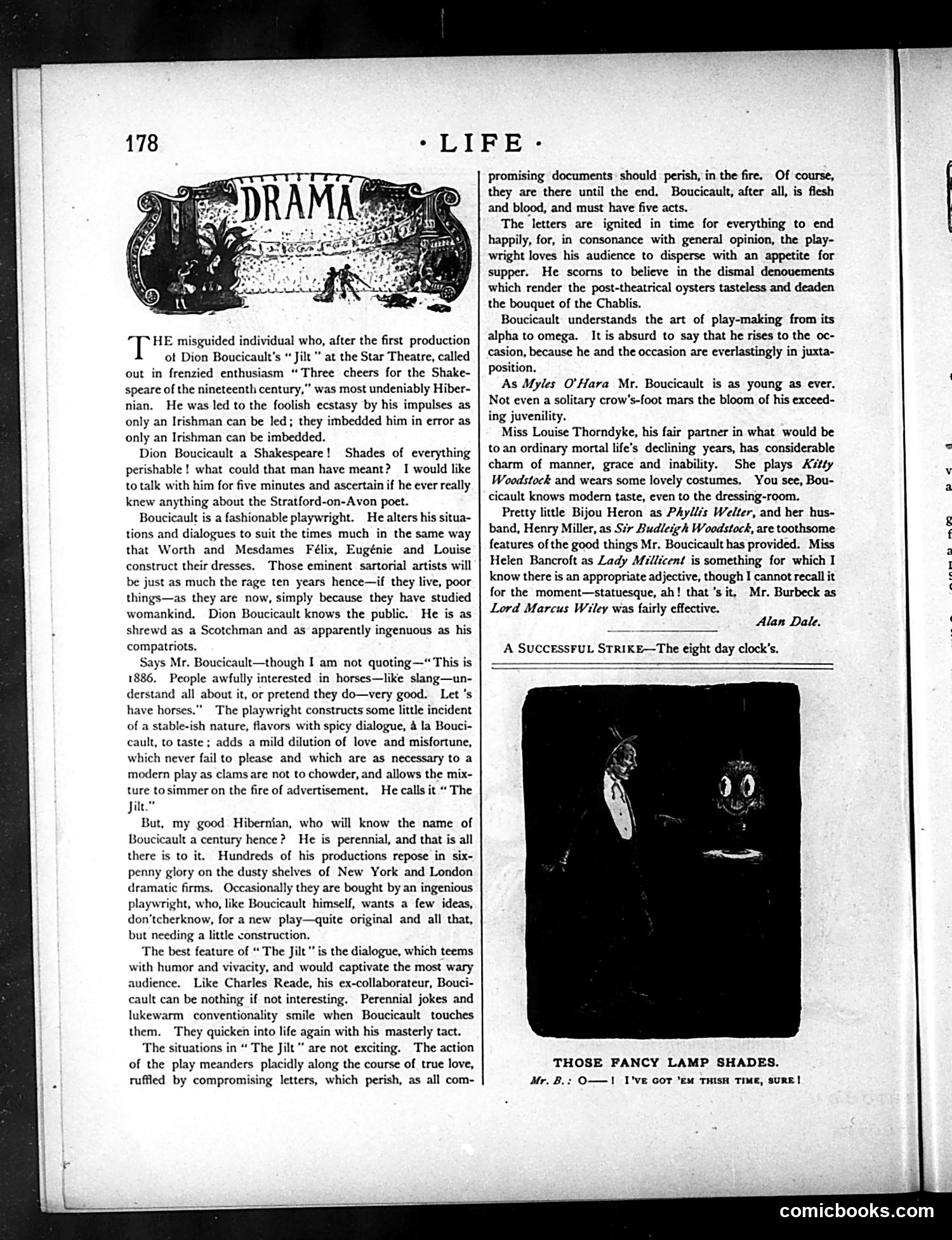
This is a theatre review of Dion Boucicault's play "The Jilt," performed at the Star Theatre. The critic mocks an Irish audience member who enthusiastically compared Boucicault to Shakespeare—dismissing this as typically foolish Irish sentiment. The reviewer argues Boucicault is a commercial hack, not an artist. He cynically constructs plays by adding fashionable elements (horses, slang, romance, compromising letters) to suit current tastes, like a dressmaker tailoring garments. The critic predicts Boucicault will be forgotten in a century, his hundreds of plays gathering dust on theatrical shelves. The accompanying illustration titled "Those Fancy Lamp Shades" shows a figure examining decorative lamp shades—likely visual satire on superficial theatrical decoration matching the text's critique of Boucicault's formulaic, surface-level approach to playwriting.
📄 Transcribed text from this page (OCR, searchable)
Machine-transcribed from the original scan — historical spelling and the odd misread are preserved.
HE misguided individual who, after the first production ot Dion Boucicault’s “ Jilt " at the Star Theatre, called out in frenzied enthusiasm “Three cheers for the Shake- speare of the nineteenth century,” was most undeniably Hiber- nian. He was led to the foolish ecstasy by his impulses as only an Irishman can be led; they imbedded him in error as only an Irishman can be imbedded. Dion Boucicault a Shakespeare! Shades of everything perishable ! what could that man have meant? I would like to talk with him for five minutes and ascertain if he ever really knew anything about the Stratford-on-Avon poet. Boucicault is a fashionable playwright. He alters his situa- tions and dialogues to suit the times much in the same way that Worth and Mesdames Félix, Eugénie and Louise construct their dresses. Those eminent sartorial artists will be just as much the rage ten years hence—if they live, poor things—as they are now, simply because they have studied womankind. Dion Boucicault knows the public. He is as shrewd as a Scotchman and as apparently ingenuous as his compatriots. Says Mr. Boucicault—though I am not quoting—“ This is 1886. People awfully interested in horses—like slang—un- derstand all about it, or pretend they do—very good. Let 's have horses.” The playwright constructs some little incident of a stable-ish nature, flavors with spicy dialogue, 4 la Bouci- cault, to taste ; adds a mild dilution of love and misfortune, which never fail to please and which are as necessary to a modern play as clams are not to chowder, and allows the mix- ture tosimmer on the fire of advertisement. He calls it “ The Jilt.” But, my good Hibernian, who will know the name of Boucicault a century hence? He is perennial, and that is all there is to it. Hundreds of his productions repose in six- penny glory on the dusty shelves of New York and London dramatic firms. Occasionally they are bought by an ingenious playwright, who, like Boucicault himself, wants a few ideas, don'tcherknow, for a new play—quite original and all that, but needing a little construction. The best feature of “ The Jilt’ is the dialogue, which teems with humor and vivacity, and would captivate the most wary audience. Like Charles Reade, his ex-collaborateur, Bouci- cault can be nothing if not interesting. Perennial jokes and lukewarm conventionality smile when Boucicault touches them. They quicken into life again with his masterly tact. The situations in “ The Jilt” are not exciting. The action of the play meanders placidly along the course of true love, ruffled by compromising letters, which perish, as all com- -LIFE- promising documents: should perish, in the fire. Of course, they are there until the end. Boucicault, after all, is flesh and blood, and must have five acts. The letters are ignited in time for everything to end happily, for, in consonance with general opinion, the play- wright loves his audience to disperse with an appetite for supper. He scorns to believe in the dismal denouements which render the post-theatrical oysters tasteless and deaden the bouquet of the Chablis. Boucicault understands the art of play-making from its alpha to omega. It is absurd to say that he rises to the oc- casion, because he and the occasion are everlastingly in juxta- position. As Myles O'Hara Mr. Boucicault is as young as ever. Not even a solitary crow’s-foot mars the bloom of his exceed- ing juvenility. Miss Louise Thorndyke, his fair partner in what would be to an ordinary mortal life’s declining years, has considerable charm of manner, grace and inability. She plays K#tty Woodstock and wears some lovely costumes, You see, Bou- cicault knows modern taste, even to the dressing-room. Pretty little Bijou Heron as Phyl/'s Welter, and her hus- band, Henry Miller, as Sir Budleigh Woodstock, are toothsome features of the good things Mr. Boucicault has provided. Miss Helen Bancroft as Lady Millicent is something for which I know there is an appropriate adjective, though I cannot recall it for the moment—statuesque, ah! that ‘sit, Mr. Burbeck as Lord Marcus Wiley was fairly effective. Alan Dale. A SUCCESSFUL STRIKE—The eight day clock’s, THOSE FANCY LAMP SHADES. Mr. B.: O—1 I've GOT 'EM THISH TIME, SURE! comicbooks.com Pay ea Py pela