
A complete issue · 16 pages · 1886
Life — March 11, 1886
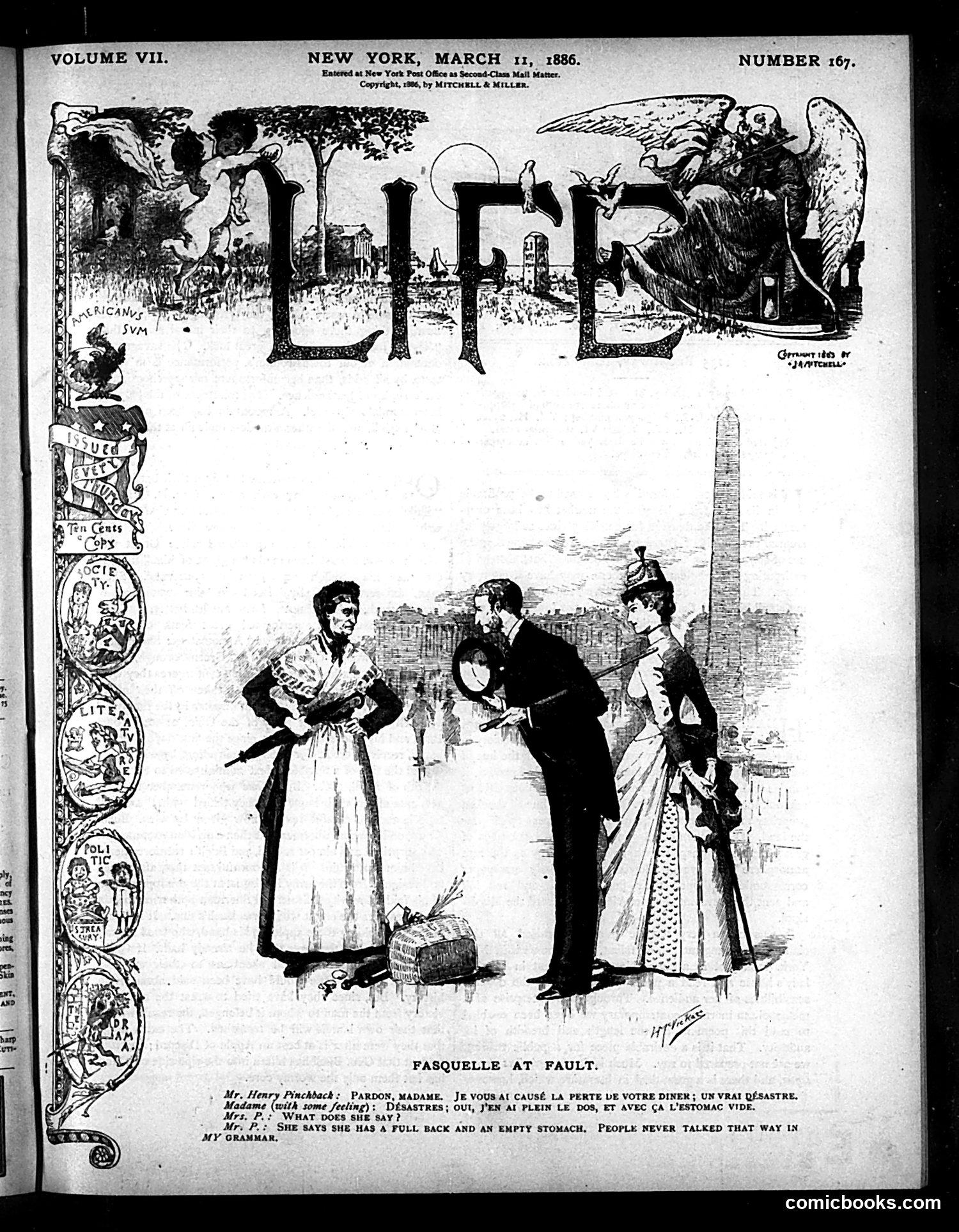
This satirical cartoon depicts a social scene at Washington D.C. (the Washington Monument visible in background). A well-dressed man confronts two women, one holding a fan. The dialogue suggests a dispute over dinner arrangements. The humor centers on conflicting accounts of responsibility: Mr. Henry Pinchback claims the women caused "the loss of your dinner" through some unspecified mishap, while one woman retorts that he "has a full back and an empty stomach" — implying his gluttony rather than their negligence caused the problem. The title "Pasquelle at Fault" suggests this references a specific scandal or social figure, though the identity remains unclear from the image alone. The joke appears to mock Victorian-era social pretensions and dinner etiquette disputes among the elite.
The page contains satirical editorial commentary rather than a cartoon. The text critiques Washington society's reaction to a controversial poem recitation by a woman at a charity event. The piece mocks the "outraged innocence" of Capitol society, suggesting their shock was performative. The editorial then discusses Union generals Grant and Sherman, specifically Gen. D.C. Buell's "Shiloh Reviewed" article published in *Century* magazine. The satire questions competing historical narratives about Civil War battles, particularly who deserves credit for victories. The writer suggests both Grant and Sherman have attempted to claim laurels unfairly, leaving "only the wormy core" of truth. The piece exemplifies *Life*'s role as a venue for political and social satire during the Reconstruction era.
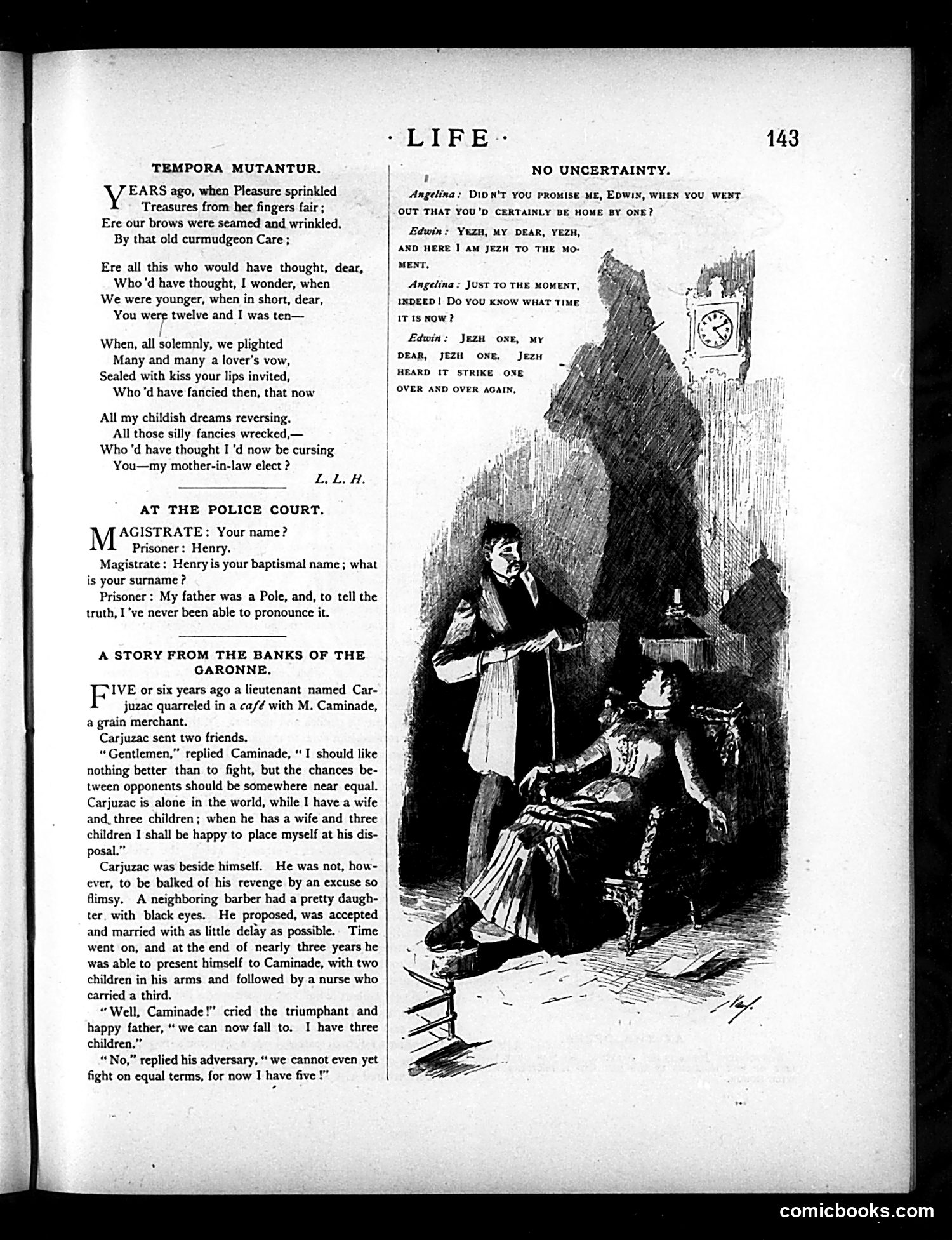
This page contains three unrelated satirical pieces: 1. **"Tempora Mutantur"** (poem): A nostalgic reflection on lost youth and marriage, lamenting how childish romantic dreams have reversed into current marital discord. 2. **"At the Police Court"** (dialogue): A magistrate interrogates a prisoner named Henry about his surname. The prisoner explains his father was Polish and he cannot pronounce the name—satirizing the difficulty of assimilating immigrant names in the British legal system. 3. **"A Story from the Banks of the Garonne"** (narrative with illustration): An anecdote about rival French gentlemen (Carjuzac and Caminade) who cannot duel as equals because their life circumstances differ—one has a wife and three children while the other doesn't. The satire targets honor-culture absurdities regarding fair combat.
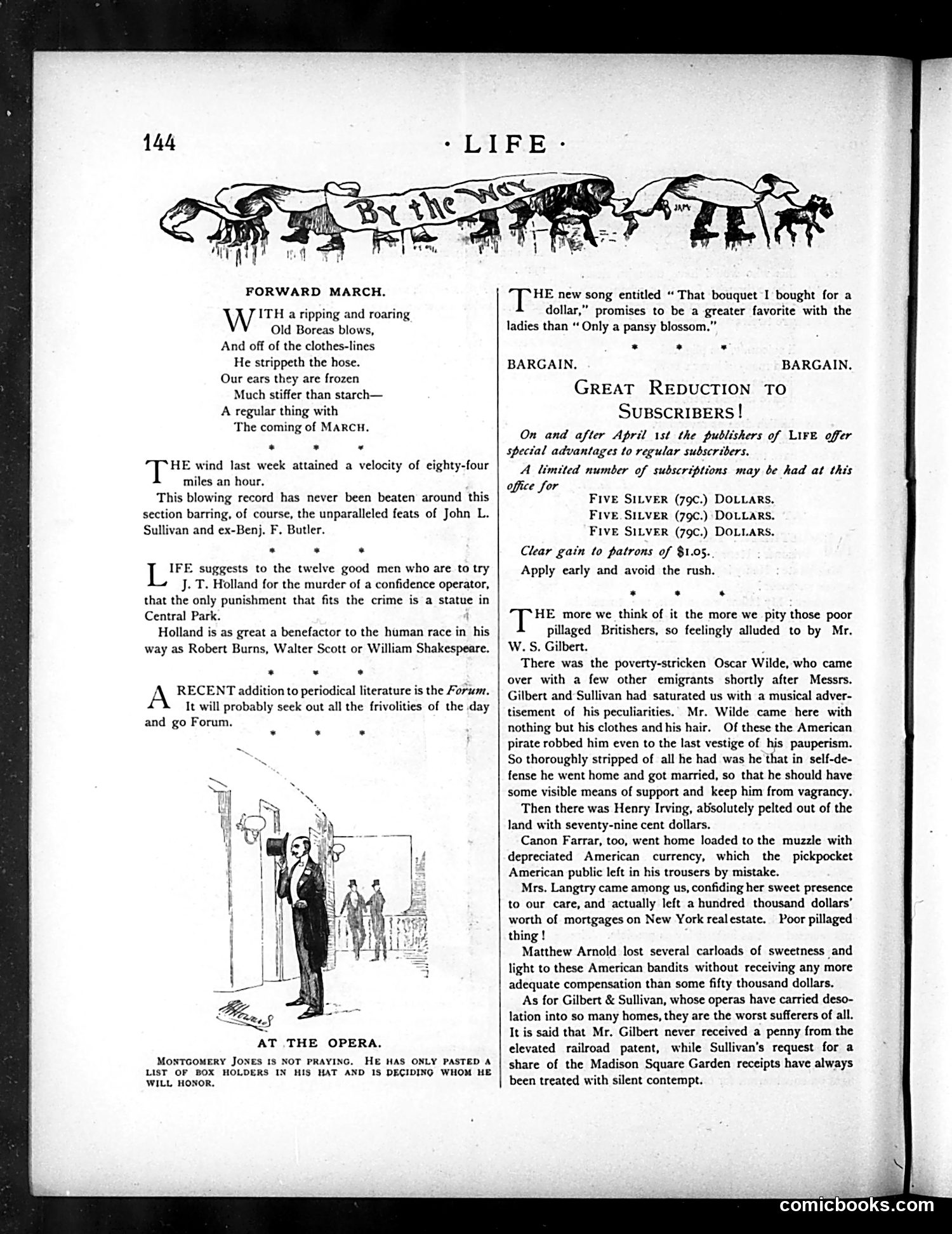
The page contains several distinct elements: **"Forward March" poem**: A seasonal verse about March weather and wind, referencing a record wind velocity of eighty-four miles per hour. The text mentions this record was "never been beaten" around "this section," likely referring to the New York area where Life was published. **"At the Opera" cartoon**: Shows a man in formal dress at an opera house. The caption indicates Montgomery Jones is "not praying" but rather checking his list of box holders, deciding whom to honor—a satirical jab at social pretension and the performative nature of high society attendance. **Right column prose**: Discusses impoverished British emigrants and mentions Oscar Wilde, Henry Irving, Canon Farrar, and Matthew Arnold—all famous figures who emigrated to America, highlighting the irony of distinguished foreigners arriving with nothing while wealthy Americans waste resources.
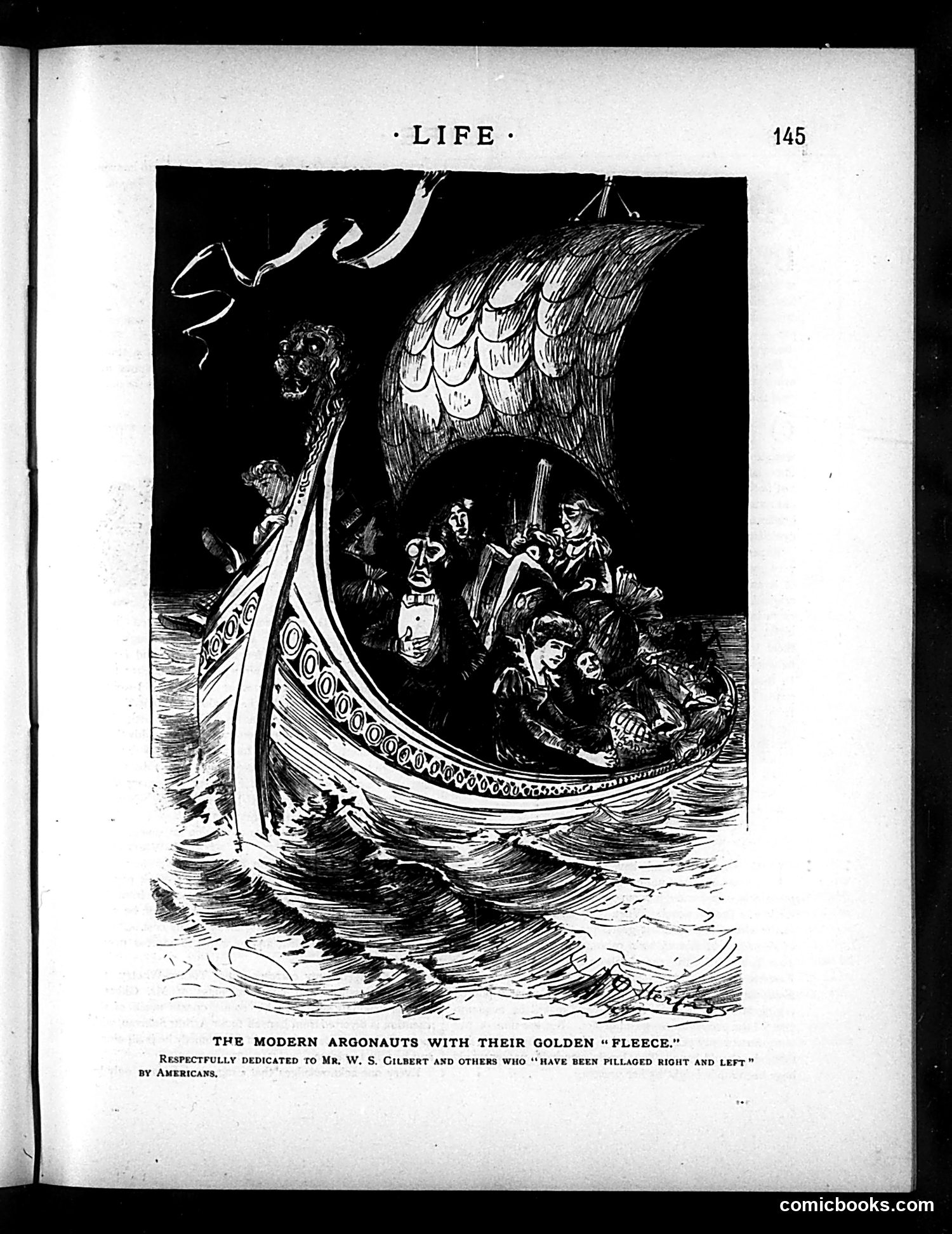
This satirical cartoon depicts a ship labeled with Greek/classical ornamentation carrying multiple figures, referenced as "modern Argonauts." The caption dedicates it to W.S. Gilbert and others "who have been pillaged right and left by Americans." The cartoon appears to satirize American copyright infringement or artistic theft during the late 19th century. Gilbert, the British librettist (of Gilbert and Sullivan fame), was among creators whose works were frequently pirated by American publishers and producers without compensation or permission—a common practice before international copyright agreements. The ship metaphor (evoking the mythological Argonauts' quest) sarcastically portrays these creators as treasure-seekers whose "golden fleece" (their intellectual property) has been stolen by Americans. The crowded vessel suggests multiple victims of this systematic appropriation.
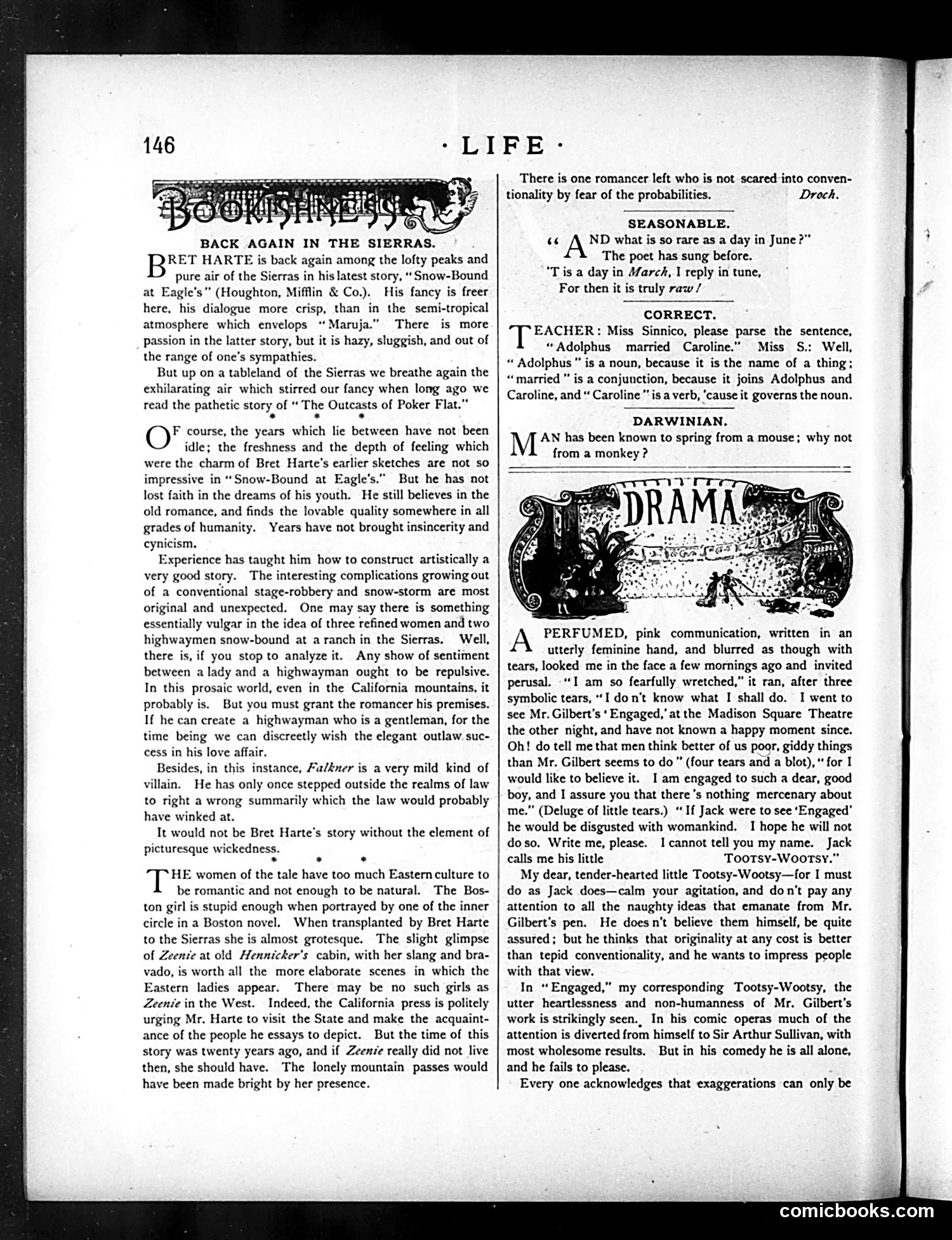
This page contains literary criticism rather than political cartoons. The main sections are: **"Bookishness"**: Reviews Bret Harte's latest story "Snow-Bound" at Eagle's, noting his continued romantic sensibility despite years of absence from publication. **"Seasonable"**: A brief poetic exchange about June weather. **"Correct"**: A grammar lesson parsing the sentence "Adolphus married Caroline." **"Darwinian"**: A humorous question asking why humans didn't evolve from monkeys rather than mice. **"Drama"**: A lengthy critique of a theater piece called "Engaged," discussing feminine writing styles and Mr. Gilbert's theatrical work, with particular attention to character development and originality versus convention. The page functions as cultural commentary and literary satire rather than political commentary.
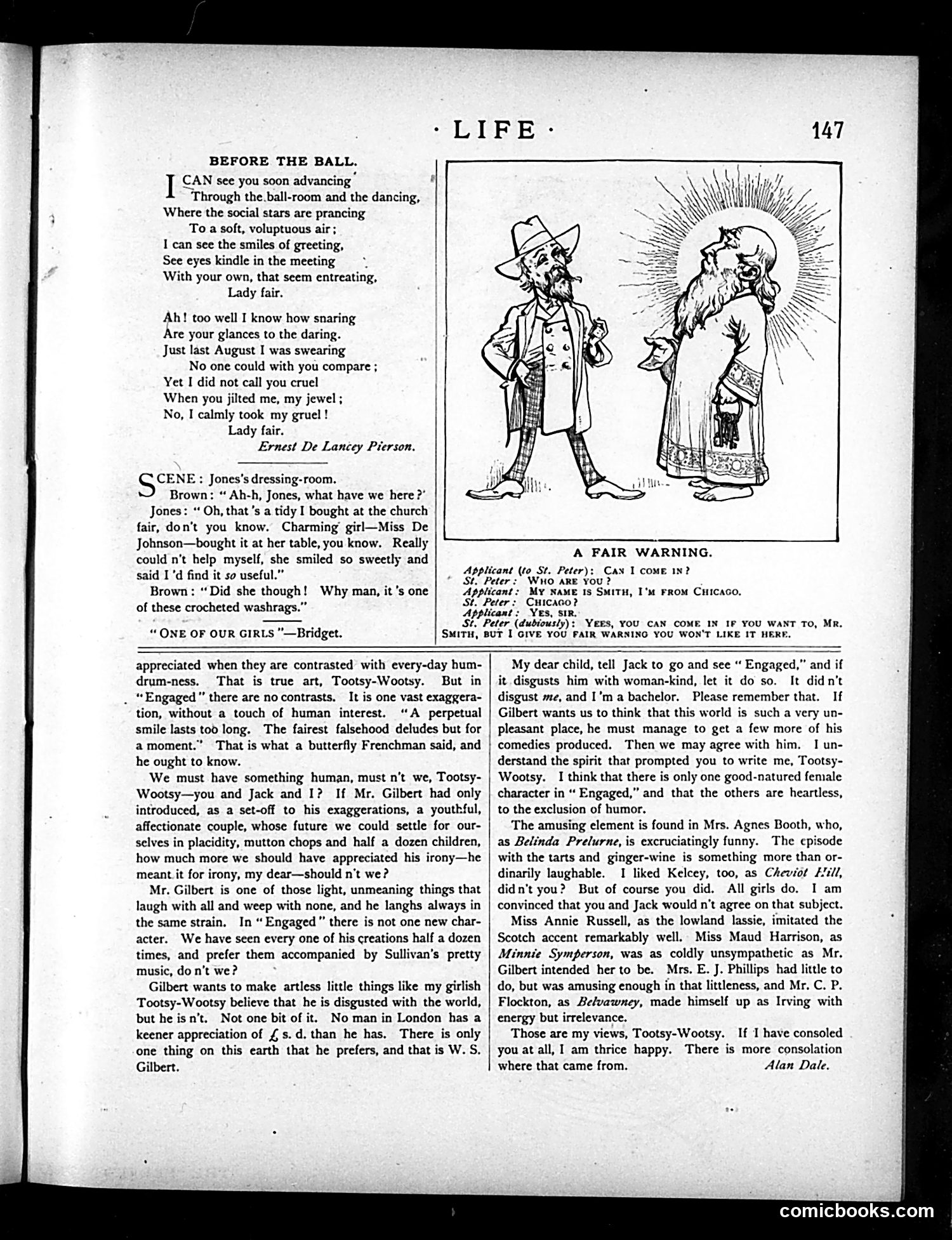
The cartoon depicts two figures: a man in a cowboy hat (labeled as "Applicant") and Saint Peter at the gates of heaven. The applicant, identified as "Smith from Chicago," seeks entry to heaven. Saint Peter delivers a stern "fair warning": he will only admit Smith if Smith truly loves his future wife—otherwise, Peter warns against the marriage. This is satirical commentary on matrimony, playing on the common anxieties about marriage in early 20th-century America. The joke juxtaposes heavenly judgment with earthly marriage vows, suggesting that marrying without genuine love is spiritually damning. The Western character type (cowboy) adds humor through the incongruity of rough Americana meeting religious authority.
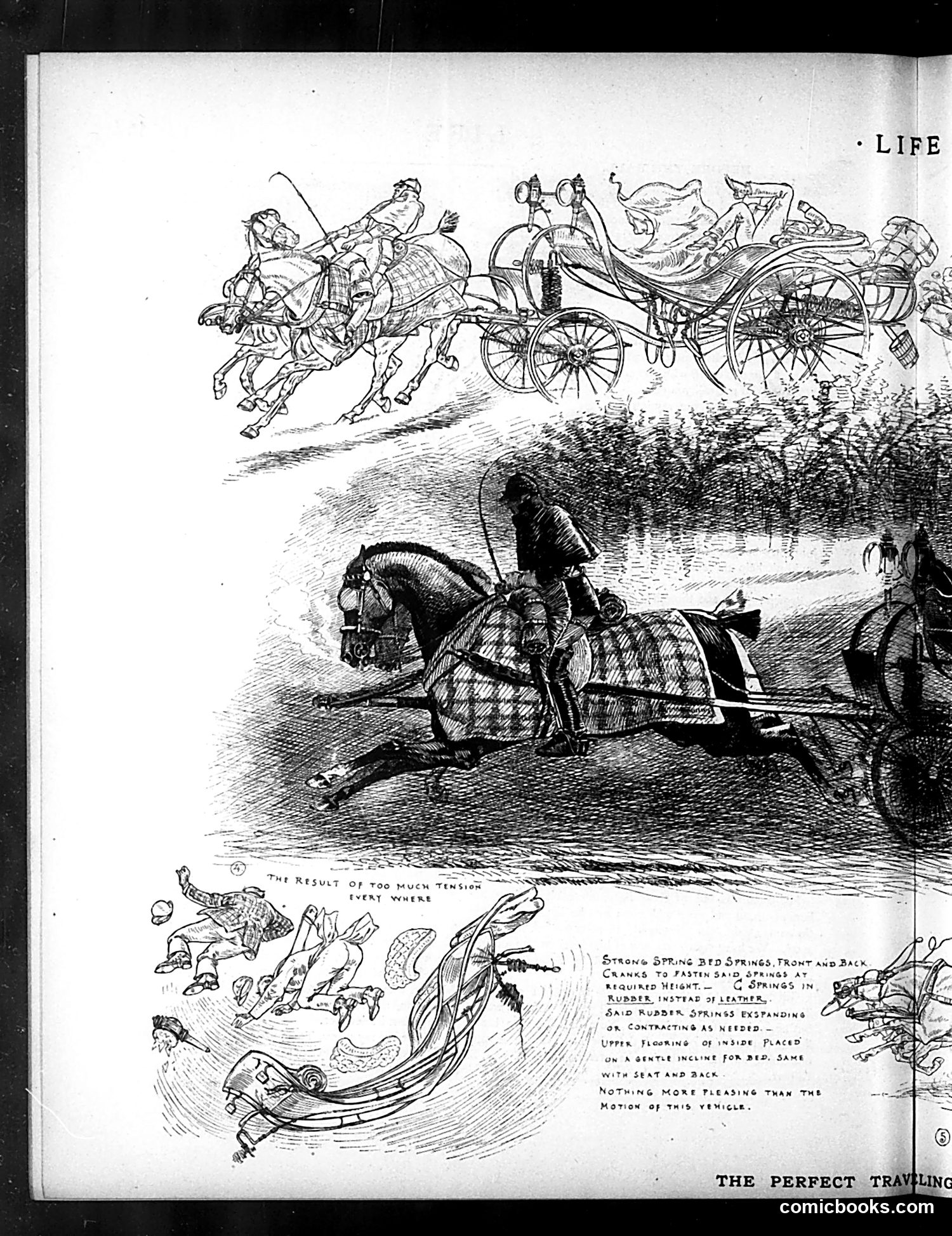
This page satirizes the motorcar as a revolutionary transportation innovation. The top illustration shows a chaotic, overcrowded carriage with multiple passengers precariously balanced, suggesting the absurdity of early automobile design and safety. The main cartoon depicts a horse-drawn carriage moving smoothly along a country road while a motorcar behind it appears to be malfunctioning or causing disturbance. The bottom section lists technical specifications (spring systems, openings, rubber components) with the caption: "Nothing more pleasing than the motion of this vehicle"—clearly ironic, as the detailed mechanical requirements suggest unreliability and complexity compared to traditional horse transport. This reflects early 1900s skepticism about automobiles: they were viewed as temperamental, over-engineered contraptions inferior to established horse-drawn transportation.
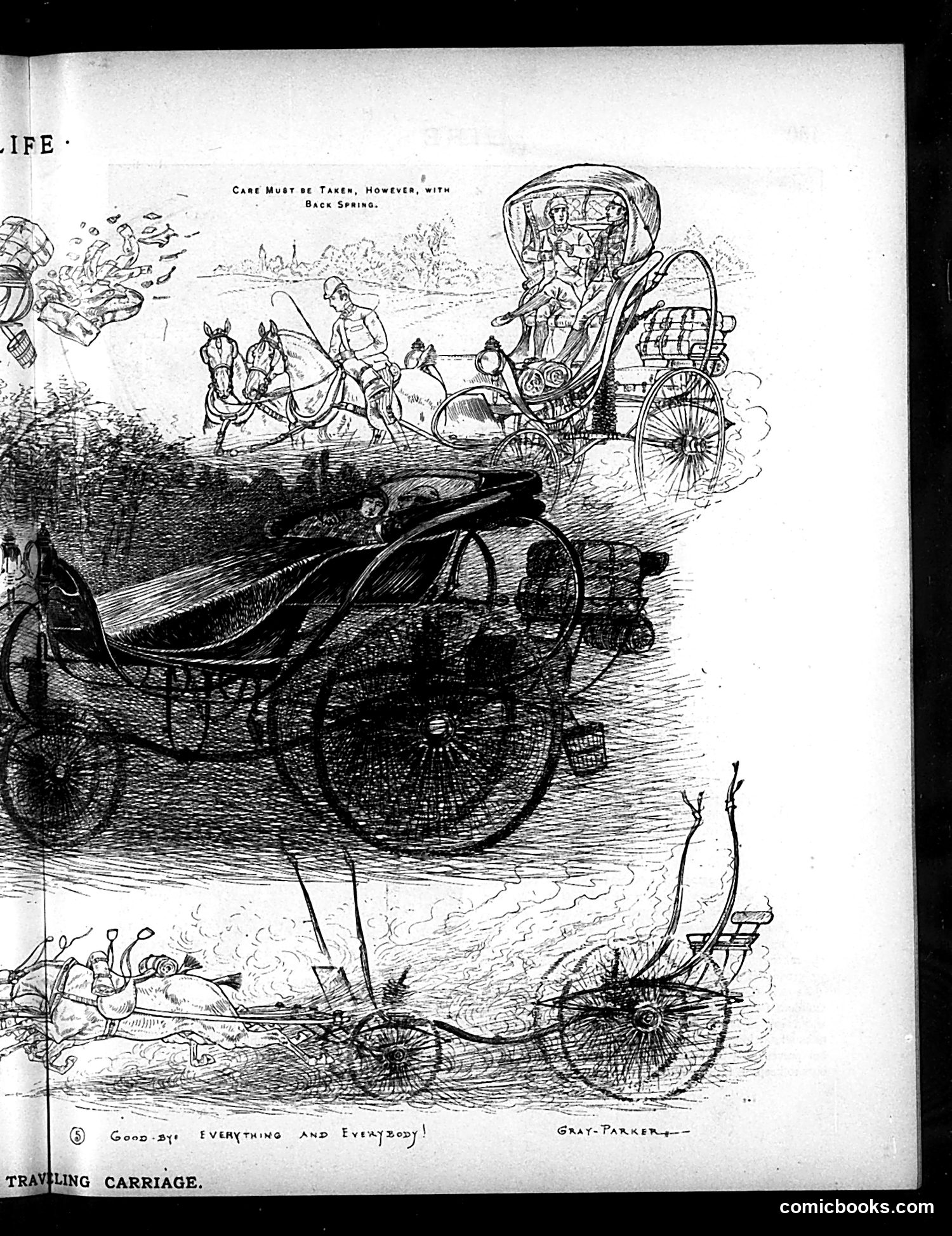
This page shows two satirical scenes about horse-drawn carriages and travel. The top panel depicts a well-sprung carriage with passengers, captioned "Care Must Be Taken, However, with Back Spring" — likely satirizing the mechanical challenges of early carriage design, particularly suspension systems that could fail unexpectedly. The bottom panel shows a broken-down carriage wreck with the caption "Good-Bye Everything and Everybody!" credited to "Gray-Parker." This appears to be dark humor about the dangers and unreliability of contemporary carriage travel, suggesting that mechanical failure could be catastrophic. Together, these cartoons mock both the fragility of period transportation technology and passengers' anxiety about safety during journeys. The humor relies on exaggeration of real vehicular hazards.
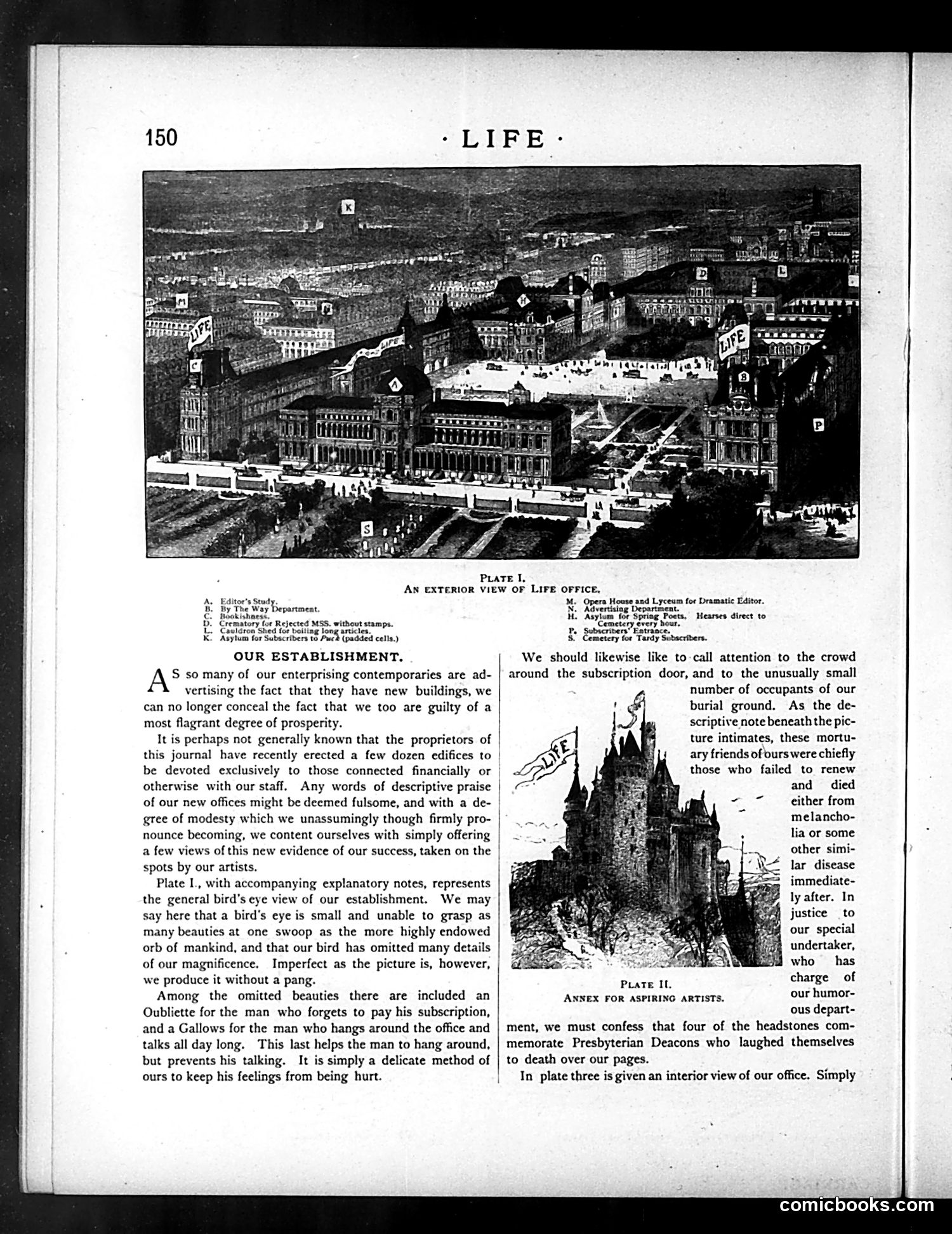
This is a self-promotional piece where *Life* magazine satirizes its own success by giving a mock-architectural tour of its offices. The humor targets the magazine's competitors who boast about new buildings. The labeled diagram shows absurdist facilities: a "Crematory for Rejected MSS" (burned manuscripts), a "Gallows for the man who hangs around the office," and an "Asylum for Subscribers to Punch" (their rival magazine, housed in padded cells). There's a "Cemetery for Tardy Subscribers" filled with those who died from melancholia after failing to renew. The joke operates on multiple levels: mocking both competitors' bragging and *Life's* own pretension; poking fun at subscription troubles; and making dark humor about a rival publication (Punch). The text notes four headstones memorialize Presbyterian Deacons who "laughed themselves to death" over *Life's* pages—combining self-congratulation with irreverent religious mockery typical of 19th-century satirical magazines.
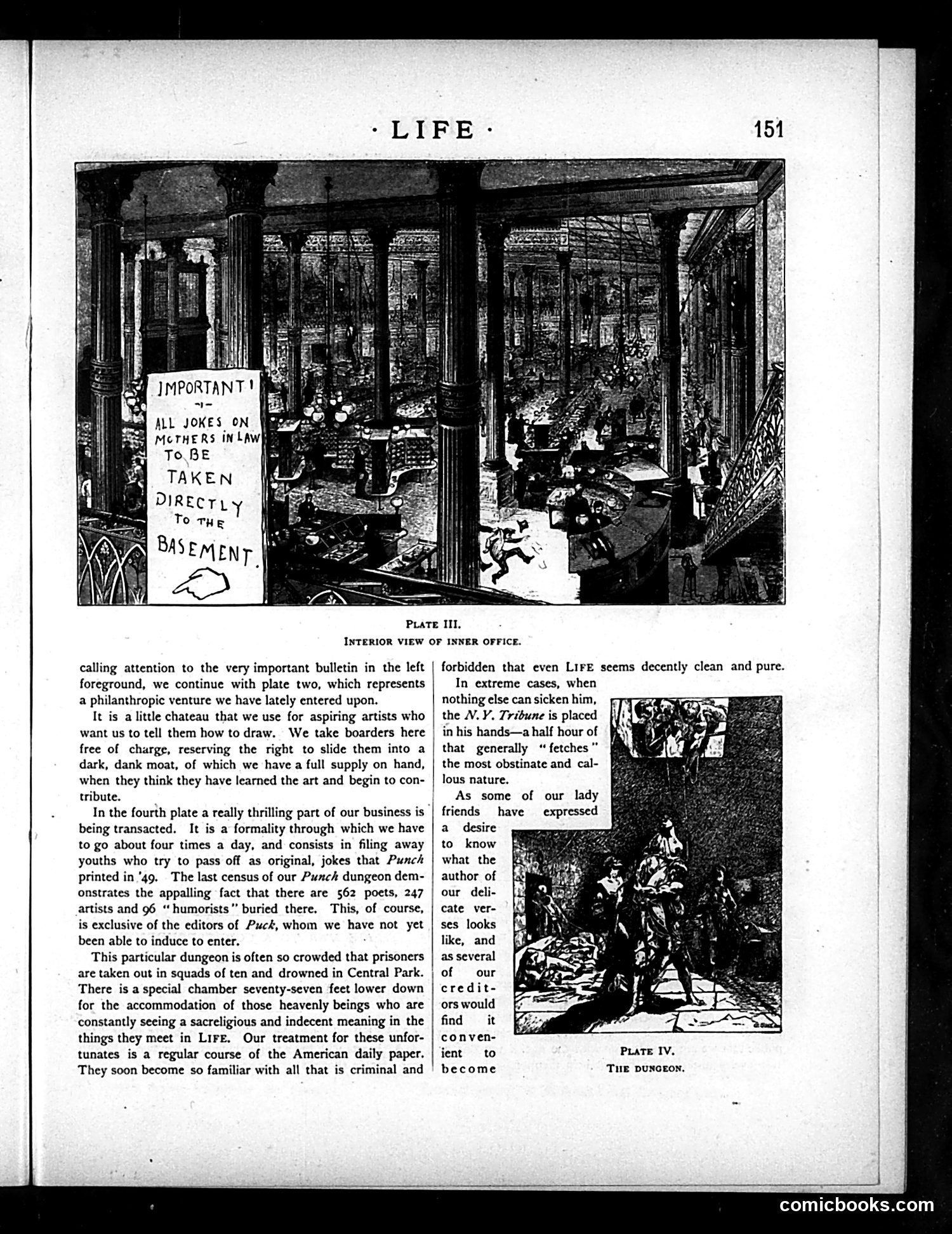
This is a humorous piece where *Life* magazine describes its fictional "operations," using exaggerated satire to mock rival publications and joke submissions. **Key targets:** - **Punch magazine** (British rival): mocked for being so old that *Life* claims to imprison 562 poets and 247 artists who plagiarized from Punch's 1849 issues - **Puck magazine** (American competitor): insulted as so bad their editors belong in the dungeon - **The New York Tribune**: cited as so morally degrading it can "sicken" even hardened criminals **The "dungeon" joke** (Plate IV): depicts where *Life* allegedly executes or drowns unwanted submissions and derivative humorists, with a special chamber for readers who find indecent meanings in their content. **The satire's point**: *Life* positions itself as superior arbiter of American humor and taste by viciously mocking competitors and bad submissions. The crude brutality described (drowning in Central Park) emphasizes the ruthlessness of editorial gatekeeping—presented as darkly comedic rather than serious. This reflects 1880s-90s magazine warfare and competitive humor publishing.
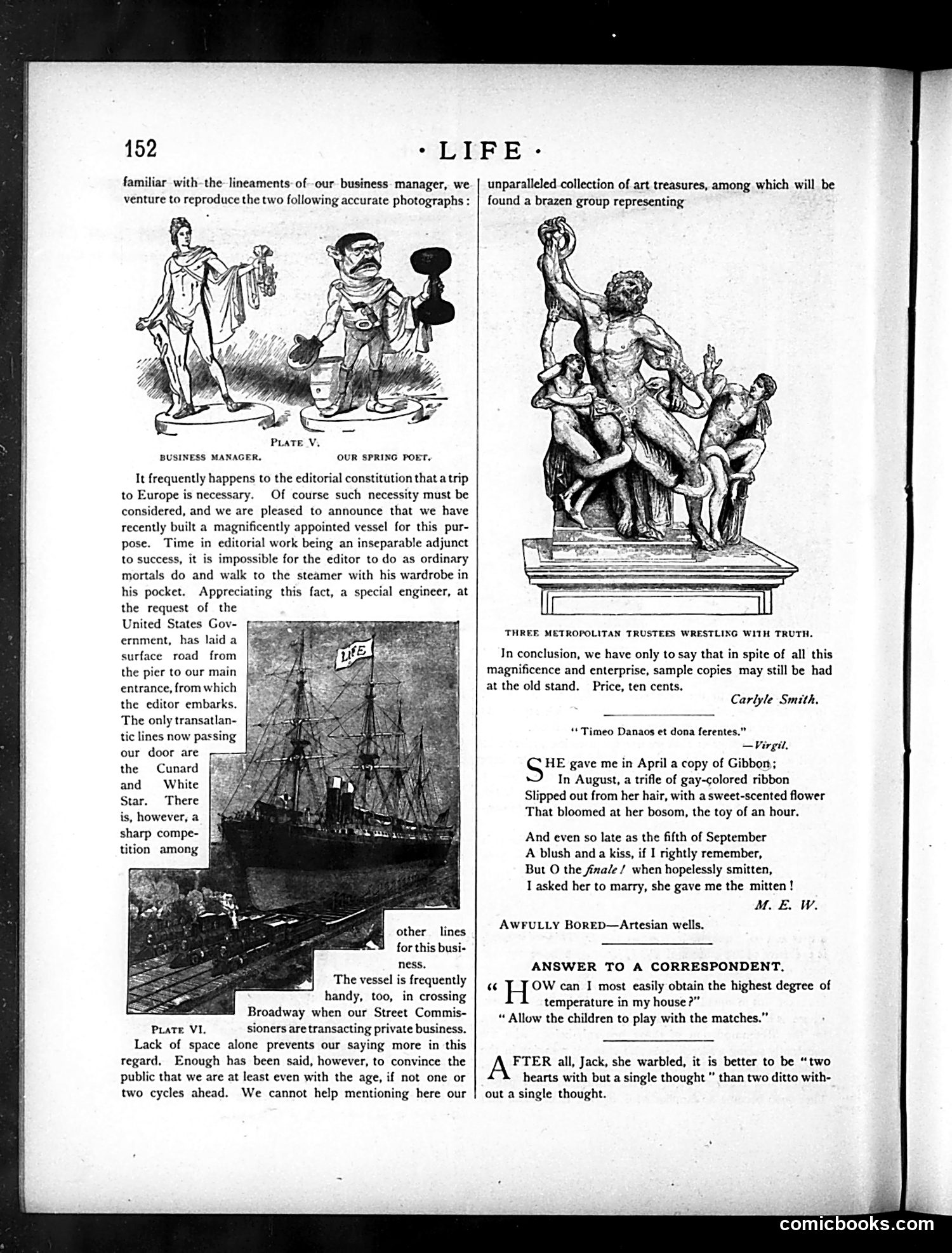
This page satirizes *Life* magazine's own pretensions and those of New York's cultural establishment. The two cartoons labeled "Plate V" mock the magazine's self-importance: the "Business Manager" (left) is depicted as an absurdly pompous figure, while "Our Spring Poet" (right) is caricatured as equally ridiculous. The accompanying text jokingly claims *Life* has built a luxurious vessel for editorial trips to Europe and that the U.S. Government laid a special road from the pier to their office—obvious exaggerations mocking institutional self-aggrandizement. "Plate VI" shows a brazen sculpture titled "Three Metropolitan Trustees Wrestling with Truth," satirizing New York's wealthy cultural trustees as actually struggling against (rather than pursuing) truth—a jab at their pretense and corruption. The page is self-aware satire: *Life* humorously exposes its own grandiosity while simultaneously exposing that of New York's elite cultural institutions.
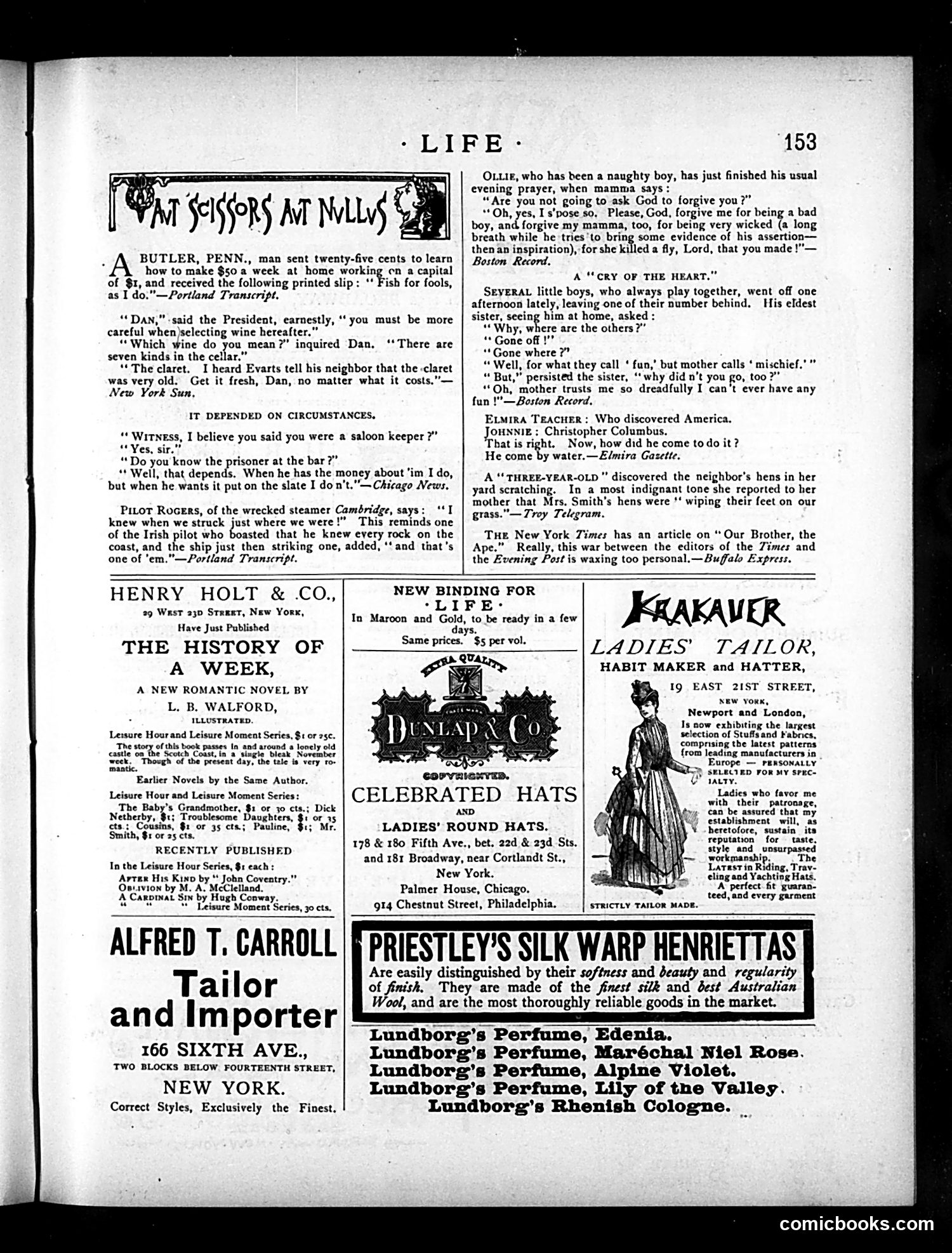
This page is primarily **advertising and short humorous anecdotes** rather than political cartoons. The content consists of brief satirical jokes typical of Life magazine's format. The humor targets everyday social absurdities: a con artist's "fish for fools" scheme, a President concerned about wine freshness, a bartender's selective memory of customers based on payment ability, an Irish pilot's dubious boasting, and children's innocent logic (a boy's prayer mentioning a fly God created, siblings excluded from "mischief" due to maternal trust). One item references contemporary journalism rivalry between the *New York Times* and *Evening Post* over evolutionary theory ("Our Brother, the Ape"), likely alluding to post-Darwin debates still active in the 1880s. The page is dominated by **period advertisements** for books, clothing, perfume, and hat retailers—standard Life magazine content showing what urban Americans consumed and wore during this era.
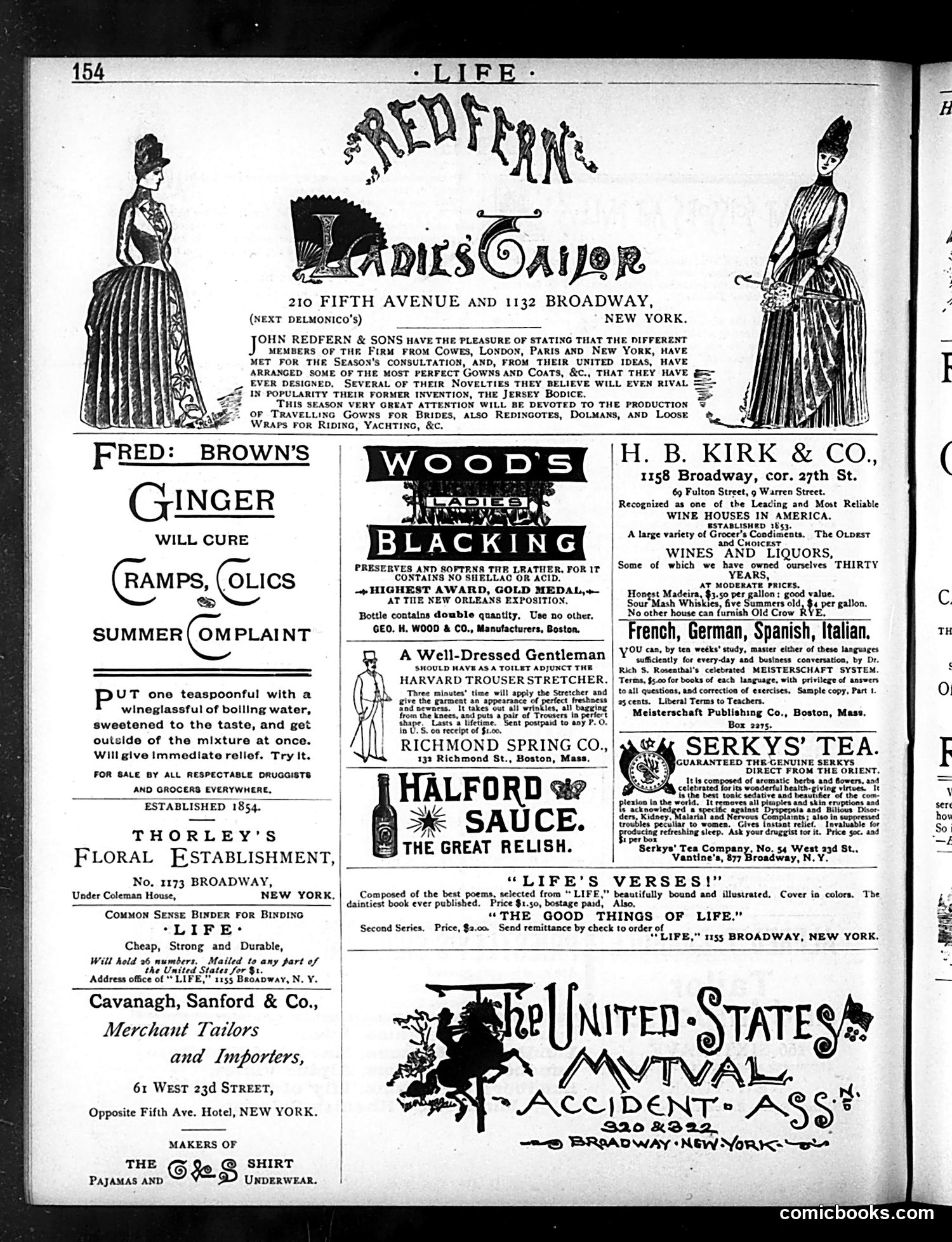
This is primarily an **advertising page** from Life magazine, not a satirical cartoon. The page showcases various commercial products and services popular in late 19th-century America. Key advertisements include: - **Fred Fern's Ladies Tailor** (top): A high-end dressmaking establishment announcing new seasonal fashions, particularly highlighting the "Jersey Bodice" as a popular innovation - **Fred Brown's Ginger**: A patent medicine claiming to cure cramps and digestive complaints - **Wood's Blacking**: Shoe polish with a gold medal award - **Halford Sauce**: A condiment product - **Serky's Tea**: A medicinal tea marketed for digestive and beauty benefits - Various tailors, wine merchants, and other services catering to affluent New York customers The advertisements reflect Gilded Age consumer culture—expensive imported goods, patent medicines with exaggerated health claims, and luxury fashion. There is no apparent satire; this represents Life's revenue model, mixing editorial content with paid advertisements aimed at wealthy urban readers.
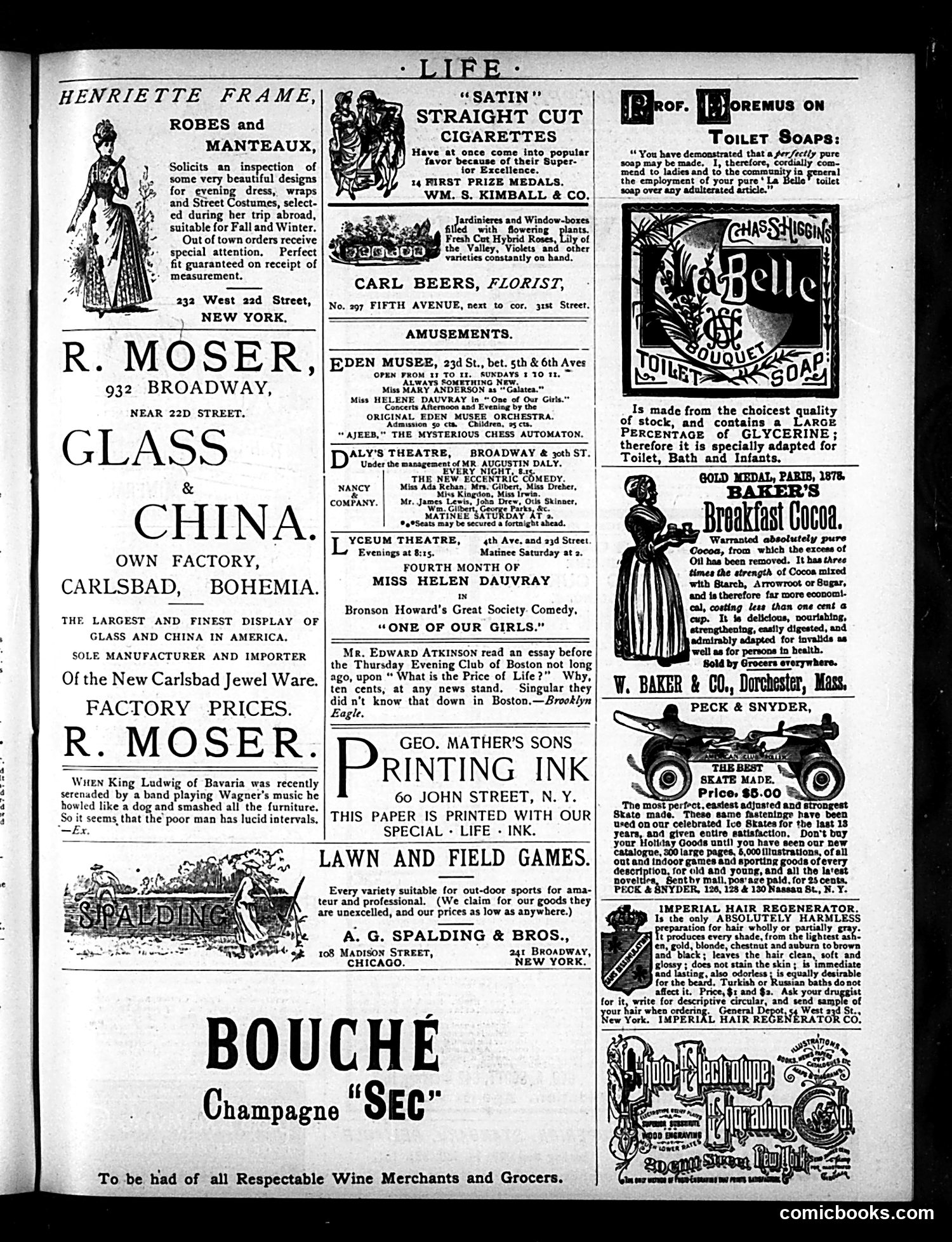
This is primarily an **advertising page** from a late 19th-century American satirical magazine, with one brief satirical comment. The sole joke appears in the King Ludwig of Bavaria anecdote: when the Bavarian king was serenaded with Wagner's music, he "howled like a dog and smashed all the furniture"—the satire being that his violent, irrational response suggests he only has occasional moments of sanity ("lucid intervals"). This mocks Ludwig as mentally unstable, likely referencing contemporary gossip about the historical King Ludwig II. The remainder consists of period advertisements for luxury goods: fashionable women's clothing, fine glassware and china from Bohemia, cigarettes, flowers, theater productions (featuring actress Helen Dauvray), household products (soap, cocoa), sporting equipment, and champagne. These ads target upper-class readers and reveal what affluent Americans purchased in this era.
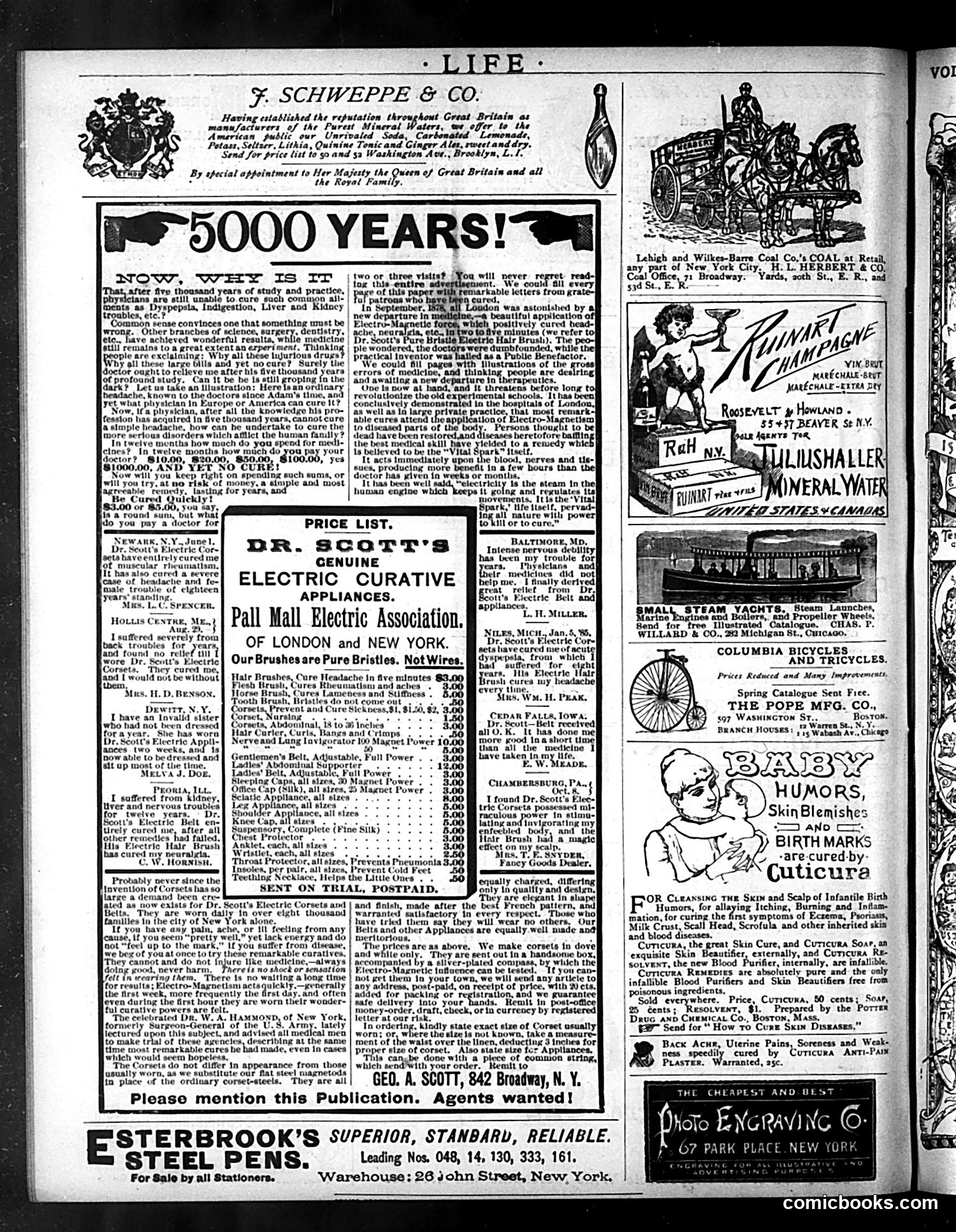
This page is primarily **advertising**, not editorial satire. The dominant content is Dr. Scott's "Electric Curative Appliances"—a pseudoscientific medical product line from the late 19th century. ## The "5000 Years" Advertisement The headline mocks traditional medicine's failure to cure common ailments (dyspepsia, indigestion, rheumatism) despite millennia of study. It then pivots to selling "electric" corsets, belts, and brushes as superior alternatives. ## The Satire (Implicit) While not overtly drawn as political cartoon, the ad itself is satirical of medical quackery: it positions electricity—a newly understood force—as a cure-all, backed only by testimonials. The ad's logic is deliberately absurd: if doctors can't cure a headache in 5,000 years, why trust them at all? ## Historical Context "Electrotherapy" was genuinely marketed to Americans in this era (likely 1880s-1890s) as legitimate treatment. We now recognize it as pseudoscience, making the ad unintentionally humorous to modern eyes—exactly what *Life* magazine's satirical audience would have found darkly funny about contemporary medical fraud.