
Life, 1886-03-11 · page 6 of 16
Life — March 11, 1886 — page 6: what you’re looking at
What you’re looking at
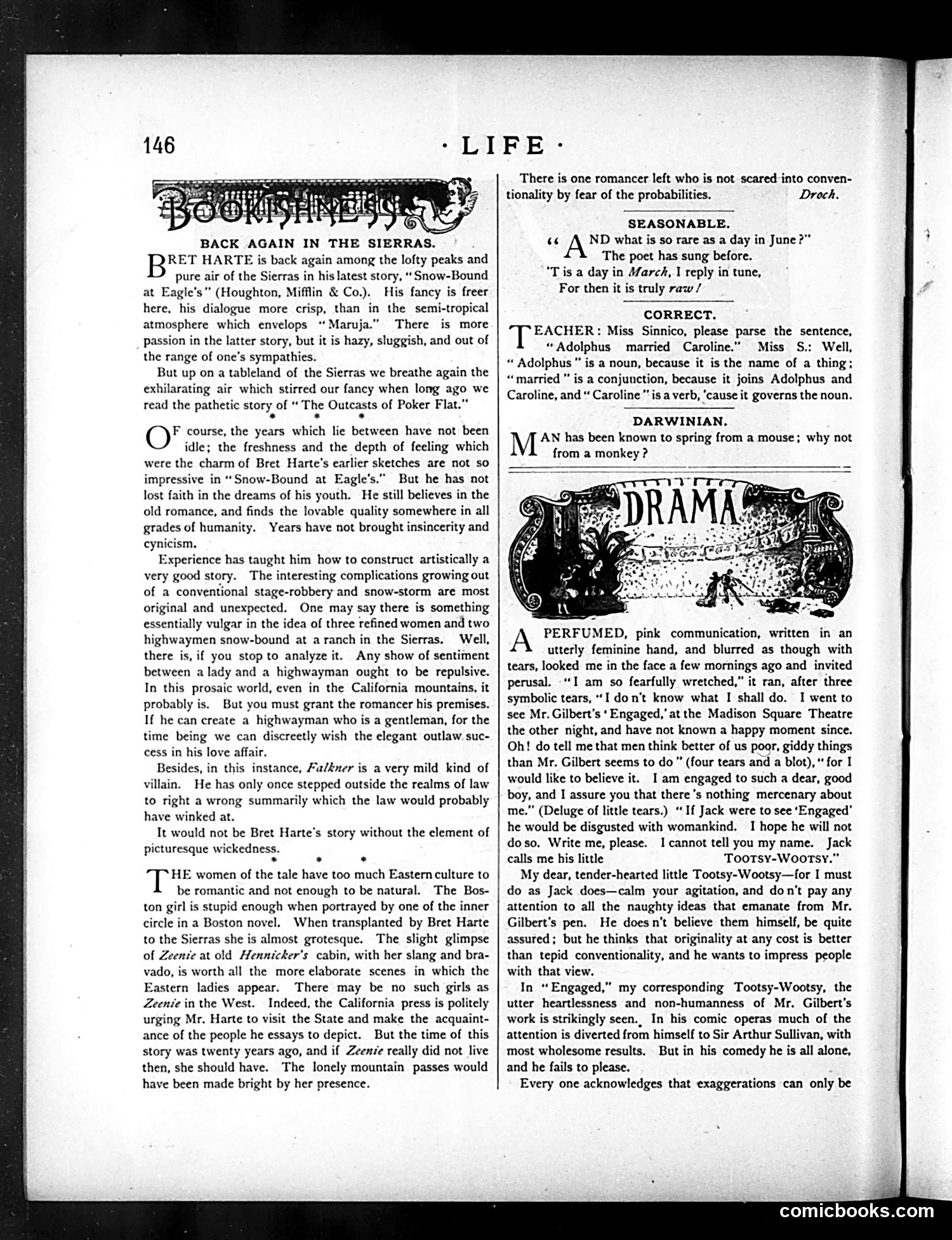
This page contains literary criticism rather than political cartoons. The main sections are: **"Bookishness"**: Reviews Bret Harte's latest story "Snow-Bound" at Eagle's, noting his continued romantic sensibility despite years of absence from publication. **"Seasonable"**: A brief poetic exchange about June weather. **"Correct"**: A grammar lesson parsing the sentence "Adolphus married Caroline." **"Darwinian"**: A humorous question asking why humans didn't evolve from monkeys rather than mice. **"Drama"**: A lengthy critique of a theater piece called "Engaged," discussing feminine writing styles and Mr. Gilbert's theatrical work, with particular attention to character development and originality versus convention. The page functions as cultural commentary and literary satire rather than political commentary.
📄 Transcribed text from this page (OCR, searchable)
Machine-transcribed from the original scan — historical spelling and the odd misread are preserved.
- LIFE: BACK AGAIN IN THE SIERRAS. RET HARTE is back again among the lofty peaks and pure air of the Sierras in his latest story, “ Snow-Bound at Eagle's" (Houghton, Mifflin & Co.). His fancy is freer here, his dialogue more crisp, than in the semi-tropical atmosphere which envelops ‘Maruja.” There is more passion in the latter story, but it is hazy, sluggish, and out of the range of one’s sympathies. But up on a tableland of the Sierras we breathe again the exhilarating air which stirred our fancy when long ago we read the pathetic story of “ The Outcasts of Poker Flat.” ‘* . F course, the years which lie between have not been idle; the freshness and the depth of feeling which were the charm of Bret Harte’s earlier sketches are not so impressive in “ Snow-Bound at Eagle's.” But he has not lost faith in the dreams of his youth. He still believes in the old romance, and finds the lovable quality somewhere in all grades of humanity. Years have not brought insincerity and cynicism. Experience has taught him how to construct artistically a very good story. The interesting complications growing out of a conventional stage-robbery and snow-storm are most original and unexpected. One may say there is something essentially vulgar in the idea of three refined women and two highwaymen snow-bound at a ranch in the Sierras. Well, there is, if you stop to analyze it. Any show of sentiment between a lady and a highwayman ought to be repulsive. In this prosaic world, even in the California mountains, it probably is. But you must grant the romancer his premises. If he can create a highwayman who is a gentleman, for the time being we can discreetly wish the elegant outlaw. suc- cess in his love affair. Besides, in this instance, Fa/kner is a very mild kind of villain. He has only once stepped outside the realms of law to right a wrong summarily which the law would probably have winked at. It would not be Bret Harte’s story without the element of picturesque wickedness. . . ° HE women of the tale have too much Eastern culture to be romantic and not enough to be natural. The Bos- ton girl is stupid enough when portrayed by one of the inner circle in a Boston novel. When transplanted by Bret Harte to the Sierras she is almost grotesque. The slight glimpse of Zeente at old Hennicker’s cabin, with her slang and bra- vado, is worth all the more elaborate scenes in which the Eastern ladies appear. There may be no such girls as Zeente in the West. Indeed, the California press is politely urging Mr. Harte to visit the State and make the acquaint- ance of the people he essays to depict. But the time of this story was twenty years ago, and if Zeenze really did not live then, she should have. The lonely mountain passes would have been made bright by her presence. There is one romancer left who is not scared into conven- tionality by fear of the probabilities. Droch. SEASONABLE. 73 ND what is so rare as a day in June?” The poet has sung before. 'T is a day in March, I reply in tune, For then it is truly raw / CORRECT. EACHER: Miss Sinnico, please parse the sentence, “Adolphus married Caroline.” Miss S.: Well, « Adolphus " is a noun, because it is the name of a thing; “married ” is a conjunction, because it joins Adolphus and Caroline, and “ Caroline” is a verb, ‘cause it governs the noun. DARWINIAN. AN has been known to spring from a mouse; why not from a monkey ? PERFUMED, pink communication, written in an utterly feminine hand, and blurred as though with tears, looked me in the face a few mornings ago and invited perusal. “I am so fearfully wretched,” it ran, after three symbolic tears, “I don’t know what I shall do. I went to see Mr. Gilbert's ‘ Engaged,’ at the Madison Square Theatre the other night, and have not known a happy moment since. Oh! do tell me that men think better of us poor, giddy things than Mr. Gilbert seems to do” (four tears and a blot), “for I would like to believe it. I am engaged to such a dear, good boy, and I assure you that there's nothing mercenary about me.” (Deluge of little tears.) “If Jack were to see ‘Engaged’ he would be disgusted with womankind. I hope he will not do so, Write me, please. I cannot tell you my name. Jack calls me his little Tootsy-Wootsy.” My dear, tender-hearted little Tootsy-Wootsy—for I must do as Jack does—calm your agitation, and don't pay any attention to all the naughty ideas that emanate from Mr. Gilbert's pen. He doesn’t believe them himself, be quite assured; but he thinks that originality at any cost is better than tepid conventionality, and he wants to impress people with that view. In “Engaged,” my corresponding Tootsy-Wootsy, the utter heartlessness and non-humanness of Mr. Gilbert's work is strikingly seen. In his comic operas much of the attention is diverted from himself to Sir Arthur Sullivan, with most wholesome results. But in his comedy he is all alone, and he fails to please. Every one acknowledges that exaggerations can only be comicbooks.com