
Life, 1886-03-11 · page 3 of 16
Life — March 11, 1886 — page 3: what you’re looking at
What you’re looking at
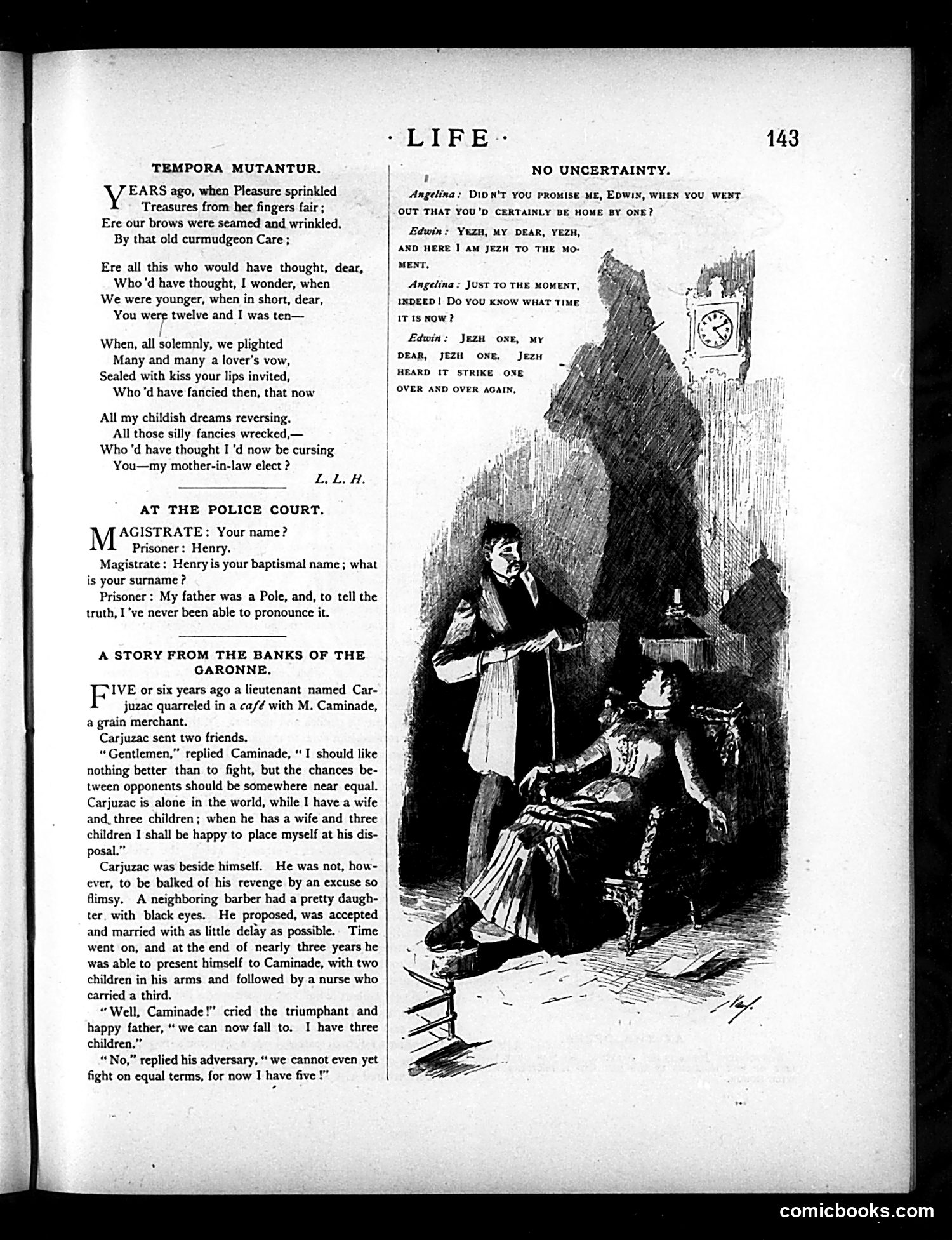
This page contains three unrelated satirical pieces: 1. **"Tempora Mutantur"** (poem): A nostalgic reflection on lost youth and marriage, lamenting how childish romantic dreams have reversed into current marital discord. 2. **"At the Police Court"** (dialogue): A magistrate interrogates a prisoner named Henry about his surname. The prisoner explains his father was Polish and he cannot pronounce the name—satirizing the difficulty of assimilating immigrant names in the British legal system. 3. **"A Story from the Banks of the Garonne"** (narrative with illustration): An anecdote about rival French gentlemen (Carjuzac and Caminade) who cannot duel as equals because their life circumstances differ—one has a wife and three children while the other doesn't. The satire targets honor-culture absurdities regarding fair combat.
📄 Transcribed text from this page (OCR, searchable)
Machine-transcribed from the original scan — historical spelling and the odd misread are preserved.
TEMPORA MUTANTUR. Y EARS ago, when Pleasure sprinkled Treasures from her fingers fair ; Ere our brows were seamed and wrinkled. By that old curmudgeon Care; Ere all this who would have thought, dear, Who'd have thought, I wonder, when We were younger, when in short, dear, You were twelve and I was ten— When, all solemnly, we plighted Many and many a lover's vow, Sealed with kiss your lips invited, Who'd have fancied then, that now All my childish dreams reversing, All those silly fancies wrecked,— Who 'd have thought I ’d now be cursing You—my mother-in-law elect ? LL. H. AT THE POLICE COURT. AGISTRATE: Your name? Prisoner: Henry. Magistrate: Henry is your baptismal name; what is your surname ? Prisoner : My father was a Pole, and, to tell the | truth, I've never been able to pronounce it. A STORY FROM THE BANKS OF THE GARONNE, IVE or six years ago a lieutenant named Car- juzac quarreled in a ca/é with M. Caminade, a grain merchant. Carjuzac sent two friends. “Gentlemen,” replied Caminade, “I should like nothing better than to fight, but the chances be- tween opponents should be somewhere near equal. Carjuzac is alone in the world, while I have a wife and_ three children; when he has a wife and three children I shall be happy to place myself at his dis- posal.” Carjuzac was beside himself. He was not, how- ever, to be balked of his revenge by an excuse so flimsy. A neighboring barber had a pretty daugh- ter. with black eyes. He proposed, was accepted and married with as little delay as possible. Time went on, and at the end of nearly three years he was able to present himself to Caminade, with two children in his arms and followed by a nurse who carried a third. “Well, Caminade!” cried the triumphant and happy father, “ we can now fall to. I have three children.” “No,” replied his adversary, “ we cannot even yet fight on equal terms, for now I have five !” | DEAR, JEZH ONE. ~LIFE- | ' NO UNCERTAINTY, Angelina: Dip N'T YOU PROMISE ME, EDWIN, WHEN YOU WENT | OUT THAT YOU'D CERTAINLY BE HOME BY ONE? Edwin: YtzH, MY DEAR, YEZH, AND HERE I AM JEZH TO THE Mo- MENT. Angelina; JUST TO THE MOMENT, INDEED! Do YOU KNOW WHAT TIME IT 18 NOW? Edwin: Jez one, my Jezu HEARD IT STRIKE ONE OVER AND OVER AGAIN, comicbooks.com