
Life, 1886-03-11 · page 2 of 16
Life — March 11, 1886 — page 2: what you’re looking at
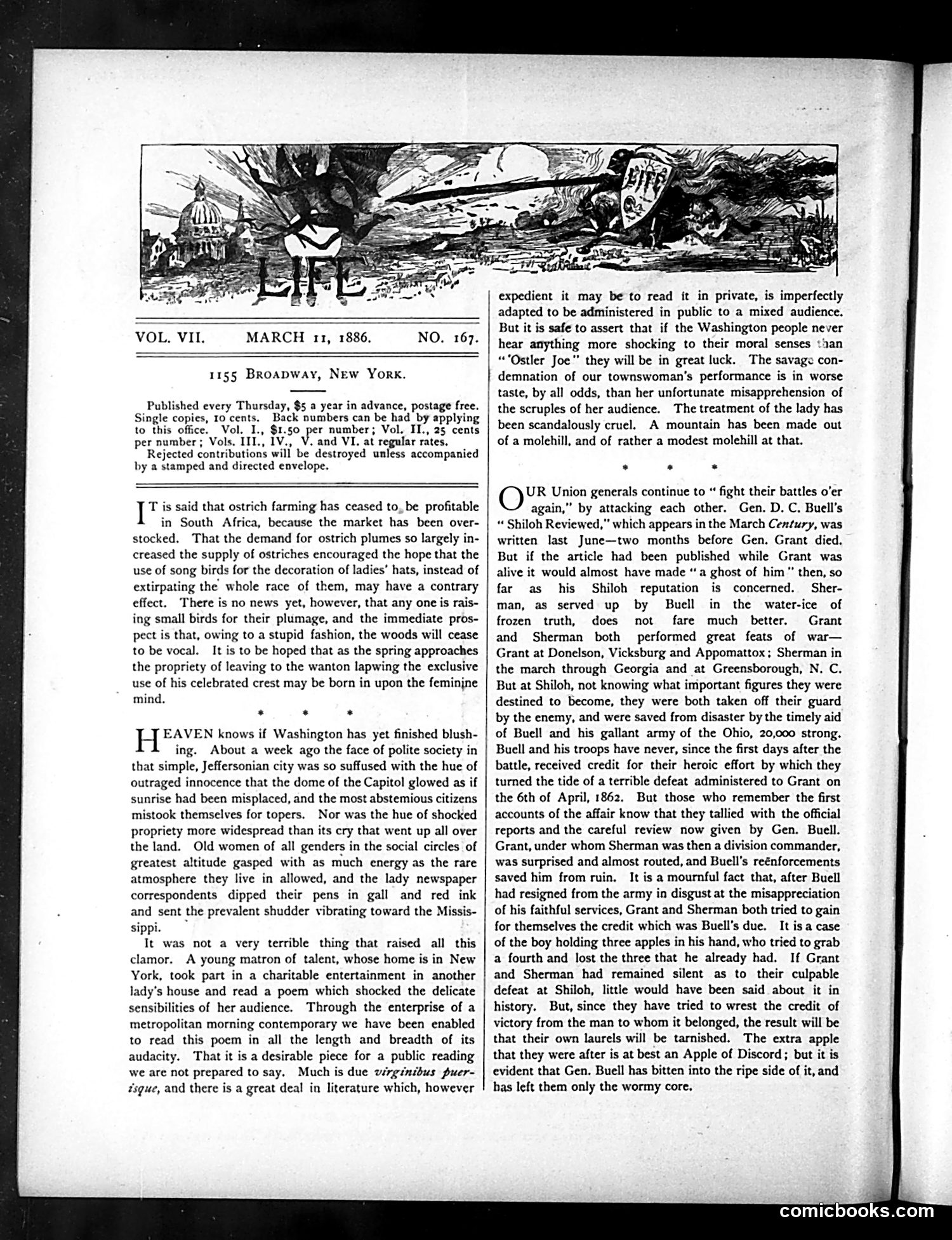
What you’re looking at
The page contains satirical editorial commentary rather than a cartoon. The text critiques Washington society's reaction to a controversial poem recitation by a woman at a charity event. The piece mocks the "outraged innocence" of Capitol society, suggesting their shock was performative. The editorial then discusses Union generals Grant and Sherman, specifically Gen. D.C. Buell's "Shiloh Reviewed" article published in *Century* magazine. The satire questions competing historical narratives about Civil War battles, particularly who deserves credit for victories. The writer suggests both Grant and Sherman have attempted to claim laurels unfairly, leaving "only the wormy core" of truth. The piece exemplifies *Life*'s role as a venue for political and social satire during the Reconstruction era.
📄 Transcribed text from this page (OCR, searchable)
Machine-transcribed from the original scan — historical spelling and the odd misread are preserved.
MARCH 11, 1886, VOL. VII. 1155 Broapway, New York. Published every Thursday, $5 a year in advance, postage free. Single copies, 10 cents. Back numbers can be had by applying to this office. Vol. $::50 per number; Vol. II., 25 cents per number; Vols, IIT., IV., V. and VI. at regular rates. Rejected contributions will be destroyed unless accompanied by a stamped and directed envelope. I" is said that ostrich farming has ceased to, be profitable in South Africa, because the market has been over- stocked. That the demand for ostrich plumes so largely in- creased the supply of ostriches encouraged the hope that the use of song birds for the decoration of ladies’ hats, instead of extirpating the whole race of them, may have a contrary effect. There is no news yet, however, that any one is rais- ing small birds for their plumage, and the immediate pros- pect is that, owing to a stupid fashion, the woods will cease to be vocal. It is to be hoped that as the spring approaches the propriety of leaving to the wanton lapwing the exclusive use of his celebrated crest may be born in upon the feminjne mind. . . . EAVEN knows if Washington has yet finished blush- ing. About a week ago the face of polite society in that simple, Jeffersonian city was so suffused with the hue of outraged innocence that the dome of the Capitol glowed as if sunrise had been misplaced, and the most abstemious citizens mistook themselves for topers. Nor was the hue of shocked propriety more widespread than its cry that went up all over the land. Old women of all genders in the social circles of greatest altitude gasped with as much energy as the rare atmosphere they live in allowed, and the lady newspaper correspondents dipped their pens in gall and red ink and sent the prevalent shudder vibrating toward the Missis- sippi. It was not a very terrible thing that raised all this clamor. A young matron of talent, whose home is in New York, took part in a charitable entertainment in another lady's house and read a poem which shocked the delicate sensibilities of her audience. Through the enterprise of a metropolitan morning contemporary we have been enabled to read this poem in all the length and breadth of its audacity. That it is a desirable piece for a public reading we are not prepared to say. Much is due viérginibus puer- #sgue, and there is a great deal in literature which, however expedient it may be to read it in private, is imperfectly adapted to be administered in public to a mixed audience. But it is safe to assert that if the Washington people never hear anything more shocking to their moral senses than “Ostler Joe” they will be in great luck. The savage con- demnation of our townswoman’s performance is in worse taste, by all odds, than her unfortunate misapprehension of the scruples of her audience. The treatment of the lady has been scandalously cruel. A mountain has been made out of a molehill, and of rather a modest molehill at that. * . . UR Union generals continue to “ fight their battles o'er again,” by attacking each other. Gen. D. C. Buell’s “ Shiloh Reviewed,” which appears in the March Century, was written last June—two months before Gen. Grant died. But if the article had been published while Grant was alive it would almost have made “a ghost of him” then, so far as his Shiloh reputation is concerned. Sher- man, as served up by Buell in the water-ice of frozen truth, does not fare much better. Grant and Sherman both performed great feats of war— Grant at Donelson, Vicksburg and Appomattox; Sherman in the march through Georgia and at Greensborough, N. C. But at Shiloh, not knowing what important figures they were destined to become, they were both taken off their guard by the enemy, and were saved from disaster by the timely aid of Buell and his gallant army of the Ohio, 20,000 strong. Buell and his troops have never, since the first days after the battle, received credit for their heroic effort by which they turned the tide of a terrible defeat administered to Grant on the 6th of April, 1862. But those who remember the first accounts of the affair know that they tallied with the official reports and the careful review now given by Gen. Buell. Grant, under whom Sherman was then a division commander, was surprised and almost routed, and Buell’s reénforcements saved him from ruin. It is a mournful fact that, after Buell had resigned from the army in disgust at the misappreciation of his faithful services, Grant and Sherman both tried to gain for themselves the credit which was Buell’s due. It is a case of the boy holding three apples in his hand, who tried to grab a fourth and lost the three that he already had. If Grant and Sherman had remained silent as to their culpable defeat at Shiloh, little would have been said about it in history. But, since they have tried to wrest the credit of victory from the man to whom it belonged, the result will be that their own laurels will be tarnished. The extra apple that they were after is at best an Apple of Discord; but it is evident that Gen. Buell has bitten into the ripe side of it, and has left them only the wormy core, comicbooks.com