
A complete issue · 16 pages · 1886
Life — February 11, 1886
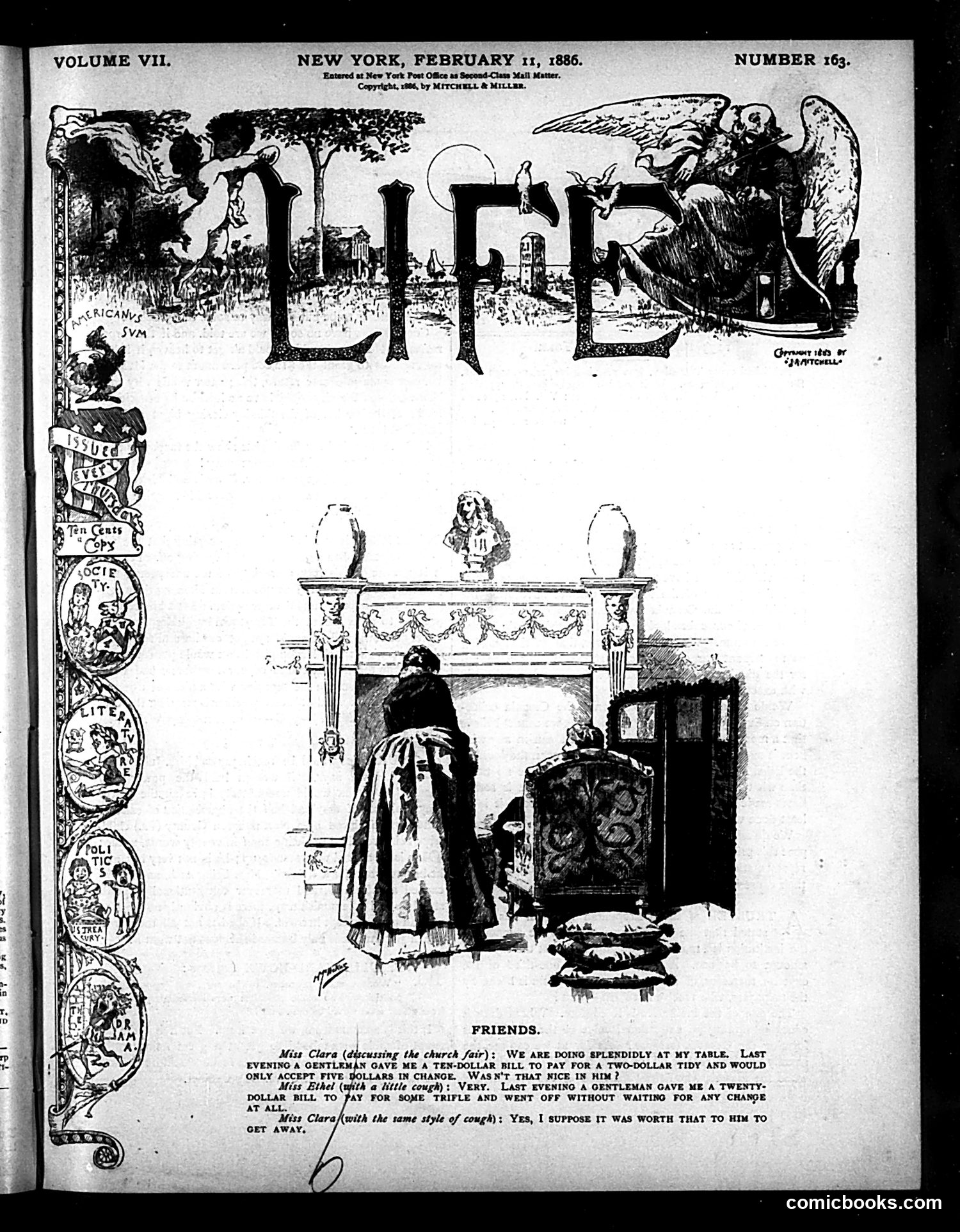
This satirical cartoon depicts two women at a fireplace discussing social etiquette around tipping and payment. The dialogue mocks the pretense of wealthy society: Miss Clara complains that a gentleman gave her a $10 bill to pay for a $2 tidy but refused to wait for change. Her friend responds that a man similarly gave her a dollar for a trifle without accepting change. The satire targets upper-class hypocrisy about money. By refusing change, these men perform generosity while actually overpaying—a way to appear wealthy while avoiding the awkwardness of small transactions. The cartoon ridicules this performative class signaling among the era's privileged set, exposing the artificiality of their social conventions.
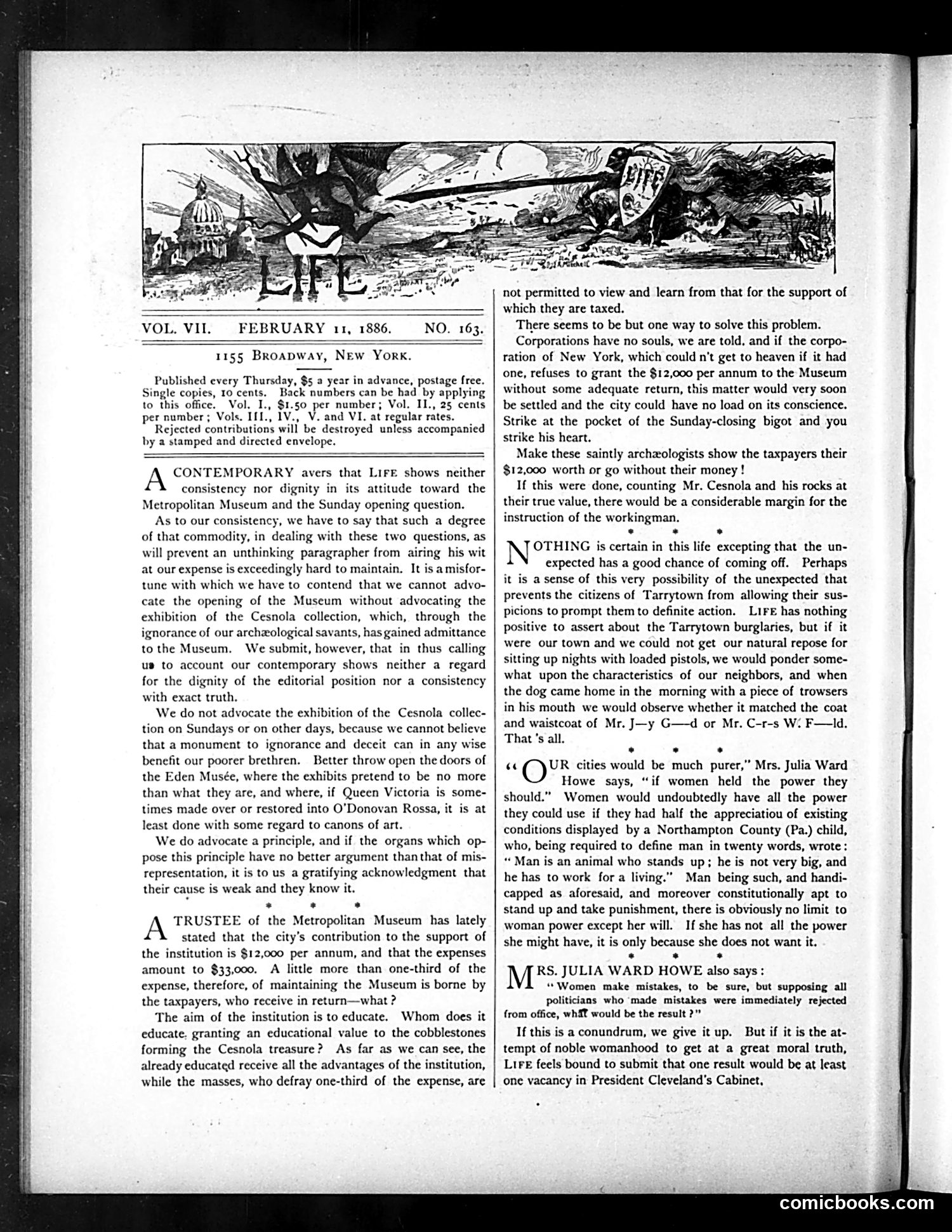
The masthead cartoon depicts a comet labeled "LIFE" approaching Earth, with a classical dome (likely representing institutional authority) in the background. This appears to be Life's self-promotional imagery emphasizing the magazine's cultural impact. The editorial content debates the Metropolitan Museum's funding and the Sunday opening question—whether the museum should open on Sundays so working-class people could visit. The text criticizes the museum's rejection of a $12,000 annual city subsidy, arguing this prevents access for poorer citizens who support it through taxes. The piece also quotes Mrs. Julia Ward Howe on women's political power and governance, suggesting satirical commentary on contemporary debates about women's suffrage and civic participation.
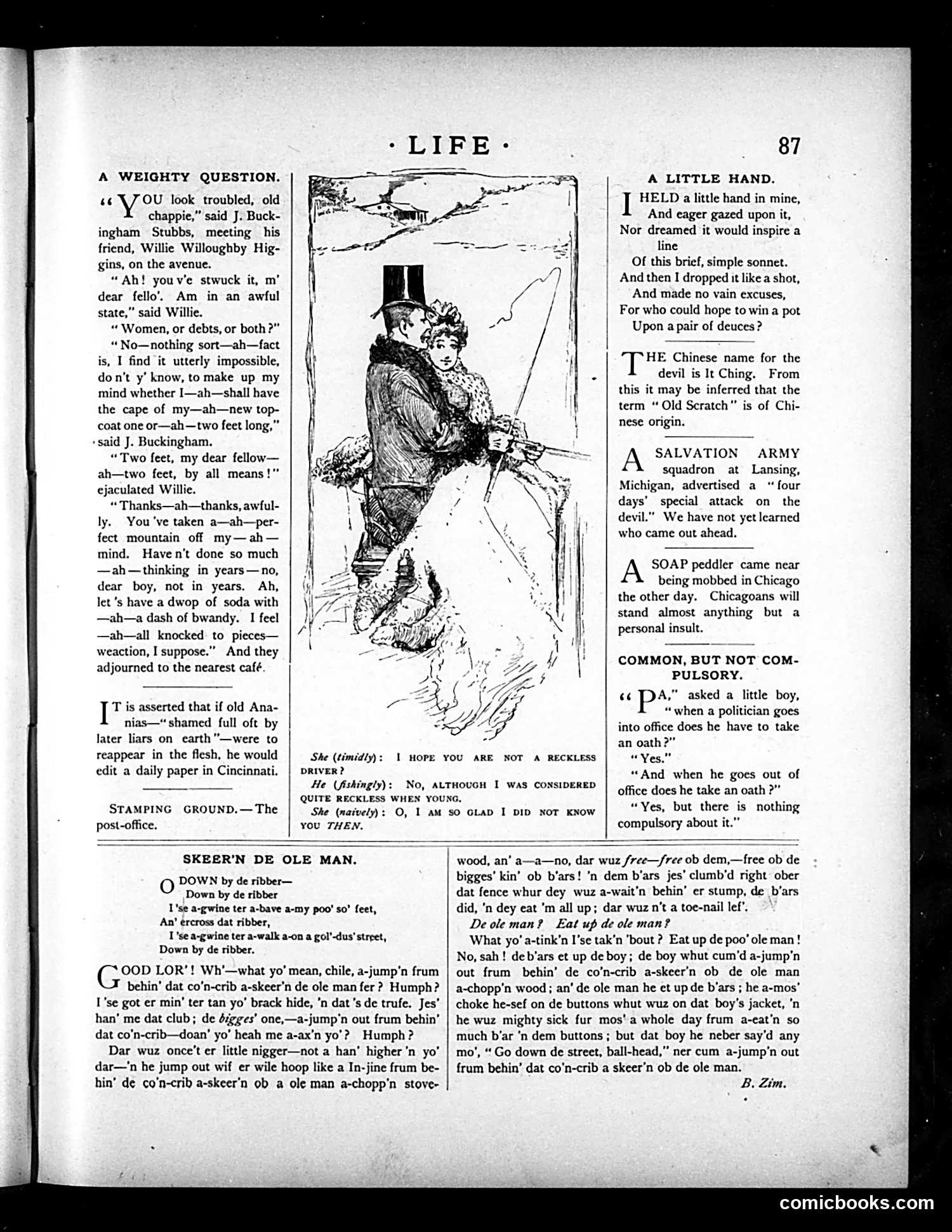
The central cartoon shows two figures fishing by a riverbank, with the caption indicating they represent a reckless driver and hope. The satire comments on reckless driving—a "weighty question" between Willie Buckingham and old Chapple about debts and financial troubles. Buckingham suggests that marrying would solve his money problems through acquiring a woman's resources, leading to the absurdist punchline about needing "two feet" of a wife to manage finances. The surrounding content includes miscellaneous short pieces typical of Life's satirical format: "A Little Hand" (a poem), notes on the Chinese devil, and dialect humor. This page represents Life's eclectic mix of social commentary, wordplay, and character-driven humor targeting contemporary American society and foibles.
This page contains satirical "society notes" rather than political cartoons. The header illustration shows silhouetted figures in formal dress. Key satirical items include: - **Irish question**: A jab at proposed solutions to Irish independence, mocking the vagueness of political promises - **Mr. Garland/Congressional investigation**: Suggests Garland is falling from favor due to a Congressional inquiry - **Mr. Howells critique**: Mocks the literary critic's claimed indifference to youth while writing youthful poetry - **Apache attacks**: Dark humor about "uncovered Apaches" being a seasonal problem - **The Buntling Ball**: Extended satire comparing an anonymously-written book's dubious attribution to Biblical scholarship The page satirizes literary pretensions, political evasiveness, and social absurdities of the era through brief, witty commentary rather than visual cartoons.
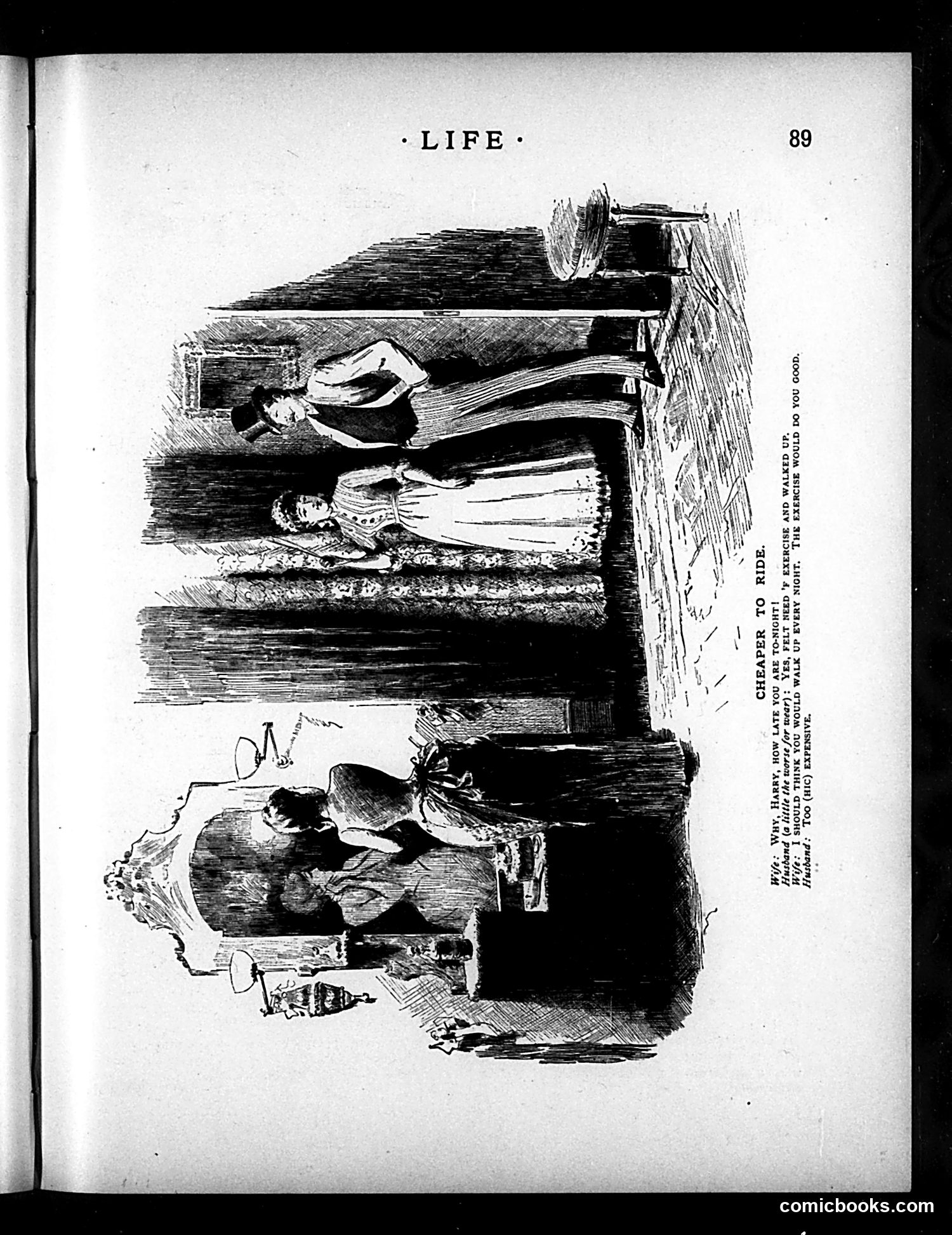
This page from *Life* magazine (page 89) appears to contain a sketch-style illustration printed upside-down. The OCR text is largely illegible, making precise identification difficult. The image shows what appears to be an interior domestic scene with multiple figures in period dress (possibly late 19th or early 20th century based on clothing styles). There's a seated figure and standing figures, with architectural elements like doorways visible. Without legible text identifying the figures or satirical context, I cannot reliably determine which political or social figures are being caricatured or what specific event or issue the cartoon addresses. The artistic style suggests social or domestic satire typical of *Life* magazine's content, but the specific target and meaning remain unclear from this reproduction.
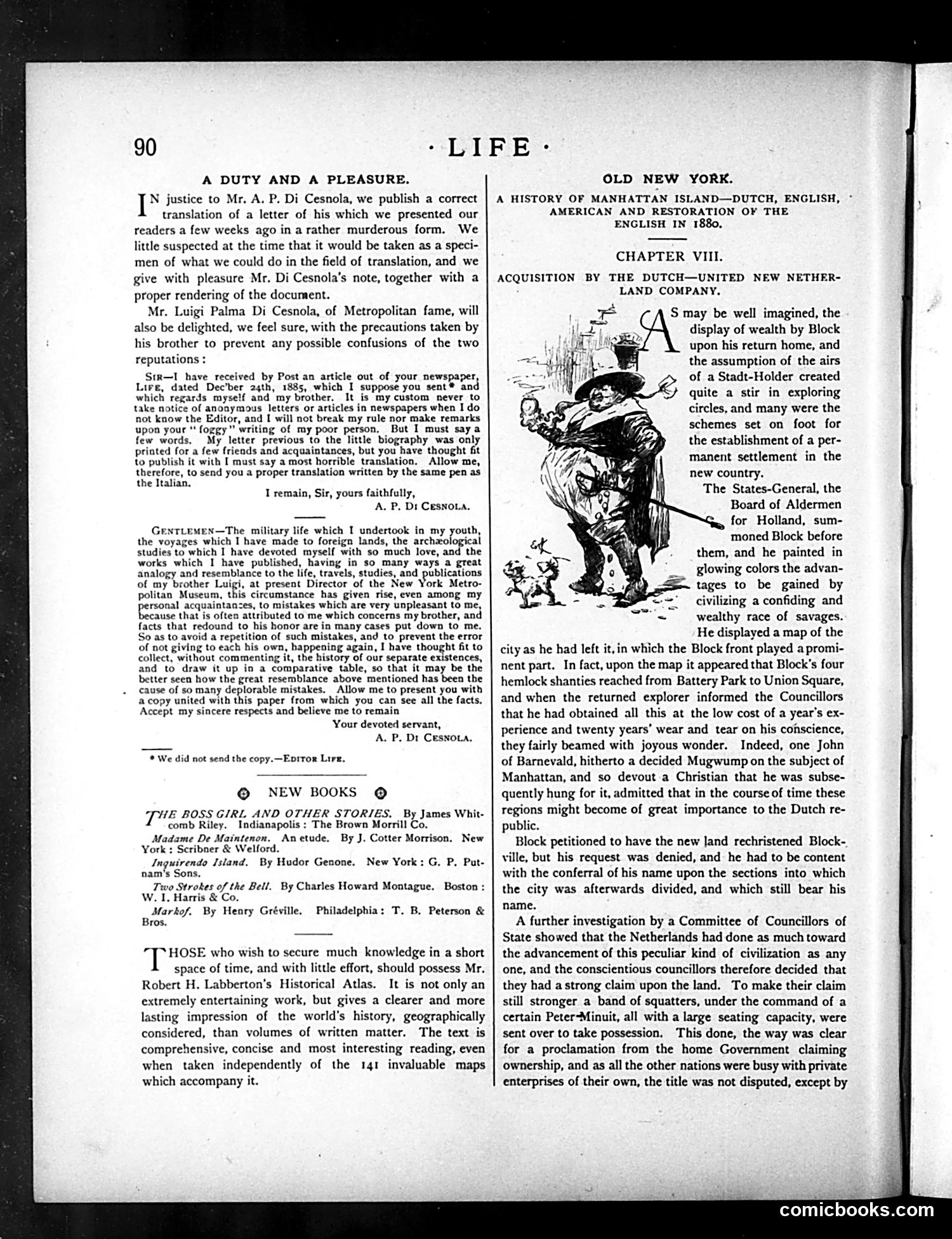
The page contains two distinct sections: **Left side:** Letters to the editor, including correspondence from A.P. Di Cesnola regarding translation accuracy and his scholarly work on the Metropolitan Museum and archaeological publications. **Right side:** An illustrated article titled "Old New York" discussing Manhattan's Dutch colonial history. The cartoon depicts a Dutch settler (likely representing Block, a historical figure mentioned in the text) in period dress, gesturing dramatically while holding a map. The illustration shows him presenting his territorial claims to Native Americans, satirizing early colonial land acquisition and the often dubious "civilizing" narratives colonizers used to justify their expansion. The text humorously describes how Block's exploration and boasts about the land's potential created excitement in Dutch circles, mocking the grandiose claims made during colonial settlement.
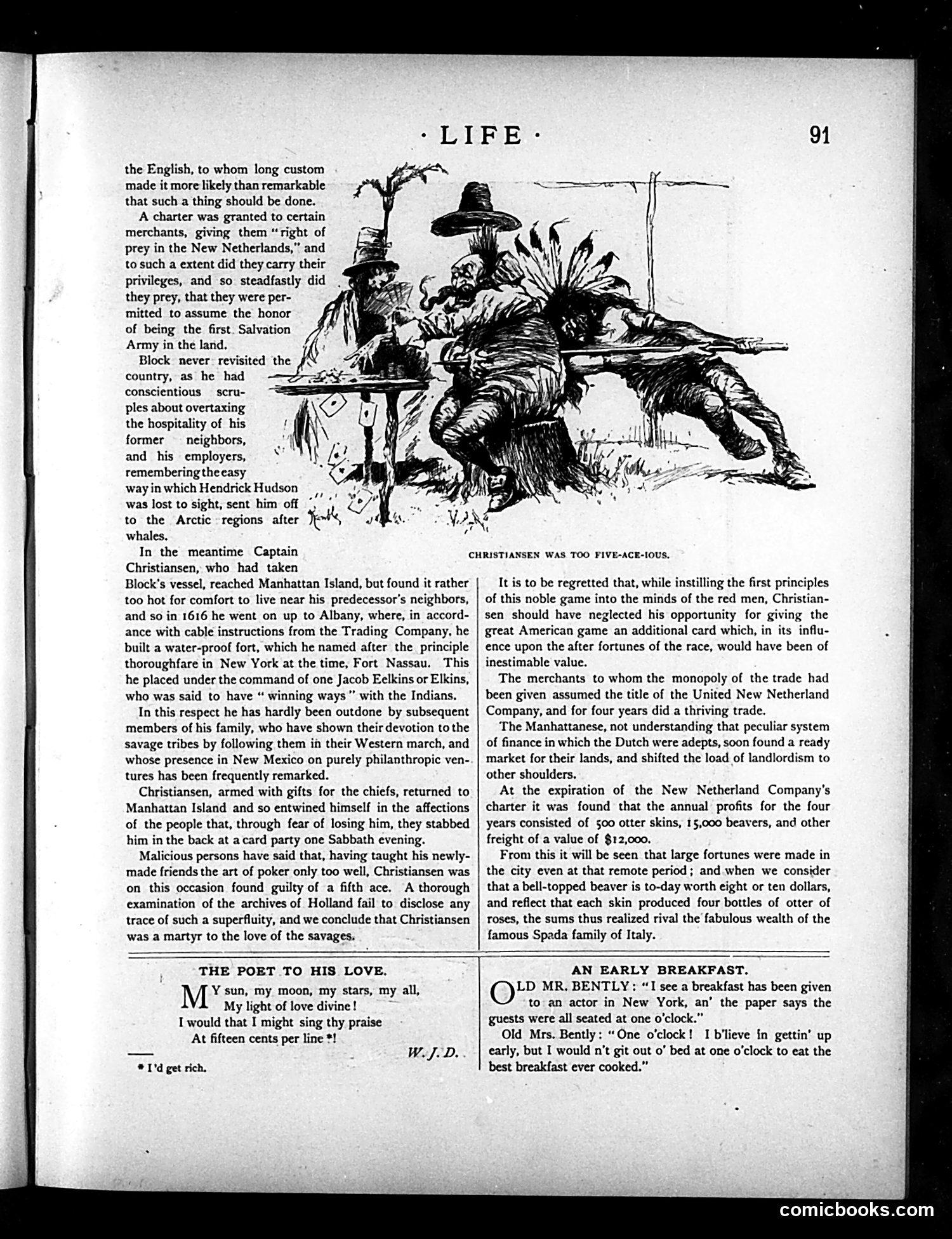
The main illustration depicts a colonial-era scene titled "CHRISTIANSEN WAS TOO FIVE-ACE-IOUS" (a pun on "facetious"). The accompanying text describes Captain Christiansen's founding of a fur-trading post in 1616 New York, his conflict with Native Americans, and his death by stabbing at a card game while playing poker. The cartoon appears to satirize early colonial traders and their moral failings—specifically Christiansen's simultaneous claims to piety and missionary work alongside his involvement in gambling and violence. The pun in the title suggests he was recklessly audacious. Below are two brief humorous pieces: a romantic poem and a dialogue joke about breakfast timing—typical filler content for the magazine.
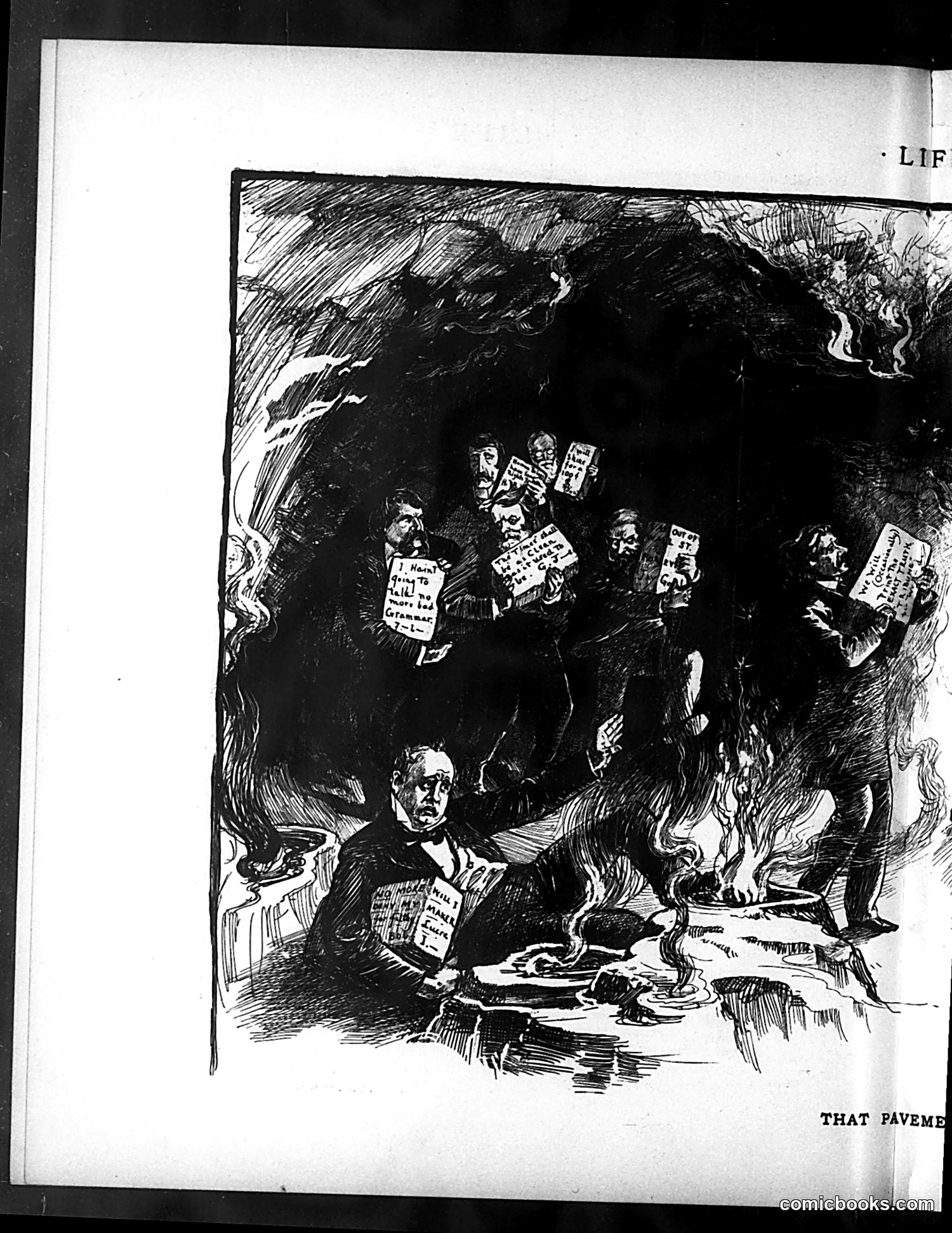
This is a political cartoon depicting demons or devils in a hellish cave setting, each holding signs with what appears to be policy positions or political statements. The figures are caricatured in an exaggerated, grotesque style typical of early 20th-century satirical illustration. The cartoon appears to criticize political positions or proposals—likely related to infrastructure or public policy, given the partially visible text mentioning "PAVEMENT" at the bottom. The demons holding scrolls/signs suggest the cartoonist views these policies as infernal or morally corrupt. However, without clearer legibility of the specific text on the signs or a visible publication date, I cannot definitively identify which political figures or exact policies are being satirized. The style and technique suggest this is from Life magazine's heyday of political satire, but the specific context remains unclear from this image alone.
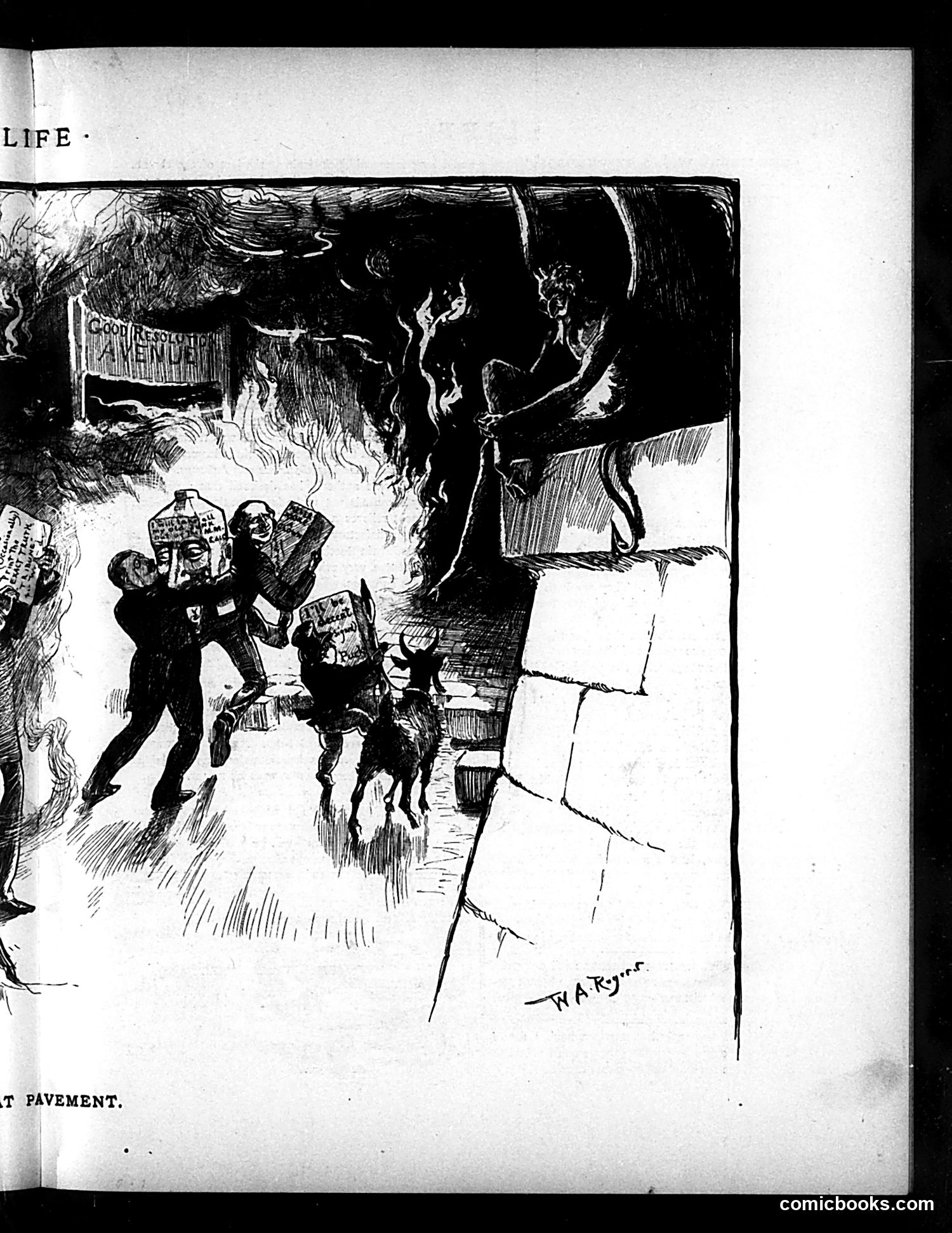
This political cartoon depicts a dramatic fire scene with figures carrying what appear to be books or documents fleeing from burning buildings. The style suggests early-to-mid 20th century satirical commentary. The burning buildings and frantic escape likely represent destruction of intellectual property or suppression of ideas—possibly referencing book burning or censorship. The figures clutching documents suggest attempts to preserve or save important materials during authoritarian crackdowns. The title fragment "T PAVEMENT" (possibly "PAVEMENT") is unclear without full context. The artist's signature appears to read "WARY" or similar. Without additional publication date or context, the specific historical event referenced remains uncertain, though the imagery strongly suggests commentary on censorship, intellectual suppression, or destruction of cultural materials during a period of political upheaval.
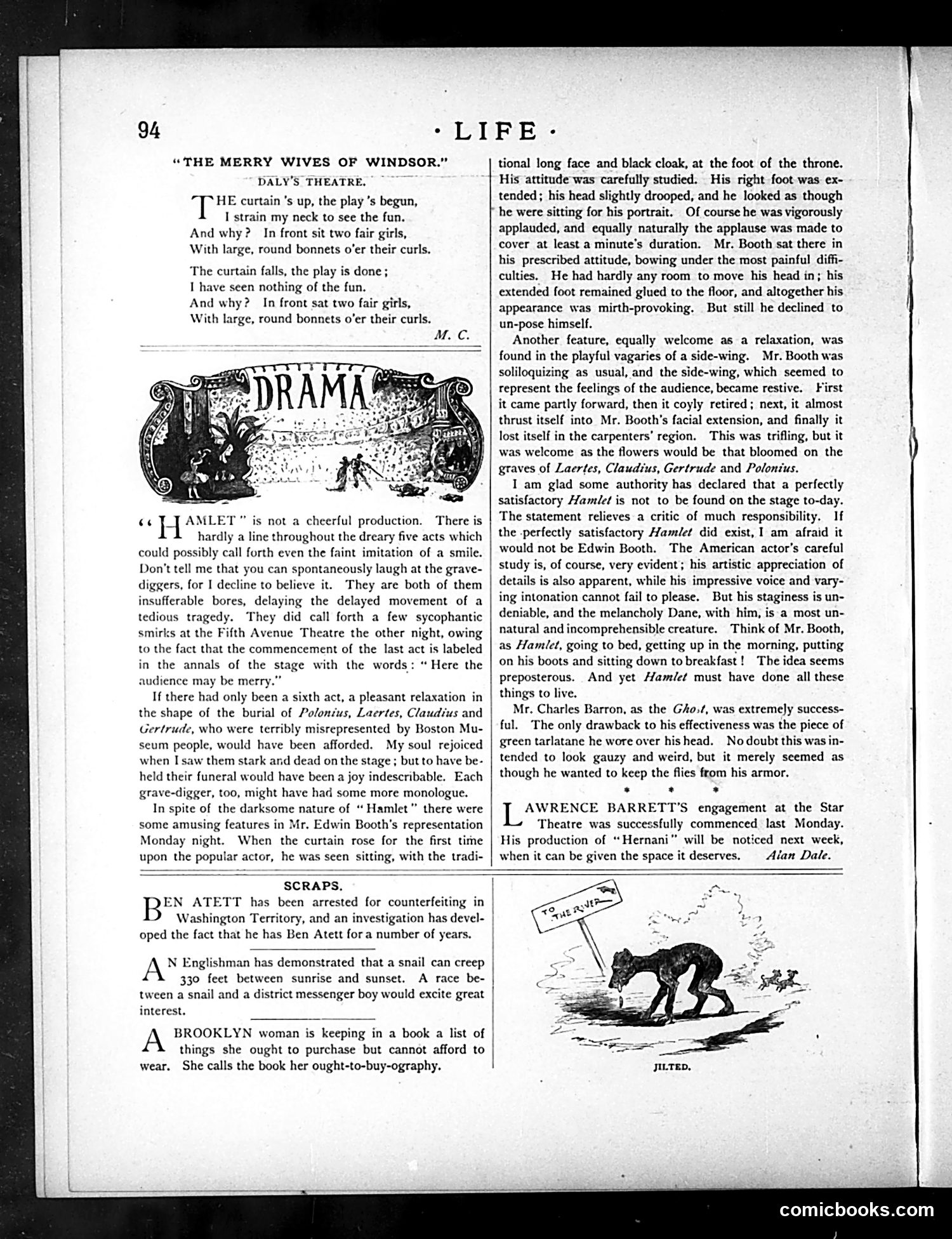
This page contains theater criticism from Life's drama section. The opening poem satirizes audience frustration at "The Merry Wives of Windsor"—patrons cannot see the stage because two women in front wear excessively large bonnets with prominent curls, a fashionable style of the era. The joke mocks both the impractical headwear and theatergoers' powerlessness to enjoy the performance. The longer Hamlet review critiques Edwin Booth's famous 1870s-era performance at Daly's Theatre. The critic mocks Booth's overly theatrical, stagy approach: his deliberately posed attitude (extended foot, drooped head) resembles sitting for a portrait rather than natural acting. The side-wing (stage scenery) shifting during soliloquies adds unintentional comedy. The reviewer argues Booth's studied, artificial performance makes the melancholy Dane implausibly stiff—impossible to imagine doing ordinary things like getting dressed or eating breakfast. The satire targets excessive theatrical artificiality masquerading as artistic appreciation.
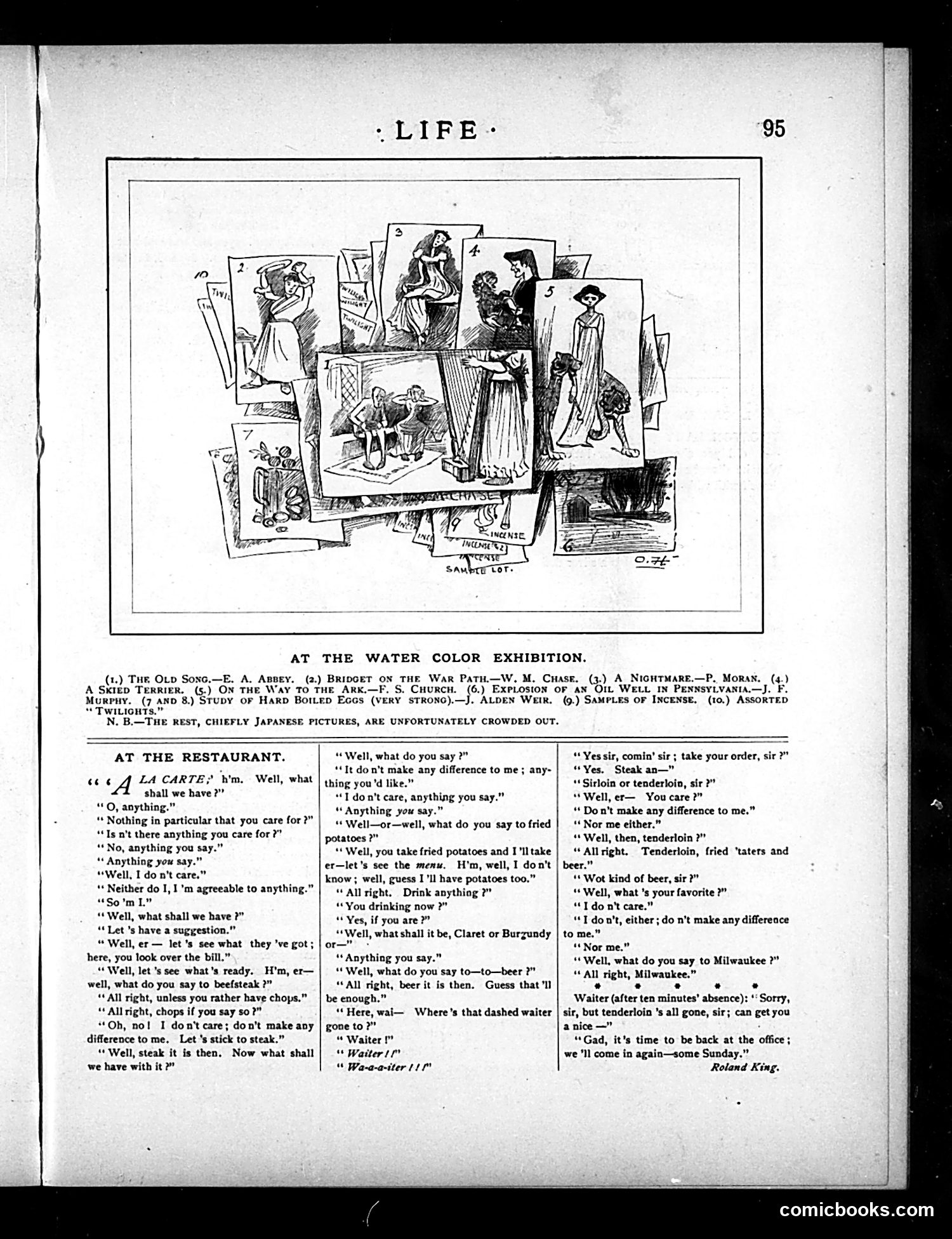
This two-part page satirizes indecision and social convention. The upper section catalogs watercolor exhibition works, appearing straightforward. The main satire—"At the Restaurant" dialogue by Roland King—mocks the paralysis of politeness. Two diners cannot decide on anything: food, preparation, side dishes, or wine. Each defers endlessly ("anything you say," "doesn't make any difference to me"), trapped in mutual accommodation. Neither wants to assert a preference, so they circle ineffectually through the menu. The joke's punchline: after their agonizing deliberation over tenderloin, the waiter announces it's gone—making their exhausting indecision completely moot. They abandon the meal entirely, claiming work obligations. This satirizes genteel masculine etiquette of the era, where appearing agreeable and non-assertive was socially valued, even when it produced absurd paralysis. The humor lies in how civility defeats its own purpose.
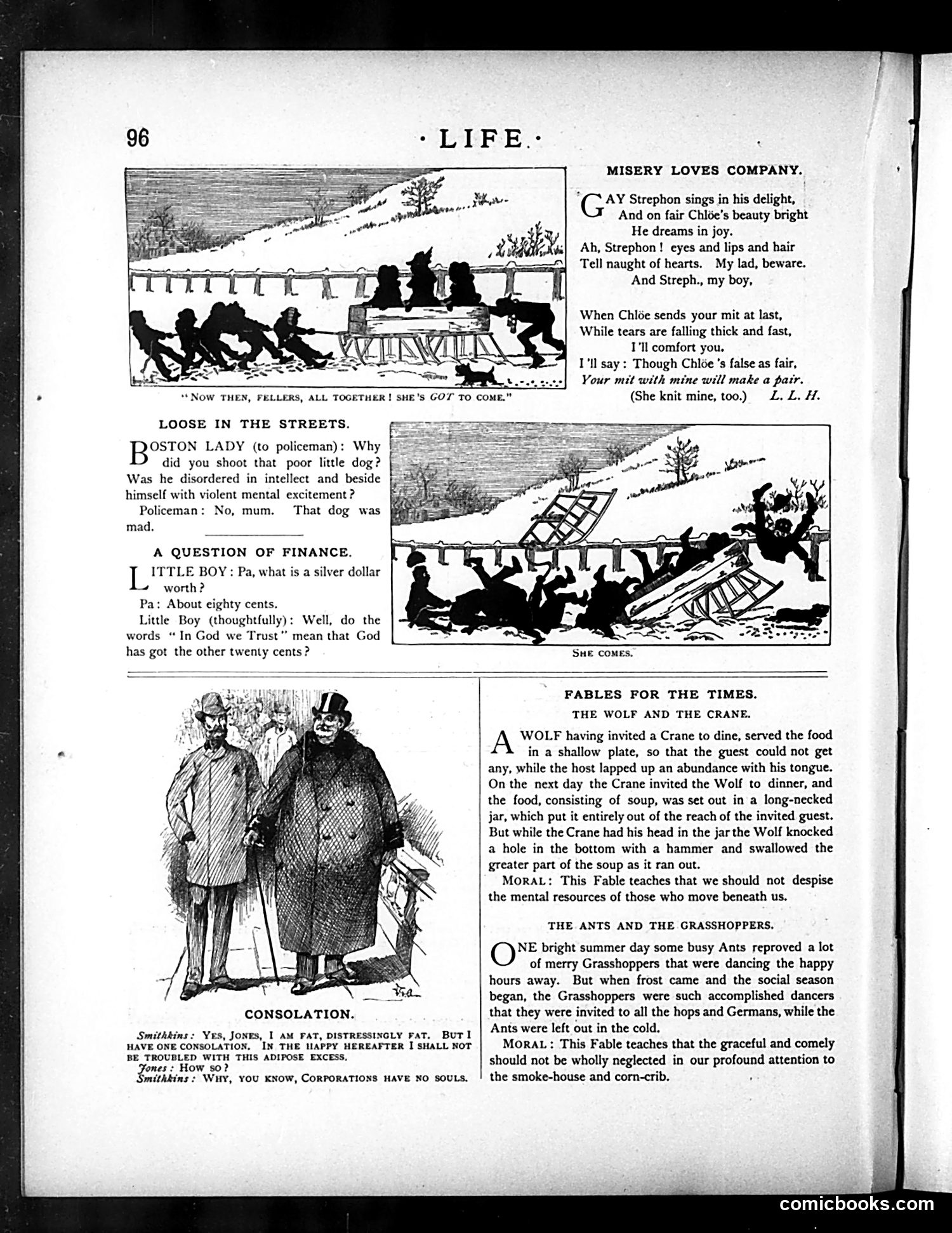
This page contains several satirical pieces typical of early 20th-century American humor: **"Misery Loves Company"** presents a romantic poem where an older woman consoles a heartbroken young man (Strephon) about his faithless lover Chloe—the joke being misery indeed loves company. **"Loose in the Streets"** satirizes upper-class speech: a Boston lady uses unnecessarily elaborate language ("disordered in intellect") to ask why a policeman shot a dog, only to learn the simple answer was that the dog was "mad" (rabid). **"A Question of Finance"** is a child's joke about currency: if a silver dollar is worth only eighty cents, where did the other twenty cents go that God supposedly oversees ("In God we Trust")? **"Consolation"** jokes darkly about corporate greed: a fat man named Smithkins consoles himself that in the afterlife he won't suffer from his obesity because "corporations have no souls"—implying he's a corporate man without spiritual consequence. The **"Fables for the Times"** modernize Aesop with cynical morals critiquing class hierarchies and social pretense.
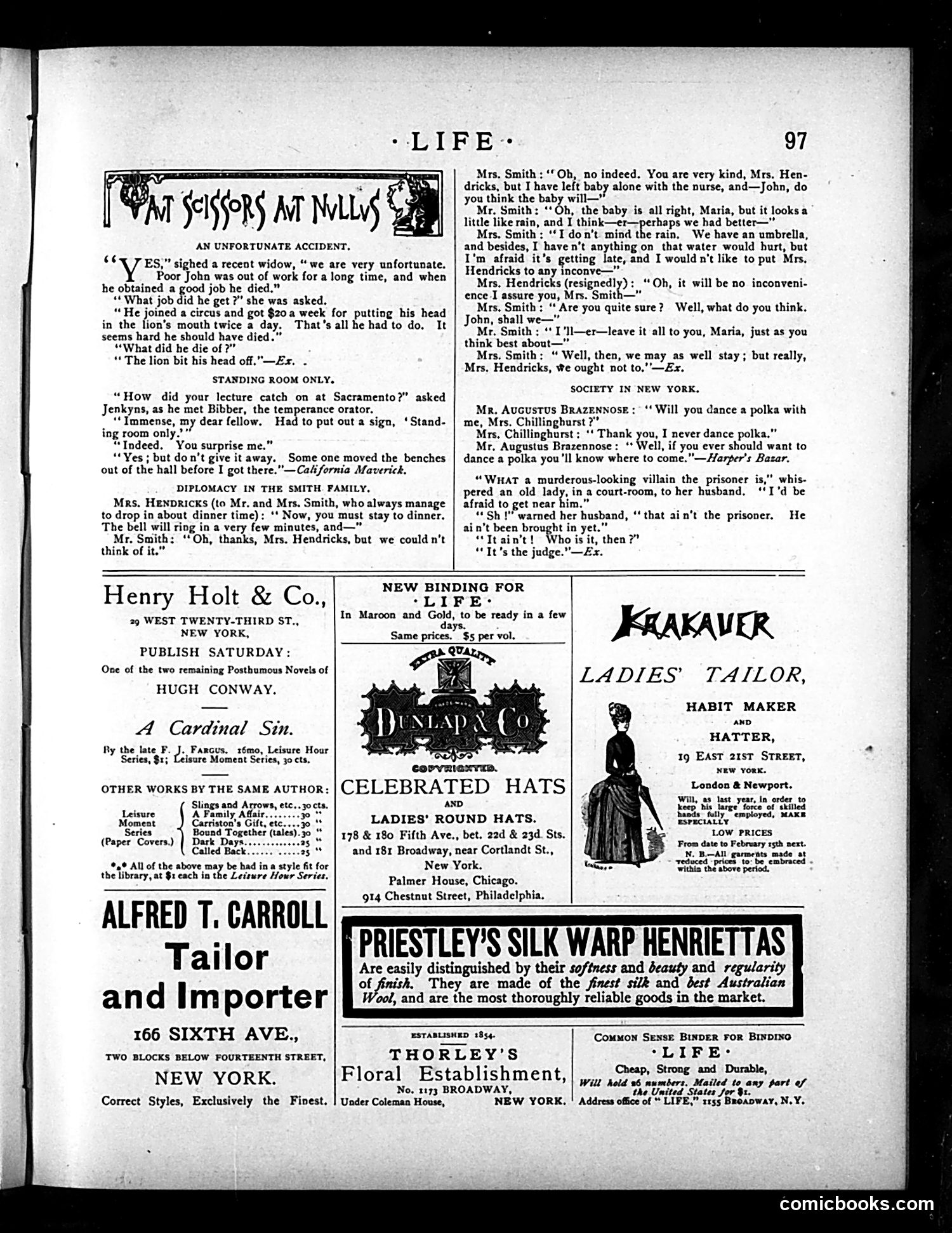
This page from *Life* magazine consists primarily of **humorous short anecdotes** rather than political cartoons. The jokes satirize everyday American social situations: 1. **"At Scissors at Mills"**: Dark humor about a circus performer earning $20/week putting his head in a lion's mouth—who dies when the lion bites it off. 2. **"Standing Room Only"**: A temperance lecturer claims success with standing-room-only crowds, but admits someone removed the benches beforehand—the real reason for crowding. 3. **"Diplomacy in the Smith Family"**: Satirizes the social awkwardness of dinner-party guests—the Smiths manufacture excuses (baby at home, possible rain) while the hostess Mrs. Hendricks politely insists they stay, creating a comedy of false courtesy. 4. **"Society in New York"**: A woman mistakes the judge for a villainous prisoner in court, revealing prejudiced assumptions about appearance. The page is otherwise filled with **advertisements** for publishers, tailors, hat makers, and florists—typical of 19th-century magazine layout.
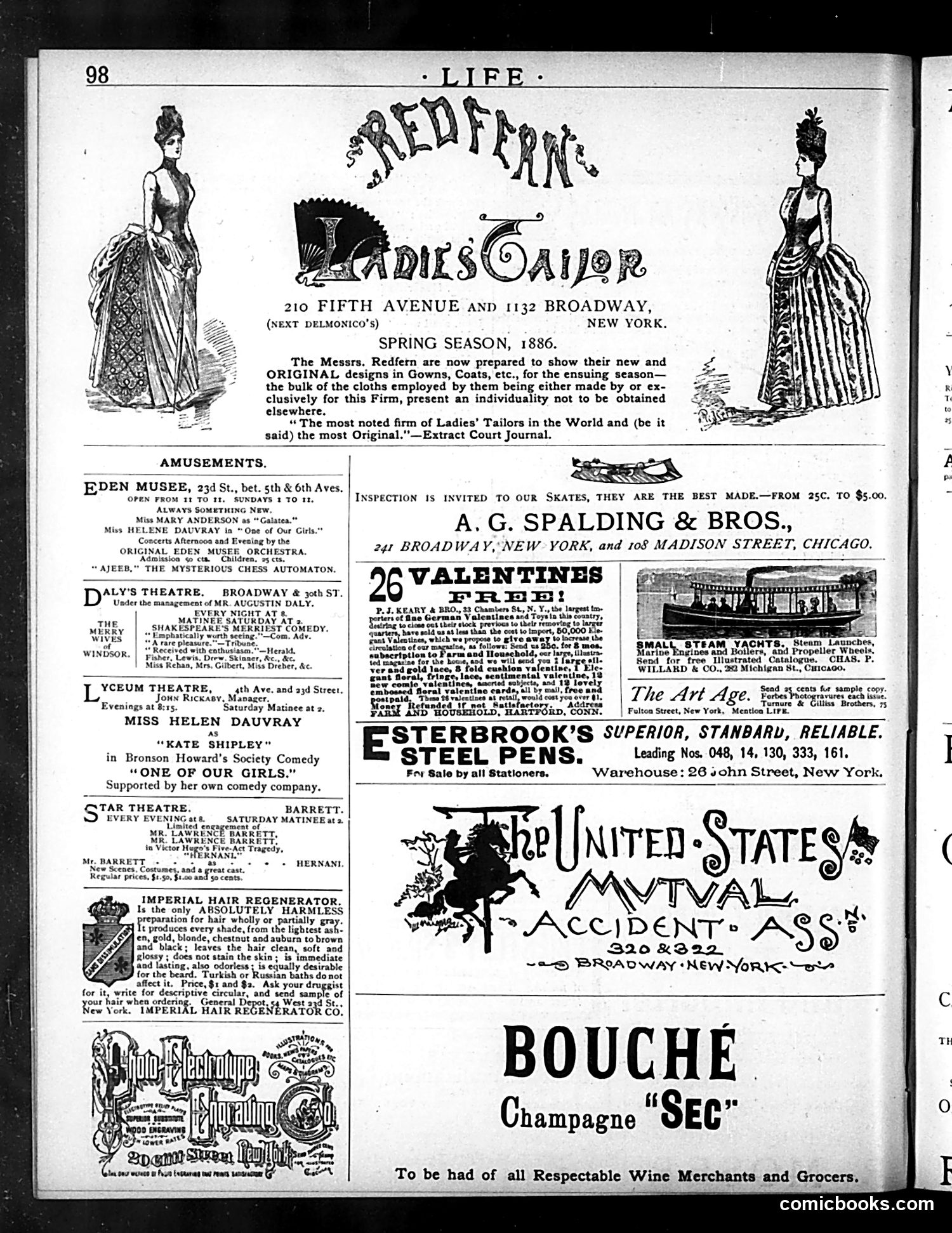
This page is primarily **advertising and entertainment listings**, not satire or political commentary. It's from Life magazine's Spring 1886 issue. The content includes: - **Fashion advertisement** for Redfern Ladies' Tailor (top), featuring two illustrated women in elaborate Victorian gowns—promoting their spring designs as the "most noted firm of Ladies' Tailors in the World" - **Theater listings** for New York venues (Eden Musee, Daly's Theatre, Lyceum, Star Theatre) advertising productions and performers - **Product advertisements** for sporting goods (A.G. Spalding ice skates), Valentine's cards, Esterbrook steel pens, hair regenerator, champagne, and other consumer goods - An illustrated advertisement for the **United States Naval Accident Association** (Broadway insurance) This is a typical 1880s magazine page mixing entertainment coverage with commercial advertising—not political satire. The illustrations simply reflect contemporary fashion and promotional aesthetics of the period.
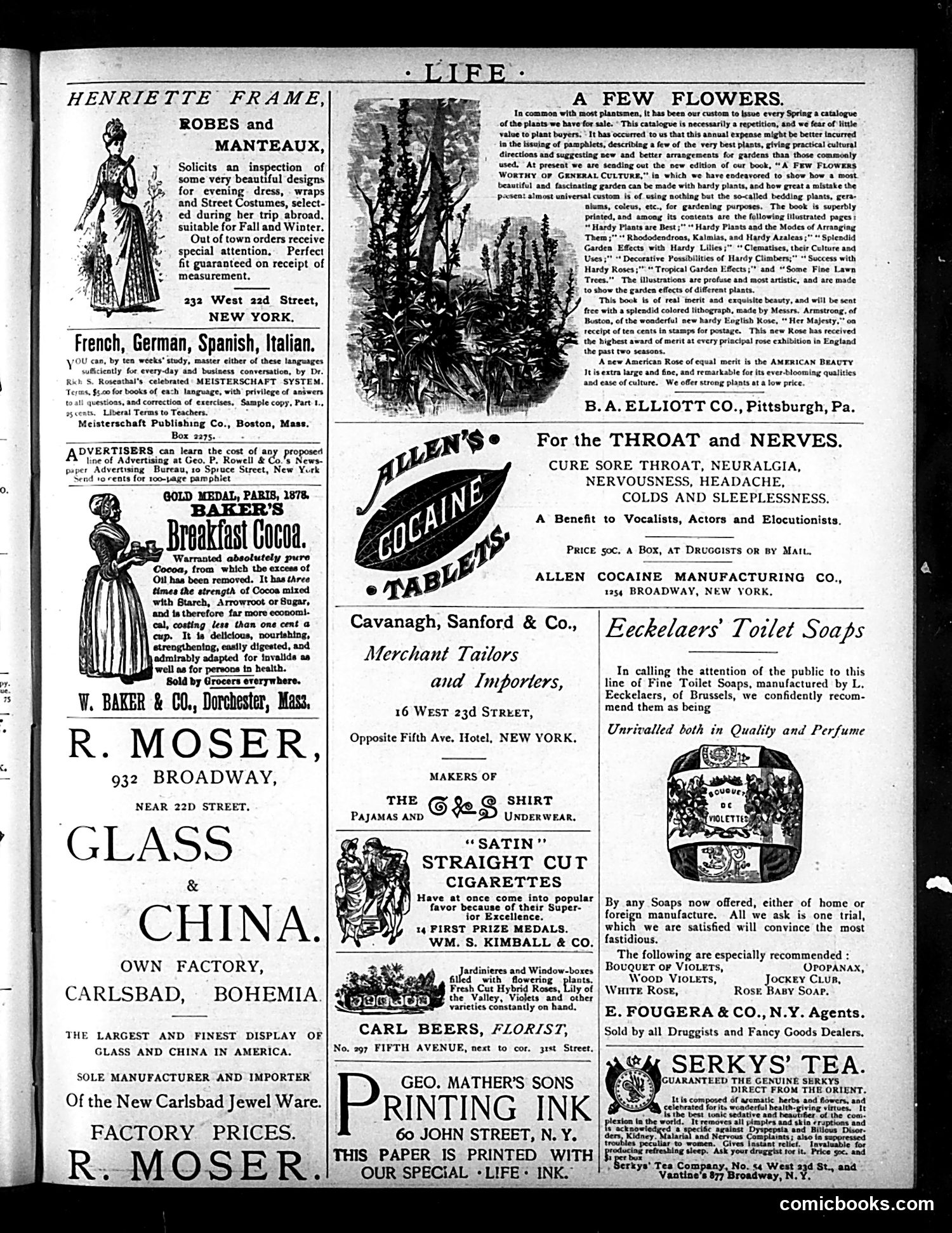
This page is primarily **advertising**, typical of Life magazine's revenue model in the 1870s-80s. Rather than containing political cartoons or satire, it features commercial advertisements interspersed with one notable editorial feature. The main content is "A Few Flowers," a promotional article by B.A. Elliott Co. (a Pittsburgh plant nursery) describing their new catalog and book on gardening with hardy plants rather than seasonal "bedding plants"—a horticultural debate of the era. They advertise the "American Beauty" rose and offer a lithograph of the hardy English rose "Her Majesty." Surrounding this are advertisements for: women's fashion (Henriette Frame), language instruction (Meisterschaft System), Baker's Breakfast Cocoa (Gold Medal winner), glass and china imports (Moser), merchant tailors, cigarettes, toiletries, printing ink, and Serky's Tea. The page reflects Victorian consumer culture and nascent advertising practices, with no discernible political satire or caricature present.
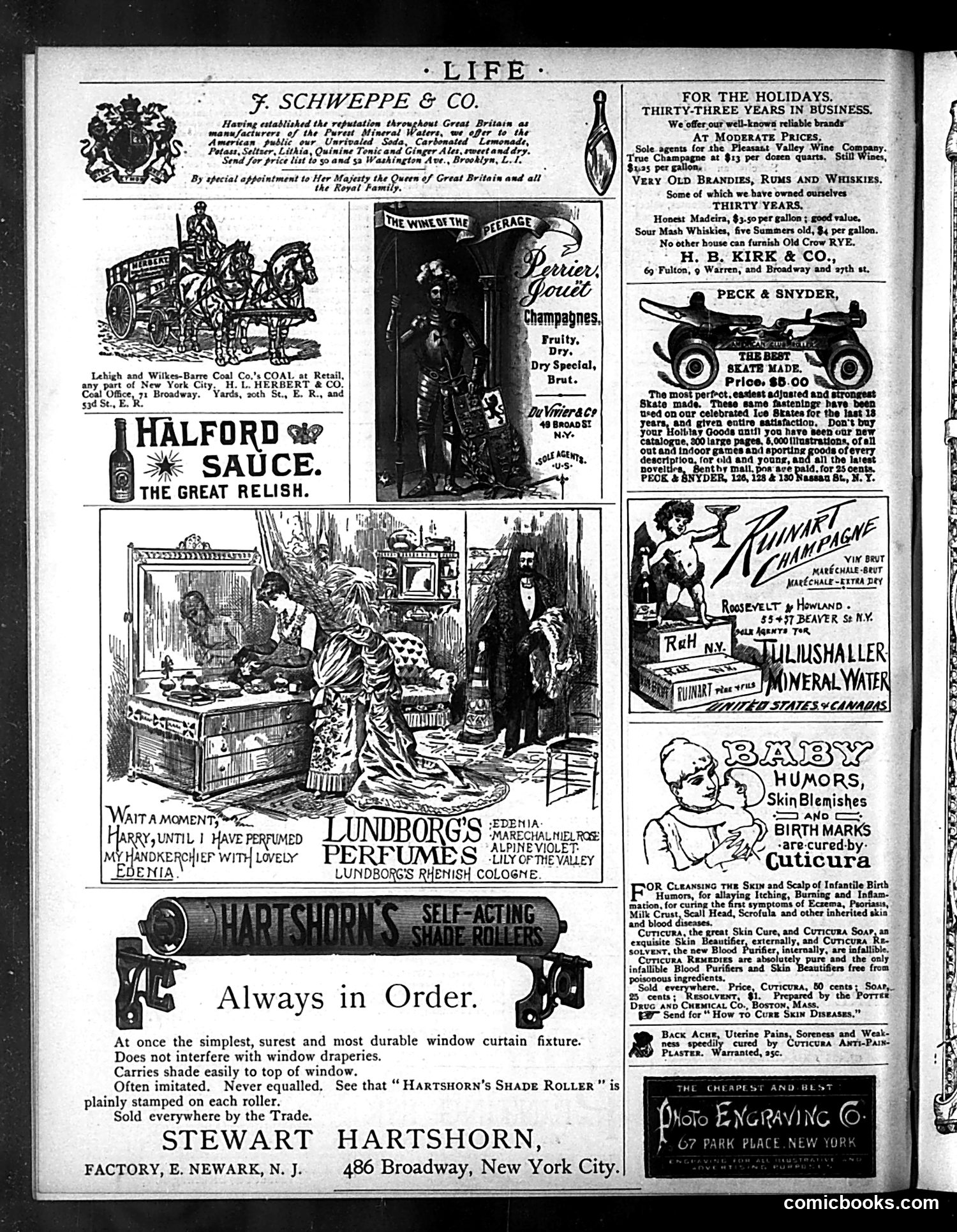
This Life magazine page (appears to be late 1800s based on typography and style) is **not primarily satirical content**—it's a commercial advertising section. The main illustrated content shows a domestic scene labeled "Lundborg's Perfumes" where a fashionably dressed woman asks her male companion to wait while she perfumes her handkerchief. This is a straightforward product advertisement, not satire. The page features numerous ads for consumer goods typical of the era: mineral waters, coal, sauce, champagne, shade rollers, skates, perfume, and medicinal skin treatments (Cuticura). The "Halford Sauce" ad includes a horse-drawn delivery cart, reflecting period commerce. One small ad mentions "Roosevelt & Howland" (likely a merchant house), but there's no clear political content or satirical intent visible. The page represents standard late-Victorian consumer advertising rather than the magazine's satirical editorial mission.