
Life, 1886-02-11 · page 6 of 16
Life — February 11, 1886 — page 6: what you’re looking at
What you’re looking at
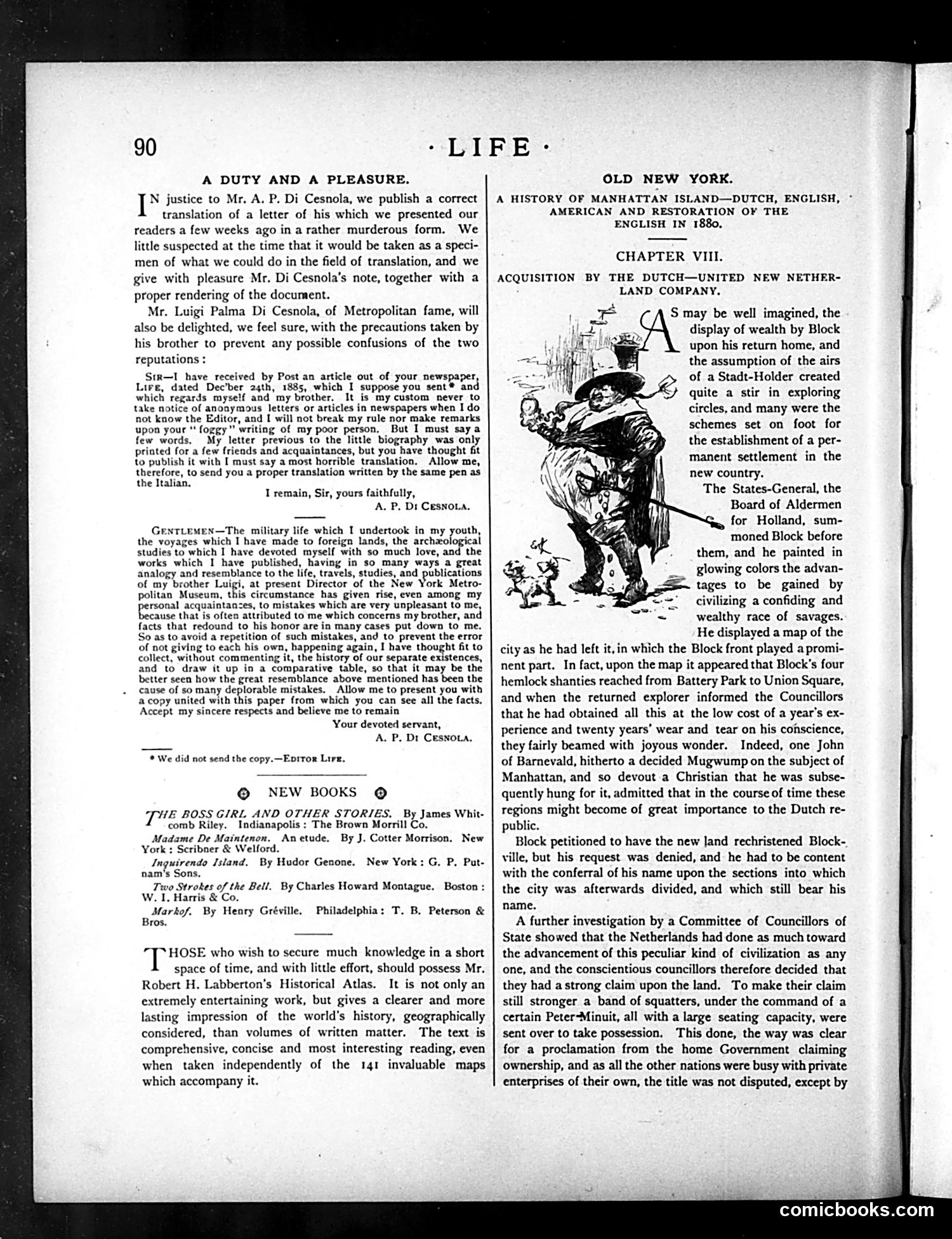
The page contains two distinct sections: **Left side:** Letters to the editor, including correspondence from A.P. Di Cesnola regarding translation accuracy and his scholarly work on the Metropolitan Museum and archaeological publications. **Right side:** An illustrated article titled "Old New York" discussing Manhattan's Dutch colonial history. The cartoon depicts a Dutch settler (likely representing Block, a historical figure mentioned in the text) in period dress, gesturing dramatically while holding a map. The illustration shows him presenting his territorial claims to Native Americans, satirizing early colonial land acquisition and the often dubious "civilizing" narratives colonizers used to justify their expansion. The text humorously describes how Block's exploration and boasts about the land's potential created excitement in Dutch circles, mocking the grandiose claims made during colonial settlement.
📄 Transcribed text from this page (OCR, searchable)
Machine-transcribed from the original scan — historical spelling and the odd misread are preserved.
90 - LIFE: A DUTY AND A PLEASURE. N justice to Mr, A. P. Di Cesnola, we publish a correct translation of a letter of his which we presented our readers a few weeks ago in a rather murderous form. We little suspected at the time that it would be taken as a speci- men of what we could do in the field of translation, and we give with pleasure Mr. Di Cesnola’s note, together with a proper rendering of the document. Mr. Luigi Palma Di Cesnola, of Metropolitan fame, will also be delighted, we feel sure, with the precautions taken by his brother to prevent any possible confusions of the two reputations : Str—I have received by Post an article out of your newspaper, Lire, dated Dec’ber 24th, 1885, which I suppose you sent® an which regards myself and'my brother. It is my custom never to take notice of anonymous letters or articles in newspapers when I do not know the Editor, and I will not break my rule nor make remarks upon your “ foggy" writing of my poor person. But I must saya few words. My letter previous to the little biography was only printed for a few friends and acquaintances, but you have thought fit to publish it with I must say a most horrible translation. Allow me, therefore, to send you a proper translation written by the same pen as the Italian, I remain, Sir, yours faithfully, A. P. Dt Cesnona. GenTLemeN—The military life which I undertook in my youth, the voyages which I have made to foreign lands, the archzological studies to which I have devoted myself with so much love, and the works which I have published, having in so many ways a great analogy and resemblance to the life, travels, studies, and publications of my brother Luigi, at present Director of the New York Metro- politan Museum, this circumstance has given rise, even among my personal acquaintances, to mistakes which are very unpleasant to me, cause that is often attributed to me which concerns my brother, and facts that redound to his honor are in many cases put down to me. So as to avoid a repetition of such mistakes, and to prevent the error of not giving to each his own, happening again, I have thought fit to collect, without commenting it, the history of our separate existences, and to draw it up in a comparative table, so that it may be the better seen how the great resemblance above mentioned has been the cause of so many deplorable mistakes. Allow me to present you with a copy united with this paper from which you can see all the facts, Accept my sincere respects and believe me to remain Your devoted servant, A, P, Dt Cesnota, * We did not send the copy.—Eprror Lire. © NEW BOOKS © THE BOSS GIRL AND OTHER STORIES. By James Whit- comb Riley. Indianapolis : The Brown Morrill Co. Madame De Maintenon. Anetude. By J. Cotter Morrison. New York : Scribner & Welford. Inguirendo Island, By Hudor Genone. New York: G. P. Put- nam's Sons, Two Strokes of the Bell. By Charles Howard Montague. Boston : W. I. Harris & Co. Markof, By Henry Gréville, Bros. Philadelphia: T. B, Peterson & T HOSE who wish to secure much knowledge in a short space of time, and with little effort, should possess Mr. Robert H. Labberton’s Historical Atlas. It is not only an extremely entertaining work, but gives a clearer and more lasting impression of the world’s history, geographically considered, than volumes of written matter. The text is comprehensive, concise and most interesting reading, even when taken independently of the 141 invaluable maps which accompany it. OLD NEW YORK. A HISTORY OF MANHATTAN ISLAND—DUTCH, ENGLISH, ~ AMERICAN AND RESTORATION OF THE ENGLISH IN 1880, CHAPTER VIII. ACQUISITION BY THE DUTCH—UNITED NEW NETHER- LAND COMPANY, S may be well imagined, the display of wealth by Block upon his return home, and the assumption of the airs of a Stadt-Holder created quite a stir in exploring circles, and many were the schemes set on foot for the establishment of a per- manent settlement in the new country. The States-General, the Board of Aldermen for Holland, sum- moned Block before them, and he painted in glowing colors the advan- tages to be gained by civilizing a confiding and wealthy race of savages. He displayed a map of the city as he had left it,in which the Block front played a promi- nent part. In fact, upon the map it appeared that Block's four hemlock shanties reached from Battery Park to Union Square, and when the returned explorer informed the Councillors that he had obtained all this at the low cost of a year's ex- perience and twenty years’ wear and tear on his conscience, they fairly beamed with joyous wonder. Indeed, one John of Barnevald, hitherto a decided Mugwump on the subject of Manhattan, and so devout a Christian that he was subse- quently hung for it, admitted that in the course of time these regions might become of great importance to the Dutch re- public. Block petitioned to have the new land rechristened Block- ville, but his request was denied, and he had to be content with the conferral of his name upon the sections into which the city was afterwards divided, and which still bear his name. A further investigation by a Committee of Councillors of State showed that the Netherlands had done as much toward the advancement of this peculiar kind of civilization as any one, and the conscientious councillors therefore decided that they had a strong claim upon the land. To make their claim still stronger a band of squatters, under the command of a certain Peter-Minuit, all with a large seating capacity, were sent over to take possession. This done, the way was clear for a proclamation from the home Government claiming ownership, and as all the other nations were busy with private enterprises of their own, the title was not disputed, except by comicbook s.com