
Life, 1886-02-11 · page 2 of 16
Life — February 11, 1886 — page 2: what you’re looking at
What you’re looking at
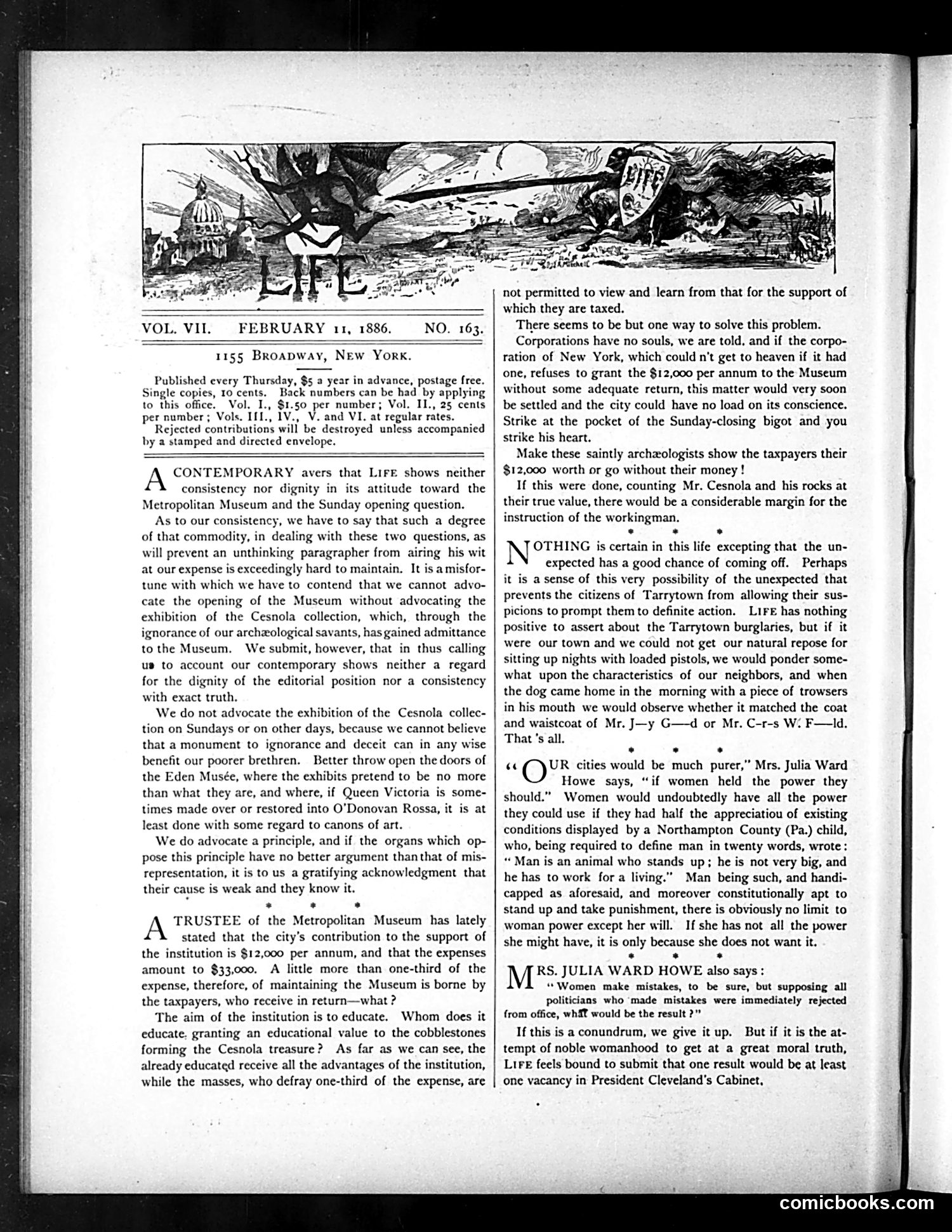
The masthead cartoon depicts a comet labeled "LIFE" approaching Earth, with a classical dome (likely representing institutional authority) in the background. This appears to be Life's self-promotional imagery emphasizing the magazine's cultural impact. The editorial content debates the Metropolitan Museum's funding and the Sunday opening question—whether the museum should open on Sundays so working-class people could visit. The text criticizes the museum's rejection of a $12,000 annual city subsidy, arguing this prevents access for poorer citizens who support it through taxes. The piece also quotes Mrs. Julia Ward Howe on women's political power and governance, suggesting satirical commentary on contemporary debates about women's suffrage and civic participation.
📄 Transcribed text from this page (OCR, searchable)
Machine-transcribed from the original scan — historical spelling and the odd misread are preserved.
VOL. Vil. “FEBRUARY 11, 1886, 1155 Broapway, NEw York. NO. 163. Published every Thursday, $5 a year in advance, postage free. Single copies, 10 cents. Back numbers can be had by applying to this office. Vol, I., $1.50 per number; Vol. II., 25 cents per number; Vols. Iff., IV., V. and VI. at regular rates. Rejected contributions will be destroyed unless accompanied by a stamped and directed envelope. A CONTEMPORARY avers that Lire shows neither consistency nor dignity in its attitude toward the Metropolitan Museum and the Sunday opening question. As to our consistency, we have to say that such a degree of that commodity, in dealing with these two questions, as will prevent an unthinking paragrapher from airing his wit at our expense is exceedingly hard to maintain. It is a misfor- tune with which we have to contend that we cannot advo- cate the opening of the Museum without advocating the exhibition of the Cesnola collection, which, through the ignorance of our archeological savants, has gained admittance tothe Museum. We submit, however, that in thus calling us to account our contemporary shows neither a regard for the dignity of the editorial position nor a consistency with exact truth, We do not advocate the exhibition of the Cesnola collec- tion on Sundays or on other days, because we cannot believe that a monument to ignorance and deceit can in any wise benefit our poorer brethren, Better throw open the doors of the Eden Musée, where the exhibits pretend to be no more than what they are, and where, if Queen Victoria is some- times made over or restored into O'Donovan Rossa, it is at least done with some regard to canons of art. We do advocate a principle, and if the organs which op- pose this principle have no better argument than that of mis- representation, it is to us a gratifying acknowledgment that their cause is weak and they know it. is . * ° TRUSTEE of the Metropolitan Museum has lately stated that the city’s contribution to the support of the institution is $12,000 per annum, and that the expenses amount to $33,000. A little more than one-third of the expense, therefore, of maintaining the Museum is borne by the taxpayers, who receive in return—what ? The aim of the institution is to educate. Whom does it educate. granting an educational value to the cobblestones forming the Cesnola treasure? As far as we can see, the already educated receive all the advantages of the institution, while the masses, who defray one-third of the expense, are not permitted to view and learn from that for the support of which they are taxed. There seems to be but one way to solve this problem. Corporations have no souls, we are told, and if the corpo- ration of New York, which could n't get to heaven if it had one, refuses to grant the $12,000 per annum to the Museum without some adequate return, this matter would very soon be settled and the city could have no load on its conscience. Strike at the pocket of the Sunday-closing bigot and you strike his heart. Make these saintly archxologists show the taxpayers their $12,000 worth or go without their money ! If this were done, counting Mr. Cesnola and his rocks at their true value, there would be a considerable margin for the instruction of the workingman. . . . OTHING is certain in this life excepting that the un- expected has a good chance of coming off. Perhaps it is a sense of this very possibility of the unexpected that prevents the citizens of Tarrytown from allowing their sus- picions to prompt them to definite action. LIFE has nothing positive to assert about the Tarrytown burglaries, but if it were our town and we could not get our natural repose for sitting up nights with loaded pistols, we would ponder some- what upon the characteristics of our neighbors, and when the dog came home in the morning with a piece of trowsers in his mouth we would observe whether it matched the coat and waistcoat of Mr. J—y G—d or Mr. C-r-s W: F—ld. That's all. . . . “a UR cities would be much purer,” Mrs. Julia Ward Howe says, “if women held the power they should.” Women would undoubtedly have all the power they could use if they had half the appreciatiou of existing conditions displayed by a Northampton County (Pa.) child, who, being required to define man in twenty words, wrote: “ Man is an animal who stands up; he is not very big, and he has to work for a living.” Man being such, and handi- capped as aforesaid, and moreover constitutionally apt to stand up and take punishment, there is obviously no limit to woman power except her will. If she has not all the power she might have, it is only because she does not want it. * . . RS. JULIA WARD HOWE also says : “Women make mistakes, to be sure, but supposing all politicians who made mistakes were immediately rejected from office, what would be the result ?”” If this is a conundrum, we give it up. But if it is the at- tempt of noble womanhood to get at a great moral truth, Lire feels bound to submit that one result would be at least one vacancy in President Cleveland's Cabinet, comicbooks.com