
Life, 1886-02-11 · page 12 of 16
Life — February 11, 1886 — page 12: what you’re looking at
What you’re looking at
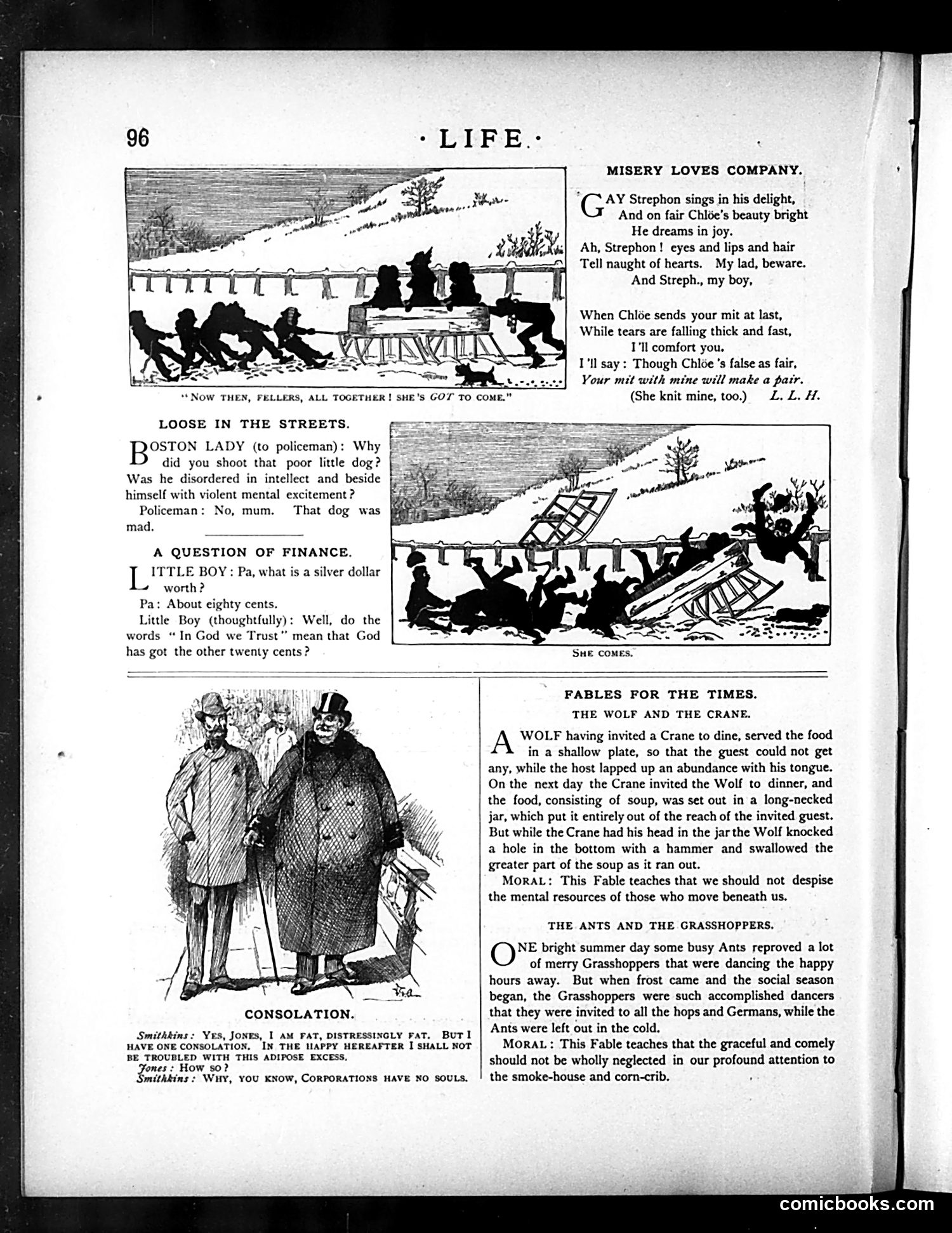
This page contains several satirical pieces typical of early 20th-century American humor: **"Misery Loves Company"** presents a romantic poem where an older woman consoles a heartbroken young man (Strephon) about his faithless lover Chloe—the joke being misery indeed loves company. **"Loose in the Streets"** satirizes upper-class speech: a Boston lady uses unnecessarily elaborate language ("disordered in intellect") to ask why a policeman shot a dog, only to learn the simple answer was that the dog was "mad" (rabid). **"A Question of Finance"** is a child's joke about currency: if a silver dollar is worth only eighty cents, where did the other twenty cents go that God supposedly oversees ("In God we Trust")? **"Consolation"** jokes darkly about corporate greed: a fat man named Smithkins consoles himself that in the afterlife he won't suffer from his obesity because "corporations have no souls"—implying he's a corporate man without spiritual consequence. The **"Fables for the Times"** modernize Aesop with cynical morals critiquing class hierarchies and social pretense.
📄 Transcribed text from this page (OCR, searchable)
Machine-transcribed from the original scan — historical spelling and the odd misread are preserved.
MISERY LOVES COMPANY. (Gs Strephon sings in his delight, And on fair Chlée’s beauty bright He dreams in joy. Ah, Strephon ! eyes and lips and hair Tell naught of hearts. My lad, beware. And Streph., my boy, When Chlée sends your mit at last, While tears are falling thick and fast, T'll comfort you. I'll say : Though Chloe 's false as fair, Your mit with mine will make a parr. “NOW THEN, FELLERS, ALL TOGETHER! SHE's GOT TO COME.” LOOSE IN THE STREETS. OSTON LADY (to policeman): Why did you shoot that poor little dog? Was he disordered in intellect and beside himself with violent mental excitement ? Policeman: No, mum. That dog was mad. A QUESTION OF FINANCE. I ITTLE BOY : Pa, what is a silver dollar “ worth ? Pa: About eighty cents. Little Boy (thoughtfully): Well, do the words “In God we Trust” mean that God has got the other twenty cents? (She knit mine, too.) LZ. L. #H. SHE COMEs, CONSOLATION. Smithhins : Yes, Jones, | AM FAT, DISTRESSINGLY FAT. BUTI HAVE ONE CONSOLATION. IN THE HAPPY HEREAFTER I SHALL NOT BE TROUBLED WITH THIS ADIPOSE EXCESS, ones : HOW sO? Smithkins : WHY, YOU KNOW, CORPORATIONS HAVE NO SOULS, FABLES FOR THE TIMES. THE WOLF AND THE CRANE. WOLF having invited a Crane to dine, served the food in a shallow plate, so that the guest could not get any, while the host lapped up an abundance with his tongue. On the next day the Crane invited the Wolf to dinner, and the food, consisting of soup, was set out in a long-necked jar, which put it entirely out of the reach of the invited guest. But while the Crane had his head in the jarthe Wolf knocked a hole in the bottom with a hammer and swallowed the greater part of the soup as it ran out. MorAL: This Fable teaches that we should not despise the mental resources of those who move beneath us. THE ANTS AND THE GRASSHOPPERS. NE bright summer day some busy Ants reproved a lot of merry Grasshoppers that were dancing the happy hours away. But when frost came and the social season began, the Grasshoppers were such accomplished dancers that they were invited to all the hops and Germans, while the Ants were left out in the cold. MorRAL: This Fable teaches that the graceful and comely should not be wholly neglected in our profound attention to the smoke-house and corn-crib. ’ comicbooks.com