
Life, 1886-02-11 · page 10 of 16
Life — February 11, 1886 — page 10: what you’re looking at
What you’re looking at
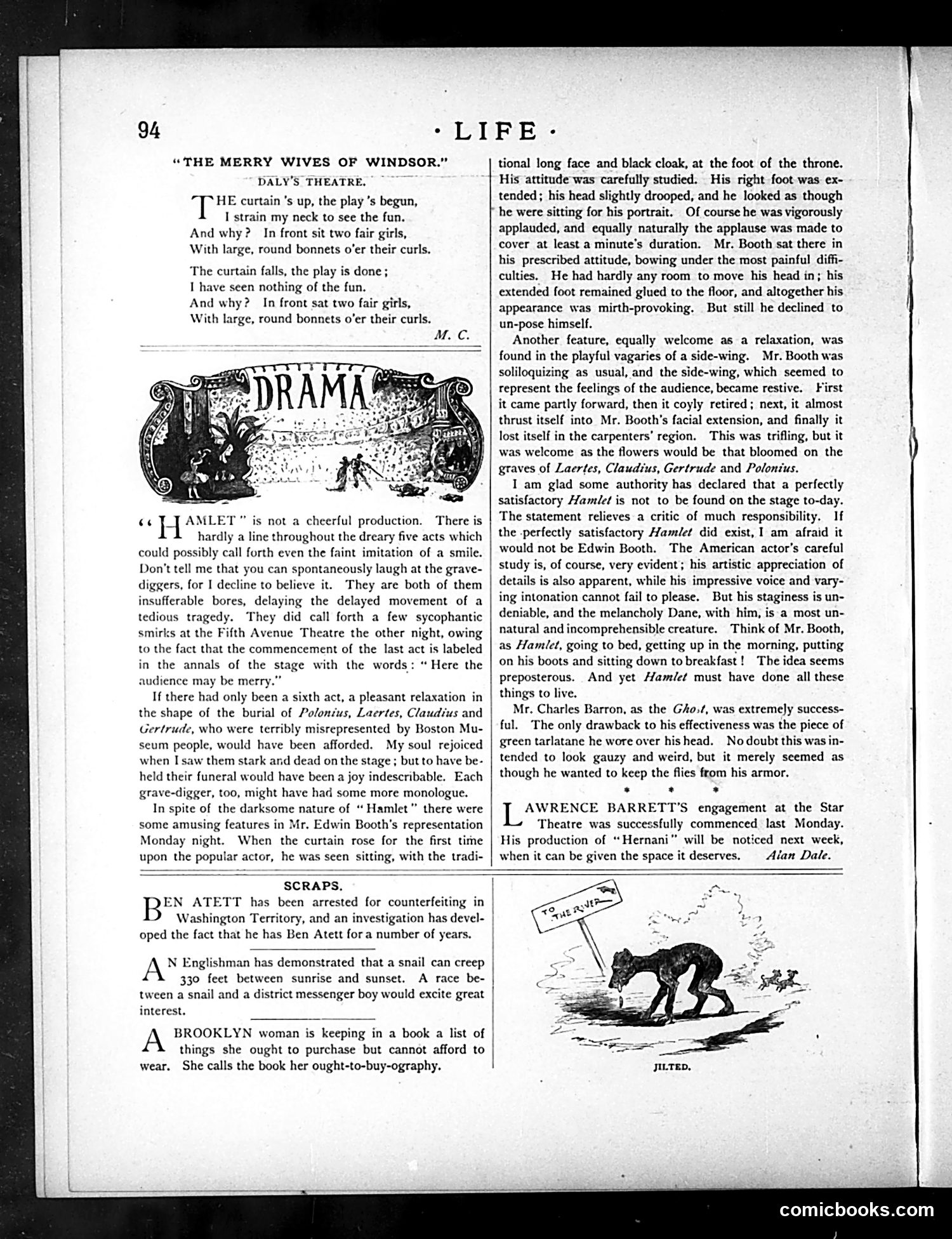
This page contains theater criticism from Life's drama section. The opening poem satirizes audience frustration at "The Merry Wives of Windsor"—patrons cannot see the stage because two women in front wear excessively large bonnets with prominent curls, a fashionable style of the era. The joke mocks both the impractical headwear and theatergoers' powerlessness to enjoy the performance. The longer Hamlet review critiques Edwin Booth's famous 1870s-era performance at Daly's Theatre. The critic mocks Booth's overly theatrical, stagy approach: his deliberately posed attitude (extended foot, drooped head) resembles sitting for a portrait rather than natural acting. The side-wing (stage scenery) shifting during soliloquies adds unintentional comedy. The reviewer argues Booth's studied, artificial performance makes the melancholy Dane implausibly stiff—impossible to imagine doing ordinary things like getting dressed or eating breakfast. The satire targets excessive theatrical artificiality masquerading as artistic appreciation.
📄 Transcribed text from this page (OCR, searchable)
Machine-transcribed from the original scan — historical spelling and the odd misread are preserved.
- LIFE: “THE MERRY WIVES OF WINDSOR.” DALY'S THEATRE, HE curtain 's up, the play ’s begun, I strain my neck to see the fun. And why? In front sit two fair girls, With large, round bonnets o’er their curls, ‘The curtain falls, the play is done; I have seen nothing of the fun. And why? In front sat two fair girls, With large, round bonnets o’er their curls. 6 H AMLET” is not a cheerful production. There is hardly a line throughout the dreary five acts which could possibly call forth even the faint imitation of a smile. Don't tell me that you can spontaneously laugh at the grave- | diggers, for I decline to believe it. They are both of them insufferable bores, delaying the delayed movement of a tedious tragedy. They did call forth a few sycophantic smirks at the Fifth Avenue Theatre the other night, owing to the fact that the commencement of the last act is labeled in the annals of the stage with the words: “ Here the audience may be meri If there had only been a sixth act, a pleasant relaxation in the shape of the burial of Po/onius, Laertes, Claudius and Gertrude, who were terribly misrepresented by Boston Mu- seum people, would have been afforded. My soul rejoiced when I saw them stark and dead on the stage ; but to have be- held their funeral would have been a joy indescribable. Each grave-digger, too, might have had some more monologue. In spite of the darksome nature of “ Hamlet” there were some amusing features in Mr. Edwin Booth’s representation Monday night. When the curtain rose for the first time tional long face and black cloak, at the foot of the throne. His attitude was carefully studied. His right foot was ex- tended; his head slightly drooped, and he looked as though he were sitting for his portrait. Of course he was vigorously applauded, and equally naturally the applause was made to cover at least a minute's duration. Mr. Booth sat there in his prescribed attitude, bowing under the most painful diffi- culties. He had hardly any room to move his head in; his extended foot remained glued to the floor, and altogether his appearance was mirth-provoking. But still he declined to un-pose himself. Another feature, equally welcome as a relaxation, was found in the playful vagaries of a side-wing. Mr. Booth was soliloquizing as usual, and the side-wing, which seemed to represent the feelings of the audience, became restive. First it came partly forward, then it coyly retired; next, it almost thrust itself into Mr. Booth’s facial extension, and finally it lost itself in the carpenters’ region. This was trifling, but it was welcome as the flowers would be that bloomed on the graves of Laertes, Claudius, Gertrude and Polonius. I am glad some authority has declared that a perfectly satisfactory Hamlet is not to be found on the stage to-day. The statement relieves a critic of much responsibility. If the -perfectly satisfactory Hamlet did exist, 1 am afraid it would not be Edwin Booth. The American actor's careful study is, of course, very evident; his artistic appreciation of details is also apparent, while his impressive voice and vary- ing intonation cannot fail to please. But his staginess is un- deniable, and the melancholy Dane, with him, is a most un- natural and incomprehensible creature. Think of Mr. Booth, as Hamlet, going to bed, getting up in the morning, putting on his boots and sitting down to breakfast! The idea seems preposterous. And yet Hamlet must have done all these things to live. Mr. Charles Barron, as the Gho,t, was extremely success- ful. The only drawback to his effectiveness was the piece of green tarlatane he wore over hishead. No doubt this was in- tended to look gauzy and weird, but it merely seemed as though he wanted to keep the flies from his armor. . * . AWRENCE BARRETT’S engagement at the Star Theatre was successfully commenced last Monday. His production of “Hernani" will be noticed next week, when it can be given the space it deserves. Alan Dale. upon the popular actor, he was seen sitting, with the tradi- SCRAPS. EN ATETT has been arrested for counterfeiting in Washington Territory, and an investigation has devel- | oped the fact that he has Ben Atett fora number of years. N Englishman has demonstrated that a snail can creep | 330 feet between sunrise and sunset. A race be- tween a snail and a district messenger boy would excite great | interest. BROOKLYN woman is keeping in a book a list of | things she ought to purchase but cannot afford to | wear. She calls the book her ought-to-buy-ography. JULTED. comicbooks.com