
A complete issue · 34 pages · 1885
Life — December 10, 1885
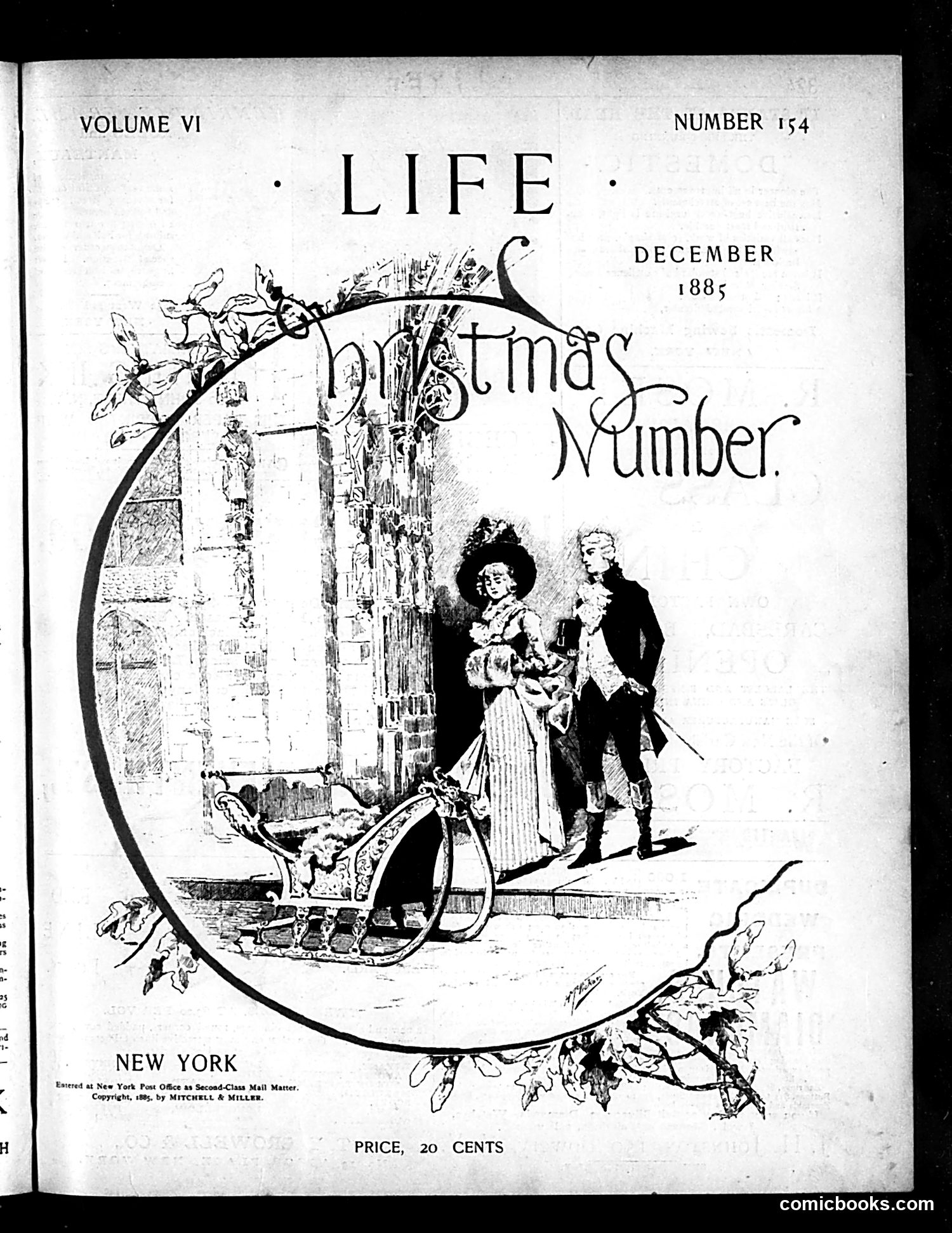
This is the cover of Life's December 1885 Christmas issue. The illustration depicts a couple in Victorian dress standing before a Gothic cathedral doorway, examining what appears to be a wreath or Christmas decoration. The ornate circular frame formed by decorative foliage and an architectural arch creates a festive seasonal composition. Without additional interior content visible, the specific satirical point remains unclear. However, Life magazine was known for social commentary on Victorian manners, fashion, and relationships. The formal attire and church setting suggest this likely comments on holiday traditions, courtship customs, or class-conscious seasonal celebrations among wealthy New Yorkers—typical subjects for the magazine's humor. The price of 20 cents indicates this was a premium holiday special edition.
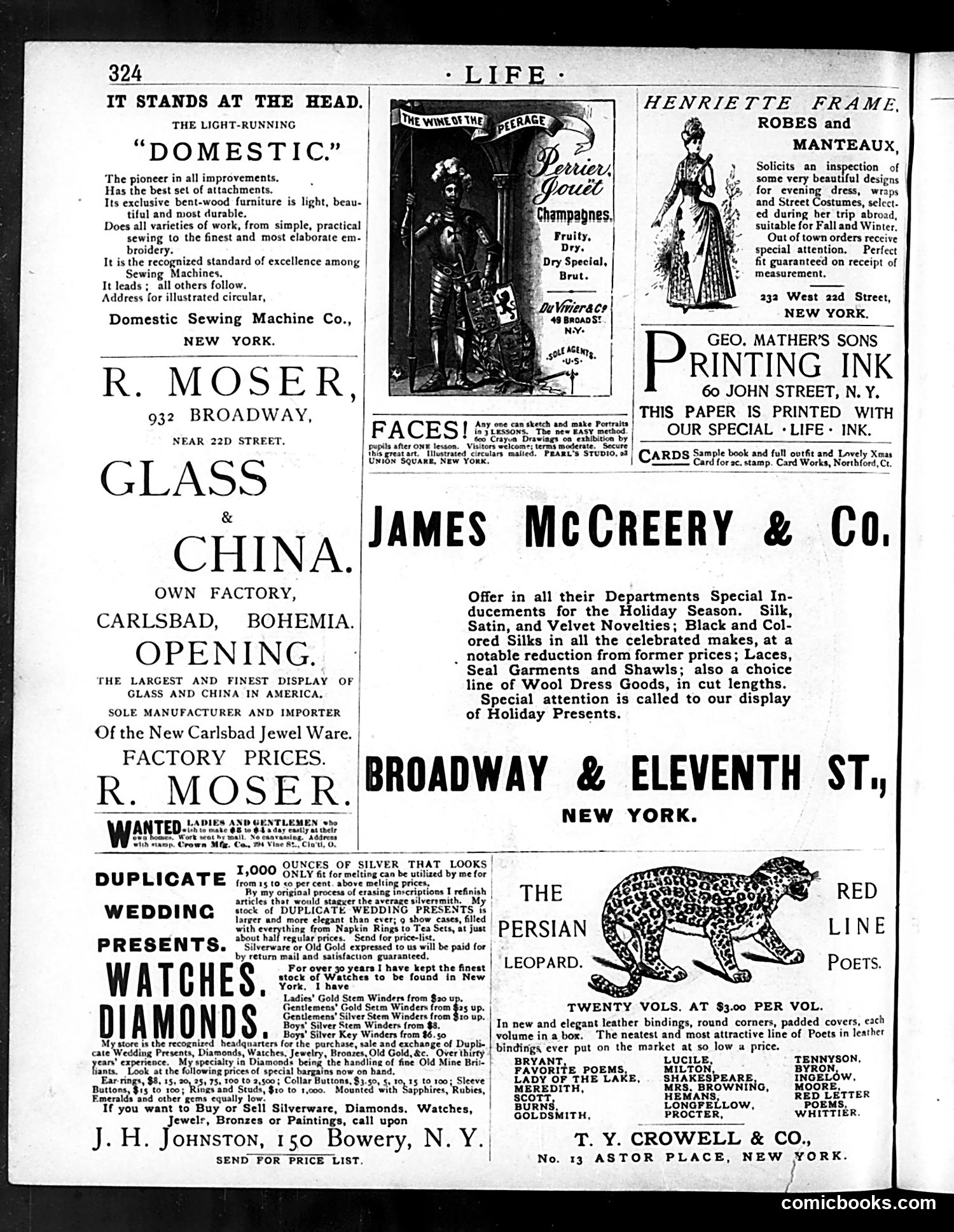
This page is primarily **advertising** rather than editorial content or political satire. It features multiple advertisements for consumer goods and services typical of the era: - Domestic Sewing Machine Co. promotes their product as the "pioneer in all improvements" - R. Moser advertises glass and china from a Carlsbad, Bohemia factory opening - James McCreery & Co. announces holiday sales of silk, satin, velvet, and wool dress goods - Henriette Frame offers fashionable robes and manteaux - The Red Line Poets series (leather-bound volumes) is promoted - Various jewelers and watchmakers advertise luxury goods The one illustrated element—a **champagne advertisement** featuring what appears to be a classical or allegorical figure—is purely commercial. There is no discernible political cartoon or satire on this page.
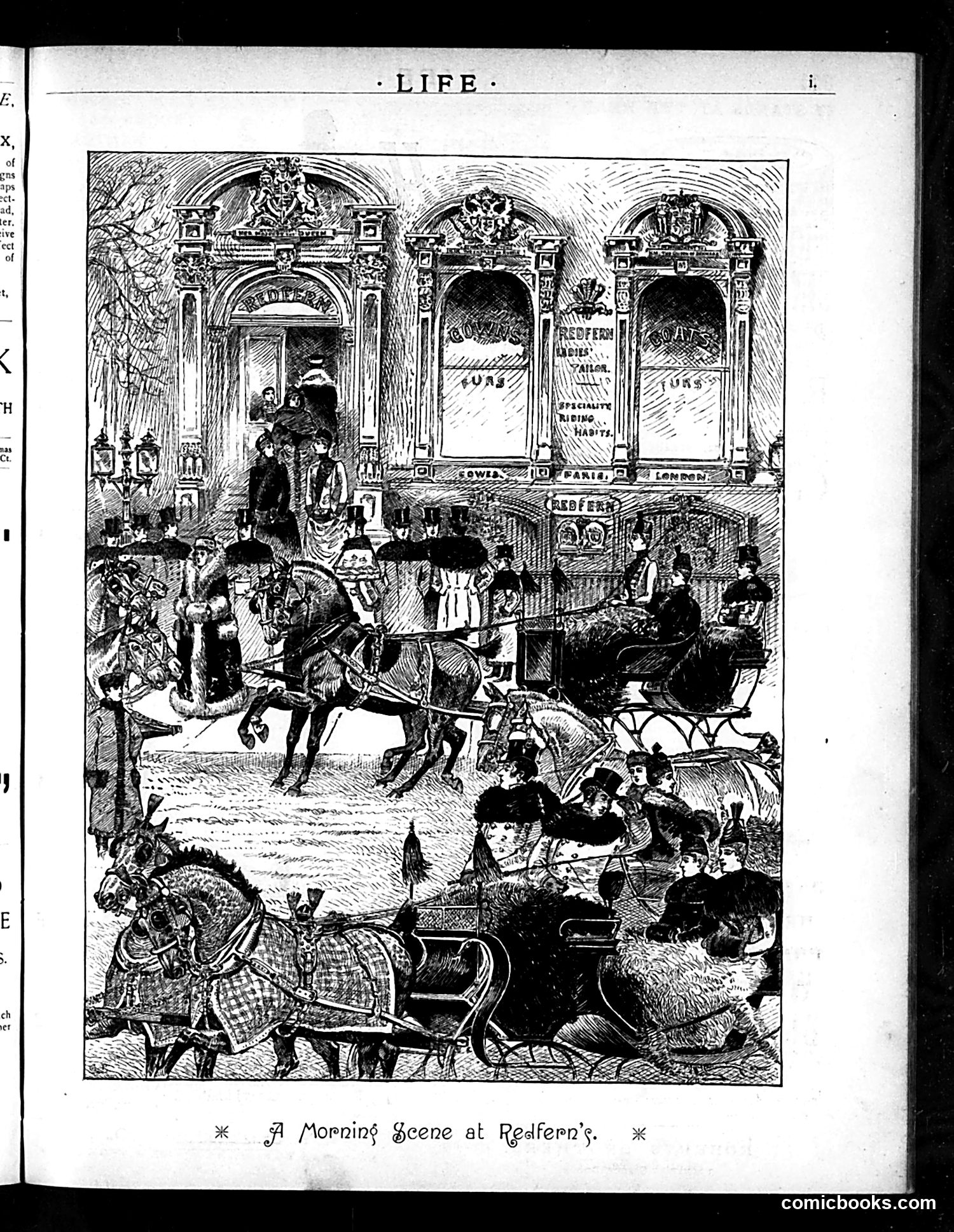
This engraving depicts a fashionable street scene outside Redfern's, a prestigious Parisian dress shop. The storefront shows window displays with the shop's name prominently featured. The satire targets high society's obsession with fashion and social display. The scene shows elaborately dressed pedestrians and those arriving by carriage, emphasizing the conspicuous consumption and peacocking behavior of the wealthy. The detailed rendering of expensive clothing, horses, and accessories highlights how much effort and resources the fashionable class devoted to appearance. The composition suggests satirical commentary on vanity and the superficiality of upper-class society—mocking the morning ritual of shopping and being seen at exclusive establishments like Redfern's, then a celebrated couture house.
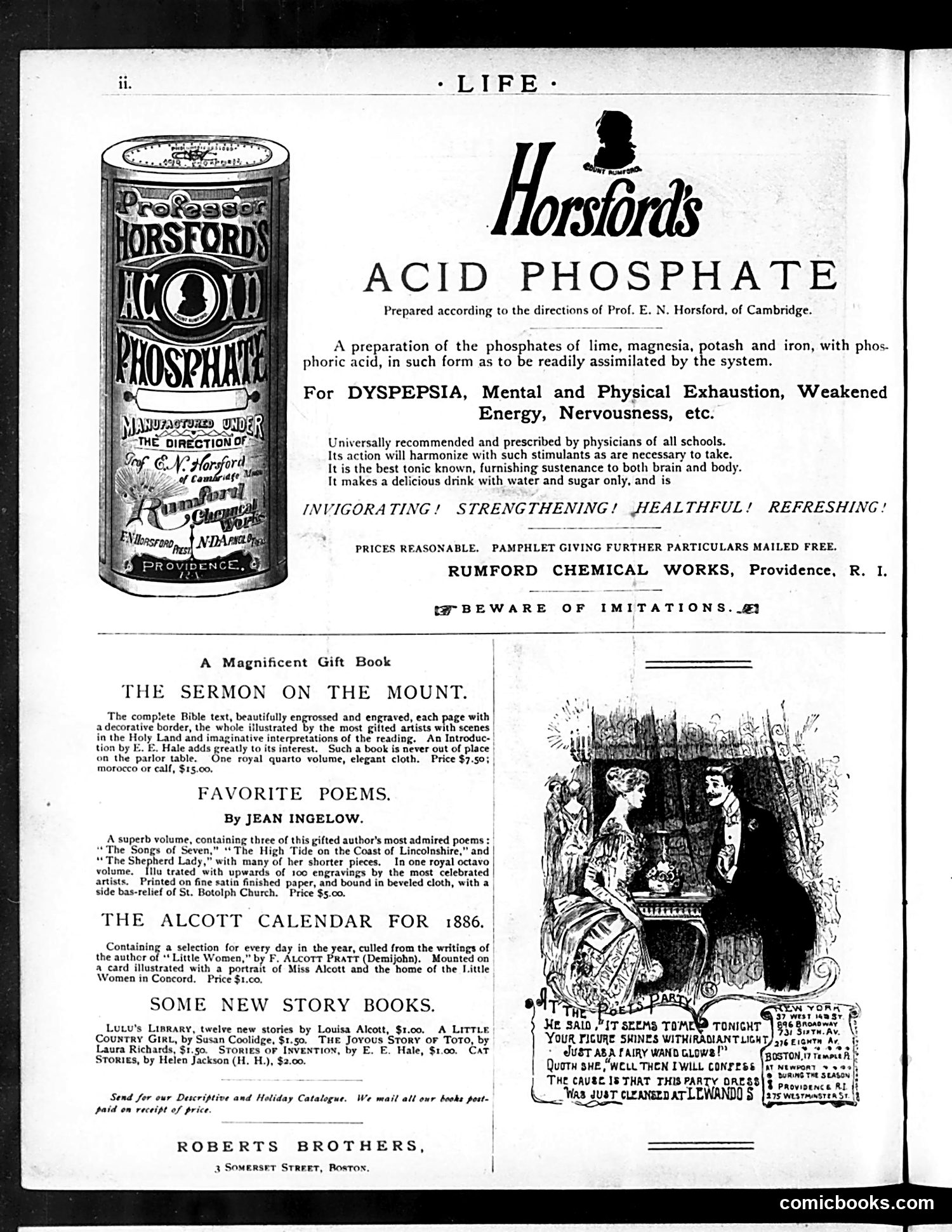
This page is primarily **advertising and book promotions** rather than political satire. The main advertisements are for Horsford's Acid Phosphate (a patent medicine claiming to treat dyspepsia, nervousness, and exhaustion) and several Victorian-era books including *The Sermon on the Mount*, poems by Jean Ingelow, and an 1886 Alcott calendar. The only illustrated cartoon appears in the lower right—a Victorian domestic scene showing a couple at what appears to be a social gathering. The caption references "the Poet's tomb" and mentions "Your figure shines with radiant light / Just as a fairy wand glows." This appears to be a humorous commentary on courtship flattery or romantic exaggeration, though the specific reference is unclear without additional context. The page reflects typical late 19th-century *Life* magazine content mixing advertising with light social humor.
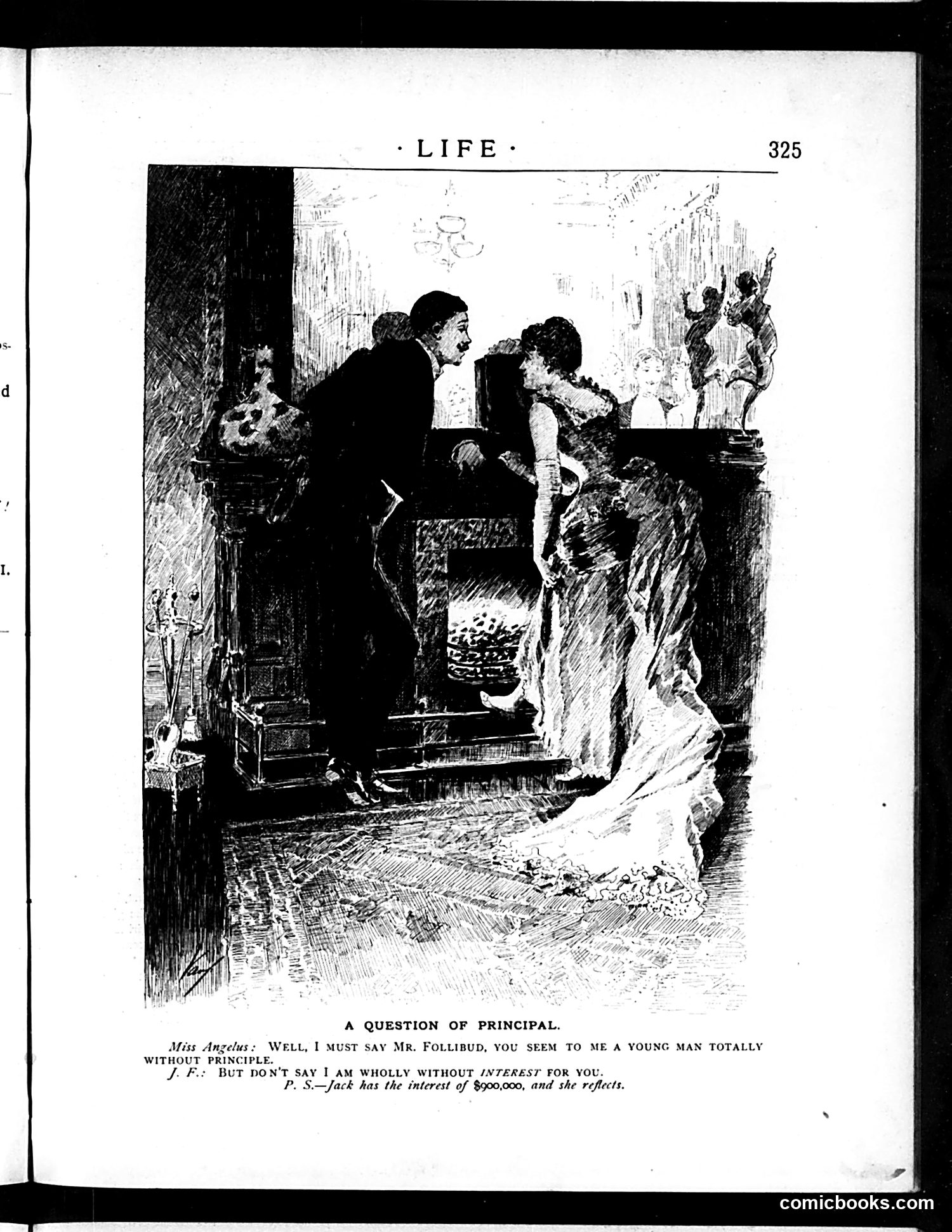
This cartoon depicts a social satire about wealth and morality. A well-dressed man (Mr. Follibud) is being confronted by Miss Angelos about his lack of principles. He defends himself by noting he has financial "interest" in her—specifically $200,000 and its "reflecks" (returns/reflections). The joke plays on the double meaning of "interest": moral concern versus financial investment. Follibud essentially argues that money *is* his principle—he's interested in Miss Angelos solely because of her substantial wealth. The satire mocks wealthy men who equate financial ties with genuine personal virtue or concern, exposing how capitalism can substitute monetary calculation for ethical behavior. This reflects Gilded Age anxieties about materialism replacing traditional values.
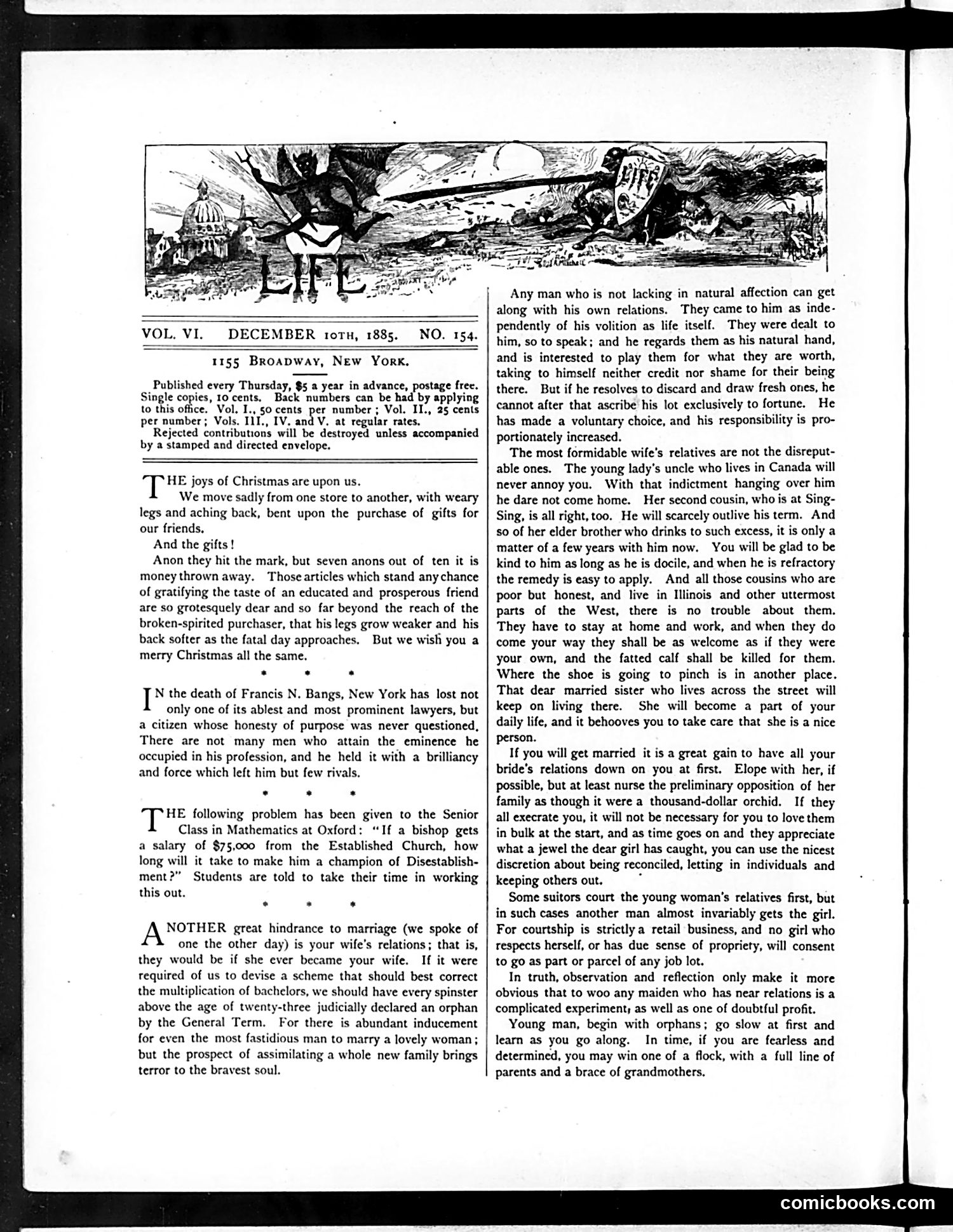
The masthead illustration depicts a chaotic scene with figures and a "LIFE" banner, though specific identities aren't clearly legible at this resolution. The page's printed content doesn't contain political cartoons but rather **satirical essays** on social topics: 1. **Christmas shopping** — mocking the exhaustion of gift-buying season 2. **Francis N. Banks' death** — praising a prominent New York lawyer's integrity 3. **Marriage advice** — satirizing the complications of marrying into relatives' families, with extended commentary on courtship and family dynamics The writing adopts Life's characteristic satirical tone, using exaggeration and irony to critique social customs. The marriage section, in particular, humorously warns against the entanglement of in-laws while offering tongue-in-cheek guidance to prospective husbands about managing their bride's family obligations.
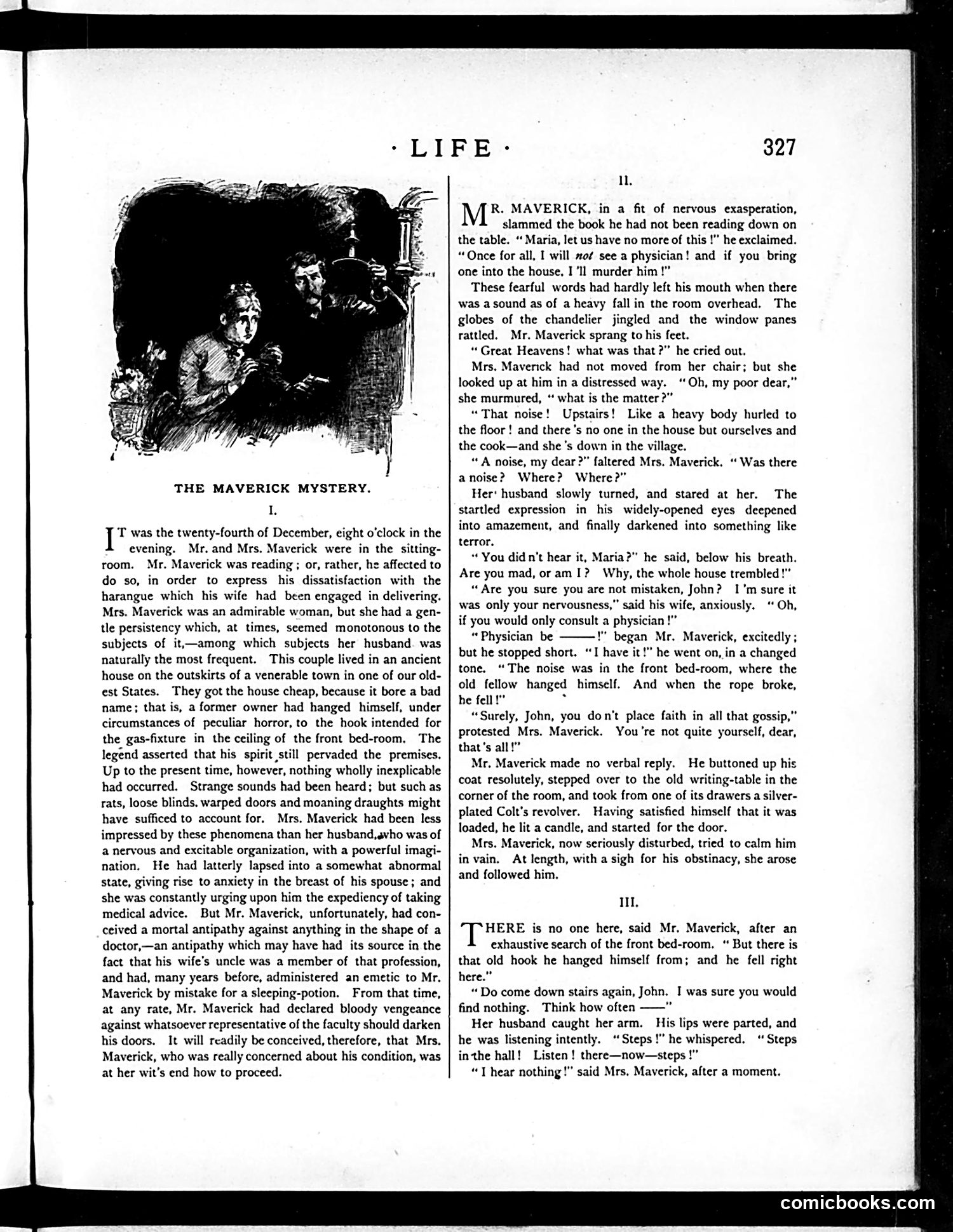
This page contains the opening of a serialized mystery/suspense story rather than political satire. The illustration shows Mr. Maverick in his sitting room, apparently disturbed by supernatural phenomena—strange noises and a chandelier crash—in his house on the outskirts of a New England town. The narrative establishes Gothic atmosphere: the house has a dark history (a former owner hanged himself), Mr. Maverick is nervous and imaginative, and his wife urges him to consult a physician rather than believe in ghosts. The story plays on period anxieties about rationalism versus superstition, with the husband's skepticism tested by inexplicable events. This appears to be general fiction content rather than political commentary.
This page contains serialized fiction rather than political satire or cartoons. It's a multi-chapter ghost story titled with Roman numerals (sections IV and V visible), featuring characters named Mr. Maverick and Maria dealing with supernatural phenomena in their home—mysterious sounds, glimpses of shadowy figures, and apparitions near a portrait. The text describes gothic-style horror elements: unexplained noises from the barn, a ghostly figure visible through windows, and a portrait that "frowned grimly back" at them. The narrative builds suspense through dialogue between husband and wife debating rational versus supernatural explanations. This appears to be entertainment fiction rather than satirical content, typical of Life magazine's mixed editorial content during the period when it functioned as a general-interest publication before becoming primarily a photo-magazine.
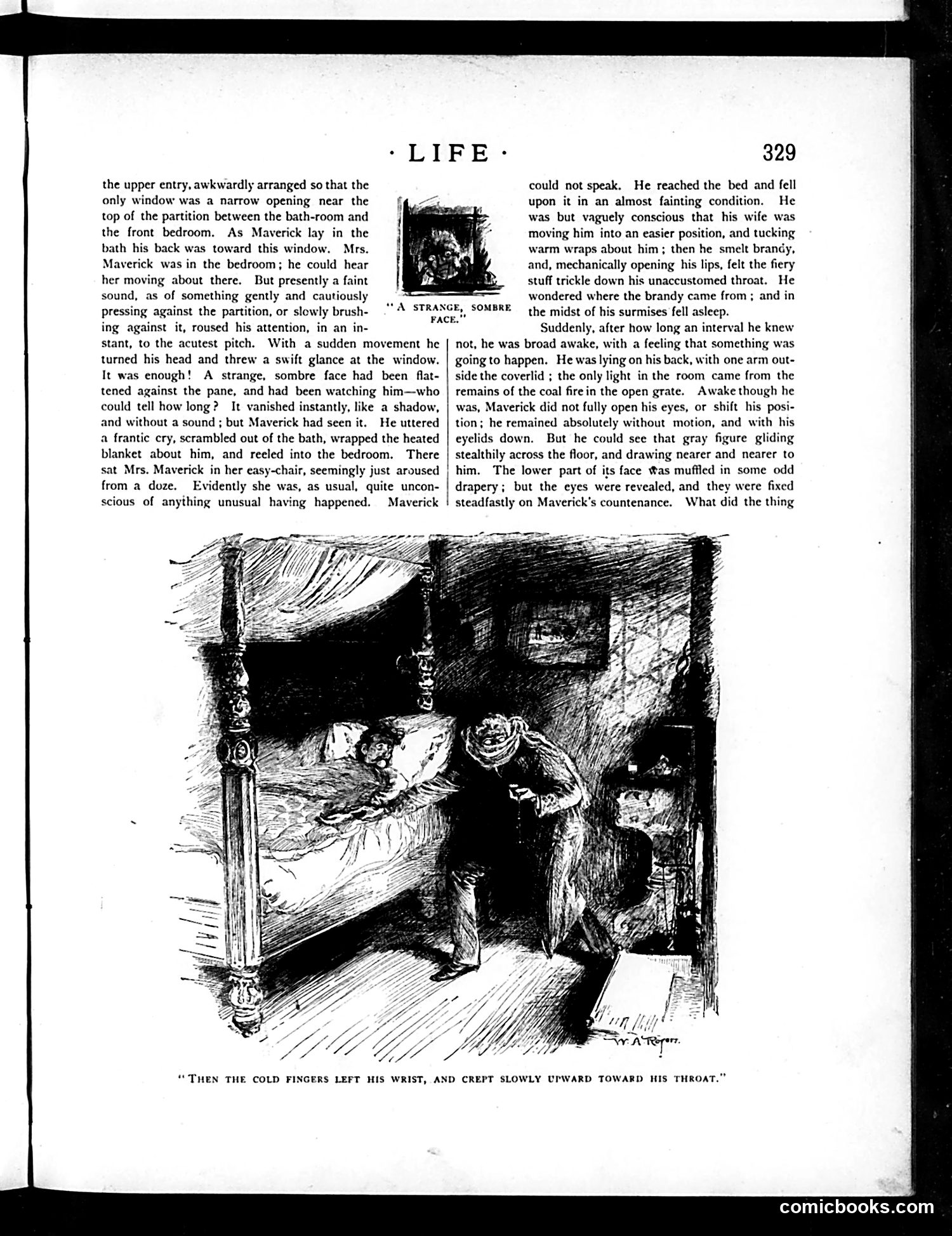
This page appears to be a literary illustration rather than political satire. It depicts a scene from what seems to be a ghost story or supernatural tale. The narrative describes a character named Maverick who awakens in bed to discover a "strange, somber face" pressed against his window—a disembodied, ghostly visage watching him. The accompanying illustrations show: first, the apparition at the window; second, a dramatic scene where an unseen supernatural force (depicted as cold fingers) approaches Maverick's throat as he lies helpless in bed. This is Gothic horror fiction with period-appropriate illustrations, not political commentary. The page showcases Life magazine's literary content alongside its better-known satirical work.
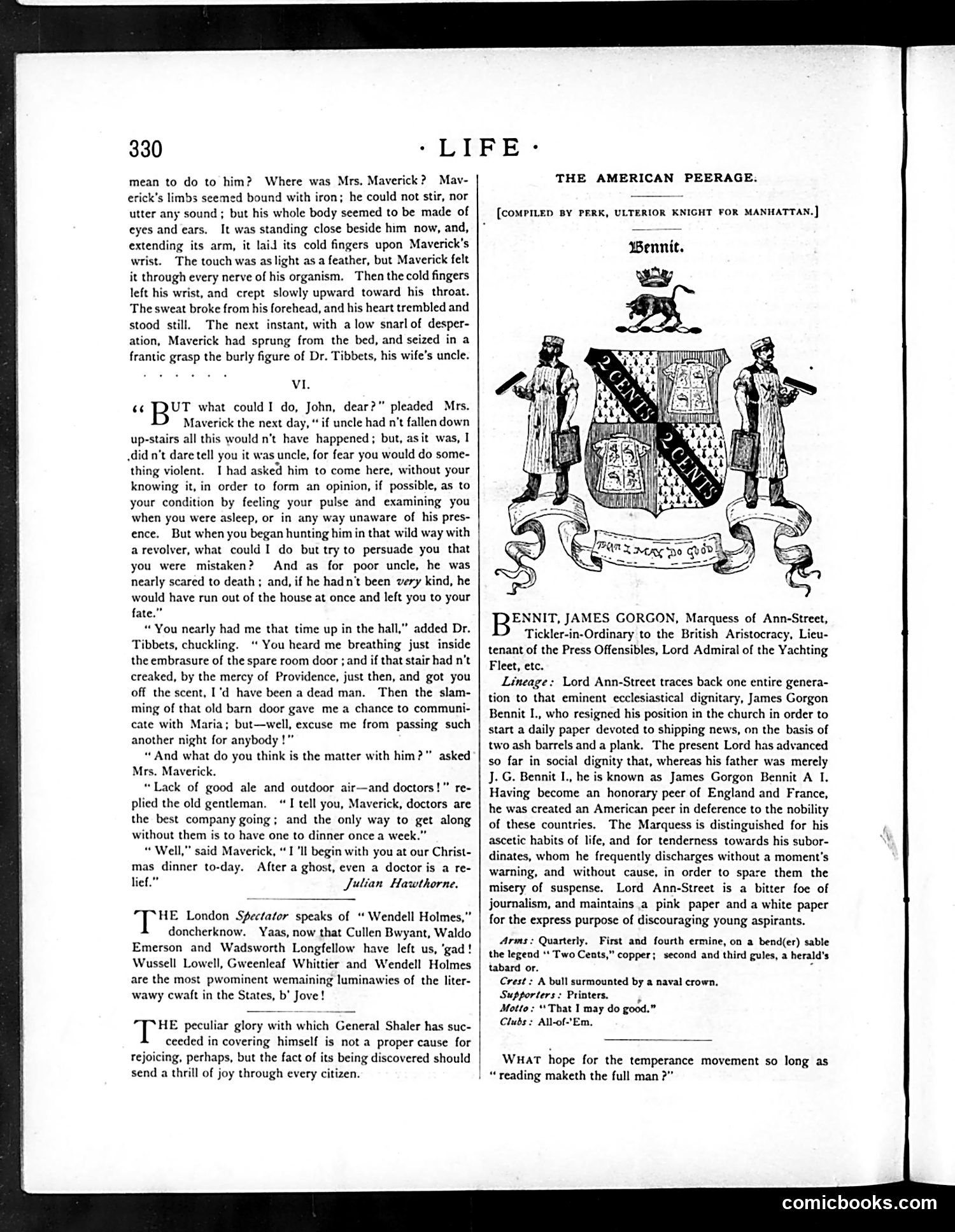
This page contains a serialized ghost story (continuing narrative about a man named Maverick) and a satirical feature titled "The American Peerage," compiled by someone credited as "Perk." The satire mocks the pretensions of American journalists and writers who adopt aristocratic British affectations. The "Bennit" entry ridicules James Gordon Bennett (founder of the *New York Herald*), inflating his humble origins—starting a shipping news paper from "two ash barrels and a plank"—into mock-nobility as "Marquess of Ann-Street." The absurd titles ("Tickler-in-Ordinary," "Lord Admiral of the Yachting Fleet") and heraldic imagery parody British peerage while skewering American social climbing and journalistic self-importance. The accompanying brief editorial mocks British literary references, sarcastically naming American writers (Wendell Holmes, Bryant, Emerson, Longfellow, Lowell, Whittier) in exaggerated British accents, suggesting Americans ape British cultural authority. The joke: American newspapers and writers were adopting pretentious European mannerisms while their actual foundations were comically modest.
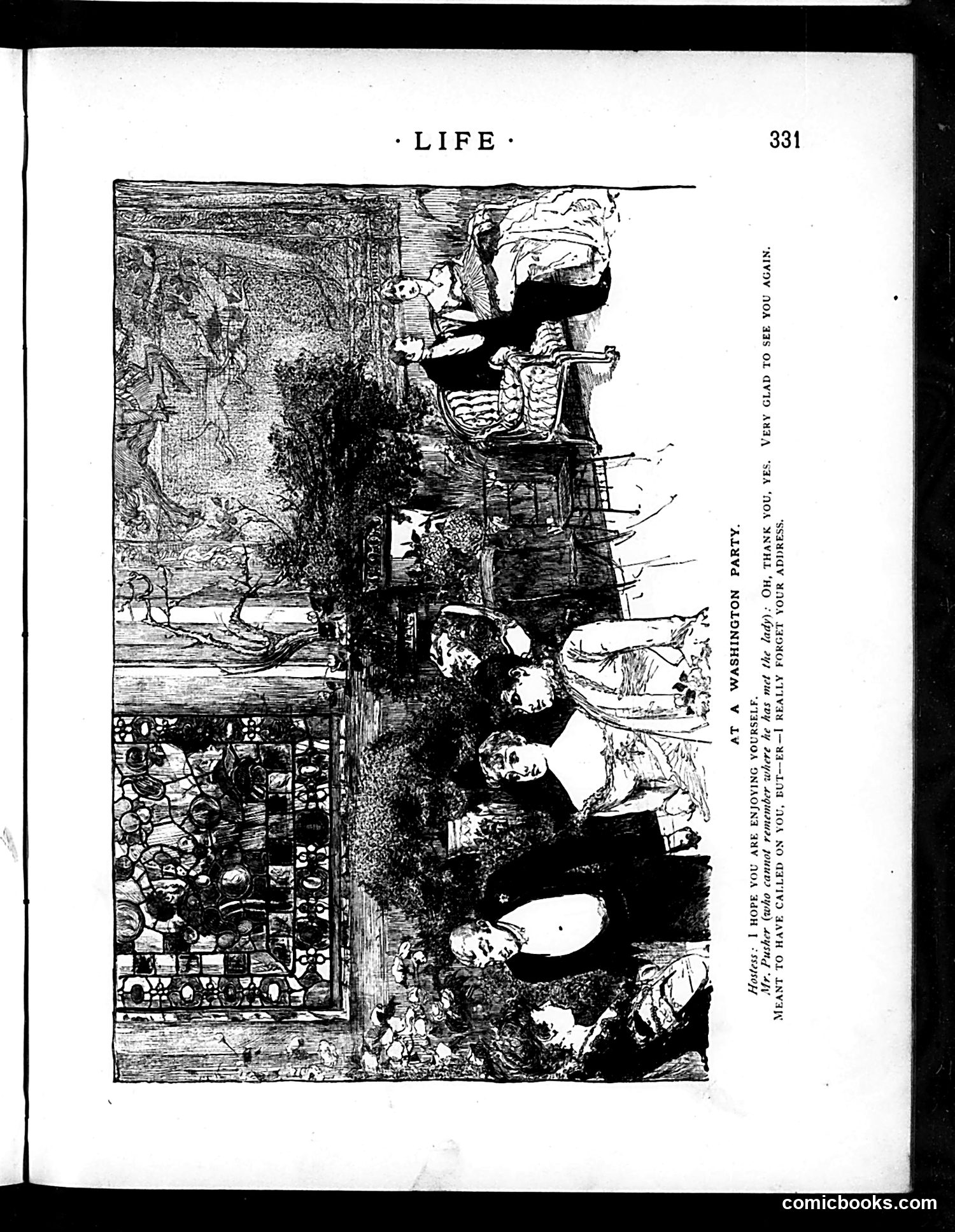
I cannot reliably read the OCR'd text on this page—it appears corrupted or reversed. The IMAGE shows a detailed engraving or etching depicting what appears to be a Washington party scene. The composition shows multiple figures in period dress gathered indoors, with ornate architectural details and decorative elements visible. The style and execution suggest this is a satirical illustration typical of *Life* magazine's social commentary. However, without legible text identifying the specific figures, political references, or the cartoon's central point, I cannot accurately explain what this satire means to a modern reader. The page number (331) and header confirm this is from *Life*, but I cannot responsibly identify who is caricatured or what event is being mocked without clearer information.
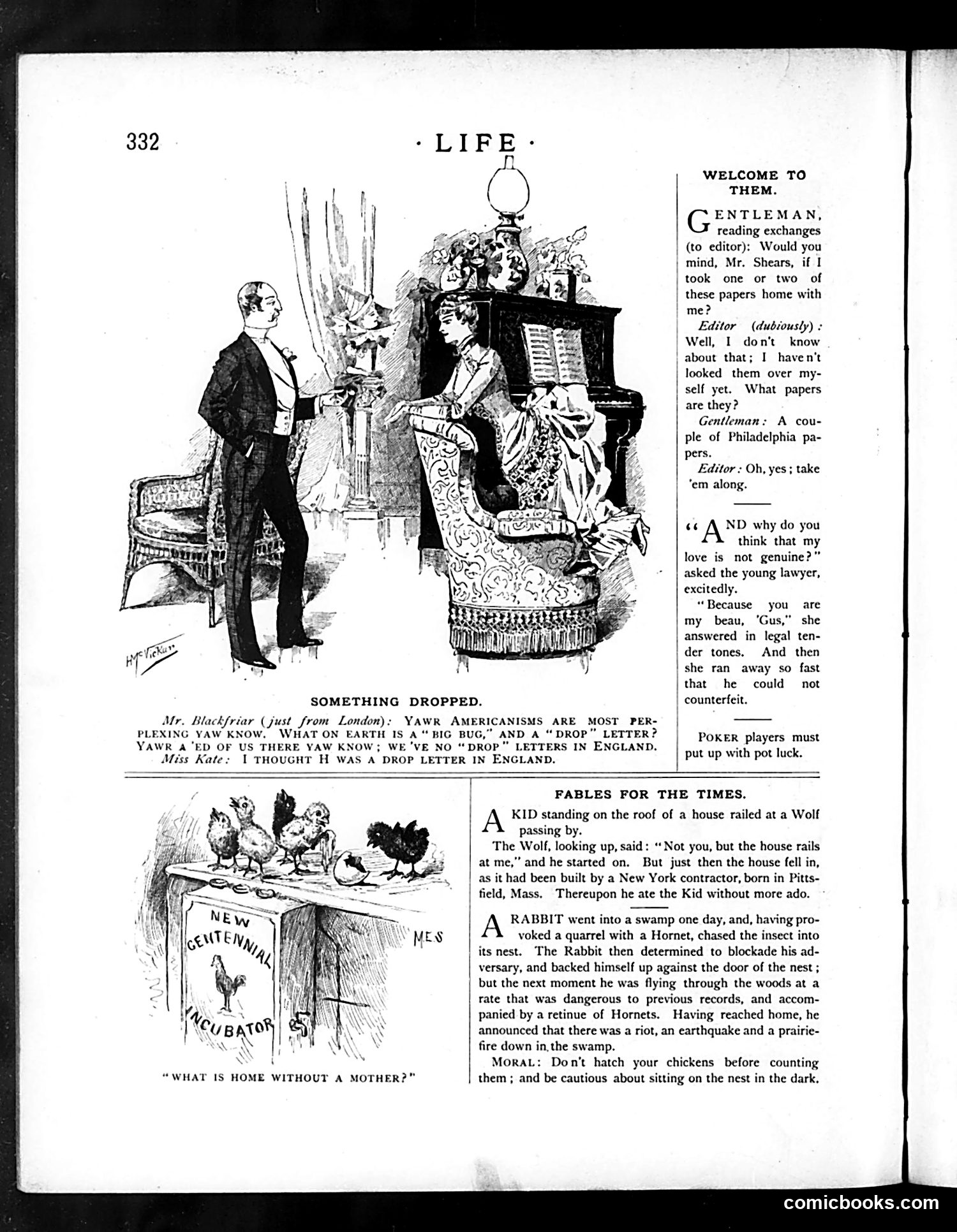
This page contains four distinct satirical pieces: **"Something Dropped"**: A British visitor (Mr. Blackfriar) complains that American slang is confusing—specifically "big bug" and "drop" letter. Miss Kate's punchline ("I thought it was a drop letter in England") suggests the British actually use similar terminology, mocking his pretentious complaint. **Editor Exchange**: An editor refuses to let a reader borrow *Philadelphia papers* but casually agrees when told what they are—satire on regional newspaper reputation or quality disparities. **Lawyer Joke**: A young lawyer's girlfriend makes a pun on "legal tender," implying his love isn't genuine currency—wordplay mocking lawyers' professional jargon. **"Fables for the Times"**: Two Aesop-style fables with modern morals: one critiques shoddy New York construction (contractor from Massachusetts); another warns against overconfidence. These mock contemporary American failures in building standards and business practices.
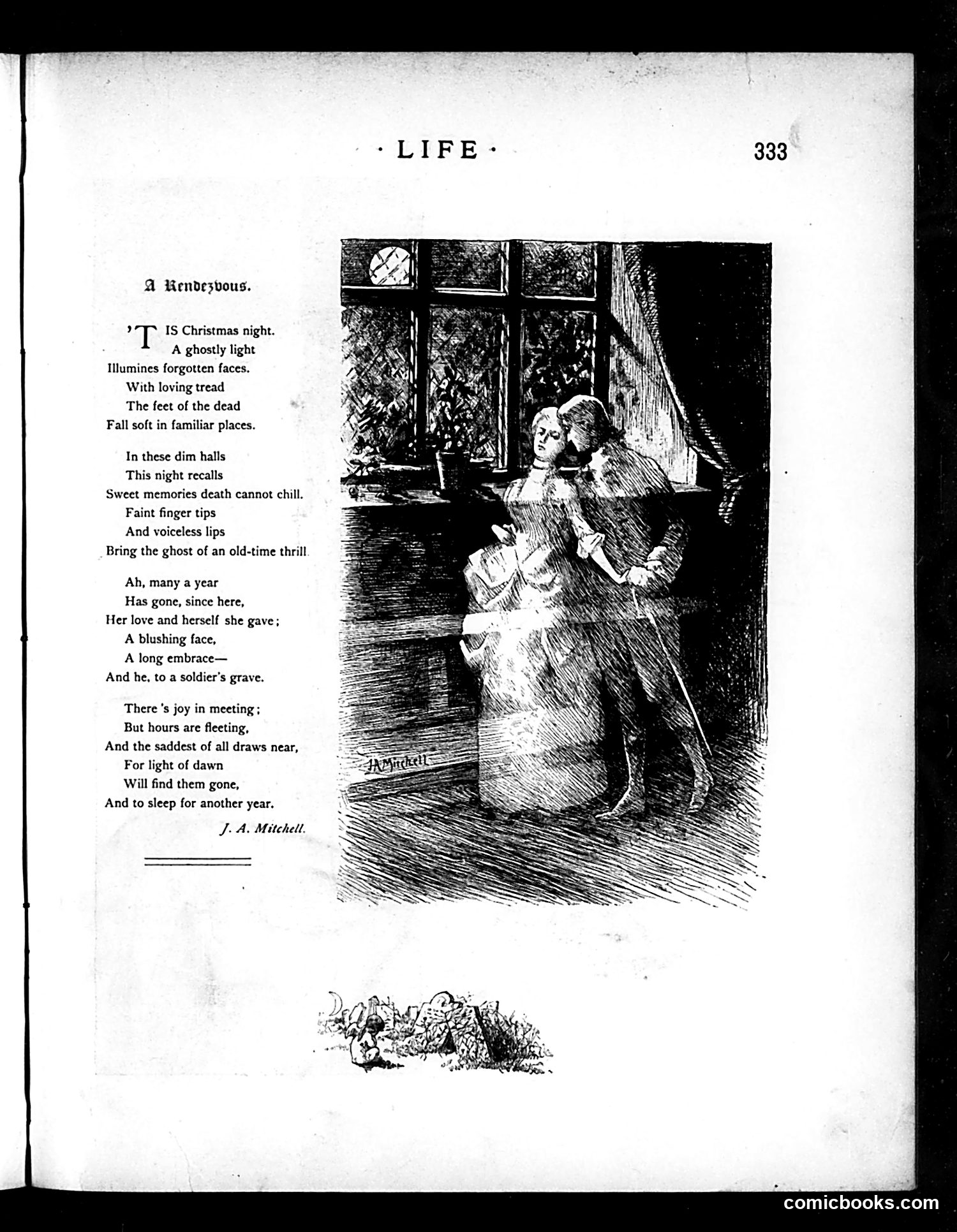
This is not political satire but a sentimental Christmas poem illustrated by an etching. The image shows two figures in what appears to be a ghostly reunion—a woman and a man (suggested to be a soldier) meeting by a window on Christmas night. The poem's theme is melancholic romance: a woman is visited by the spirit of her lover, a soldier who died (implied: in war, sent "to a soldier's grave"). The reunion is bittersweet—they share joy in meeting, but dawn will separate them again "to sleep for another year." This reflects a common Victorian/early-20th-century literary motif: the supernatural Christmas encounter allowing temporary communion between the living and dead. The illustration's sketchy, ethereal quality emphasizes the ghostly nature of their meeting. The piece evokes pathos through the image of wartime loss and enduring love transcending death.
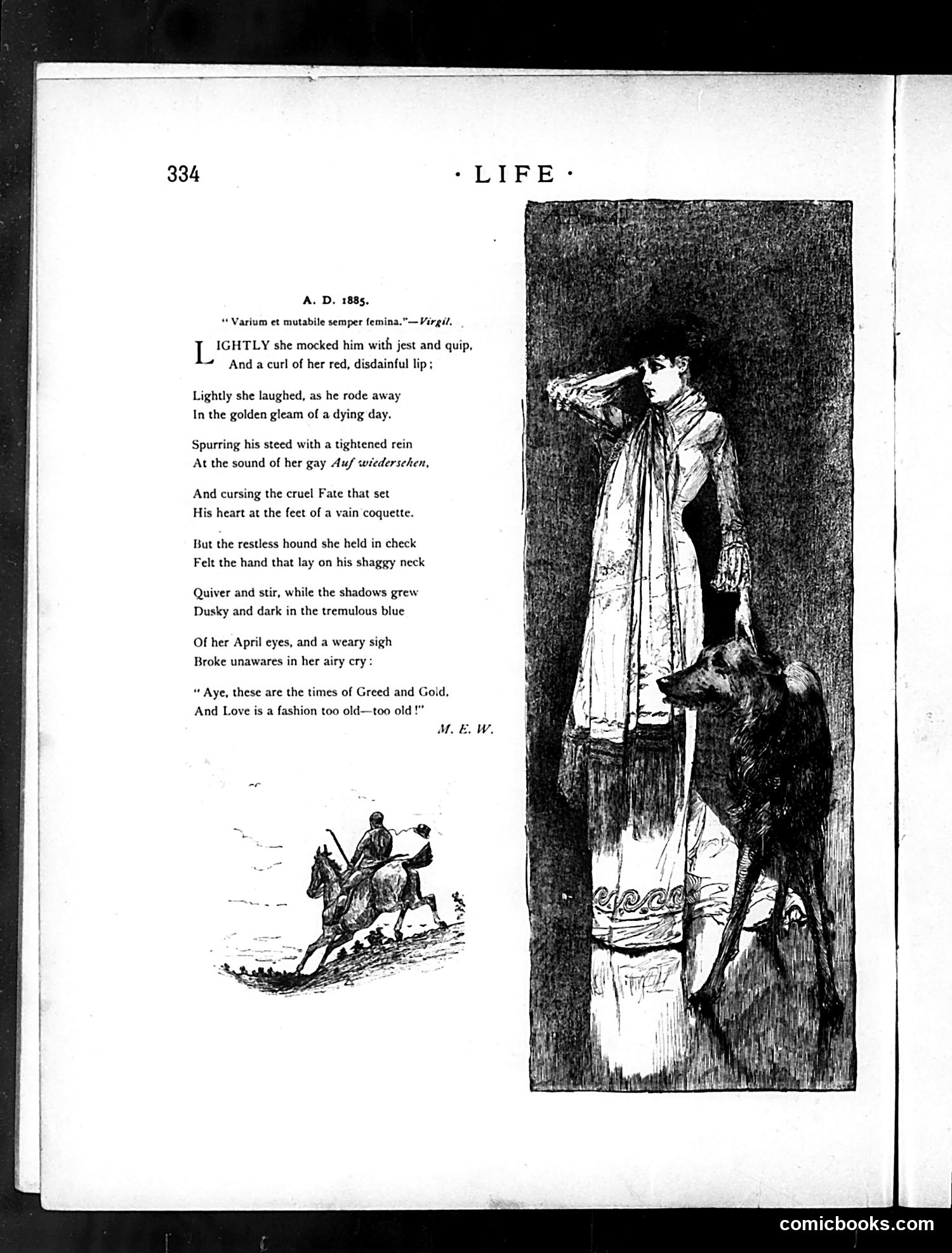
This page presents a romantic poem with accompanying illustrations satirizing female inconstancy. The verse, attributed to Virgil's line about women being "always variable and changeable," depicts a woman mocking a departing horseman with apparent indifference, yet the accompanying image reveals her true emotional state—her hand trembles on her dog's neck, her eyes betray sadness, and she sighs deeply. The satire targets the contradiction between women's outward behavior (flirtation, dismissal) and inner feeling (genuine attachment). The final lines suggest social commentary: she claims love is "too old" for modern times of "Greed and Gold," implying that materialism and changing social values have corrupted romantic sentiment. The dual illustration—showing both the departing lover and the woman's concealed emotion—emphasizes the gap between appearance and reality, the poem's central irony about feminine nature.
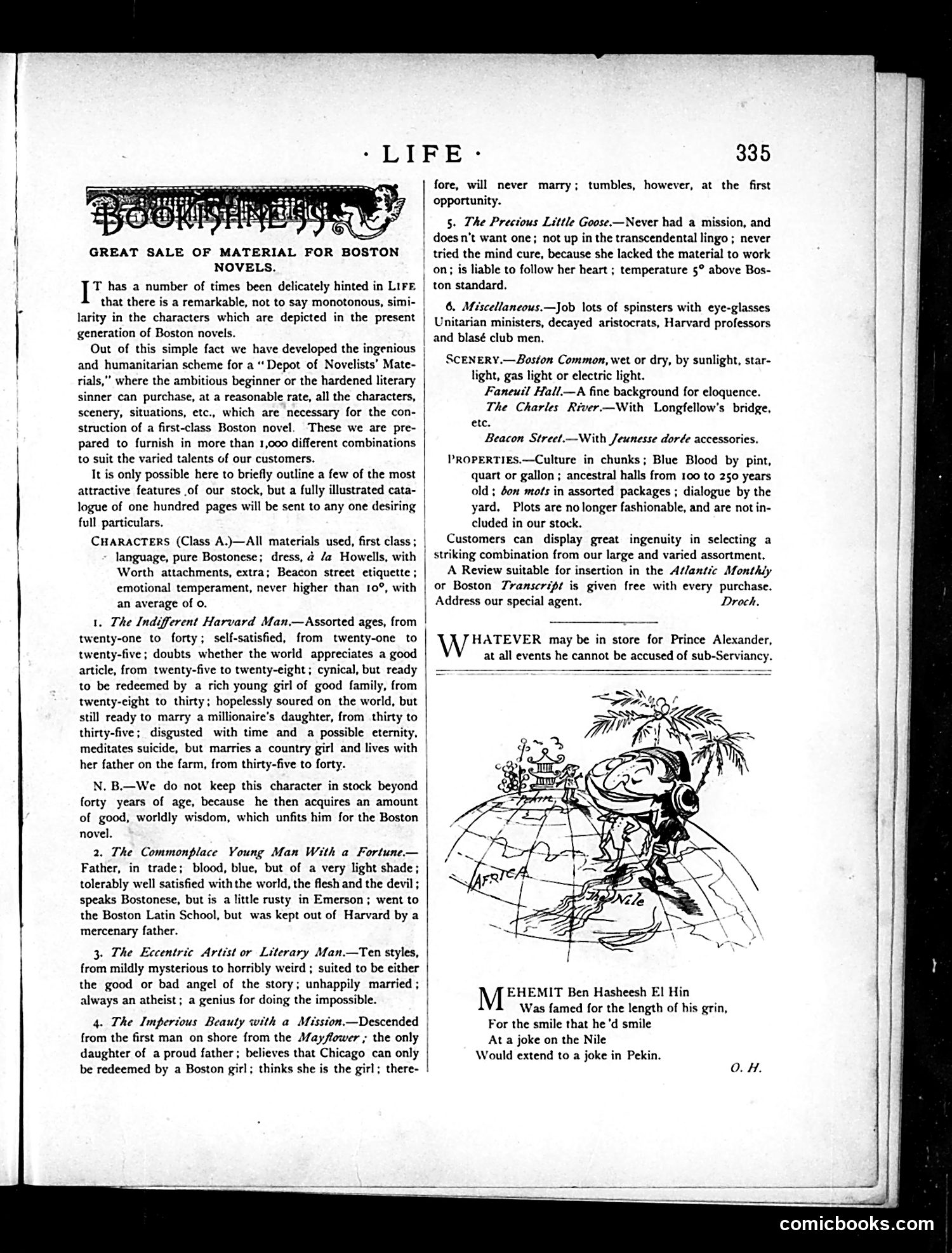
This is a mock advertisement satirizing the formulaic predictability of Boston novels—a literary genre Life found repetitive and creatively bankrupt. The satire mocks how Boston authors recycled identical character types, settings, and properties. The "Depot of Novelists' Materials" offers pre-packaged stock characters: the jaded Harvard man (who becomes redeemed by a rich girl or marries a farmer), the wealthy but mediocre businessman, the eccentric artist, the imperious beauty with a "mission" to reform Chicago, and the naive girl. Settings (Boston Common, Faneuil Hall, Beacon Street) and "properties" (culture, blue blood) are sold "by the pint." The humor targets Boston's literary establishment—likely referencing William Dean Howells and similar realist authors—for producing interchangeable novels about morally superior Bostonians. Life suggests these novels are so formulaic they might as well be assembled from a catalog. The cartoon at right remains unclear but likely continues this satirical theme.
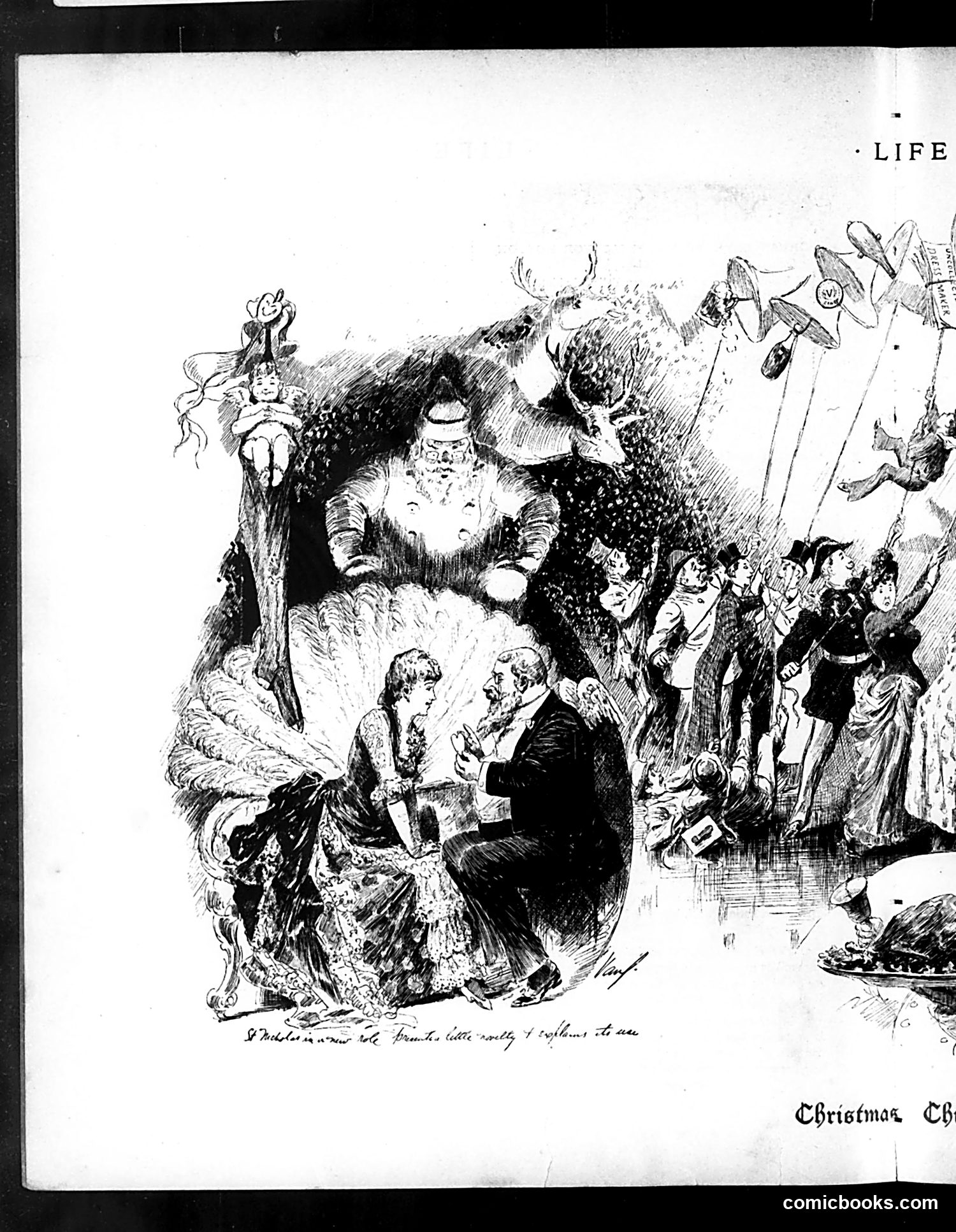
This appears to be a Victorian-era satirical illustration from *Life* magazine showing a Christmas scene. A portly gentleman in formal dress converses with a young woman in an elaborate gown, while a large, rotund figure (possibly Father Christmas or a wealthy patron) looms above them. A crowd of costumed revelers surrounds the scene. The OCR text is largely illegible, but the caption appears to reference "Christmas" and possibly social commentary about wealth or class distinctions. The caricatured figures and exaggerated proportions suggest satire of holiday excess, social pretension, or the commercialization of Christmas—common targets of *Life* magazine's humor. Without clearer text, the specific target remains unclear, though the composition emphasizes contrast between the elegant central figures and the surrounding crowd.
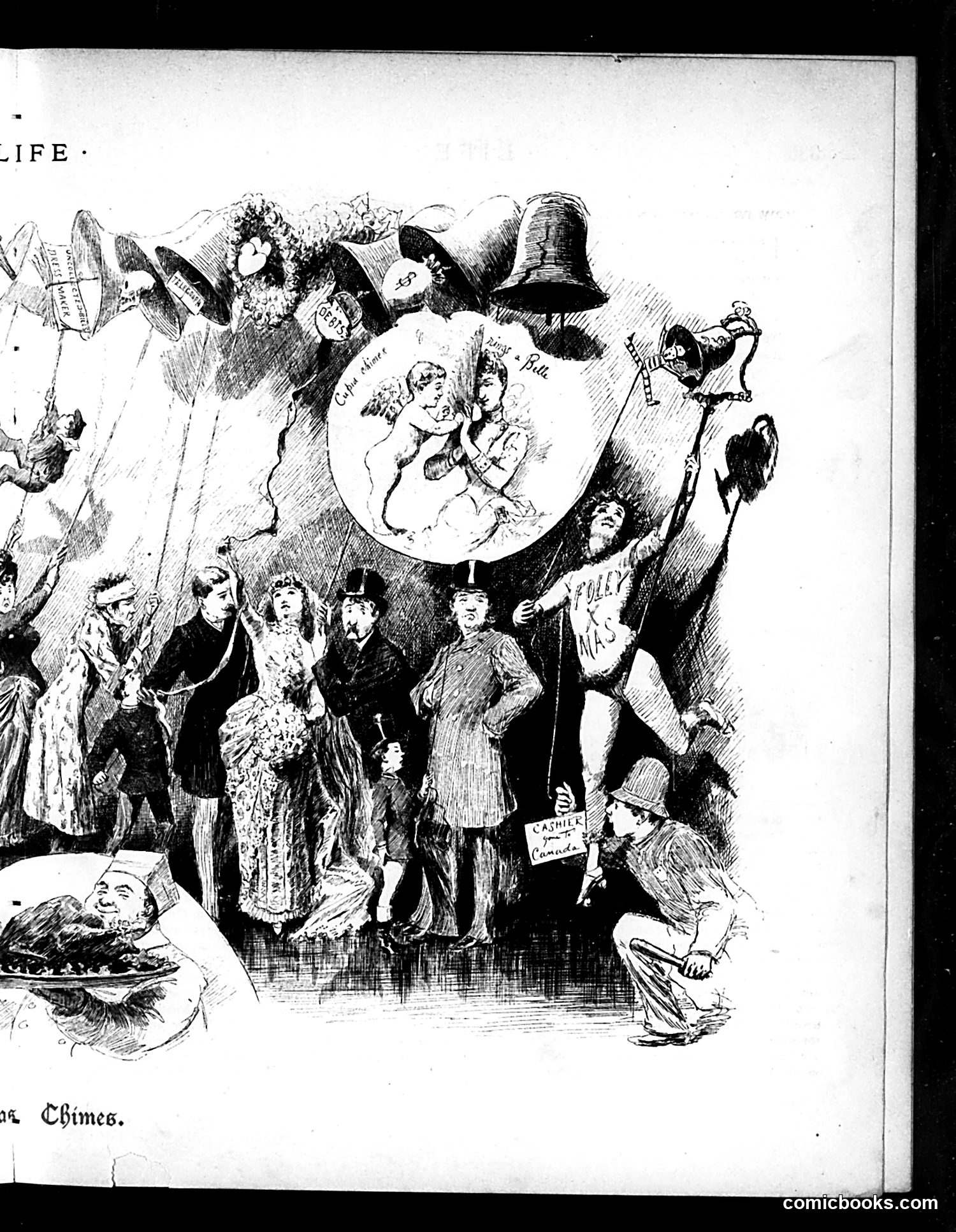
This is a satirical illustration depicting a theatrical or operatic scene. A large balloon or sphere dominates the composition, containing figures labeled as characters from what appears to be an opera or dramatic production. Below, an audience of well-dressed Victorian-era figures gazes upward, some holding poles or implements to manipulate the spectacle above. The visible text references "Cassilda" and "Comrade," suggesting political or social commentary, possibly satirizing popular entertainment or public spectacles. The style and composition suggest this mocks how audiences are manipulated by theatrical productions or propaganda presented as entertainment. Without clearer text visibility, the specific political targets remain unclear, though the general satire appears to critique mass entertainment and social gullibility.
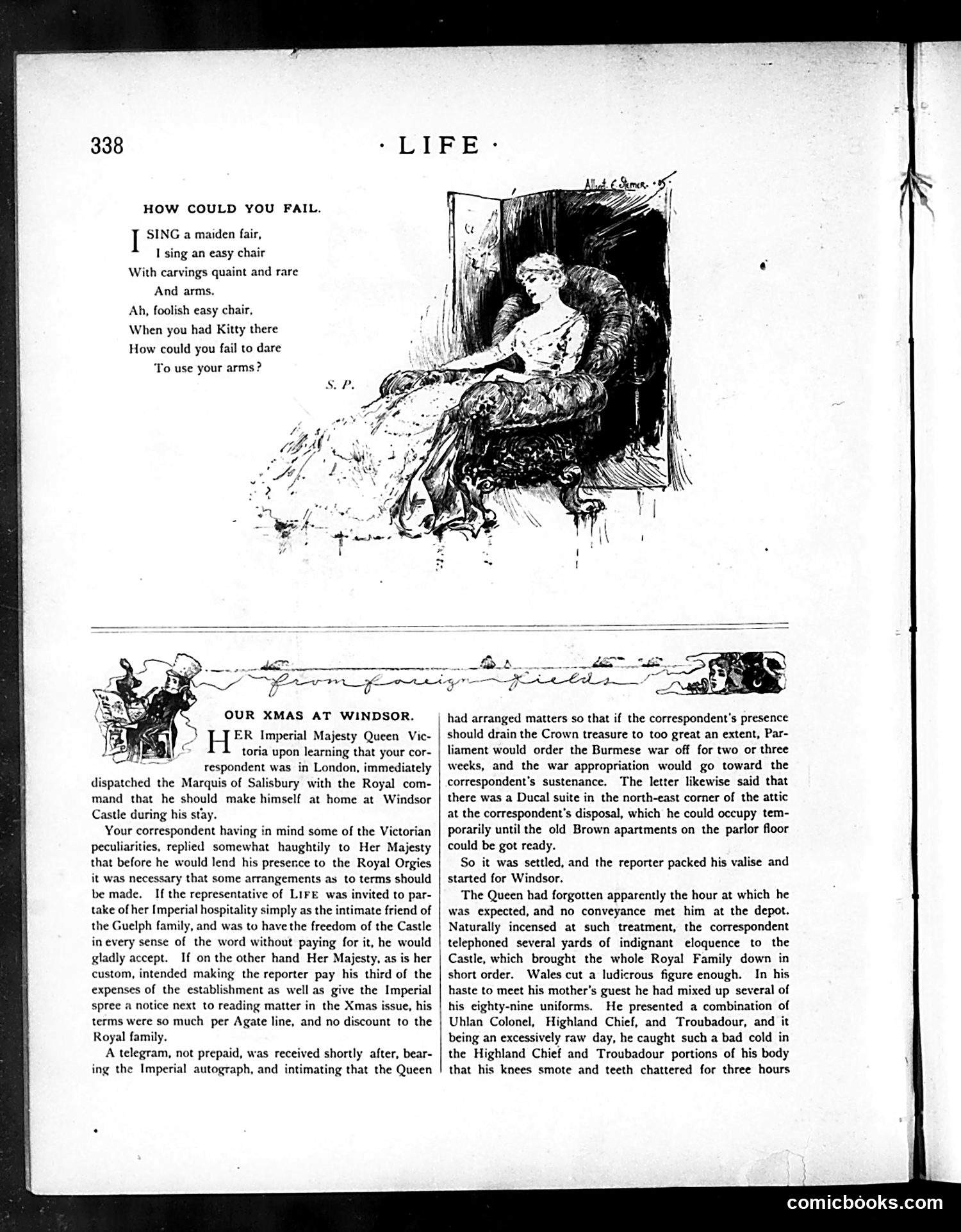
The top poem is a romantic lament: a speaker addresses an easy chair, reproaching it for failing to embrace a woman named Kitty when she sat upon it—a cheeky innuendo about the chair's passivity. The main article is satirical mock-reporting of a Life magazine correspondent's visit to Windsor Castle. The humor depends on inverting social hierarchy: the reporter brazenly negotiates terms with Queen Victoria as if she were a vendor, demanding either free lodging or advertising rates. The Queen's reply continues the absurdist tone, joking she'll redirect military funds (from the Burma War) to pay his sustenance. The punchline involves the Prince of Wales arriving in a comically mismatched uniform combining three military styles, catching pneumonia from the Highland costume and shivering uncontrollably—mocking both his apparent disorganization and the absurdity of rigid Victorian etiquette. The satire targets Victorian royal pretension, portraying the monarchy as simultaneously ridiculous and subordinate to American commercial interests.
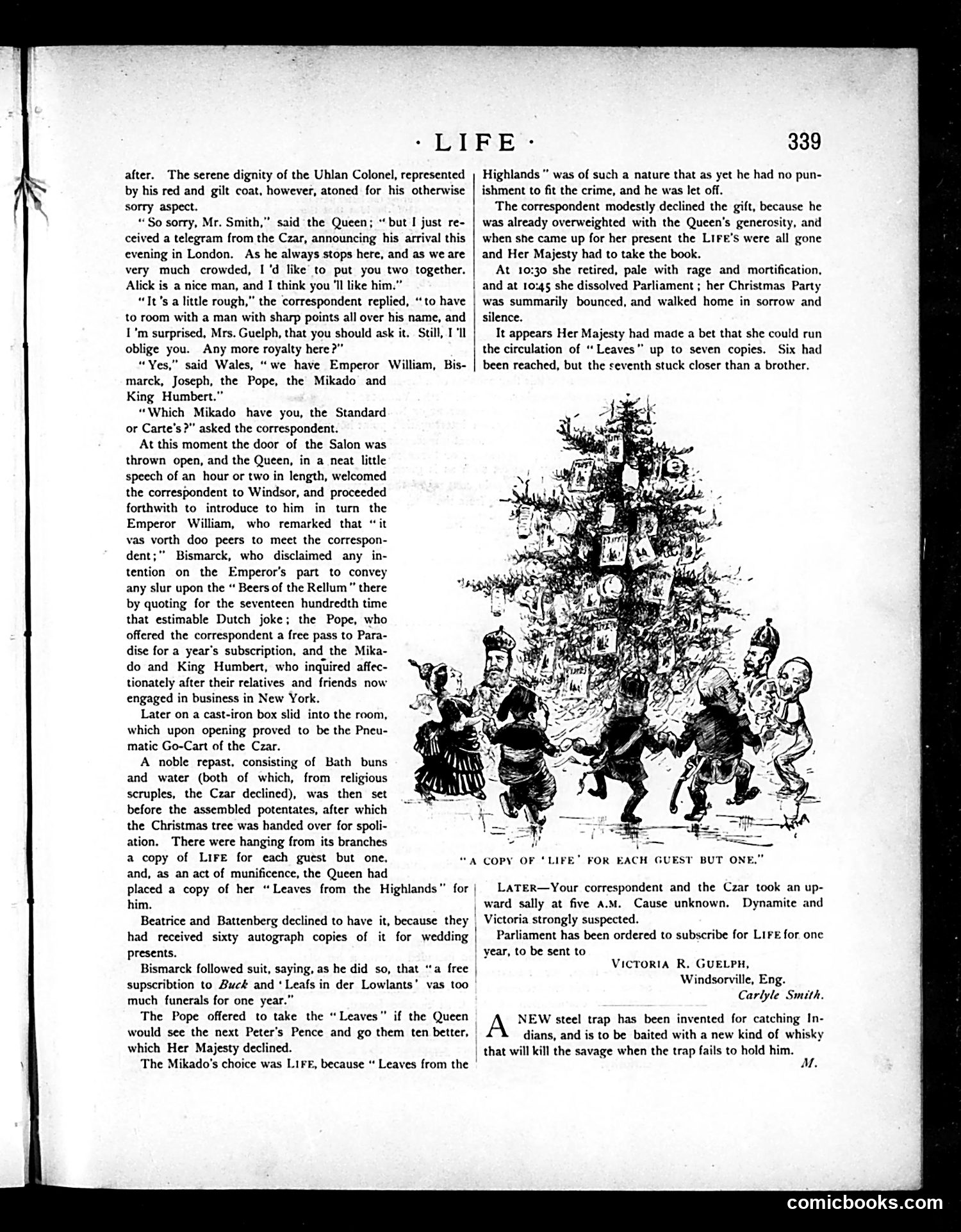
This is a satirical short story about Queen Victoria hosting a Christmas party at Windsor Castle. The joke mocks Victoria's vanity and her recent book "Leaves from the Highlands"—a real memoir she published that became unexpectedly popular. The humor centers on the Queen trying to give copies of her book as Christmas gifts to various world leaders (Emperor William, Bismarck, the Pope, the Mikado, King Humbert). Everyone politely refuses—the Pope even offers her a "free pass to Paradise" in exchange. Only the Mikado accepts, with a cutting joke: the book is so bad it requires "no punishment to fit the crime." The cartoon below shows these world figures gathered around a Christmas tree. Victoria becomes so enraged at the failure to distribute her book that she "dissolves Parliament" at 10:45 PM—an absurd overreaction that lampoons her power and petulance. The satire targets both Victoria's self-importance and the hype surrounding her memoir.
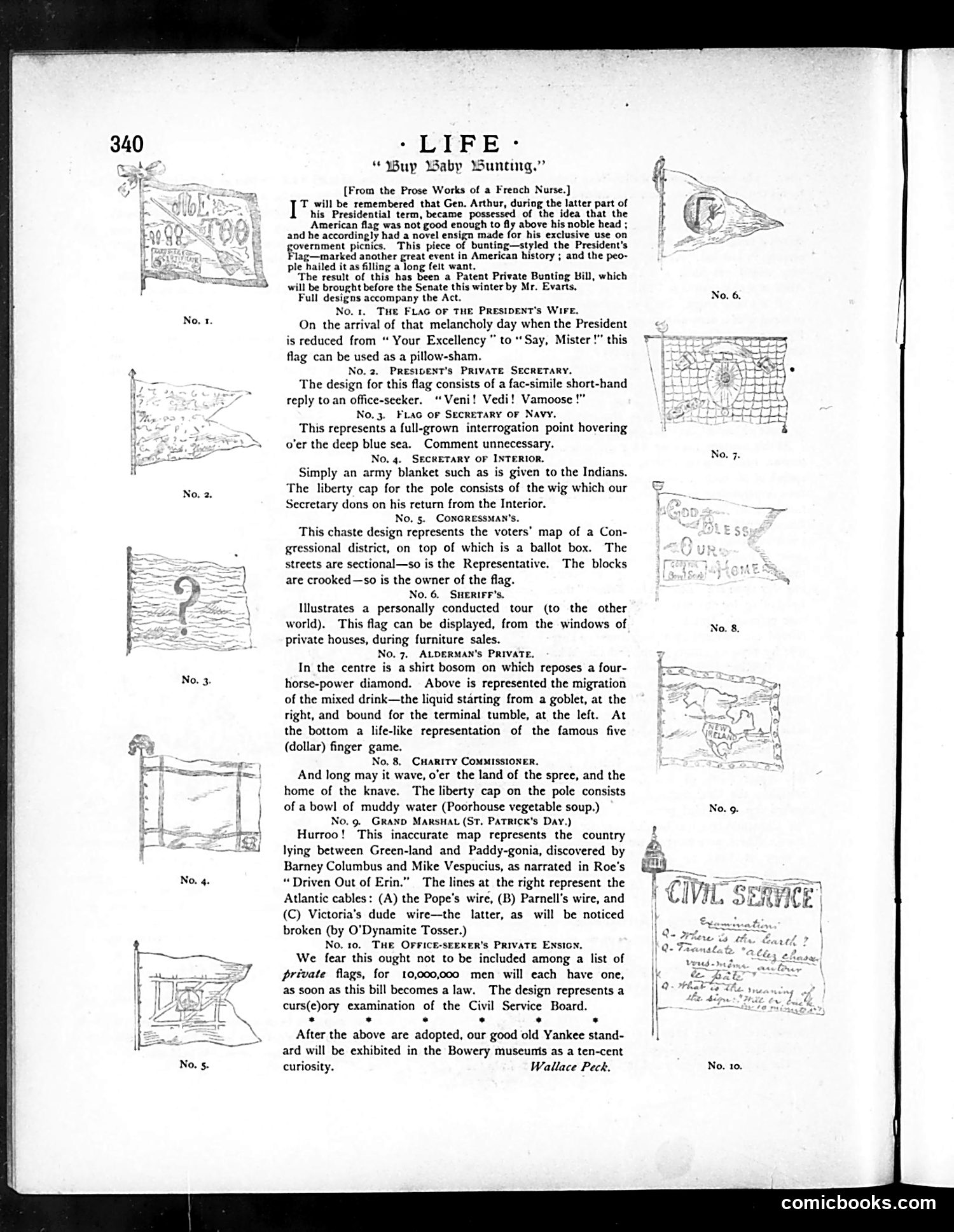
This 1880s satirical piece by Wallace Peck mocks President Chester Arthur's creation of a presidential flag—a luxury the author treats as absurd overreach. The satire extends this idea to imaginary "private flags" for various government officials. Each numbered design ridicules its target through crude visual metaphor: - **Secretary of Navy**: A question mark (incompetence) - **Secretary of Interior**: An army blanket (connection to Indian affairs, worn as the secretary's wig) - **Congressman**: A crooked district map with ballot box (corruption paralleling his district's layout) - **Alderman**: A shirt bosom with diamond (materialism and alcohol consumption) - **Grand Marshal**: A drunk Irishman's imaginary map (ethnic mockery of St. Patrick's Day) - **Office-seeker**: Deliberately omitted—10 million men would need one The underlying argument: if the president deserves a personal flag, why not every corrupt or self-interested official? The joke warns against unnecessary government pretension and suggests widespread graft among elected officials.
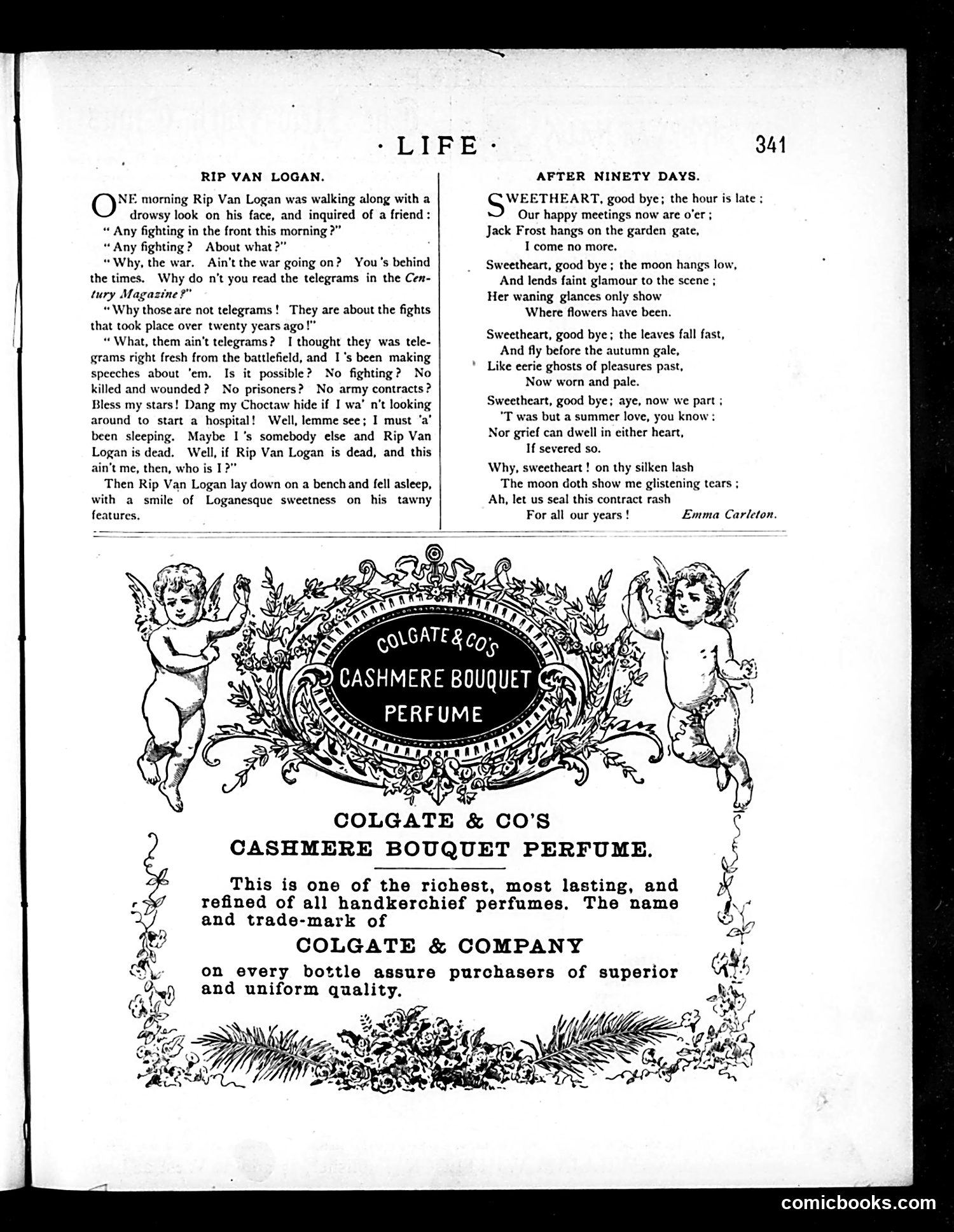
This piece satirizes **John B. Logan**, a prominent Civil War general and politician, by adapting Washington Irving's "Rip Van Winkle" tale. The joke: Logan appears so disconnected from current events that he's accused of sleeping through reality—specifically, he mistakes old *Century Magazine* articles about Civil War battles from "twenty years ago" for current telegrams about present fighting. The satire suggests Logan is out of touch, living in the past, and making speeches based on outdated information. His confusion about whether the war is still happening and his bewildered musings about starting hospitals mock his seeming disconnection from contemporary affairs. The page also includes a sentimental poem titled "After Ninety Days" (unrelated to the cartoon) and a Colgate perfume advertisement.
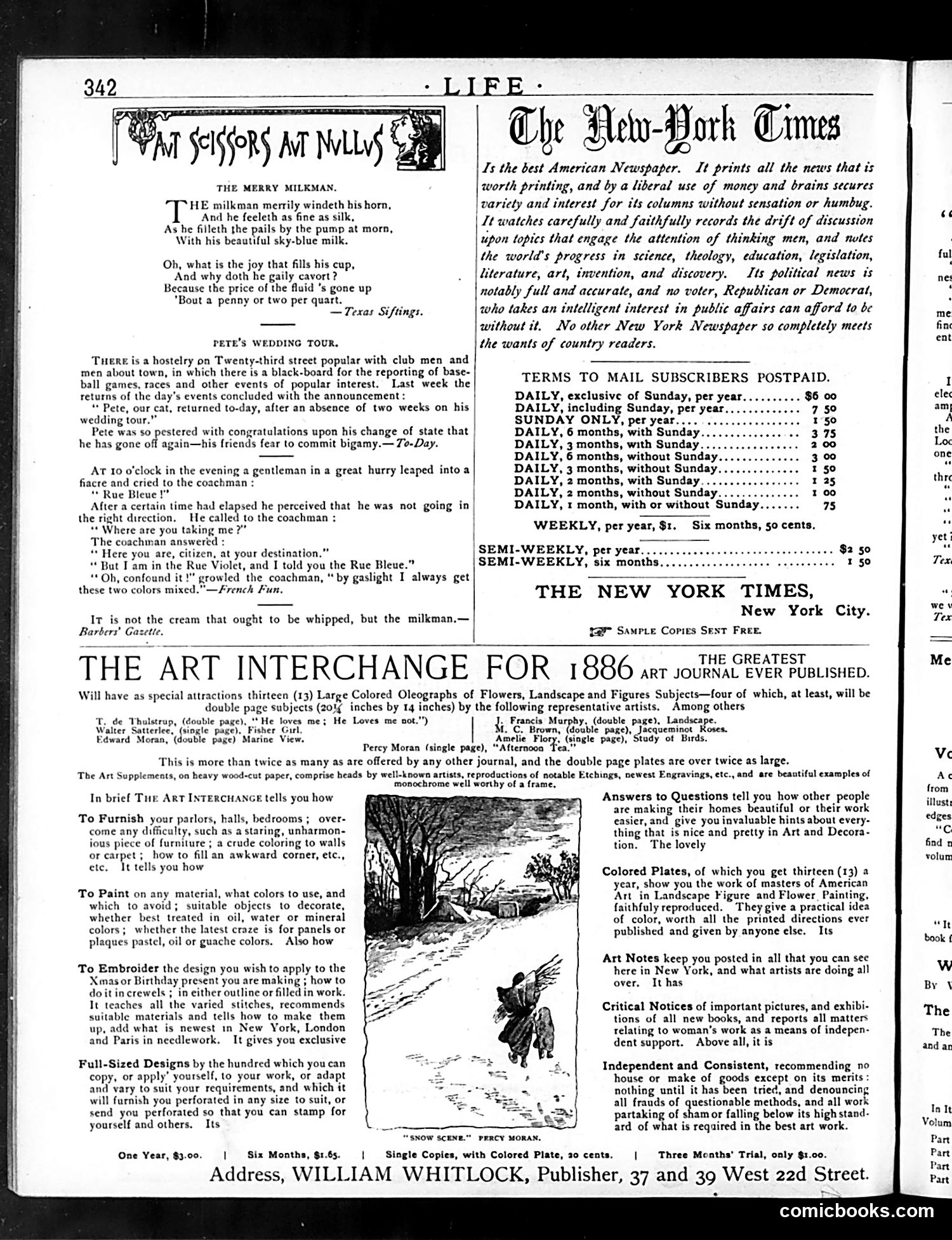
This page from Life magazine (circa 1886) contains humorous poetry and anecdotes rather than political cartoons. The jokes satirize: **"The Merry Milkman"**: A poem mocking the milkman's cheerfulness, revealing he's actually happy because milk prices have risen—a jab at commercial opportunism and inflation. **"Pete's Wedding Tour"**: A humorous anecdote about a cat named Pete who disappears after his wedding, with friends joking he's committed bigamy. It's lighthearted social commentary on marriage. **The French coachman story**: A joke about a taxi driver confusing "Rue Bleue" (Blue Street) with "Rue Violet" (Violet Street) at night, blaming gaslight for mixing up colors—simple comedic wordplay. The page is largely promotional material for The New York Times and The Art Interchange journal, with subscription rates and feature announcements. The humor targets everyday absurdities (price gouging, infidelity jokes, urban confusion) typical of 1880s satirical magazine content.
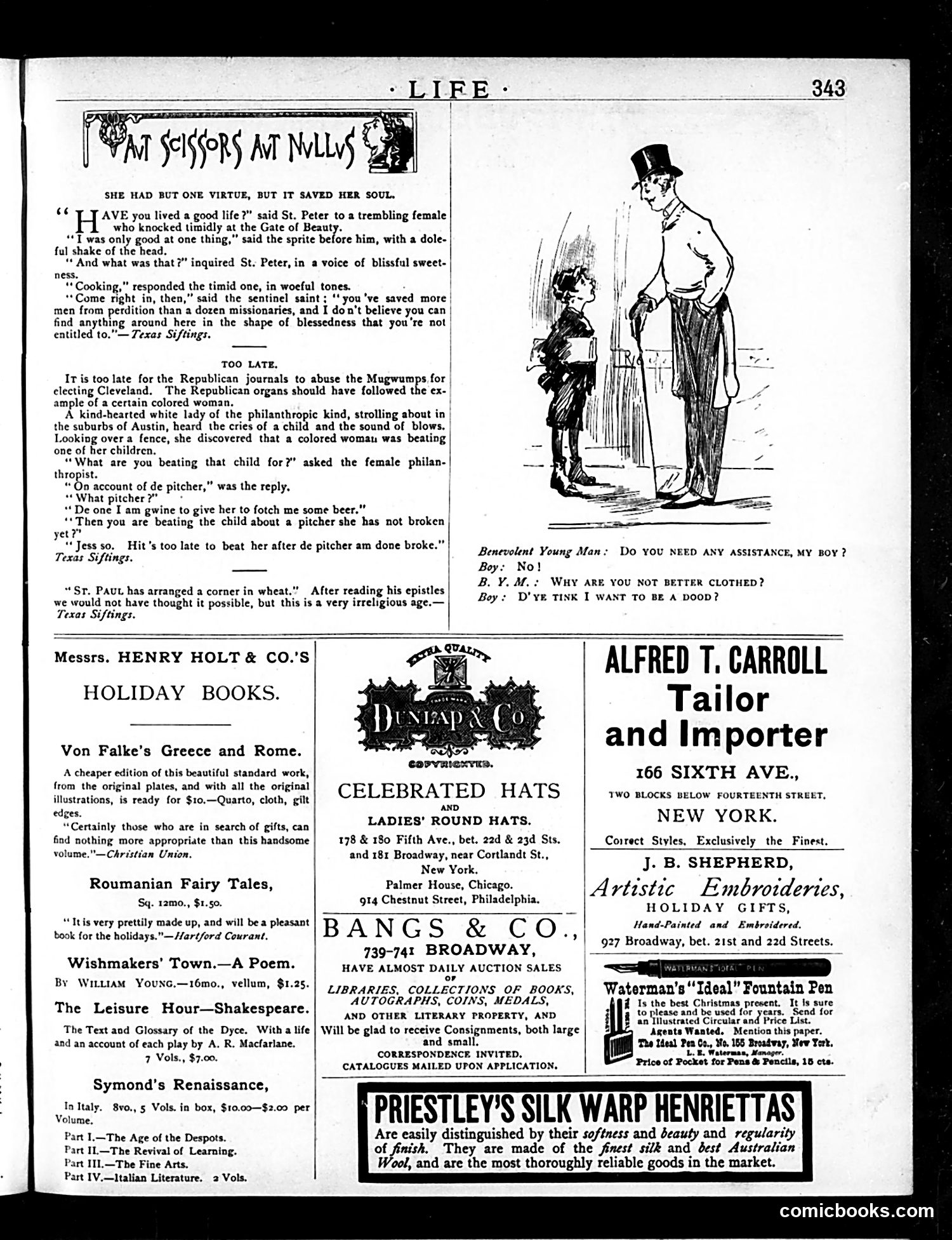
This page contains three distinct satirical pieces: 1. **"At St. Peter's Gate"**: A joke about a woman admitted to heaven solely for her cooking skills—the implication being that feeding men well is her only virtue, yet St. Peter credits her with "saving more men from perdition than a dozen missionaries." The humor mocks both domestic stereotypes and religious hypocrisy. 2. **"Too Late"**: A commentary on Republican criticism of "Mugwumps" (Republicans who defected to support Democrat Cleveland's election). The allegory compares this to a Black woman beating her child preemptively for breaking a pitcher she'll later use—pointless blame after the deed. It satirizes Republicans for belatedly criticizing those who already influenced the election outcome. 3. **"Benevolent Young Man"**: A brief dialogue cartoon mocking class pretensions. A well-dressed man offers assistance to a poorly clothed boy, who refuses because he aspires to be a "dood" (dandy/well-dressed man), not accept charity. It satirizes aspiration and false pride among the working poor. The page is primarily advertisements otherwise.
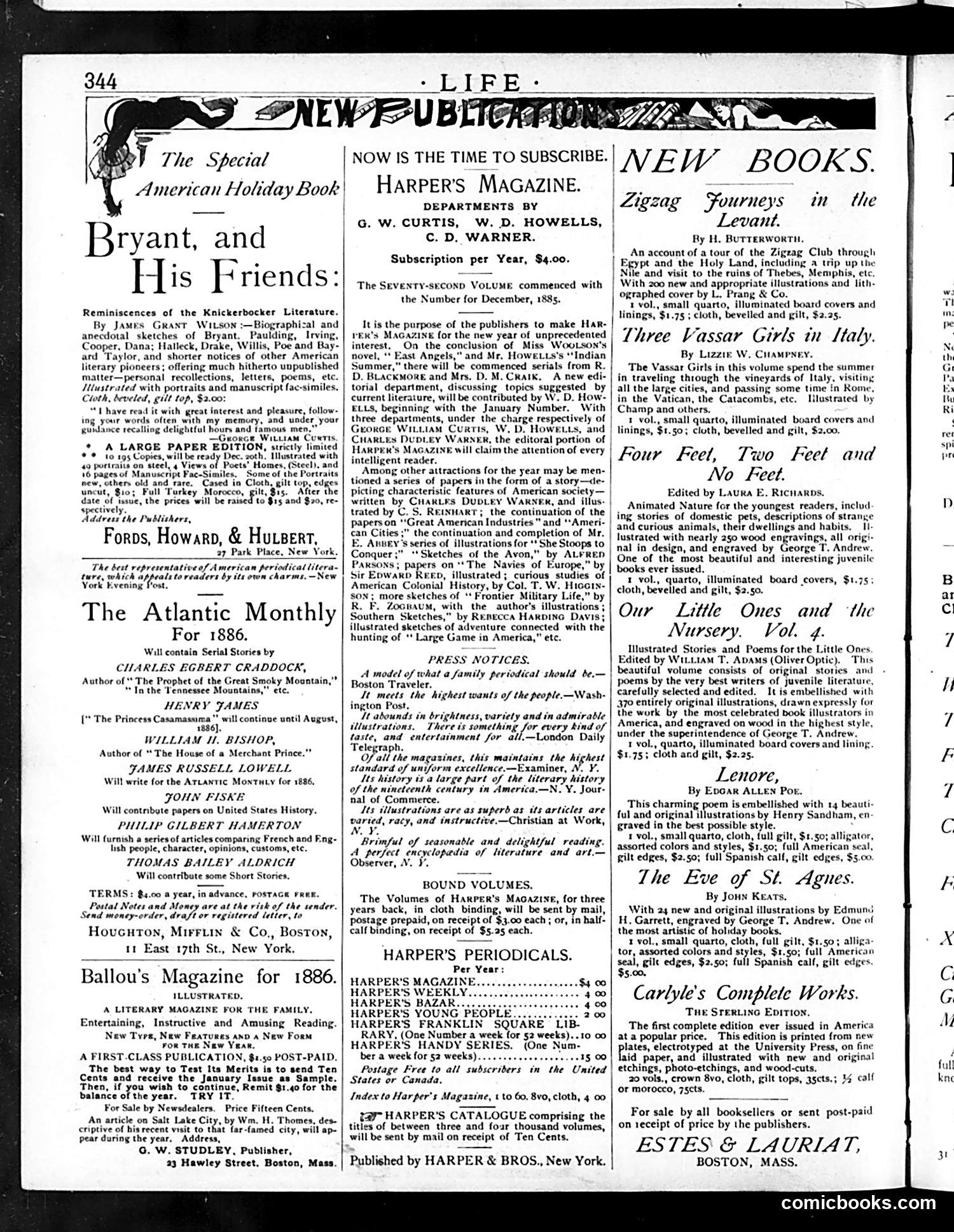
This is primarily an advertising page from *Life* magazine (1886), not a satirical cartoon page. The dominant content consists of book and magazine advertisements, with no visible political satire or cartoon imagery. The page advertises several publications for the coming year: *The Atlantic Monthly*, *Harper's Magazine*, and *Ballou's Magazine*. Notable contributors listed include Henry James, William H. Bishop, and James Russell Lowell, reflecting the literary prestige of these periodicals. A special book advertisement highlights a volume on "Bryant, and His Friends"—reminiscences of early American Knickerbocker literature figures including William Cullen Bryant, Washington Irving, and James Fenimore Cooper. This reflects Victorian-era nostalgia for earlier American literary giants. The page is essentially a snapshot of 1880s American periodical publishing and literary culture, targeting educated, middle-class readers.
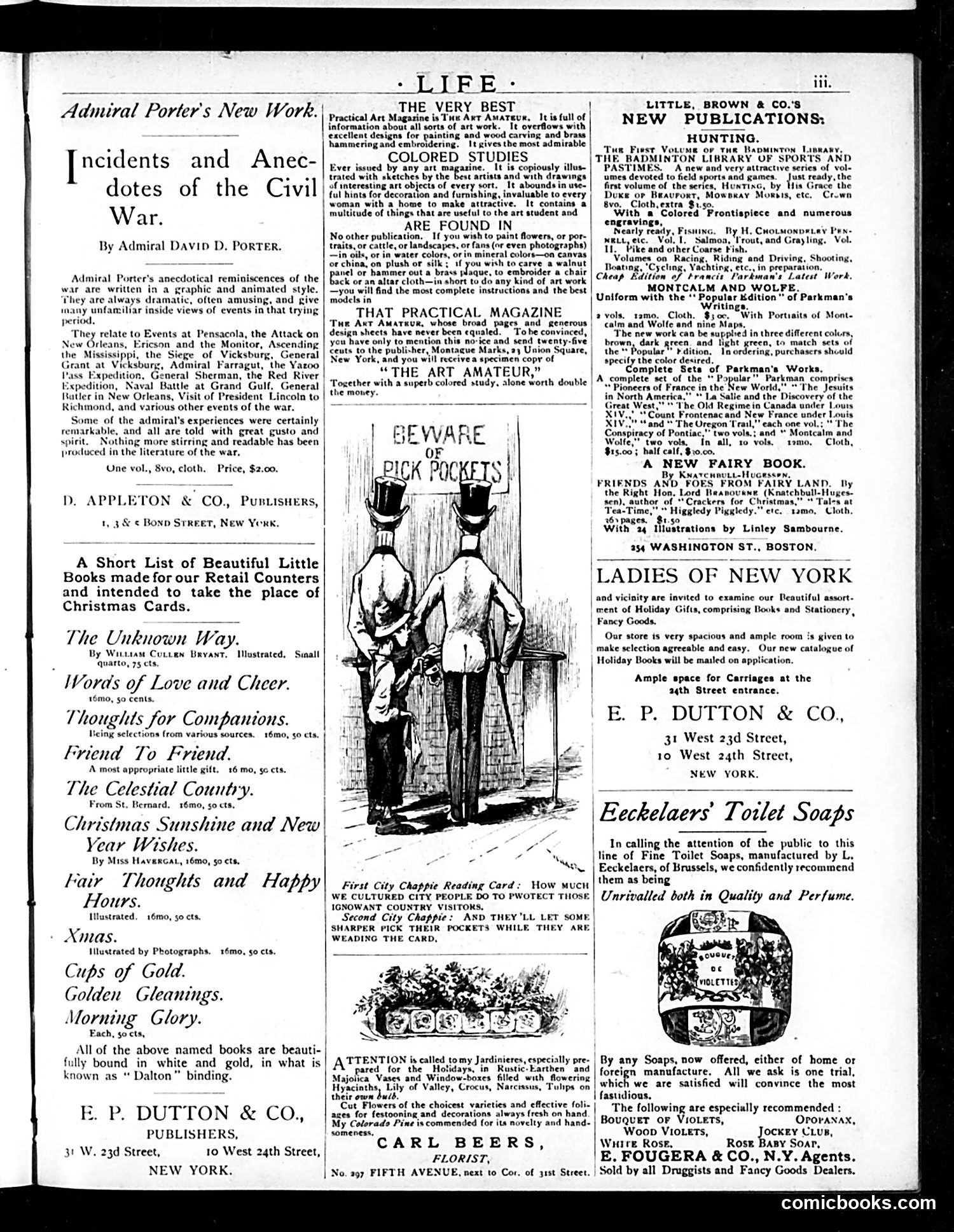
This cartoon satirizes the naïveté of country visitors to the city. Two well-dressed men read a card warning cultured city people to "protect" ignorant country visitors from pickpockets. The joke's irony: while the card itself serves as a *distraction*, sharpers (con artists) pick the visitors' pockets. The satire targets both groups—mocking rural visitors as gullible and city dwellers as falsely superior while being equally complicit in their own victimization. It reflects a common late-19th-century urban anxiety about con games and the vulnerability of unsophisticated travelers to metropolitan crime. The "helpful" warning becomes the very tool of their exploitation.
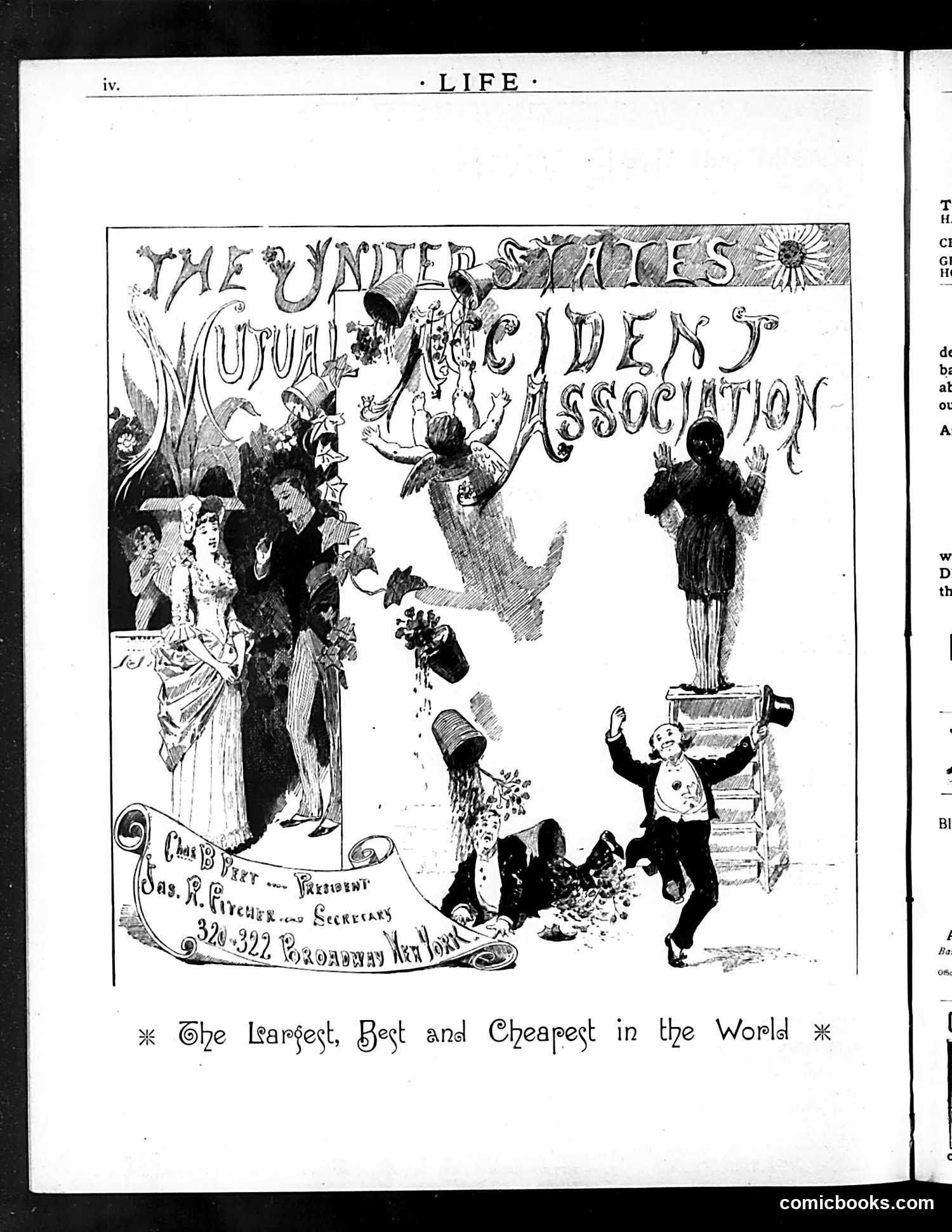
This is an advertisement for the United States Mutual Aid Association, appearing in Life magazine. The illustration shows a chaotic scene with figures collecting money (depicted by falling coins and buckets) beneath an ornate banner. A man in formal dress stands triumphantly atop a pedestal while others gather contributions below. The satire appears to target the organization's claims of being "the largest, best and cheapest in the world" — the image suggests it's primarily engaged in collecting funds rather than delivering promised services. The visual chaos and the emphasis on money-gathering implies the magazine is mocking the organization's actual operations versus its grand advertising claims. The address listed (320-322 Broadway, New York) places this as a New York-based operation. Without clearer OCR of the officer names, the specific leadership being caricatured remains unclear.
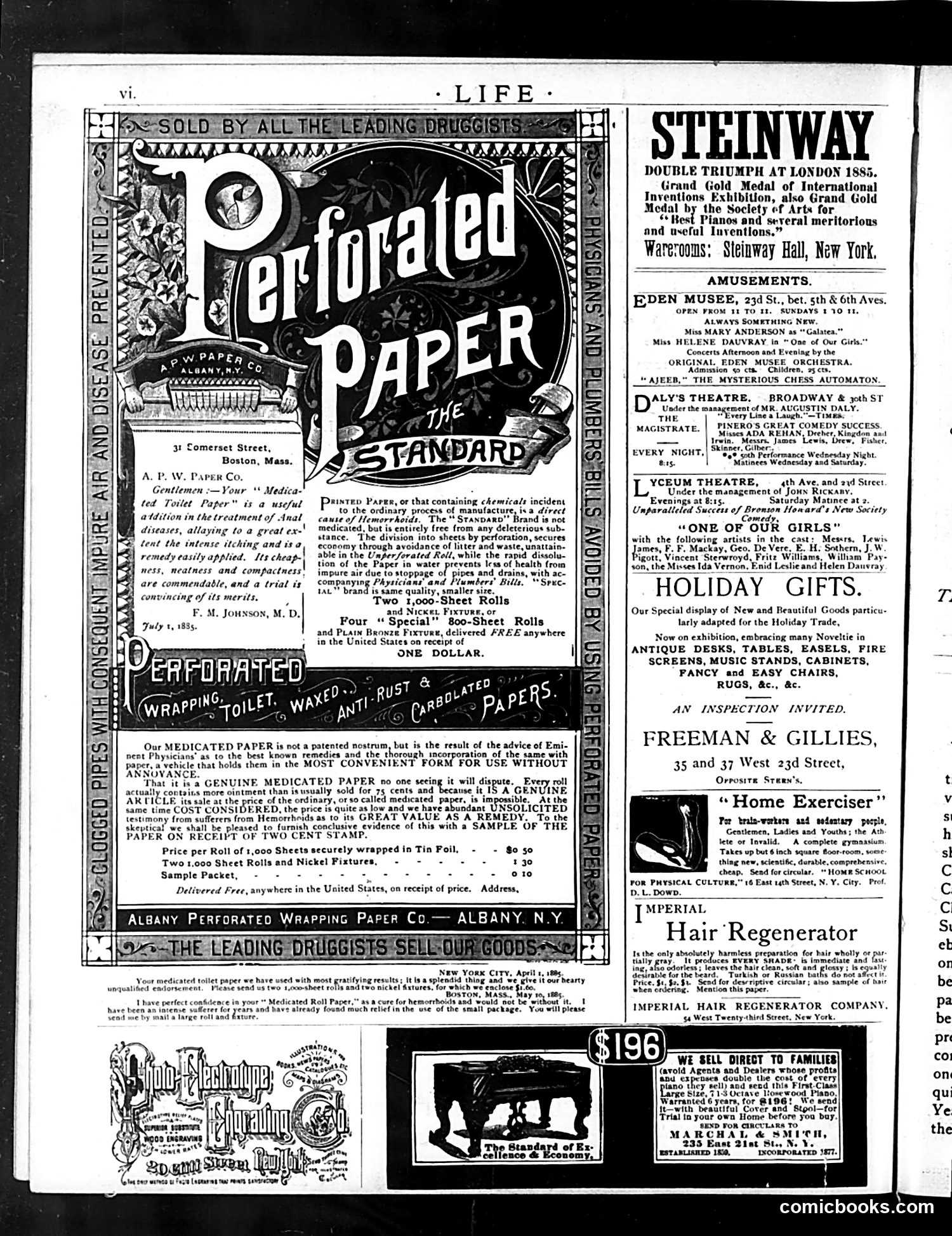
This page is primarily **advertising**, not political satire. The main content features two competing medicinal products: **"Perforated Paper"** (top left) and **"Medicated Paper"** (center-left) are both toilet papers marketed with medicinal claims—specifically to treat hemorrhoids. The "Medicated" version includes chemical treatments; the "Standard" version emphasizes perforation for convenience and hygiene. The right side contains standard period advertisements: Steinway pianos (highlighting 1885 London medals), theaters, furniture dealers, and patent medicines like "Home Exerciser" and "Hair Regenerator." **The satirical element** is implicit: Life magazine was satirizing the era's tendency to medicalize everyday products and make questionable health claims. The earnest doctor's testimonial and emphasis on "GENUINE ARTICLE" mock the proliferation of dubious patent remedies. This reflects genuine 1885 concerns about sanitation and intestinal health, but viewed today, the ads seem absurdly over-marketed for basic bathroom products.
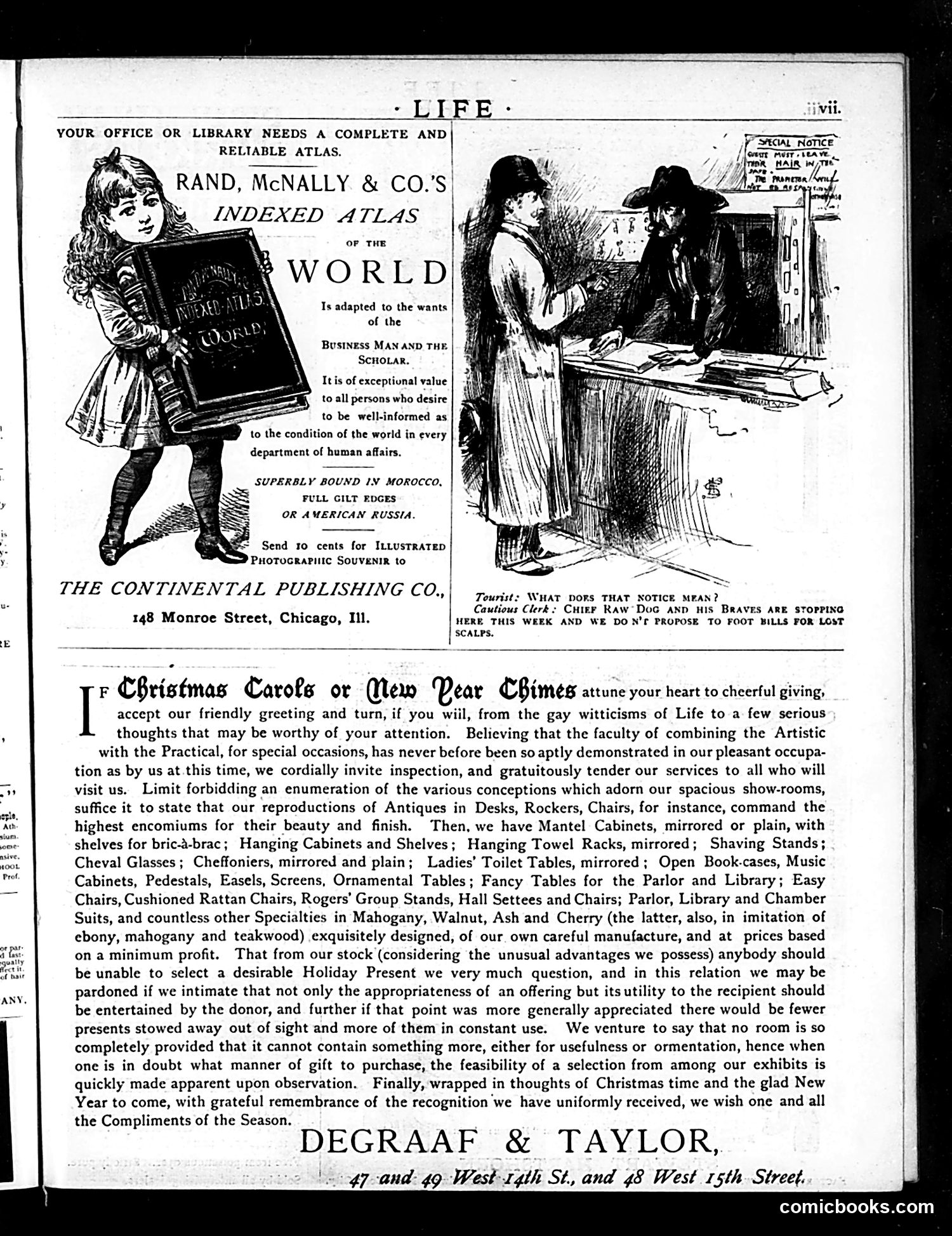
The small cartoon depicts a hotel clerk explaining to a tourist why they won't cover lost items. The clerk references "Cuter Raw Dog and his Braves," likely a satirical reference to a Native American leader visiting the city. The joke plays on period stereotypes—the implication being that Native Americans are inherently associated with scalping and theft, so the hotel refuses financial responsibility for guest losses during their stay. This reflects late-19th-century American attitudes: casual racism toward Indigenous peoples, stereotyping them as dangerous and criminal. The "humor" relies entirely on dehumanizing caricature and the assumption that readers would find Native Americans intrinsically untrustworthy. The rest of the page consists of period advertisements for atlases and furniture, unrelated to the cartoon's satire.
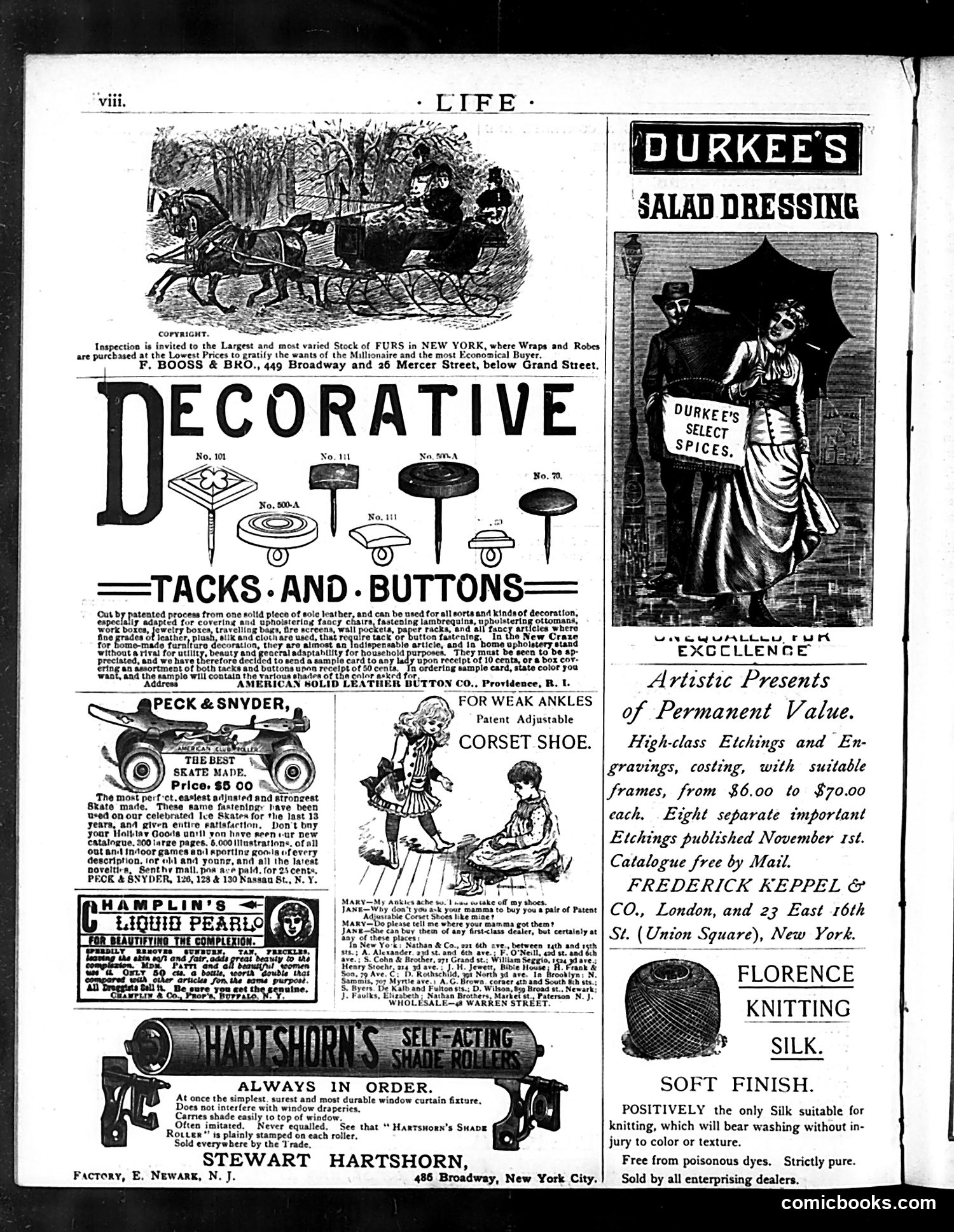
This page is **primarily a collection of advertisements** rather than political satire or editorial cartoons. The small engraving at the top showing a horse-drawn carriage appears to be decorative rather than satirical. The ads showcase late 19th-century consumer goods: fur coats, decorative tacks and buttons, ice skates, a corset shoe for weak ankles, window shade rollers, salad dressing, and knitting silk. Each emphasizes quality and availability to different economic classes—note the fur ad's reference to both "millionaires" and "economical" buyers. The only figure of note is the classical female statue in the Durkee's Salad Dressing ad (right side), labeled "Unequalled for Excellence"—a generic allegorical image meant to convey quality rather than satirize anyone specific. This is typical of Life magazine's revenue model: mixing serious editorial content with paid advertisements, with minimal distinction between the two in layout.
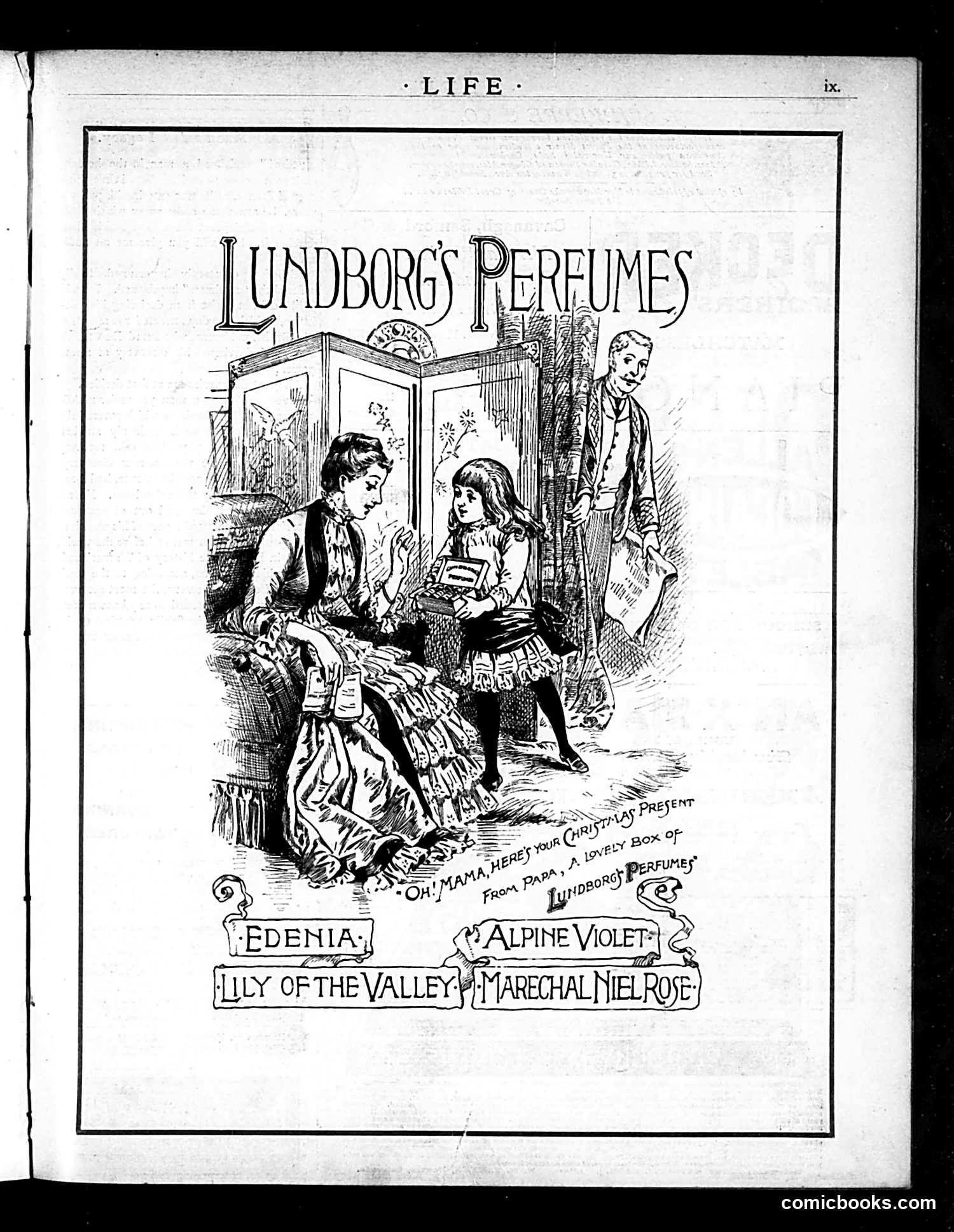
This is a full-page advertisement for Lundborg Perfumes from Life magazine. The illustration depicts a Victorian-era domestic scene: a well-dressed woman sits with a young girl, presenting her with a box of perfume as a Christmas gift. A man stands in the background, apparently approving of the selection. The advertisement lists five perfume varieties: Edenia, Alpine Violet, Lily of the Valley, Marechal Nel Rose, and one partially visible. The tagline reads: "Oh! Mama, here's your Christmas present from Papa—a lovely box of Lundborg Perfumes." This is not political satire but rather period advertising that reflects early 20th-century consumer culture and gender roles, positioning perfume as an appropriate luxury gift for women. The scene emphasizes refinement and domestic virtue.
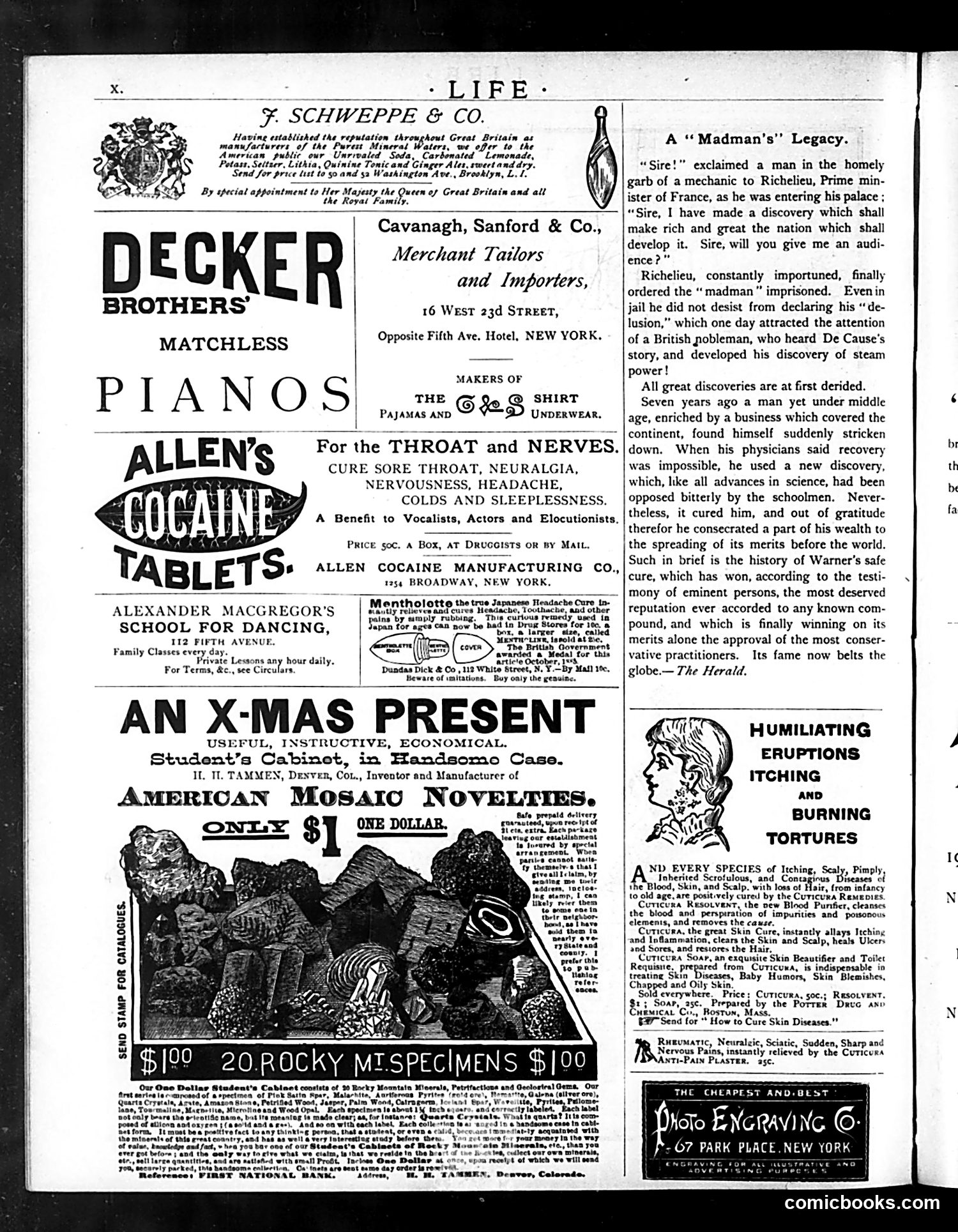
This page is primarily **advertising**, not satirical content. It contains commercial promotions typical of late 19th-century American publications, including: **Notable ads:** - Decker Brothers pianos - Allen's Cocaine Tablets (marketed for throat, nerves, and headaches—cocaine was legal and sold over-the-counter then) - Schweppe's mineral waters - Cuticura remedies for skin conditions - A "Student's Cabinet" of rock specimens **The only editorial content** is "A 'Madman's' Legacy"—a brief narrative praising Warner's Safe Cure. It draws an analogy to Richelieu dismissing a mechanic's steam-power discovery, arguing that great innovations face initial ridicule. The piece promotes Warner's product as similarly misunderstood but ultimately vindicated. **Context for modern readers:** This reflects an era when patent medicines, including cocaine products, were unregulated and promoted in mainstream publications as legitimate remedies.
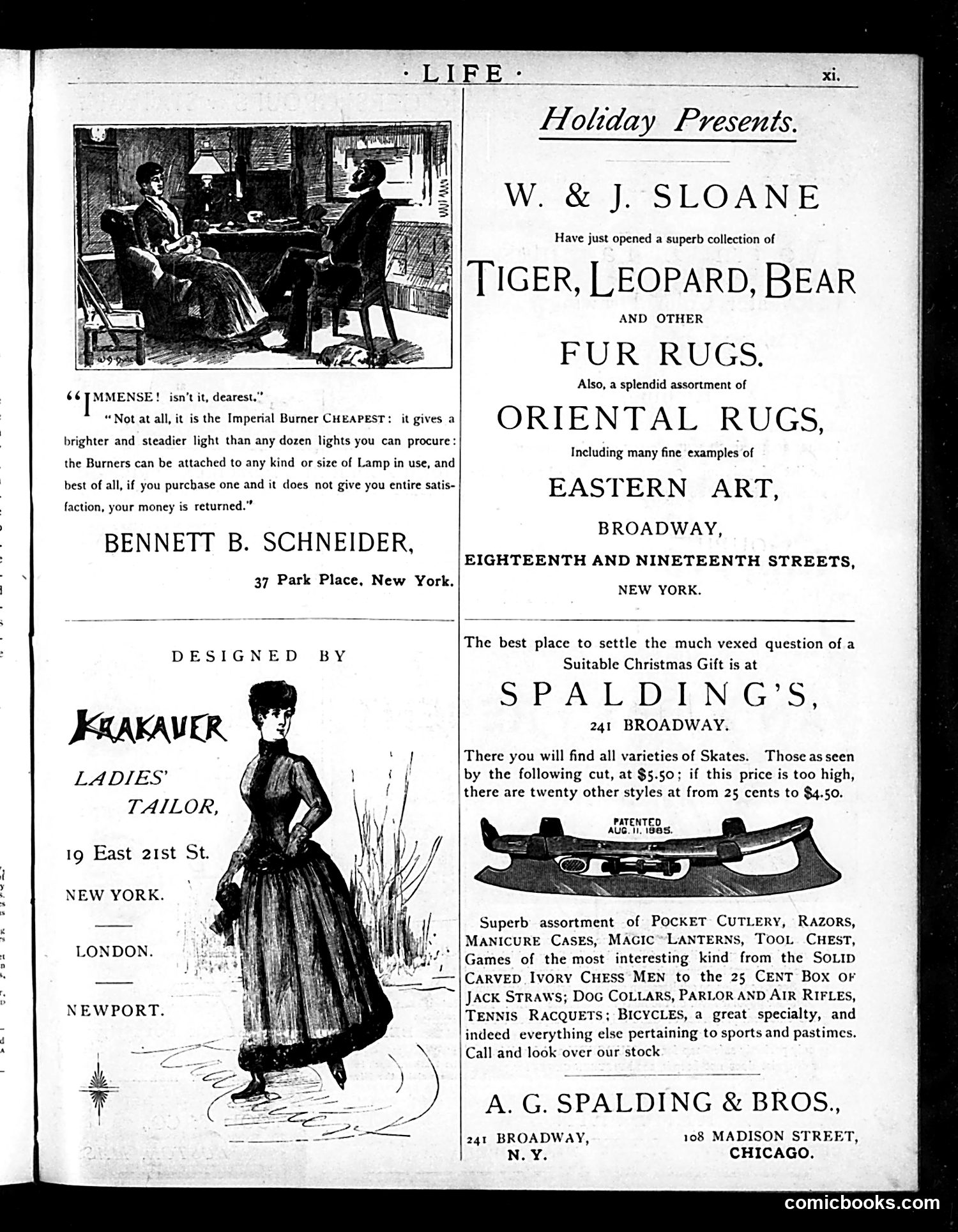
This is primarily a **holiday shopping advertisement page**, not a political cartoon. The small illustration at top left shows a domestic scene where a woman admires an "Imperial Burner" lamp—a gas lamp accessory that provides brighter, steadier light than competing options. The humor is gentle: the man claims superiority while the woman expresses delight, depicting the product as a desirable gift. The page consists mostly of luxury advertisements for affluent New York shoppers: fur rugs and Oriental carpets from W. & J. Sloane, a ladies' tailor, and extensive sporting goods from Spalding's (ice skates, pocket knives, chess sets, rifles, bicycles). These reflect late-19th-century leisure pursuits and consumer culture. **Context for modern readers**: This shows how Life marketed to wealthy audiences through aspirational gift suggestions, with gendered assumptions (lamps for wives, sporting equipment for men).
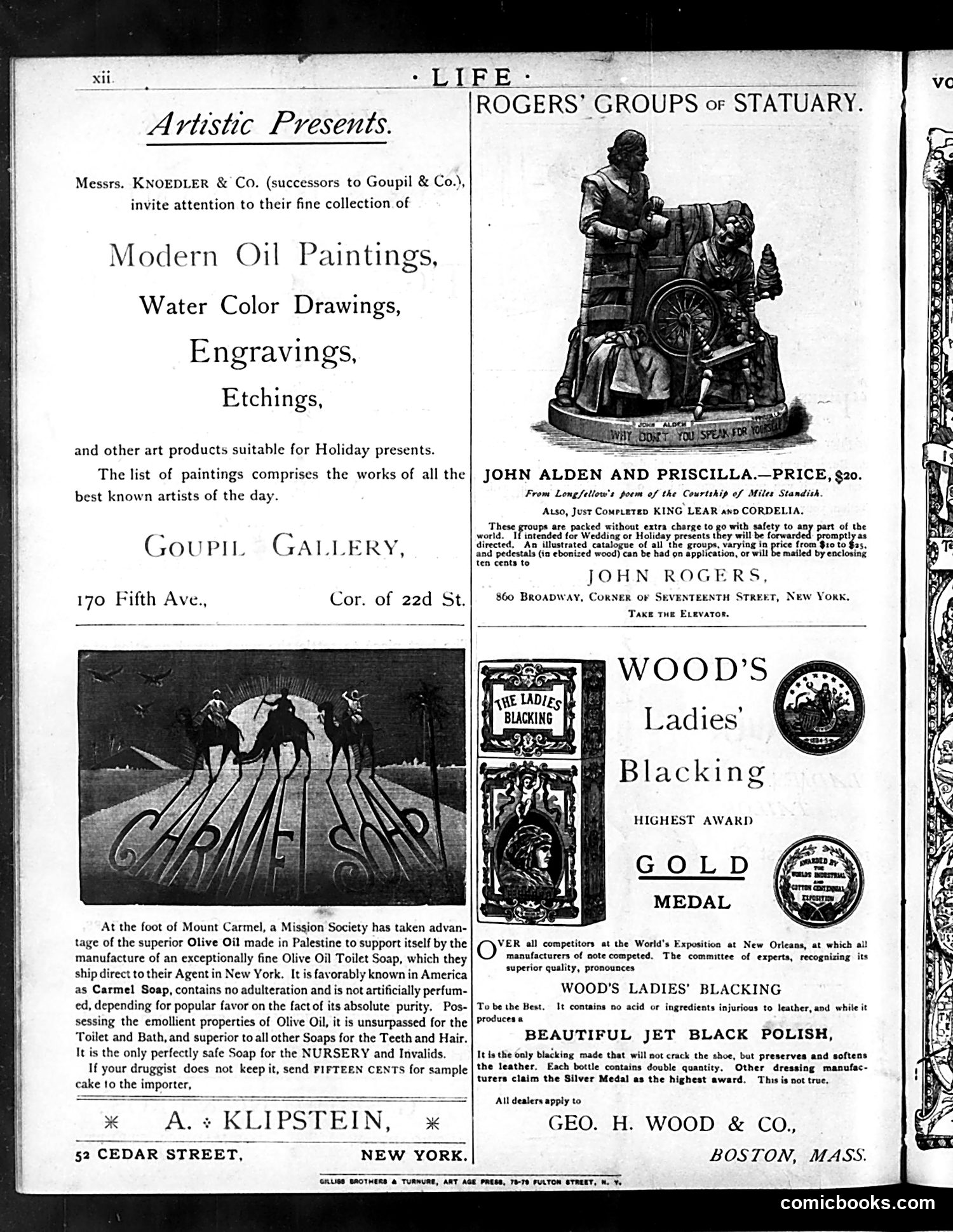
This page is primarily **advertising**, not satire or political commentary. It contains several Victorian-era product advertisements interspersed with some editorial content. The main visual element is a **Rogers' Groups statuary advertisement** showing a sculptural tableau of "John Alden and Priscilla" from Longfellow's poem—popular decorative pieces for wealthy homes. These were mass-produced plaster figurines. Other ads promote: - **Goupil Gallery**: fine art for holiday gifts - **Carmel Soap**: olive oil soap from Palestine, marketed as pure and safe for infants - **Wood's Ladies' Blacking**: shoe polish that won a gold medal at the World's Exposition in New Orleans The bottom includes an illustration of **camels at Mount Carmel**, tying the soap's origin story to its name. There is no political satire visible. This represents typical *Life* magazine content from the late 19th century, when the publication mixed literary/artistic editorial matter with luxury consumer advertising targeting affluent readers.