
A complete issue · 16 pages · 1885
Life — November 5, 1885
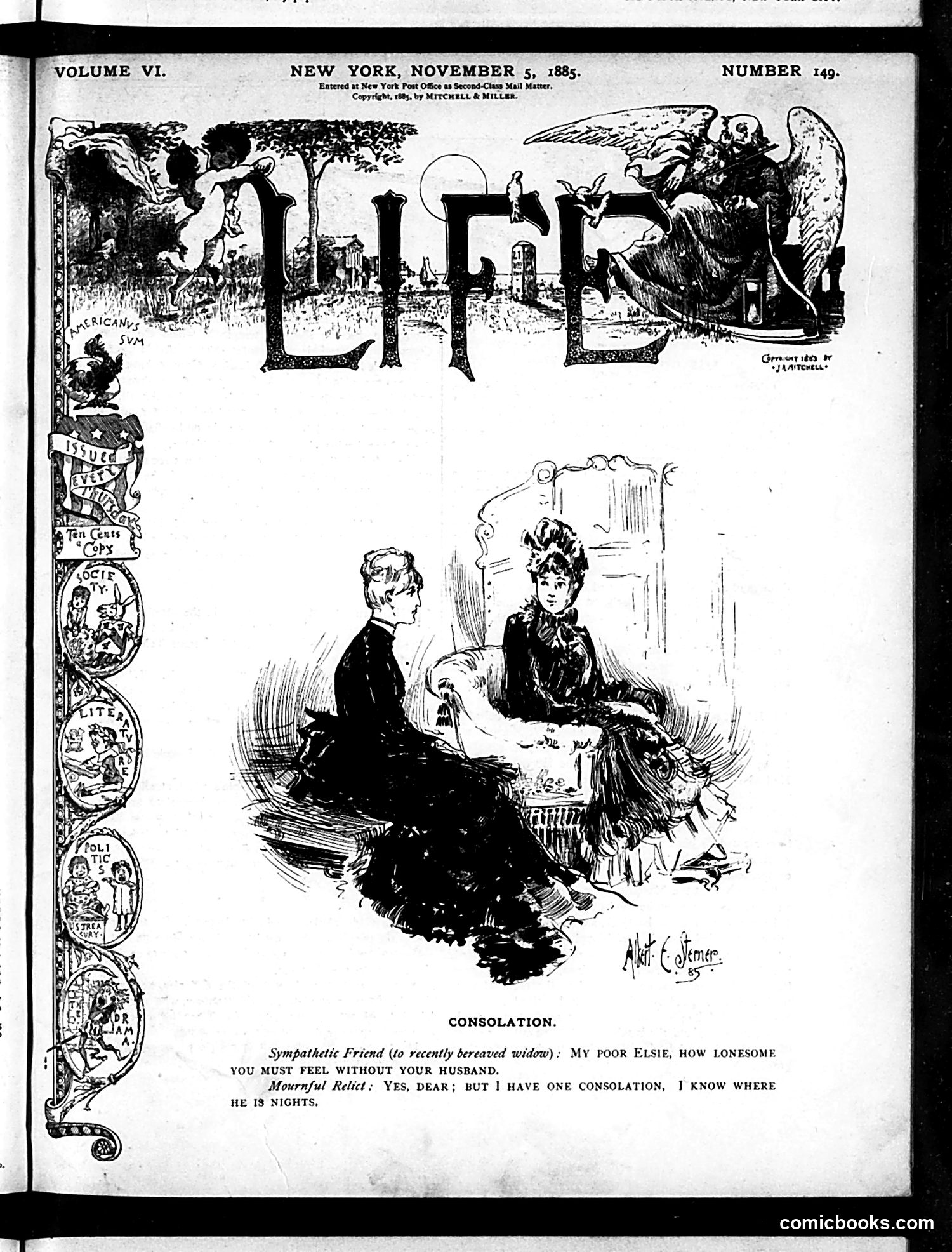
The page features a cartoon titled "Consolation" by Albert Sterner depicting a social scene. A sympathetic friend consoles a recently bereaved widow named Elsie about her loneliness following her husband's death. The mourning woman responds that she knows "where he is nights"—a dark joke implying her husband visits her at night, likely suggesting either ghostly visits or, more probably, that he's unfaithful and conducting an affair. The satire targets Victorian attitudes toward widowhood and marital fidelity, suggesting that even deceased husbands' infidelities persist as sources of female suffering. The elaborate decorative border on the left contains various Life magazine section headers and emblems typical of the publication's design.
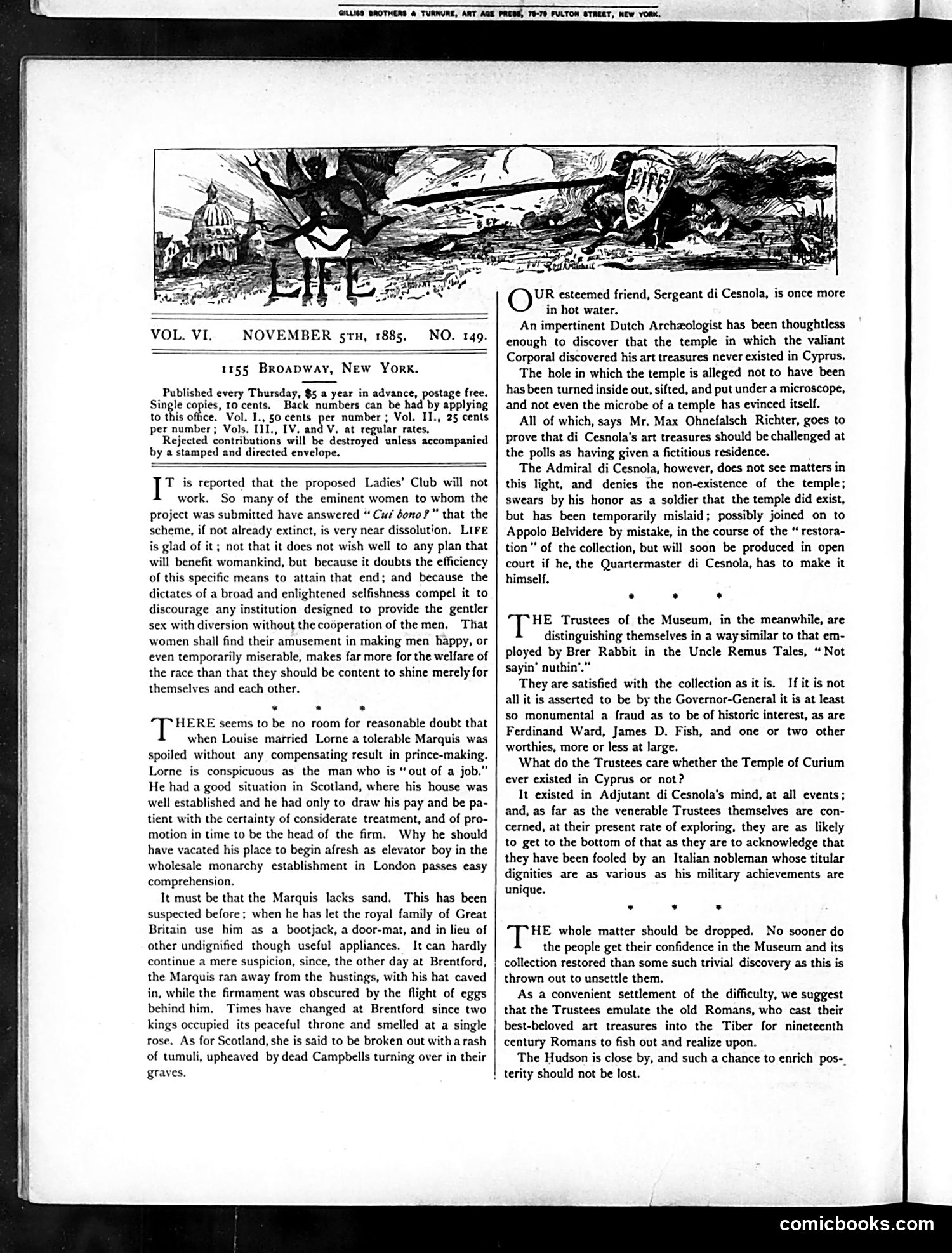
The masthead illustration shows "LIFE" with classical and allegorical imagery. The main text articles are satirical commentary rather than visual cartoons. The first piece mocks a proposed Ladies' Club, suggesting women lack the "broad and enlightened selfishness" needed to run institutions independently. The satire argues women need male cooperation to function effectively—a backhanded critique of Victorian gender restrictions dressed as concern. The second section ridicules the Marquis of Lorne (married to Queen Victoria's daughter Louise), calling him unfit for royal responsibilities and suggesting he serves merely as a "bootjack" or doormat in the monarchy. The final piece discusses the Museum's Temple of Curium controversy, where trustees were accused of being duped by fraudulent discoveries—mocking institutional credulity. The satire targets institutional incompetence, gender politics, and aristocratic pretension typical of 1880s Life magazine commentary.
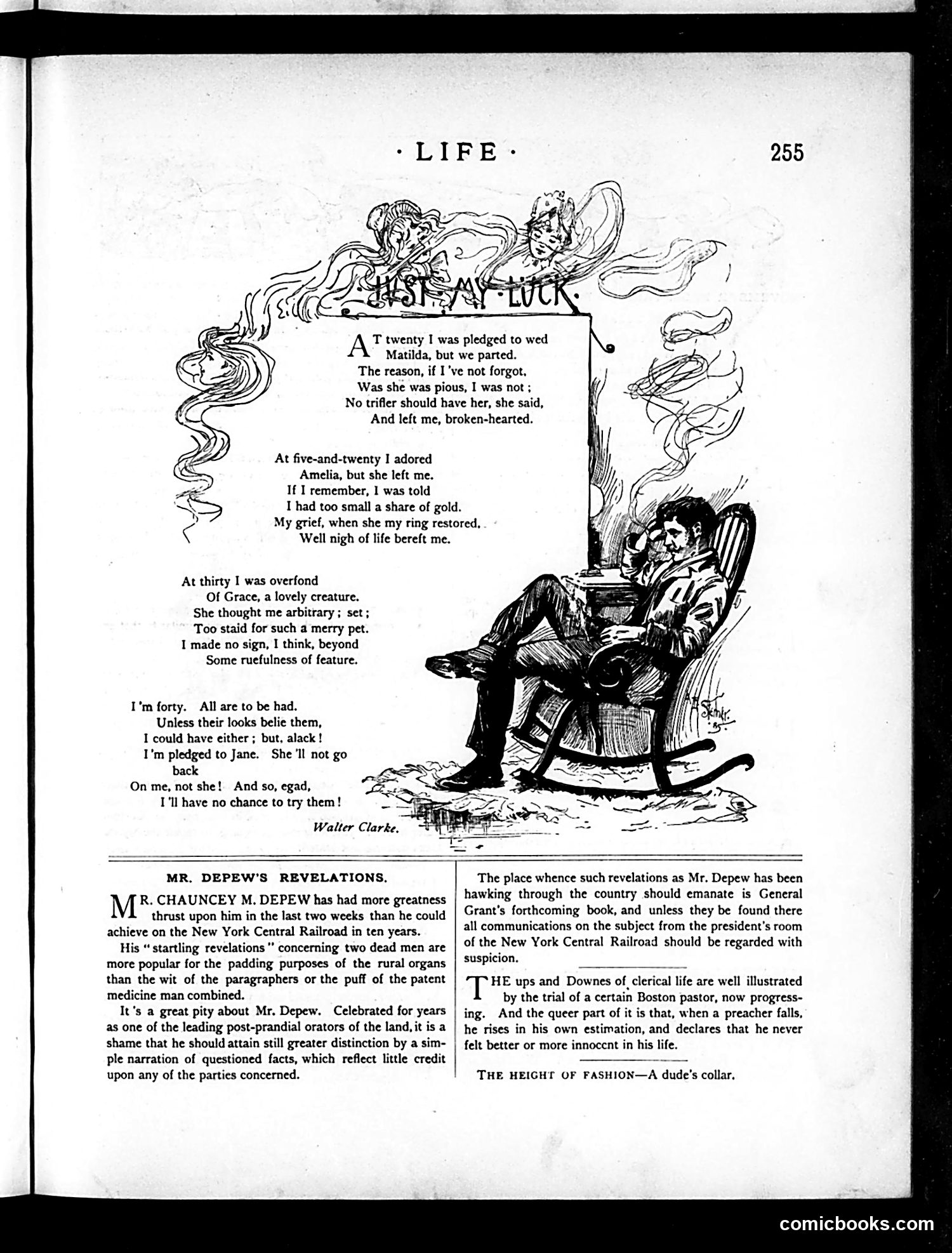
**Main Content: "Last Luck" Poem by Walter Clarke** This is a sentimental poem about romantic misfortunes across a man's life—rejected at twenty (Matilda), twenty-five (Amelia), and thirty (Grace)—culminating in being pledged to Jane against his wishes. The accompanying illustration shows a dejected man slumped in a chair, reinforcing the theme of romantic disappointment. **Secondary Content: "Mr. Depew's Revelations"** This section discusses Chauncey M. Depew, a prominent New York Central Railroad executive and public figure known for speeches ("post-prandial orations"). The text critiques him for making questionable public statements about railroad matters, suggesting his casual remarks lack credibility and reflect poorly on those involved. The page exemplifies *Life*'s mix of poetry, humor, and satirical commentary on contemporary figures.
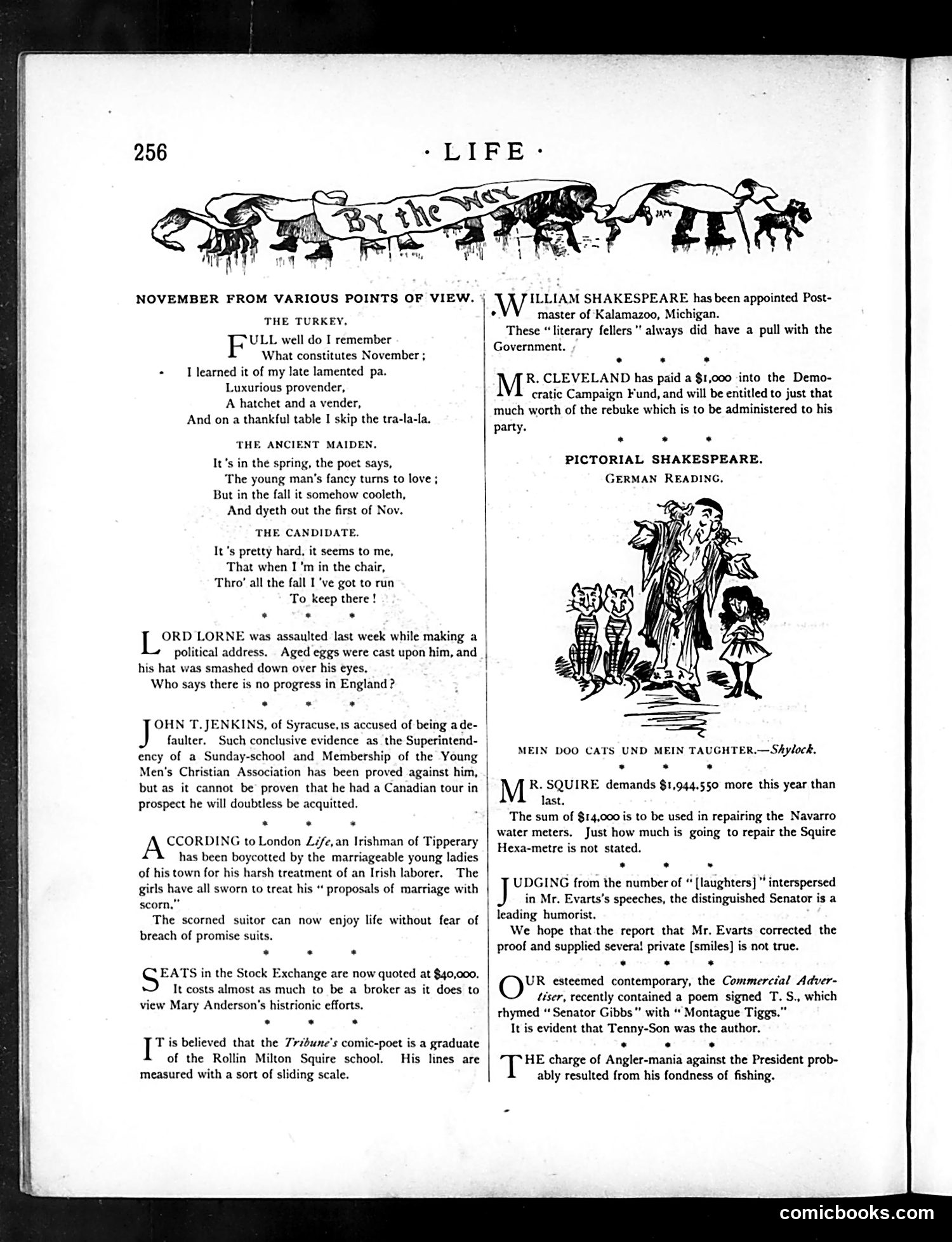
This page contains brief satirical news items typical of Life's format. Key references include: **William Shakespeare appointment**: A joke about Shakespeare being named Postmaster of Kalamazoo, Michigan—likely satirizing political patronage appointments of unqualified candidates. **Cleveland's donation**: President Cleveland contributing $1,000 to the Democratic Campaign Fund, with the satire that he'll receive back only his proportionate share of the "rebuke"—mocking his political standing or unpopularity. **Lord Lorne assault**: A real incident where eggs were thrown at a political speaker, used humorously to question whether England truly has "progress." **"Pictorial Shakespeare" cartoon**: Shows a German reader surrounded by cats, suggesting German audiences misunderstand or comically misinterpret Shakespeare. The page exemplifies Life's formula: quick political jabs at contemporary figures and events, assuming reader familiarity with current news.
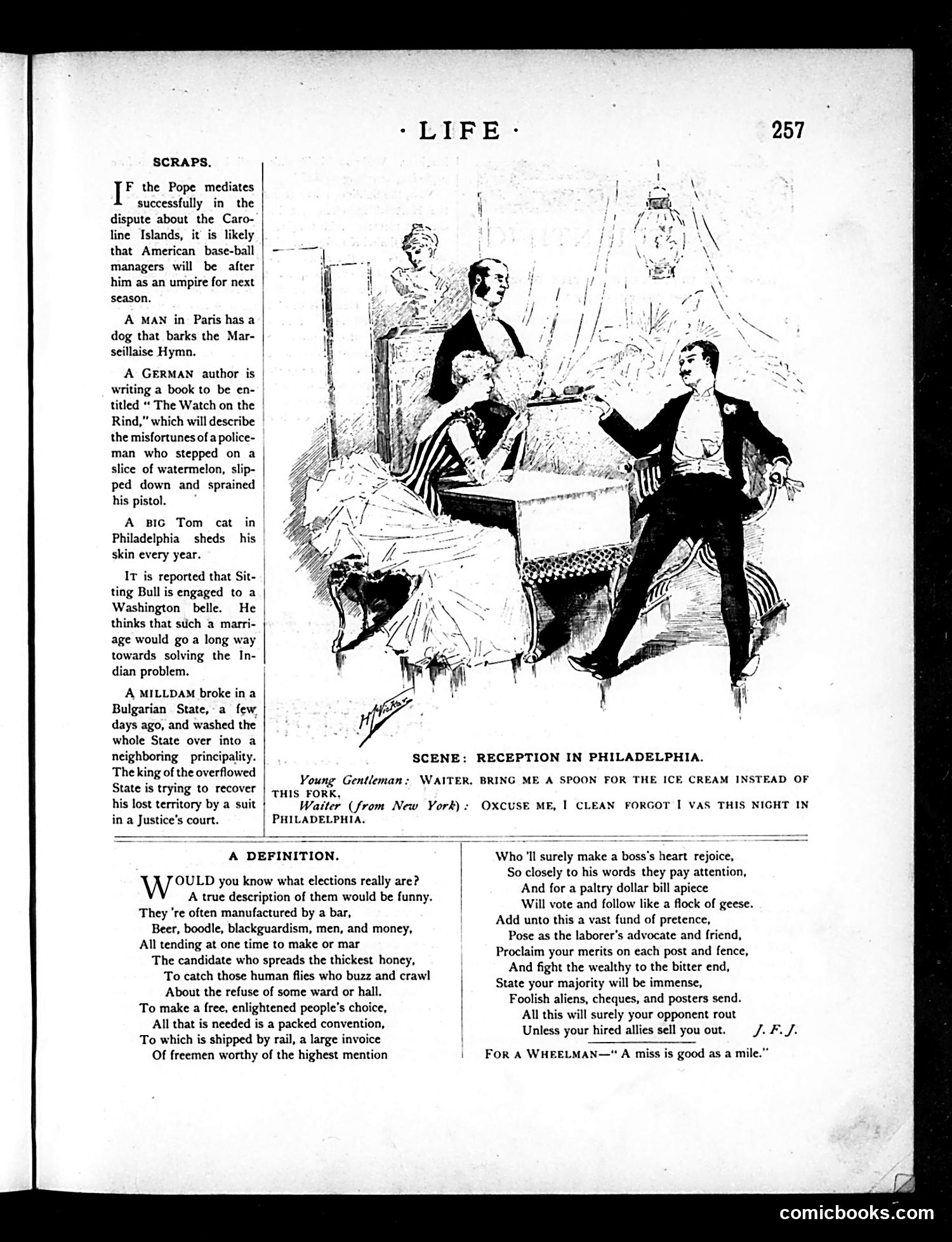
**Main Cartoon: "Reception in Philadelphia"** The sketch depicts a waiter offering ice cream with a fork instead of a spoon to a diner. The caption indicates this occurs in Philadelphia, with the waiter claiming he "forgot" proper utensil etiquette. This appears to be gentle satire about Philadelphia's provincial or unsophisticated manners compared to New York standards—a common East Coast regional joke. **"Scraps" Section:** Brief humorous anecdotes, including jokes about papal mediation, a Parisian dog, and a Philadelphia cat. These are light filler content typical of the magazine. **"A Definition":** Satirical poem mocking elections, describing them as manufactured spectacles involving money, backguardism, and deception—commentary on political corruption and voter manipulation in the era.
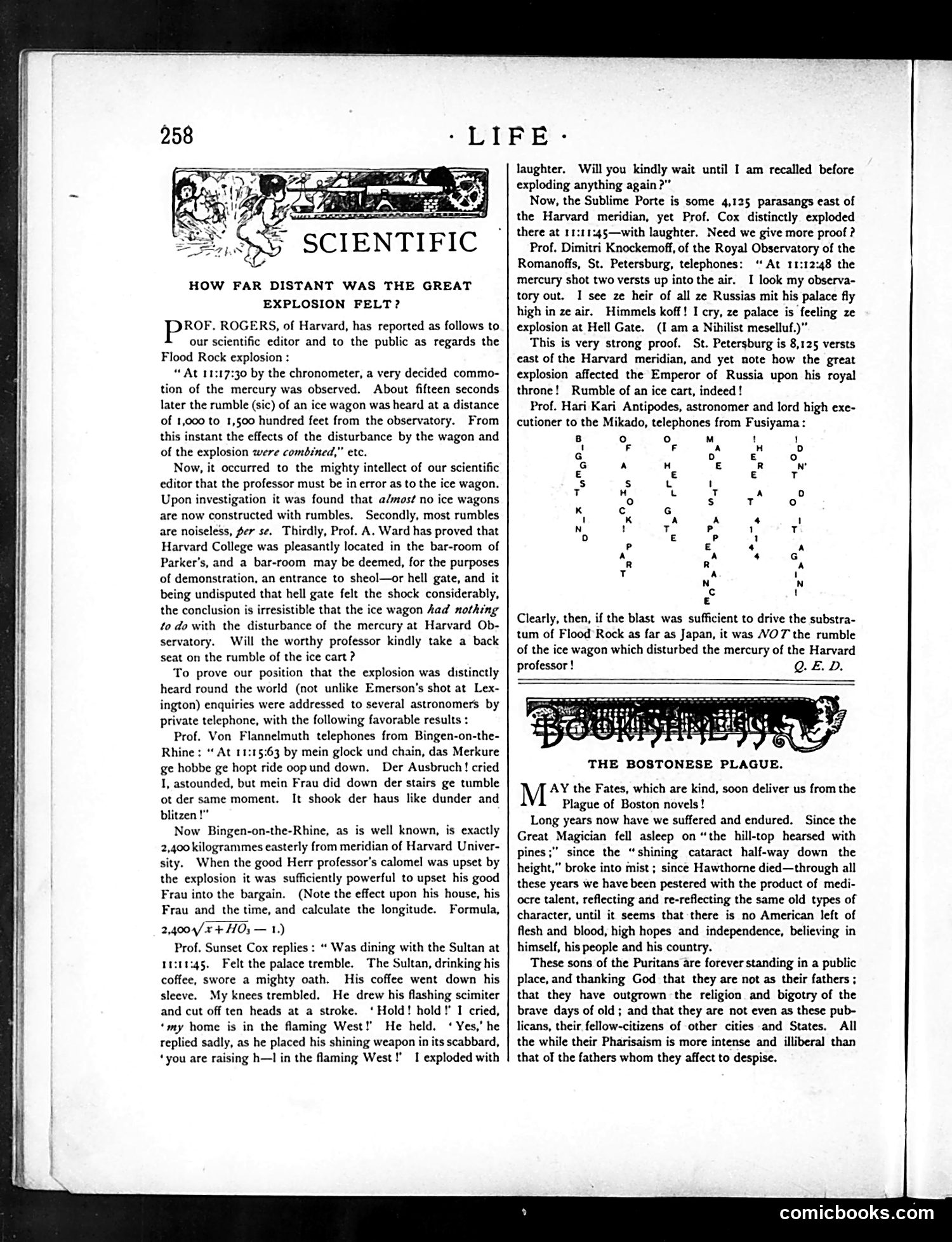
This page contains two satirical pieces from *Life* magazine: **"Scientific: How Far Distant Was the Great Explosion Belt?"** A humorous debate about whether a dramatic explosion observed at Harvard Observatory was caused by an ice wagon or other local disturbance. The satire mocks academic pretension by featuring absurdly detailed international telegrams from European scientists (in Bingen-on-the-Rhine, St. Petersburg, and Japan) all claiming the explosion affected their locations. The joke ridicules how easily scientists accept far-fetched explanations and how academics inflate minor local events into matters of international importance. **"The Bostonese Plague"** A darker satirical piece about Boston's Puritan heritage. It laments the city's religious rigidity and intolerance, contrasting the "brave days of old" with contemporary Puritan descendants' "intense and illiberal" attitudes toward other Americans and religions.
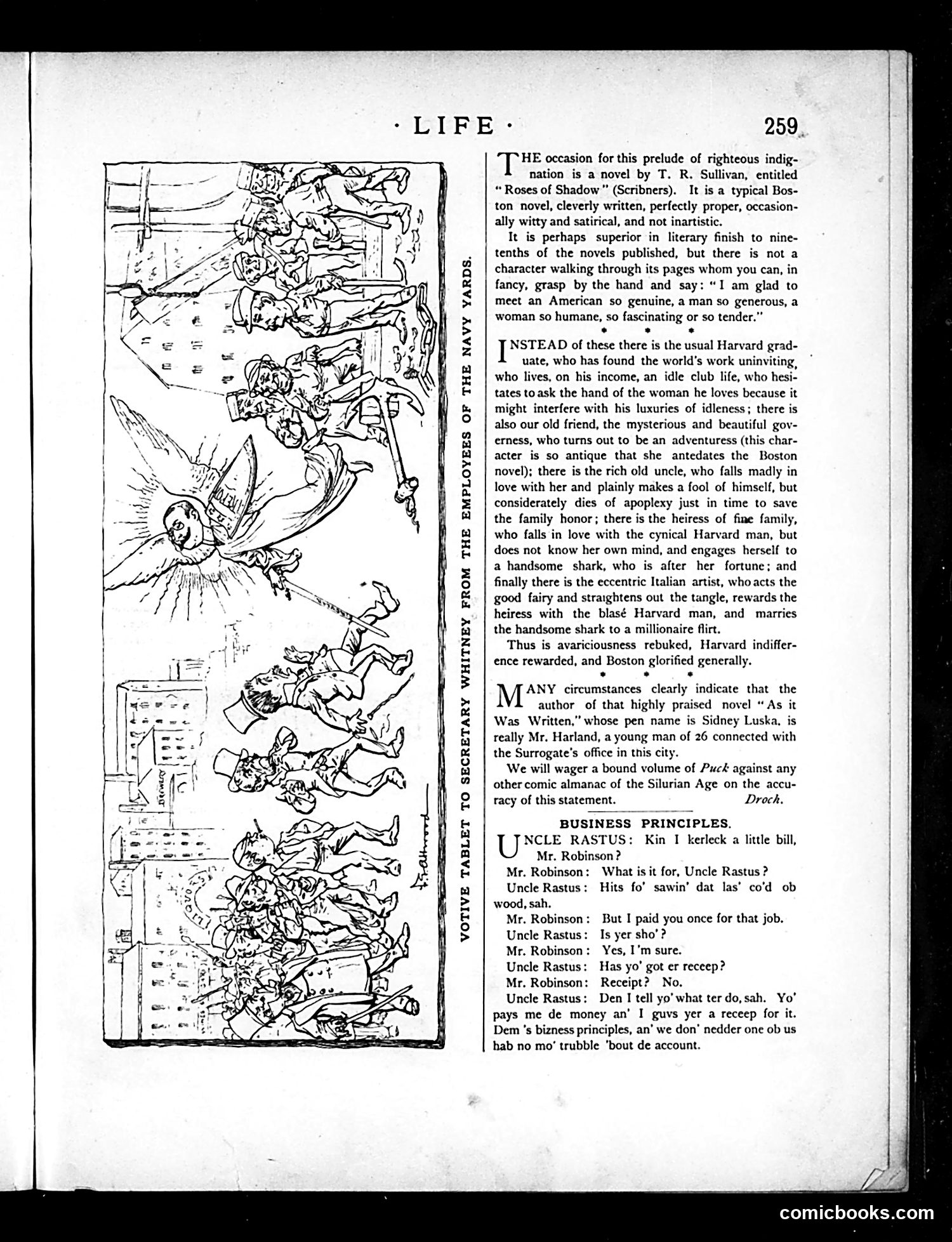
This page contains literary criticism and humor rather than political cartoons. The left side features an illustration labeled "VOTIVE TABLET TO PRESERVE OF THE NAVY YARDS" (appears to be a satirical naval/maritime scene, though details are difficult to discern). The right column reviews T.R. Sullivan's novel "Roses of Shadow," praising its literary merit. It then satirizes typical Harvard graduate characters—idle wealthy men who pursue women of lower social standing, die conveniently to preserve family honor, or marry heiresses to millionaires. The satire mocks predictable Boston novel tropes and Harvard masculine stereotypes. The "Business Principles" dialogue between Uncle Rastus and Mr. Robinson uses dialect humor (common to the era) about payment receipts, reflecting early 20th-century comic conventions.
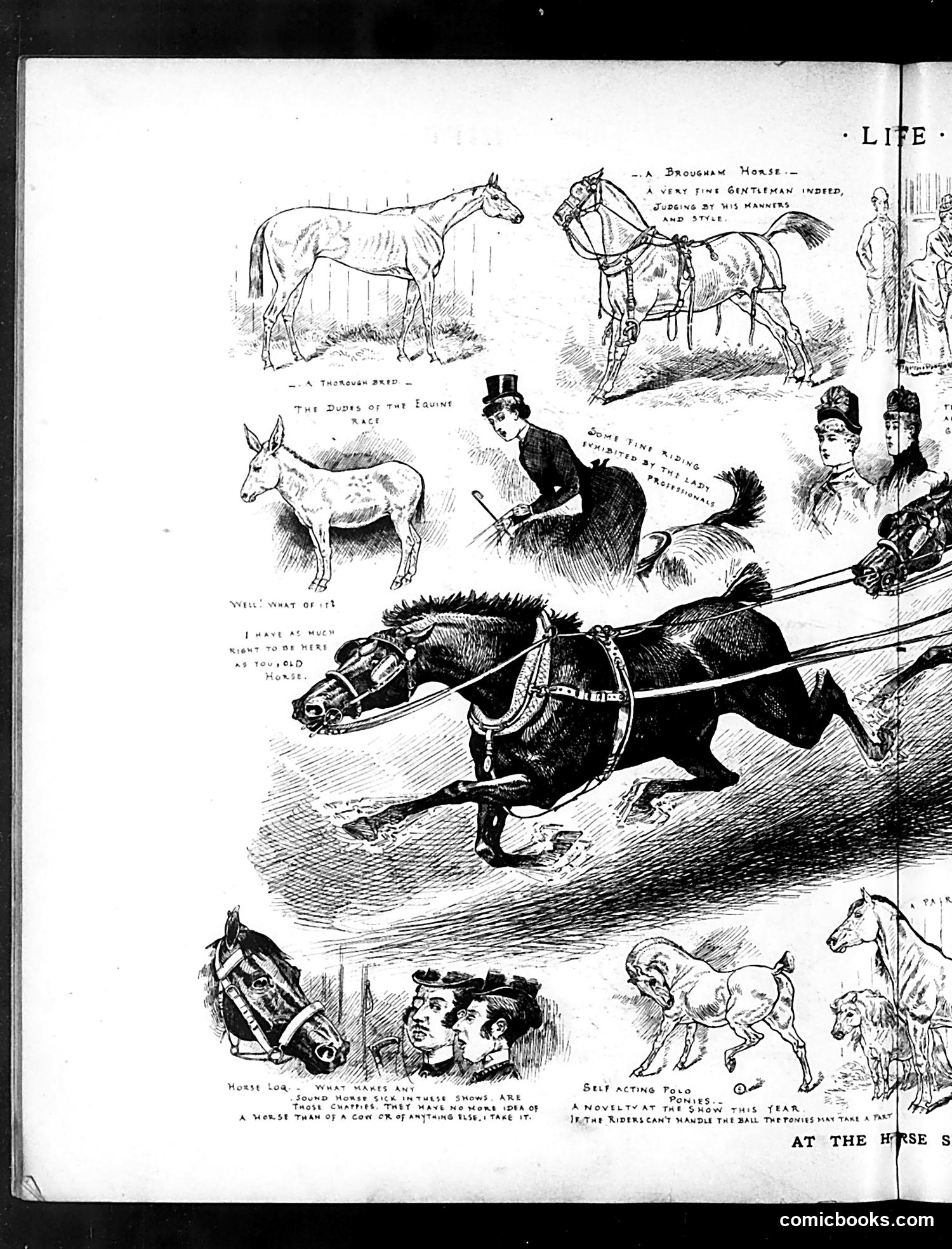
This satirical page from *Life* magazine depicts various aspects of the fashionable horse show scene. The illustrations mock both the animals and their wealthy owners. The central image shows an elegant carriage horse that appears poorly behaved or uncontrollable, contrasting with the refined gentleman driver. Upper sketches present idealized horses and well-dressed equestrians judging animals "by their manners and style." Lower panels appear to ridicule the pretension of horse-show culture—one caption mentions "horse talk" and suggests owners lack genuine knowledge about their animals. The donkey sketch may mock those who mistake inferior animals for quality stock. The satire targets the wealthy class's superficial engagement with horsemanship and their reliance on appearance over substance, a recurring theme in *Life*'s social criticism.
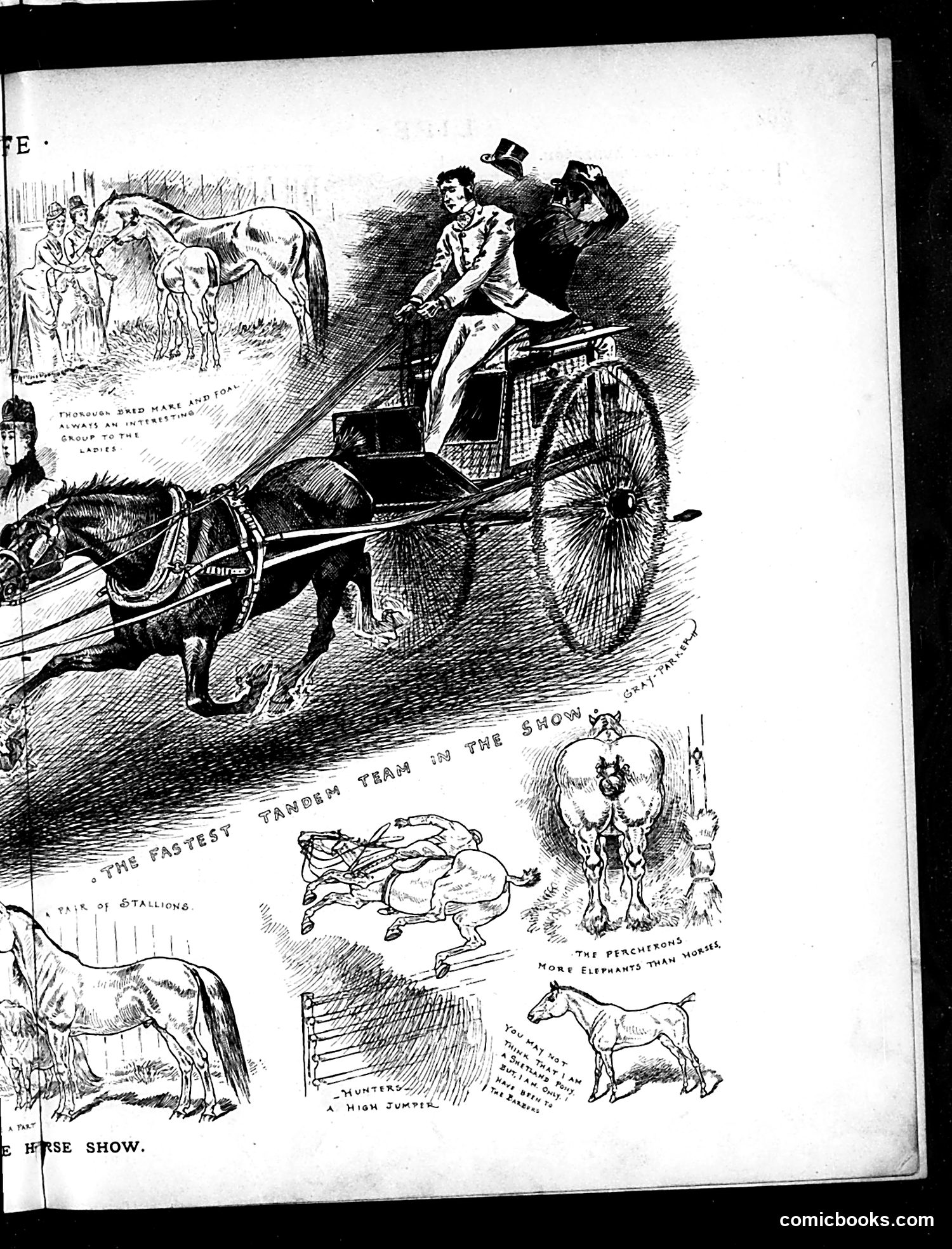
This page satirizes the pretensions of elite horse shows through comparative animal drawings. The main illustration shows fashionably dressed riders on elaborate carriages, contrasted with smaller sketches of various animals labeled with satirical captions. The text references "the fastest tandem team in the snow," "a pair of stallions," "the pencil more eloquent than horse," and "a high jumper," suggesting mockery of horse show categories and judges' criteria. The satire appears to critique how wealthy society obsesses over trivial distinctions in horse breeding and riding while missing the animals' actual qualities. The elaborate engraving style and layout typical of *Life* magazine's Victorian-era humor emphasizes the absurdity of upper-class equestrian competitions.
This page mocks the theatrical actress **Mary Anderson**, a popular performer of the era. The left column is a parody poem in the style of Walt Whitman (credited humorously as "Poet Lariat"), using absurdly grandiose language to celebrate Anderson's performances—comparing her effect on audiences to earthquakes, explosions, and cosmic phenomena. The joke is the *excessive* praise itself: the overwrought metaphors ("gleaming bald-head by the bass violin cracks open like a wounded watermelon") mock both theatrical hyperbole and the fawning critical adulation actors received. The author mocks himself too, presenting an inflated ego ranting with self-aggrandizing language. The right column discusses a play, "In His Power," and praises the British actor **Kyrle Bellew** for introducing beauty to American audiences—again with gentle satire about dramatic conventions and the merchandising of actors' images on cigarette packages. The "Literary Notes" section further parodies contemporary literary pretension with absurd claims about famous writers.
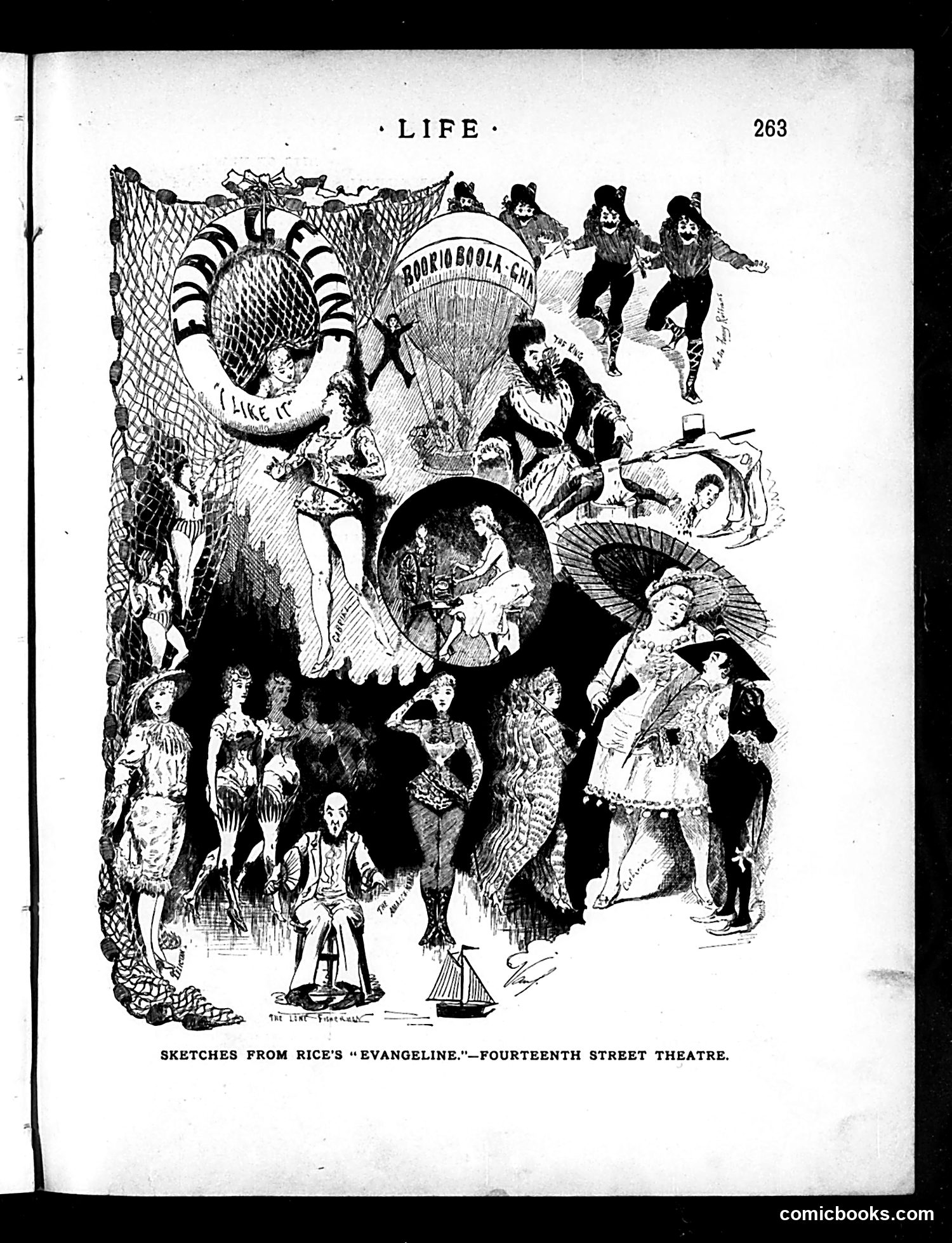
This page presents sketches from a theatrical production of "Evangeline" at the Fourteenth Street Theatre, adapted by Rice. The illustration is a collage of scenes and characters from the play, featuring various performers in period costume and theatrical poses. "Evangeline" was a popular 19th-century musical comedy based on Longfellow's poem. The sketches show the theatrical spectacle and comedic elements of the production—acrobats, dancers, and performers in elaborate costumes. The overall composition satirizes the theatrical experience itself, capturing the variety entertainment and visual extravagance audiences could expect from this particular stage adaptation. The page serves primarily as entertainment coverage and promotion of the theatrical production rather than political satire.
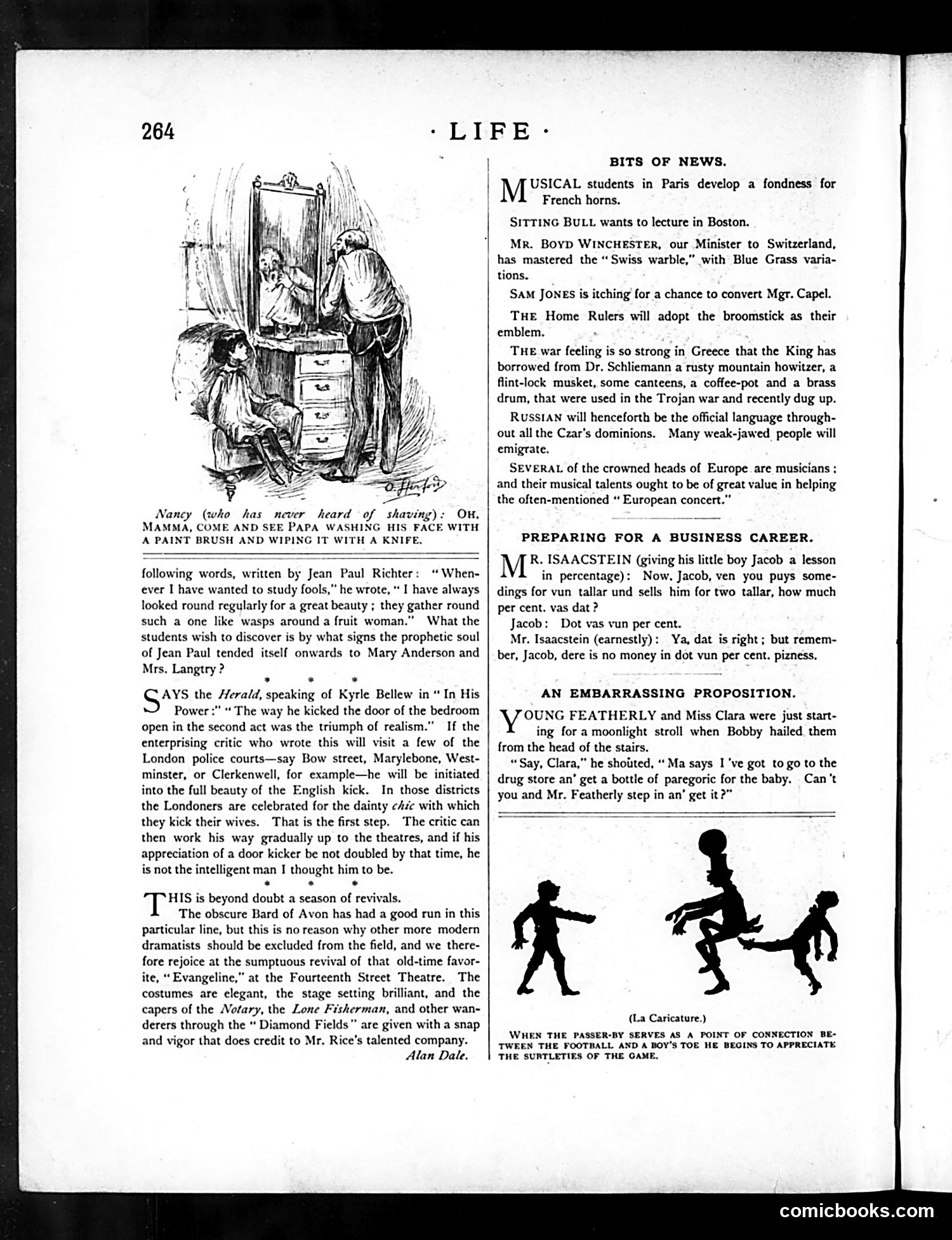
This page contains several brief satirical pieces typical of *Life* magazine's social commentary: **Main Cartoon**: A child observes her father using a paintbrush and knife to wash and dry his face—absurd exaggeration mocking men's grooming routines or possibly criticizing sloppy masculine hygiene practices. **"Bits of News"**: Rapid-fire one-liners satirizing current events and figures. Notable references include Sitting Bull (the famous Native American leader) wanting to lecture in Boston, and Greek military desperation (borrowing ancient Trojan War weapons). The piece mocking "Home Rulers" adopting a broomstick emblem likely references Irish Home Rule politics. **"Preparing for a Business Career"**: A Jewish immigrant father teaches his son Jacob about profit margins using Yiddish dialect humor—stereotypical depiction of Jewish merchants and commerce. **"An Embarrassing Proposition"**: Social comedy about a young couple interrupted by a child's errand request, suggesting impropriety in their moonlit stroll. The dialect humor and ethnic stereotyping reflect late-19th-century *Life* magazine conventions, targeting immigrants and various social groups for comedic effect.
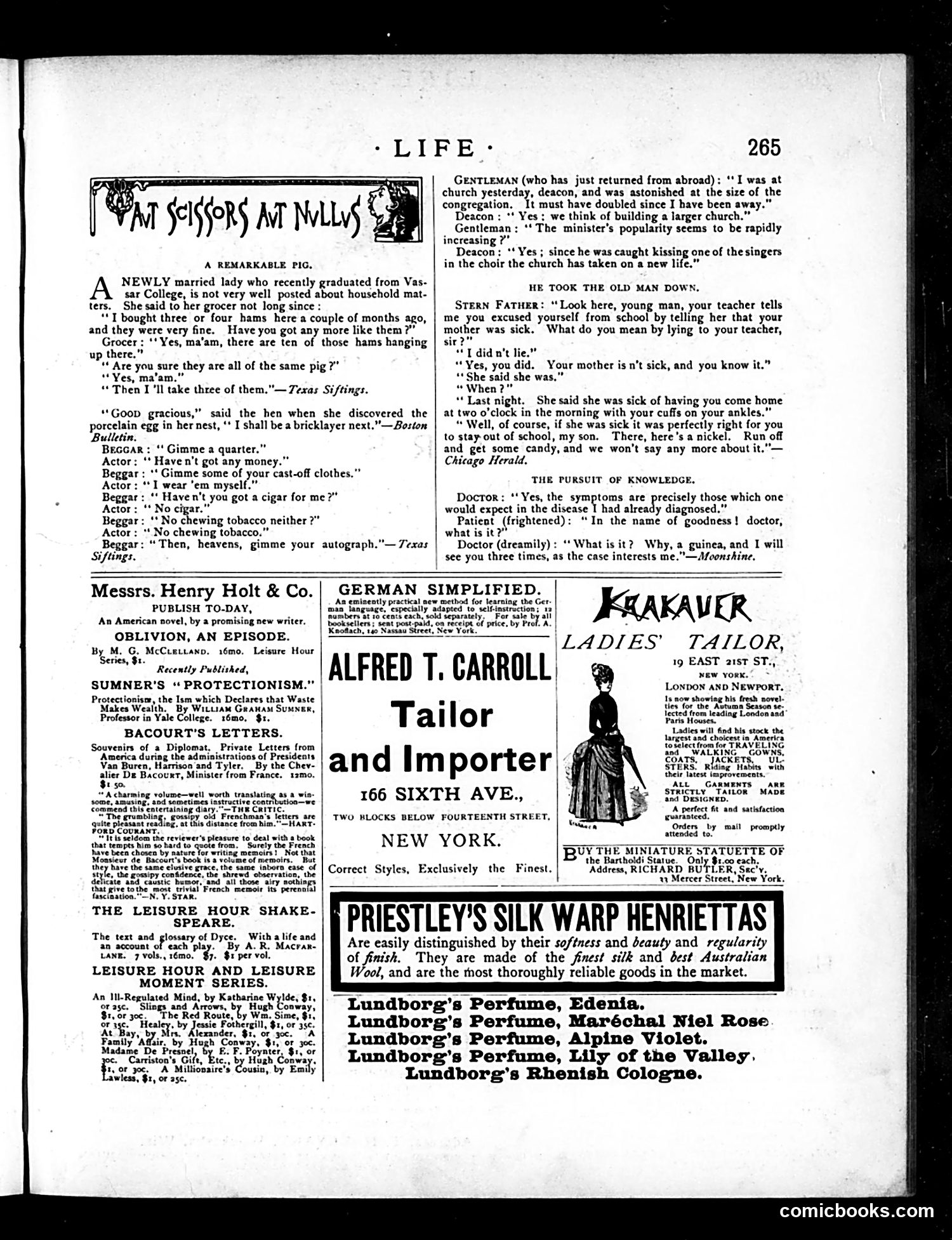
This page contains five humorous anecdotes typical of late-19th-century American satire: **"A Remarkable Pig"**: A newly married Vassar graduate, apparently sheltered from practical matters, asks a grocer if all his hams came from the same pig—revealing her naive assumption that multiple hams could come from a single animal. **The Hen and Porcelain Egg**: A hen discovers a fake egg and jokingly concludes she'll become a bricklayer instead—absurdist humor about confused identity. **Beggar and Actor**: A penniless beggar methodically asks an actor for increasingly valueless items, finally requesting his autograph—suggesting celebrity signatures were treated as worthless despite their supposed prestige. **The Church Congregation**: A minister's popularity increases after being caught kissing a choir singer, satirizing how scandal paradoxically attracts church attendance. **Father and Truant Son**: A stern father initially scolds his son for lying about his mother being sick, then rewards him with candy upon learning mother genuinely dislikes his late-night behavior—mocking parental hypocrisy. The humor targets naivety, social pretension, and human contradiction.
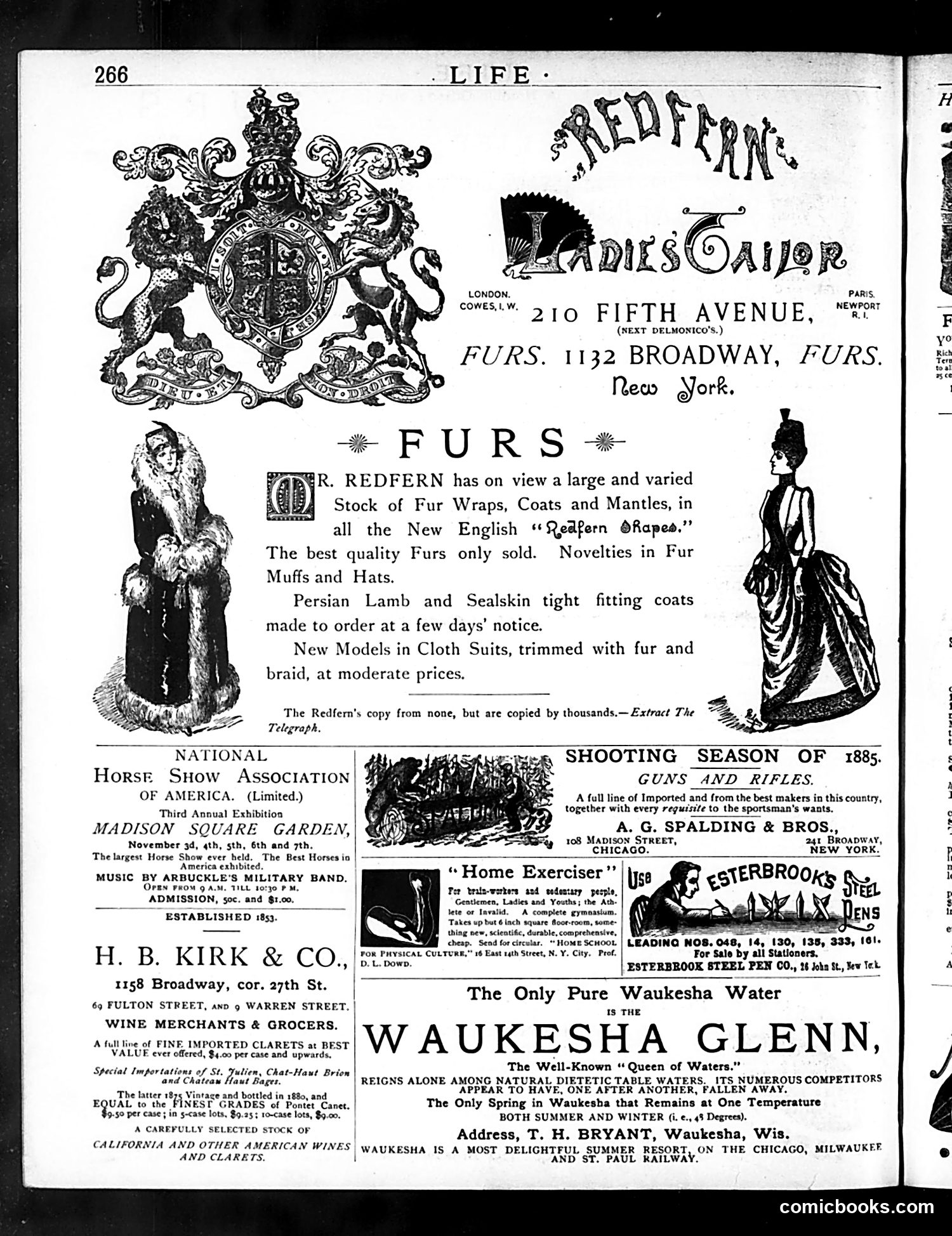
This page is primarily **advertising**, not editorial content or satire. It contains multiple advertisements typical of an 1885 American magazine: **Key advertisements include:** - **Redfern's** (fur merchant): A fashionable London/Paris furrier advertising fur wraps, coats, and the "New English Redfern shapes"—the ad boasts that competitors copy their designs - **National Horse Show Association**: Promoting the third annual exhibition at Madison Square Garden - **A.G. Spalding & Bros.**: Sporting goods vendor advertising guns and rifles for the hunting season - **H.B. Kirk & Co.**: Wine and spirits merchant - **"Home Exerciser"**: Fitness equipment for gentlemen and ladies - **Waukesha Glenn**: A mineral water spa claiming superiority over competitors **The satire angle**: The Redfern ad's claim that competitors copy them "by thousands" (attributed to The Telegraph) is self-congratulatory puffery typical of Victorian advertising. Otherwise, this is straightforward commercial promotion reflecting upper-class 1880s consumer interests: fashion, sporting equipment, luxury goods, and leisure activities.
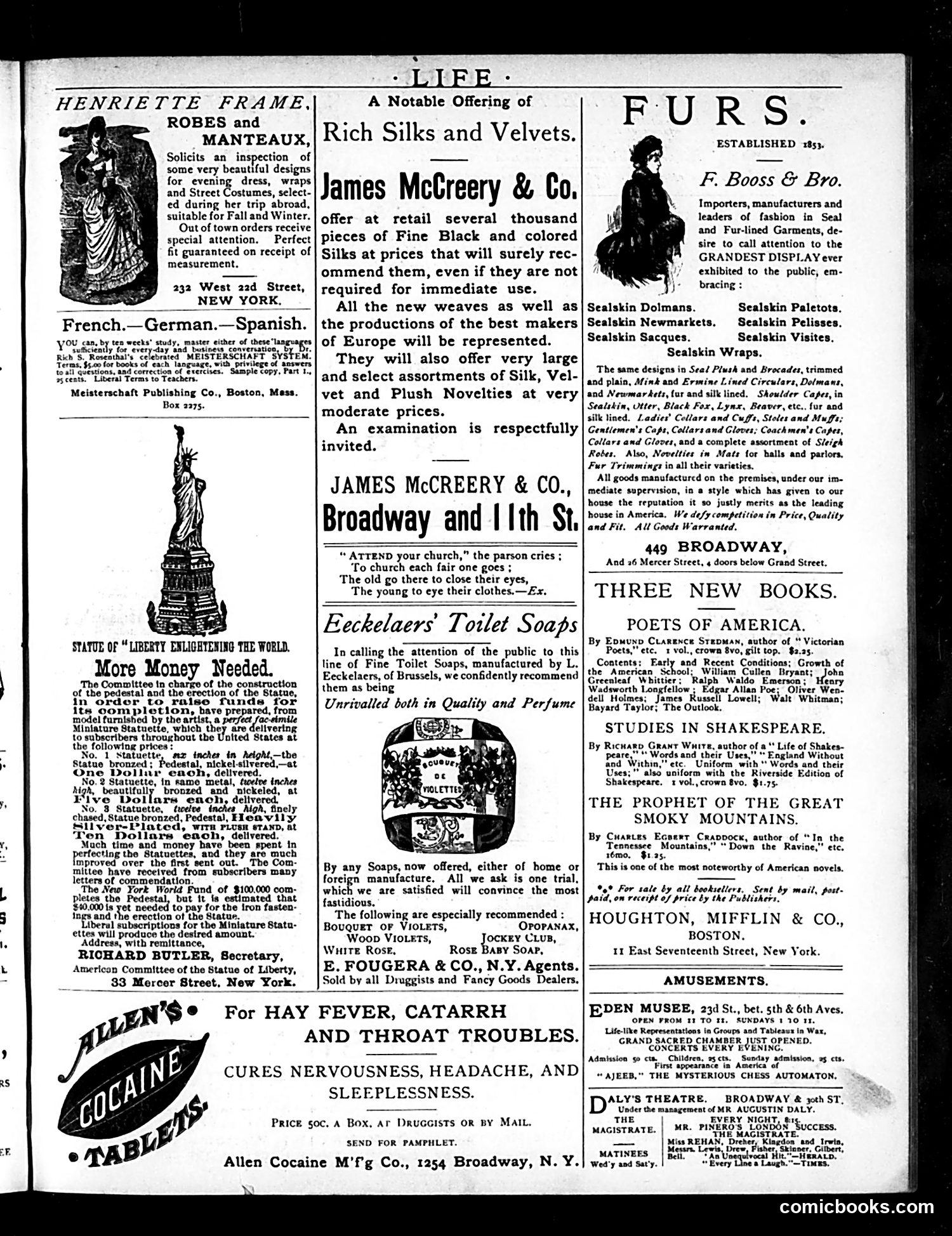
This page is primarily **advertisements** with one notable editorial element: a small satirical verse about churchgoing. ## The Cartoon/Satire: The only satirical content is a brief verse criticizing church attendance: > "ATTEND your church," the parson cries... The old go there to close their eyes, / The young to eye their clothes. This mocks the hypocrisy of church attendance—suggesting older parishioners sleep through services while younger attendees use church as a fashion display venue. It's gentle social satire about vanity and inattention during worship. ## Other Notable Content: The page features a large illustration of the **Statue of Liberty** advertising miniature reproductions to raise funds for the statue's pedestal construction. This references the 1880s fundraising campaign (the statue was dedicated in 1886). The remaining content consists of period advertisements for fashionable goods (silks, furs, robes) and patent medicines (Allen's Cocaine tablets for hay fever and nervousness—cocaine was legal and marketed medicinally in this era).
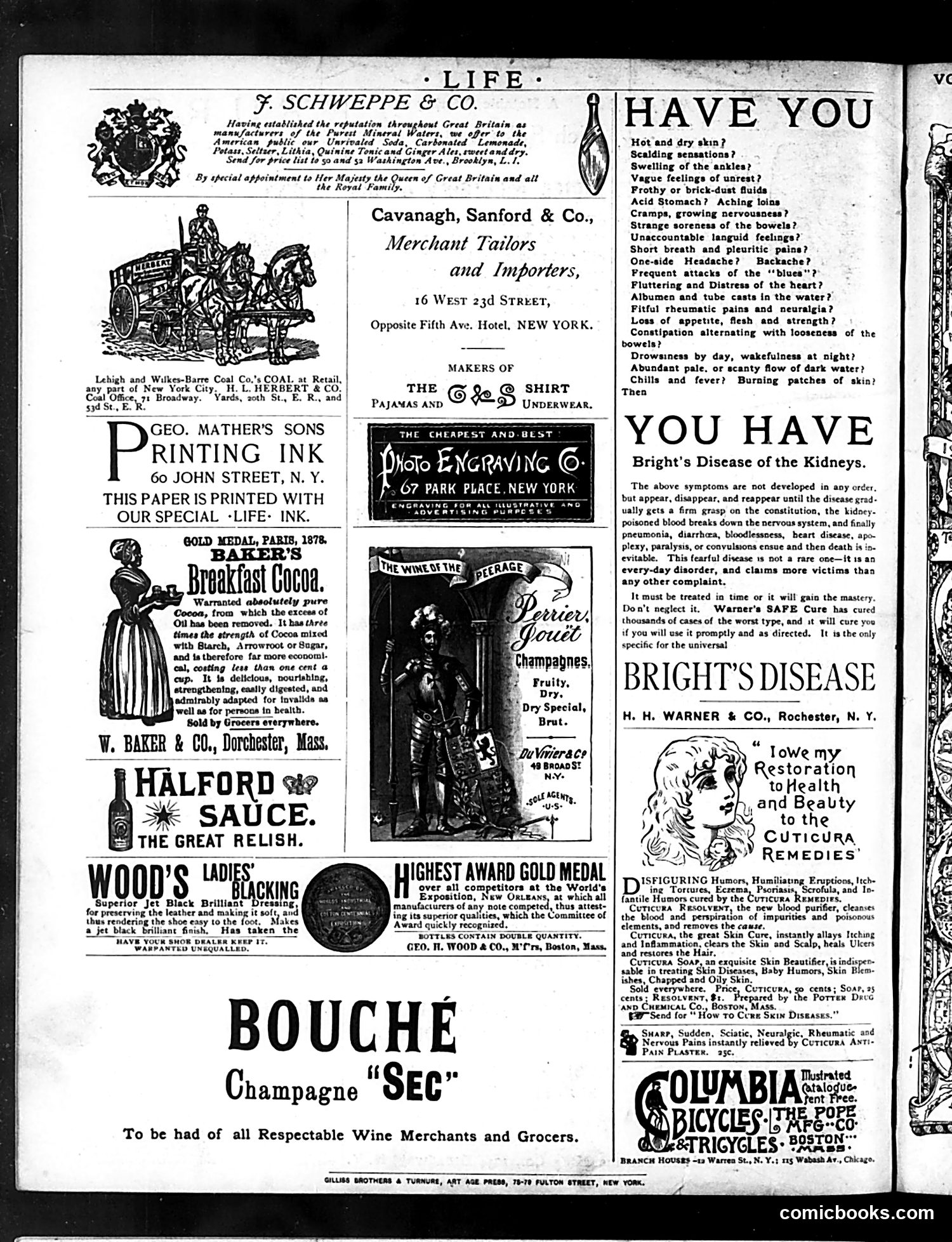
This page is primarily **advertisements** with no political cartoon or satire. It's a typical late-19th-century Life magazine page featuring various product promotions. The key content is a large **medical advertisement** for Warner's Safe Cure, claiming to treat Bright's Disease (kidney disease). The ad lists dozens of symptoms—from swollen ankles to burning skin—and insists the disease is common and deadly but curable only with their product. This represents **patent medicine marketing**, a widespread practice of the era when unregulated companies made extravagant health claims without scientific basis. Other ads promote cocoa, champagne, coal, printing ink, and tailoring services—standard commercial advertising. The Schweppes mineral water ad emphasizes royal approval (appointment to the Queen), a common marketing tactic. **For modern context**: This reflects an era before FDA regulations, when dubious "cure-all" remedies dominated magazines, preying on genuine health fears with no proven efficacy.