
Life, 1885-11-05 · page 7 of 16
Life — November 5, 1885 — page 7: what you’re looking at
What you’re looking at
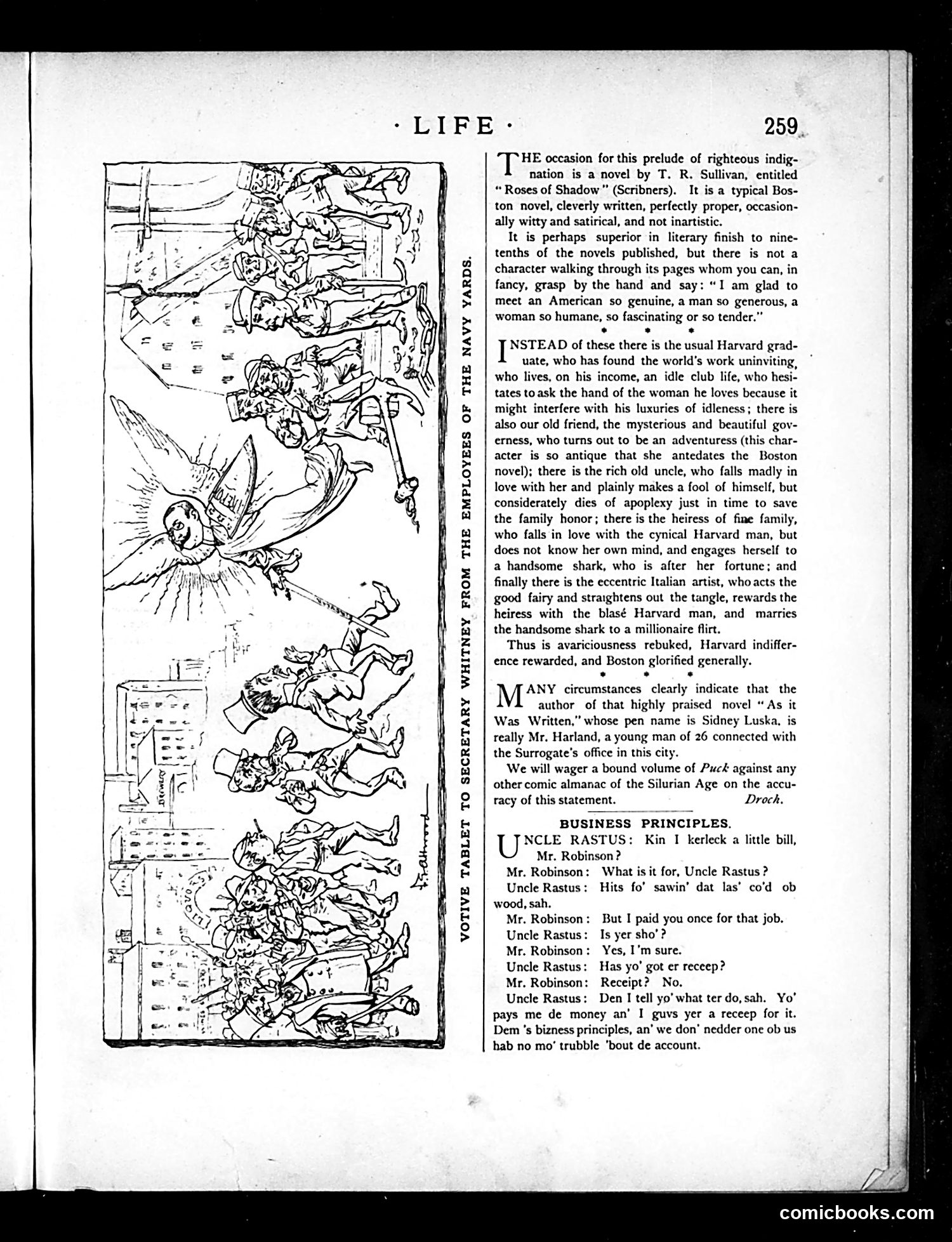
This page contains literary criticism and humor rather than political cartoons. The left side features an illustration labeled "VOTIVE TABLET TO PRESERVE OF THE NAVY YARDS" (appears to be a satirical naval/maritime scene, though details are difficult to discern). The right column reviews T.R. Sullivan's novel "Roses of Shadow," praising its literary merit. It then satirizes typical Harvard graduate characters—idle wealthy men who pursue women of lower social standing, die conveniently to preserve family honor, or marry heiresses to millionaires. The satire mocks predictable Boston novel tropes and Harvard masculine stereotypes. The "Business Principles" dialogue between Uncle Rastus and Mr. Robinson uses dialect humor (common to the era) about payment receipts, reflecting early 20th-century comic conventions.
📄 Transcribed text from this page (OCR, searchable)
Machine-transcribed from the original scan — historical spelling and the odd misread are preserved.
gree occasion for this prelude of righteous indig- nation is a novel by T. R. Sullivan, entitled “ Roses of Shadow” (Scribners). It is a typical Bos- ton novel, cleverly written, perfectly proper, occasion- ally witty and satirical, and not inartistic. It is perhaps superior in literary finish to nine- tenths of the novels published, but there is not a character walking through its pages whom you can, in fancy, grasp by the hand and say: “I am glad to meet an American so genuine, a man so generous, a woman so humane, so fascinating or so tender.” . . . | Peete of these there is the usual Harvard grad- uate, who has found the world’s work uninviting, who lives, on his income, an idle club life, who hesi- tates toask the hand of the woman he loves because it might interfere with his luxuries of idleness; there is also our old friend, the mysterious and beautiful gov- erness, who turns out to be an adventures (this char- acter is so antique that she antedates the Boston novel); there is the rich old uncle, who falls madly in love with her and plainly makes a fool of himself, but considerately dies of apoplexy just in time to save the family honor; there is the heiress of fine family, who falls in love with the cynical Harvard man, but does not know her own mind, and engages herself to a handsome shark, who is after her fortune; and finally there is the eccentric Italian artist, who acts the good fairy and straightens out the tangle, rewards the heiress with the blasé Harvard man, and marries the handsome shark to a millionaire flirt. Thus is avariciousness rebuked, Harvard indiffer- ence rewarded, and Boston glorified generally. . . . ANY circumstances clearly indicate that the author of that highly praised novel “As it Was Written,” whose pen name is Sidney Luska, is really Mr. Harland, a young man of 26 connected with the Surrogate’s office in this city. We will wager a bound volume of Puck against any other comic almanac of the Silurian Age on the accu- racy of this statement. Droch. BUSINESS PRINCIPLES, NCLE RASTUS: Kin I kerleck a little bill, Mr. Robinson? Mr. Robinson: What is it for, Uncle Rastus ? Uncle Rastus: Hits fo’ sawin’ dat las’ co’d ob wood, sah. Mr. Robinson: But I paid you once for that job. Uncle Rastus: Is yer sho’? Mr. Robinson: Yes, I’m sure. Uncle Rastus: Has yo’ got er receep? Mr. Robinson: Receipt? No. Uncle Rastus: Den I tell yo’ what ter do,sah. Yo’ pays me de money an’ I guvs yer a receep for it. Dem 's bizness principles, an’ we don’ nedder one ob us hab no mo’ trubble ‘bout de account. VOTIVE TABLET TO SECRETARY WHITNEY FROM THE EMPLOYEES OF THE NAVY YARDS. comicbooks.com