
Life, 1885-11-05 · page 2 of 16
Life — November 5, 1885 — page 2: what you’re looking at
What you’re looking at
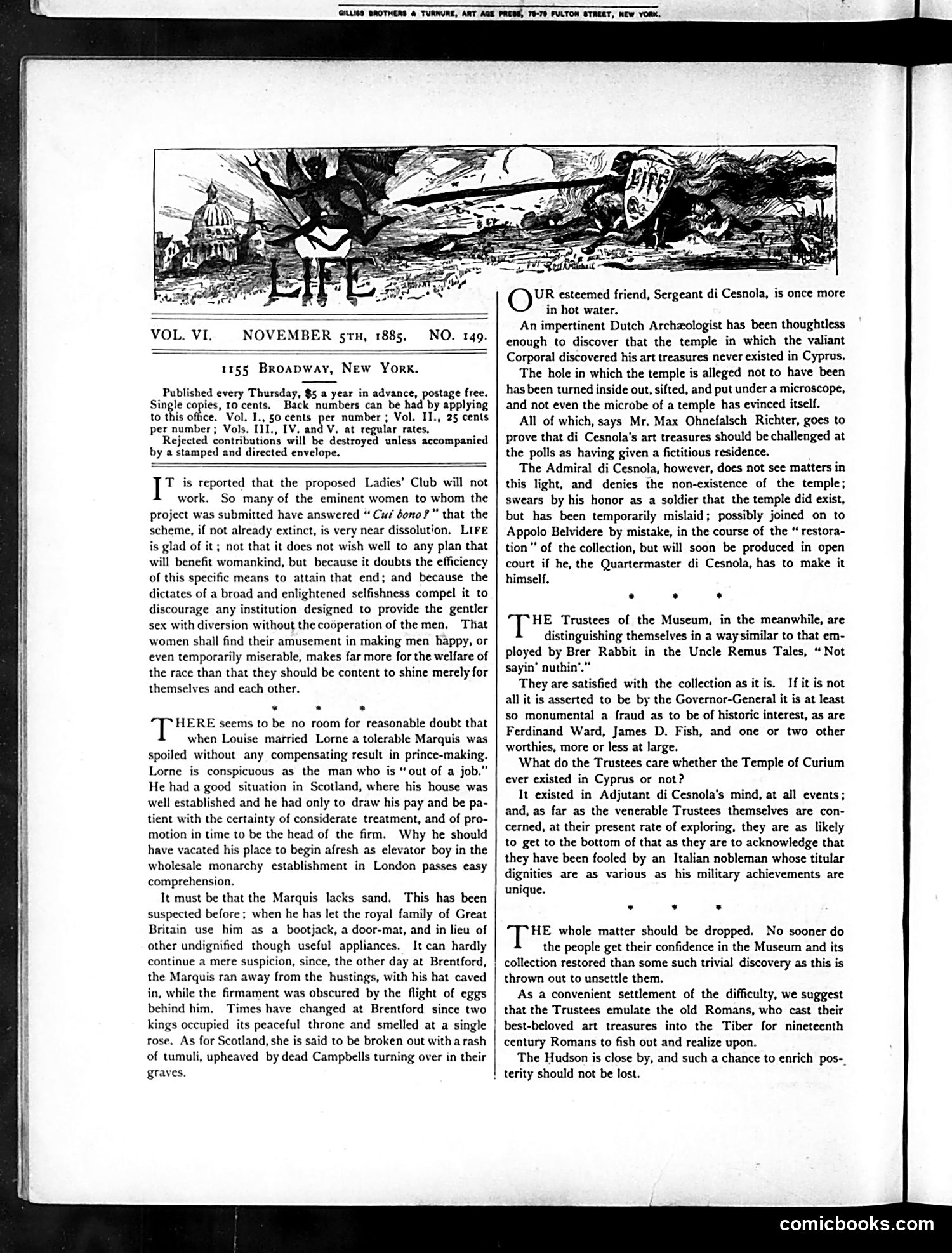
The masthead illustration shows "LIFE" with classical and allegorical imagery. The main text articles are satirical commentary rather than visual cartoons. The first piece mocks a proposed Ladies' Club, suggesting women lack the "broad and enlightened selfishness" needed to run institutions independently. The satire argues women need male cooperation to function effectively—a backhanded critique of Victorian gender restrictions dressed as concern. The second section ridicules the Marquis of Lorne (married to Queen Victoria's daughter Louise), calling him unfit for royal responsibilities and suggesting he serves merely as a "bootjack" or doormat in the monarchy. The final piece discusses the Museum's Temple of Curium controversy, where trustees were accused of being duped by fraudulent discoveries—mocking institutional credulity. The satire targets institutional incompetence, gender politics, and aristocratic pretension typical of 1880s Life magazine commentary.
📄 Transcribed text from this page (OCR, searchable)
Machine-transcribed from the original scan — historical spelling and the odd misread are preserved.
GLI BROTHERS & TURNURE, ART AGE PREBS, 70-70 FULTON STREET, NEW YORK. VOL. VI. NOVEMBER 5th, 1885. NO. 149. 1155 Broapway, New York. Published every Thursday, $5 a year in advance, postage free. Single copies, ro cents. Back numbers can be had by applying to this ofice. Vol. I., 50 cents per number ; Vol. II., 25 cents per number; Vols. IIT., IV. angV. at regular rates. Rejected contributions will be destroyed unless accompanied by a stamped and directed envelope. T is reported that the proposed Ladies’ Club will not work. So many of the eminent women to whom the project was submitted have answered “ Cus bono?” that the scheme, if not already extinct, is very near dissolution. LIFE is glad of it; not that it does not wish well to any plan that will benefit womankind, but because it doubts the efficiency of this specific means to attain that end; and because the dictates of a broad and enlightened selfishness compel it to discourage any institution designed to provide the gentler sex with diversion without the cooperation of the men. That women shall find their amusement in making men happy, or even temporarily miserable, makes far more for the welfare of the race than that they should be content to shine merely for themselves and each other. . . . HERE seems to be no room for reasonable doubt that when Louise married Lorne a tolerable Marquis was spoiled without any compensating result in prince-making. Lorne is conspicuous as the man who is “out of a job.” He had a good situation in Scotland, where his house was well established and he had only to draw his pay and be pa- tient with the certainty of considerate treatment, and of pro- motion in time to be the head of the firm. Why he should have vacated his place to begin afresh as elevator boy in the wholesale monarchy establishment in London passes easy comprehension. It must be that the Marquis lacks sand. This has been suspected before; when he has let the royal family of Great Britain use him as a bootjack, a door-mat, and in lieu of other undignified though useful appliances. It can hardly continue a mere suspicion, since, the other day at Brentford, the Marquis ran away from the hustings, with his hat caved in, while the firmament was obscured by the flight of eggs behind him. Times have changed at Brentford since two kings occupied its peaceful throne and smelled at a single rose, As for Scotland, she is said to be broken out witha rash of tumuli, upheaved by dead Campbells turning over in their graves. R esteemed friend, Sergeant di Cesnola, is once more in hot water. An impertinent Dutch Archzologist has been thoughtless enough to discover that the temple in which the valiant Corporal discovered his art treasures never existed in Cyprus. The hole in which the temple is alleged not to have been has been turned inside out, sifted, and put under a microscope, and not even the microbe of a temple has evinced itself. All of which, says Mr. Max Ohnefalsch Richter, goes to prove that di Cesnola’s art treasures should be challenged at the polls as having given a fictitious residence. The Admiral di Cesnola, however, does not see matters in this light, and denies the non-existence of the temple; swears by his honor as a soldier that the temple did exist, but has been temporarily mislaid; possibly joined on to Appolo Belvidere by mistake, in the course of the “ restora- tion” of the collection, but will soon be produced in open court if he, the Quartermaster di Cesnola, has to make it himself. . . . HE Trustees of the Museum, in the meanwhile, are distinguishing themselves in a way similar to that em- ployed by Brer Rabbit in the Uncle Remus Tales, “ Not sayin’ nuthin’.” They are satisfied with the collection as it is. If it is not all it is asserted to be by the Governor-General it is at least so monumental a fraud as to be of historic interest, as are Ferdinand Ward, James D. Fish, and one or two other worthies, more or less at large. What do the Trustees care whether the Temple of Curium ever existed in Cyprus or not? It existed in Adjutant di Cesnola’s mind, at all events; and, as far as the venerable Trustees themselves are con- cerned, at their present rate of exploring, they are as likely to get to the bottom of that as they are to acknowledge that they have been fooled by an Italian nobleman whose titular dignities are as various as his military achievements are unique. . . . HE whole matter should be dropped. No sooner do the people get their confidence in the Museum and its collection restored than some such trivial discovery as this is thrown out to unsettle them. As a convenient settlement of the difficulty, we suggest that the Trustees emulate the old Romans, who cast their best-beloved art treasures into the Tiber for nineteenth century Romans to fish out and realize upon. The Hudson is close by, and such a chance to enrich pos-. ! terity should not be lost. comicbooks.com