
Life, 1885-11-05 · page 3 of 16
Life — November 5, 1885 — page 3: what you’re looking at
What you’re looking at
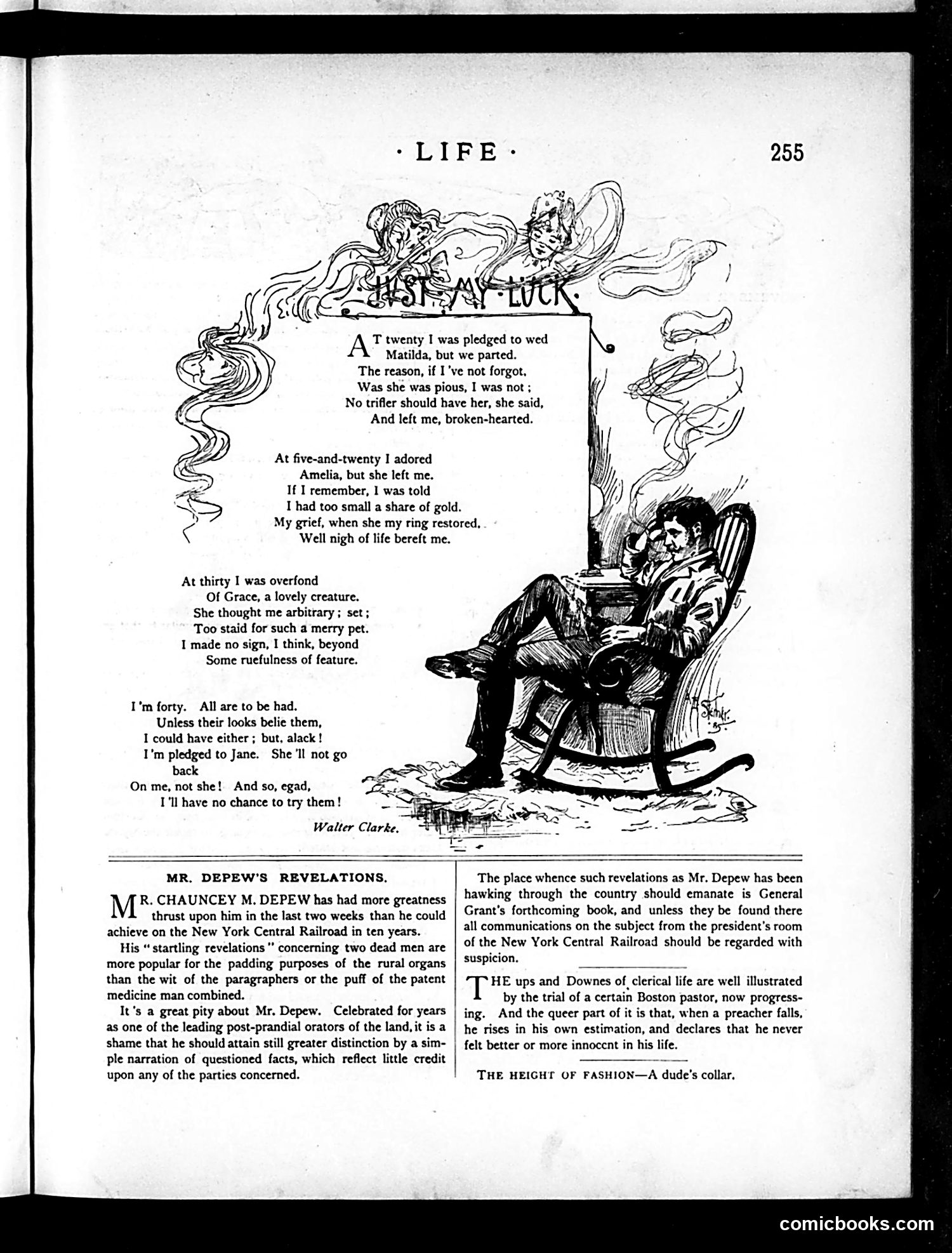
**Main Content: "Last Luck" Poem by Walter Clarke** This is a sentimental poem about romantic misfortunes across a man's life—rejected at twenty (Matilda), twenty-five (Amelia), and thirty (Grace)—culminating in being pledged to Jane against his wishes. The accompanying illustration shows a dejected man slumped in a chair, reinforcing the theme of romantic disappointment. **Secondary Content: "Mr. Depew's Revelations"** This section discusses Chauncey M. Depew, a prominent New York Central Railroad executive and public figure known for speeches ("post-prandial orations"). The text critiques him for making questionable public statements about railroad matters, suggesting his casual remarks lack credibility and reflect poorly on those involved. The page exemplifies *Life*'s mix of poetry, humor, and satirical commentary on contemporary figures.
📄 Transcribed text from this page (OCR, searchable)
Machine-transcribed from the original scan — historical spelling and the odd misread are preserved.
T twenty I was pledged to wed Matilda, but we parted. The reason, if I've not forgot, Was she was pious, I was not ; No trifler should have her, she said, And left me, broken-hearted. At five-and-twenty I adored Amelia, but she left me. If I remember, 1 was told I had too small a share of gold. My grief, when she my ring restored, Well nigh of life bereft me. At thirty I was overfond Of Grace, a lovely creature. She thought me arbitrary ; set; Too staid for such a merry pet. I made no sign, I think, beyond Some ruefulness of feature. I’m forty. All are to be had. Unless their looks belie them, I could have either ; but, alack ! I'm pledged to Jane. She ‘ll not go back On me, not she! And so, egad, I'll have no chance to try them! Walter Clarke. MR. DEPEW’S REVELATIONS. R. CHAUNCEY M. DEPEW has had more greatness thrust upon him in the last two weeks than he could achieve on the New York Central Railroad in ten years. His “ startling revelations” concerning two dead men are more popular for the padding purposes of the rural organs than the wit of the paragraphers or the puff of the patent medicine man combined. It's a great pity about Mr. Depew. Celebrated for years as one of the leading post-prandial orators of the land, it is a shame that he should attain still greater distinction by a sim- | ple narration of questioned facts, which reflect little credit upon any of the parties concerned. The place whence such revelations as Mr. Depew has been hawking through the country should emanate is General Grant's forthcoming book, and unless they be found there all communications on the subject from the president's room of the New York Central Railroad should be regarded with suspicion, by the trial of a certain Boston pastor, now progress- ing. And the queer part of it is that, when a preacher falls, he rises in his own estimation, and declares that he never felt better or more innocent in his life. THE HEIGHT OF FASHION—A dude's collar, comicbooks.com