
A complete issue · 16 pages · 1885
Life — October 22, 1885
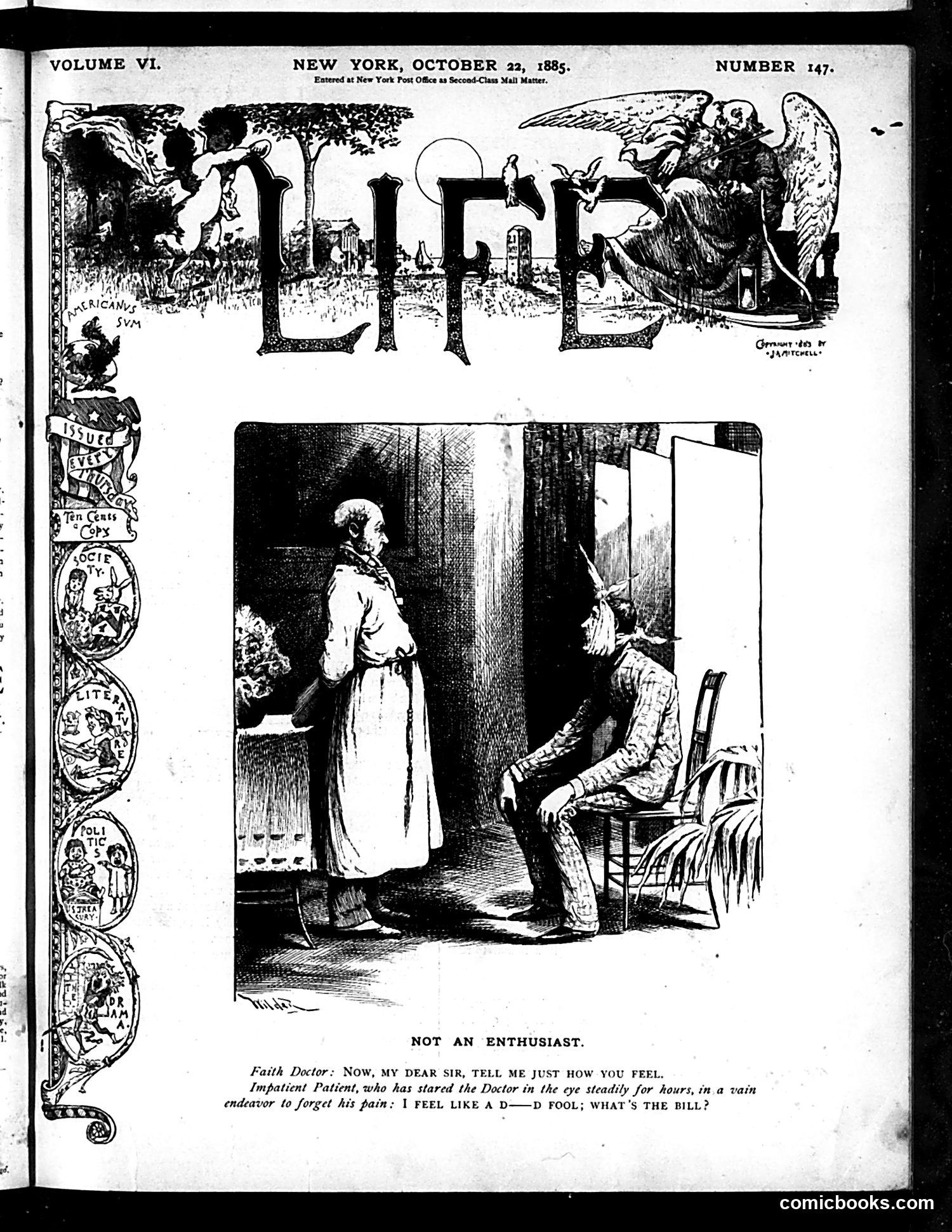
This cartoon satirizes a patient's reluctant visit to a "Faith Doctor"—a practitioner of faith healing or alternative medicine popular in the 1880s. The impatient patient, seated and clearly skeptical, complains to the doctor that staring at her steadily for hours hasn't eased his pain; he feels like a "D—— fool" and questions the bill. The satire mocks the growing trend of faith-based medical practitioners who claimed to cure ailments through mental focus or spiritual means rather than conventional medicine. The patient's irritation and sarcasm highlight the magazine's skepticism toward such unproven treatments, while the doctor's earnest demeanor suggests the practitioners' genuine (if misguided) belief in their methods. The joke targets both medical charlatanism and gullible patients.
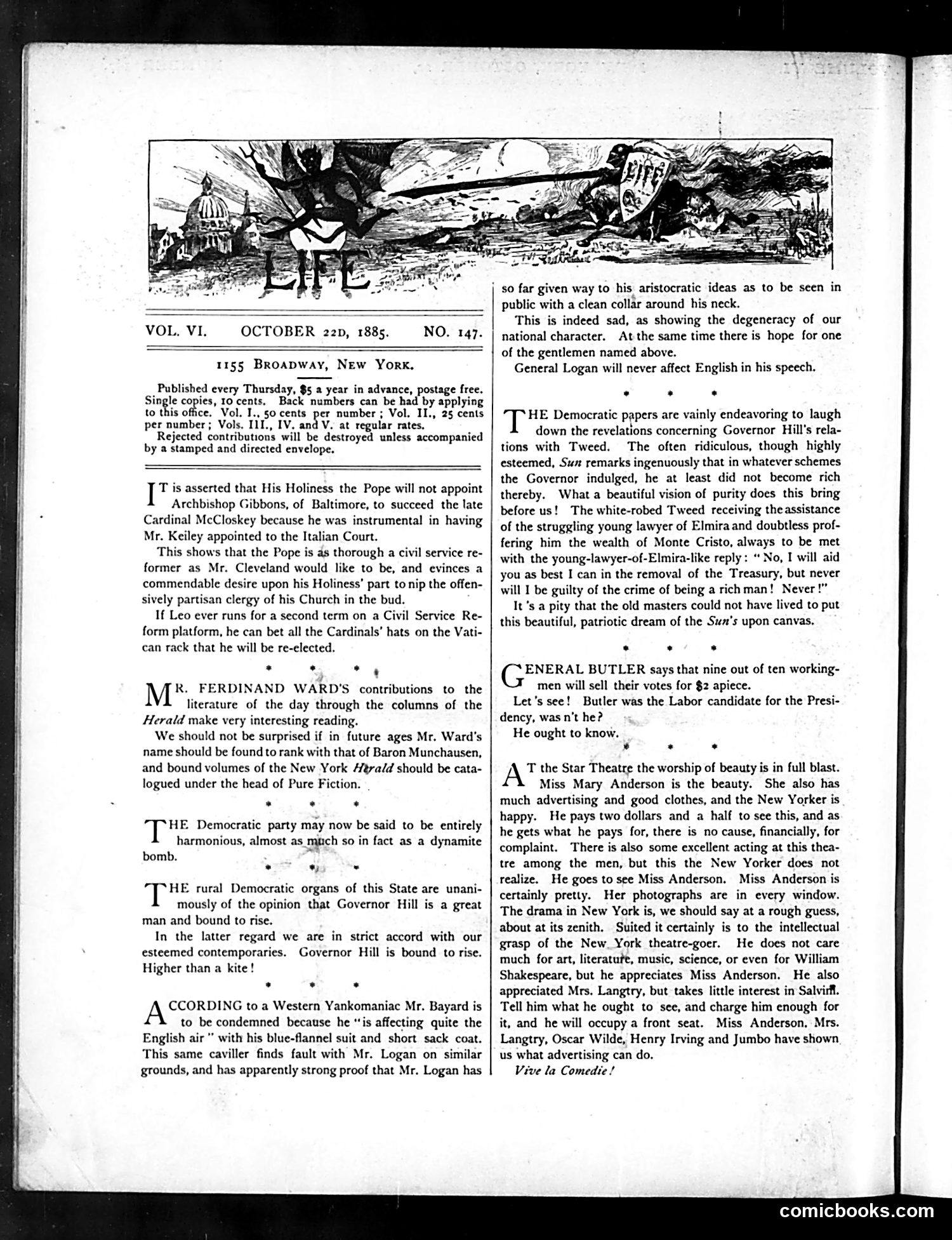
The page's header cartoon depicts a chaotic scene with figures and what appears to be a falling or collapsing structure labeled "LIFE," suggesting commentary on the magazine itself or contemporary events. The text discusses several political matters: Governor Hill's relationship with "Tweed" (likely referencing Tammany Hall corruption), criticism of aristocratic pretensions among political figures, and commentary on General Butler's claim that working men will vote for him. There's also social satire about Miss Mary Anderson, an actress at the Star Theatre, whose beauty and advertising prowess are mocked—suggesting her talent for self-promotion exceeds her dramatic ability. The piece critiques how advertising drives theatrical success in New York. The overall tone is partisan Democratic mockery mixed with broader social commentary on American politics and popular culture.
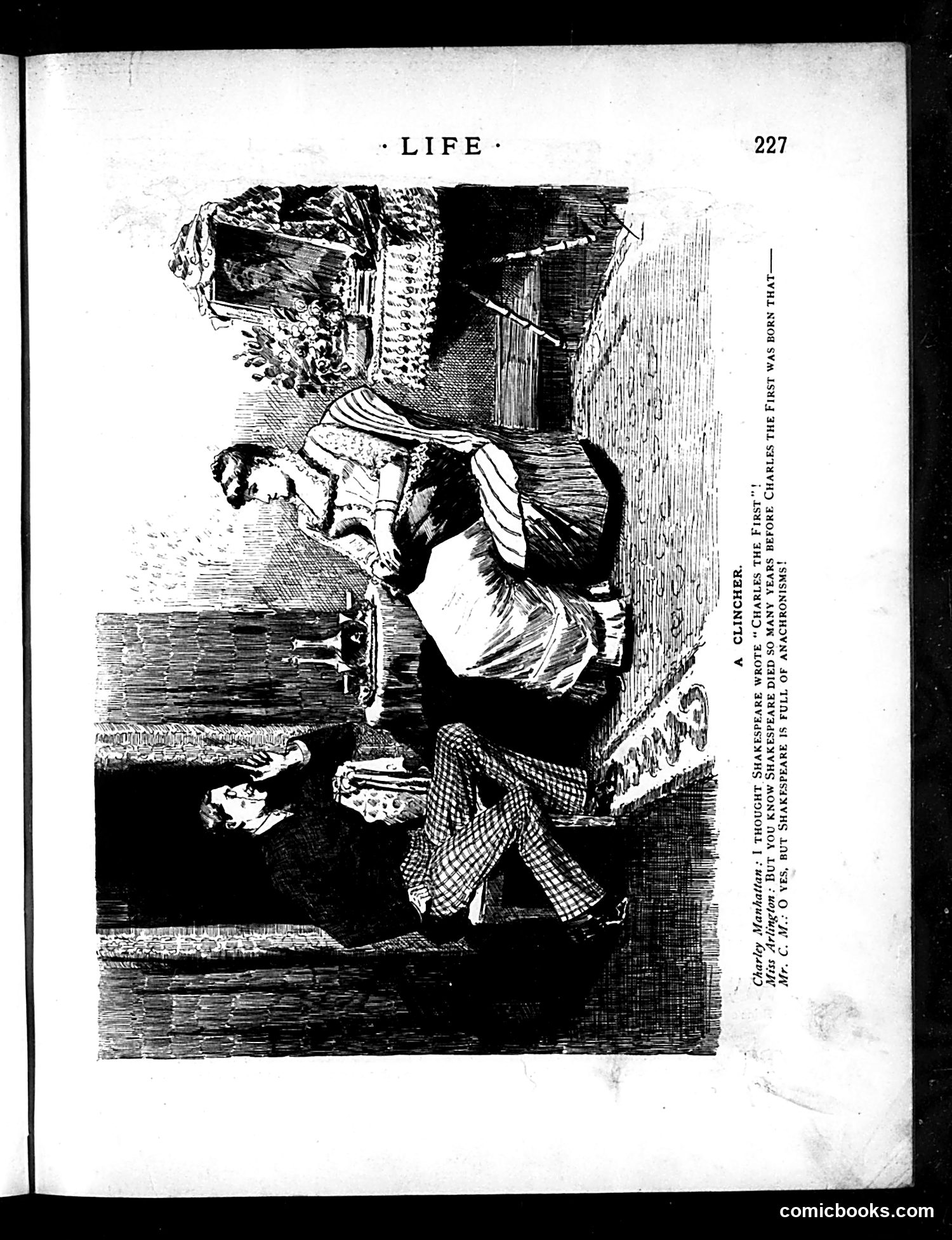
This engraving depicts "A Clincher" — a satirical scene showing what appears to be a wealthy or upper-class woman in elaborate dress confronting or striking a working-class man in checkered clothing. The caption references "Church Socialists" and mentions "Charles the First" and "shareholder" concerns. The cartoon appears to satirize tensions between social classes, likely critiquing either wealthy people claiming socialist sympathies while maintaining class privilege, or tensions between labor and capital. The "clincher" (final decisive blow) suggests the woman's dramatic response defeats an argument. Without precise dating, the specific historical context remains unclear, though the engraving style and socialist references suggest late 19th or early 20th-century American social commentary.
This page contains satirical commentary and brief humorous notes rather than political cartoons. The header illustration shows various animals, likely representing different nations or political entities in the context of international affairs. Key items include: - **"International Copyright"**: A poem mocking copyright law debates, suggesting the issue is trivial - **"A Telegram"**: A quip about Flood Rock vibrations, referencing a known geological incident - **Various society notes**: Comments on Pope Leo's finances, Lady Randolph Churchill's views on women, and references to figures like General Jones and Mr. Davenport The humor relies on contemporary political/social knowledge—references to General Newton, Tweed (likely Boss Tweed), and General Grant—that would be immediately recognizable to 1880s-90s readers but requires historical context for modern audiences.
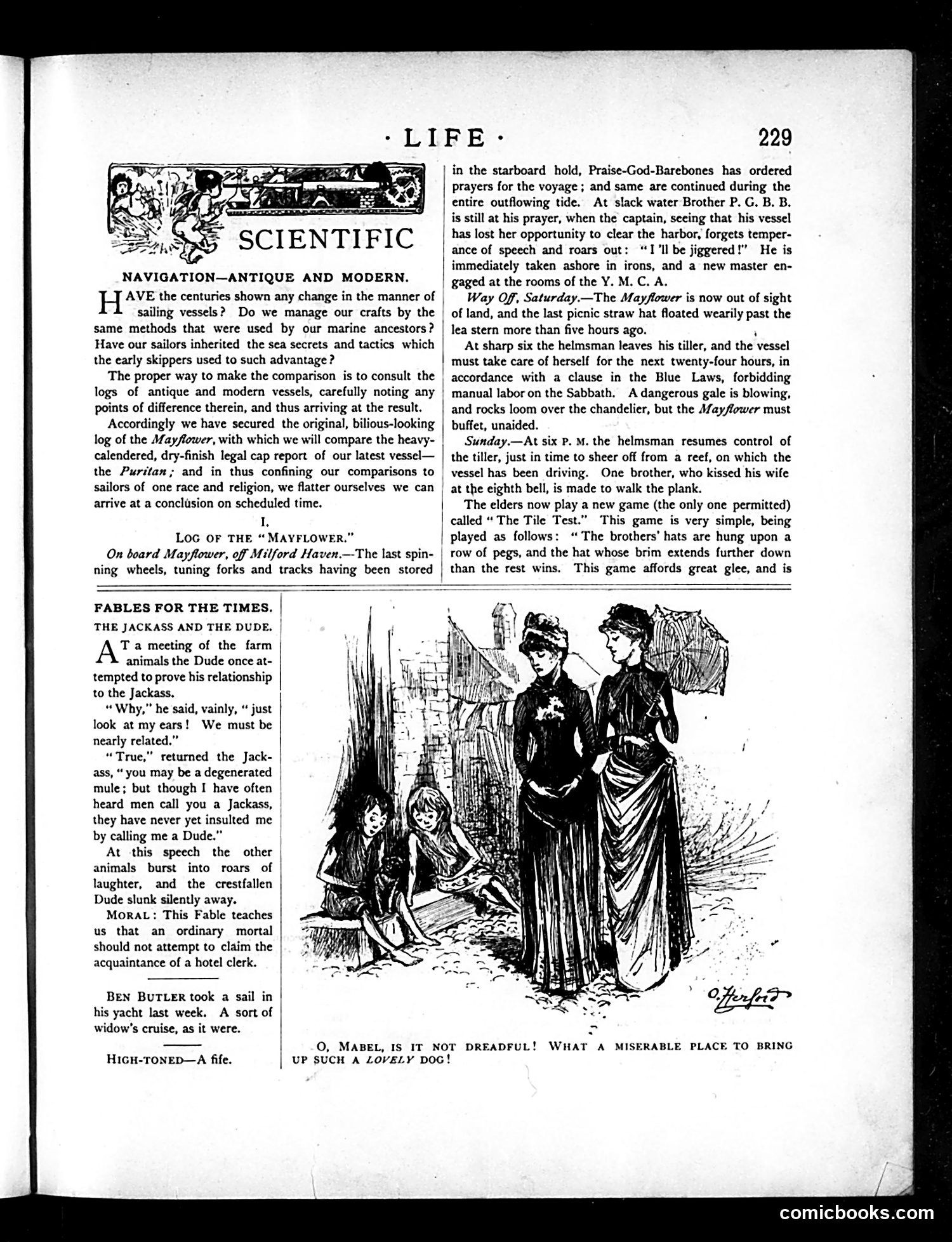
This page contains two unrelated items: **"Scientific Navigation"** discusses the historical log of the *Mayflower*, comparing ancient and modern sailing methods—a straightforward historical article with no satirical content. **"The Jackass and the Dude"** is a fable wherein a Dude attempts to prove kinship to a Jackass by claiming they're "nearly related." The Jackass refuses, noting he's never insulted humans by calling them jackasses. The moral warns against attempting to claim acquaintance with a hotel clerk—likely satirizing social climbing or pretension among the working class. The accompanying illustration shows well-dressed women encountering street children, with the caption about bringing a "lovely dog" to a "miserable place," reinforcing themes of class distinction and the mockery of those who patronizingly visit the poor.
This page contains no political cartoon. Instead, it features two distinct sections: **Left side:** A humorous ship's log from the "Puritan," documenting mundane shipboard life with witty observations about sailors' priorities (eyes, luck, wind matter; "Somebody else" doesn't). **Right side:** A book review section titled "Bookshelf," discussing Bret Harte's novel "Maruja" and recent biographical works about Louis Agassiz and William Lloyd Garrison. The reviews praise Harte's romantic storytelling while noting these biographies document lives devoted to singular purposes—science and social reform respectively. The page is primarily **literary content and book criticism** rather than satirical cartooning. It reflects Life magazine's role as a general-interest publication covering culture, travel, and intellectual matters alongside humor.
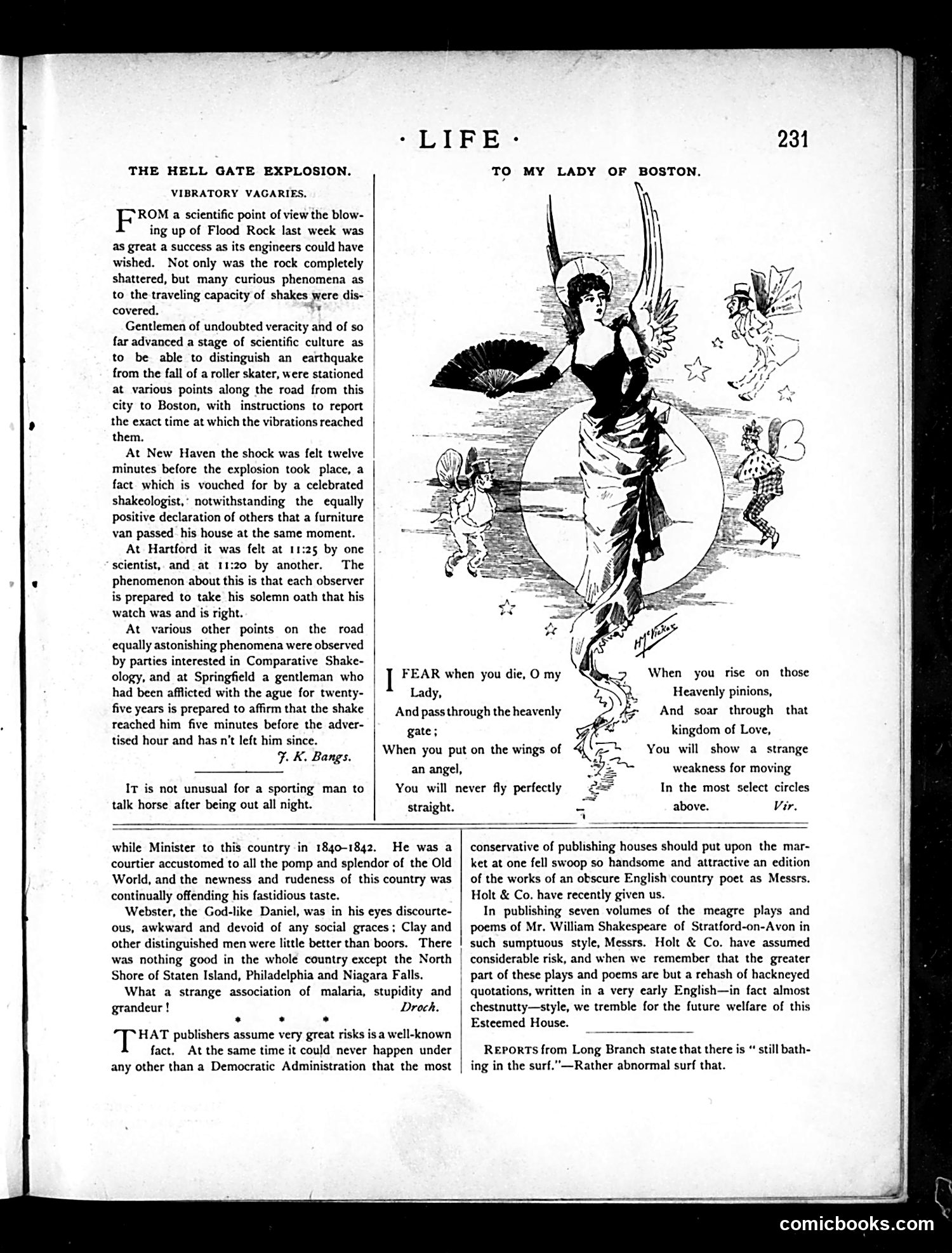
This illustration satirizes the pretensions of Boston society, personified as a fashionable woman ascending to heaven on angel wings. The cartoon mocks the city's self-regard and cultural snobbery through the figure's exaggerated vanity and affected pose. The accompanying verse humorously warns that even in heaven, she'll "show a strange weakness for moving / In the most select circles above"—suggesting Boston society's obsession with exclusive social hierarchies transcends earthly life itself. The cherubs and stars surrounding the figure emphasize the satirical tone. This reflects 19th-century American magazine humor that targeted regional pretension, particularly Boston's reputation for intellectual elitism and class consciousness. The satire implies such social climbing is both foolish and inescapable.
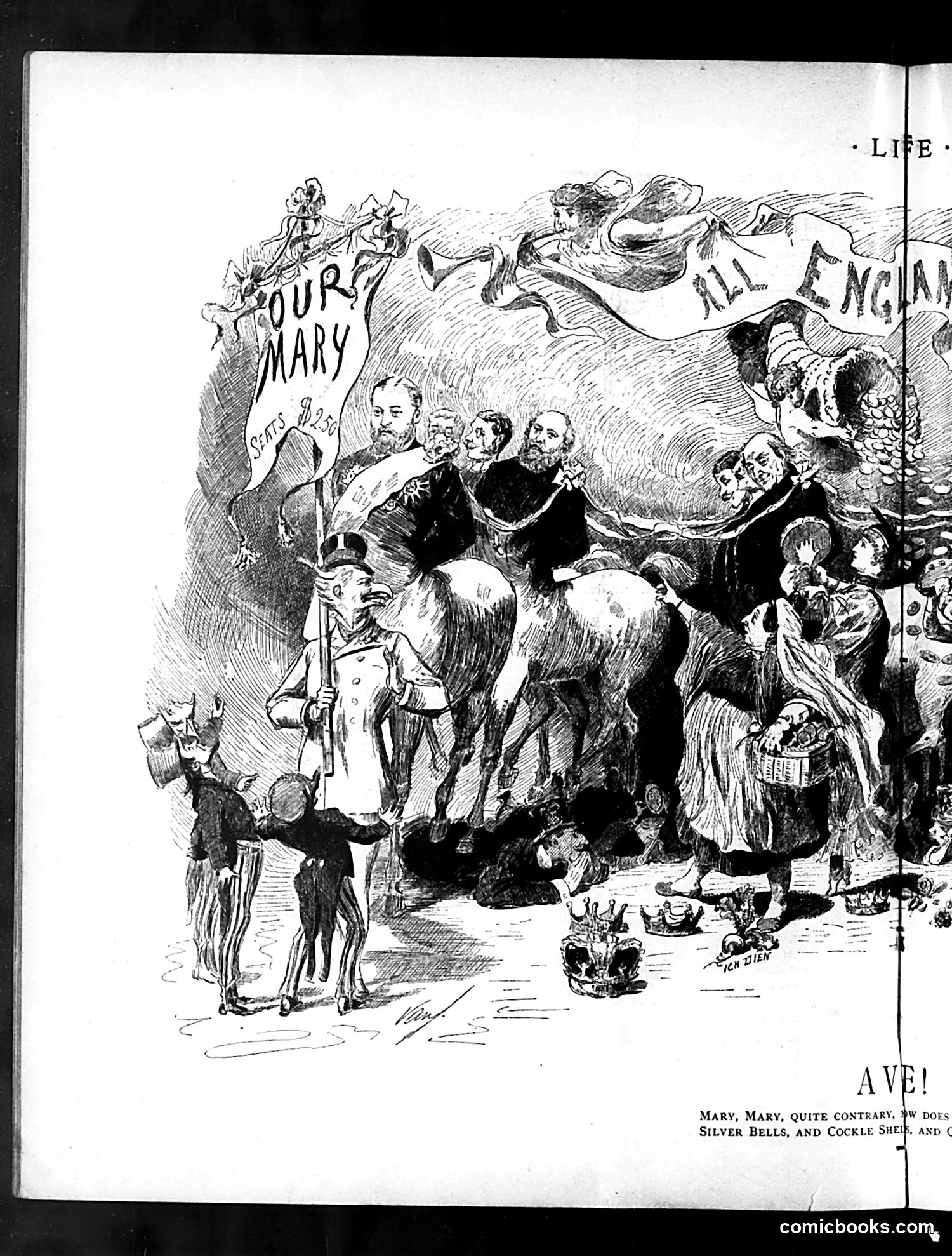
This is a satirical cartoon titled "Ave!" referencing the nursery rhyme "Mary, Had a Little Lamb." The visible text mentions "Mary, Mary, quite contrary" and references to "Silver Bells, and Cockle Shells." The cartoon depicts a figure on horseback (appearing to be a military or political leader) greeting a group of men in formal dress on the right side. Flying cherubs or allegorical figures appear above, carrying a banner labeled "Our Mary." The scene appears to mock British political figures or policy—likely related to Mary (possibly Queen Mary or a metaphorical "England"). The left side shows a uniformed soldier or guard figure. The overall composition suggests satirical commentary on British governance, possibly from the early 20th century, though specific identities require additional context to confirm definitively.
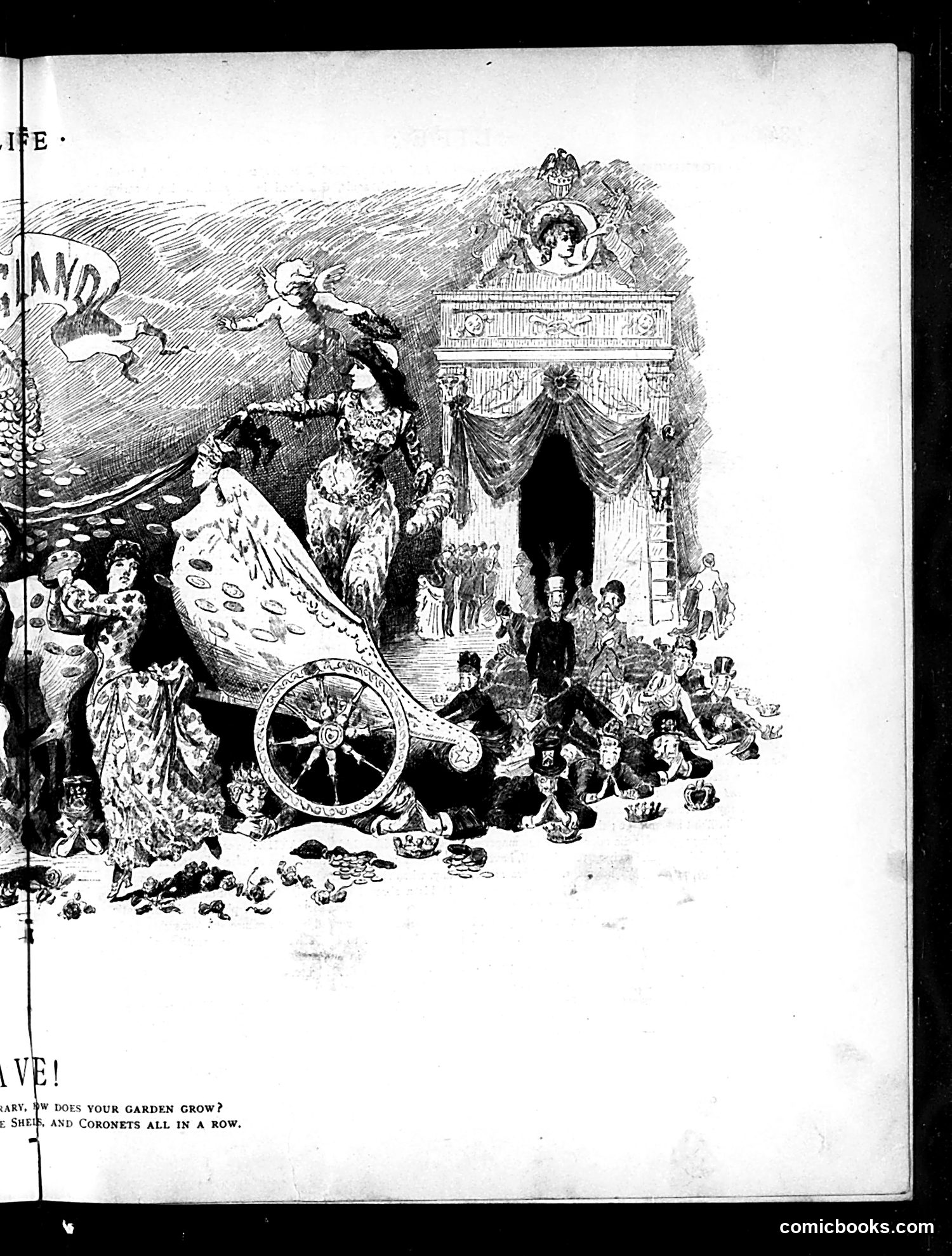
This appears to be a satirical illustration from *Life* magazine depicting a royal or aristocratic procession. The central figure is a bearded man in ornate clothing, possibly representing royalty or nobility, accompanied by elaborately dressed attendants and cherubs. A large decorated carriage with a prominent wheel is featured prominently. The bottom text references a garden growing "Sheep and Coronets all in a row"—suggesting satire about aristocratic pretension or the absurdity of royal succession and inherited privilege. The crowded, chaotic composition with numerous figures and symbolic elements typical of 19th-century satirical art suggests commentary on class hierarchies or the pomp of court life. However, **without knowing the specific historical context or publication date, I cannot definitively identify which monarch or political event this targets.**
This page contains two pieces of satirical commentary on theatrical and romantic culture: **"Nothing But Leaves"** (poem): A cynical critique of male romantic fickleness. A man pursues a woman devotedly through summer social season, then abandons her without explanation when autumn arrives—leaving her with nothing but "leaves" (worthless remnants). The satire targets shallow courtship rituals. **Theatre Scene Dialogue**: Two allegorical characters—**Discernment** and **False Pride**—debate actress Mary Anderson's reception upon returning to America after performing in London. False Pride celebrates her enhanced prestige from foreign approval (notably the Prince of Wales's attention), while Discernment dismissively counters that her actual performance as Rosalind is mediocre and that her value shouldn't increase simply from European validation. The satire mocks American deference to British aristocracy and the tendency to overvalue artists based on foreign approval rather than actual merit. Anderson's talent remains unchanged; only perceived status differs.
This page contains two satirical pieces mocking prominent figures of the era: **"Claret and Oratory"** ridicules **Mr. Evarts** (likely William Maxwell Evarts, a famous orator), suggesting his eloquence operates independently of his brain. The joke: he claims one glass of wine affects his speech, implying his mouth runs automatically while his mind wanders elsewhere—a cutting critique of his verbosity. **"Mr. Cleveland on Current Affairs"** satirizes **President Cleveland**, depicting him frantically issuing campaign denials. The satire targets how Democrats allegedly spread rumors about Cleveland (joining multiple churches for votes, creating fake "automaton" letters) while Cleveland himself manufactures counter-denials. The piece mocks both the president's defensive posture and the absurd nature of campaign dirty tricks, including a jab at New York Tribune editor Whitelaw Reid for spreading anti-Administration material. Both pieces exemplify *Life* magazine's role as a satirical publication attacking political figures and public personalities through humor.
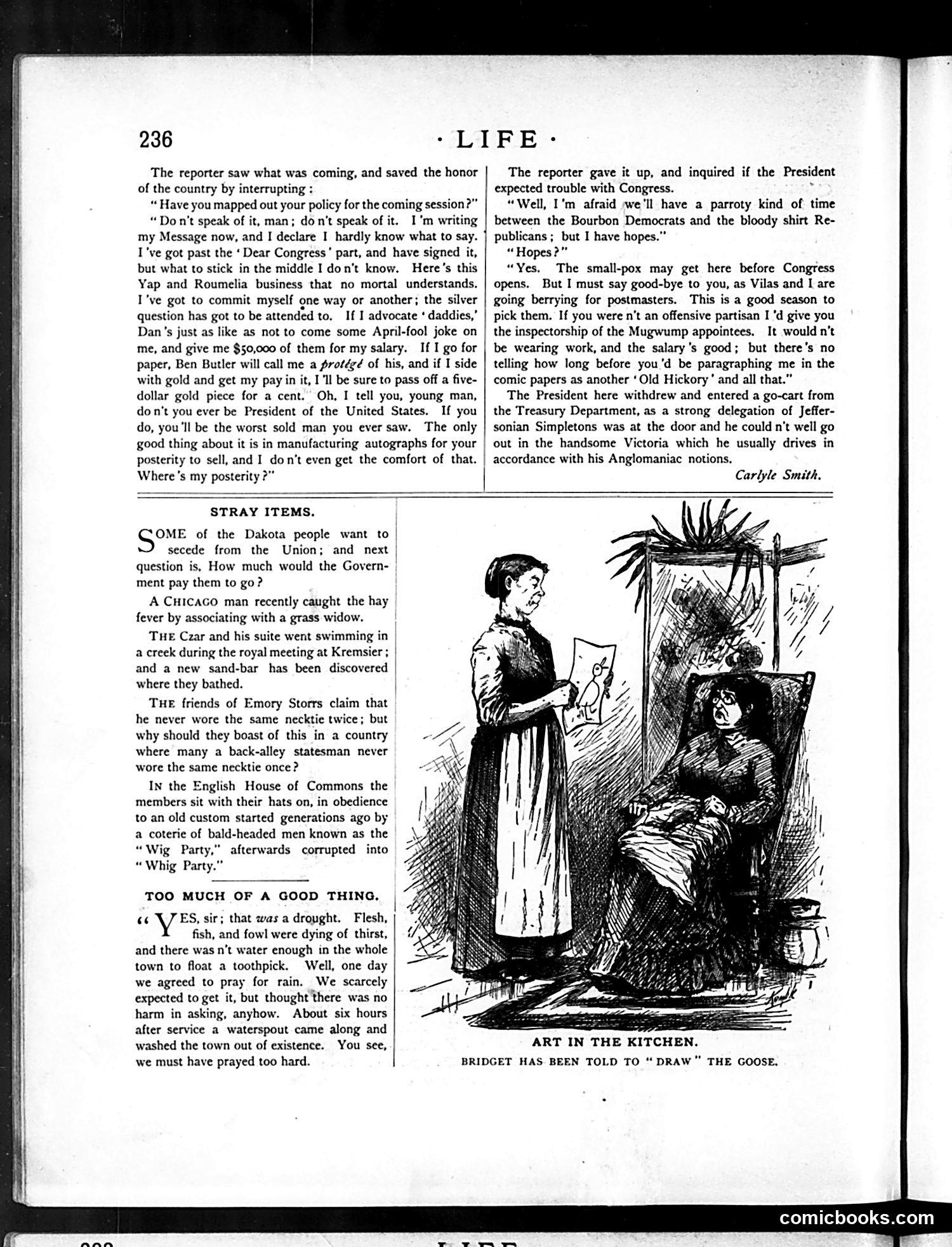
This page contains political satire mocking an unnamed U.S. President (likely from the 1870s-80s, based on references to "silver question," "Bourbon Democrats," and "bloody shirt Republicans"). **The Main Cartoon:** A reporter interviews the President, who complains he cannot write his Congressional Message because he's paralyzed by competing political pressures—the Yap and Roumelia crisis, currency debates (silver vs. paper vs. gold), and factional conflicts. He laments the presidency offers only posthumous value through autographs. **Key References:** - "Bourbon Democrats" and "bloody shirt Republicans"—political factions of the era - "Vilas and...berrying for postmasters"—patronage appointments - Mentions of "Ben Butler" and "Dan" (likely political rivals) - "Mugwump appointees"—civil service reformers **The Satire:** The joke targets presidential indecision, spoils-system corruption, and the president's anxiety about contradictory political demands. The cartoon mocks both the office itself and partisan gridlock. **Additional Items** include humorous asides (Dakota secession, the "Whig Party" etymology, a servant misunderstanding "draw the goose").
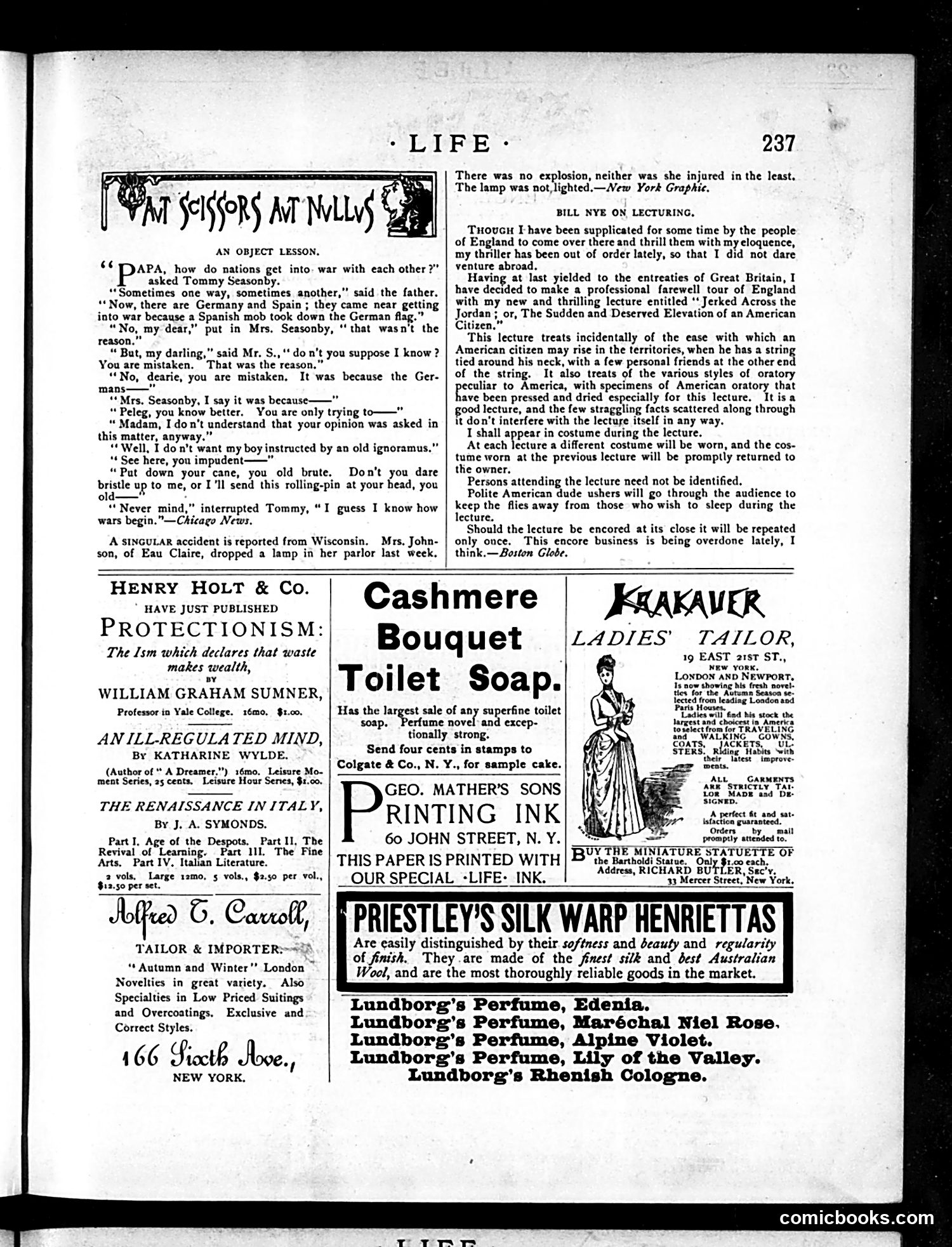
## Main Cartoon: "Scissors at Nulls" This comic dialogue satirizes marital discord through the lens of a trivial international incident. When Tommy Seasonby asks his father how nations go to war, both parents immediately contradict each other about whether Germany and Spain nearly clashed over a fallen German flag. Their heated argument—escalating to threats of rolling pins and canes—perfectly illustrates the cartoonist's point: couples bicker over the *reason* for conflict without resolving the underlying disagreement, just as nations do. The humor relies on the parallel between domestic and international conflict, suggesting both involve ego and stubbornness rather than rational cause-and-effect. ## Secondary Item: Bill Nye on Lecturing Humorist Bill Nye promotes an upcoming English lecture tour by ironically describing his act: discussing lynching ("Jerked Across the Jordan") while wearing different costumes each night and employing ushers to shoo away flies from sleeping audience members. The satire mocks popular lecture culture—suggesting his content is deliberately absurd and audiences largely indifferent.
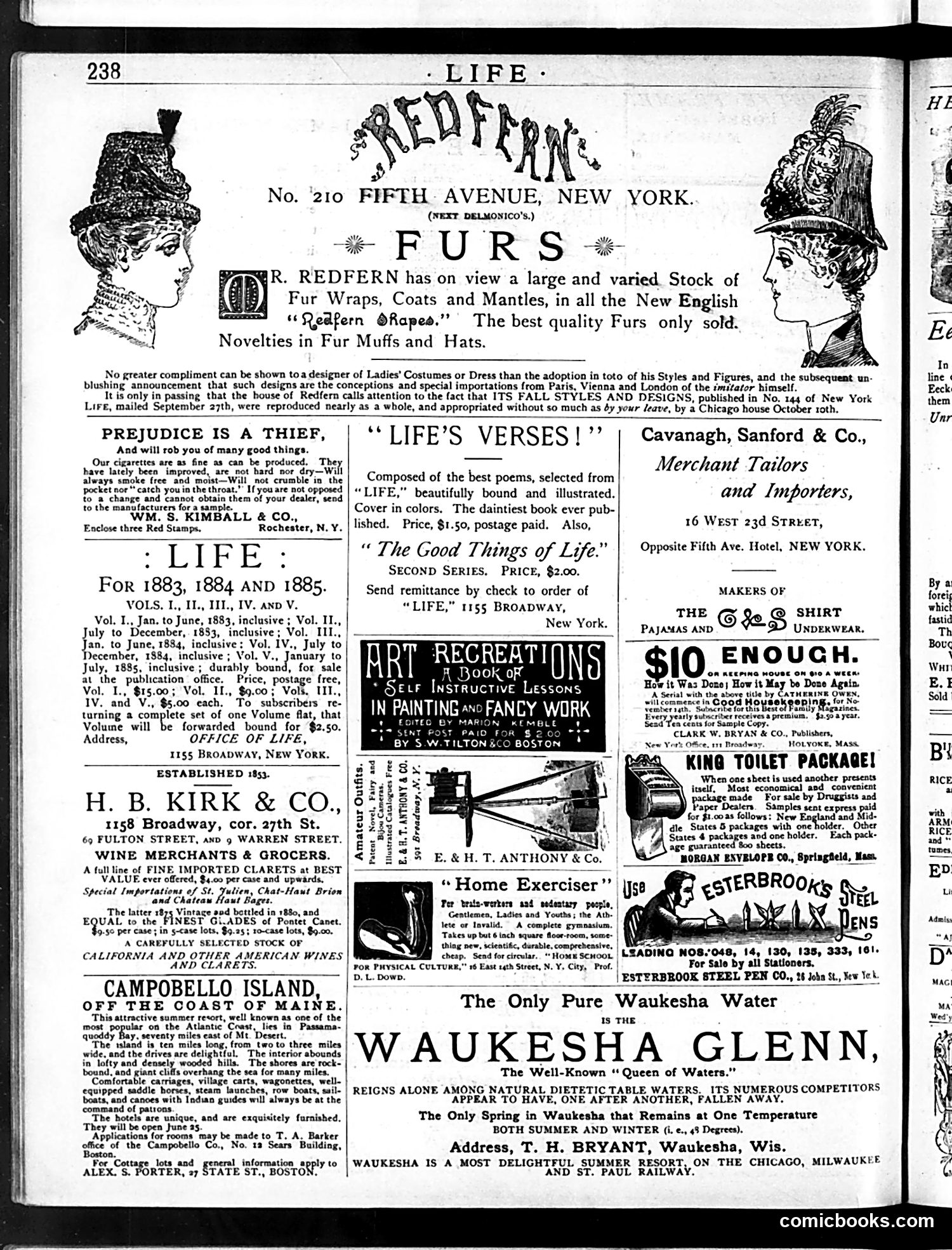
This page is primarily **advertising**, not political satire. It's a typical late-19th-century magazine advertising section (circa 1885) featuring luxury goods and services aimed at wealthy New York consumers. The only satirical content appears in the **"Prejudice is a Thief"** cigarette advertisement by Wm. S. Kimball & Co., which uses mild irony: the ad claims their cigarettes are superior quality and won't be "hard nor dry" or "catch in the throat"—reassuring potential customers against common prejudices about the product. This is gentle commercial satire, not political commentary. The remaining content includes advertisements for furs (Redfern), wine merchants (H.B. Kirk), a summer resort (Campobello Island), merchant tailors, and books. There's a brief complaint about design plagiarism from a Chicago firm, suggesting competitive business disputes of the era. The page reflects **Gilded Age consumer culture** and the rise of branded luxury marketing to affluent urban audiences.
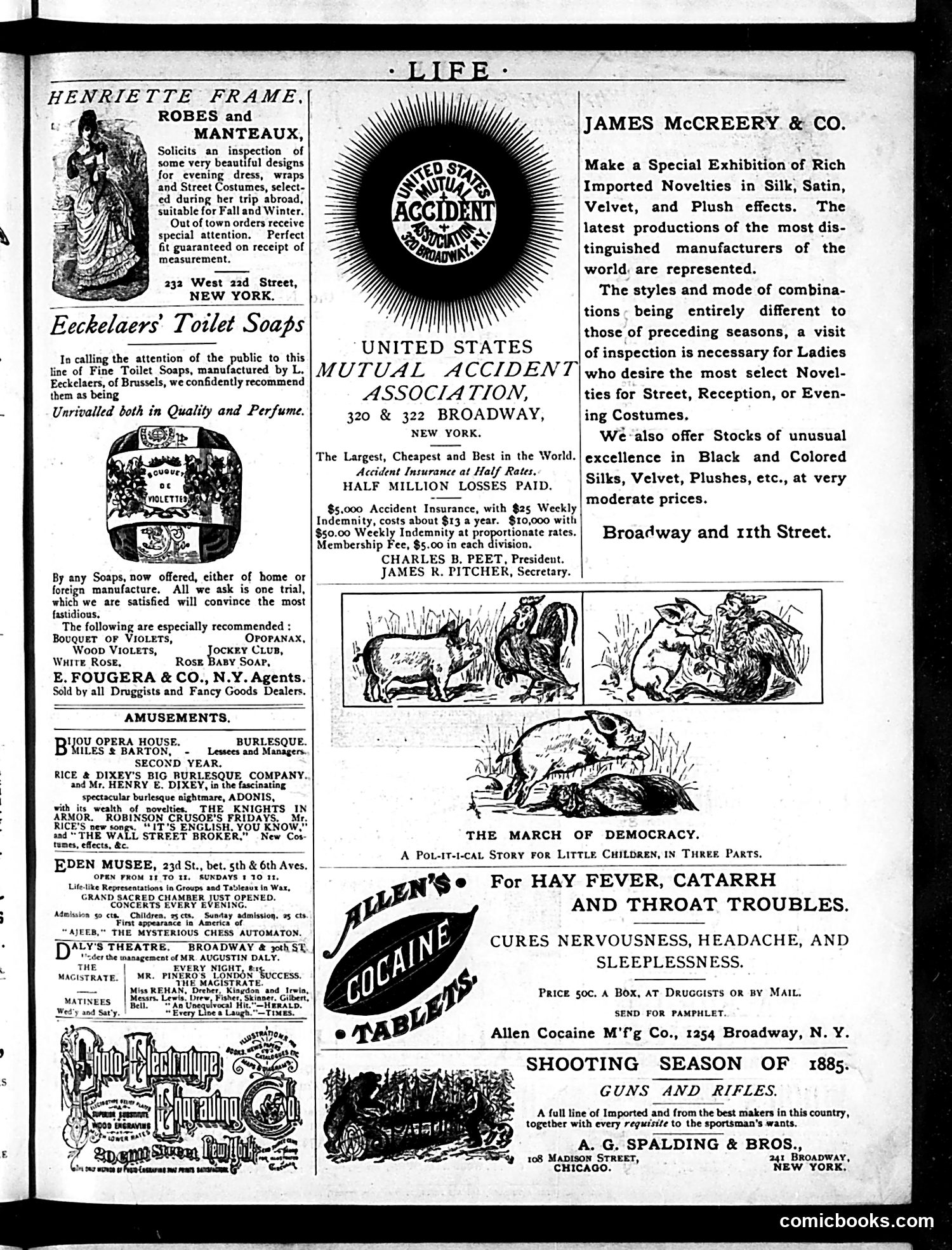
This page is primarily **advertisements** for clothing, soaps, insurance, theater, and sporting goods. However, the central cartoon titled **"The March of Democracy"** (subtitle: "A Political Story for Little Children, in Three Parts") appears to depict **anthropomorphized animals in a procession or march**, likely satirizing American democratic processes or political movements of the 1880s. The cartoon uses animals as political allegory—a common 19th-century satirical technique. Without seeing all three parts clearly, the specific political targets are unclear, but the framing as a children's story suggests **ironic commentary on American democracy itself**, presenting political processes as simplistic or absurd enough for children to understand. The surrounding ads (including one for **Allen's Cocaine Tablets** for hay fever—then legal) establish this as an 1880s publication reflecting that era's cultural attitudes.
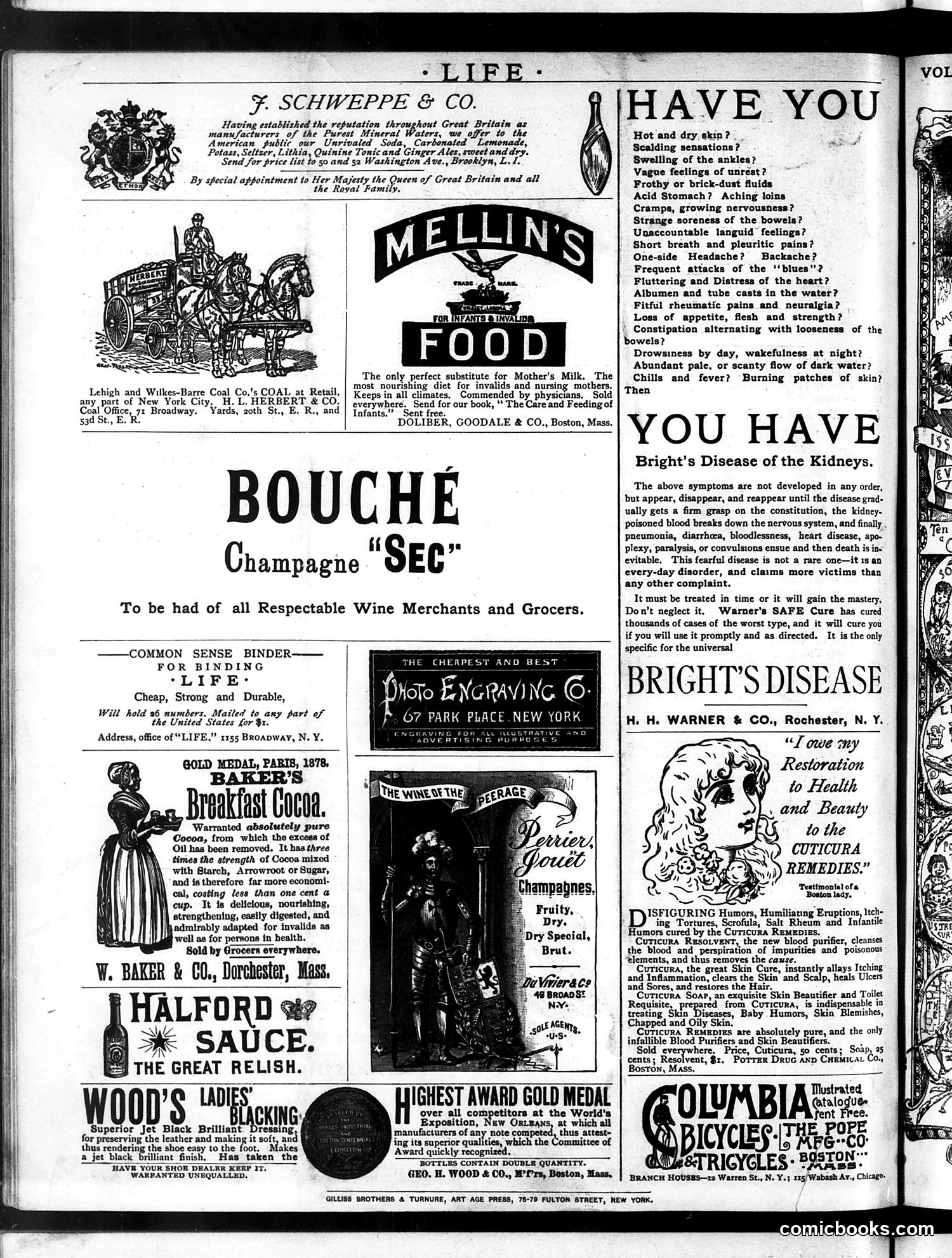
This page is **primarily advertisements**, not political satire. However, it contains one notable medical pitch: a large section advertising Warner's Safe Cure for Bright's Disease of the Kidneys. The advertisement uses a checklist of symptoms (hot skin, swelling ankles, shortness of breath, dark urine, etc.) to convince readers they have this kidney disease, then promises Warner's remedy will cure it. This reflects **19th-century patent medicine marketing**—exploiting public health anxiety with vague symptom lists that could apply to many conditions, then offering unproven "cures." The remaining content is standard period advertising for imported luxuries (Bouché Champagne, Schweppe's mineral waters) and household products (cocoa, shoe polish, sauce). The page demonstrates how Life magazine's revenue model relied heavily on advertisements rather than editorial content.