
Life, 1885-10-22 · page 11 of 16
Life — October 22, 1885 — page 11: what you’re looking at
What you’re looking at
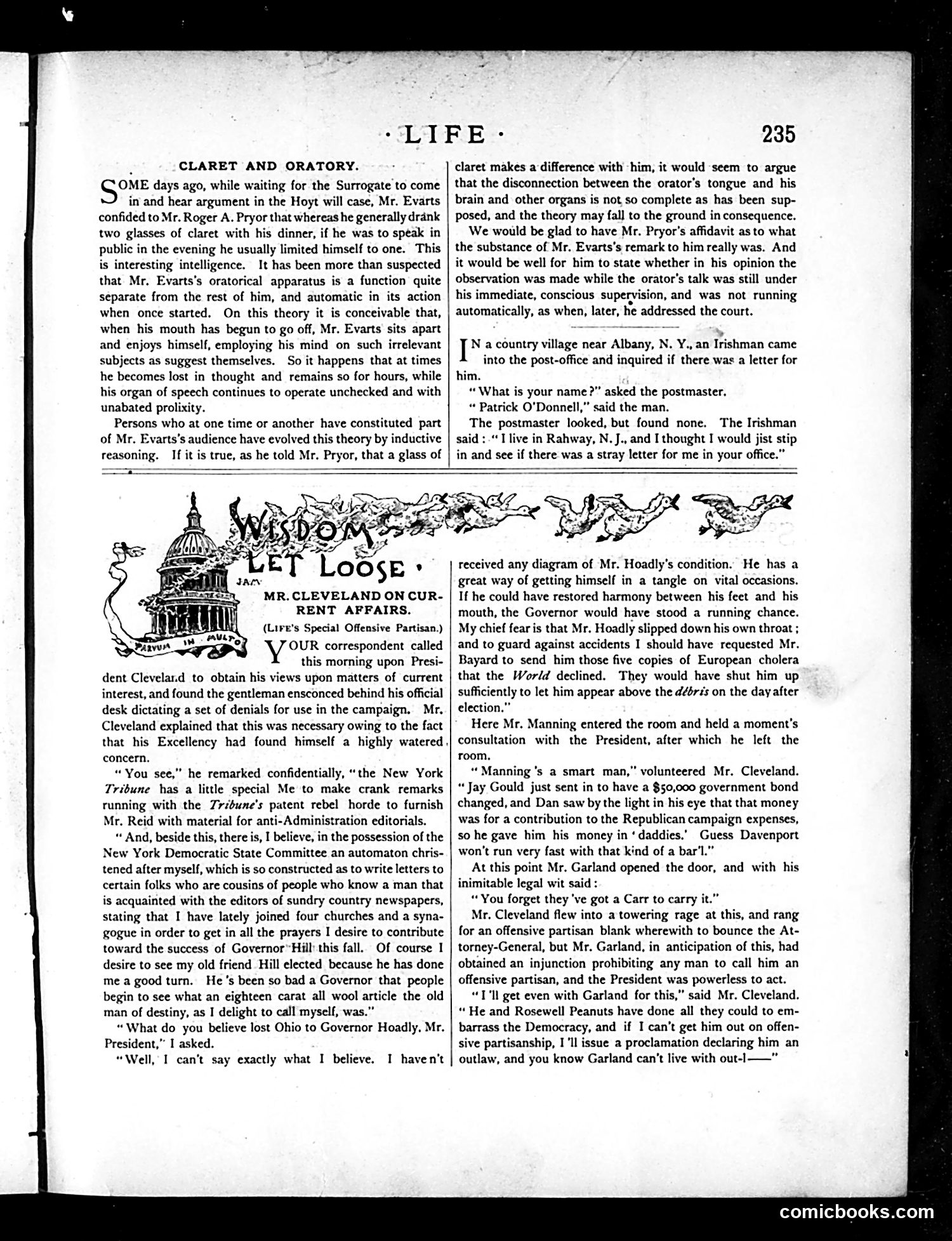
This page contains two satirical pieces mocking prominent figures of the era: **"Claret and Oratory"** ridicules **Mr. Evarts** (likely William Maxwell Evarts, a famous orator), suggesting his eloquence operates independently of his brain. The joke: he claims one glass of wine affects his speech, implying his mouth runs automatically while his mind wanders elsewhere—a cutting critique of his verbosity. **"Mr. Cleveland on Current Affairs"** satirizes **President Cleveland**, depicting him frantically issuing campaign denials. The satire targets how Democrats allegedly spread rumors about Cleveland (joining multiple churches for votes, creating fake "automaton" letters) while Cleveland himself manufactures counter-denials. The piece mocks both the president's defensive posture and the absurd nature of campaign dirty tricks, including a jab at New York Tribune editor Whitelaw Reid for spreading anti-Administration material. Both pieces exemplify *Life* magazine's role as a satirical publication attacking political figures and public personalities through humor.
📄 Transcribed text from this page (OCR, searchable)
Machine-transcribed from the original scan — historical spelling and the odd misread are preserved.
LIFE CLARET AND ORATORY. OME days ago, while waiting for the Surrogate to come in and hear argument in the Hoyt will case, Mr. Evarts confided to Mr. Roger A. Pryor that whereas he generally drank two glasses of claret with his dinner, if he was to speak in public in the evening he usually limited himself to one. This is interesting intelligence. It has been more than suspected that Mr. Evarts’s oratorical apparatus is a function quite separate from the rest of him, and automatic in its action when once started. On this theory it is conceivable that, when his mouth has begun to go off, Mr. Evarts sits apart and enjoys himself, employing his mind on such irrelevant subjects as suggest themselves. So it happens that at times he becomes lost in thought and remains so for hours, while his organ of speech continues to operate unchecked and with unabated prolixity. Persons who at one time or another have constituted part of Mr. Evarts’s audience have evolved this theory by inductive reasoning. If it is true,.a as he told Mr. Pryor, that a glass of 235 claret makes a difference with “him, it would seem to argue that the disconnection between the orator’s tongue and his brain and other organs is not so complete as has been sup- posed, and the theory may fall to the ground in consequence. We would be glad to have Mr. Pryor's affidavit as to what the substance of Mr. Evarts’s remark to him really was. And it would be well for him to state whether in his opinion the observation was made while the orator’s talk was still under his immediate, conscious supervision, and was not running automatically, as whens later, he addressed the court. I N a country village near Albany, N. Y.,an Irishman came into the post-office and inquired if there was a letter for “What is your name?” asked the postmaster. “ Patrick O'Donnell,” said the man. The postmaster looked, but found none. The Irishman said : “I live in Rahway, N. J., and I thought I would jist stip in and see if there was a stray letter for me in your office.” MR.CLEVELAND ON CUR- RENT AFFAIRS. s Special Offensive Partisan.) OUR correspondent called this morning upon Presi- dent Cleveland to obtain his views upon matters of current interest, and found the gentleman ensconced behind his official desk dictating a set of denials for use in the campaign. Mr. Cleveland explained that this was necessary owing to the fact that his Excellency had found himself a highly watered. concern. “You see,” he remarked confidentially, “the New York Tribune has a little special Me to make crank remarks running with the Zrzbune's patent rebel horde to furnish Mr. Reid with material for anti- Administration editorials. “ And, beside this, there is, I believe, in the possession of the New York Democratic State Committee an automaton chris- tened after myself, which is so constructed as to write letters to certain folks who are cousins of people who know a man that is acquainted with the editors of sundry country newspapers, stating that I have lately joined four churches and a syna- gogue in order to get in all the prayers I desire to contribute toward the success of Governor” Hill this fall. Of course I desire to see my old friend Hill elected because he has done me a good turn. He's been so bad a Governor that people begin to see what an eighteen carat all wool article the old man of destiny, as I delight to call myself, was.” “What do you believe lost Ohio to Governor Hoadly, Mr. President,” I asked. “Well, I can’t say exactly what I believe. I haven't received any diagram of Mr. Hoadly’s condition. He has a great way of getting himself in a tangle on vital occasions. If he could have restored harmony between his feet and his mouth, the Governor would have stood a running chance. My chief fear is that Mr. Hoadly slipped down his own throat ; and to guard against accidents I should have requested Mr. Bayard to send him those five copies of European cholera that the World declined. They would have shut him up sufficiently to let him appear above the dééris on the dayafter election.” Here Mr. Manning entered the room and held a moment's consultation with the President, after which he left the room, “ Manning 's a smart man,” volunteered Mr. Cleveland. “Jay Gould just sent in to have a $50,000 government bond changed, and Dan saw by the light in his eye that that money was for a contribution to the Republican campaign expenses, so he gave him his money in ‘daddies.’ Guess Davenport won't run very fast with that kind of a bar’l.” At this point Mr. Garland opened the door, and with his inimitable legal wit said : “You forget they 've got a Carr to carry it.” Mr. Cleveland flew into a towering rage at this, and rang for an offensive partisan blank wherewith to bounce the At- torney-General, but Mr. Garland, in anticipation of this, had obtained an injunction prohibiting any man to call him an offensive partisan, and the President was powerless to act. “T'll get even with Garland for this,” said Mr. Cleveland. “He and Rosewell Peanuts have done all they could to em- barrass the Democracy, and if I can’t get him out on offen- sive partisanship, I'll issue a proclamation declaring him an outlaw, and you know Garland can’t live with out-|——” comicbooks.com