
Life, 1885-10-22 · page 10 of 16
Life — October 22, 1885 — page 10: what you’re looking at
What you’re looking at
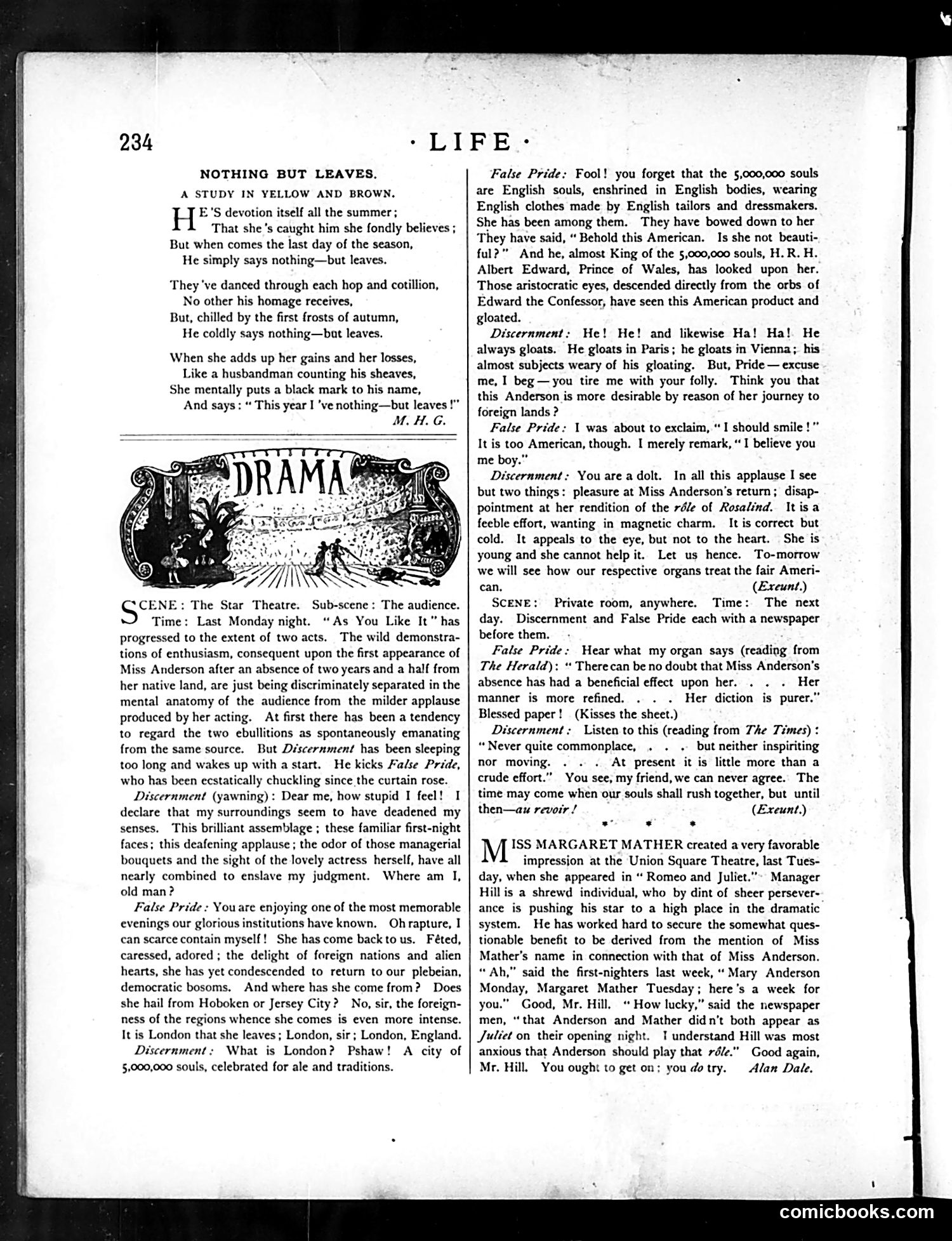
This page contains two pieces of satirical commentary on theatrical and romantic culture: **"Nothing But Leaves"** (poem): A cynical critique of male romantic fickleness. A man pursues a woman devotedly through summer social season, then abandons her without explanation when autumn arrives—leaving her with nothing but "leaves" (worthless remnants). The satire targets shallow courtship rituals. **Theatre Scene Dialogue**: Two allegorical characters—**Discernment** and **False Pride**—debate actress Mary Anderson's reception upon returning to America after performing in London. False Pride celebrates her enhanced prestige from foreign approval (notably the Prince of Wales's attention), while Discernment dismissively counters that her actual performance as Rosalind is mediocre and that her value shouldn't increase simply from European validation. The satire mocks American deference to British aristocracy and the tendency to overvalue artists based on foreign approval rather than actual merit. Anderson's talent remains unchanged; only perceived status differs.
📄 Transcribed text from this page (OCR, searchable)
Machine-transcribed from the original scan — historical spelling and the odd misread are preserved.
‘LIFE. NOTHING BUT LEAVES. A STUDY IN YELLOW AND BROWN, E'S devotion itself all the summer ; That she’s caught him she fondly believes ; But when comes the last day of the season, He simply says nothing—but leaves. They ‘ve danced through each hop and cotillion, No other his homage receives, But, chilled by the first frosts of autumn, He coldly says nothing—buat leaves. When she adds up her gains and her losses, Like a husbandman counting his sheaves, She mentally puts a black mark to his name, And says: “ This year I 've nothing—but leaves !" ~CENE: The Star Theatre. Sub-scene: The audience. Time: Last Monday night. “As You Like It” has progressed to the extent of two acts. The wild demonstra- tions of enthusiasm, consequent upon the first appearance of Miss Anderson after an absence of two years and a half from her native land, are just being discriminately separated in the mental anatomy of the audience from the milder applause produced by her acting. At first there has been a tendency to regard the two ebullitions as spontaneously emanating from the same source. But Discernment has been sleeping too long and wakes up with a start. He kicks False Pride, who has been ecstatically chuckling since the curtain rose. Discernment (yawning): Dear me, how stupid I feel! I declare that my surroundings seem to have deadened my senses. This brilliant assemblage ; these familiar first-night faces; this deafening applause ; the odor of those managerial bouquets and the sight of the lovely actress herself, have all nearly combined to enslave my judgment. Where am I, old man? False Pride : Youare enjoying one of the most memorable evenings our glorious institutions have known, Oh rapture, I can scarce contain myself! She has come backtous. Féted, caressed, adored ; the delight of foreign nations and alien hearts, she has yet condescended to return to our plebeian, democratic bosoms. And where has she come from? Does she hail from Hoboken or Jersey City? No, sir, the foreign- ness of the regions whence she comes is even more intense. It is London that she leaves ; London, sir; London, England. Discernment; What is London? Pshaw! A city of 5,000,000 souls, celebrated for ale and traditions. False Pride: Fool! you forget that the 5,000,000 souls are English souls, enshrined in English bodies, wearing English clothes made by English tailors and dressmakers. She has been among them. They have bowed down to her They have said, “ Behold this American. Is she not beauti- ful?” And he, almost King of the 5,000,000 souls, H. R. H. Albert Edward, Prince of Wales, has looked upon her. Those aristocratic eyes, descended directly from the orbs of Edward the Confessor, have seen this American product and gloated. Discernment: He! He! and likewise Ha! Ha! He always gloats. He gloats in Paris; he gloats in Vienna; his almost subjects weary of his gloating. But, Pride — excuse me, I beg—you tire me with your folly. Think you that this Anderson is more desirable by reason of her journey to foreign lands ? False Pride: 1 was about to exclaim, “I should smile!” It is too American, though. I merely remark, “I believe you me boy.” Discernment: You area dolt. In all this applause I see but two things: pleasure at Miss Anderson's return; disap- pointment at her rendition of the ré/e of Rosalind. Itisa feeble effort, wanting in magnetic charm, It is correct but cold. It appeals to the eye, but not to the heart. She is young and she cannot help it. Let us hence. To-morrow we will see how our respective organs treat the fair Ameri- can, (Exeunt.) SCENE: Private room, anywhere. Time: The next day. Discernment and False Pride each with a newspaper before them. False Pride: Hear what my organ says (reading from The Herald): “ Therecan be no doubt that Miss Anderson's absence has had a beneficial effect upon her. Her manner is more refined. Her diction is purer.” Blessed paper! (Kisses the sheet.) Discernment; Listen to this (reading from The Times): “ Never quite commonplace, but neither inspiriting nor moving. At present it is little more than a crude effort.” You see, my friend, we can never agree. The time may come when our souls shall rush together, but until then—au revoir! (Exeunt.) a . . ISS MARGARET MATHER created a very favorable impression at the Union Square Theatre, last Tues- day, when she appeared in “ Romeo and Juliet.”* Manager Hill is a shrewd individual, who by dint of sheer persever- ance is pushing his star to a high place in the dramatic system. He has worked hard to secure the somewhat ques- tionable benefit to be derived from the mention of Miss Mather’s name in connection with that of Miss Anderson. “Ah,” said the first-nighters last week, “ Mary Anderson Monday, Margaret Mather Tuesday; here's a week for you.” Good, Mr. Hill. “ How lucky,” said the newspaper men, “that Anderson and Mather didn’t both appear as Juliet on their opening night. 1 understand Hill was most anxious that Anderson should play that ré/e." Good again, Mr. Hill. You ought to get on; youdotry. Alan Dale. comicbooks.com