
Life, 1885-10-22 · page 2 of 16
Life — October 22, 1885 — page 2: what you’re looking at
What you’re looking at
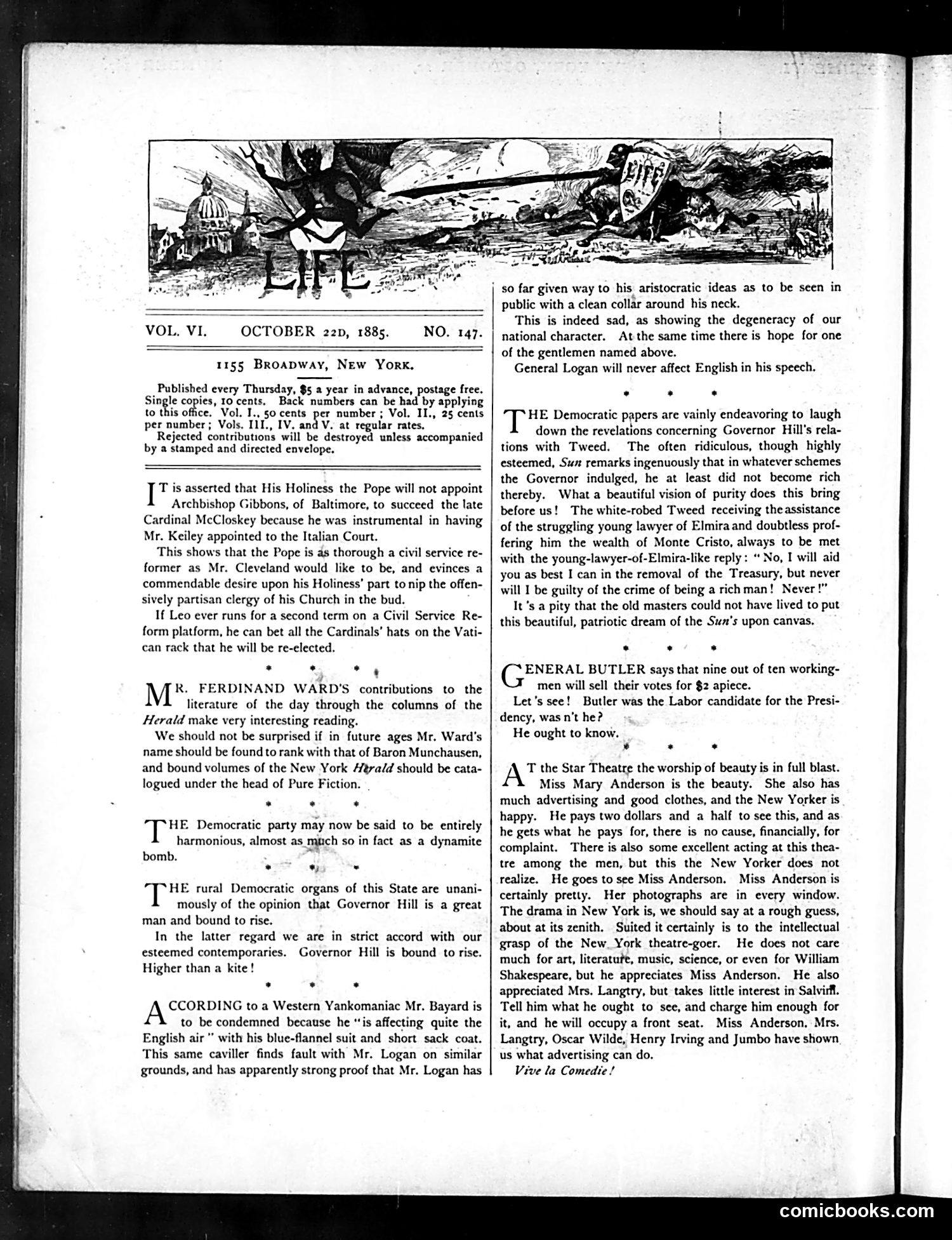
The page's header cartoon depicts a chaotic scene with figures and what appears to be a falling or collapsing structure labeled "LIFE," suggesting commentary on the magazine itself or contemporary events. The text discusses several political matters: Governor Hill's relationship with "Tweed" (likely referencing Tammany Hall corruption), criticism of aristocratic pretensions among political figures, and commentary on General Butler's claim that working men will vote for him. There's also social satire about Miss Mary Anderson, an actress at the Star Theatre, whose beauty and advertising prowess are mocked—suggesting her talent for self-promotion exceeds her dramatic ability. The piece critiques how advertising drives theatrical success in New York. The overall tone is partisan Democratic mockery mixed with broader social commentary on American politics and popular culture.
📄 Transcribed text from this page (OCR, searchable)
Machine-transcribed from the original scan — historical spelling and the odd misread are preserved.
VOL. VI. OCTOBER 2z2p, 1885. NO. 147. 1155 Broapway, New York. Published every Thursday, $5 a year in advance, postage free. Single copies, ro cents, Back numbers can be had by applying to this office. Vol. I., 50 cents per number ; Vol. II., 25 cents per number; Vols. I1I., IV, and V. at regular rates, Rejected contributions will be destroyed unless accompanied by a stamped and directed envelope. I’ is asserted that His Holiness the Pope will not appoint Archbishop Gibbons, of Baltimore, to succeed the late Cardinal McCloskey because he was instrumental in having Mr. Keiley appointed to the Italian Court. This shows that the Pope is as thorough a civil service re- former as Mr. Cleveland would like to be, and evinces a commendable desire upon his Holiness’ part to nip the offen- sively partisan clergy of his Church in the bud. If Leo ever runs for a second term on a Civil Service Re- form platform, he can bet all the Cardinals’ hats on the Vati- can rack that he will be re-elected. * * 4 M R. FERDINAND WARD'S contributions to the literature of the day through the columns of the Herald make very interesting reading. We should not be surprised if in future ages Mr. Ward's name should be found to rank with that of Baron Munchausen, and bound volumes of the New York Héra/d should be cata- logued under the head of Pure Fiction. * . . Tt Democratic party may now be said to be entirely harmonious, almost as much so in fact as a dynamite bomb. fi . * - HE rural Democratic organs of this State are unani- mously of the opinion that Governor Hill is a great man and bound to rise. In the latter regard we are in strict accord with our esteemed contemporaries. Governor Hill is bound to rise. Higher than a kite! . . . CCORDING to a Western Yankomaniac Mr. Bayard is to be condemned because he “is affecting quite the English air” with his blue-flannel suit and short sack coat. This same caviller finds fault with Mr. Logan on similar grounds, and has apparently strong proof that Mr. Logan has | so far given way to his aristocratic ideas as to be seen in public with a clean collar around his neck. This is indeed sad, as showing the degeneracy of our national character. Atthe same time there is hope for one of the gentlemen named above. General Logan will never affect English in his speech. . * * Te Democratic papers are vainly endeavoring to laugh down the revelations concerning Governor Hill's rela- tions with Tweed. The often ridiculous, though highly esteemed, Su remarks ingenuously that in whatever schemes the Governor indulged, he at least did not become rich thereby. What a beautiful vision of purity does this bring before us! The white-robed Tweed receiving the assistance of the struggling young lawyer of Elmiraand doubtless prof- fering him the wealth of Monte Cristo, always to be met with the young-lawyer-of-Elmira-like reply : “ No, I will aid you as best I can in the removal of the Treasury, but never will I be guilty of the crime of being a rich man! Never!” It’s a pity that the old masters could not have lived to put this beautiful, patriotic dream of the Sun's upon canvas. * * . ENERAL BUTLER says that nine out of ten working- men will sell their votes for $2 apiece. Let’s see! Butler was the Labor candidate for the Presi- dency, was n’t he? He ought to know. * * * A’ the Star Theatre the worship of beauty is in full blast. Miss Mary Anderson is the beauty. She also has much advertising and good clothes, and the New Yorker is happy. He pays two dollars and a half to see this, and as he gets what he pays for, there is no cause, financially, for complaint. There is also some excellent acting at this thea- tre among the men, but this the New Yorker does not realize. He goes to see Miss Anderson. Miss Anderson is certainly pretty. Her photographs are in every window. The drama in New York is, we should say at a rough guess, about at its zenith. Suited it certainly is to the intellectual grasp of the New_York theatre-goer. He does not care much for art, literatufe, music, science, or even for William Shakespeare, but he appreciates Miss Anderson. He also appreciated Mrs. Langtry, but takes little interest in Salvirf. Tell him what he ought to see, and charge him enough for it, and he will occupy a front seat. Miss Anderson, Mrs. Langtry, Oscar Wilde, Henry Irving and Jumbo have shown. us what advertising can do. Vive la Comedie! comicbooks.com