
A complete issue · 16 pages · 1885
Life — July 16, 1885
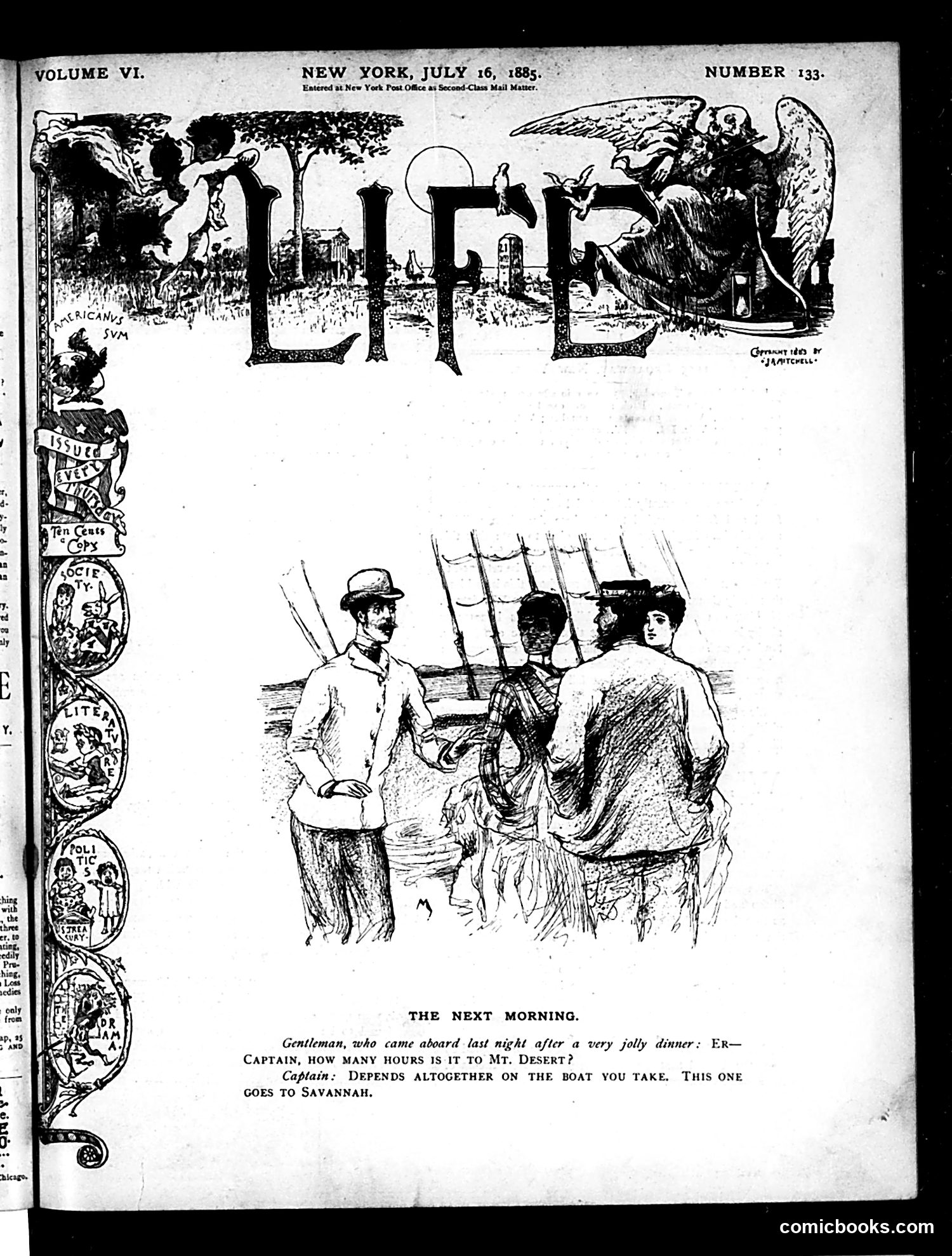
This page features a brief humorous sketch titled "The Next Morning." The dialogue depicts a gentleman who arrived aboard a ship after "a very jolly dinner" asking the captain how many hours remain until reaching Mt. Desert (a popular coastal destination in Maine). The captain's reply—that the journey time "depends altogether on the boat you take. This one goes to Savannah"—suggests the intoxicated passenger has boarded the wrong vessel entirely, heading south to Georgia instead of remaining in New England. The joke plays on the common trope of drunken confusion and mistaken identity. The accompanying sketch shows the befuddled gentleman conversing with the captain and crew aboard ship, illustrating the comedic moment of this embarrassing realization.
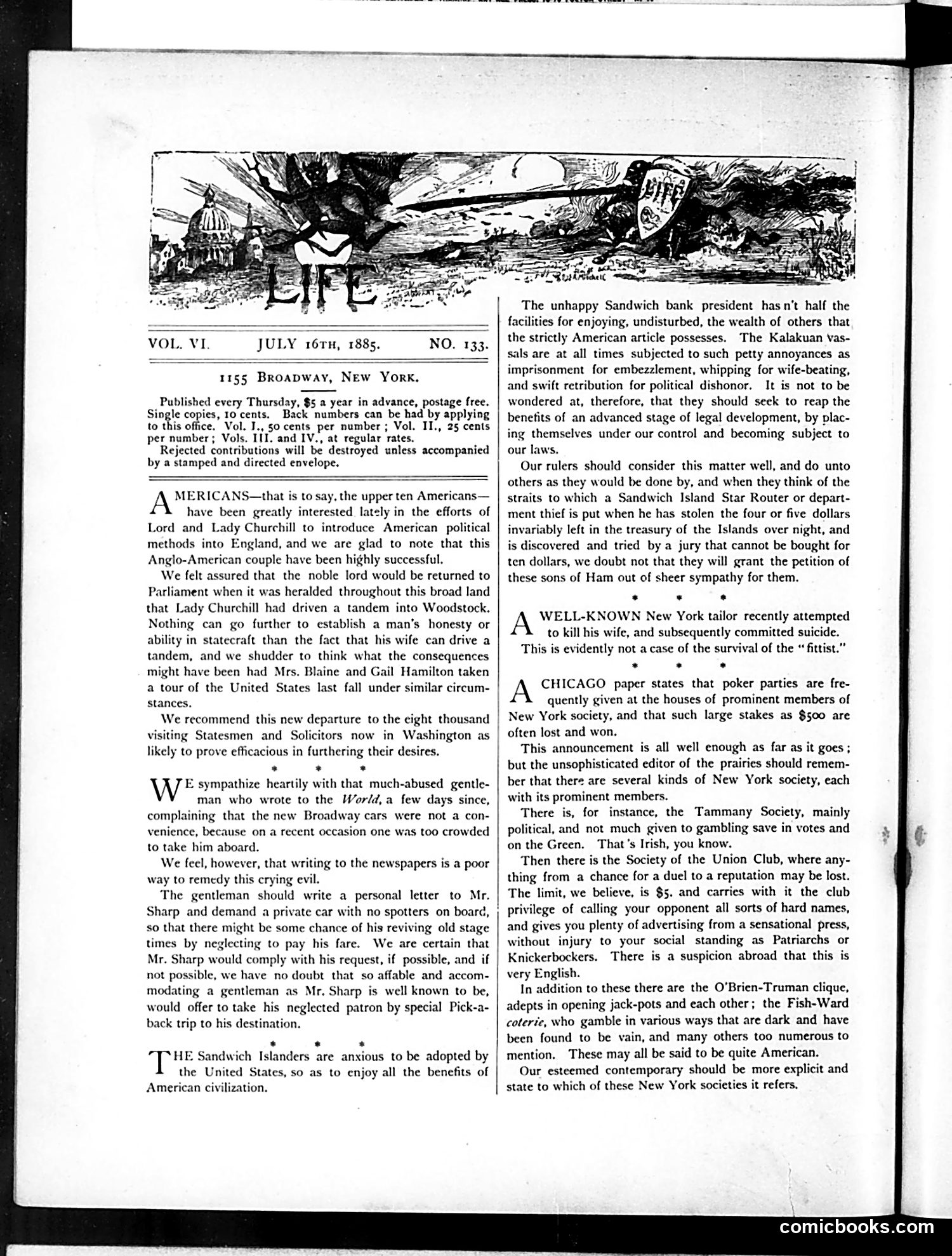
The masthead features "LIFE" with an ornate illustration of what appears to be a tree or natural scene. The page contains several brief satirical commentary pieces rather than political cartoons. Topics include: 1. **American political visitors to England**: Praising Lord and Lady Churchill's success introducing American political methods to Parliament. 2. **Broadway cable cars**: Sympathizing with a gentleman whose wife caused a scene on new Broadway streetcars, suggesting he write personally to Mr. Sharp (likely the transit operator) rather than complain to newspapers. 3. **Sandwich Island banking**: Mocking a bank president's concerns about subjecting Kalakauan vassals to American legal processes. 4. **New York society gambling**: Satirizing prominent New York social clubs (Tammany Society, Union Club, O'Brien-Truman clique) for their gambling habits, suggesting this is "very English" behavior. The satire targets American hypocrisy about civilization and proper conduct.
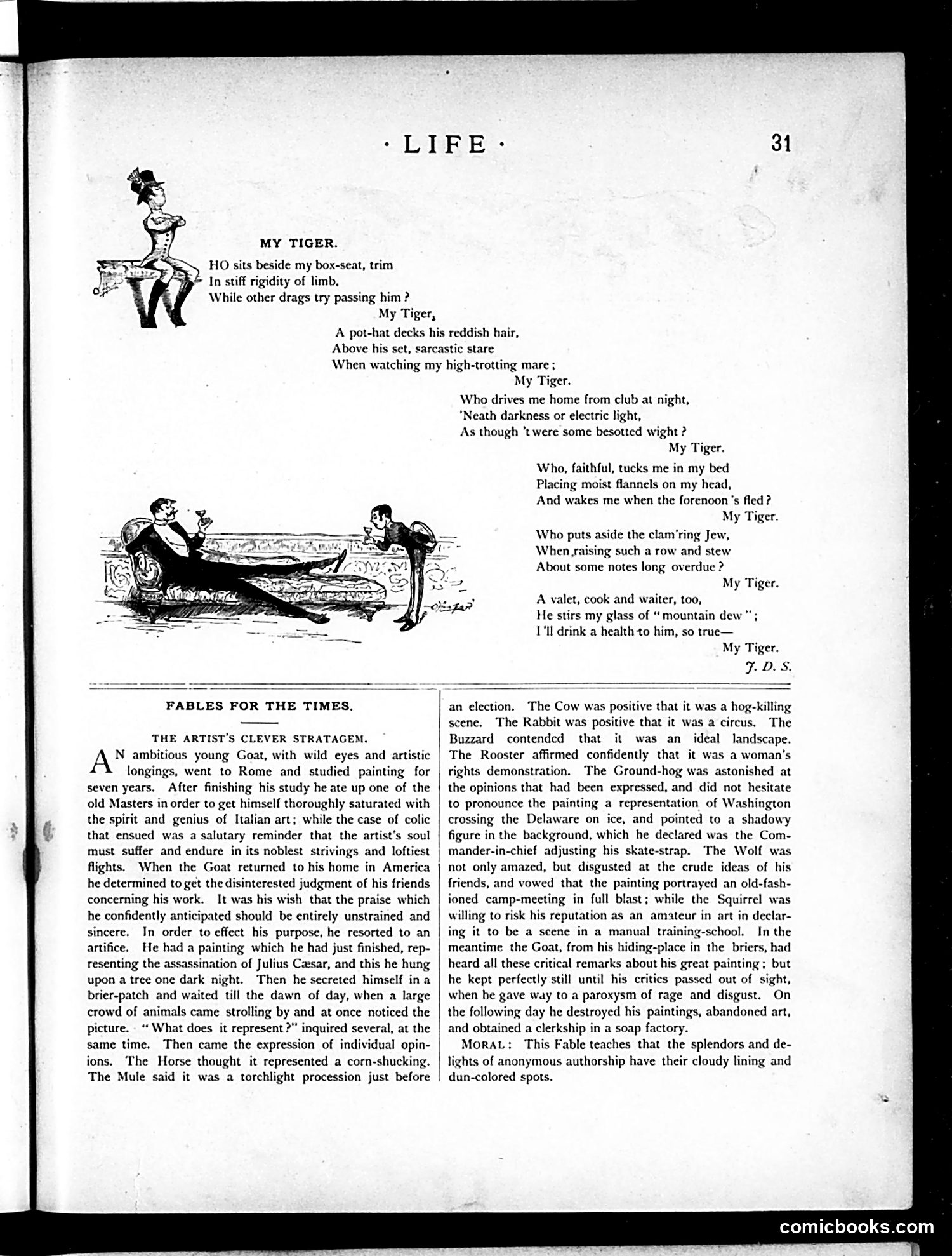
**"My Tiger"** is a humorous poem about a fashionable gentleman's automobile (his "Tiger"). It catalogs the car's various roles—rushing him from clubs, serving as a bed when he's tired, handling his debts—with affectionate exasperation. The satire targets wealthy men's dependence on automobiles as essential status symbols and lifestyle accessories. **"Fables for the Times"** mocks anonymous artists seeking critical praise. A Goat paints secretly, then displays his work to farm animals who interpret it through their own narrow perspectives (torchlight procession, hog-killing, woman's rights demonstration). When critics pass judgment, the Goat destroys everything in humiliation. The moral critiques how anonymous work receives unfair, subjective criticism based on viewers' biases rather than artistic merit.
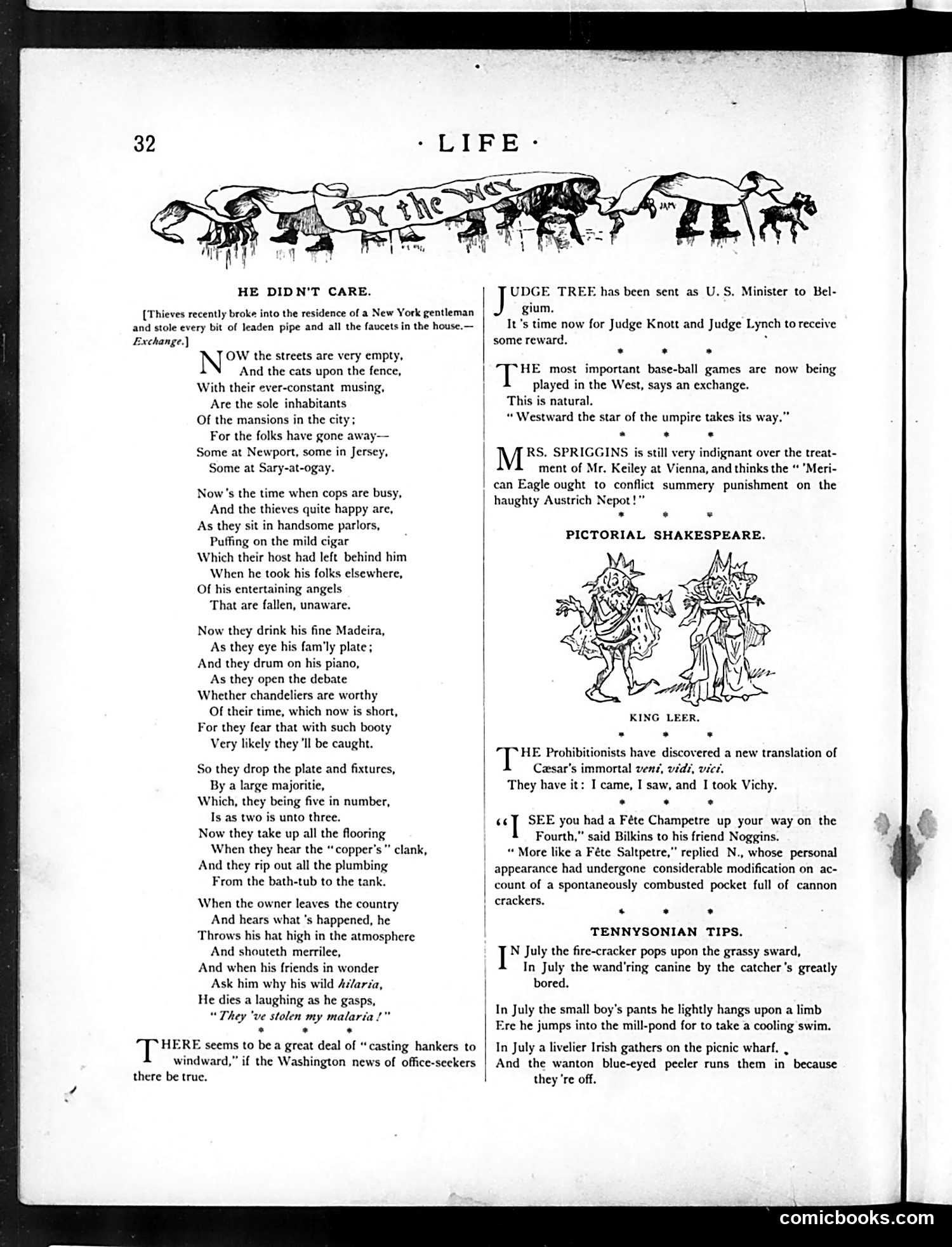
**"He Didn't Care"** is a satirical poem about thieves robbing a New York gentleman's house of lead pipes and faucets. The joke appears to be social commentary: the wealthy owner is so indifferent to his material possessions that he doesn't even notice the theft. The poem mocks either upper-class detachment or suggests the theft is so commonplace it's unremarkable. The page also contains brief gossipy items about Judge Tree's diplomatic appointment, baseball in the West, and Mrs. Spriggins's complaints about treatment in Vienna. **"Pictorial Shakespeare"** shows a crude cartoon labeled "King Lear," though its relevance is unclear. The remaining content consists of wordplay and satirical "tips," typical of Life's humorous miscellany format from this era.
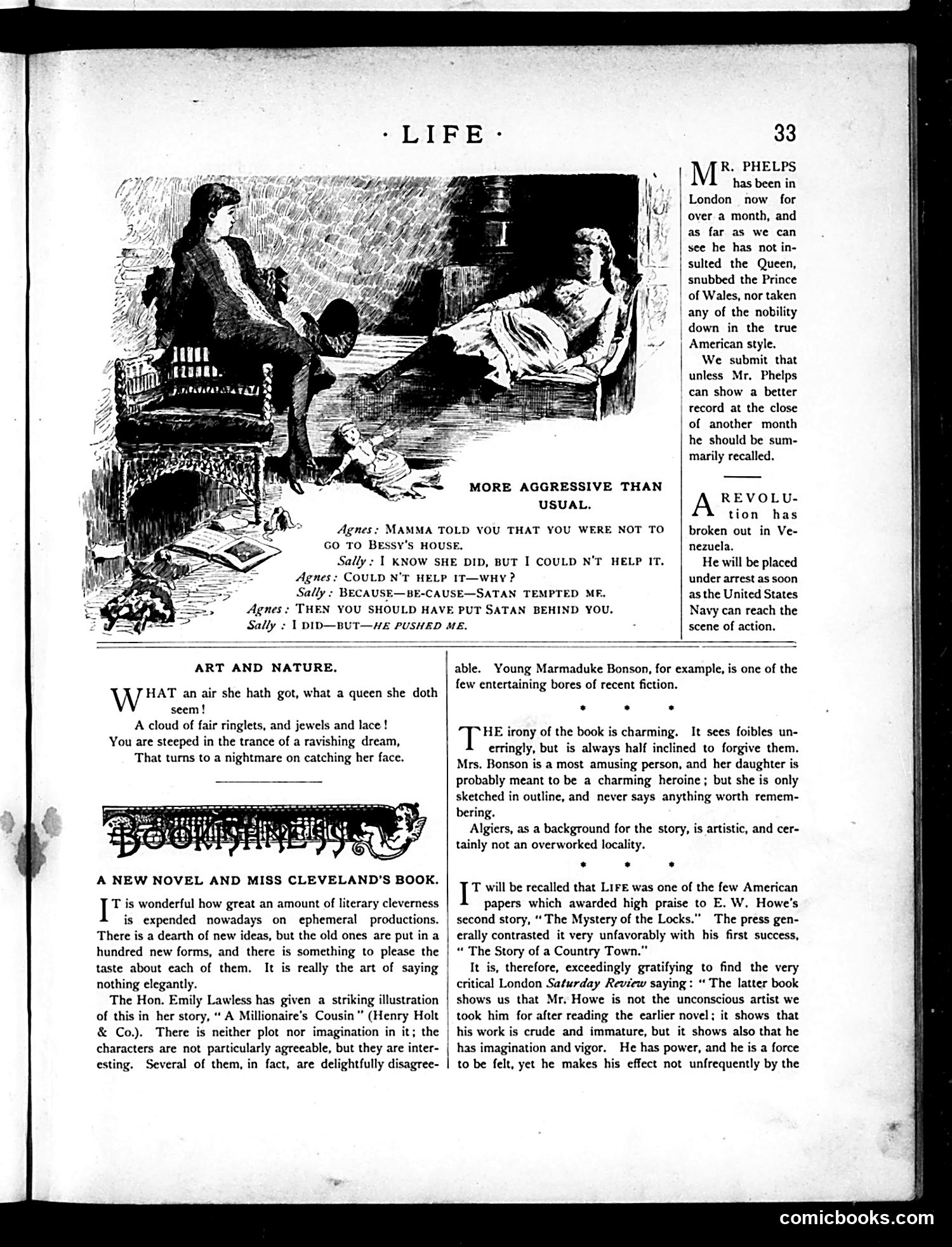
The main cartoon, titled "MORE AGGRESSIVE THAN USUAL," depicts a domestic scene between two women discussing Mr. Phelps's behavior in London. Agnes reports that Phelps's mother warned him against visiting "Bessy's house," but he went anyway. Sally explains his transgression: "Satan tempted Mr. Phelps" and "he pushed me." The satire mocks Victorian-era moral hypocrisy and gender dynamics. A man's inappropriate behavior toward a woman is blamed on demonic influence rather than personal responsibility. The women's resigned acceptance of male misbehavior—framed as inevitable temptation—satirizes the era's double standards regarding sexual conduct and accountability. Below, the page reviews literary works, including Emily Lawless's novel and E.W. Howe's fiction, with no clear political content visible.
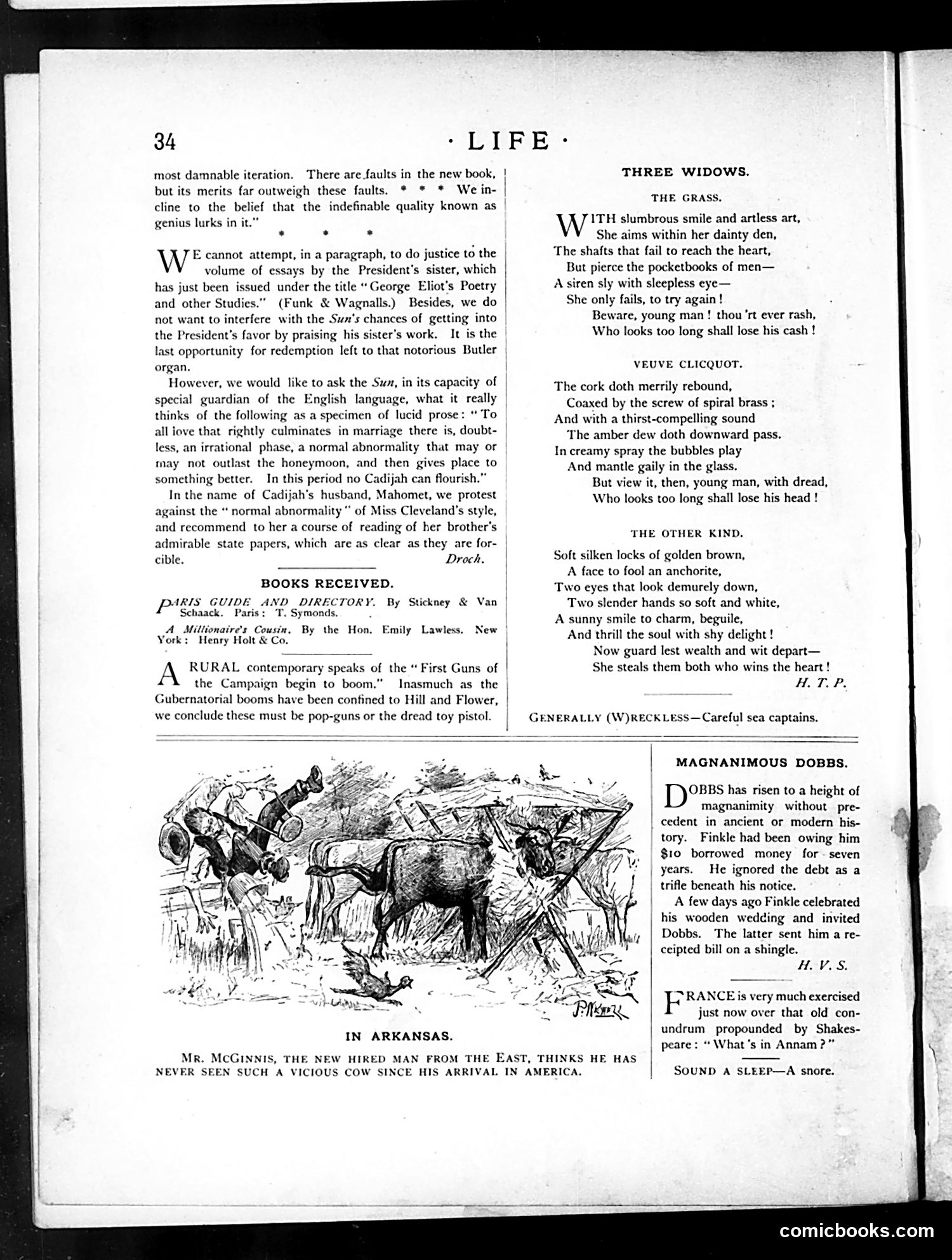
The page contains a cartoon titled "In Arkansas" depicting a man with a horse-drawn carriage in a rural setting. The caption states: "Mr. McGinnis, the new hired man from the East, thinks he has never seen such a vicious cow since his arrival in America." The satire targets the contrast between Eastern urbanites and rural Western/Southern life. McGinnis, apparently an Eastern newcomer, encounters rough frontier conditions he finds shocking. The humor relies on the stereotype of Easterners as unaccustomed to frontier hardships and animal dangers. The page also features poetry sections ("Three Widows," "The Grass," "Veuve Clicquot") and brief commentary pieces typical of Life's satirical format, though these don't appear cartoonish in nature.
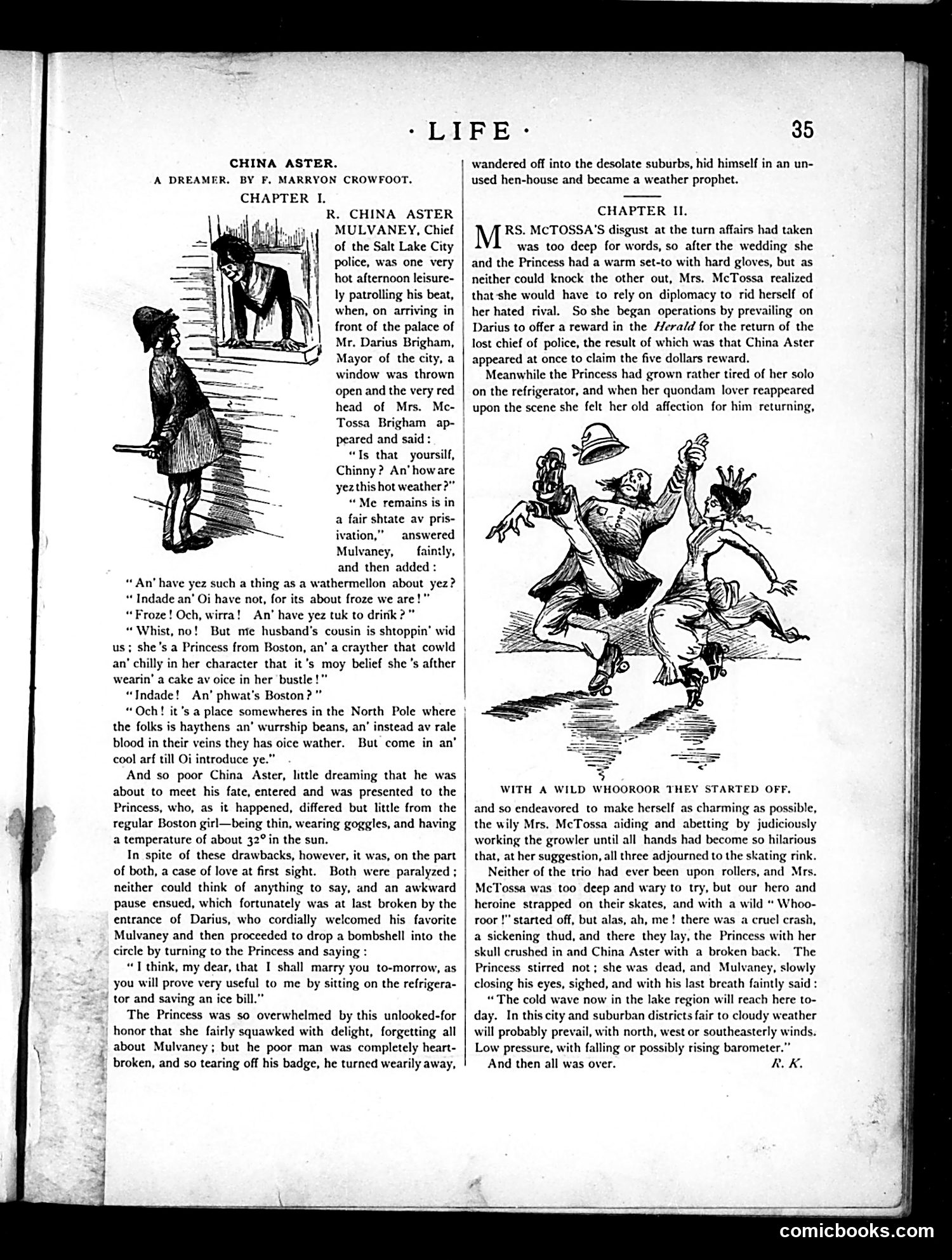
This is a serialized short story rather than political satire. Chapter I introduces China Aster, described as "one very hot afternoon" character in Salt Lake City police work under Chief Mulvaney. The narrative involves romantic rivalry—Mrs. McTossa (apparently a Boston woman) competes with a Princess over a male character named Darius. Chapter II depicts the trio attempting roller skating, which ends comedically when they crash. The story emphasizes slapstick humor and social comedy around turn-of-century leisure activities and romantic entanglements rather than political commentary. The illustrations are sketch-style period drawings typical of Life magazine's fiction accompaniment. This appears to be light entertainment fiction rather than satirical commentary on current events or politics.
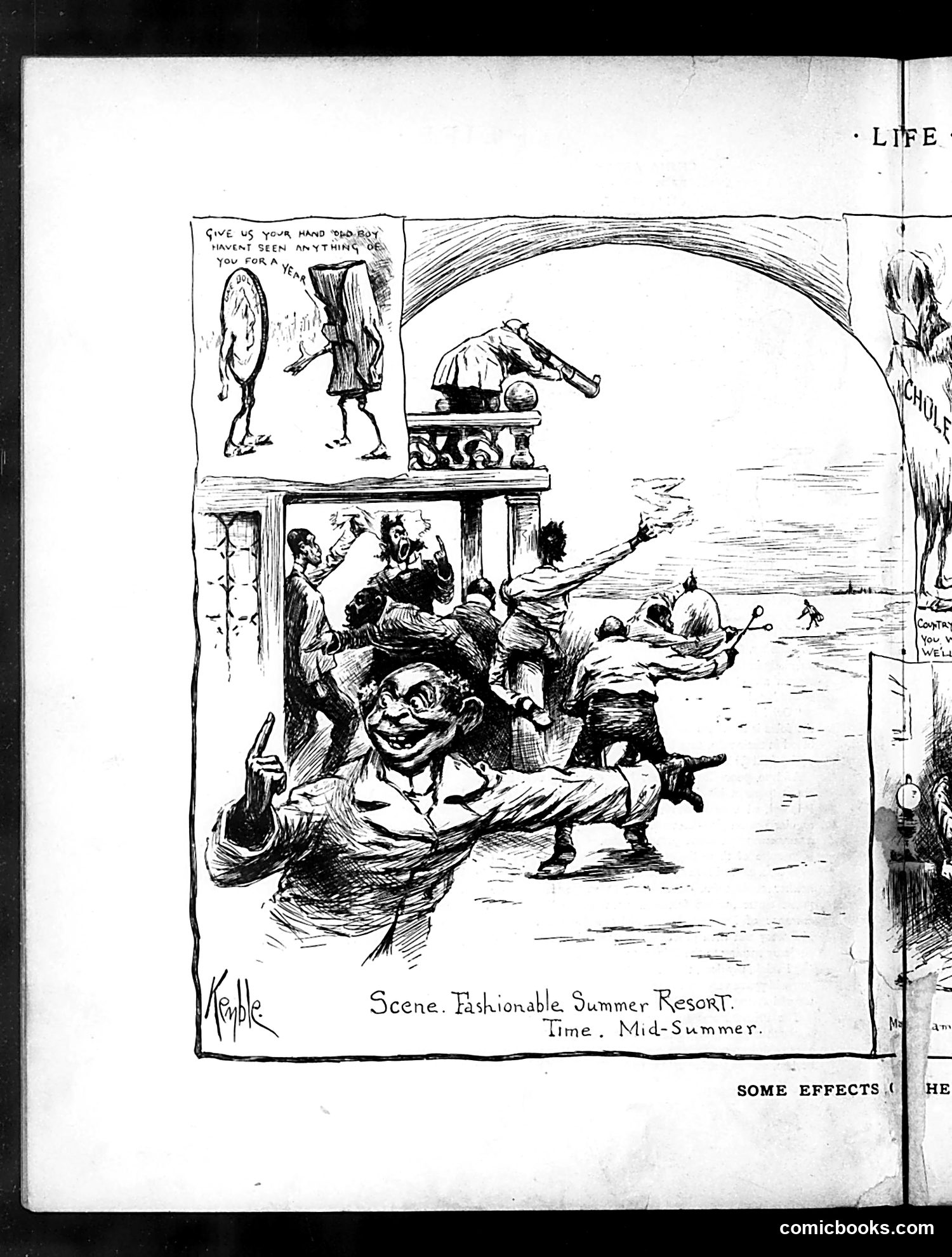
This is a satirical cartoon titled "Scene. Fashionable Summer Resort. Time. Mid-Summer." by Kepple (the artist's signature). The main joke depicts a caricatured figure in the foreground with an exaggerated grin, holding what appears to be a knife or utensil. Behind him, well-dressed resort guests are actively engaged in various leisure activities—swimming, socializing, and relaxing. The inset dialogue at top-left reads: "Give us your hand 'old boy. Haven't seen anything of you for a year." This sarcastically contrasts the speaker's friendly greeting with the oblivious front-figure's menacing appearance and pose. The satire likely mocks the contrast between genteel summer resort culture and an uncouth or threatening presence disrupting polite society—a commentary on class tensions or the intrusion of crude behavior into refined social spaces during this period.
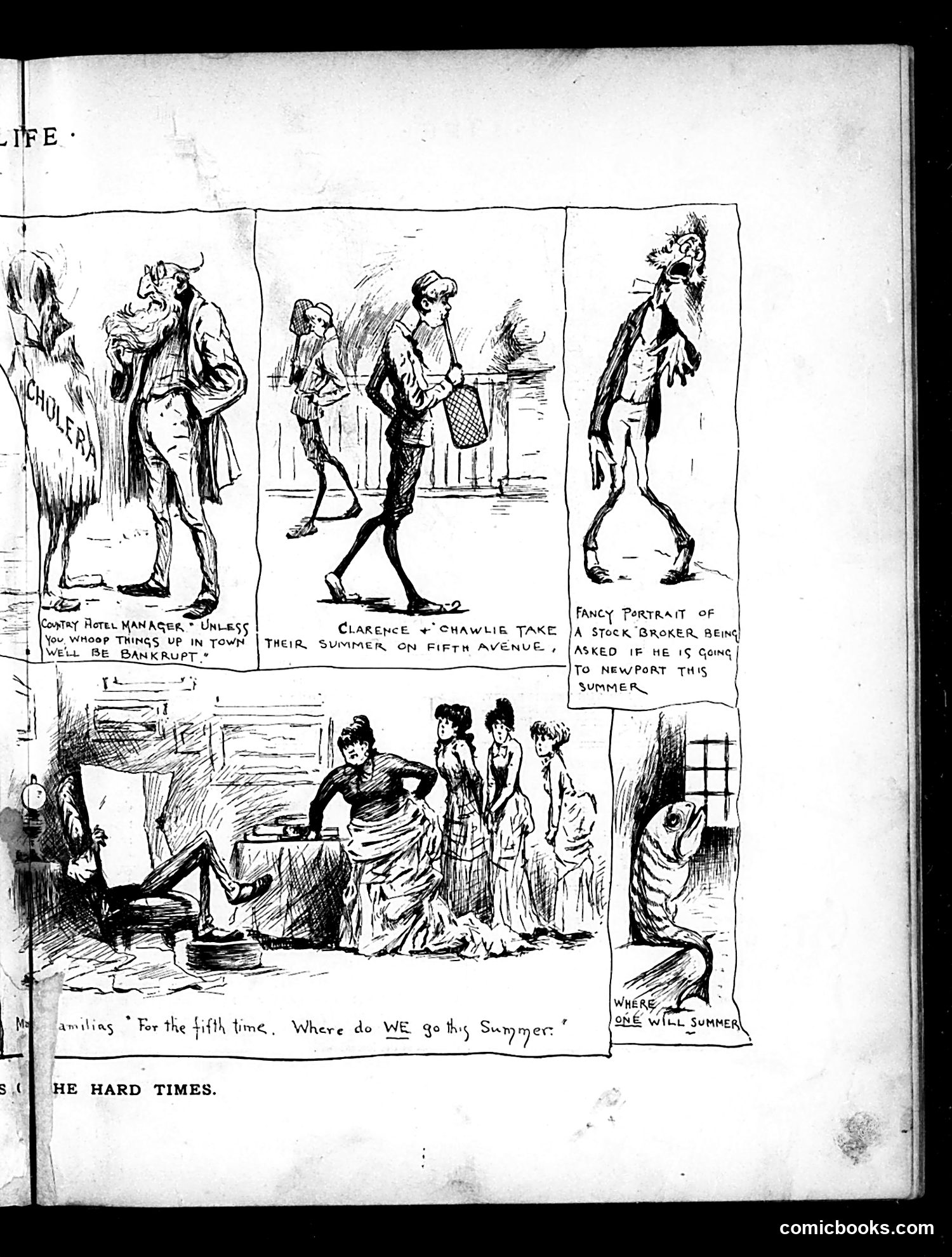
This satirical page depicts the economic hardships of the Gilded Age through interconnected vignettes about wealthy New Yorkers struggling with summer plans during financial difficulty. The top panels show: - A "Country Hotel Manager" threatening bankruptcy unless wealthy guests pay their bills - "Clarence" and "Chawlie" debating whether to vacation on Fifth Avenue - A stock broker anxiously asking about Newport summer plans The bottom panel shows multiple women asking repeatedly, "For the fifth time, where do WE go this summer?"—suggesting wealthy families cannot afford their customary expensive summer retreats. The page title, "The Hard Times," indicates this reflects actual economic depression when even the wealthy faced financial constraints. The satire mocks how severely reduced circumstances affect the leisure class's status-dependent social calendar.
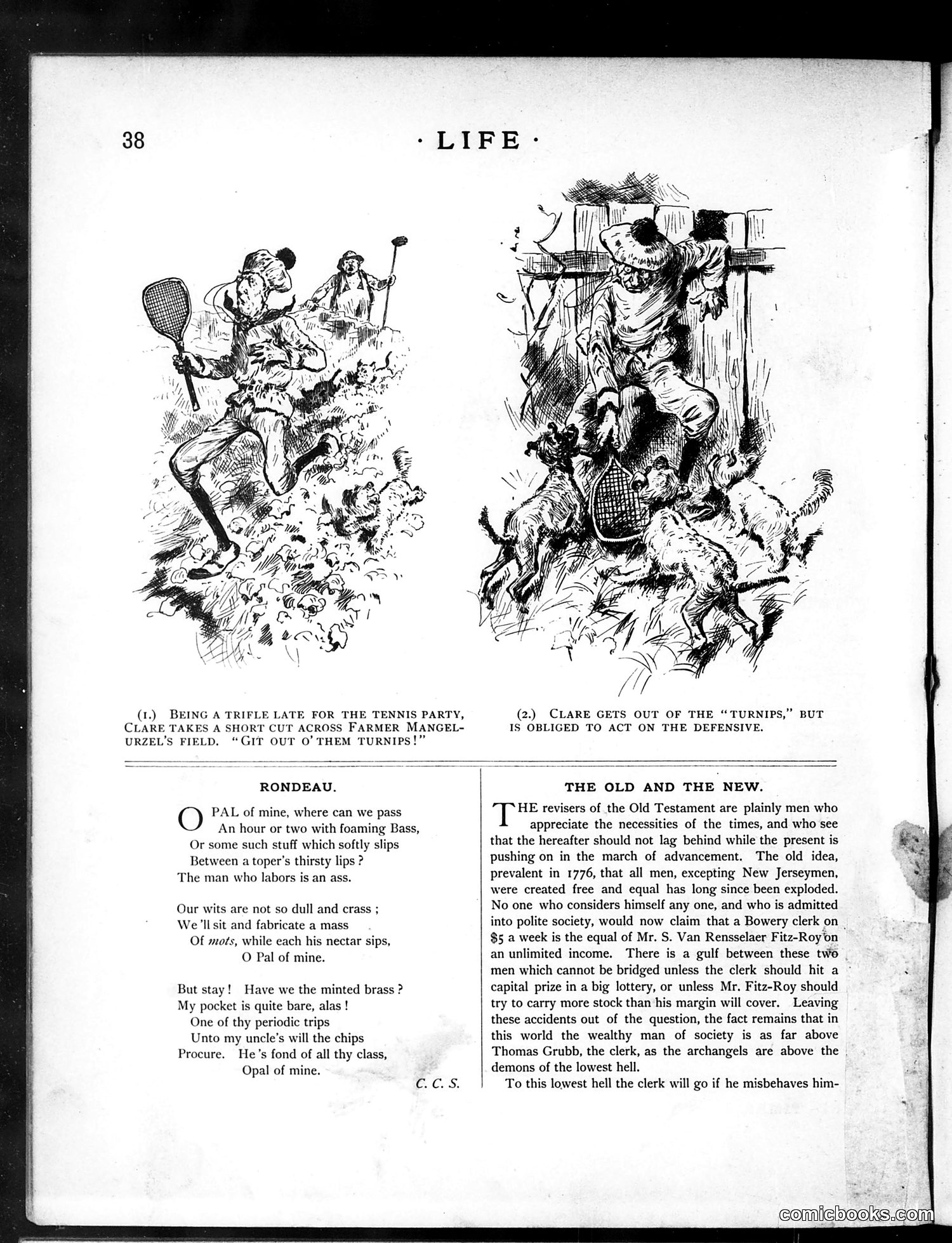
**The Cartoons (top):** Two sequential panels satirize a socialite named Clare attending a tennis party. Panel 1 shows her trespassing through a farmer's turnip field as a shortcut; Panel 2 depicts her fleeing from an angry farmer with a weapon. The humor lies in the contrast between genteel leisure activities and harsh rural reality—the farmer's violent reaction to trespassing undermines her upper-class presumptions. **"Rondeau" Poem:** A satirical poem about wealthy idlers discussing drinking and leisure while claiming poverty, then casually expecting to borrow money from a wealthy uncle. It mocks aristocratic pretense and financial irresponsibility. **"The Old and the New" Essay:** A scathing critique of class inequality, sarcastically arguing that 1776's ideal of equality has been abandoned. The author attacks wealthy society's treatment of poor clerks (like "Thomas Grubb" earning $5/week) as inferior beings, comparing their status to demons versus archangels. The piece condemns this moral hypocrisy in contemporary American society. Together, the page satirizes class privilege and social inequality in late 19th-century America.
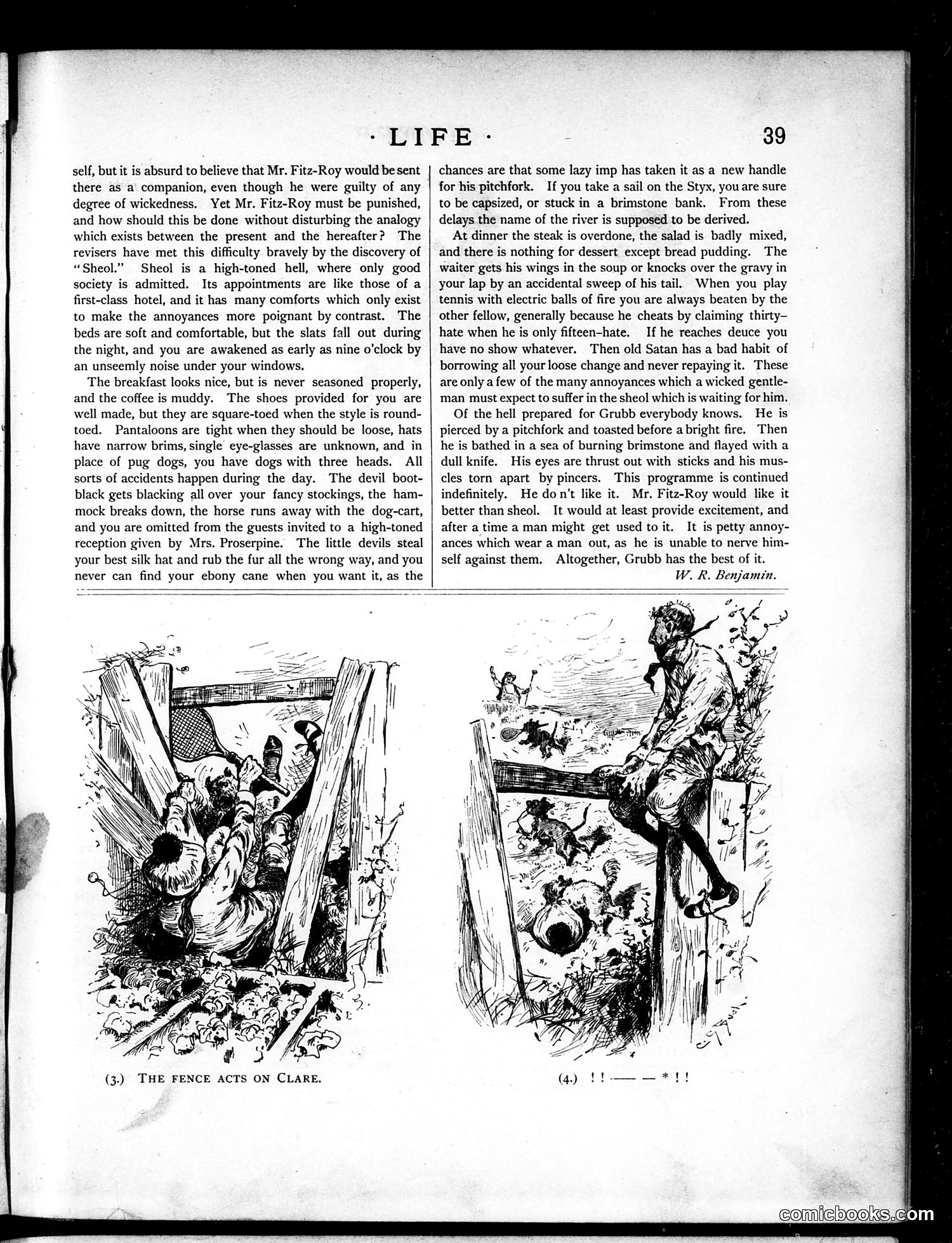
This page contains a satirical essay by W.R. Benjamin mocking the concept of "Sheol"—a refined, high-society version of hell. The piece contrasts two hypothetical punishments: one for "Mr. Fitz-Roy" (a gentleman who would suffer petty annoyances in genteel surroundings) and one for "Grubb" (who faces brutal, physical torment). The satire targets Victorian social anxieties about punishment and morality. Benjamin argues that for a privileged man, the worst hell wouldn't be dramatic suffering but rather the accumulation of minor humiliations—muddy coffee, square-toed shoes, social exclusions, cheating at tennis. For a lower-class figure like Grubb, actual physical torture might paradoxically be preferable to psychological torment. The two illustrations below appear unrelated to the essay text, labeled "(3) The Fence Acts on Clare" and "(4)" with cryptic notation. Their specific reference is unclear without additional context.
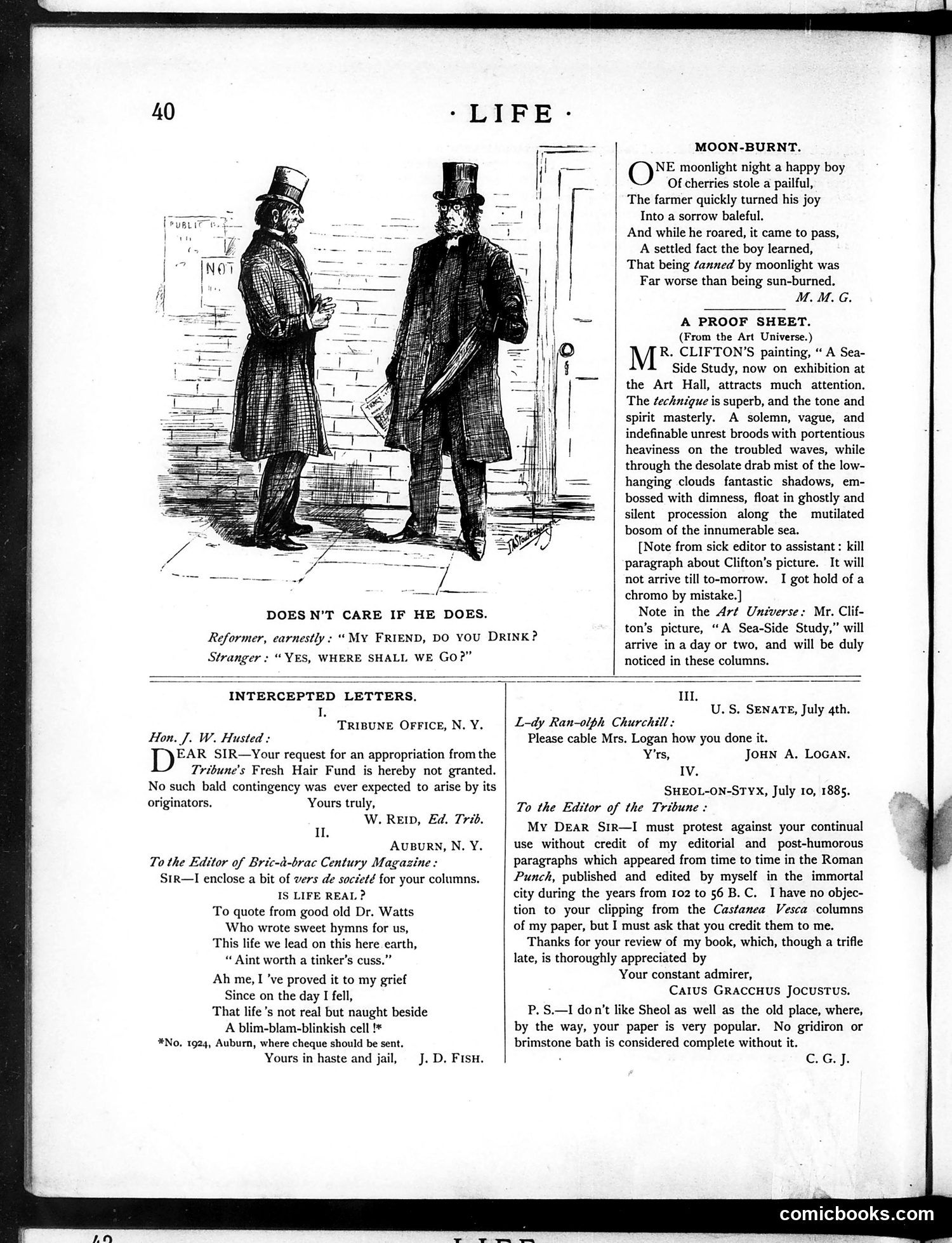
This page contains several satirical pieces typical of 19th-century American humor: **Main Cartoon:** "Doesn't Care If He Does" depicts a reformer earnestly asking a stranger about drinking. The stranger's response—asking *where* to go drink rather than *whether*—satirizes the ineffectiveness of temperance advocates. The joke is that moral persuasion fails when the target misses the point entirely. **Verse:** "Moon-Burnt" humorously invents a pseudo-scientific phenomenon worse than sunburn, mocking folk superstitions. **"Proof Sheet":** This satirizes pretentious art criticism. An overly elaborate, flowery review of a painting is rejected because the artwork hasn't arrived yet—it was replaced by error with a chromolithograph. The note mockingly exposes how art criticism often uses bombastic language regardless of actual quality. **Intercepted Letters:** Four humorous fake letters satirize various targets: politicians (the Tribune's "Fresh Hair Fund" reference), struggling poets submitting work, society figures, and ancient Roman plagiarism claims—all playing on contemporary concerns and absurdist humor.
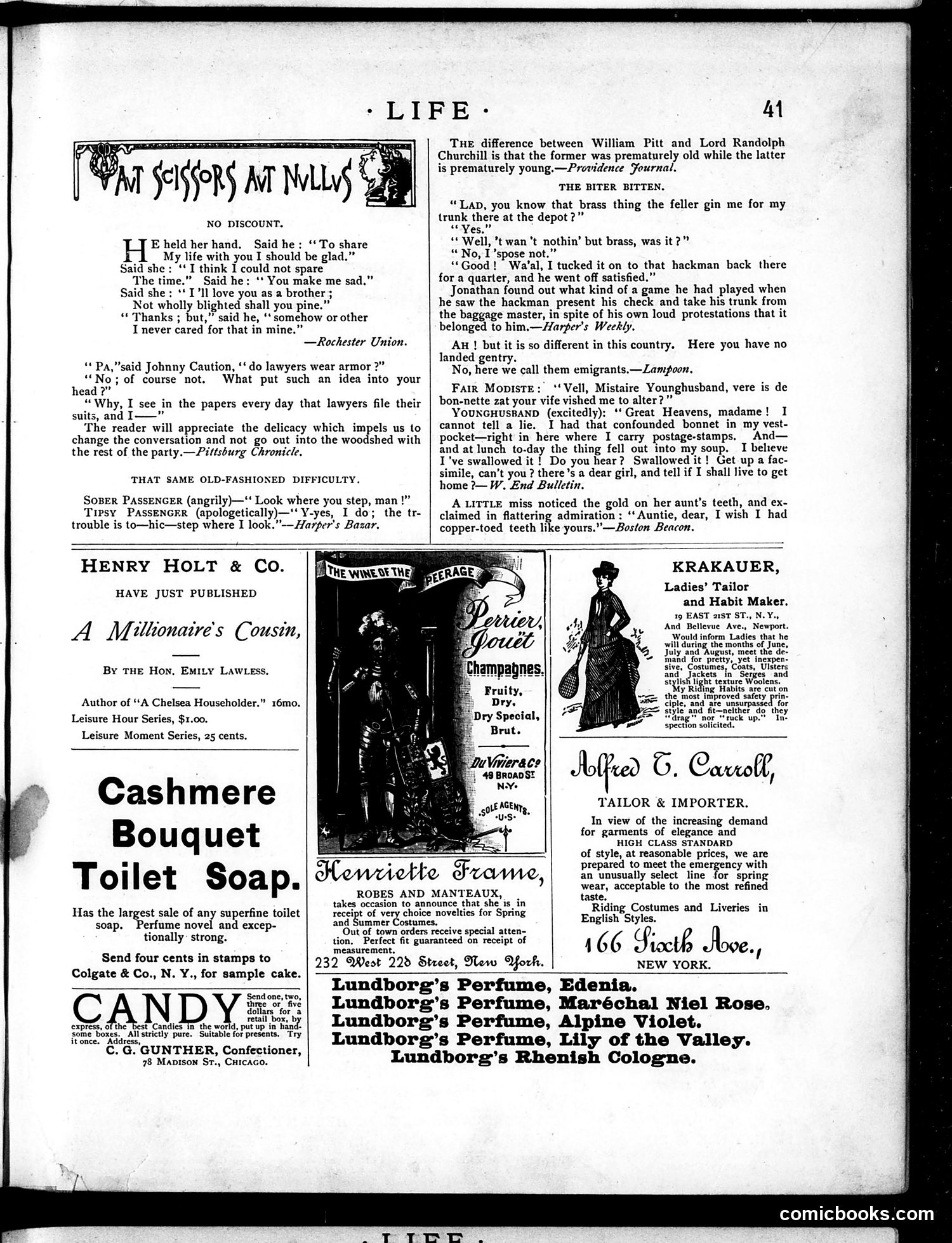
This page is primarily **advertising and humorous filler content** rather than political cartoons. The main content consists of several short jokes and anecdotes: **The humor pieces include:** - A romantic dialogue joke about a woman unwilling to share her time - A pun about lawyers "filing suits" (wordplay on legal and clothing terminology) - A drunk vs. sober passenger exchange playing on coordination and perception - A story about Jonathan's trunk-tag swindle backfiring - Class commentary contrasting British "landed gentry" with American "emigrants" - A mishap where a husband accidentally swallows his wife's bonnet in soup - A child's malapropism about "copper-toed teeth" **The satirical point** is gentle, domestic humor typical of 1880s-90s American magazines—poking fun at everyday social situations, gender relations, drunkenness, class pretensions, and family life. There are **no identifiable political figures or current events referenced** on this page. It appears to be a standard page of advertisements interspersed with brief comedic vignettes meant to amuse readers between product pitches.
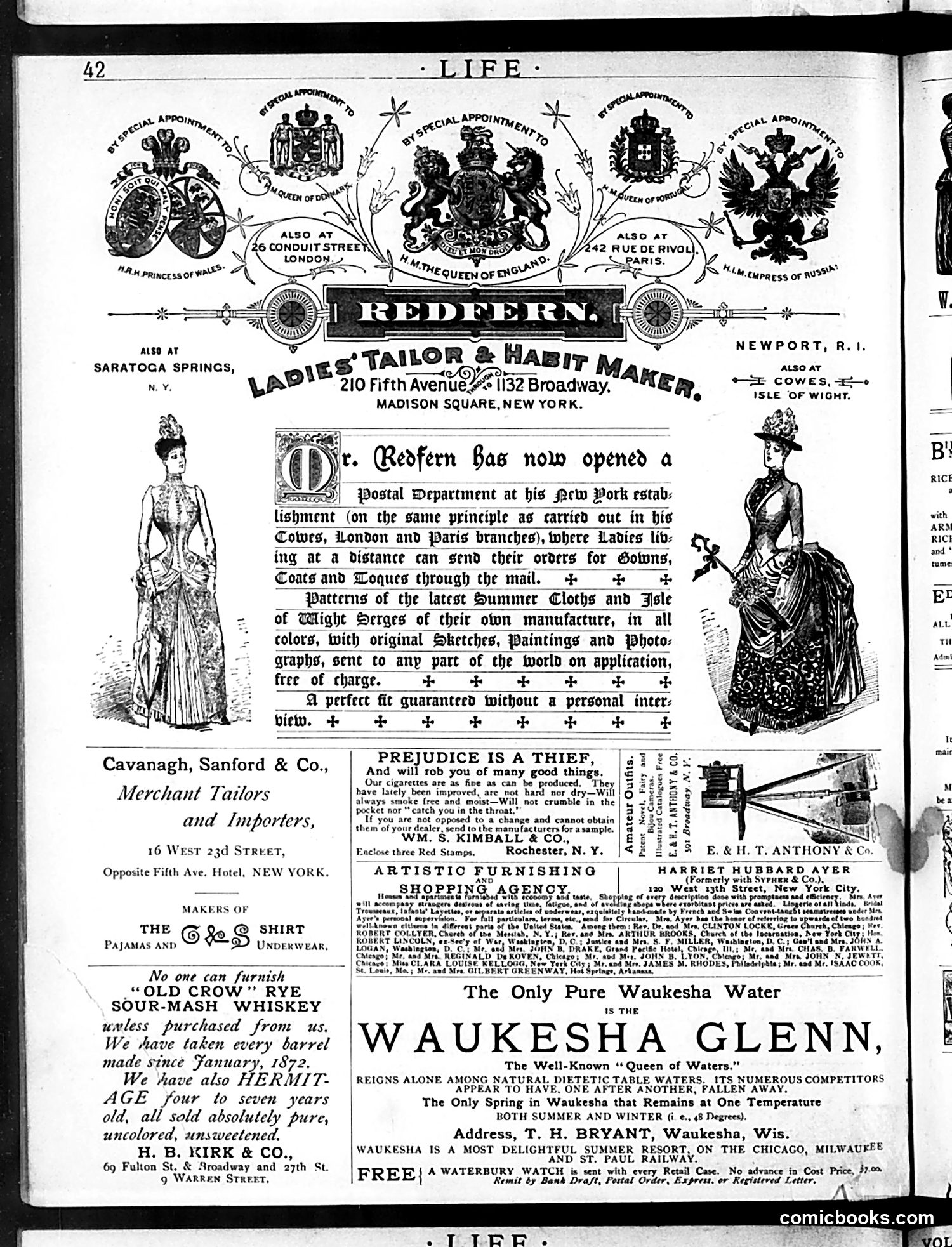
This page is primarily **advertising**, not editorial cartooning. However, it includes one notable satirical ad: "PREJUDICE IS A THIEF." ## The Satire The ad for **W.S. Kimball & Co. cigarettes** uses social commentary to sell product. The headline claims prejudice robs people of "good things," then argues their improved cigarettes deserve a chance despite consumer bias against change. This cleverly positions product innovation as combating narrow-mindedness—a common advertising strategy of the era. ## The Context The remaining content is straightforward commercial advertising: luxury tailoring services (Redfern), men's haberdashery (Cavanagh, Sanford & Co.), whiskey, photography equipment, and bottled water from Waukesha, Wisconsin—marketed to wealthy readers of *Life* magazine. The fashion illustrations show women's formal wear appropriate to upper-class venues (Newport, Saratoga Springs, Paris). The page reflects Gilded Age consumer culture and how advertisers appealed to elite audiences through both prestige and subtle philosophical arguments.
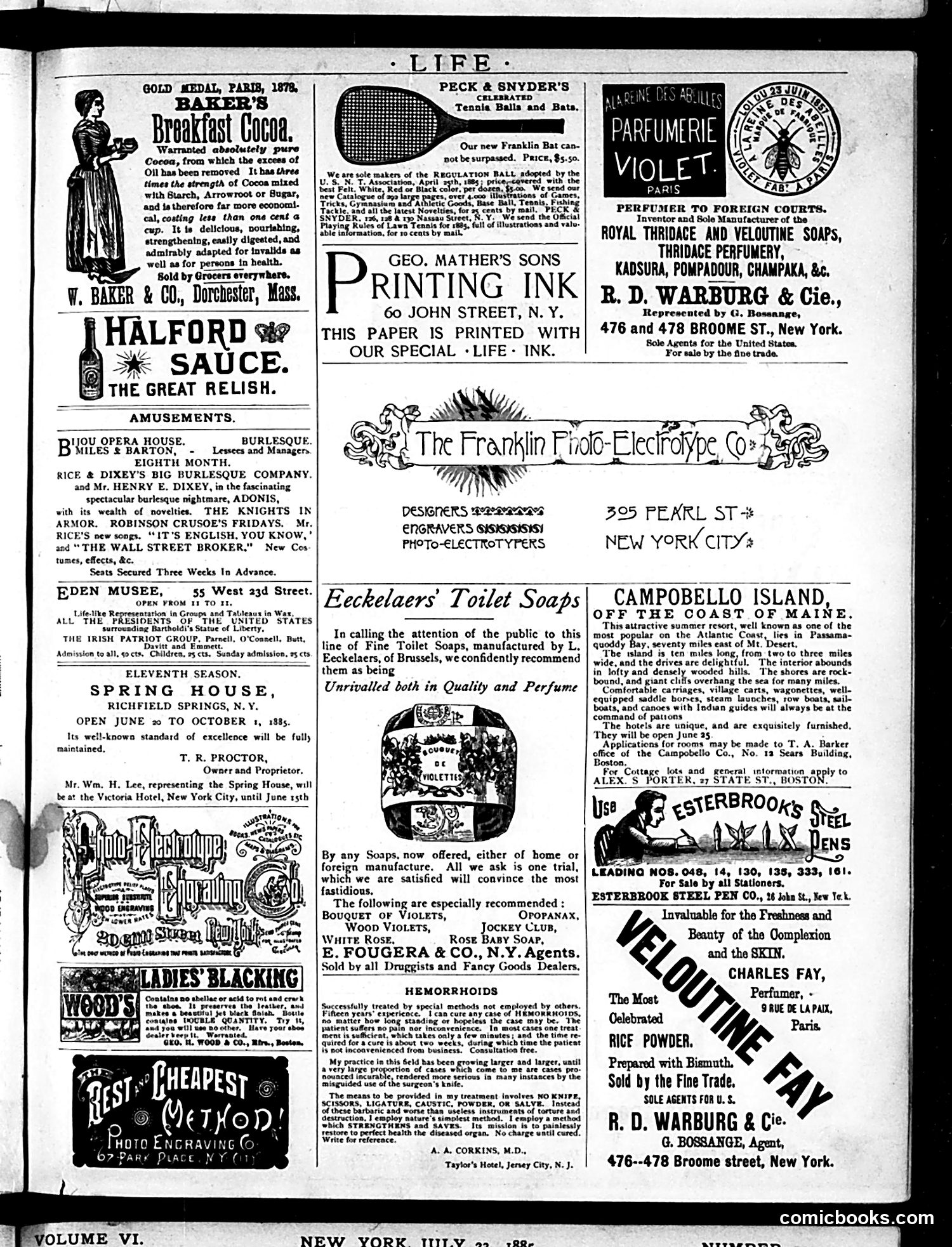
This is primarily an **advertising page** with no discernible political cartoons or satirical content. The page consists almost entirely of commercial advertisements typical of the 1880s: breakfast cocoa, sauces, theater notices (including a burlesque production called "Adonis"), resort promotions, printing ink, perfumes, tennis equipment, toilet soaps, steel pens, and medical treatments for hemorrhoids. The only potentially notable item is an advertisement for Rice & Dixey's burlesque production "Adonis"—a popular 1880s theatrical spectacle known for its elaborate sets and comedy. However, no political satire or cartoon content is visible on this particular page. The page represents how Life magazine monetized its publication through advertisements rather than relying solely on editorial content.
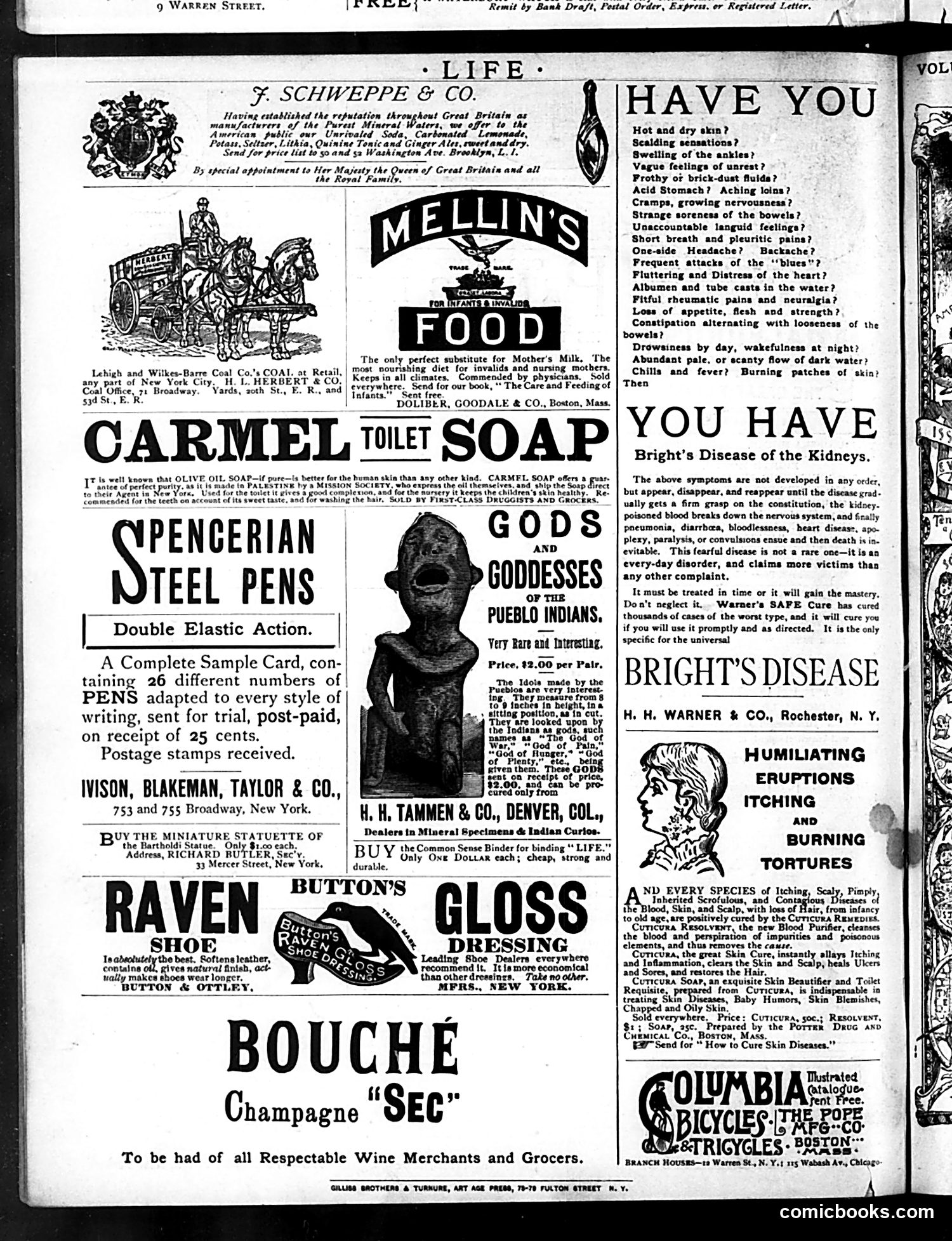
This is primarily a **advertising page** rather than satirical content. The page features numerous patent medicine and consumer product advertisements typical of the late 19th century. The most notable content is a large advertisement for **Warner's Safe Cure for Bright's Disease** (kidney disease). It employs a common advertising tactic of the era: listing exhaustive symptoms—hot skin, scalding sensations, aching loins, heart palpitations, etc.—designed to convince readers they have the affliction and need the remedy. This reflects the period's widespread medical quackery, where vague symptom lists matched nearly any ailment. Other ads promote Mellin's Food (infant formula), Carmel Toilet Soap, Spencerian Steel Pens, and Bouché Champagne. The page includes an ethnographic artifact listing: a Pueblo Indian idol figurine available for purchase, reflecting the era's casual commodification of Indigenous cultural objects. The advertising reflects Gilded Age consumer culture and the unregulated patent medicine industry that preyed on public health anxieties.