
Life, 1885-07-16 · page 3 of 16
Life — July 16, 1885 — page 3: what you’re looking at
What you’re looking at
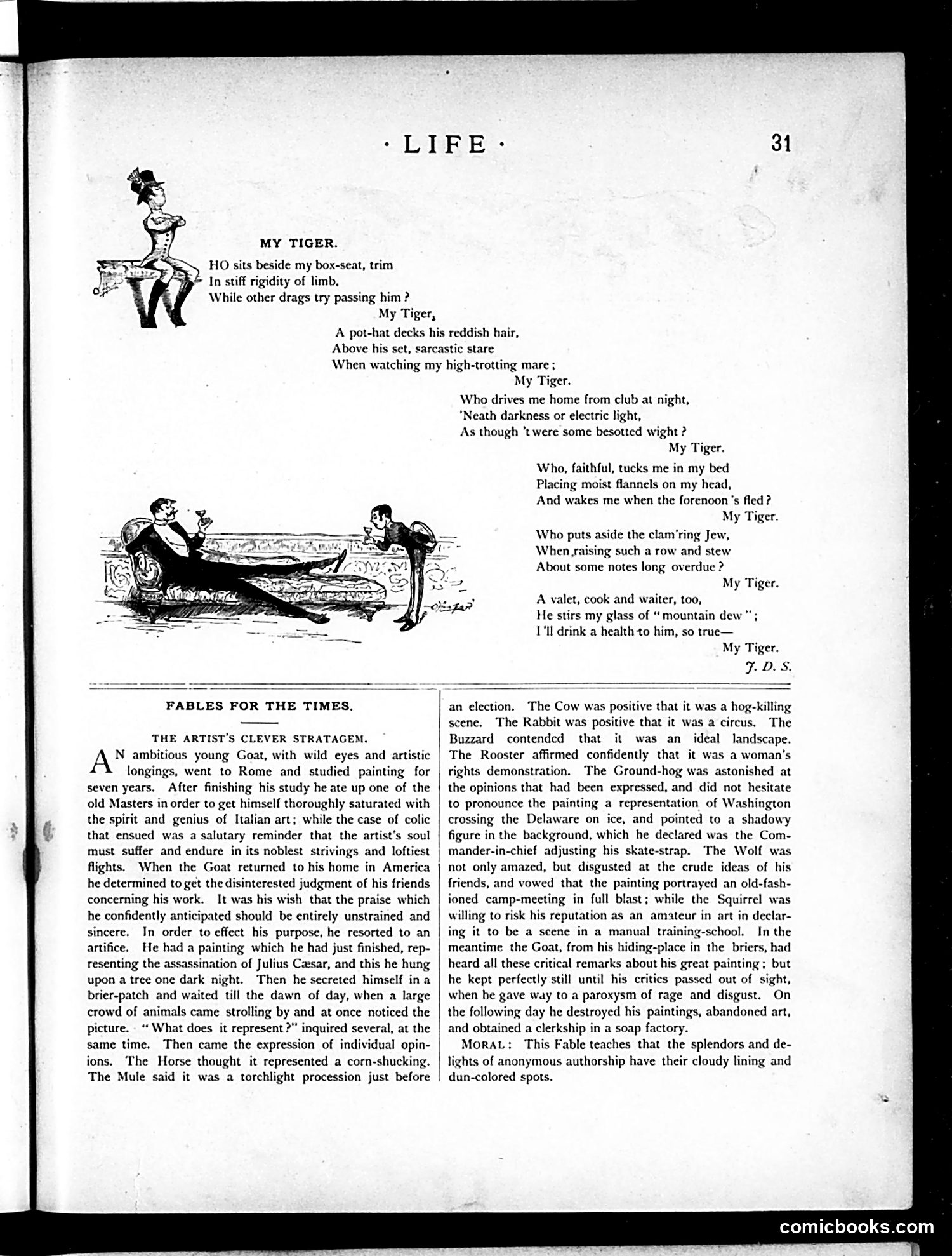
**"My Tiger"** is a humorous poem about a fashionable gentleman's automobile (his "Tiger"). It catalogs the car's various roles—rushing him from clubs, serving as a bed when he's tired, handling his debts—with affectionate exasperation. The satire targets wealthy men's dependence on automobiles as essential status symbols and lifestyle accessories. **"Fables for the Times"** mocks anonymous artists seeking critical praise. A Goat paints secretly, then displays his work to farm animals who interpret it through their own narrow perspectives (torchlight procession, hog-killing, woman's rights demonstration). When critics pass judgment, the Goat destroys everything in humiliation. The moral critiques how anonymous work receives unfair, subjective criticism based on viewers' biases rather than artistic merit.
📄 Transcribed text from this page (OCR, searchable)
Machine-transcribed from the original scan — historical spelling and the odd misread are preserved.
MY TIGER. HO sits beside my box-seat, trim In stiff rigidity of limb, While other drags try passing him ? My Tiger, A pot-hat decks his reddish hair, Above his set, sarcastic stare When watching my high-trotting mare ; My Tiger. Who drives me home from club at night, *Neath darkness or electric light, As though 't were some besotted wight ? My Tiger. Who, faithful, tucks me in my bed Placing moist flannels on my head, And wakes me when the forenoon's fled ? My Tiger. Who puts aside the clam’ring Jew, When raising such a row and stew About some notes long overdue ? My Tiger. A valet, cook and waiter, too, He stirs my glass of “ mountain dew "; I'll drink a health to him, so true— My Tiger. 7. D.S. FABLES FOR THE TIMES, THE ARTIST'S CL ambitious young Goat, with wild eyes and artistic ER STRATAGEM. N A longings, went to Rome and studied painting for | seven years. After finishing his study he ate up one of the old Masters in order to get himself thoroughly saturated with the spirit and genius of Italian art; while the case of colic that ensued was a salutary reminder that the artist's soul must suffer and endure in its noblest strivings and loftiest | flights. When the Goat returned to his home in America he determined to get the disinterested judgment of his friends concerning his work. It was his wish that the praise which he confidently anticipated should be entirely unstrained and sincere. In order to effect his purpose, he resorted to an artifice, He had a painting which he had just finished, rep- resenting the assassination of Julius Czsar, and this he hung upon a tree one dark night. Then he secreted himself ina brier-patch and waited till the dawn of day, when a large crowd of animals came strolling by and at once noticed the picture. same time. Then came the expression of individual opin- ions. The Horse thought it represented a corn-shucking. The Mule said it was a torchlight procession just before “What does it represent ?” inquired several, at the | | an election. The Cow was positive that it was a hog-killing scene. The Rabbit was positive that it was a circus. The Buzzard contended that it was an ideal landscape. The Rooster affirmed confidently that it was a woman's rights demonstration. The Ground-hog was astonished at the opinions that had been expressed, and did not hesitate to pronounce the painting a representation of Washington crossing the Delaware on ice, and pointed to a shadowy figure in the background, which he declared was the Com- mander-in-chief adjusting his skate-strap. The Wolf was not only amazed, but disgusted at the crude ideas of his friends, and vowed that the painting portrayed an old-fash- ioned camp-meeting in full blast; while the Squirrel was willing to risk his reputation as an amateur in art in declar- ing it to be a scene in a manual training-school. In the meantime the Goat, from his hiding-place in the briers, had heard all these critical remarks about his great painting; but he kept perfectly still until his critics passed out of sight, when he gave way to a paroxysm of rage and disgust. On the following day he destroyed his paintings, abandoned art, and obtained a clerkship in a soap factory. Mora: This Fable teaches that the splendors and de- lights of anonymous authorship have their cloudy lining and | dun-colored spots. comicbooks.com