
Life, 1885-07-16 · page 5 of 16
Life — July 16, 1885 — page 5: what you’re looking at
What you’re looking at
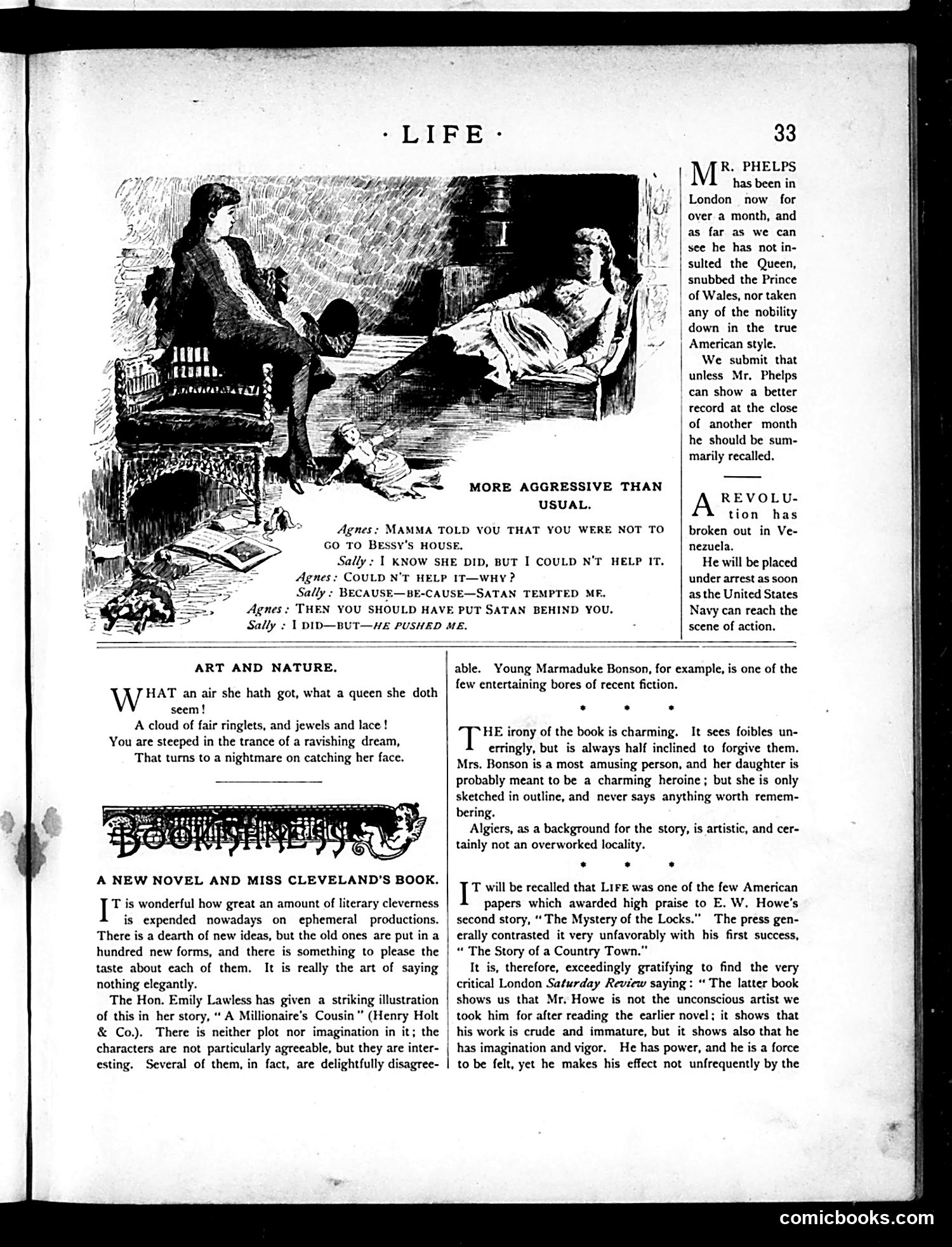
The main cartoon, titled "MORE AGGRESSIVE THAN USUAL," depicts a domestic scene between two women discussing Mr. Phelps's behavior in London. Agnes reports that Phelps's mother warned him against visiting "Bessy's house," but he went anyway. Sally explains his transgression: "Satan tempted Mr. Phelps" and "he pushed me." The satire mocks Victorian-era moral hypocrisy and gender dynamics. A man's inappropriate behavior toward a woman is blamed on demonic influence rather than personal responsibility. The women's resigned acceptance of male misbehavior—framed as inevitable temptation—satirizes the era's double standards regarding sexual conduct and accountability. Below, the page reviews literary works, including Emily Lawless's novel and E.W. Howe's fiction, with no clear political content visible.
📄 Transcribed text from this page (OCR, searchable)
Machine-transcribed from the original scan — historical spelling and the odd misread are preserved.
8 meer WU Agnes: MAMMA TOLD YOU THAT YOU WERE NOT TO GO TO BEssy’s HOUSE. Sally: | KNOW SHE DID, BUT I COULD N'T HELP IT. Agnes: COULD N'Y HELP IT—WHY ? Sally : BECAUSE—BE-CAUSE—SATAN TEMPTED ME. Agnes; THEN YOU SHOULD HAVE PUT SATAN BEHIND YOU. Sally ; | DID—BUT—HE PUSHED ME. ART AND NATURE. Wt an air she hath got, what a queen she doth seem! A cloud of fair ringlets, and jewels and lace! You are steeped in the trance of a ravishing dream, That turns to a nightmare on catching her face. A NEW NOVEL AND MISS CLEVELAND'S BOOK. T is wonderful how great an amount of literary cleverness is expended nowadays on ephemeral productions. There is a dearth of new ideas, but the old ones are put in a hundred new forms, and there is something to please the | taste about each of them. nothing elegantly. The Hon. Emily Lawless has given a striking illustration of this in her story, “ A Millionaire's Cousin" (Henry Holt & Co.). There is neither plot nor imagination in it; the It is really the art of saying characters are not particularly agreeable, but they are inter- | esting. Several of them, in fact, are delightfully disagree- 33 R, PHELPS has been in London now for over a month, and as far as we can see he has not in- sulted the Queen, snubbed the Prince of Wales, nor taken any of the nobility down in the true American style. We submit that | unless Mr. Phelps can show a better | record at the close of another month he should be sum- marily recalled. MORE AGGRESSIVE THAN USUAL. REVOLU- tion has broken out in Ve- nezuela. He will be placed under arrest as soon as the United States Navy can reach the scene of action. able. Young Marmaduke Bonson, for example, is one of the few entertaining bores of recent fiction. * . . HE irony of the book is charming. It sees foibles un- erringly, but is always half inclined to forgive them. Mrs. Bonson is a most amusing person, and her daughter is probably meant to be a charming heroine; but she is only sketched in outline, and never says anything worth remem- bering. Algiers, as a background for the story, is artistic, and cer- tainly not an overworked locality. * * . T will be recalled that LIFE was one of the few American papers which awarded high praise to E. W. Howe's second story, “ The Mystery of the Locks.” The press gen- erally contrasted it very unfavorably with his first success, “ The Story of a Country Town.” It is, therefore, exceedingly gratifying to find the very critical London Saturday Review saying: “ The latter book | shows us that Mr. Howe is not the unconscious artist we took him for after reading the earlier novel; it shows that his work is crude and immature, but it shows also that he has imagination and vigor. He has power, and he is a force to be felt, yet he makes his effect not unfrequently by the comicbooks.com