
A complete issue · 16 pages · 1885
Life — June 18, 1885
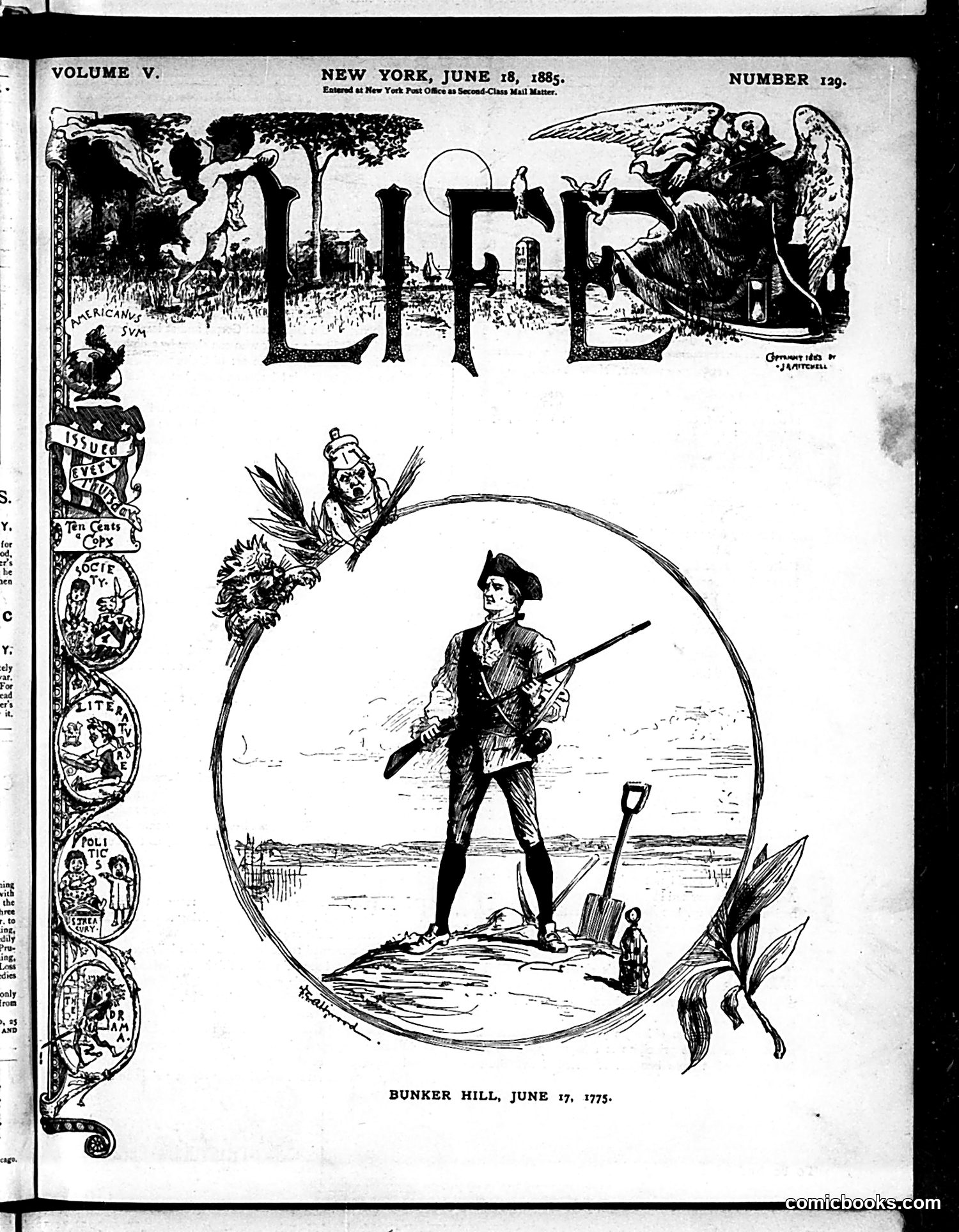
This cover commemorates the Battle of Bunker Hill (June 17, 1775) during the American Revolution. The central illustration depicts a colonial soldier in period military dress, standing with rifle and bayonet in a defensive stance on the battlefield. The decorative left border contains heraldic shields and emblems representing various American states and civic institutions, emphasizing national unity and patriotic themes. The elaborate "LIFE" masthead features allegorical figures and classical imagery, typical of the magazine's ornamental design style. This appears to be a patriotic retrospective piece, using historical commemoration to reinforce American nationalist sentiment during the 1880s—a common editorial approach for Life magazine during this era. The specific date references the 110th anniversary of the famous Revolutionary War battle.
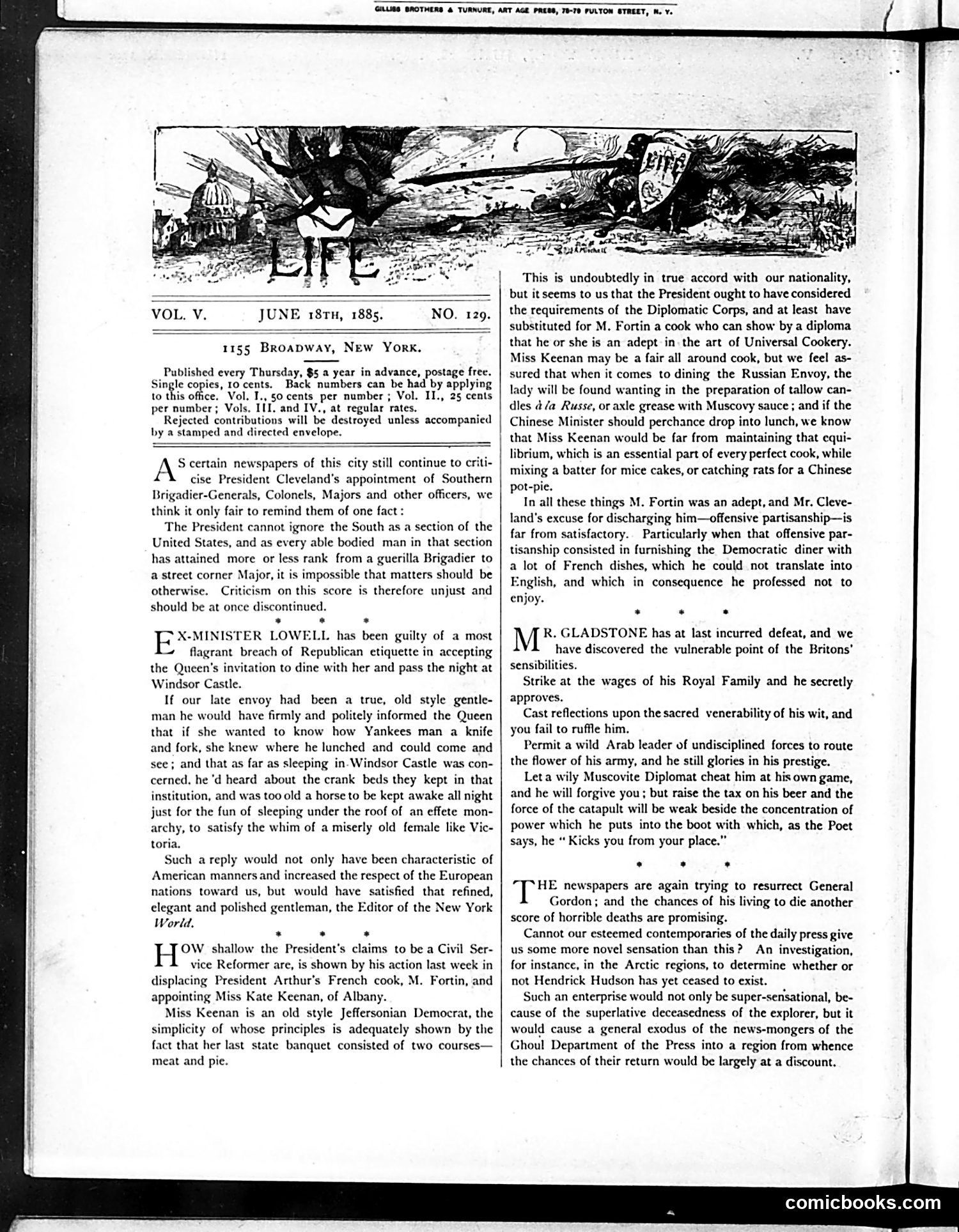
The header illustration appears to show allegorical figures representing "LIFE" itself in a landscape setting, typical of the magazine's artistic branding. The page contains several satirical editorial pieces criticizing President Cleveland's administrative appointments. The first article attacks his appointment of Southern Republicans and military officers to federal positions, arguing such criticism is unfair given the South's historical dominance of military ranks. A second piece mocks Ex-Minister Lowell for breaching "Republican etiquette" by accepting the Queen's invitation to dine at Windsor Castle, sarcastically suggesting this represents un-American deference to monarchy. The final section criticizes President Cleveland's replacement of his French cook M. Fortin with Miss Kate Keenan, questioning her culinary qualifications—an early example of satirizing administrative personnel decisions.
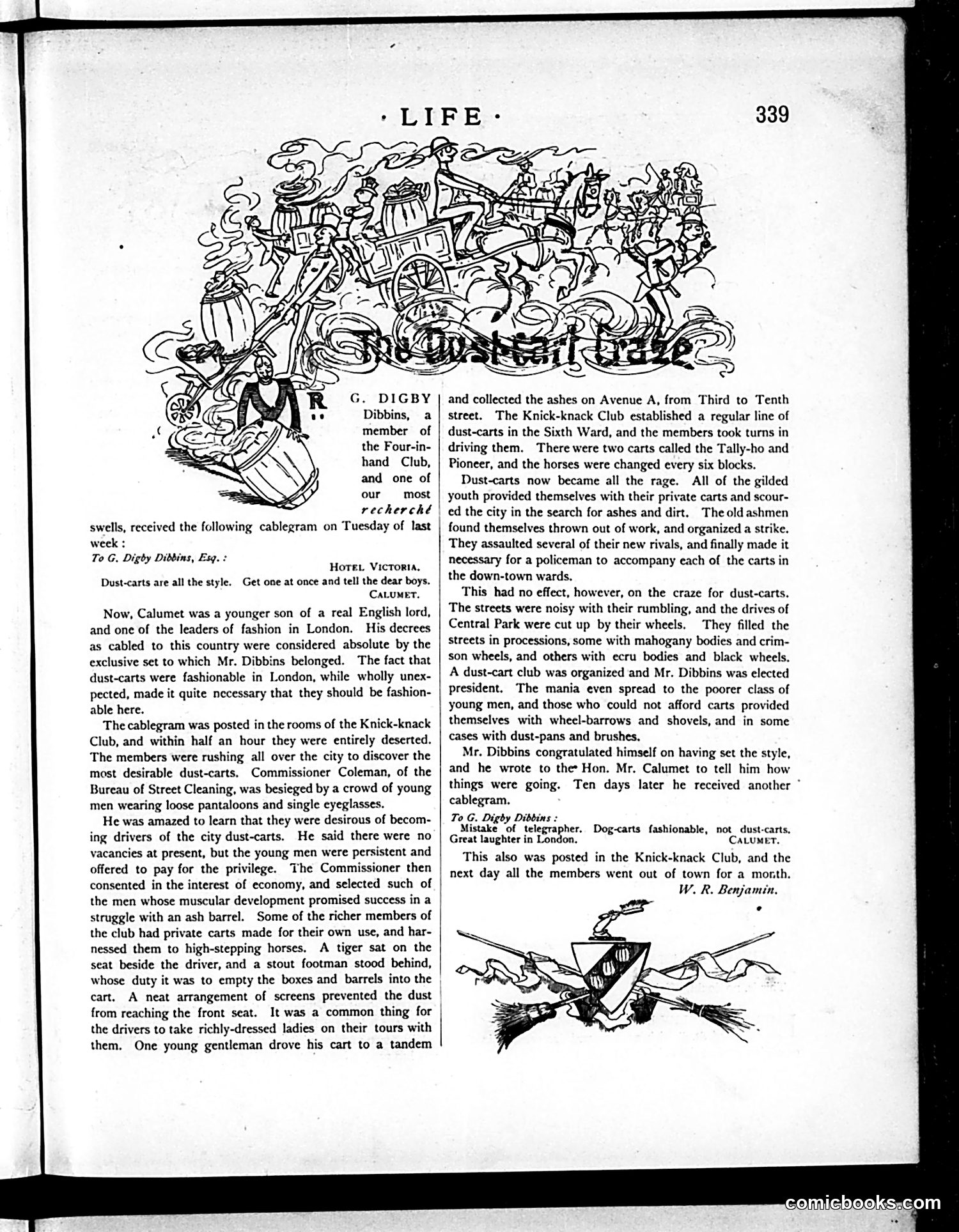
This page satirizes the "dust-cart" craze among wealthy young men in London. The elaborate illustration at top depicts chaotic street scenes with dust carts and fashionably dressed participants. The article mocks how G. Digby Dibbins, a member of an exclusive club called the "Four-in-hand Club," received a cablegram announcing that dust-carts had become fashionable. Young aristocrats competed to drive these refuse vehicles through city streets, hiring them for social outings and even taking wealthy ladies along. The satire targets upper-class frivolity—how idle wealthy youth adopted working-class activities as trendy entertainment, treating street cleaning like sport. The absurdity lies in fashionable people abandoning their dignity to pursue whatever novelty strikes their fancy, regardless of how ridiculous.
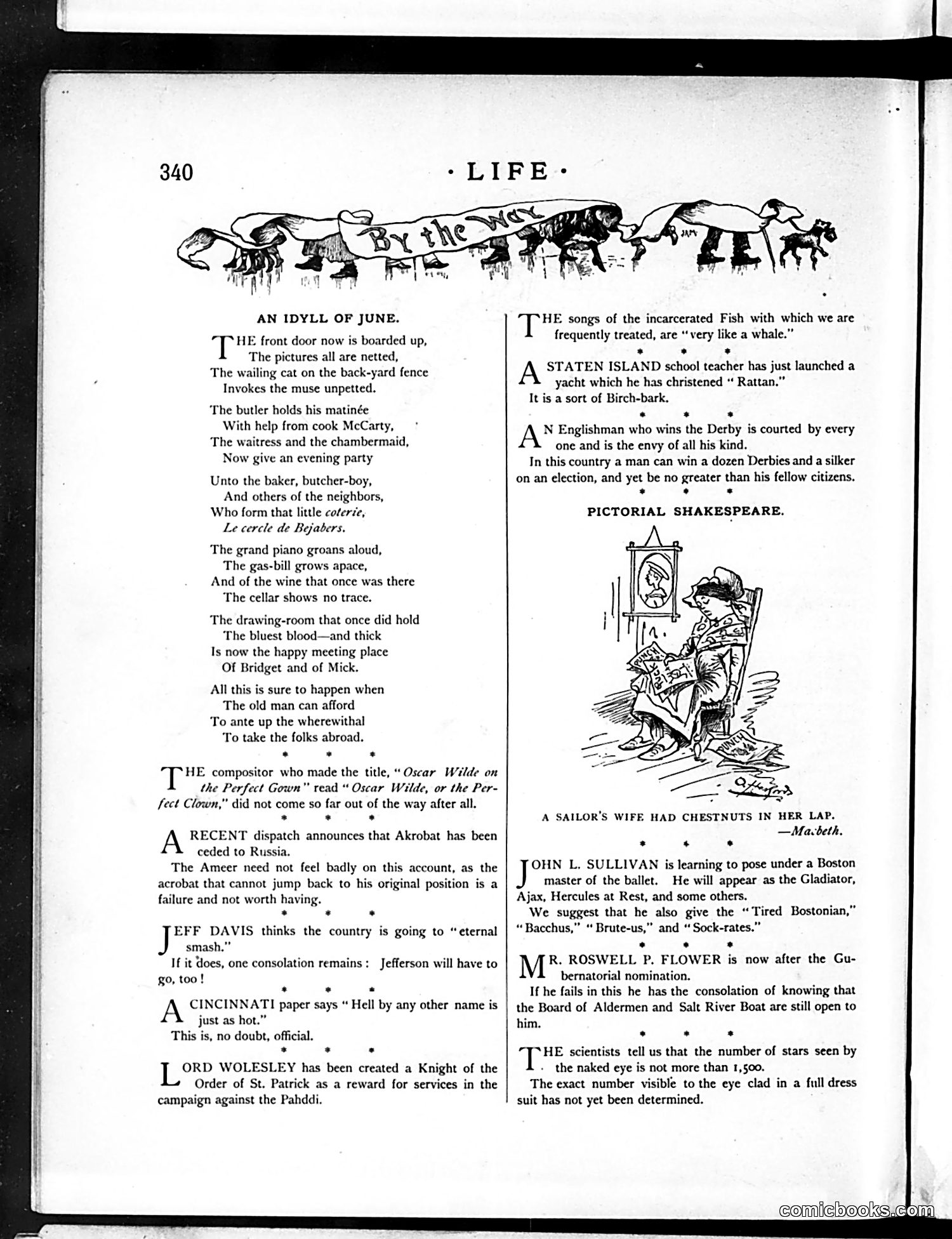
The page contains mixed content: a poem titled "An Idyll of June" about a middle-class household preparing for an evening party, and right-column brief satirical items about contemporary figures. The cartoon illustration labeled "Pictorial Shakespeare" shows a figure in period costume lounging in a chair—apparently mocking theatrical productions or actors of the era. The text items reference specific individuals: Lord Wolsley (military figure), Jeff Davis (likely Jefferson Davis), and John L. Sullivan (famous boxer being cast in classical theatrical roles). Other items joke about newspaper editors, government positions, and obscure civic matters. Without identifying specific dates or events, the overall tone suggests fin-de-siècle American social satire targeting politics, entertainment, and public figures of that era.
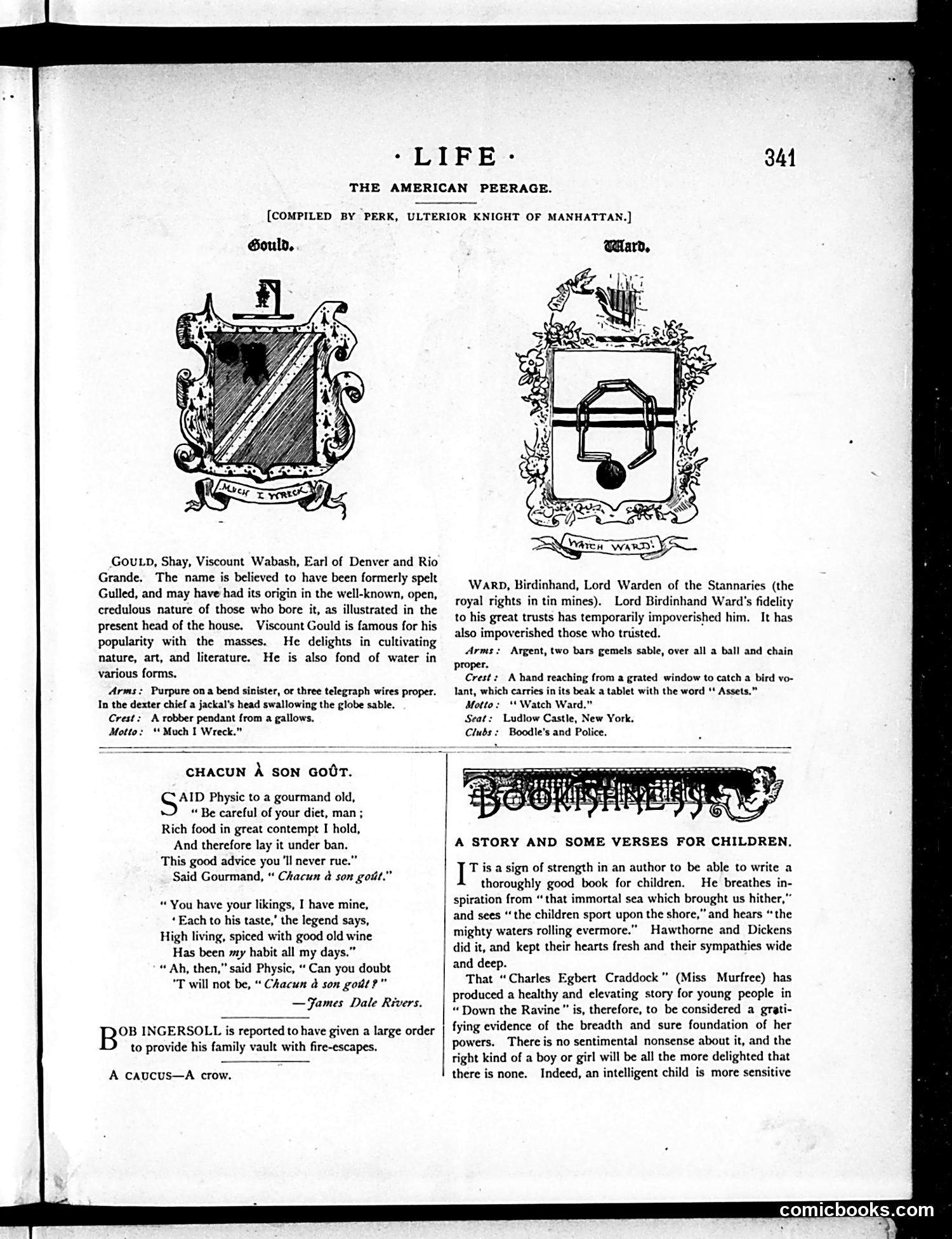
This page contains **heraldic coat-of-arms entries** for American families of prominence, compiled by "Perk, Ulterior Knight of Manhattan"—a satirical touch suggesting mock-serious genealogical pretension. The two main coats of arms shown are for the **Gould** and **Ward** families. The satire appears to mock American wealthy families' attempts to establish aristocratic credentials and heraldic legitimacy—a common target of Life's humor about the nouveau riche and social climbing in the Gilded Age. The accompanying text humorously describes family traits: Gould's "popularity with the masses" and love of water features, while Ward's arms reference tin mines and trusts. The lower section shifts to literary content and children's stories, unrelated to the heraldry above.
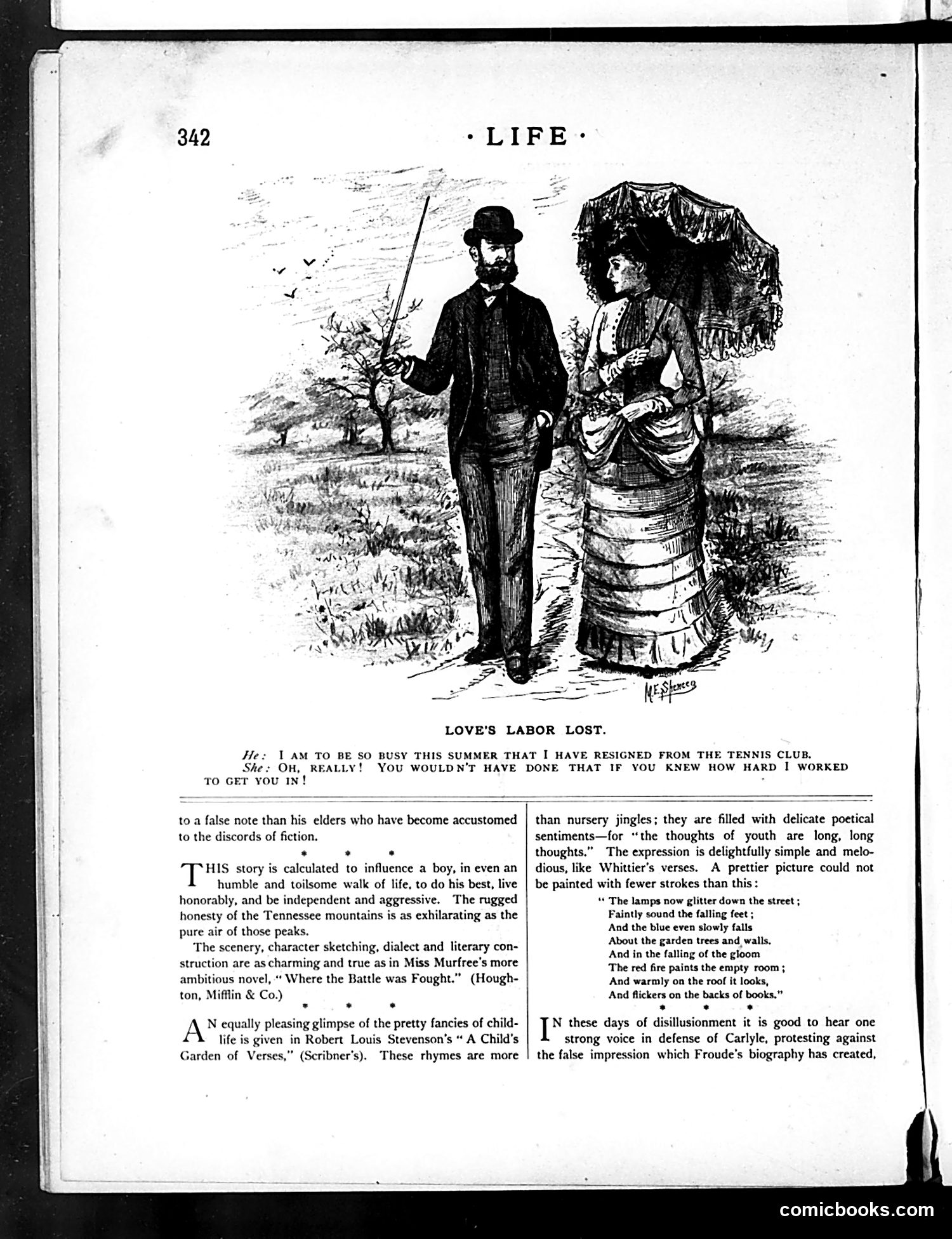
This illustration depicts a gentleman with a fishing rod speaking to a woman with a parasol. The caption quotes the man saying he's resigned from the tennis club because he's been so busy—implying he's devoted himself to courting her instead. The joke plays on the double meaning of "labor": the man has abandoned his recreational activities (tennis) to pursue romantic courtship, which he presents as requiring hard work. The woman's skeptical expression suggests she's unimpressed by his claim that winning her affection required such effort. The title references Shakespeare's *Love's Labour's Lost*, a play about courtship and romance. This is gentle Victorian-era satire about male courtship rituals and the competitive social activities (like tennis clubs) that romance might interrupt.
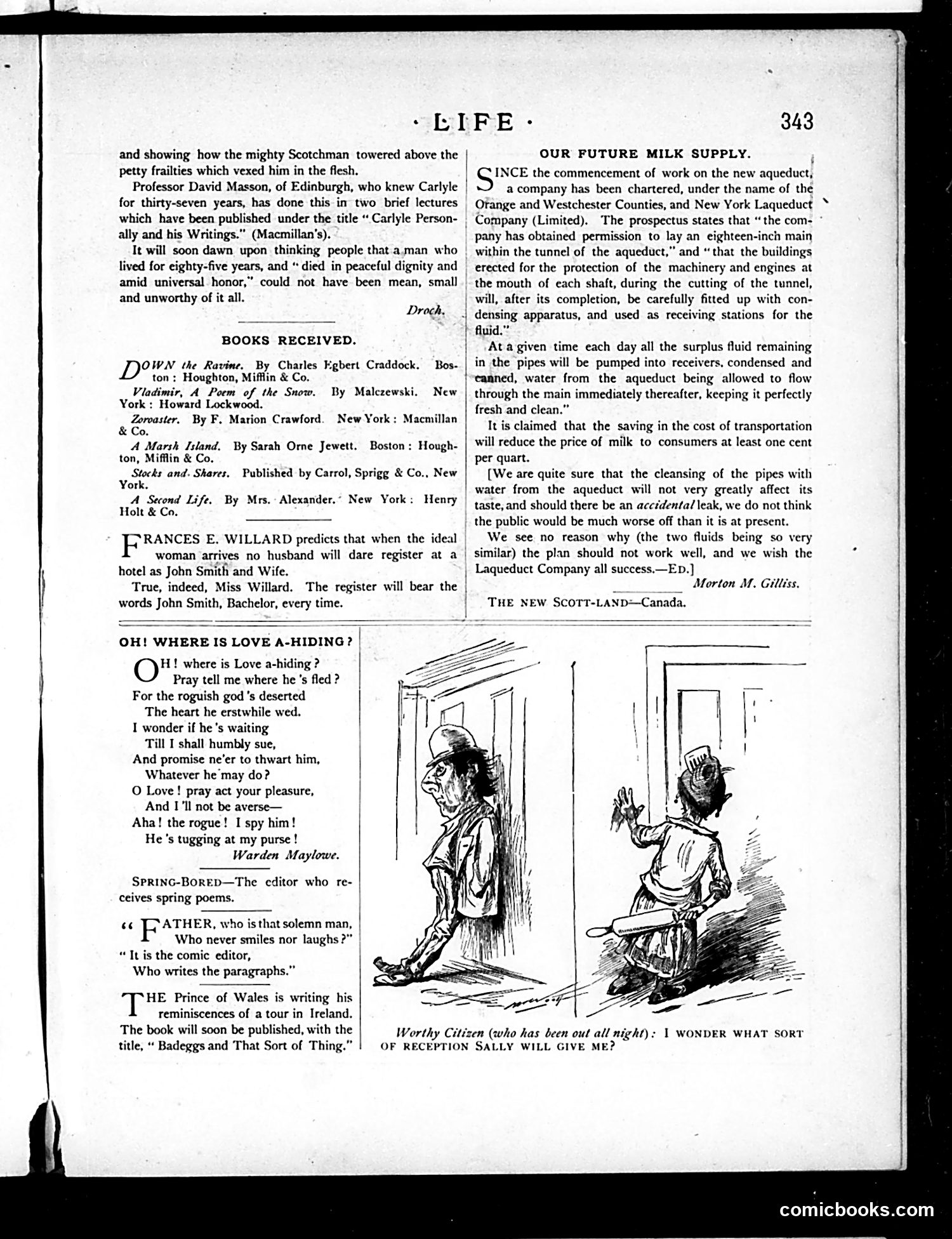
The page contains two main illustrations with accompanying text: **"Oh! Where is Love a-Hiding?"** is a humorous poem about romantic disappointment, with an illustration showing a man appearing distressed or lovestruck against a wall while a woman sits nearby, apparently indifferent to his advances. The satire targets romantic idealization versus reality. **"Worthy Citizen (who has been out all night): I wonder what sort of reception Sally will give me?"** depicts a disheveled man returning home late, presumably after a night out, worried about his wife's reaction. This is domestic satire mocking infidelity or irresponsible behavior and anticipating marital consequences. Both cartoons use visual exaggeration and social commentary typical of Life's satirical approach to relationships and gender dynamics of the era.
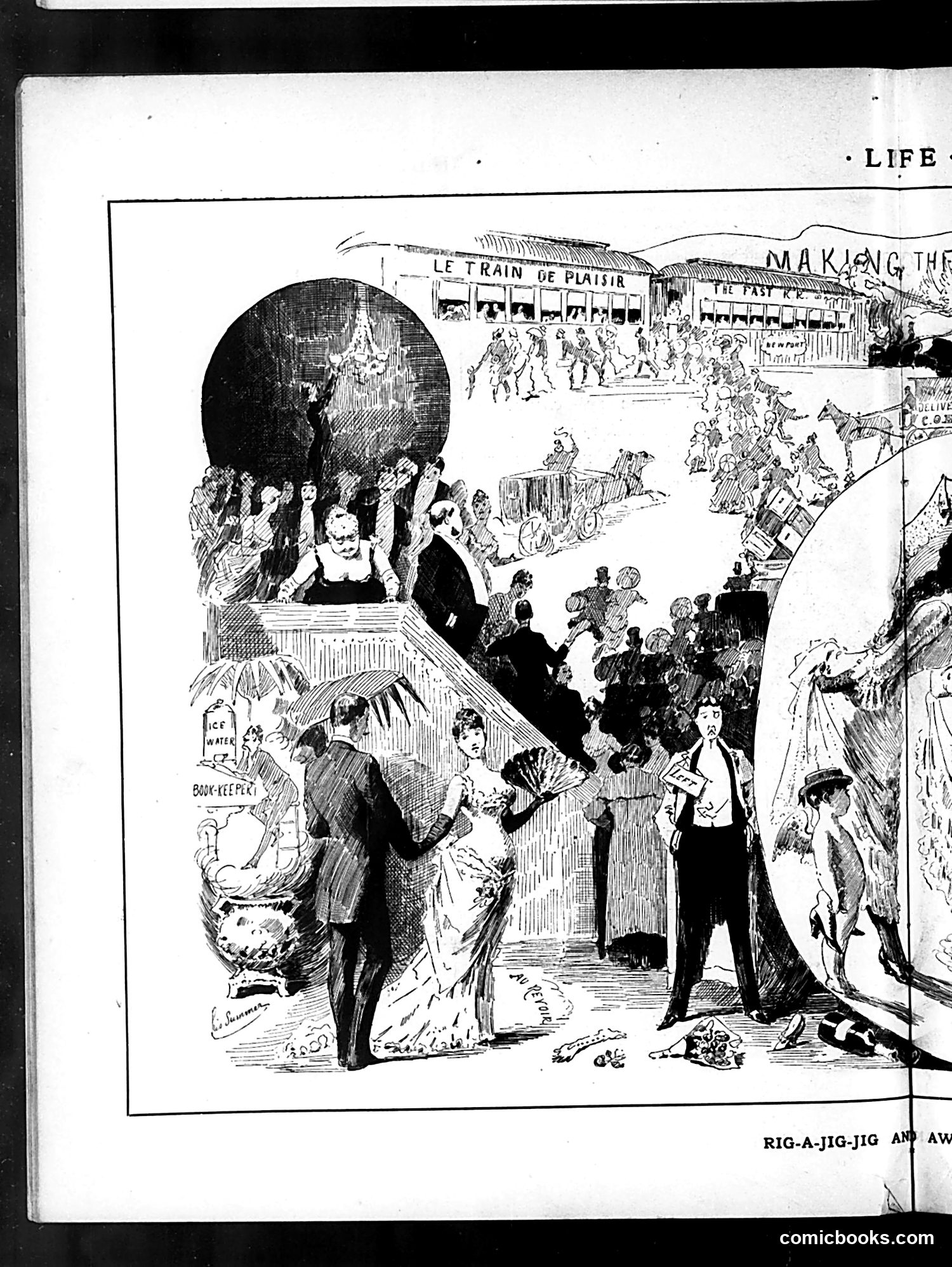
This appears to be a satirical illustration from Life magazine depicting a scene at "Le Train de Plaisir" (The Pleasure Train), a French amusement park or entertainment venue visible in the background. The cartoon shows elegantly dressed figures in what appears to be a social gathering or promenade area. The central image features a large spherical structure (possibly a balloon or dome) with figures gathered around it, suggesting commentary on spectacle or public attraction. The well-dressed attendees, including women with fans and men in formal wear, indicate this satirizes upper-class leisure and social pretension. The title "RIG-A-JIG-JIG AND AW[...]" (partially visible) likely references a popular song or cultural reference of the era, suggesting this mocks fashionable entertainment trends. The cartoonist's signature appears present but is illegible at this resolution.
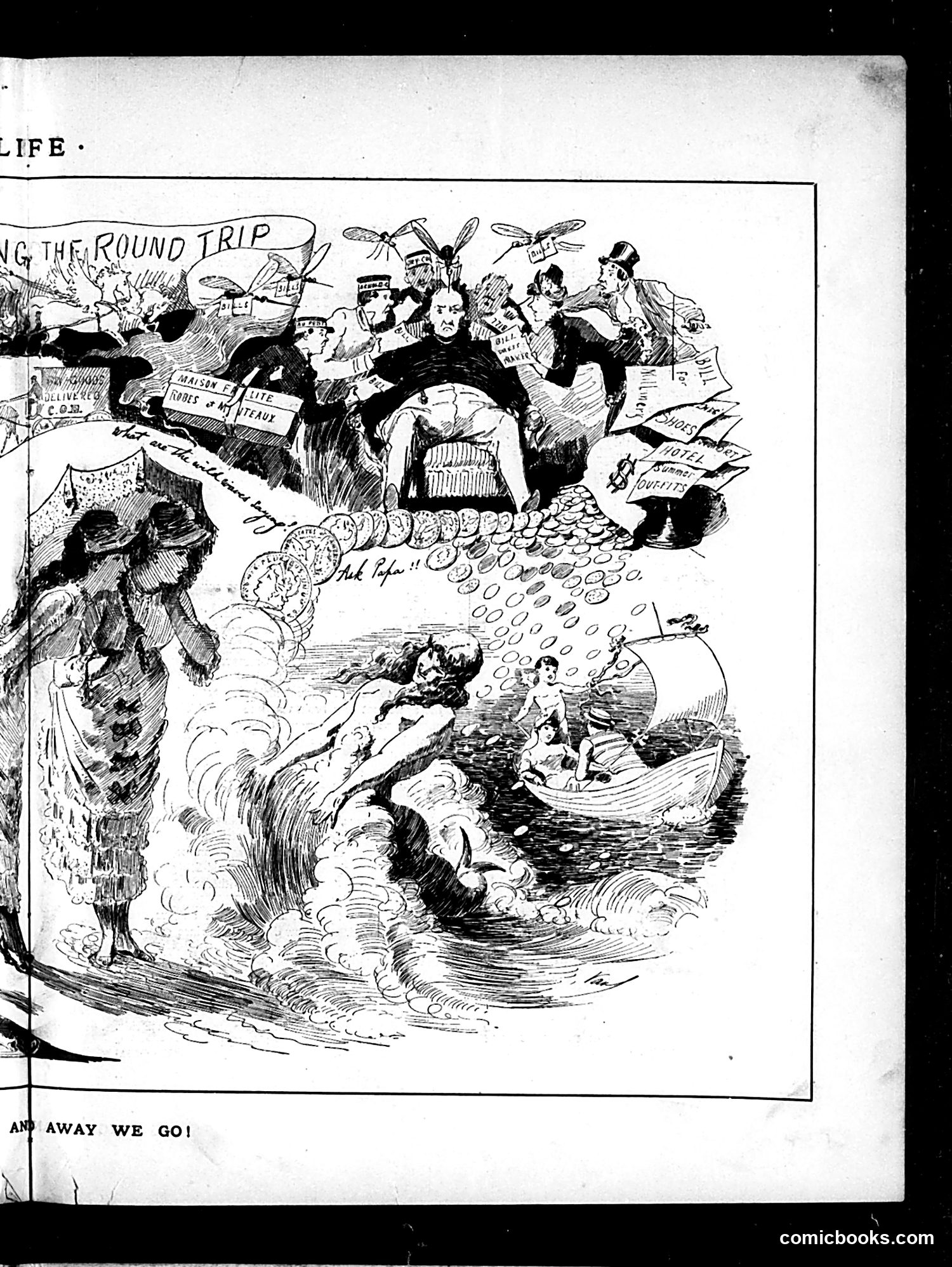
This satirical cartoon depicts wealthy tourists on an extravagant around-the-world journey. The upper panel shows well-dressed travelers surrounded by luggage, travel documents, and hotel bills, seated in what appears to be a large vessel or transport. Money coins rain down from above, suggesting excessive spending. The lower panel shows these same tourists in water, apparently struggling or floundering during their voyage. The satire mocks the frivolous spending habits and impracticality of wealthy travelers embarking on elaborate round-the-world trips. The contrast between their confident departure (upper) and their literal immersion in their expenses (lower) suggests the folly of such extravagant tourism—a commentary on wealth, excess, and the consequences of unchecked spending during the Gilded Age or early 20th century.
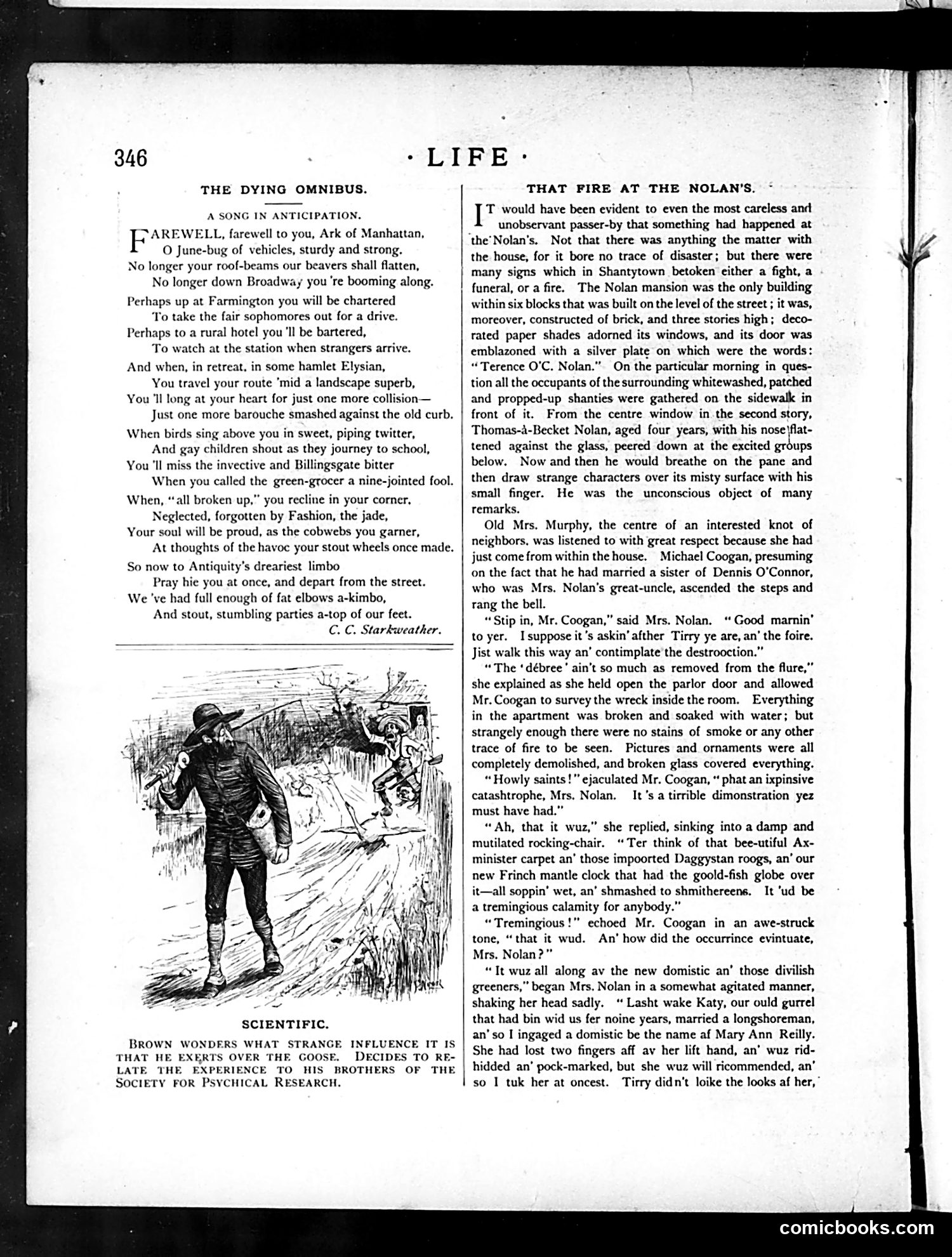
This page contains two distinct pieces of satirical content: **"The Dying Omnibus"** is a humorous farewell poem to horse-drawn streetcars, which were being displaced by newer transportation (likely electric trolleys or automobiles). The satire mocks the omnibus—personifying it as a worn-out vehicle that created chaos in Manhattan streets through collisions and crowded conditions. The poem ironically celebrates its retirement while nostalgically imagining it yearning for "just one more collision." **"That Fire at the Nolan's"** is a prose story (excerpt visible) set in "Shantytown," depicting working-class Irish immigrants. It describes a mysterious incident at the Nolan house where everything is destroyed and water-soaked, yet bears no traces of fire or smoke—the setup for apparent comedic mystery. The heavy Irish dialect and references to social hierarchy ("Mrs. Murphy...was listened to with great respect") provide gentle ethnic humor typical of early-1900s Life magazine. Both pieces satirize urban American life and social change.
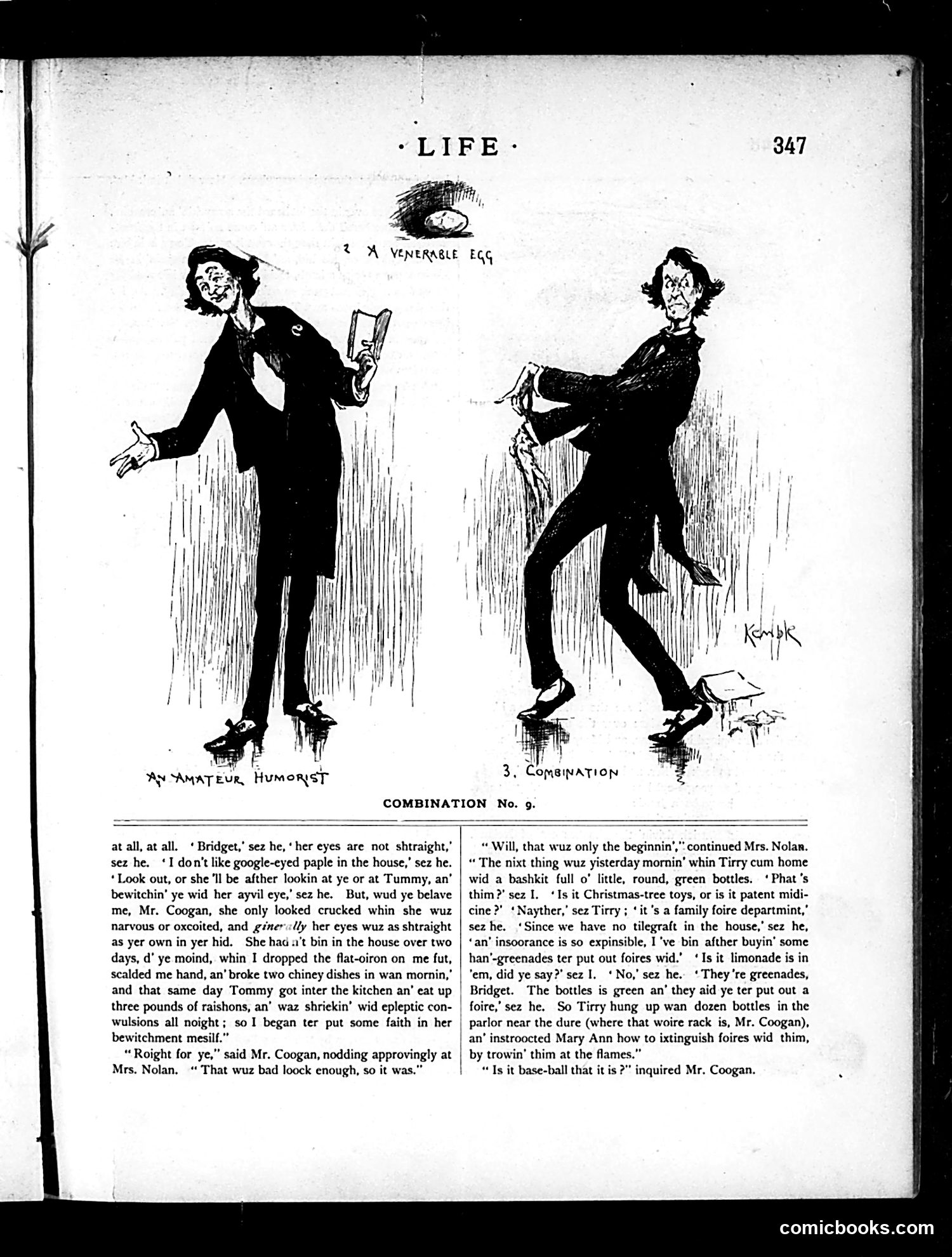
This is "Combination No. 9," a humorous two-panel cartoon from *Life* magazine satirizing Irish immigrants and their stereotyped speech patterns and behaviors. The left panel shows "An Amateur Humorist"—a man telling an absurd story in exaggerated Irish dialect. The right panel depicts the "Combination" or punchline: physical comedy of a man slipping or falling. The accompanying text presents Mrs. Nolan recounting a tale of a servant girl with a "crooked eye" supposedly causing household disasters. Her son later brings home hand grenades (mistaking them for fire-fighting equipment), instructing the maid to throw them at fires. The humor relies on ethnic caricature: mocking Irish pronunciation ("sez," "shtraight," "wid"), superstition about the evil eye, and dimwitted misunderstanding of modern safety equipment. The final joke—Mr. Coogan asking if it's "base-ball"—suggests absurd confusion. This reflects *Life's* era of casual, derogatory stereotyping of immigrant populations that would be considered offensive today.
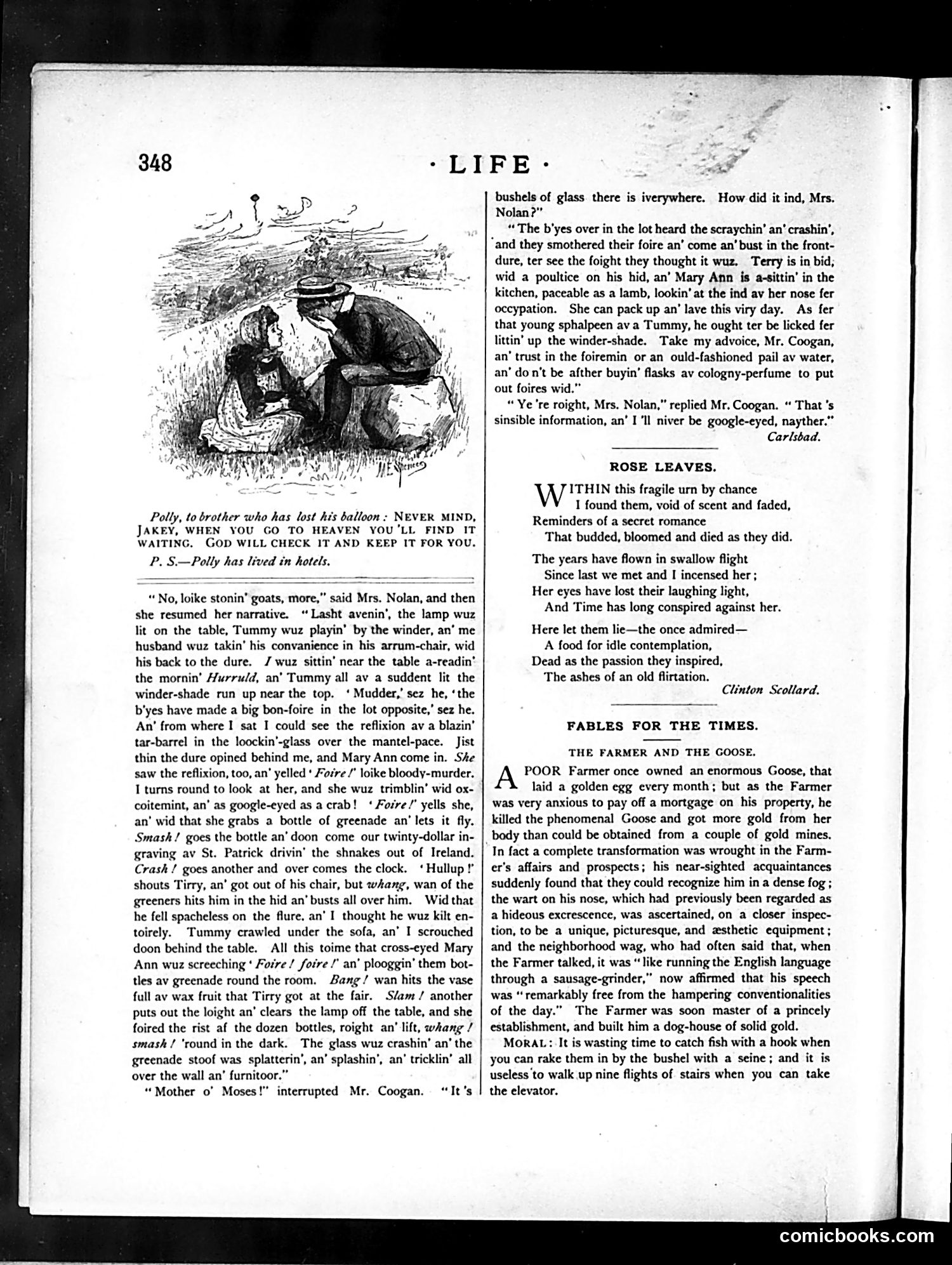
This page contains two main pieces of satirical content: **The Cartoon:** A simple sketch labeled with dialogue from "Polly" to her brother "Jakey" about a lost balloon. The joke mocks Irish immigrant hotel life—Polly's naive reassurance that God will return the balloon in heaven is undercut by the postscript noting she "has lived in hotels," implying transience and displacement. It's gentle humor about working-class Irish experience. **The Narrative:** Mrs. Nolan's lengthy story (rendered in thick Irish dialect) describes a chaotic domestic accident where a young woman named Mary Ann mistakenly throws grenades at a fire, destroying household items. The dialect-heavy narrative is typical of Life's era—comedic exaggeration of Irish-American immigrant speech patterns and working-class domestic mishaps were popular satirical fare. **The Point:** Both pieces mock Irish immigrants through stereotyped dialect and physical comedy involving poverty and misadventure. While appearing sympathetic (the characters aren't villainized), the heavy dialect and emphasis on chaos and confusion reflect era-typical ethnic humor.
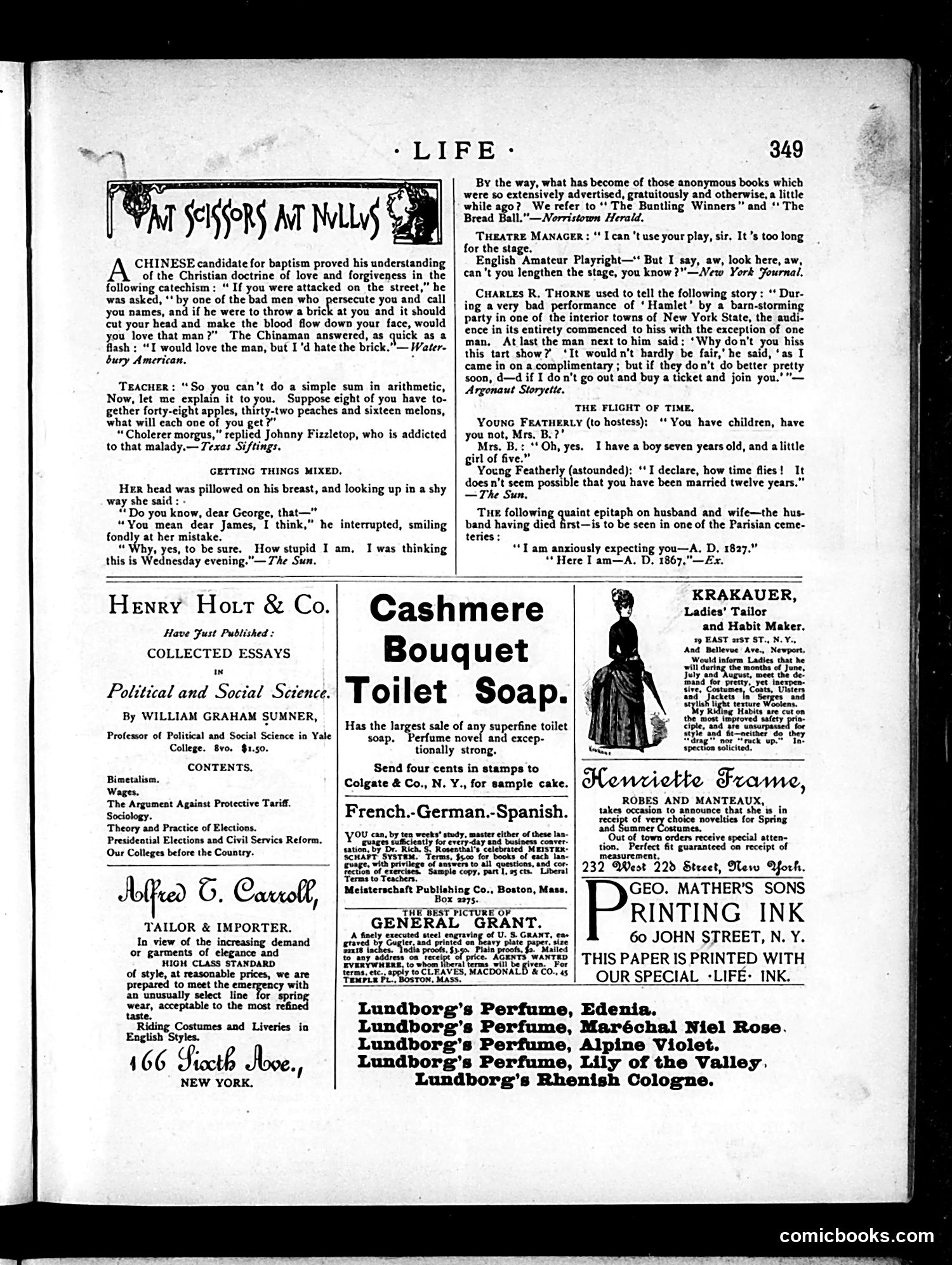
This page is primarily **advertisements and humor columns** rather than political cartoons proper. The humor pieces include: - **"Cashmere Bouquet Toilet Soap" section**: Contains anecdotes like a Chinese catechism joke about loving an attacker but hating the brick that wounds him—contrasting Christian forgiveness doctrine with practical frustration. - A math teacher joke about a student answering absurdly to an arithmetic problem. - A theater manager joke: an amateur playwright, using comically exaggerated British accent ("aw, look here, aw"), asks the manager to *lengthen the stage* rather than shorten his play. - A story attributed to Charles Thorne about a disinterested audience member at a bad "Hamlet" performance who refuses to hiss the show because he came on a complimentary ticket. - A romance joke about a woman accidentally calling her boyfriend "James" instead of "George" on a Wednesday. The page also contains book advertisements (Sumner's *Political and Social Science Essays*), tailors, and perfume ads. **No clear political satire is evident**—primarily period humor and commercial notices.
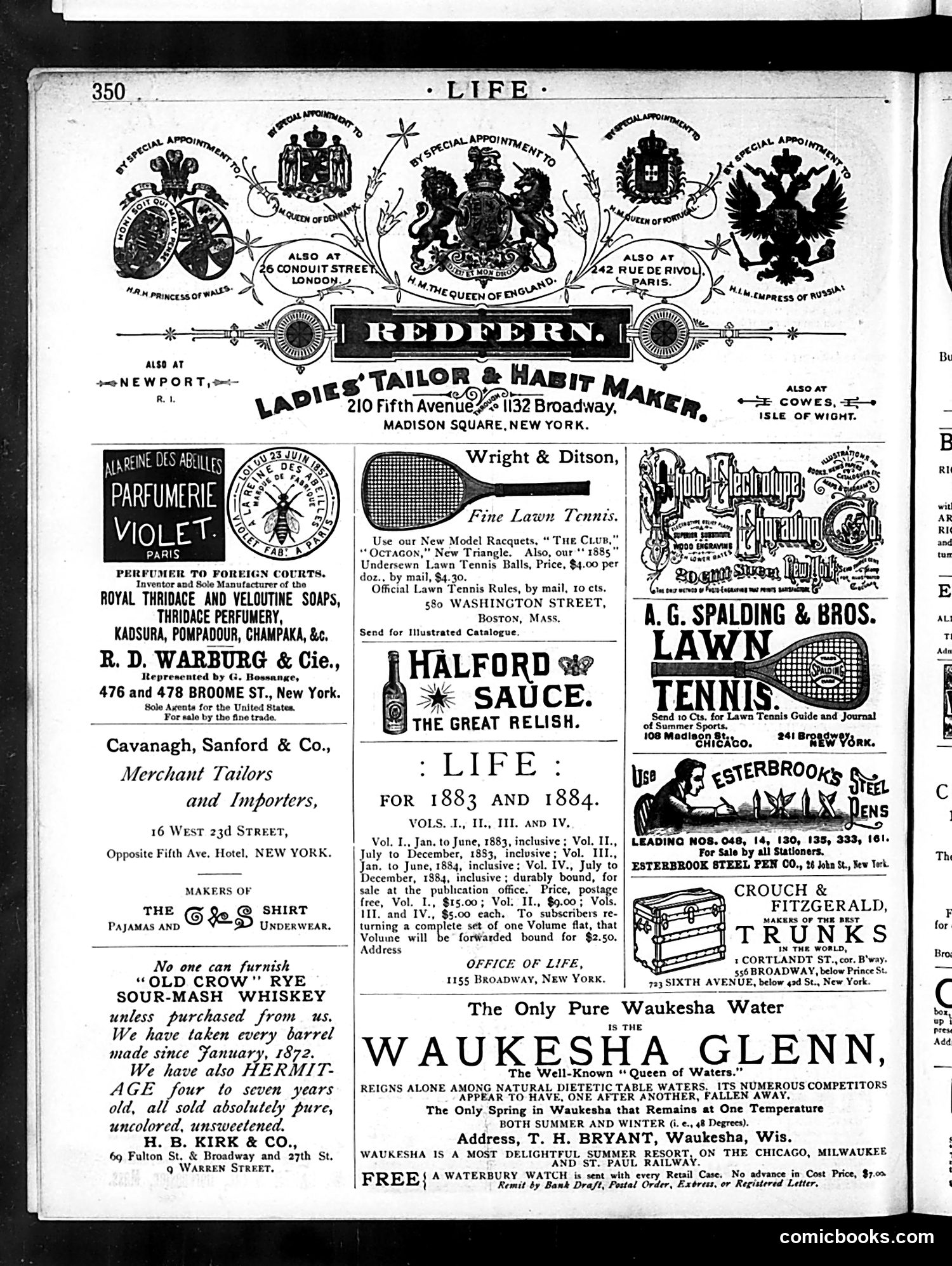
This is primarily an **advertising page**, not a satirical cartoon page. It showcases luxury goods and services targeting wealthy Americans of the 1880s. **Key advertisers include:** - **Redfern**: A prestigious ladies' tailor with royal patronage (H.M. the Queen of England, the Empress of Russia, etc.)—indicating elite status - **Wright & Ditson**: Lawn tennis equipment, reflecting the era's fashionable new sport - **H.B. Kirk & Co.**: "Old Crow" whiskey, claiming exclusive distribution since 1872 - **Waukesha Glenn**: "Pure" mineral water marketed as a health product - **Halford Sauce** and other luxury items The decorative royal coats-of-arms at the top emphasize European sophistication and exclusivity. This page demonstrates how *Life* magazine catered to an affluent readership through high-end product placement rather than political satire.
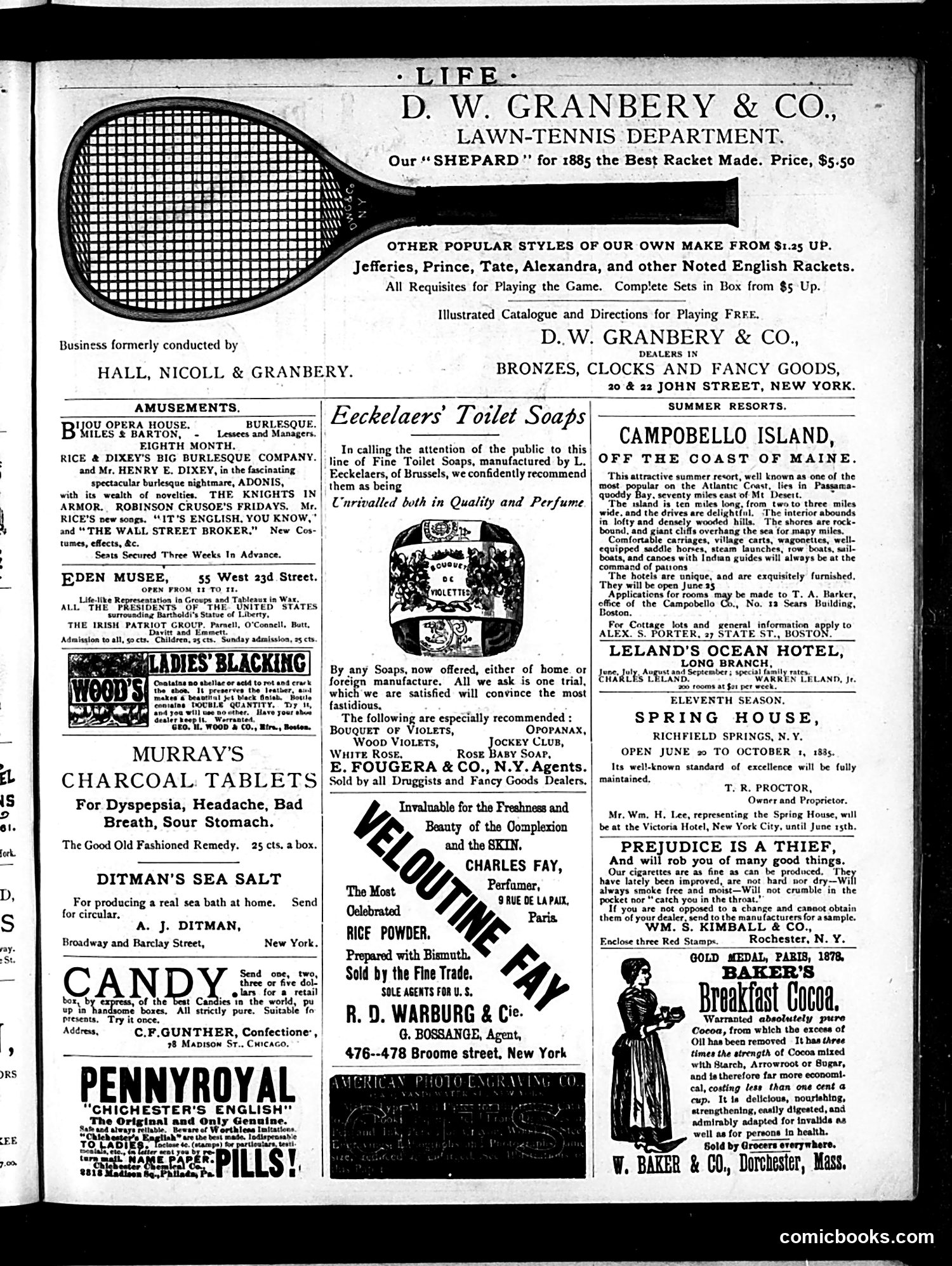
This is primarily an **advertising page** from Life magazine (circa 1885), not a satirical cartoon page. The layout features various commercial advertisements for products and services popular in the 1880s. ## Key Content: **Top**: D.W. Granbery & Co. advertises lawn-tennis equipment, including their "Shepard" racket ($5.50), reflecting tennis's emergence as a fashionable sport. **Left column**: Entertainment venues (opera houses, museums) and patent medicines (charcoal tablets, sea salt treatments) typical of the era's medical marketplace. **Center/Right**: Luxury goods including Belgian toilet soaps, rice powder with bismuth for complexion care, and "Pennyroyal" pills (a period contraceptive). **Bottom right**: Summer resort advertising for Campobello Island, Maine—a destination for wealthy vacationers. The page reflects late-19th-century consumer culture: concerns with appearance, theatrical entertainment, dubious medical remedies, and leisure travel for the affluent. There are **no political cartoons or satirical commentary** visible here.
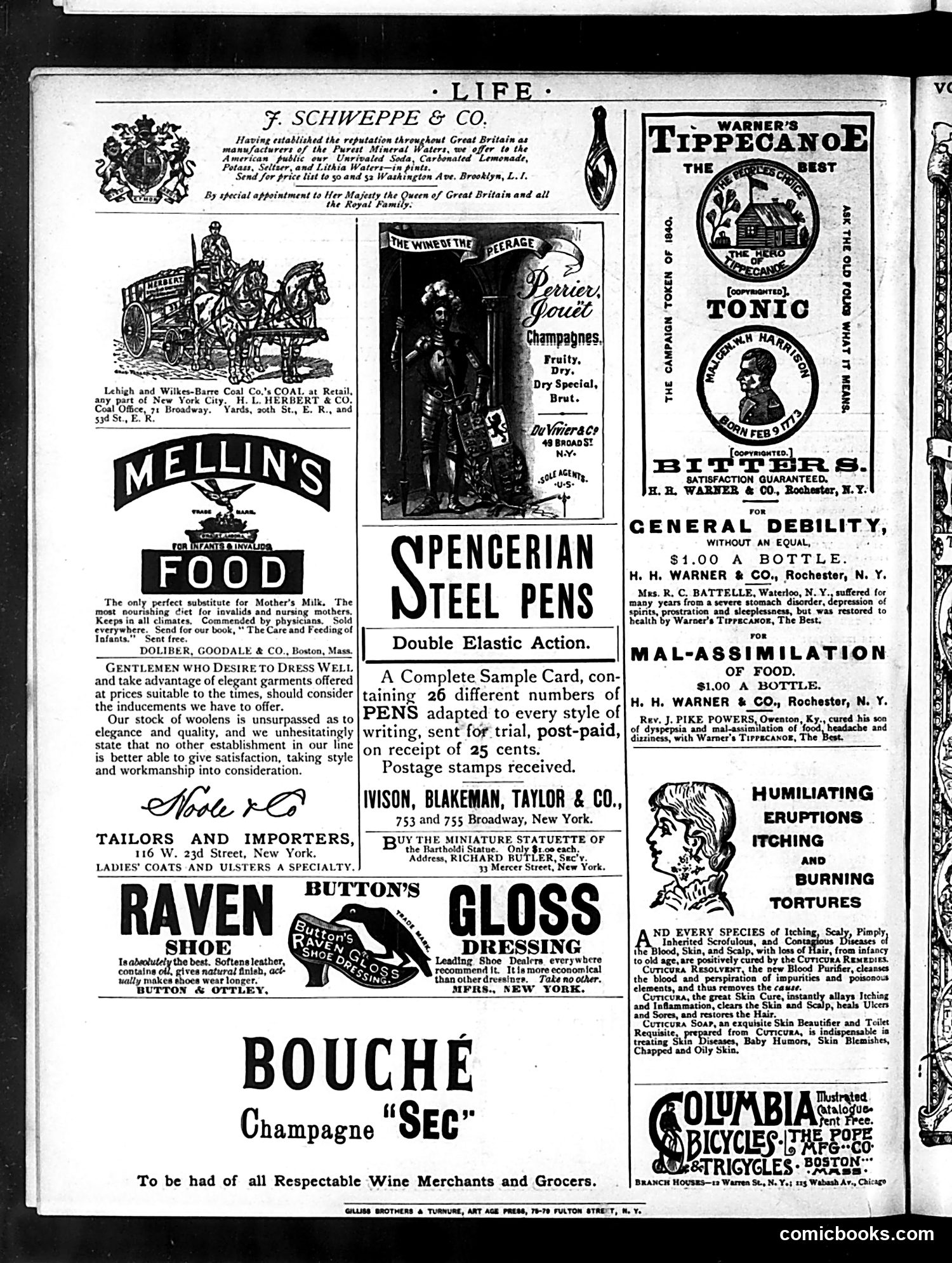
This page is **primarily advertising**, not editorial content or political cartoons. It represents a typical late 19th-century Life magazine advertisement section. The ads showcase products marketed to middle and upper-class Americans: mineral waters (Schweppe & Co.), food supplements (Mellin's Food), clothing (tailors), writing instruments (Spencerian steel pens), and various patent medicines—notably Warner's Tippecanoë remedies for ailments like "general debility" and "mal-assimilation of food." One notable ad references the "Campaign Token of 1840," alluding to William Henry Harrison's presidential campaign, but this appears incidental. The **Cuticura remedies** advertisement makes exaggerated medicinal claims typical of the era, promising cures for skin conditions in children "from infancy to old age." The page reflects the period's aggressive patent-medicine marketing and the magazine's reliance on advertising revenue rather than editorial satire on this particular page.