
Life, 1885-06-18 · page 6 of 16
Life — June 18, 1885 — page 6: what you’re looking at
What you’re looking at
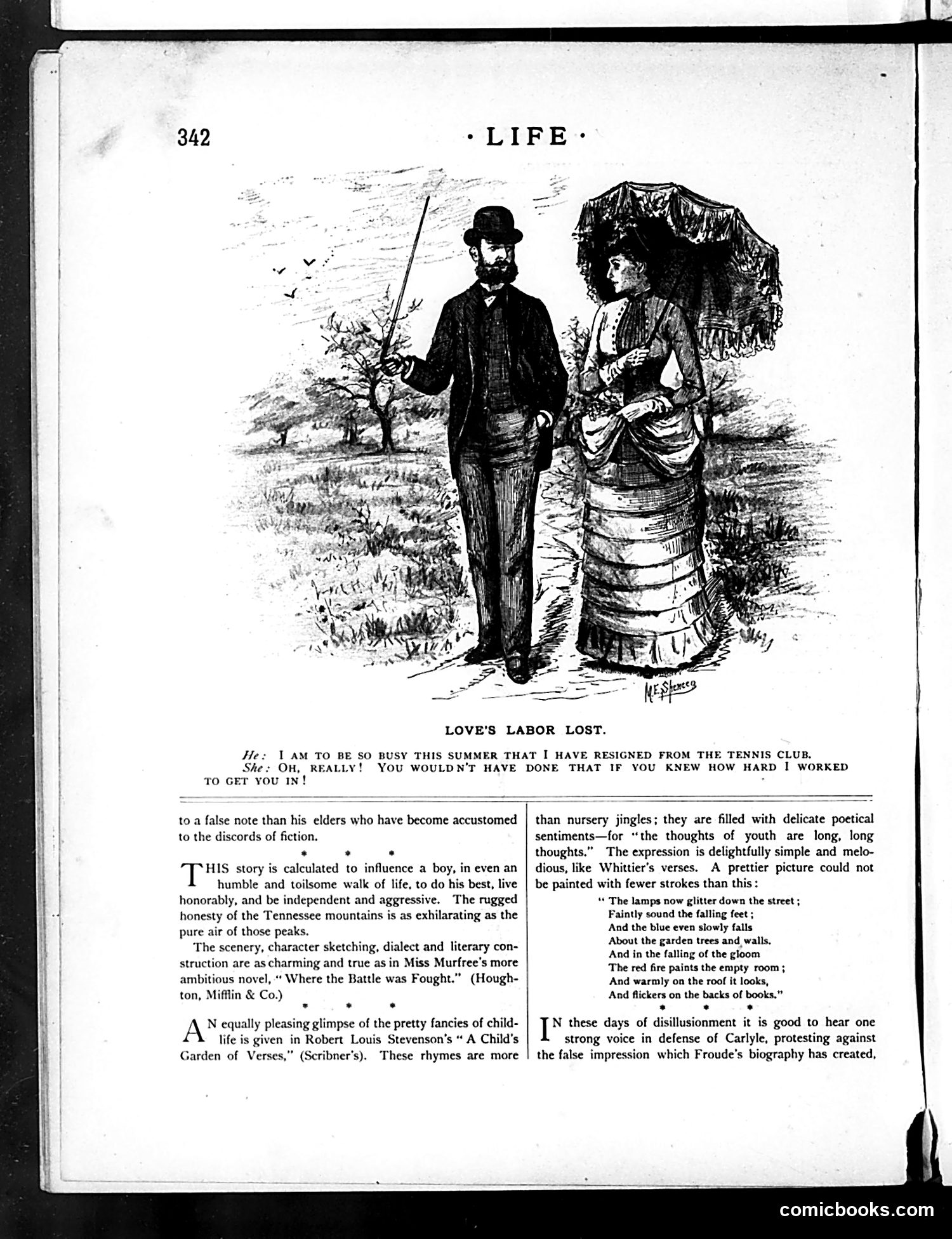
This illustration depicts a gentleman with a fishing rod speaking to a woman with a parasol. The caption quotes the man saying he's resigned from the tennis club because he's been so busy—implying he's devoted himself to courting her instead. The joke plays on the double meaning of "labor": the man has abandoned his recreational activities (tennis) to pursue romantic courtship, which he presents as requiring hard work. The woman's skeptical expression suggests she's unimpressed by his claim that winning her affection required such effort. The title references Shakespeare's *Love's Labour's Lost*, a play about courtship and romance. This is gentle Victorian-era satire about male courtship rituals and the competitive social activities (like tennis clubs) that romance might interrupt.
📄 Transcribed text from this page (OCR, searchable)
Machine-transcribed from the original scan — historical spelling and the odd misread are preserved.
LOVE’S LABOR LOST. I AM TO BE SO BUSY THIS SUMMER THAT I HAVE RESIGNED FROM THE TENNIS CLUB. : OH, TO GET you IN! REALLY! YOU WOULDN'T HAVE DONE THAT IF YOU KNEW HOW HARD I WORKED to a false note than his elders who have become accustomed to the discords of fiction. . THs story is calculated to influence a boy, in even an humble and toilsome walk of life, to do his best, live honorably, and be independent and aggressive. The rugged honesty of the Tennessee mountains is as exhilarating as the pure air of those peaks. The scenery, character sketching, dialect and literary con- struction are as charming and true as in Miss Murfree’s more ambitious novel, ““ Where the Battle was Fought.” (Hough- ton, Mifflin & Co.) . . N equally pleasing glimpse of the pretty fancies of child- life is given in Robert Louis Stevenson’s “ A Child's Garden of Verses,” (Scribner's). These rhymes are more than nursery jingles; they are filled with delicate poetical sentiments—for “the thoughts of youth are long, long thoughts.” The expression is delightfully simple and melo- dious, like Whittier’s verses. A prettier picture could not be painted with fewer strokes than this : “ The lamps now glitter down the street ; Faintly sound the falling feet ; And the blue even slowly falls About the garden trees and_ walls. And in the falling of the gloom The red fire paints the empty room ; And warmly on the roof it looks, And flickers on the backs of books.” . . . N these days of disillusionment it is good to hear one strong voice in defense of Carlyle, protesting against the false impression which Froude’s biography has created, comicbooks.com